New Haven's Chez Panisse

Dara writes:

When I resided in Berkeley College at Yale University in the mid-90s, the dining hall food was so abysmal I moved off campus. The dingy, co-ed bathroom, minute cubicle with bunk beds I shared with my roommate, and the rodents didn't help either. All that has changed. Not only have most residential colleges at Yale undergone total renovations, but my college's dining hall has become a model for sustainable, local, and mostly organic food.

James and I have taken so many car trips lately to see his father, that we have taken to listening to Podcasts. Several recent ones were from a Princeton conference on food and ethics, which took place last November. Panelists repeatedly mentioned the Yale Sustainable Food Project as a model.

The daughter of Alice Waters, the chef who was instrumental in the "eat seasonal and local" movement, matriculated at Yale and inspired her mother to urge more organic dining. What has happened at the residential college Berkeley is staggering. The menu sounds amazing, it is seasonal, and some of it comes from a farm that is a fifteen minute walk from campus. The farm takes summer interns and I was kind of sad to learn the interns must be undergrads.

Unfortunately being on the road so much has meant a steady diet of McDonald's Snack Wraps: crispy chicken, jack cheese, lettuce, and ranch dressing in a tortilla. My theory is it is small enough to not make me sick, or for that matter thirsty for three days because of the amount of salt McDonald's pours on its food.

An update on my father's stroke

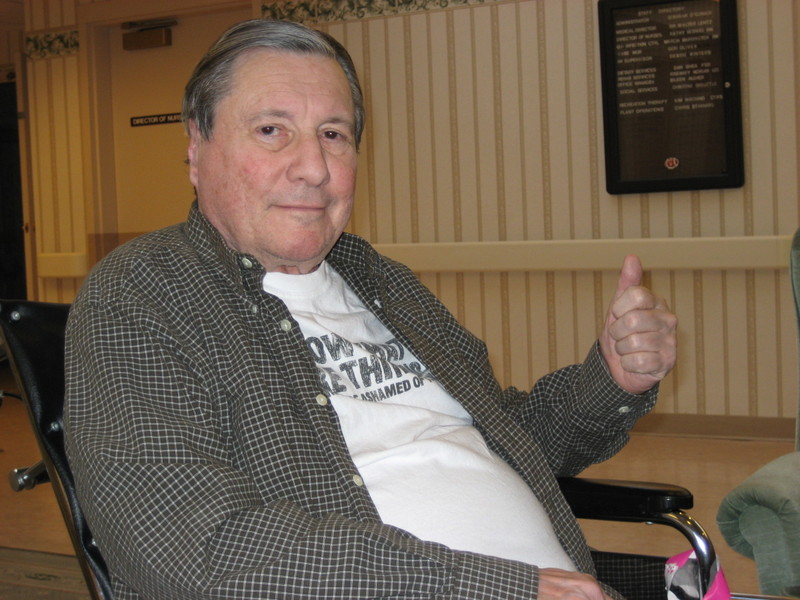
Img_0240

In a follow up to this post, James writes:

I am pleased to report that my father continues to improve in his alertness and articulation. I am attaching a photo I took of him over the weekend that well reflects his determined spirit. He still shows signs of confusion. He remains weak. He is also far from the point of being able to make the daily decisions that are necessary to live on one's own. I am very happy, however, that he is now able to hold small conversations, and to express his state of mind. This means that he can consider what he wants to do after he completes ‘sub acute’ rehabilitation (which still won’t be for several weeks).

I thought I would attach in this update a report from my mother, who was able to sit in on a therapist meeting yesterday morning at the rehabilitation center. Here is her report:

I went up today for the 9 AM team meeting. Carl seemed pretty alert – he was in the dining room having breakfast and saw me from afar and waved. He wheeled himself back to the room after breakfast. I mentioned how much I enjoyed seeing Christine [Panero] on Sunday, that it had been so long since I had seen her. And he said “over 20 years”, The speech therapist said his talking is so much better although he still gets confused sometimes with answering questions.

The team said they were delighted with his progress but thought there was still much more to be made – that he was nowhere near plateauing out. But we all did talk about where to go next. Everyone—including Carl—agreed that going back to Block Island to live was out of the question – he would need to drive etc. etc., and he will need assistance. So we all agreed we would shoot for Assisted Living—and their goal is to help him (and us) get him prepared for that. He said he “has a lot to think about”. He did not seem interested in a place in NYC. He seems to treasure his visits from his BI friends. He had gotten a card from a whole bunch of them and a gardenia plant. He was obviously touched. I said I did not know them and he said “that is because you do not hang around the Beachhead”. Tell everyone how much Carl enjoys visitors, that he is very touched by everyone’s concern, and that he also loves cards, that he can read them.

It's Snowbird, Ma'am

Dara writes:

Last week James and I returned from our annual ski trip to Alta, Utah, home to probably the best snow in the country. The conditions are always at least good at Alta, though this year they were just that, good, and not amazing, as their base registered only 60 inches, as opposed the usual 100+.

I enjoy Alta, though not as much as James. I like to ski, but not the extreme stuff. I prefer walks in the park. I like to ski down, chat, and go for hot chocolate in the lodge. James likes to push it on a double black. I can get down anything, but groomers are just fine.

Alta is crude and rustic. Elements that to me define a vacation are missing. For instance, you don't go out to eat. Breakfast and dinner are included in the hotel cost. The meals are fine. A prime rib special one night was quite delicious. But there is no gourmet. There is no town. My first year high in the Rockies two years ago, it snowed one foot every day, causing such treacherous avalanche conditions that we were not allowed to leave our hotel after 4pm or before 9am each day. This is called interlodge. But truly, being at Alta anytime is kind of a voluntary interlodge. You ski. You eat. You sleep. You wake and do it again.

James loves this boot camp. He loves the challenge. Me, I don't mind if a "challenge" on vacation is choosing an entree from a delicious list of possibilities.

I could also do without the Alta attitude which is, summed up: Vail is for suckers. To Alta folks, any mountain, however world-class, is for pussies if bars, shops, and eateries distract from skiing. One must pronounce "Alta" with a flat A, not an A like a British "Aunt." James overheard the following exchange between a mountain man and a visitor: "Is it Alta or Ahlta?" "It's Snowbird, Ma'am."

We usually stay at Goldminer's Daughter, essentially a barracks at the foot of the mountain. Each staff member is a skier, which means any guest request involving skiing--lift tickets, a humidifier in the room to sleep better so as to ski better--is ably fulfilled, while any request in the dining room--to be served, for instance--is better filled by professionals. Last year we explored the Alta Lodge, old stomping ground of the likes of Bill Buckley and Milton Friedman. We found it equally bare bones as Goldminer's, but more expensive and with more attitude. The attitude we did like, however, was that of two eighty-plus year old men we met in the Lodge's common room. One of these "Alta cockers," as we liked to call them, lived in an assisted living location in Danbury, Connecticut, but still skied in Alta. Amazing. This man fled Germany on Hitler's arrival, came to America, then enlisted so he could fight back against the Nazis. He skied in the Seventh Mountain Division during World War II. The Alta Lodge requires one to huff down 63 steps upon arriving, has no elevator, and requires one to use an arm-wrenching rope tow, on which I received repetitive stress trauma, to reach it from the slopes. Just visiting the place means one is fit.

This is my view. I think James will write his own perspective...