The Culture Crash: a response

James writes:

Earlier this summer I contributed an article to a special issue of City Journal on "New York's Tomorrow." My article, The Culture Crash, was an analysis of how arts organizations are doing in the economic downturn. The quick answer is not well. I then question why arts endowments lost so much money (often between 25 and 33 percent of value). I argue that a risky, heavily managed, and fee-driven strategy of investment, sometimes called the "Yale Model," led to bad habits in many organizations.

The article has received a great deal of attention. Investment managers have contacted me to say that the Yale Model still cannot be beat in a comparison of investment strategies over time. One friend sent me a copy of David Swensen's book Pioneering Portfolio Management, which is much appreciated. The reason arts endowments have fallen to such an extent, they point out, is because art funds went up so much in previous years.

All true, but that's only part of the story. The other side is the human factor--part of a disconnect I see between arts administrators and their investment managers. The Yale Model produced lavish results in good times, maybe too good, and this encouraged organizations to expand and overspend beyond their means. If the fluctuations of the Yale Model really average out on the plus side, why do so many arts organizations now face such financial hardship? The answer is that they loved the rewards, but arts organizations prepared far too little for the risks of the Yale Model.

On the investor side, the supposed irrefutability of the Yale Model also became a cover for bad behavior. Managers could rationalize higher fee structures. Half-billion-dollar losses could be excused as part of the plan. The Yale Model may still be the best strategy for long-term investment, but when applied to non-profit organizations it has become a snake-oil tonic, overly hyped and more than a little addictive.

So maybe it should come as little surprise that, according to The Wall Street Journal, Harvard University has announced a change in its investment strategy. As with many non-profit endowments, when the market tanked, Harvard's alternative investments and illiquid assets could not be sold, and the endowment took a nosedive. Now Harvard says it will move away from some of the more perilous alternative investments at the heart of the Yale Model that have wreaked such havoc over the past year.
The Buckley Panel

James writes:

How could I not mention a post by Daniel McCarthy at Tory Anarchist that states: "I think there's more to be said for Panero's view than I allowed at the time." Alas, I hear this refrain all too often.

McCarthy's comments comes out of a panel discussion I took part in last February on "The Enduring Legacy of William F. Buckley Jr," sponsored by the Intercollegiate Studies Institute. The venue was the Conservative Political Action Conference in Washington and my co-panelists were McCarthy of The American Conservative and Matthew Continetti of The Weekly Standard. The audio of the conference is now available below, and ISI has also posted a video at its website.

In the years after God and Man at Yale and McCarthy and His Enemies, both influenced by Willmoore Kendall, Buckley lavished a great deal of his energies on his more non-political pursuits. My desire at the conference was to take into account Buckley's novels and memoirs, along with his passions for sailing, skiing, and music, in understanding his legacy. Admittedly, my understanding of Buckley starts at the end of his life and looks back in. For our panel discussion, Daniel McCarthy began with the philosophy that informed the young Buckley and carried it forward. Both points of view are relevant. So allow me return the compliment above with my own observation: there's more to be said for Daniel McCarthy's view than that I allowed at the time.


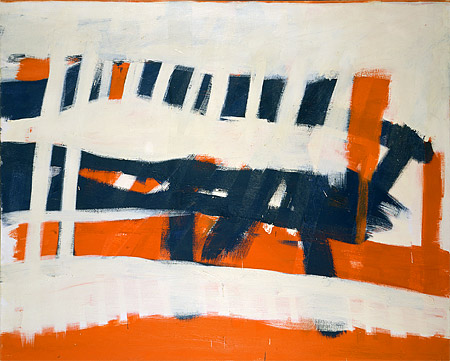
My abstraction obsession: Jack Tworkov

Tworkov

Jack Tworkov, RWB #3 (1961)

Collection of Michael Rosenfeld Gallery, New York.

James writes:

In 1960 the Abstract Expressionist painter Jack Tworkov complained that "I've been second-rated by every critic, large or small." Two first-rate productions now allow us to reconsider this estimation. At no other moment, including 1964's Whitney survey and 1987's Pennsylvania retrospective, could this artist be so fully examined. At the UBS Art Gallery in midtown Manhattan, the curator Jason Andrew has assembled a must-see show called "Jack Tworkov: Against Extremes" which remains on view through October 27.

The exhibition presents numerous Tworkov drawings and twenty-nine major paintings, from Untitled (Still Life with Peaches and Magazine) (1929) to the large Compression and Expansion of the Square, completed just before the artist's death in 1982. At the same time, Yale University Press has published the definitive collection of Tworkov's writing in a book called The Extreme of the Middle, edited by Mira Schor. This 480-page volume brings together Tworkov's artist statements, published reviews, and correspondence, but most notably it unearths extensive selections from Tworkov's diaries.

I have a review of both show and book in my next "Gallery chronicle," in the forthcoming issue of TNC (it will post on the first of September). It's now the August doldrums in New York galleryland. The impressive UBS exhibition, which opened last night, is the exception. And if you visit be sure to stop in the Archives of American Art just down the lobby hallway to see some of Tworkov's journals, which largely make up the collection in the Yale book.