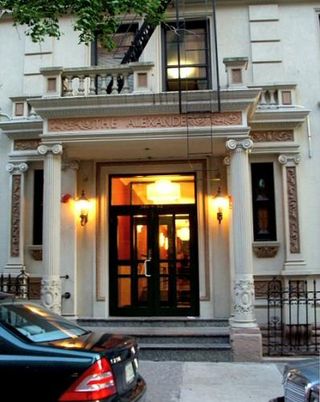
UWS residents to protest 94th Street shelter tonight

James writes:

Neighborhood in the Nineties and other community groups on the Upper West Side have organized a protest at tonight's meeting of the Health & Human Services Committee of Community Board 7 over the conversion of a local hotel into a homeless shelter. Here are the details from Aaron Biller, head of NitN:

Show up TONIGHT at CB7, 250 West 87 St. on the proposed homeless shelter at The Alexander at 306 West 94th Street – Let the City know that transient housing is not “permanent” housing;
CB7 Health & Human Services Committee
***At Community Board 7, 250 West 87 Street**
T O N I G H T @ 7 PM
Be there early. We are First on the agenda:
ITEM #1. 306 West 94th ST (West End Ave-Riverside DR.) Presentation by Samaritan Village and the NYC Department of Homeless Services on the program for 306 West 94th Street.

Leslie Albrecht at DNAinfo has more details. Meanwhile, The Wall Street Journal and the Daily News editorial board pick up on the story I first reported here (complete recap here).

SROs: the latest on a policy disaster for the Upper West Side

James writes:

The disastrous legislation banning the SRO hotels on the Upper West Side, which I first wrote about in The Daily News, continues to fall out around the politicians who planned it, with still no satisfactory resolution for local residents.

When the hotels were banned through legislation in Albany, its advocates claimed the move would protect tenants rights by preventing the spread of so-called "illegal" businesses. Instead, the legislation cut off the only means of free-market profitability for the buildings' owners--whether unintentionally or by design remains an open question.

Rather than open up more space for tenants, the legislation has sent SRO landlords into the arms of city agencies looking to utilize the buildings for their own programs, and willing to offer sweetheart deals with taxpayer money to do it. In the case of one building on 94th Street, this means that a pleasant hotel that was welcomed by the community will be converted into a 200-bed homeless shelter with a 9-year contract.

 The Upper West Side is a liberal neighborhood, but it already bears an unfair share of such facilities, against the spirit of "Fair Share" in the city charter. As one resident put it, the neighborhood is rightly facing a case of "compassion fatigue."

The News editorial, distributed through the email lists of neighborhood organizations, in particular Neighborhood in the Nineties managed by Aaron Biller, mobilized a swift response. Hundreds of concerned residents showed up at the Community Board 7 meeting on January 3 to voice their complaints. Their protests were covered by CBS news and other agencies.

Following this event, The New York Times picked up on the story on January 14. As I made clear in my editorial, despite the rhetoric, the SRO legislation does nothing to protect tenants. In fact, it has caused a crisis for the tenants who still live in the permanent apartments within the converted hotels. In the case of 94th Street, the tenants welcomed the hotel in their buildings. The hotels were certainly a welcome improvement over the dilapidated state of the buildings decades ago (click here to see a fascinating photo essay of SRO living four decades ago). Now, ironically, they will most likely lose their homes as the homeless shelter moves in. The Times story profiles some of these tenants.

Within hours of the appearance of the Times story, Councilwoman Gale Brewer called a press conference in front of the 94th Street hotel. Her event took place Sunday at noon. She brought in Congressman Charlie Rangel, Manhattan Borough President Scott Stringer, and other politicians to join her in denouncing the conversion of the building into a shelter.

As a member of the "Illegal Hotels Working Group," Brewer was one of the politicians championing the hotel ban in Albany. She has built her political career around advancing "tenants rights." Yet legislation she supported has now become a disaster for tenants in the building and all residents in the neighborhood.

And a disaster for her political future. Brewer created the problem that she is now attempting to claim to fix. Her calling in Rangel and others at short notice is an indication of how much political damage she may foresee for herself if the homeless shelter goes through against the wishes of a mobilized constituency, due either to her own ineptitude or to willful collusion. (One also wonders if Rangel, who was censored by congress for taking up multiple rent-controlled apartments for his own use, is the best advocate for tenant rights).

Above is a video I took of the Rangel/Stringer/Brewer press rally.

Brewer wants to get in front of this story for her own political future, but her ability to do so will depend on two things: whether she will be able to stop the conversion of the building into a shelter, as well as the conversion of other nearby SRO hotels into supportive housing. Second, the question remains of how much she knew about the shelter and when. This report quotes a source at the Department of Homeless Services saying that the agency had been in many talks with Brewer and the Community Board about the shelter. This implies that either little was initially done to oppose it, or the deal was  accepted by Brewer before she faced strong community opposition. This open question calls for further investigation.

The case of the SROs conversion, which remains unresolved despite community uproar, is just one example of how bad government policy has retarded positive growth on the Upper West Side. The questions are why and what can be done about it. These are the systemic issues I am currently investigating for a longer essay in City Journal magazine. Stay tuned...

Goodbye hotels, hello homeless?

4452
NEW YORK DAILY NEWS
December 26, 2010

Goodbye hotels, hello homeless?
by James Panero

Thanks to a new law against SRO hotels, the UWS is at risk

If you want to stay at the Alexander, a boutique hotel on 94th St. on the upper West Side, you better book your room soon. With plush bedding, sparkling renovated bathrooms and a welcoming staff, this hotel has received great reviews online. Problem is, the only guests who may stay here in the new year could be the homeless.

Because of a change in New York law, starting in 2011, single-resident-occupancy buildings (SROs) such as the Alexander will no longer be allowed to rent rooms for less than 30 days unless they get a new certificate of occupancy and, in most cases, a zoning exemption. So out goes this legitimate hotel, its hardworking employees, the happy tourists and a revenue engine for the city.

In comes Samaritan Village. On Dec. 10, this Queens-based substance abuse and mental-health center gave notice to the local community board that it intends to run a 200-bed homeless facility out of the Alexander, according to community sources and confirmed by a spokesman for Samaritan.

The conversion of a welcome local institution into a shelter for the city's indigent population may sound like deja vu all over again to longtime residents of the upper West Side like me. Unfortunately, it may be the beginning of a broader attack on urban sanity and gentrification throughout the city.

For decades, my neighborhood - like neighborhoods in Harlem, Chelsea and the East Village - has borne an unfair burden of New York's supportive housing industry. Despite the "fair share" law in the city Charter that requires social service facilities to be evenly distributed through all neighborhoods, W. 94th and 95th Sts. alone, next door to where I live, have seen half-a-dozen such institutions proposed in recent years, from homeless shelters to drug treatment centers to halfway houses. The residents of these two tree-lined streets - with their public schools, nursery schools and family residences - must wonder what they did to deserve such generosity.

State Sen. Liz Krueger has largely kept supportive housing out of the wealthiest portion of her district, the upper East Side, but she has championed legislation in Albany amending the multiple-dwelling law that could result in more than a dozen new supportive-house facilities opening in the old SROs on the upper West Side.

Krueger and her political allies - including Councilwoman Gail Brewer and State Assembly members Richard Gottfried and Linda Rosenthal - may believe they are protecting tenants' rights by preventing the proliferation of small hotels into SRO buildings. Instead, their beneficence has only managed to clear these buildings of useful small businesses, while protecting the special interests of the hotel workers' union, since the targeted SRO hotels generally employ nonunion labor.

The landlords will chase the dollars still available. Many vacated rooms can be expected to enter contracts with organizations operating with the Department of Homeless Services or other city agencies. The presence of these facilities and the undesirable groups they import, in turn, will push out industrious neighbors, rich and poor, or at least those who can afford to leave, along with local retail.

If Samaritan Village is allowed to open on the upper West Side, it will be the first of many such conversions here - a sad sign that the local political complex appears interested in anything but the rights of a community that has fought for decades to make its streets safer, better and more beautiful.

Other parts of the city should beware. By Krueger's own tally, once the new legislation goes into effect in 2011, it will impact 280 buildings citywide.

Only in New York would politicians complain about the blight of middle-aged European tourists asking for directions. Force out one population, and you leave a hole for another one to fill. You only hope your new neighbor isn't the next Larry Hogue.