How Brooklyn Missed Brooklyn

IMAG1213

The best of Brooklyn: Gleich dancers in "The Brooklyn Performance Combine,” produced by Norte Maar in the Beaux-Arts Court of the Brooklyn Museum. Photo: James Panero


THE NEW CRITERION
December 2014

How Brooklyn Missed Brooklyn
by James Panero

For years, the Brooklyn Museum has overlooked the art happening in its own backyard.

“The persons now in this room have it in their power to decide whether in the future intellectual progress of this nation, Brooklyn is to lead or to follow far in the rear.”

—George Brown Goode, “The Museum of the Future” (1889)

On the afternoon of Saturday, November 1, a small U-Haul truck pulled up to the loading dock of the Brooklyn Museum. Behind the delivery was Jason Andrew, the director and curator of Norte Maar, a Bushwick-based nonprofit at the crux of Brooklyn’s artistic renaissance. The Brooklyn Museum’s education department had invited Norte Maar to produce a “performance by sound artists and dancers” for its free “Target First Saturday.” The show, “The Brooklyn Performance Combine,” was a two-hour event Andrew and the choreographer Julia K. Gleich had planned to take place in the museum’s Beaux-Arts Court that evening. Hidden among the cargo that Andrew was expected to deliver in the truck—sound equipment, costumes, and props—were unsolicited canvases and sculptures by Brooklyn artists he planned to sneak into his performance.

The museum brought in the “Combine” to promote “Crossing Brooklyn: Art from Bushwick, Bed-Stuy, and Beyond,” its self-described “major survey” of thirty-five borough artists currently on view. Yet for many observers, this exhibition, which opened in October, continues through January, and had been touted as “reflecting the rich creative diversity of Brooklyn,” turned out to be anything but.

“An exhibition at the Brooklyn Museum billed as a ‘major survey’ of Brooklyn-based artists should be exciting and revelatory,” wrote Ken Johnson in The New York Times. “Disappointingly, it’s not.” Led by extensive wall labels, “Crossing Brooklyn” looked almost exclusively to artists working in what’s known as “relational aesthetics,” the art of context over content, some whimsically, others with heavy social agendas. One artist focused “on the need for nutritious food in economically disadvantaged urban neighborhoods.” Another explored “the culture of mass consumption, overproduction, and waste” along with “the exploitation of workers and natural resources.”

“Evidently counted out from the start,” Johnson observed, “were artists who toil in studios making paintings, sculptures and other sorts of objects intended just to be looked at.” In other words: many of the accomplishments you now see in the borough’s open studios and gallery shows had been excluded from the museum. By zeroing in on a small subset of artistic production (mainly created by artists with tenuous connections to Brooklyn at best), “Crossing Brooklyn” accomplished just the opposite of displaying the borough’s “rich creative diversity.” Johnson’s conclusion reflected the feelings of many: “Brooklyn artists deserve better than this too-small, ideologically blinkered exhibition.”

For “Crossing Brooklyn,” the museum claimed the curators Eugenie Tsai and Rujeko Hockley “drew upon their extensive knowledge of the borough, as well as a wide-ranging network of unofficial advisors composed of artists, colleagues, and other creative professionals.” Yet Andrew, who has curated a decade of local exhibitions and programs through Norte Maar, says that no one from the museum came to observe what he does, despite talking to Tsai. “I don’t think those curators have enough pride in what is happening in Brooklyn. That is reflected in their curation. They can’t keep up with the pace, the spontaneity. But in order to keep the historical relevance, you have to keep up with the art.”

IMAG1221

Brooklyn artists protest the Brooklyn Museum at “The Brooklyn Performance Combine" with painting by Loren Munk. Photo: James Panero

Andrew’s account of the Brooklyn Museum’s indifference to the studios and galleries of contemporary Brooklyn gets repeated across the borough’s artistic communities. “It’s Brooklyn’s time, now,” the painter, videographer, and art historian Loren Munk told me, but “the Brooklyn Museum is so wedded to their petrified state, they are going to miss it. The community has busted their buns for years. Slowly through the work of thousands of people, people started coming out here. Yet the curators are not familiar with the art community. A lot of their direction comes from academia, so they don’t do the hard-ass work, do the legwork, talk to a lot of people, go to a lot of places. These people don’t have the inclination.”

“There should be studio buzz,” Munk told me of the lead-up to “Crossing Brooklyn.” Instead, there was “nothing. None of that. There was zero outreach. We were frustrated. The disengagement. The elitist approach.” A Red Hook-based artist since the 1980s, Munk believes the Brooklyn Museum has been failing its own creative community for years, and in fact “the museum has gotten worse. A lot of significant people have been ignored by the Brooklyn Museum for decades. People having international influence, and the Brooklyn Museum has blown them off.” The Brooklyn Museum could be at the center of the borough’s creative renaissance, Munk concluded, “but it would take work. They need to reach out to the community.”

As the “Brooklyn Performance Combine” took shape in the weeks leading up to its November evening, many of its local artists saw the performance as an opportunity to demonstrate the burgeoning energy of Brooklyn that the museum had long ignored. Although the “Combine,” which was let in through the side door by the education department rather than by the curators of “Crossing Brooklyn,” was billed as a live performance, with art works and art making officially excluded, Andrew stretched the invitation into a “mashup of Brooklyn-based poets, painters, and performers.” Mixed in with his performance equipment, that afternoon he brought the canvases and sculptures of artists that he saw as indicative of Brooklyn’s artistic energy but which had been ignored by the museum: Amy Feldman, Ryan Michael Ford, Rico Gatson, Tamara Gonzales, Susanna Heller, Brooke Moyse, Jessica Weiss, Rachel Beach, Ben Godward, and Jim Osman.

For two hours that evening, in an electrifying synergy that was part celebration, part exorcism, all of these canvases and sculptures became the props for the musicians, dancers, and poets of the “Combine.” Carried out and positioned in the middle of the Beaux-Arts Court, the angular sculpture of Rachel Beach resonated with the vectored choreography of the Gleich dancers and the Brooklyn Ballet Youth Ensemble. The artist Jeff Feld and the cellist Mariel Roberts reflected the performance traditions of Robert Rauschenberg and John Cage. Ben Godward built up a towering abstract sculpture of plastic cups and poured materials, which he then sawed up and distributed to the audience. Sarah Schmerler, with deadpan delivery, read the descriptions and sponsor names of the museum’s own stilted exhibition program, contrasting it with the energy of the room and formative personalities such as Deborah Brown and Richard Timperio who were left out of “Crossing Brooklyn.” Before the event, Loren Munk had put out a call to Brooklyn artists who felt “somehow excluded from ‘Crossing Brooklyn.’ ” During the performance, he watched as his work incorporating nearly one hundred names on a painted map of the borough, covered with an X, was unveiled. Titled RE-CROSSING BROOKLYN, “this is a small reminder to the Brooklyn Museum that they are in the center of one of the greatest art enclaves in the world,” he promised his respondents. “They should open their eyes and engage with this unique community.” During the unveiling, the artist William Powhida joined the stage and delivered a monologue on the painting: “I happen to be on Loren’s list of artists not included in the exhibition. I never had a studio visit. And a lot of the artists on that list never had studio visits. . . . This list is long. Take a look at it and study it.” To which an audience member shouted: THANK YOU! Even if the Brooklyn Museum chose not to feature significant elements of the arts in “Crossing Brooklyn,” Andrew and his performers would not let them go unnoticed. “It is a borough of immense creativity,” Andrew explained to me, “and the Brooklyn Museum has missed the boat.”
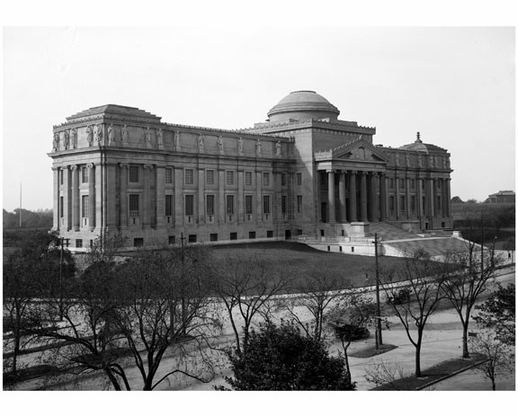
Brooklyn-institute-of-arts-sciences-brooklyn-museum-24

Brooklyn Museum's stately original building with its Grand Staircase.

For an institution that has long prided itself as a community center and public accommodation rather than an elitist repository of art, such accusations would seem to cut against the promises of the museum’s progressive leadership. Yet the criticism in fact speaks to the Brooklyn Museum’s deep-seated misapprehension around its own history and what a great museum of art should be.

It wasn’t always so. The Brooklyn Museum was born in 1823, in an era of rising civic confidence in what would become America’s third largest city. The acquisitions of American paintings by the Brooklyn Institute, the museum’s forerunner, reflected this outlook. Francis Guy’s Winter Scene in Brooklyn (ca. 1819–20) entered the institution’s collection in 1846 as an immensely popular view of Brooklyn’s bustling and diverse mercantile port, a reflection of the city’s transformation from old Dutch farmland into a modern metropolis—and one that could now fuel its own civic institutions. Today such an acquisition demonstrates how the Brooklyn Museum was once open to local contemporary art, in an age when other nascent museums were fixated on the Old Masters.

Following the Civil War, as great museums took shape across the East River in Manhattan, the call went up for the city of Brooklyn to build “an Institute of Arts and Sciences worthy of her wealth, her position, her culture and her people.” Situated at the intersection of the grand new parks and parkways designed by Frederick Law Olmsted and Calvert Vaux, and soon to be linked by subways, the museum’s new classical edifice designed by McKim, Mead & White in 1897 reflected the ideals of nineteenth-century Brooklyn. It also spoke to the ambitions of the director Franklin Hooper, who planned an institution some four times larger than the museum we see today. The current Eastern Parkway wing is but one side of what was designed to be a square building and the largest museum in the world.

Plan2

Drawing of the fully realized original plan of the museum.

Yet rather than following through on this grand vision, the Brooklyn Museum has for a century remained one of the world’s great unfinished institutions—with a large parking lot on what was meant to be its footprint. Some of this can be attributed to the changing fortunes of Brooklyn. With Brooklyn’s consolidation into greater New York City in 1898, the once independent city lost much of the energy behind its own civic mandates as it fell into the shadows of twentieth-century Manhattan. But the museum’s leadership is also to blame, especially for a radical shift instituted by its progressive director Philip Newell Youtz in the 1930s.

Believing that the “museum of today must meet contemporary needs,” Youtz attacked the founding mandates of his own institution as a citadel of artistic achievement. He vowed to “turn a useless Renaissance palace into a serviceable modern museum.” Praising the educational practices of museums under the Soviet regime, Youtz undertook the transformation of his museum from a temple of contemplation into a school of instruction, where the arts were put in the service of progressive ends, and funding would derive from the state rather than private philanthropy. Youtz sought to transform his institution into a “socially oriented museum” with, as he stated, “a collection of people surrounded by objects, not a collection of objects surrounded by people.” He hired department store window-dressers to arrange exhibitions and transformed the collection of his composite museum into a parade of teachable moments.

He then turned his programmatic assault into a physical one. Historians question the ultimate motivation behind his demolition of the Brooklyn Museum’s exterior Grand Staircase, which resembled the entrance of the Metropolitan Museum of Art and was meant to elevate the museum-goer from Eastern Parkway into the refined precincts of the museum. What is not in doubt is Youtz’s belief that his iconoclasm, pushing the museum lobby down to street level, “improved” upon the McKim, Mead & White design. Recalling this destruction of the museum’s patrimony, Linda S. Ferber recounts how Youtz intended it “as a socially responsible gesture, eliminating the grand ceremonial entry, which literally elevated the visitor to the level of the arts, in order to facilitate public access directly from the street.” Continuing in this way, Youtz went about mutilating much of the museum’s ornamental interior.
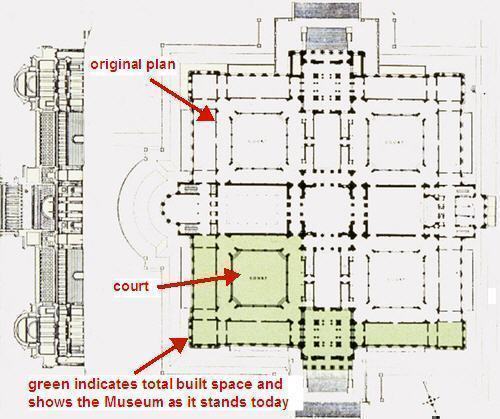
Brooklyn-museum-never-completed

Floorplan detailing what has been built of the original museum plan.

As the director of the Brooklyn Museum since 1997, Arnold Lehman has closely followed Youtz’s lead. He has championed exhibitions with either heavy social components or populist appeal—or both, as in the case of 1999’s “Sensation” show. He has taken the lead in demanding public funds while importing demotic displays on the costumes of STAR WARS, photographs of rock stars, and (currently) “killer heels.” He pumped attendance statistics with free late-night weekends filled with fashion shows, jewelry sales, music, and drinks. He gave ticket-buyers free rein to run through his halls, for example by hosting a regular scavenger hunt—billed as “part scavenger hunt, part obstacle course and ALL Brooklyn Museum”—with contestants “competing for classes at StripXpertease and Babeland.” He destroyed the independence of the museum’s traditional curatorial departments—tasked with maintaining what remained of the collections that the museum hadn’t traded away—in order to centralize exhibitions under his administration. He even made his own mark on the museum’s entrance, pushing Youtz’s populist assault out towards Eastern Parkway with a radiating glass canopy. “I like people to think of [the museum] as their favorite park,” he says.

Yet as with Youtz, Lehman’s approach undermined rather than strengthened the foundations of the museum by mistaking the greatness of art for mere programmatic utility. At the same time, an intelligent public that Lehman had underestimated, far from rallying around their own edification, largely stayed away both as ticket buyers and museum supporters. “Brooklyn Museum’s Populism Hasn’t Lured Crowds,” read a New York Times headline in 2010. Trustees resigned. Lehman even disbanded a community committee of supporters that had dated back to 1948.

This posture helps explain why the Brooklyn Museum has been slow to appreciate Brooklyn art, especially those artists who work without clear didactic agendas. For the museum, their art serves little use beyond fodder for contests, such as the reality television program “Work of Art: The Next Great Artist,” or social experiments, such as “Go: A Community-curated Open Studio Project.” To expect the museum to appreciate local art as a connoisseur, studying, guiding, and elevating the best to public attention, would be an affront to this progressive vision.
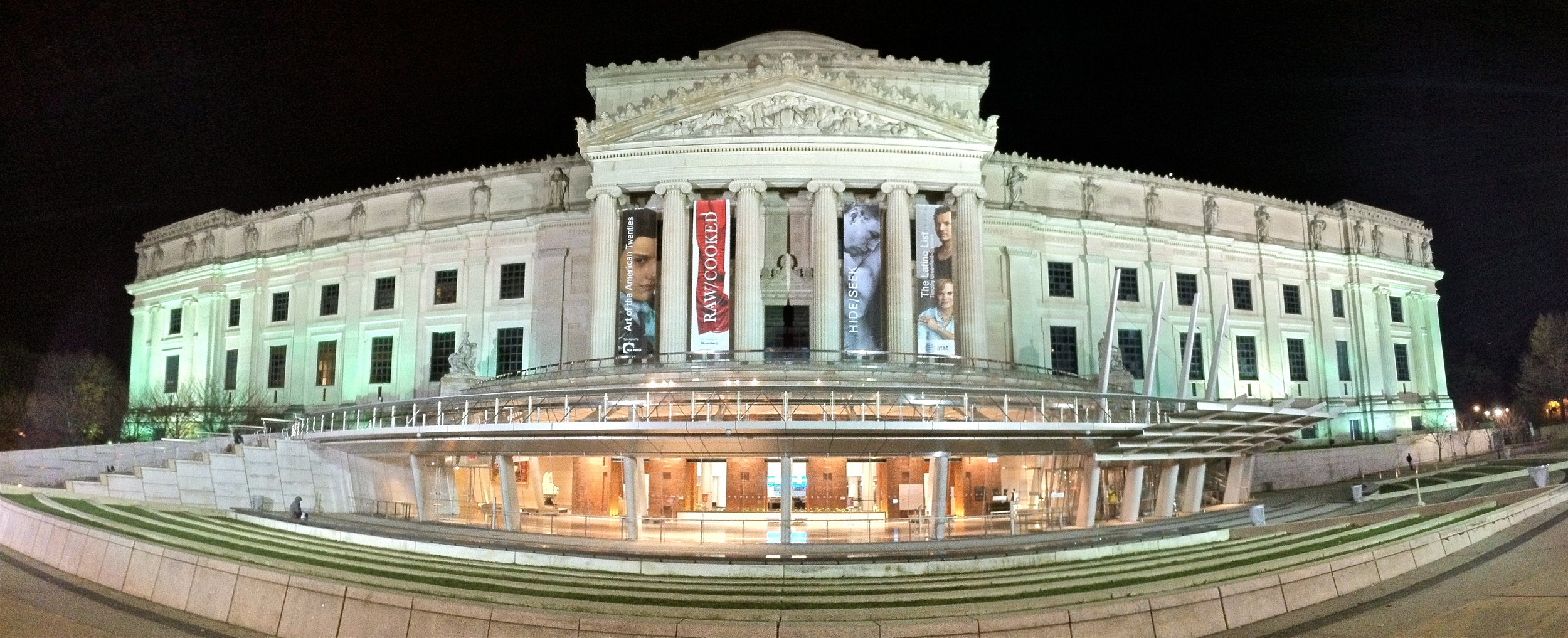
Brooklyn_art_museum_night

The once-grand staircase of the Brooklyn Museum has been replaced by a glass atrium.

Yet just as Brooklyn art has flourished, so too has Brooklyn been reborn. The borough has shaken its defensive posture to become once again a leading metropolis, perhaps exceeding its nineteenth-century reach and confidence. This past September, Arnold Lehman announced he will step down in a year, and the search is on for the next leader. Lehman has been a likeable showman, perhaps the only sort of director who could survive in an overshadowed institution of diminishing returns. But the changing fortunes of the borough now call for a director who can draw on Brooklyn’s civic strengths to build the museum into what its founders intended. The time has come for a Brooklyn Museum that is truly “worthy of her wealth, her position, her culture and her people”—and her artists.

Not Like Ike

PJ-BY442_IKEMEM_M_20141113000648

Model of the Eisenhower Memorial looking at Independence Ave. GEHRY PARTNERS, LLP

THE WALL STREET JOURNAL
November 13, 2014

Not Like Ike
by James Panero

Plans for the Eisenhower Memorial have turned into another Washington boondoggle.

Imagine if the great Lincoln Memorial had been designed today. No longer would we feature our 16th president enthroned in a Doric temple. No more would we contend with an off-putting set of stairs as we strain to look up at cold, noninteractive marble.

Instead, Lincoln could be brought down to our size. In an immersive multimedia environment, tapping the latest technologies to recall log-cabin life, here we might help Lincoln as a child contend with his humble beginnings. The native vegetation of Kentucky, Indiana and Illinois could be planted on site, part of a LEED-certified green drainage plan. Through the Lincoln E-Memorial app, visitors could test their strength against the famous rail splitter through a game that posts scores directly to Twitter (hashtag: #RailedIt). Just be sure to duck when visiting the “Ford’s Theatre Experience.”

Thankfully, there is little risk of seeing the Lincoln Memorial recast this way. For Marian Anderson, Martin Luther King Jr. and many others, it has served as one of the most famous backdrops of the past century despite its antiquated marble technology. Yet since 1999, Washington’s master planners have been at work on another presidential memorial on the National Mall—for Dwight D. Eisenhower—that will pursue the opposite of the tried and true: a plan that was touted in its 2008 prospectus as a “21st Century memorialization,” using “new avenues” and “the widest possible range of innovative concepts and ideas,” with a “very significant electronic component,” leading to a “new vision for memorialization.”

National memorials have a history of long gestation and partisan controversy. Even the Lincoln Memorial, designed by Henry Bacon with sculpture by Daniel Chester French, completed in 1922, saw its share of criticism. Yet in this classical city, in hindsight, Washington’s traditional monuments have stood the test of time. So why must new mean “new”?

The congressionally authorized Eisenhower Commission certainly believes it got “new” in Frank Gehry, its chosen architect. With a proposal that subverts many of the classically based traditions of memorial design, the core of Gehry’s plan is the periphery: a 447-foot-long metal screen, suspended between 80-foot-tall columns, interwoven with images of trees. “The setting for Eisenhower Square,” reads the Commission website, “will be framed by transparent stainless steel tapestries, which depict the plains of Kansas, representing Eisenhower’s humble beginnings.” This device would serve as the backdrop for the sculptural program playing out in front of it.

In the initial proposal, since amended to include a greater cast of characters, this program centered on a statue of Eisenhower as a barefoot boy. The memorial would also be designed around an app that “will enable visitors to view historical footage, speeches, and events within the context of the physical memorial through augmented reality.”

Should we be surprised that the plan has become more bogged down than the Battle of the Bulge? The design has received widespread criticism—from Justin Shubow of the National Civic Art Society to Sam Roche of the group Right by Ike, not to mention members of Eisenhower’s own family—that has resonated with lawmakers and the general public. The site would also imperil the historic L’Enfant Plan by overlaying Maryland Avenue, between the Air and Space Museum and the Department of Education. In the New Yorker last year, Jeffrey Frank said the design “has managed to achieve something rare in Washington: in true bipartisan spirit, almost everyone hates it.”

This past summer, congressional members of the Committee on Natural Resources issued a 60-page report damning the project as a “five-star folly.” It is easy to see why. Congress has already appropriated $65 million for a project that would cost $100 million or more. Yet without a stone—or screen—in place, $41 million of this funding has already been spent or obligated, including almost $16.4 million for the designer and $13.3 million for administrative support. A $1.4 million fundraising effort slated to generate $35 million in private support has taken in less than $500,000. Meanwhile, the Commission maintains nine full-time employees and six full-and part-time contractors.

Beset by criticism, Congress has rightly halted future funding, some commissioners have resigned and calls have been mounting to scrap the Gehry plan altogether. Bruce Cole, the former head of the National Endowment for the Humanities who was appointed to the Commission a year ago, remains a skeptic. “A great memorial is an exclamation point, not a question mark,” he recently testified.

Yet led by its chairman, Rocco Siciliano, the Commission has dug in. Recent approvals by the National Capital Planning Commission and the U.S. Commission of Fine Arts have been hailed by Gehry defenders as the green light, even if the project has only enough gas to idle at the curb. Of course the bureaucrats behind the wheel still get their salaries. That’s right: Commission staffers will continue to draw down millions of tax dollars regardless of whether anything gets built.

Yet a greater force than self-interest has propelled the memorial to this point: the sometimes blinding mythology of the “new,” where widespread criticism can be mistaken for vindication, and pushback ennobles a self-anointed vanguard. Mr. Siciliano and others may believe they are following the example of the Vietnam Memorial, an unconventional design that overcame initial controversy to win the public over. But criticism alone does not authenticate avant-garde success. An unconventional design may just be bad, and design à la mode risks falling from fashion.

Eisenhower deserves a great national memorial, and it would be wrong to see this battle reduced to a mandate for one style over another. But the critics are right to demand something genuinely revolutionary—a design that is not simply “new,” but new, and that successfully communicates the essence of the man it claims to honor.

After all, here is the Supreme Allied Commander who oversaw the most complex amphibious assault in history. He liberated Europe, went on to become the president of Columbia University and the commander of NATO. As the American president who ended the Korean War, he ushered in a period of peacetime prosperity, connected the country through the Interstate Highway System, created NASA and the agency that would invent the Internet, while pushing civil-rights legislation and sending federal troops to desegregate the schools. When he died in 1969, he was buried, by his request, in his green World War II jacket in an $80 government-issue casket. Does this say “8-story-high, $100 million metal screen” to you?

Grounded Zero


9/11 Memorial north pool and Museum pavilion at night. Photo: Jin Lee

THE NEW CRITERION
September 2014

Grounded Zero
by James Panero

On the recently completed National September 11 Memorial and Museum.

I arrived at the National September 11 Memorial and Museum with frankly low expectations. Like all of the civilized world, I have little affection for the date the museum commemorates and the site it now occupies. It need not be said that the murder of nearly 3,000 innocent people by jihadist terrorists, broadcast to a reported 2 billion viewers worldwide, defined my generation’s darkest day. Even as I watched the ruins of the Trade Center cleared away and new buildings rise, the memory continued to drive me, physically and emotionally, from the site of the attacks.

It hasn’t helped that the subsequent renewal of these blocks of downtown Manhattan has turned tragedy into farce. Caught in a mire of city and state agencies, redevelopment rights, insurance claims, and the supra-governmental ownership of the Port Authority of New York and New Jersey, not to mention the divergent wishes of the families directly affected by the attacks, Ground Zero ground to a halt for years after 2001. Thirteen years on, the area largely remains a construction zone, imprisoned by barbed wire, guarded by a militarized police force, with a folly of new buildings encircling the federally protected footprints of the former Twin Towers.

On one side, punctuated by the sound of acetylene torches, is the overbuilt and overpriced skeleton of Santiago Calatrava’s future rail station, now resembling the flayed carcass of an armadillo. On another is One World Trade Center, the skyscraper formerly known as the Freedom Tower. Saved and crystallized by the architect David Childs from the ambulance-chasing Daniel Libeskind, this monumental headstone was ultimately shortchanged through a scandalous deal between the Port Authority and the Durst Organization, which eliminated the sculptural radome from the building’s forty-story spire and squared off its chamfered base. And at the center is the Memorial itself, a set of inverse fountains by Michael Arad called Reflecting Absence. In concept, they looked to me like an endless replay of the cascading curtain walls of the collapsing towers.

Then there’s the question of how to memorialize brazen acts of terror. The asymmetrical nature of terrorist strategy relies on the spectacle of destruction to make up for deficiencies in force. Most often terrorism turns the peaceful tools of its adversaries into weapons against them: the liberalizing good of commercial air travel; the freedom of the press. Modern terrorism would largely cease to terrorize without the assistance of our broadcast media. One reason why the attacks of 9/11 were so terrifying was that their coordination meant they were captured and broadcast worldwide in real time. Wouldn’t a museum of crushed relics and looped videotape simply further the terrorizing spectacle, putting the trophies of the attackers on permanent display?

And finally there’s the issue of whether any contemporary museum can suitably address a solemn topic on sacred ground. Our cultural establishment has long made a priority out of desacralizing civic institutions. Museumgoers have long been encouraged to check their reverence at the door. No surprise that early reports of the Museum have mostly swirled around the conflicts between the hallowed expectations of the victims’ families and the profane business of what would otherwise be standard museum practice: cocktail fundraisers, photo opportunities, and merchandise sales through a gift shop, all taking place on the site of a mass grave.

Yet, somehow despite all these challenges, I found the 9/11 Memorial and Museum to be profoundly moving, a complex distilled of its own complexity, with the calming grace of renewal emerging from the center of destruction. The fountains themselves went through several changes, as the landscape architect Peter Walker and then-mayor Michael Bloomberg reportedly reined in some of the expense of Arad’s more elaborate proposal. The Memorial, which opened to the public over the tenth anniversary of the attacks, reveals that sometimes design by committee actually works. The fountains are the first features you encounter when visiting the site and, along with the Museum, are administered by the 9/11 Memorial Foundation. They also set the theme for the overall memorial complex: a structure in reverse, an anti-monument of negative space, introverted and underground, affecting in its strangeness.

The fountains are deeper and larger than I imagined. Far from destabilizing, they are wells of contemplation. By overlaying the footprints of the original towers, they restore the first sense of rectilinear order that the terrorists tried to erase. In a smart departure from Arad’s original design, which imagined a subterranean passage behind the falls, the names of the deceased are now etched at plaza level in a slanted table ringing each fountain. Accessible, touchable, and returned to daylight, they have been arranged through a painstaking algorithm of affinities that further restores the individualism of the dead. The names of all the victims of the four-pronged 9/11 attacks are included, including those who lost their lives at the Pentagon and on the field in Pennsylvania, as well as the six individuals who were killed in the 1993 World Trade Center bombing.

Through the sound of the water and the mist of the falls, the fountains distinguish a separate, unenterable space set apart from the noise of the city. They are also technical and aesthetic marvels: The falling water is more orderly and channeled than I first had feared. The pattern of ripples in the basin is mesmerizing, acting less like a reflecting mirror and more like an ethereal portal. And the water laps into a second square void at the center of each fountain with a bottom that is below our line of sight, creating an infinite recession.

In their final design, the fountains accomplish nearly the impossible. Amidst the rush of the commercial city, they restore order through division, each setting aside an acre of downtown space for the spirits. A similar approach is then continued through the Museum itself, which opened on May 21 of this year. The entry-point is a shard-like pavilion, designed by the architecture firm Snøhetta, which cuts into the surface of the plaza beside the two fountains. While the Memorial precinct is free to enter, the Museum requires a $24 ticket, either purchased in advance or at the gatehouse. The high ticket price, the security checkpoint, the food concession, and the gift shop inside have all rankled the public. Certainly they are not ideal. If the operating expenses of the Museum were government- rather than privately-funded, things might be different. Then again, considering the state of construction where the Port Authority and other government agencies have not relinquished control, the Museum would probably not yet exist. And as it stands, the small gift shop, which sells books and Trade Center mementos that help fund the Museum, is set far off from the exhibits. There is no “exit through the gift shop.”

After an initial descent from daylight, the Museum darkens to a receiving floor. On the way down, the escalators pass beneath a trident-shaped piece of the salvaged Trade Center facade, part of the Museum’s gradual introduction of artifacts. A ramp then zigzags deep down to the base of the site. In different hands, this could have been “9/11: The Ride,” but here the Museum has gone a different way, opting for spareness and quiet, with a few key objects, like the Last Column removed from the rubble, rising from the bedrock into the subterranean space of the Museum and visible at points on the walkway down.

After a final descent by escalator, positioned beside the rubble of the Survivors’ Stairs, the Museum reaches bedrock. Designed by the architecture firm Davis Brody Bond, the space here divides between the open void of the overall underground chamber and a tighter area directly beneath the two fountains—the locations of the former Twin Towers. Encouraged by victims’ groups, the Museum has left the square box foundations of the towers’ curtain wall visible in the concrete floor.


9/11 Memorial, Foundation Hall with Last Column. Photo: Jin Lee

Under the stewardship of Alice M. Greenwald, the Museum has wisely divided its layout into distinct precincts, with different feels. The open space called Foundation Hall, outside the ring of the towers, bounded by slurry walls, looks at life outside of the fateful day. Here are items that speak to the heroism of the recovery efforts and the outpouring of worldwide emotion, such as memorial quilts and the Dream Bike restored in honor of the fallen FDNY firefighter Gerard “Biscuits” Baptiste. Here also is a handful of the largest relics of the destruction: a crushed fire truck, a section of the north tower’s radio mast, other pieces of twisted steel. While at first seeming to aestheticize the attacks, like crumbled sculptures by John Chamberlain, these spare items take on a spiritual transference, especially as one notable relic came to resemble a cross, and recovery workers carved another into religious symbols. Not everything worked for me: A large commissioned wall piece by Spencer Finch called Trying to Remember the Color of the Sky on That September Morning, meant to honor the thousands of unidentified remains behind it, merely managed to bring minimalist kitsch below grade.

A section here is also devoted to the history of the towers themselves: the innovation and exhibitionism that went into their construction and the controversies surrounding their design. As the excavations descend to schist, there is comfort in reaching the stability of lowest ground, of seeing sparkling rock. It is reassuring how the Museum looks to tell so many chapters of a long story, with many narrators and varieties of tone, rather than just the one the attackers set out to broadcast.

As a final separation, the Museum divides out the story of the attacks and an exhibition honoring the victims between the two tower footprints. Each is set off by its own entry-point, and guards remind visitors that cameras are not permitted in either space. In one instance, I found the loud admonition more jarring than the offense, although the policy is appropriate, and it sets the tone for these tight inner sanctums.


9/11 Museum, Memorium Exhibition. Photo: Jin Lee

Both of these spaces are affecting, in profoundly different ways. The Memorial Exhibition is spare, small, and solemn, more like a chapel, with simple photographs of each of the victims and an inner projection room that profiles each of them. Although made nowhere apparent in the museum, the reason more of this tower’s footprint is inaccessible is that much of it is still taken up by the commuter rail PATH tracks. As in the original tower design, trains cut through the lowest level of the site—a reminder of the conflicting demands on this real estate.

The Historical Exhibition, beneath the north tower, is harrowing as it replays the 9/11 attacks frame by frame. In contrast to the rest of the Museum, here the information is dense, dizzying, and at times both breathtaking and overwhelming as it looks at a specific event from every available angle. One illustration of the country’s circulating flight patterns, pulsating in the morning, grounded by the evening, speaks to the pall that was cast over the country. The Museum also goes back to the 1990 journals of El Sayyid Nosair, convicted in the 1993 bombing, to reveal the long tail of radicalized Islam. “Destroy the morale of the enemies of Allah,” he wrote. “Exploding . . . Their high . . . Buildings.” Osama bin Laden is also quoted, vowing to “prevail over the Americans and the Jews.”

Telling the story of 9/11 is a minefield. Yet it must be told, and the 9/11 Museum does it better than anyone might expect. Although named after 9/11, the Museum uses its spaces not to broadcast but to encapsulate the spectacle of the terrorizing day. The Museum is “As much about ‘9/12’ as it is about 9/11,” Greenwald explains in an introductory message. While neutralizing the specter of mass murder, the 9/11 Museum leaves little doubt of the fascist virus behind the attacks. It also helps replace swirling memory with a new foundation. It preserves an intimate story of our soldier citizens for the growing ranks of those who did not experience it firsthand, in particular the foreign and the young. Contrary to some reports, almost every visitor I saw behaved with dignity. There is comfort in bearing witness together as we ensure that We Will Never Forget.