THE NEW CRITERION
December 2015
The Vengeance of the Vandals
Little remains of the Basilica Aemilia in the Roman Forum save for its marble floor. Yet that floor tells its own story of the fall of the Roman Empire. Small circles, green and brown, blemish the light gray stone. The circles are not ordinary stains. These are the shadows of a cataclysm that shook Rome beginning on the night of August 23, 410 AD. The sack of Rome by Alaric and his army of Arian Goths broke the 800-year security of the walls of the Eternal City. Not since the Battle of the Allia in 390 BC, when the ancient Gauls descended on the Seven Hills, had the Pax Romana been so fundamentally challenged. As Alaric’s Goths swept through the city, fleeing merchants dropped and scattered their coins across the ground of the Basilica Aemilia, where they operated their shops. When the Goths looted and then burned the building, the heat of the fire calcinated the copper and bronze of the coins to the floor of the Basilica. Today those coins are still permanently affixed right where they fell.
Through the marks left by those coins, we can see how the merchants of the Basilica Aemilia no more anticipated the sack of Rome than we do the terrorist attacks on our own cities, whether New York or London or Paris, or Mumbai or Nairobi or Beirut, or any other center of free people. In an idle civilization, the prosperity and values of a Pax Romana or Pax Americana ultimately prove less appealing than we always assume, and one assault does little to prepare us for the next. Absent a fundamental reassertion of countervailing force, further attacks become not just a possibility but an inevitability.
How can it be otherwise? Only a civilization that recognizes the value of its enduring symbols can anticipate at what price barbarians will seek to destroy and cart them away. So it has been over the past year for those of us who have closely followed the wholesale “cultural cleansing” of ISIS-held territory in the Middle East, from museums to houses of worship to archeological sites of historical significance throughout Iraq and Syria, which has foreshadowed ISIS’s global ambition.
The dozens of cultural targets have ranged widely: from Shia mosques and shrines as the Sunni Salafists of ISIS have waged a doctrinal war against their co-religionists in a bid for tribal supremacy; to churches and monasteries, including (without irony) the Armenian Genocide Memorial Church in Der Zor, Syria; to the many priceless archeological sites that populate the Cradle of Civilization. Whatever valuables could be looted and moved have been sold on the black market. Architecture and larger relics have been bulldozed, jackhammered, attacked with rocket fire, and rigged with explosives.
Beyond the handheld videos, photographs, and tweets sent out by individual jihadists, the record of these actions has been made amply available as ISIS has produced a series of increasingly professional, high-definition films memorializing its path of destruction. In February 2015, ISIS released a video in the guise of an educational documentary about its rampage through the Mosul Museum. “Muslims, the remains that you see behind me are the idols of peoples of previous centuries, which were worshipped instead of Allah,” a soft-spoken host narrates in Arabic from inside the museum, drawing on examples set forth by the Prophet Muhammad as justification.
The Assyrians, Akkadians, and others took for themselves gods of rain, of agriculture, and of war, and worshipped them along with Allah, and tried to appease them with all kinds of sacrifices. The Prophet Muhammad shattered the idols with his own honorable hands, when he conquered Mecca. The Prophet Muhammad commanded us to shatter and destroy statues. This is what his companions did later on, when they conquered lands. Since Allah commanded us to shatter and destroy these statues, idols, and remains, it is easy for us to obey, and we do not care what people think, even if this will cost billions of dollars.
At the sound of a synthesized bass drum, a dubbed soundtrack of Arabic singing mixes with machine-gun fire as a group of jihadists smashes the museum’s artifacts with sledgehammers through slow motion and cross-fade takes. At one point a caption reads “Quran 21:58 ‘he reduced them to fragments.’ ” As the rampage turns to defacing a 2,700-year-old Assyrian lamassu sculpture (one of the few artifacts in the museum, it turns out, that had not been a copy), a split screen shows a black and white image of its excavation. A caption explains how “These idols and statues were not visible in the days of the Prophet Muhammad and his companions, but were extracted by the worshippers of devils.”
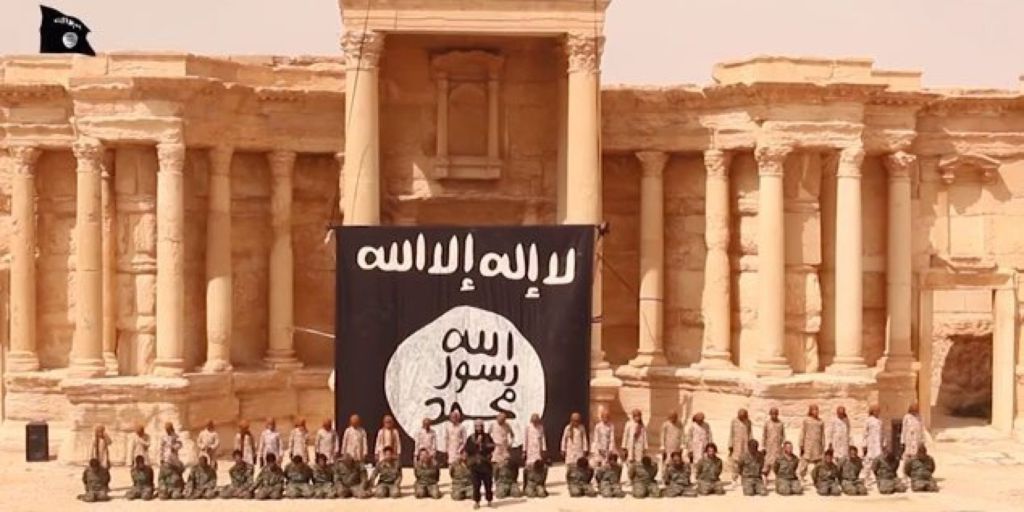
Later, in spring 2015, ISIS reached the Roman city of Palmyra, a World Heritage Site in occupied Syria, and found an even more compelling and ultimately valuable platform for its rampage. Palmyra’s Roman amphitheater became the backdrop for a slickly produced, multiple-viewpoint film of the execution of Syrian soldiers by ISIS teenagers, who shot the soldiers in the backs of their heads as they knelt on the ancient Roman proscenium with the black ISIS banner framed behind them. A month later, after Palmyra’s resident archeologist and scholar, the octogenarian Khaled al-As’ad, refused to divulge where the site’s antiquities had been hidden, ISIS publicly beheaded him in a square outside the city’s museum and tied his body to a column with his head between his legs and a sign that read “heretic” in Arabic. The ancient town was subsequently leveled by ISIS bulldozers, explosives, and gunfire.
Compared to its spectacle of murder, comparably less attention and less concern has been paid to this specter of vandalism. Yet attacks over apostasy and iconoclasm are part of the same fluid strategy of fanatical terror that forms a pretext for killing, raping, looting, and the further spread of lawlessness and chaos. The terrorism of 9/11 was as much about the destruction of the symbols represented by the Twin Towers, the Pentagon, and the jet planes as the murder of the thousands of people inside them. Similarly the public beheadings favored by Islamists demonstrate both the murder of their victims and the destruction of their bodies in equal fashion. In the symbolic battleground of asymmetrical warfare, the elimination of one form of destruction must therefore be matched by the suppression of the other.
Here again the fall of Rome provides a lesson. As we have seen in our war against militant Islam, so too did the people of the late Roman Empire face repeated victimization over their final century at the hands of Arian hordes. Just as we trade one Islamist foe for another—al Qaeda for ISIS—so too did Rome face a new and even worse Arian enemy forty-five years after the Gothic sack, with the rise of another tribe known as the Vandals.
“The march of the mujahideen will continue until they reach Rome,” promised Abu Bakr al-Baghdadi, the leader of ISIS, otherwise known as ISIL, Islamic State, and Daesh, a year ago. At the time, his threat was discounted as mere rhetoric from an underestimated organization that was, in fact, less than a year away from executing its brazen attack on France. So too did the breach of 410 AD, known as the “first sack of Rome,” leave the Eternal City unprepared for the Vandal assault that ultimately led, as Edward Gibbon lamented, to the decline and fall of the Roman Empire.
The second sack of Rome, in 455 AD, was even more vicious than the first. As with ISIS, this time the spectacle of vandalism was not the misdemeanor crime of conquest. For the Vandals, from whom, of course, we get the term, vandalism was a primary strategy of terrorizing warfare. The Vandals swept down from the Germanic north and circled through the Roman Empire in a campaign of terror that first extended through the rich Roman territories of northern Africa that were geopolitical chokepoints, robbing the Empire of the oil that fueled its power—olive, in this case, rather than crude.
Gibbon describes how the “rapacious Vandals confiscated the patrimonial estates of the senators, and intercepted the regular subsidies that relieved the poverty and encouraged the idleness of the plebeians. The distress of the Romans was soon aggravated by an unexpected attack; and the province, so long cultivated for their use by industrious and obedient subjects, was armed against them by an ambitious barbarian.” This territorial conquest gave the Vandals the resources they needed for their attack on Rome, where, Gibbon writes, the “pillage lasted fourteen days and nights; and all that yet remained of public or private wealth, of sacred or profane treasure, was diligently transported to the vessels.”
Writing from the vantage point of the eighteenth century, Gibbon did not go into extensive detail of the Vandal assault, except to note that the Romans willingly opened their gates to the invaders in a bid for mercy, which was followed by the wholesale despoiling of their city and the enslavement of Roman families where “the unfeeling barbarians, in the division of the booty, separated the wives from their husbands, and the children from their parents.”

The-course-of-empire-destruction-thomas-cole-1836
Thomas Cole, The Course of Empire, Destruction (1836), a painting based on the Vandal sack of Rome of 455 AD.
A contemporaneous observer, a fifth-century African bishop named Victor of Vita, provides a more extensive account in his History of the Vandal Persecution. Victor experienced first hand the horrors carried out on his Nicene Christians by the zealous Arian invaders, radicals who sought to “rebaptize” the conquered peoples in their own faith. The cry of apostasy formed their pretext for torture and murder, while the call of iconoclasm gave the Vandals license to destroy sacred buildings and institutions. The purpose of such spectacle was, then as now, to wage a psychological campaign against a people that would (in the world of al-Baghdadi) “embitter their lives and make them occupied with themselves instead of us.” “In particular,” writes Victor, the Vandals
gave bent to their wicked ferocity with great strength against the churches and basilicas of the saints, cemeteries and monasteries, so that they burned houses of prayer with fires greater than those they used against the cities and all the towns. When they happened to find the doors of a sacred building closed they were keen to open up a way with the blows of their hatchets. . . . How many were the distinguished bishops and noble priests put to death by them at that time with different kinds of torments, as they tried to make them give up any gold or silver belonging to themselves or the churches! And so that the things which were in their keeping would be brought forth more easily under the pressure of pain, they inflicted cruel torments a second time on those who produced things, asserting that they had produced a part but not the whole, and the more a person gave, the more they believed he had still more. . . . Some had their mouths forced open with poles and stakes, and disgusting filth was put in their jaws so that they would tell the truth about their money. They tortured others by twisting cords around their foreheads and shins until they snapped. Devoid of mercy they offered many people saltwater, others vinegar, the lees of olive oil, fish sauce and many other cruel things, while full wineskins were placed near their mouths.
Islamists did not invent terror and cultural persecution. Yet in Iraq and Syria, the systematic destruction of cultural resources by ISIS nevertheless continues a history of iconoclasm that has long been a hallmark of the fundamentalist forms of the Islamic faith they claim for their state. In March 2001, the Taliban of Afghanistan infamously destroyed the sixth-century Buddhas of Bamiyan, reportedly on orders from Osama bin Laden. Yet efforts to destroy these colossal statues as symbols of pagan idolatry in fact go back to nearly every successive Islamic power that has occupied the region. The Mughals and the Persians each turned their guns on the Silk Road statues, as did Afghan kings. The Taliban had been attempting to destroy the Buddhas since 1997, drilling holes in which to place explosives and burning tires on their heads. A short-lived debate to spare them as a tourist attraction was tabled in 2000 as 400 Afghan clerics determined that the Buddhas represented symbols against Islam. “We are destroying the statues in accordance with Islamic law,” declared Mullah Mohammed Omar. “Muslims should be proud of smashing idols. It has given praise to Allah that we have destroyed them.” As artillery bombardment and anti-tank mines failed to wipe out the statues at first blush, it was left to the Taliban’s Information Minister to admit that “this work of destruction is not as simple as people might think.”
Then as now this destruction was met with stern words from the international elite. The head of UNESCO, the cultural arm of the United Nations, issued a warning, not directed against the Taliban, but at the non-Muslim world: “It is abominable to witness the cold and calculated destruction of cultural properties. . . . As inexcusable as this action is, I hope that it will not provide fanatics elsewhere with an excuse for acts of destruction targeting Muslim cultural properties.” Meanwhile a delegation of the fifty-five-nation Organization of Islamic Conference and other outside observers lamented how the episode was “bad publicity for Islam.”
A concern over bad publicity for Islam did little to stop the subsequent attacks of 9/11 and the now ceaseless Islamist march across the globe. To the contrary, bin Laden proved to be a mastermind not only of terror but also of its publicizing potential, intimately studying his own recorded videos, which we now know based on photographs of him seized from his Pakistani compound. He also used the symmetry of spectacular attacks on cultural landmarks to draw in Western mass media. Bin Laden’s sense for weaponizing the television news-cycle was a development over the Taliban’s more reticent iconoclasm. In early 2001, CNN could even claim to have “exclusive” images of the destruction of the Buddhas, since the Taliban showed little interest in disseminating their efforts much beyond the local Afghan population they hoped to further subjugate through the application of Sharia.
Compared to the Taliban, and even to al Qaeda, the broader ambitions of ISIS should have been apparent not just through the path of its destruction but moreover through its desire to broadcast this destruction to the widest audience possible, making vandalism not just a strategy but a central component of its terrorist brand. ISIS has feverishly deployed professionally edited video and an equally sophisticated understanding of social media to disseminate its crimes. From its inception, ISIS has not so much waged a territorial war with a media arm but rather a media campaign with a territorial backdrop. The regions in which ISIS has seized power have been both a real place to enslave and a landscape on which to perform its destructive acts. By tweeting genocide and uploading blockbuster videos of death and destruction to YouTube, ISIS has demonstrated its jihadist bona fides at home, attracted thousands of Muslim recruits from abroad, and inspired the expansion of jihad while revealing the West’s anemic response to its outrages.
It was clearly wrong to see ISIS as merely a ground force isolated to its captured territory when, in fact, the spread of terror in the digital age gives Islamist vandalism a virtual presence the world over. As an upstart ISIS rampaged through Iraq and Syria, an army of dedicated retweeters pushed its actions into the forefront of what has been called the Internet’s increasingly competitive terror space, one until recently monopolized by its tactical rival al Qaeda. So as al-Baghdadi promised to reach Rome, his organization had with images already breached its walls, both through the reach of its virtual messages and through the chaos done to its historical content. In the process, ISIS also vandalizes the pathways of the open Internet and subverts the appearance of Western media with its own diabolical productions that turned murder into reality television and vandalism into its own form of educational public broadcasting.
The media savvy of ISIS is likely a consequence of the organization’s evolution from its origins in Saddam Hussein’s Ba’athist regime. The Ba’athist government had the distinction of being a worldwide innovator in the use of terrorist video to shame and control its population. Through the practice known as “cutting the eye,” Ba’athists filmed their crimes and delivered copies of the videos to the families of their victims, in particular so that husbands and fathers would see records of the rape of their wives and daughters, which would heap further shame on the abuse. It could be said that Iraq was an early adopter of anti-social media, and ISIS now furthers this deployment of revenge porn and snuff films as the darkest consequences of the Internet age.
It would be untrue to say our cultural community has had no response to ISIS aggression. New York’s Metropolitan Museum has hosted hand-wringing discussions concerning the destruction. U.S. Secretary of State John Kerry gave ISIS a stern-faced lecture from the Temple of Dendur. The U.S. State Department has staffed up a social media department to troll ISIS recruitment with hashtag campaigns. UNESCO has proposed labeling cultural destruction a war crime, while American museums have offered safe harbor to collections in war zones as temporary loans.
Yet these technocratic and bureaucratic solutions do little to counteract the underlying Islamist impulse that wages war outside of any international convention and looks to vandalize the symbols of civilization wherever they are found. Islamist strategy, now played out through the unchecked rise of ISIS, has put cultural institutions the world over at their greatest risk since the Second World War, when Kenneth Clark’s “Picture of the Month” initiative allowed Londoners to still see a single masterpiece in the National Gallery at the height of the Blitz.
Then as now, the only answer to such a threat is the enemy’s unconditional surrender and their de-jihadification by whatever means necessary. In the meantime their prosecution must be even more relentless and multifaceted than their own initiatives, including the deployment of a media campaign that refills the vacuum left by the secret machinations of the current U.S. Administration. The civilized world must now wage a public war over the preservation of symbols, a fight that will involve the advancement of ideals in virtual territory and the destruction of online networks as equally well as boots on the ground. If only Osama bin Laden had been stopped at the Buddhas of Bamiyan.

