With Much Fanfare

THE NEW CRITERION, February 1, 2023

With much fanfare

On the City Ballet’s premiere of Copland Dance Episodes, choreographed by Justin Peck.

The music of Aaron Copland might as well be the soundtrack of the American century. From Billy the Kid (1938) to Appalachian Spring (1944), Rodeo to Fanfare for the Common Man (both 1942), the compositions are energetic, expansive, hopeful. You envision birds at daybreak, sunlight on the prairie, cowboys dancing with the farmers’ daughters and farmers dancing with the ranchers’ gals. The spiritedness of the works lends itself to the ballet stage. So it’s no surprise that some of Copland’s most recognizable pieces were originally commissioned for choreography: Billy the Kid for Eugene Loring via Lincoln Kirstein, Rodeo for Agnes de Mille, and Appalachian Spring for Martha Graham. In 1959 Copland even returned to ballet with the commission of his Dance Panels for Jerome Robbins and the New York City Ballet.

Copland’s repertoire has become so iconic that it might now seem overly tied to time and place, like some grand old Hollywood Western forever in black and white. Justin Peck, the resident choreographer of the New York City Ballet, has taken on the challenge of introducing new color to these works. In 2015 he choreographed his Rodeo: Four Dance Episodes, inspired by a staging of de Mille’s original ballet at American Ballet Theatre.

This season he returns with Copland Dance Episodes, an ambitious work that premiered at City Ballet on January 26. Staged in twenty-two “episodes,” the seventy-five-minute piece presented without intermission is not only Peck’s first “full evening” work for the company but also NYCB’s first full-fledged plotless ballet since George Balanchine premiered Jewels way back in 1967.

Balanchine, Copland, Graham, de Mille, Robbins—the ancestors weigh heavy on such an undertaking. Peck responds by stripping away the heft of narrative ballet for discursive abstraction, through a tumbling of episodes with sonic and choreographic connections that are at most evanescent and fleeting. A thigh slap here, a head bob there, that’s all we get as the work floats free of the classical narrative of the American story.

With lighting, scenery, and costumes all tuned up to high color, Copland Dance Episodes is at its best in exploring the chromatic vision that weaves together the composer’s uplifting piecework. In the program, the set designer Jeffrey Gibson states that his art “fuses his Choctaw-Cherokee heritage and experience of living in Europe, Asia, and the USA with references that span club culture, queer theory, fashion, politics, literature, and art history.” This boilerplate reads like an application to the John Simon Guggenheim Foundation. Nevertheless Gibson’s colorful painted drop curtain introduces the ballet in Sixties hard-edge abstraction crossed with television test patterns. Ellen Warren picks up on these complementary saturations for her two-toned leotards while Brandon Stirling Baker employs high-index illumination with mostly subtle, and at one time jarring, lighting transitions.

Russell Janzen and Miriam Miller in Justin Peck’s Copland Dance Episodes. Photo: Erin Baiano.

Peck tends to be at his best in ensemble work, as multiple movements on stage coalesce and dissolve. As we hear those epic opening chords of Fanfare, Dance Episodes opens with the full company covered in tulle. A slogan, “The only way out is through,” is written on the drop and also serves as a title for this opening episode. At first the dancers appear frozen like mannequins under plastic wrap, there to be dusted off and reanimated. Then they walk off, leaving only one—the “common man,” no longer elevated, but merely lost in the crowd.

We get some hints at narrative through several such vignettes: racers at the starting line, ticket takers at the turnstyle, a flower in bloom. Fingers left pointing up at the end of one scene are touched ET-style in the next (in an episode called, yes, “Phone Home.”) With titles such as “Etch-a-sketch” and “Kismet,” the episodes are tumbleweeds and rodeos as seen in a Sunday morning cartoon, the past visualized in the light of the screen pixel. 

Peck, now aged thirty-five, conveys all the autistic affectation of his millennial generation. It’s a case of too much FaceTime, not enough facetime. I have written about the shortcomings of his partnerings in the past, with his dancers moving around one another without the necessary emotional engagement. Of course the pandemic has only made things worse, as City Ballet still rehearses masks up, practicing social distancing in an art that should be about profound connection. 

And yet here some of Peck’s pairings proved to be the highlights of the performance. In the episode “Two Birds,” Copland’s birdsong was given new life in the quick flutterings of Miriam Miller and Russell Janzen on the afternoon I attended. The two returned in “The Split.” Likewise for the partnering of Alexa Maxwell and Jovani Furlan, who shined once the company’s overly busy stage commotion moved on.

It should be said that no ballet should have twenty-two episodes and expect us to keep track of them all, especially in a darkened auditorium, and especially with titles like “Alone Together” (Parts 1 through 3). Whatever happened to the simplicity of “Emeralds,” “Rubies,” and “Diamonds”? Anchor points such as “Simple Gifts,” danced by the company, give way to the unexpected abstractions of “Shadowboxer,” with the stage lighting suddenly switched to silhouette. 

Do the twenty two episodes of this non-narrative work come off as too episodic? Yes they do. But Copland’s music mostly sustains the riffs—and stays with you long after. Ultimately this is the achievement of Copland Dance Episodes, a work that should now enter the standard NYCB repertoire. The piece reveals how music so rooted in the twentieth century can still send tingles and shocks into the ballet of the twenty-first.

Reaching

THE NEW CRITERION, April 14, 2022

Reaching

On the Dance Theatre of Harlem at the City Center Dance Festival.

New York has an abundance of ballet companies. Last summer five of them took the Lincoln Center outdoor stage for the first time together. The initiative—restoring live performance after over a year of pandemic closures—was called the BAAND Together Dance Festival, an acronym of the New York–based companies taking taking part in it: Ballet Hispánico, Alvin Ailey American Dance Theater, American Ballet Theatre, New York City Ballet, and Dance Theatre of Harlem.

New York’s cultural institutions can be notoriously siloed, often competing for the same donor dollars. The unusual five-day event therefore turned into what I might call a friendly battle of the bands—or make that “Baands.” The evenings exposed both performers and audience members to repertoires they might not otherwise see, with different companies performing alternating works. And on my night, evening number two, the winner in my mind was Dance Theatre of Harlem with its New Bach. Created by the company’s resident choreographer Robert Garland in what he calls “post-modern-urban neoclassicism,” here was classical ballet with street rococo, George Balanchine by way of “Soul Train.”  

Dance Theatre of Harlem in Odalisques Variations from Le Corsaire, by Dylan Santos after Marius Petipa. Photo: Theik Smith.

Founded in 1969 by Arthur Mitchell, the first black principal dancer to join New York City Ballet, and his teacher Karel Shook, Dance Theatre of Harlem has brought classical ballet uptown for over half a century. At the same time, Dance Theatre has incorporated uptown into classical ballet, promoting dancers and works that have expanded the classical repertoire. 

The greatness of Balanchine, the co-founder of City Ballet, can be explained in part by how he incorporated various dance vernaculars into the classical language of ballet. As principal dancer, Mitchell proved to be a particular inspiration for Balanchine, who choreographed the famous pas de deux for him in Agon and the role of Puck in A Midsummer Night’s Dream. When Mitchell then set out to found Dance Theatre, Balanchine gave him the rights to several works and co-choreographed others to add to his new company’s repertoire. 

Billing itself as a “neo-classical ballet company,” Dance Theatre has preserved the ideal of Balanchine in its own luminous frequency. It hasn’t been easy. Mitchell and his colleagues had to revive the company after an eight year financial hiatus between 2004 and 2012. In 2013, founding dancer Virginia Johnson became the school’s new artistic director. In 2019, a year after Mitchell’s death, the company crossed its fifty-year milestone with the dancers, the school, and the repertoire thriving. 

The Dance Theatre of Harlem in Balamouk by Annabelle Lopez Ochoa. Photo: Christopher Duggan.

Recently Dance Theatre returned to the New York stage with four performances as a centerpiece of the first City Center Dance Festival. Anchoring the program was the New York premiere of Higher Ground, Robert Garland’s latest work, set to the music of Stevie Wonder. Also on the bill was Balamouk, by Annabelle Lopez Ochoa featuring live accompaniment by The Klezmatics. Rounding out the run was Passage, by Claudia Schreier with live music by Jessie Montgomery, and Odalisques Variations from Le Corsaire, by Dylan Santos after Marius Petipa, which were presented in alternating performances.

At a time when new ballet seems to be minimal, cerebral, and “forward-thinking,” Garland is an unabashed retrospectivist. He draws on a sincere appreciation of dance history, one that includes both classical ballet and the soul of his youth. He has described waking up as a child in Philadelphia to the clock radio and hearing Stevie Wonder. It is remarkable to consider that this music is now as distant to us as the music of the 1920s was to the 1970s. And the differences between 1970s Stevie Wonder and the music of today can be just as profound. Here was genuine instrumentalism, not electronic sound, performed at a pace and rhythm that is slower and fuller than today’s rapid auto-tuned beeps and bops. Wonder is also anything but cold and minimal. If the music of Stevie Wonder had a color tone, it would be yellow, orange, and red. The songs recall smoggy city summers, the scent of the unairconditioned bus. This music gives heat.

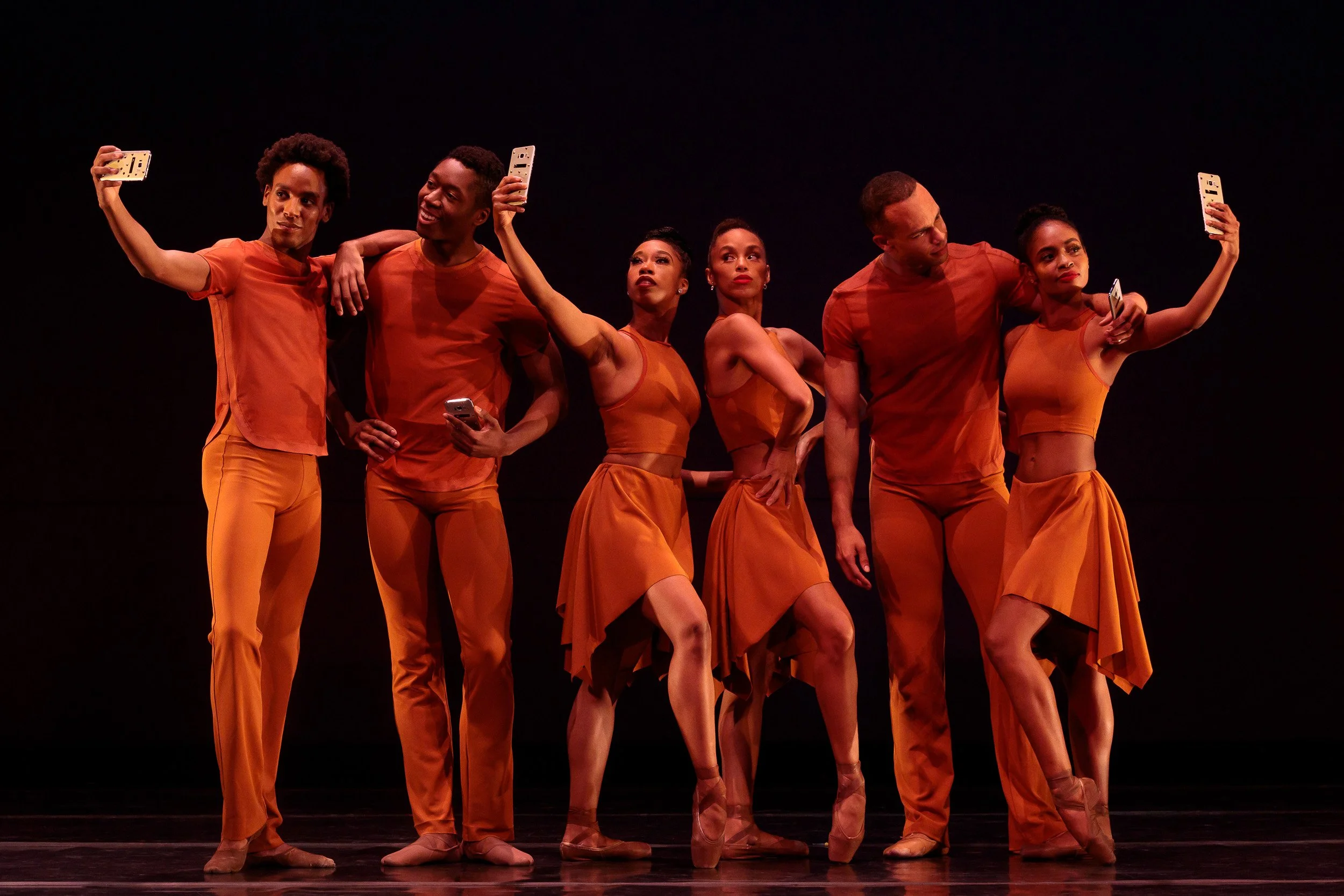
Over the years, Wonder has been reluctant to license this work, but Garland got his hands on six of his songs for a new ballet named after the final number, “Higher Ground.” With six dancers on stage in earth-toned costumes by Pamela Allen-Cummings, bathed in a warm light by Roma Flowers, the ballet could be called Wonder variations. 

The Dance Theatre of Harlem in Higher Ground by Robert Garland. Photo: Theik Smith.

The first dance, to “Look Around,” seems unnecessarily restrained, too withholding of the dancers’ virtuosity. By “You Haven’t Done Nothin” and “Heaven Is Ten Zillion Light Years Away,” the following songs, the energy was up. At times the dancers gestured to the audience, amplifying the rhythm and miming the street poses of the past. “Village Ghetto Land” then connected past to present, with a nod to the illusions of modern culture as dancers posed with smartphones. 

You might not think the “up” direction of pointe work would lend itself to the downbeat of soul, but “Saturn” well deployed its pirouettes for the celestial song. Then for “Higher Ground,” the final number, the company came together in a joyful, spiritual ensemble. Here was ballet with feeling, with the dancer Anthony Santos a particular standout. In the program, Garland describes his work as a “Sankofa-esque reflection on our current times.” What does this mean? “Sankofa” can refer to a mythical bird that looks back—an appropriate symbol for a choreographer who reaches back to what is left behind.      

The Dance Theatre of Harlem in Passage by Claudia Schreier. Photo: Theik Smith

It was something of a disservice for Passage and Balamouk to be programmed after the high of Higher Ground. Choreographed by Claudia Schreier, Passage has its passing moments. This is  especially true for its ominous beginning, as dancers emerge from the fog like three prows of a ship and then fall in acrobatic waves. According to the program, the work is meant to reference “the first documental arrival of enslaved Africans” and reflect “in abstract the fortitude of the human spirit and an enduring will to prevail.” With live music by Jessie Montgomery and costumes by Martha Chamberlain, this ballet was more head than heart, with symbols lost in its treacherous woods. 

If such a ballet would seem too on the nose for Dance Theatre of Harlem, Balamouk should have been a welcome and worldly departure. The work calls for Klezmer music, and a live band called The Klezmatics performed. I did not know they were there until they took their bow. The music was so over-amplified, it was unclear this was live accompaniment. Musicians should make themselves known at a ballet performance. Wave from the pit. Or better yet, have them perform from the stage. This music was wonderful, energy-filled, exotic. We are grateful they are there. 

With choreography by Annabelle Lopez Ochoa, this was the “extended version” of Balamouk. The ballet is a goulash of Slavic movement, with gypsy, Russian, and Ashkenazi influences. The title is Romanian for “house of the insane.” The bright costumes by Mark Zappone and uptempo rhythms by Les Yeax Noirs, Lisa Gerrard, and René Aubry were there to amplify the mania. Even in its extended version, the ballet never seemed to develop, but again here was Dance Theatre of Harlem looking to tradition—even “Tradition!” (as in Fiddler on the Roof)—and making it their own. 

Snowbound at City Ballet

THE NEW CRITERION

Snowbound at City Ballet

On Kyle Abraham’s When We Fell, performed by New York City Ballet.

Video killed the ballet star. At least that’s the impression we got watching the many attempts over the past year at translating the ballet stage to the computer screen. Iced out of the David H. Koch Theater, last fall New York City Ballet tried to turn up the heat for the final week of its digital fall season with five video premieres. To its credit, the pre-recorded programs gratefully brought ballet out onto the streets. Coming home from the office one evening, I happened to see one of the works in production, with the principal dancer Taylor Stanley moving fluidly, then spastically, as if suddenly possessed, as he stood up from a bench in Riverside Park.

The joy of seeing live dance—even just a few seconds of it set to recorded music—seemed far removed from the treacly, overedited final product that ensued. Created by Justin Peck, with Jody Lee Lipes as the director of photography, that sneaker ballet became just another Nike ad, in this case set to Chris Thile’s earworm of a tune called “Thank You, New York.” Really, no thanks. Another reason to pack up and move to Texas.

Despite the talent of their choreographers and dancers, the other four works fared little better. The problem was the overly redolent filmmaking by Ezra Hurwitz and cinematography by Jon Chema. In Andrea Miller’s “new song,” set to music by the executed Chilean singer Víctor Jara, the perfume was at its fullest, and was in fact quite evocative. But ballet does not need quick cuts, smokey closeups, and lens flares. Just let dancers dance.

2863.jpeg

With its new spring initiative, City Ballet has learned from the mistakes of last fall. The mandate to let dancers dance is what makes choreographer Kyle Abraham’s latest video premiere, called When We Fell, so compelling. Developed with eight City Ballet dancers during a three week residency—“COVID-compliant,” we are assured—at the Kaatsbaan Cultural Park in Tivoli, New York, the ballet offers a haunting return to form. Co-directed by Abraham and the cinematographer Ryan Marie Helfant, When We Fell captures the performers in 16-millimeter black-and-white film as they move across the Koch Theater stage and, even more affectingly, Philip Johnson’s mezzanine. Now the cameras are static, often fitted with a fisheye lens, so that the point of view resembles surveillance footage switching intermittently among feeds. In the otherwise empty theater—empty of all of us for far too long—the work feels like “night at the ballet,” or day at the ballet, with the ghosts of dance filling the shadows.

But of course, the Koch theater has not been entirely vacant this past year. Those colossal marble statues, enlarged by Lincoln Kirstein from tiny figurines by Elie Nadelman, have kept watch over the hall. With bodysuit costumes by Marc Happel, in When We Fell the dancers arrive as marble halfway made flesh. In her pantomime poses, the soloist Claire Kretzschmar enters the scene as a Nadelman sculpture herself, at times come to life, at others returning to the cold stone of the space.

Captured at various angles, this ballet, which remains available for streaming through Thursday, makes the most of the rigid geometries of the mezzanine’s architecture. The dancers move like chess pieces across the gridded marble floor. They watch one another. Then they freeze in position, as when the corps dancer India Bradley pauses in penché. Taylor Stanley is most adroit at incorporating Abraham’s liquid breakdancing flow with the Balanchine technique—two dance traditions that are not so far removed as one might imagine. Done right, the hip-hop dancing looks like ballet in reverse, with movement made strange, popping and melting down. The opening music of “Piece for Four Pianos,” by Morton Feldman, adds to the odd emptiness as it seemingly reverberates through the vacant theater.

We should not expect such ballet, at moments like this, to resolve into the Nutcracker Suite. And indeed, as Abraham’s sixteen-minute work continues, it shifts from the mezzanine to the Koch Theater stage, with dancers now overanimated by the cacophony of Jason Moran’s “All Hammers and Chains,” which sounds as advertised. As the performers dance past one another, an abundance of cabriole leaps and fouetté turns by the apprentice KJ Takahashi resolves into a pas de deux. Now the lighting designer Dan Scully shines a backlight on the principals Lauren Lovette and Taylor Stanley and it seems as if we observe them from offstage. Nico Muhly supplies the music, titled “Falling Berceuse,” for this elegiac coda. Finally the camera zooms out to reveal dapples of light that turn out to be the faceted lamps of the Koch auditorium, so well known, but here become strange. Created during a snowy residency in upstate New York, When We Fell captures that eerie, snowbound feeling of a year in frozen isolation.