Beatnite: Bushwick

James writes:

You don't need a passport to cross the border into the vital arts scene of Bushwick, Brooklyn, but it can help to have a guide. That's why Jason Andrew, the co-owner of Storefront Gallery and the director of the Bushwick nonprofit Norte Maar, organizes Bushwick Beatnite. For these semi-annual events, usually on Fridays, Bushwick's galleries stay open late. Jason and his co-sponsor, Hyperallergic.com, issue maps listing all the venues. The gallery crawl then concludes at a bar starting around 10. In this case, the Cedar Tavern of Bushwick is a place called Bodega.

Here's what the scene looked like at Friday's event. Katarina Hybenova of Bushwick Daily has more. Most of these shows just opened, so there's still time to see the art over the next few weeks. 

508_BEATNITE_021811_LARGE

Beatnite poster by the singular Bushwick assemblage artist Andrew Hurst


BN-243926820 (1)

Jason Andrew (driving, in trucker's hat) took the VIPs around by minivan. In the flashbulb, Hrag Vartanian and Veken Gueyikian of Hyperallergic.com  Not pictured, Jason's dog Fern, sitting on my lap. 
 

BN-243896553

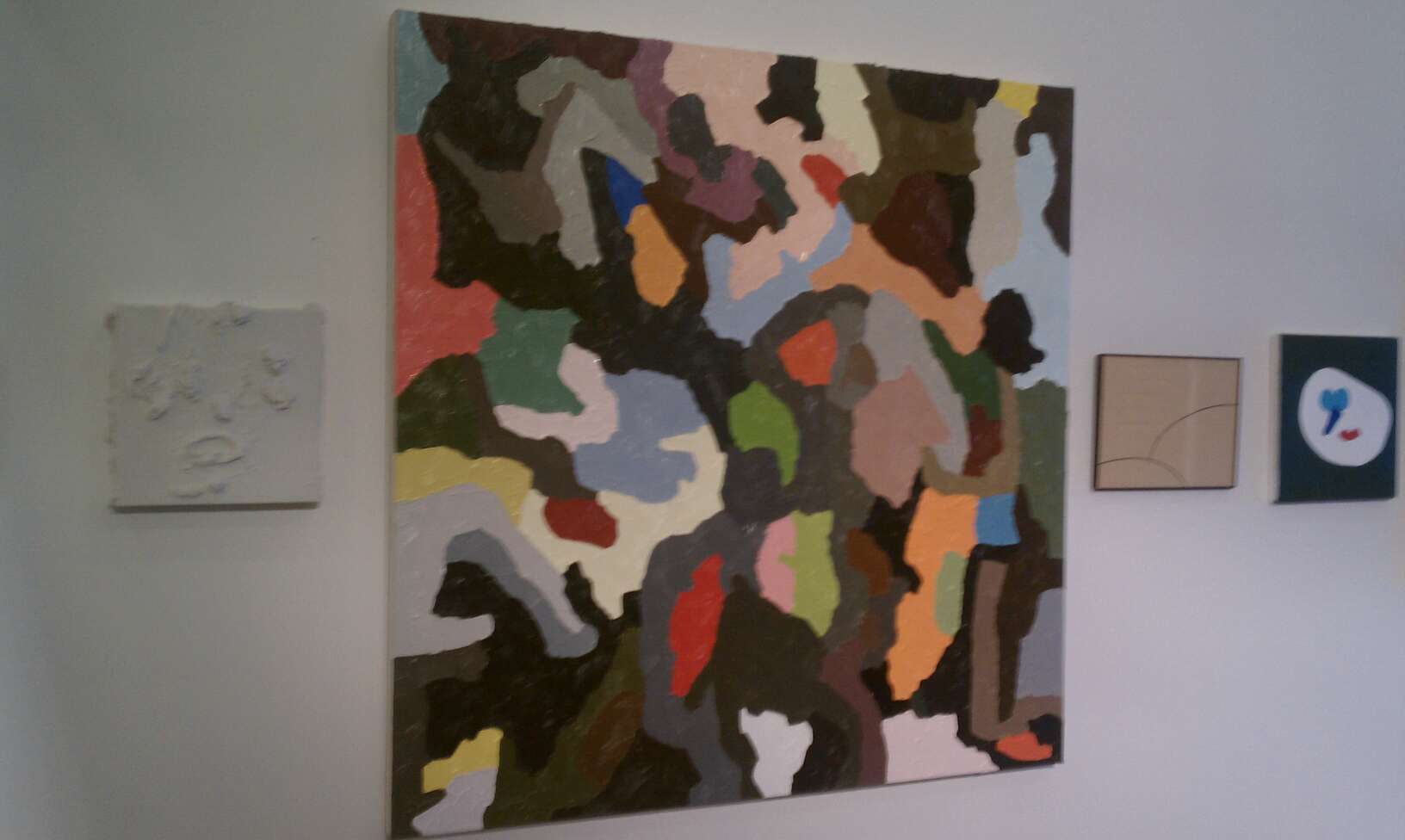
Some of the work on view at Fortress to Solitude, the gallery run by Guillermo Creus, who seeks out an eclectic range of artists. The center two pieces are by Jenna Bauer.  


BN-243902039

Paul D'Agostino of Centotto talks with Jason Andrew. Dove-tailed sculptures and rope made of styrofoam and acrylic by artist Zane Wilson.


BN-243910175

Artist Ashley Zelinskie is the co-founder of the ambitious new Bushwick collective Curbs and Stoops, an "art accessibility think-tank." On the wall is a painting by Angel Otero, whose inaugural New York show is now on view at Lehmann Maupin. I write about a studio visit with Otero in my next column for The New Criterion, out March 1.
 

BN-243919992

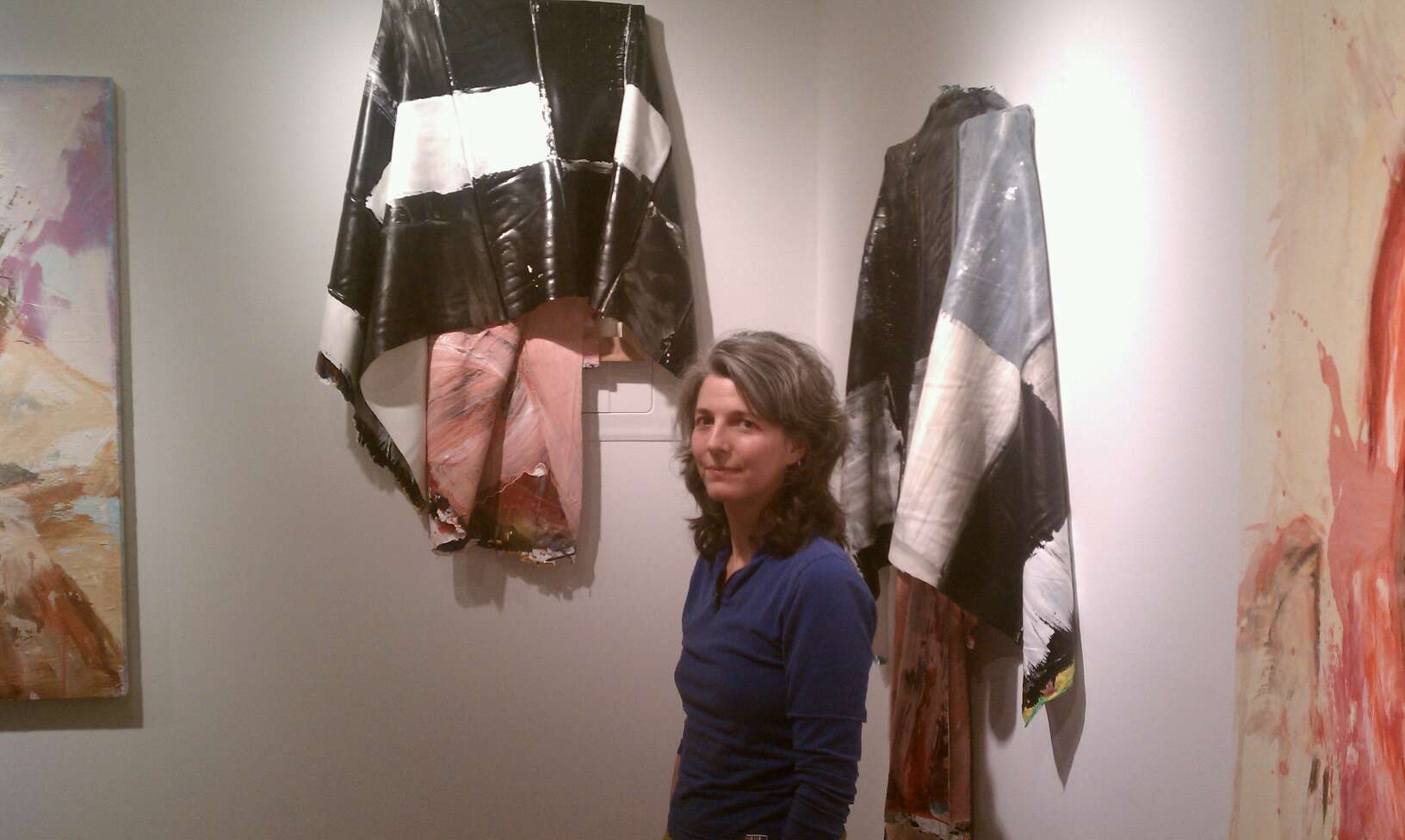
Gwen Skaggs of Sugar shows paint skins by the artist Erika Keck.


BN-243977014

Much of the party centered around Norte Maar, Jason Andrew's home gallery. Here Austin Thomas has curated a group show in the living room. Austin's t-shirt references her newest venture, Hippie Potluck, a regular symposium of artists and writers hosted at the offices of Hyperallergic.   

Not pictured, but also on my rounds, was Meg Hitchcock's obsessive text work of Biblical proportions at Famous Accountants (check out this James Kalm Report for more), the closing party for Mary Judge at Storefront, and the gallery Laundromat in its new location across from Norte Maar. 

My thanks to Jason, and all of the participating artists and gallery owners, for keeping the lights on and allowing us to see a creative neighborhood in its prime.  

UPDATE: Hrag Vartanian has published a "personal beatnite in photos" at hyperallergic.com. Caught on film is the author (left) on assignment with Paul D'Agostino (right) and Fern Dog (center), the unofficial mascot of Beatnite. 

Beatnite-03
/ hv

No media standards at The Huffington Post

Metropolis_maria_robot

Arianna Huffington, center, with staff at The Huffington Post

Yesterday my friend Sharon Butler posted a version of her response to My Jerry Saltz Problem on The Huffington Post. With a business model that I find problematic, Arianna Huffington's site is one of my new-media bugaboos. Like you know who on you know what, HuffPost relies on the unpaid content of its writers to add to the cumulative luster to its owner. I'm not the first to say this. Mayhill Fowler wrote the definitive HuffPost protest essay.

Metropolis_drones

Shift change for writers at The Huffington Post

With these thoughts in mind, I wrote a response to Sharon's post that addressed my concerns and uploaded it as a comment on The Huffington Post. It read:

Hi Sharon, I'm glad to see you get to pull the oars at The Huffington Post for some stale breadcrumb­s and the pleasure of the lash (a quote from my article). What still concerns me are those qualities we lose in the migration from print-styl­e production to online. What I mean is the system of editors and fact checkers and a print publication's self-impos­ed brand standards, which serve to guide critical behavior. And then there is print's ability to provide income to the writer. On the upside, the great benefit of online writing and social networking is its low barrier to entry. I also enjoy using new media (and have become addicted to Twitter in particular­). On the downside, online writing offers few of the qualities that have made print great, in particular the ability to provide financial support for people who write for a living. I wrote a summary about the responses to "My Jerry Saltz Problem" (including this essay) here. http://www­.supremefi­ction.com/­theidea/20­11/01/my-j­erry-saltz­-problem-a­ny-solutio­ns.html Also in my forthcomin­g in the February issue of The New Criterion I discuss the upside of online writing for the world of art. Look for it at newcriteri­on.com on February 1.

After an invasive registration process, I pushed the comment button at The Huffington Post last night and waited. And waited. First my comment showed up in the HuffPost's "pending" category. As I waited some more, plenty of other comments went up singing the praises of new media (and by extension The Huffington Post). 

Metropolis-0238 The office of comment moderation at The Huffington Post

And then this morning, my comment disappeared. Poof! For a time, the staff moderators at HuffPost refused/deleted/turned my comment to soylent green. Just what aspect of their moderation policy did I violate? I am still not sure. Could my comment have disappeared because it was critical of the site? Who knows. It was only after I contacted Sharon directly that HuffJokePost pulled my letter from its shredder and posted it. Erroneously, it said that I had posted it yesterday, even though the comment had just gone up.

Are these the journalistic standards we can expect in the new media revolution? As Lincoln Steffens remarked upon returning from a trip to the Soviet Union in 1919: "I have seen the future, and it works." Not. 

My Jerry Saltz Problem: Any Solutions?

James writes:

Last month's publication of My Jerry Saltz Problem, my essay on art criticism and new media, generated quite a conversation in the circles of, well, art criticism and new media. The article became the most heavily trafficked piece on The New Criterion website. Much of the attention came by way of social media like Facebook, Twitter, and personal blogs.

Sadly, I had my last correspondence with the late Denis Dutton over the article, who posted it at Arts and Letters Daily. His wonderful website sent thousands of readers to the article. Our back and forth over the piece is also how I learned of his tragic and terminal diagnosis. He passed away only a few weeks later.

Other sites picked up the essay as well, including Andrew Sullivan's blog at The Atlantic, the College Art Association (CAA), and the Economist. Several bloggers also gave it due consideration. The painter and blogger Sharon Butler called my essay "a spiritedly discursive philippic" and wrote a spirited rebuttal on her site Two Coats of Paint (I wrote more about that here). Matthew Miller at Millinerd.com wrote that "the internet should facilitate friendships and cultural encounters, not replace them." The artist Paul McLean at "Artforhumans" said the essay was "An astounding piece of analysis... a must read." The writer Victor Infante called the essay "equal parts honest concern for the art form, reactionary venom and no small degree of jealousy." In her own smart post, Claudine Ise at Artslant wrote that "Panero’s critique is the most persuasive I’ve yet read, though I could have done without some of his prose, which seemed to border on jealous personal attack." It's interesting that in her follow-up, Ise writes of the response from some of Saltz's Facebook Friends: "Dear God, though, many of them sure are the fawning type."

And then there were the hundreds of readers who Tweeted and posted the piece to Facebook. The photographer Damien Franco called it "fantastic reading." Giovanni Garcia-Fenech, a self-described "pissy painter," said he would "post it on [Saltz's] Facebook wall but he dumped me for not commenting enough." 

The critic Jerry Saltz himself, the personality at the center of my cautionary note, used his rollout on Twitter to announce that "Some people's 'Jerry Saltz Problem just acted up. Entertainment Weekly just named me Best New Reality TV Judge' of the year. Hah!" (December 23). He also said that "Chicken Littles and self-styled Savonarolas with 'Jerry Saltz Problems' Baer Fax 'Reader’s Poll' just voted me “Best Art Critic.'" (December 29).

UPDATE! Garcia-Fenech writes in: "In the interest of fairness, I have to add that Jerry Saltz 'friended' me on Facebook after I made that comment about being unfriended, and I then saw that Panero's article had already been posted on his Facebook Wall by someone else. Saltz acknowledges the article and acknowledges that some people like what he's doing and others don't, and adds that that's how it should be, but doesn't respond to specific points raised in the piece."

And there were plenty of excellent comments at The New Criterion site. I wrote about one in particular here (with a great quote from Randall Jarrell).

So, were there any solutions to my "problem"? The responses helped my thinking. In my next New Criterion column, I have written a follow-up to the essay that takes into account the positive potential of art criticism and new media. Again I focus on one personality--in this case, Loren Munk, a painter and video blogger who has been at the center of a new social art criticism. I also look at some current shows including "I Like the Art World and the Art World Likes Me" at the Elizabeth Foundation. Below are two pictures of Munk--one in his studio, the other filming his James Kalm Report at a gallery.

Look for my complete essay at newcriterion.com and in print on February 1.

Share photos on twitter with Twitpic Share photos on twitter with Twitpic

UPDATE: My "immense self regard" has just been inflated by Artnet! On his Twitter feed, Walter Robinson accuses me of "exactly that" in writing this post--which he quickly learned about, I suspect, by obsessing over his inclusion in "Art Basel Miami Beach Hooverville" by William Powhida and Jade Townsend (I first mentioned this post on a Facebook thread concerning the image). So, self-regard is clearly something Robinson knows. I appreciate his expertise. But I would argue I'm up to something different here than Robinson's own cyber-stalking. In fact, my interest has been to gather and draw attention to everyone else who wrote about the essay--hence, the links--and the mixed response ("reactionary venom...jealousy" etc). What perplexes me is Robinson's own "venom." I can only imagine he is out to settle some old score with Hilton Kramer by proxy. Anyway, I appreciate the link. The conversation continues!