If you dress up a bit for others—especially for those you don’t know—you honor them by your efforts. So I wear a bow tie to take my stand against the unraveling of man. It’s also a social thing to do. You would be surprised how many street conversations start simply from wearing a bow tie. You’re part of a club that cuts across ordinary divisions. And there are also practical considerations. A bow tie doesn’t brush against an inky desk. Editors, doctors, and shopkeepers traditionally wear bow ties for a reason.
My ties mostly come from Seigo Neckwear on the Upper East Side. The owner Seigo Katsuragawa designs the styles and has them woven in Kyoto. He’s also almost always in the shop and there to help pick out a pattern to match your needs. Most of my shirts, suits, and sport coats are from J. Press. I especially like their garments made in the USA from Fox Brothers fabric (When visiting the store in the Yale Club, ask for Tuck). Add a spritz of St. Johns Bay Rum and I’m ready for my day. On the weekends I generally wear Filson, in part because I LARP as an outdoorsman, but also because I like traditional materials. It feels good not to wear synthetic clothing that might otherwise exist as a plastic bag.
Recently the writer Alex Nazaryan reached out for my opinion on New York’s “new prep” style. “Preppy Attire Without the Cultural Baggage,” is what the title of his article calls it in today’s New York Times calls it. Happy to oblige. I was pleased to offer my thoughts on this trend in his piece.
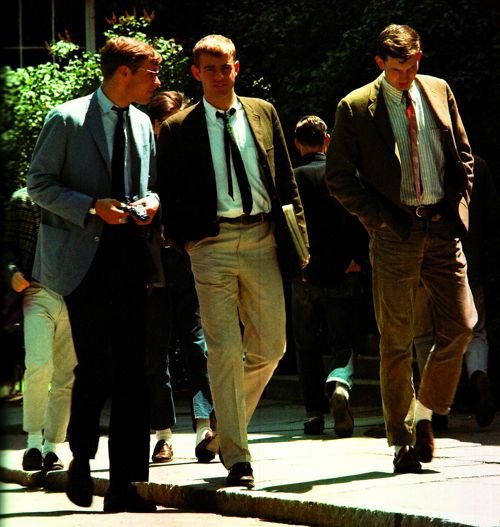
These new preppies seem to be following an old tradition. Prep is a youth style and open to experimentation. Traditionally, it has reflected a preparation for taking the reins of power, but also some indifference regarding just where and when that power is conferred. It’s an American “sprezzatura.” Consider seersucker, a workman's textile that Princetonians adopted in the 1920s. If you look at Take Ivy, the 1965 book of Japanese photography that made an anthropological study of Ivy League style, you see a lot of mixing and matching. Madras shorts with white socks and penny loafers. It’s what was clean combined with whatever father left behind on the Cape. Nowadays that can mean mixing in vintage thrift wear, or combining it with other youth styles as we saw with early Hip Hop. From Nazaryan:
James S. Panero, the executive editor of The New Criterion, exemplifies the classic prep. A graduate of the elite Trinity School and Dartmouth, Panero, 50, married a Yale graduate and wrote about skiing in Switzerland with William F. Buckley Jr.
Panero is fond of wearing bow ties and described his own style as “reactionary.” Yet he approved of the decidedly unreactionary aesthetic of Mason and his circle.
“I wouldn’t necessarily make the same choices, but I applaud the insouciant efforts,” Panero said, referring to Mason and his cohort’s blending of new with old, and their enthusiasm for wearing vintage clothes instead of one-clicking their way into a wardrobe.
“Recently I bought a Brooks Brothers ‘Made in England’ bow tie at a church sale for a dollar. Now I wear it all the time,” Panero said. “Take that, fast fashion.”