Hudson River Schooled

IMG_0916
Jacob Collins, founder of the Hudson River School for Landscape, on location in Hunter, New York, August 7, 2008

THE NEW CRITERION
SEPTEMBER 2008

Hudson River Schooled
by James Panero

On Jacob Collins's Hudson River School for Landscape.

Anyone who suspects that nineteenth-century American art has less to teach us than twentieth-century modernism should take a drive up the winding road of Route 23A, up Kaaterskill Clove in the eastern escarpment of the Catskill Mountains. Here in the town of Hunter, New York, a group of young artists is studying the nineteenth-century traditions of the Hudson River School by walking in the footsteps of the original American masters.

In the summer months, Hunter can be a desolate modern town—a weedy ski village in downtrodden Greene County trying to survive the heat while waiting for snow. Ten years ago, an organization called the Catskill Mountain Foundation saw a need to turn this area into more than just a seasonal resort, so the Foundation bought up real estate downtown and set about building an arts program, offering the traditionalist painter and teacher Jacob Collins the use of the Foundation’s buildings for a summer painting school.

This donation became the beginning of Collins’s Hudson River School for Landscape. Dedicated to reviving nineteenth-century landscape technique by “modeling itself after the artistic, social and spiritual values of the Hudson River School painters,” Collins wrote in his mission statement, his school aimed to “bring together the reawakening enthusiasm for the old American painters.” Ideally, he says, his student artists “and their beautiful representations of nature will help to lead the culture back to a stronger connection to the landscape.” This year Collins offered five-week summer fellowships for two dozen painters to live together in Hunter and paint in the surrounding countryside. The school term ran from July 17 through August 22. I dropped in during one mid-session weekend.

Over 180 years before my visit, the painter Thomas Cole went by ship up the Hudson from New York City and disembarked at West Point. He traveled into the Catskill Mountains to paint the terrain around which I was staying, becoming the inspiration for all artists who followed and the ultimate reason for my trip. Cole’s show of Catskill landscapes was a smash when he exhibited in New York in 1826. Widely publicized in the New York Evening Post, Cole’s three paintings included his image of the falls at Kaaterskill, still flowing just down the road from present-day Hunter.

In his History of the American People, Paul Johnson calls Cole, “the first painter to appreciate the immensity of the opportunities offered by the scale and variety of the American landscape.” His Falls at Kaaterskill were likewise “the first American masterpiece of landscape art.” Cole’s achievements sparked an entire movement of landscape painting and opened up the Catskills, in particular the area around Kaaterskill, to a wave of artists. Palenville, at the base of the gorge of Kaaterskill Clove, became America’s first art colony. Lavish hotels went up along the mountaintops around The Clove. A year after Cole’s death, in 1849, Asher B. Durand dedicated perhaps the most famous American landscape painting, Kindred Spirits, to his colleague by depicting Cole and William Cullen Bryant, the poet and editor of the Post, standing on a promontory overlooking Kaaterskill. (In a lowpoint for New York’s artistic patrimony, this painting, in the collection of the New York Public Library for over a century, was sold in 2005 for $35 million to the Wal-Mart heiress Alice Walton of Arkansas.)

At the time of Cole’s initial trip in 1825, the changing wilderness of New York State was very much on the American mind. Emerson’s Transcendentalism was still more than a decade off, but the idea of a natural theology, as articulated by William Paley at the turn of the century, had instilled a new reverence for the natural world. Meanwhile, the Erie Canal, the technological marvel that tamed the West by connecting the Great Lakes with the Hudson River, was built between 1817 and 1825. The rough landscape of rural New York took a literary turn in these years as well. In 1819, Washington Irving located his popular story of Rip Van Winkle in the Catskill Mountains, and four years later James Fenimore Cooper published his colonial story of the Catskill woodsman Natty Bumppo in The Pioneers—one of Cole’s reference books for his trip.

“This is the birthplace, the origin,” Collins said to me when I found him in early August, painting a sky study in an overgrown parking lot off Hunter’s Main Street. Like his students, Collins paints from eight in the morning until sunset, seven days a week when he is in town, building up a portfolio of studies that he will assemble into complete landscapes back in the studio.

After the daytime painting hours are over, the Hudson River School for Landscape turns into a commune and a summer camp. The students in each cabin prepare meals for their housemates. The bonhomie of the school is not lost on Collins, who wants to revive the camaraderie of the Hudson River School. After dinner on the evening I visited, the students laid out the day’s work for a critique that quickly turned technical. “So what would you do, Jacob?” asked Josh, a student, of his latest forest scene. “I would put something in front of it,” said Collins. Then: “When you have a white sky, you can drop the value one step.”

After the crits, Collins introduced George O’Hanlon, the owner of a paint company called Natural Pigments, who came in from California to give a talk. Collins runs a regular evening lecture series for his students, and on the day I visited O’Hanlon delivered a PowerPoint presentation on “The Secrets of the Old Masters.” His talk lasted from nine to eleven-thirty in the evening, but Collins’s students showed little sign of wear as O’Hanlon moved from the chemistry of pigments to the nuances of linseed oil. (His secret of the Old Masters had to do, in part, with the viscous properties of natural pigment versus the homogenized consistency of modern oil paints).

The next morning, a number of the students made the half-mile hike up Kaaterskill Falls. At 260 feet, the two-drop falls of Kaaterskill are the highest in New York. They are also as breathtaking as the day Cole first saw them. Cole’s dark autumn scene of the double cascades, with a mammoth boulder resting in the falls’ upper amphitheater, is both an accurate depiction of the topography and an awesome image of an untamed wilderness—a tiny, lone figure can be seen among the straggly trees and the black rocks.

Have Collins’s students been able to approach the majesty of Cole’s great image? Their successes will depend on the final paintings that, like Cole, they work up in the studio from studies in the field. But I am concerned that these students, with their small, scrupulous studies of rocks and stumps, may be missing the forest for the trees of genuine Hudson River School landscape. In his mission statement, Collins maintains, “It is through extensive and real engagement that the artist learns to capture the spirit of the landscape. The many hundreds of hours spent out in the sun and the wind, scrupulously studying nature, transform the artist. It was by this experience that the old masters of the landscape realized their art. And it is how we hope to realize ours.”

Pragmatism informed by observation is laudable, but during my visit I came to wonder if “extensive and real engagement” was truly enough to “capture the spirit of the landscape.” Collins’s students may be learning the vocabulary of the Hudson River School, but I saw little evidence that they are being taught how to speak it. Collins’s students are young, mainly in their twenties. They are the products of an art world that shouts but has little to say. So the silence offered by Collins’s draftsman drills, developed in his schools in New York and carried over to landscape, is itself a form of rebellion, a release that looks for depth in the details of leaves and bark. But this must only be a means to an end, not an end in itself.

The original Hudson River School was full of secrets—perhaps more than any other movement in American art. So the prospect of a genuine revival giving way to false profundities couched in technique is a serious concern. The original Hudson River School artists did not go into the wilderness to paint illustrations of the natural world. They went to paint the God they saw manifest in the natural world. “It’s the best piece of work that I’ve met with in the woods,” Natty Bumppo says of Kaaterskill Falls in Cooper’s story, “and none know how often the hand of God is seen in the wilderness, but them that rove it for a man’s life.”

Can there be a Hudson River School revival without the revival of God? This is the question that Collins and his students must confront. Their studies, no matter how precise, may never come together as a whole without an underlying philosophy that goes beyond mere proficiency. In a small exhibition I saw of last year’s student work, I found a landscape by Mikel Olazabal, River in Hunter, NY, to be the most accomplished but also the most problematic painting of the show. After viewing it, I walked across the street and down to the riverbank where, along an old foundation, I found the exact spot on which his image was based. Olazabal’s landscape was highly proficient, full of happy thoughts, but it struck me as altogether wrong. With flowers peeking through the rocks and every leaf on every tree glittering in the sun, his buffed-up interpretation was an idealized illustration of rural renewal, mood communicated through mood lighting.

I don’t want to suggest that landscape painters need to seek out ugliness over beauty, but if an artist believes a landscape evinces God, as the original Hudson River School painters surely did, then an artist should not improve on it without cause, or he risks descending into sentimentality.

On the day I visited, the waters of Schoharie Creek had been redirected through plastic pipes around a construction site upstream, so that the dried-out riverbed gave off a sooty odor. I am not sure this unsightly mess would be right on its own for treatment in paint, but when I think back to the best landscape painting of the nineteenth century—and the art of such modern interpreters as Rackstraw Downes—great work is defined by the intersection of industry, agriculture, and wilderness: the tamed farmland in contrast with the rugged forest in The Oxbow by Thomas Cole, or the railroad and tree stumps populating George Inness’s verdant images of the Lackawanna.

For the Hudson River School painter, the entire landscape was part of God’s world. Such thoughts, of course, rarely infiltrate modern belief. “And what remains when disbelief has gone?” asks Philip Larkin in his poem “Church Going”: “Grass, weedy pavement, brambles, buttress, sky,/ A shape less recognizable each week,/ A purpose more obscure.” To understand the Hudson River School today, Collins’s students must learn to see themselves as seminarians as well as painters. They otherwise risk becoming the mere technicians of grass, weedy pavement, brambles, buttress, and sky. Deep in the Catskill wilderness, they may be in a house of God, but that doesn’t mean they’ve got religion.

'Nature and Nurture'

071102_115

ART & ANTIQUES
September 2008

Nature and Nurture
By James Panero

Fresh from success in Venice, Arte Povera sculptor Giuseppe Penone is poised to gain wider recognition.

You would never expect a movement called Arte Povera to produce rich art. But Giuseppe Penone, a standardbearer of the “poor” Italian school that came of age in the 1960s, has always thrived on contradiction. This soft-spoken, unassuming sculptor has become one of Italy’s best living artists by producing sensuous work that explores the relationship between nature and man. Arte Povera has already achieved recognition in its native country as one of the great modernist movements, with a sensibility that cuts against the Futurism of the prewar years. Now it’s time for the art world beyond Italy, and particularly in the United States, to turn its attention to this artist and the enduring movement he represents.

In the opening lines of the Georgics, the Roman poet Virgil wondered, “What makes the cornfields smile?” Penone has been asking the same question since he first manipulated the trees and vines around his home into his earliest work. Born in 1947 on a farm in Garessio Borgo Ponte—an ancient village in the Vall’ Organa region, near Turin in the Ligurian Alps—Penone has systematically transformed his agricultural inheritance into an artistic legacy. His farm, which was purchased by his family in 1881 and began as a vineyard with potatoes and wheat sown between rows of grape vines, was his primary inspiration.

Penone’s principles and dedication to his materials have only deepened over 40 years of work. At the 2007 Venice Biennale, his installations in Italy’s new national pavilion came as a revelation to those who made the pilgrimage to the show on the far reaches of the Arsenale. Penone’s sculptures stood out as the most visceral objects in the sprawling international exhibition. He molded cowhide into the texture of tree bark and suspended the results from the walls. He applied marble to the floors and carved the stone in such a way that the veins showed in high relief. He took milled beams and chipped away at the wood grain, revealing the former trees and branches contained within. He carved out a trough from the oldest growth of a wood block and filled the void with sap, the pool of liquid giving the entire room an aromatic fragrance. “I think people were really surprised by Venice,” says New York dealer Marian Goodman, who is mounting an exhibition by Penone at her gallery this month. “He got an enormous response. They had never seen a really big piece of Penone’s before.”

“Leather is like skin,” Penone says from his home in San Raffaele Cimena, a town outside Turin, explaining one aspect of the Venice installation. “The tree becomes like an animal when it is covered by the leather. In a way, the work suggests there is no reality that is completely definite— human, mineral and vegetal. But human can become vegetal, vegetal can become mineral, mineral can become human.” According to Goodman, the artist “always has this idea that things in nature exist in many forms.”

Penone’s understanding of natural materials is informed by rural Italian life. “Perhaps 40 years ago they produced wine,” he says of the village where he lives and works. “Now it is wild because people leave the land to work in the city. It is quite interesting to live there because we are in contact with nature, but it is also very close to the town.”

His practice of reviving the natural properties of processed materials— the grain of a tree from milled wood or the veins of marble from dressed stone— expresses the anti-industrial bent of Arte Povera. In the “Italian miracle” of the 1950s and early 1960s, the northern part of the country witnessed a rapid industrialization that contrasted sharply with its traditional land-based culture. A recession during the mid-1960s cast these differences in sharper relief. In 1967, writer Germano Celant coined the term “Arte Povera” to describe the young artists who were starting to look back to Italy’s preindustrial past. Feeling impoverished by science and progress, they took up poor materials. In her recent survey Arte Povera (Phaidon Press, 2005), curator Carolyn Christov-Bakargiev attributes the movement’s “references to a preindustrial agrarian civilization and a harmonious, Arcadian world of craft-based economy” to “the contradictions of a perhaps too rapid postwar industrialization.”

During the same time period in the United States, Earth artists, conceptualists and minimalists found themselves responding to similar cultural and economic circumstances, but they developed a more dystopian vision underscored by their use of industrial materials. The Italian Povera artists—notably Giovanni Anselmo, Alighiero Boetti, Luciano Fabro, Jannis Kounellis and Mario and Marisa Merz—shared Penone’s desire to work directly with nature. Mario Merz created sculptures by using the branches of a tree as a mold for wax; Pino Pascali’s Canali di irrigazione, a sculpture made of earth and water, made reference to primitive agricultural constructions.

“Arte Povera is one of the most enduring groups of sculptures of the last half of the 20th century,” says Goodman. “American museums have been slow to give credit to bodies of work that come from other countries, and Americans are very partial to painting. It’s our loss that sculpture isn’t perceived on the same level.” American museums should take notice. Beginning in 2001, an exhibition of early Arte Povera, originating at Tate Modern in London, traveled to Minneapolis, Los Angeles and Washington, D.C., but the last major New York exhibition took place more than 20 years ago, at P.S.1. Rumors have circulated ever since that the Museum of Modern Art would organize a retrospective show. As the work of its most energetic artist ripens to perfection, the achievements of Arte Povera should not be allowed to wither on the vine.

'The critical moment'

  Greenberg Expression11b

Humanities, July/August 2008
Volume 29, Number 4

The Critical Moment: Abstract Expressionism’s Dueling Duo
BY JAMES PANERO

On the critics Harold Rosenberg and Clement Greenberg

What is art criticism today if not a muddied profession? How can we agree what criticism is if we cannot agree what art is? So the critic today contends with an unruly field. Art makes unusual demands on the viewer, and art criticism makes unusual demands on the writer, who must now fill several roles: that of a stock analyst at the art fairs and auction houses; a gossip columnist at the openings; a sports announcer at the museums and galleries; and a lifestyle guru in the popular press.

Compare this with sixty years ago. Modernism has an uncanny ability to break things down and isolate ingredients. Matisse with color, Picasso with form and line—the best modern art is radically fundamental before it is ever fundamentally radical, a distilled purification of art’s first principles. So it comes as little surprise that as American modern art reached its apex in the 1950s through the flowering of Abstract Expressionism, art criticism achieved a glittering purity of its own—a beautiful high criticism perfectly matched to the period of high art.

The writers who defined the parameters of this criticism were Clement Greenberg (1909-1994) and Harold Rosenberg (1906-1978). Greenberg & Rosenberg were like Ali & Frazier. They made up the protagonists in art criticism’s fight of the century—a Grapple in the Big Apple between personal and professional adversaries. It was also, undoubtedly, one of the few fights in art criticism to make it into the record books. Yet as the passions of their engagement have dissipated, and the art world has moved on to largely financial concerns, the Greenberg-Rosenberg rivalry has, in hindsight, come to seem of a piece. I say this as someone who has always been more in the Greenberg camp.

Greenberg and Rosenberg were diametrically opposed in their interpretations of Abstract Expressionism, but each interpretation was correct in its way. Their theories were not mutually exclusive, but instead opposite ends of a kind of dialectic. Through two forceful positions argued before the backdrop of Abstract Expressionism, in opposing language, together they laid out the full definition of modern art.

In The Birth of Tragedy, his youthful interpretation of Greek drama, written in 1872, Friedrich Nietzsche wrote that great classic art was predicated on the balance of Apollonian and Dionysian impulses—“Apollonian” after the sun god Apollo, with his “measured restraint, the freedom from the wilder emotions, that calm of the sculptor god”; and “Dionysian” after Apollo’s brother Dionysus, the god of wine, with “the blissful ecstasy that wells from the innermost depths of man, indeed of nature . . . brought home to us most intimately by the analogy of intoxication.”

“Wherever the Dionysian prevailed,” Nietzsche wrote, “the Apollonian was checked and destroyed. . . . Wherever the first Dionysian onslaught was successfully withstood, the authority and majesty of the Delphic god Apollo exhibited itself as more rigid and menacing than ever.”

Greenberg and Rosenberg were the checks and balances of American abstract art in this Nietzschean definition—Greenberg the Apollonian, Rosenberg the Dionysian. In 1947, Greenberg called for “the development of a bland, large, balanced, Apollonian art . . . in which an intense detachment informs all. Only such an art, resting on rationality . . . can adequately answer contemporary life, found our sensibilities, and, by continuing and vicariously relieving them, remunerate us for those particular and necessary frustrations that ensue from living at the present moment in the history of western civilization.”

And here was the Dionysian Rosenberg, writing in “The American Action Painters,” his most famous essay, in 1952: “At a certain moment, the canvas began to appear to one American painter after another as an arena in which to act—rather than as a space in which to reproduce, re-design, or ’express’ an object. . . . What was to go on the canvas was not a picture but an event.” And more: “The big moment came when it was decided to paint . . . just to PAINT. The gesture on the canvas was a gesture of liberation, from Value-political, esthetic, moral.”

“Action” versus “detachment,” “liberation from value” versus an art “resting on rationality”—an exhibition now at The Jewish Museum in New York called “Action/Abstraction: Pollock, de Kooning, and American Art, 1940-1976,” organized by Norman Kleeblatt, tracks these two critics and the ideals they represented through the artists they endorsed and the ephemera they left behind.

“Their initial theoretical outlooks were not that dissimilar,” Kleeblatt argues—persuasively, I might add—even though “many observers half a century ago viewed the opposed perspectives of Rosenberg and Greenberg as the only approaches to contemporary art. The two men’s impassioned writings often reduced the issues to either a formalist or an existentialist view, and each thought that his own view would prevail.” Kleeblatt calls this disagreement “the foundational dialectic of the era.” Morris Dickstein, the literary and cultural critic, maintains that Greenberg and Rosenberg “demonstrated the antithetical ways that Modernism would be assimilated to American cultural discussion in the years after World War II.”

In terms of differences, you could see it in their faces. In photographs Rosenberg wears his expression like a mask—a primitive totem neither frowning nor smiling, an angular profile punctuated by a small mustache. In a picture of him looking to the side and up to the sky, we imagine the private reverie of a critic who privileged the subjective, the mythical, and the existential over the material. In his theories Rosenberg was influenced by Jean-Paul Sartre, Albert Camus, and Maurice Merleau-Ponty.

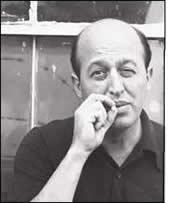
Compare this with Greenberg, who in most photographs pokes and squints and pinches his face. Greenberg, a positivist like Ludwig Wittgenstein, was concerned with materials and purity of form. Influenced by Roger Fry, Walter Pater, and Benedetto Croce, he advocated an “art for art’s sake” of internal laws and formal logic that operated outside of subjective concern. Engaged with the here and now of art, unlike Rosenberg who looked to the beyond, in photographs Greenberg radiates the worries and joys of the real world, his hooded eyes piercing rather than transcendent. “For Greenberg,” writes Kleeblatt, “the true work of art was one that exploited the uniqueness of each medium to express sensation as the essence of experience. The result was the evocation of emotion.” While for Rosenberg, “action painting was the psychic expression of the artist’s being and identity; the artist's creative process operated in the space between art and life. For Rosenberg this intimate and bold means of self-expression encouraged mythical interpretations of the artist’s ambitions.”

In the art of the era, their advocacy split right down the middle. Rosenberg’s man was Willem de Kooning, the classically trained Dutchman who delighted in making a mess in the kitchen of art. Greenberg backed Jackson Pollock. “Greenberg hadn’t created Pollock’s reputation,” Tom Wolfe wrote in his 1975 send-up of modern art, The Painted Word, “but he was its curator, custodian, brass polisher, and repairman, and he was terrific at it.”

Greenberg favored Pollock for the grand scale of his work, which brought painting down from the easel. The innovation of the drip technique furthermore detached Pollock from the canvas and flattened the image into a scrim, removing any sense of illusion and acknowledging the properties of the painting’s internal logic. Rosenberg, however, saw de Kooning as the ultimate psychic actor on canvas, an artist who would paint and scrape and repaint and whose work was a dynamic recording of artistic action. The two artists formed something of their own dialectic. In the early 1950s, with the drip, Pollock used drawing to create a painting. De Kooning, meanwhile, used painting to arrive at drawing-like cartoons.

See these artists together today and you probably notice the similarities before you see the differences. In fact, before he introduced subject matter into his paintings in the 1950s, de Kooning was an abstractionist admired by Greenberg. When photographs and movies of Pollock’s drip dance emerged in the 1950s, observers took him to be the ultimate Rosenberg action painter. (The critics themselves were not so clear-cut in their advocacy either. Both admired Hans Hofmann and Arshile Gorky, for example.)

The similarities between Greenberg and Rosenberg outweigh the differences. The critic Max Kozloff has written that “a good deal of the underlying agreement between them has been obscured,” and he is right. They were born to immigrant Jewish families in New York just years apart. They rose up through the political world of the 1930s to arrive at a Marxist-influenced aesthetic position that was ardently anti-Stalinist and pro-Trotskyist in the belief that “art can become a strong ally of revolution only in so far as it remains faithful to itself.” In their early years they both wrote for “little magazines” such as Partisan Review, Encounter, and Commentary. They hoped to insulate the high arts from popular culture with similarly influential essays: Greenberg wrote “Avant-Garde and Kitsch” for Partisan Review in 1939. Rosenberg wrote “The Herd of Independent Minds” for Commentary in 1948. And, of course, they both came to Modernism at a particular moment after 1940 to focus on the rise of American abstract painting. They tracked their disagreements through countering essays published over the next twenty years.

Their disputes played out in print through the early 1960s. In “How Art Writing Earns Its Bad Name,” Greenberg called Rosenberg’s “American Action Painters” a “misinterpretation that was also a fatality of nonsense.” In 1963, Rosenberg responded with “The Action Painting: A Decade of Distortion,” arguing that Greenberg’s formalism was an “academic concept” to “normalize” art by focusing on “line, color, form” rather than “politics, sociology, psychology, metaphysics.” Rosenberg accused Greenberg of distorting “fantastically the reality of postwar American art. This distortion is being practiced daily by all who may enjoy its fruits in comfort.” Greenberg assailed Rosenberg for “perversions and abortions of discourse: pseudo-description, pseudo-narrative, pseudo-exposition, pseudo-history, pseudo-philosophy, pseudo-psychology, and—worst of all—pseudo-poetry.” Rosenberg countered: “Formal criticism has consistently buried the emotional, moral, social and metaphysical content of modern art under blueprints of ’achievements’ in handling line, color, and form.” And so on. They even published countering anthologies just years apart: Rosenberg The Tradition of the New in 1959, and Greenberg Art and Culture in 1961.

“One indelible point,” says Kleeblatt, “that emerges from an examination of Greenberg’s and Rosenberg’s writings is that the two men saw clearly and at times even fiercely how much was at stake in their aesthetic and political views.” They were also both Jewish intellectuals who were “outsiders who faced discrimination in American society and in the ’established’ art world,” writes the critic Irving Sandler, “centered as it was in institutionally anti-Semitic museums and universities, they yearned for a brave new socialist world in which ethnic prejudice would disappear. They embraced Modernism, a marginal culture whose world was more open to them as Jews than were ’official’ milieus.”

Each critic published a single essay on the subject of Judaism. Greenberg wrote on “Self-Hatred and Jewish Chauvinism” in 1950, while Rosenberg asked, “Is There a Jewish Art?” in 1966. Greenberg voiced “a Jewish bias toward the abstract, the tendency to conceptualize as much as possible,” while Rosenberg advocated a “self-determined Jew” whose connection with the past “occurs not through his revival of forms which they [the ancestors] created—their doctrines, rituals, institutions—but through his own creative act which they inspire.”

Is there a Jewish art criticism? The art critic Donald Kuspit summed up the answer in this way: “For Rosenberg the American artist always faces a choice between being a true or false self. For Greenberg it is between being an avant-garde or kitsch artist. The essence of the choice is the same: to maintain one’s sacred integrity or to comply with society’s profane demands. The American artist is always in a Jewish situation, trapped between autonomy and assimilation.”

What eventually happened to the Greenberg-Rosenberg “family row” is indicative of the fate of culture in the latter half of the past century. It wasn't that one side won out; it was rather that art moved on. The Apollonian-Dionysian dialectic that at one point established the outer limits of art proved ill-equipped at containing and contending with the art of the 1960s and beyond. Both Greenberg and Rosenberg were flummoxed by neo-Dadaism, Pop art, and Minimalism. So art criticism lost its own internal logic. If culture could not agree on a definition of art, it could not disagree on the meanings contained within.

Greenberg went in for a particular drubbing beginning in the 1960s, as his Trotskyism and anti-Stalinism evolved into a codified form of Modernism and pro-Americanism. In 1966, just by example, a performance artist named John Latham organized a monthlong event called “Still and Chew,” in which participants bit off, masticated, and spat out pages of a copy of Art and Culture, which Latham had borrowed from his college library.

“Despite reams of politically savvy writings that condemn Greenberg,” says Kleeblatt, “his formalist theory of Modernism remains a point of departure (and contention) even in postmodern discourse. This is a foundation for some, a brick wall that needs breaking down for others.” Yet while “Greenbergianism” and “Clem” became epithets in the university art history programs in the 1970s (and remain so today), Rosenberg did not receive what might have been an expected boost to his own reputation. At a certain point, the reputations of Greenberg and Rosenberg were only serviceable in the negative—pillars to topple over. Rosenberg, whose criticism was less trenchant than Greenberg's, simply proved to be an easier challenge to overcome.

“A heroic phase of Modernist innovation . . . was soon to come to an end,” writes Morris Dickstein, “once the new became a marketing strategy rather than a life-altering encounter that mattered in its own terms.” What is art criticism today? I can tell you what it's not: Harold Rosenberg and Clement Greenberg. Some might call this progress. I call it a shame.