The Culture Crash

Nytom

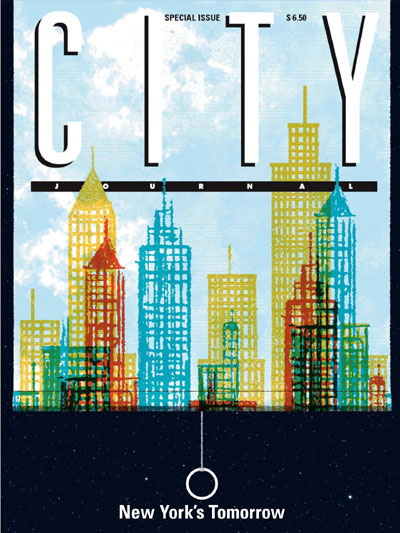
CITY JOURNAL / SPECIAL ISSUE: NEW YORK'S TOMORROW
July 2009

The Culture Crash
by James Panero

Risky investments have endangered New York’s leading arts institutions.

To understand the current condition of arts organizations in New York City, visit the Metropolitan Museum of Art. There, you will find one of Winslow Homer’s most famous works, The Gulf Stream. Painted in 1899, the canvas depicts a solitary sailor lashed to his boat on a storm-tossed sea. The mast and bowsprit have snapped, the tiller and rudder are gone, and a school of sharks circles the boat in blood-red water. On the horizon are two images. On the left, through the fog, is the silhouette of a ship under full sail: a possible rescue. On the right, a looming waterspout presents a far more ominous outcome.

Homer was no allegorist, but his work serves, unfortunately, as an all-too-appropriate metaphor. Just as the storm has knocked out the boat’s propulsion and steering, an initial wave—the downturn in the financial markets—has smashed the endowments of arts organizations. Now a second threat, the indirect effects of the downturn, is appearing on the horizon like the waterspout. Its full force will be felt by arts organizations in the months and years ahead.

The reductions in arts endowments reported over the past year have been significant, raising the question of how they have been managed. If the investment goal of arts endowments is the preservation of capital, how can they now face decreases of 35 percent, aside from the criminal actions of investors like Bernard Madoff?

For the answer, look to nonprofit money managers and “managers of managers,” such as the Commonfund, which was started with seed money from the Ford Foundation in 1969 and now manages managers for hundreds of nonprofit institutions, with $40 billion in assets under management as of 2007. These managers, now used throughout the nonprofit world, have encouraged arts organizations to seek “total returns,” including capital appreciation, from their endowments, rather than merely preserving capital and accruing dividend income. “In the post–World War II decades,” explained Commonfund in its 2005 report Principles of Nonprofit Investment Management, “the concept of prudence changed from one of avoiding risky investments altogether to one of balancing the risks of various kinds of investments against one another. . . . If you aim to get the most out of your investments long term, you have to own some that have a higher degree of risk.”

Endowment asset allocations thus moved away from the safety of fixed-income instruments, such as high-grade bond funds, to the volatility of domestic and foreign equities and even to “alternative investments,” such as distressed debt and venture-capital equity. This investment strategy paid luxuriantly during the good times, resulting in bloated budgets and massive expansions. Yet with only quarterly meetings, arts boards proved too slow to navigate away from the hazardous investments once the bad times began. In short, arts organizations adopted bad habits.

“All of the charities, all of the institutions lost money, but they didn’t have to lose 25 to 40 percent,” says Frank Martucci, a financier who has sat on several arts boards and opposed their aggressive strategy. “Why weren’t there some down only 10 percent? If you are all sharing the same strategy, it’s not really a diversified approach. Advisors are all pretty much the same. They tell you 10 to 30 percent in bonds and the rest in private equity, stocks, foreign securities, distressed securities. There are times you take your chances, but with charities I don’t think you ever do, and putting 85 percent of your money in equity and illiquid instruments is gambling. I hope this has taught people to be more conservative in their approach towards charity.”

Martucci advocates an eventual shift in endowment allocation to 40 percent to 50 percent in conservative fixed-income investments and the rest in equities—and only 5 percent to 15 percent of that in alternative investments. He also suggests that arts endowments move away from relying on active management and use volunteer board members with financial expertise to oversee investments, which can largely be maintained through bond index funds. “Managers of managers are like funds of funds,” says Martucci. “You can end up paying fees three times over.”

In the early months of 2009, arts organizations began announcing their endowment losses and the measures they were taking to balance their budgets. The news reports became week-by-week blows to the city’s cultural health. James R. Houghton, chairman of the Metropolitan Museum’s board of trustees, announced in February that the museum’s endowment had lost a staggering $700 million since the previous June—a decrease of 25 percent, leaving the endowment worth about $2.1 billion. Since investment income makes up 30 percent of the heavily endowed Met’s annual operating revenue, the loss shook the museum at all levels. Adding to the Metropolitan’s woes, the city announced that its operating support for the museum would be reduced by $1.7 million, with another cutback of $2.4 million announced for the next fiscal year.

Houghton identified a set of new cost-cutting measures, including a museum-wide hiring freeze, the elimination of temporary staff, and travel curtailment. He also flagged the museum’s retail arm for immediate cutbacks. In March, as the Metropolitan’s loss estimates rose by $100 million, its director, Thomas Campbell, announced further layoffs. Campbell added that the museum anticipated the need to reduce the rest of its workforce by 10 percent by July, which could mean a reduction of as many as 250 additional full- and part-time jobs. These cuts will represent the first museum-wide layoffs since the fiscal crisis of the early 1970s. And in June, the museum raised the estimate of its losses again, to a third of the endowment’s former value.

“We’re looking at a period of austerity this fiscal year, and the situation will be even more difficult in the fiscal year that follows,” says Metropolitan spokesman Harold Holzer. Even without an additional downturn in its portfolio, the Met’s bottom line will worsen because of the way the museum averages its endowment income over a multiyear period. “We base [endowment income] on a rolling average of 20 quarters, so it’s just beginning to be averaged in,” says Holzer. “We’ve had three quarters. Eventually the bad periods become the majority of the average. That’s when the income will go precipitously down. We’re looking at a much more pressing problem in fiscal year 2011 than in 2010.”

Bad news for the Met, but smaller arts organizations might envy a mere 33 percent endowment loss at a still-munificent museum. On April 21, Arnold Lehman, director of the Brooklyn Museum, released far grimmer news. The museum’s endowment had fallen 35 percent from the top of the market, from approximately $100 million to $65 million. In addition, since the end of the museum’s 2008 fiscal year, New York City had reduced its operating support for the institution by 32 percent, amounting to a loss of $2.31 million over three years, according to the museum. Income from museum membership fell 20 percent in the first months of 2009. Enrollment for new members dropped “precipitously” compared with the past several years, Lehman continued. Income from two major annual fund-raising events was down 35 percent in early 2009. Revenue from the museum shops and the parking lot also fell off.

To help confront these shortfalls, Lehman announced, the museum’s trustees had agreed to maintain or increase their level of financial support. Meanwhile, the museum froze hiring and put a moratorium on staff travel. Suggested admission fees for adults were raised from $8 to $10. Staff members would get a one-week unpaid vacation in the summer. Nonunion employees were asked to take salary reductions, beginning in July, and all employees were offered voluntary severance packages. Through these actions, Lehman said, the museum hoped to “reduce personnel costs sufficiently to avoid or minimize any subsequent layoffs.” Meanwhile, a major exhibition scheduled to open in the fall was canceled, and in September, the museum will shutter one of its three special-exhibition galleries “for the foreseeable future.”

Lehman’s perspective on the challenges facing New York arts organizations extends beyond Brooklyn. In addition to his job at the Brooklyn Museum, he heads the Cultural Institutions Group, a committee representing 34 city museums and cultural outlets, including the Metropolitan Museum of Art, the Brooklyn Academy of Music, and the American Museum of Natural History. The group’s members are located on city-owned property and receive funding from the city in exchange for providing cultural services. “The Cultural Institutions Group really is in the midst of a perfect storm,” Lehman said in late April. “Significant reductions in municipal support as well as huge downturns in contributed incomes at all levels have left many of our members in a much more fragile state than is understood by the general public.”

While many once-stable arts organizations are now in a “fragile state,” those that were already shaky when the financial crisis began may now be past hope. No organization represents this sad chapter of the economic crisis more than New York City Opera. At one time, City Opera—the “people’s opera,” as Mayor Fiorello La Guardia called it—was a model counterweight to the Metropolitan Opera, its tonier neighbor now located across the plaza at Lincoln Center. The opera star Beverly Sills became City Opera’s general director in 1979 and headed it for a decade, raising its profile with popular bel canto fare and increasing donations. The more than decade-long tenure of Paul Kellogg, who took over from Sills’s successor, Christopher Keene, in 1996, was likewise “stable and successful—a model balancing act,” writes New Yorker music critic Alex Ross. Yet when Kellogg announced his retirement in 2005, City Opera languished for years without finding a replacement.

Another long-running problem was City Opera’s location. For years, it fretted over finding a new venue independent from the New York State Theater at Lincoln Center, which it shared with the New York City Ballet and which was constructed with acoustics suited to ballet footfalls rather than opera arias. With each failed search, City Opera piled uncertainties on its supporters. It sought headline space at a rebuilt World Trade Center cultural venue and then at a location nearby, which it lost out to Goldman Sachs. It proposed building a new theater in Damrosch Park, the current location of the Lincoln Center band shell, and was shot down by the Metropolitan Opera. It looked at reconfiguring City Center in midtown, where Morton Baum had founded City Opera in 1944, but concluded that the fly space there couldn’t accommodate contemporary sets. It made plans to move into a new development near Lincoln Center, on Amsterdam Avenue, but that also fell through.

Now the opera company may not need a home at all, partly thanks to its 2007 selection of Belgian-born Gérard Mortier as its future director. An avant-garde impresario accustomed to government largesse (see “The Abduction of Opera,” Summer 2007), the director proved a far greater diva than Beverly Sills without singing a note. While the New York State Theater went under the knife for a $100 million renovation, becoming in the process the David H. Koch Theater, Mortier encouraged City Opera’s board to shut down the 2008–09 season almost entirely, rather than contend with the construction. (New York City Ballet had no such qualms and ran its season around the interruptions.)

While the opera was able to shed its administrative staff for the yearlong furlough, it still had to pay its chorus and orchestra. Ticket revenue declined from the $13 million that it averaged for its 2005–08 seasons to only $320,000 this past year. The ill-timed closing, combined with the economic crisis, pushed City Opera into an abyss. In 2001, City Opera’s endowment was worth $51 million; in 2008, it had shrunk to $27 million; now, after two large withdrawals for operating expenses in late 2008 and early 2009, it has dwindled to $10 million.

And what became of City Opera’s captain during this emergency? In November 2008, Mortier jumped ship without ever taking the full-time helm, accepting a job at the Teatro Real in Madrid. He says he opted out of his New York post because City Opera’s evaporating finances wouldn’t let him enact his artistic vision. “I saw myself as drowning,” Mortier told the New York Times. “I wanted to be rescued.” As he floats away on a golden lifeboat, his replacement, the young George Steel, has confronted a strike from his union performers over further emergency cuts. City Opera’s future will play out in one of two ways: either a donor steps in soon to rescue it, or Steel will oversee the end of a once-proud New York cultural institution.

The experiences of these three institutions—the Metropolitan Museum, the Brooklyn Museum, and City Opera—mirror the overall troubles of arts organizations in New York City. The Metropolitan Opera, which saw its $300 million endowment shrink by a third, has cut senior staff salaries by 10 percent and put up its colossal Marc Chagall tapestries as collateral for a loan. The Museum of Modern Art has implemented a hiring freeze and ordered a general budget cut of 10 percent. The New York Botanical Garden, facing a $2 million reduction in city support and a 12 percent budget shortfall, will cut 49 jobs; it has also canceled its 2009 summer art exhibit, despite the popularity of last year’s showing of Henry Moore sculptures, which led to an 8 percent increase in attendance. The Asia Society has seen a 30 percent decline in its endowment and has had to cut 18 positions, reducing its $26 million operating budget by 10 percent. Even animals are facing the ax, metaphorically, as the Bronx Zoo must close several exhibits. A survey in late 2008 of nearly 100 New York City cultural institutions, conducted by the Alliance for the Arts, found that 79 percent had reduced or were planning to reduce their budgets, 68 percent were deferring new hires, 42 percent were planning layoffs, and 45 percent were canceling or postponing programs.

With irrecoverable losses in endowment income, at least for the foreseeable future, the survival of arts organizations will depend not just on cutting their budgets without negatively affecting their core services, but also on finding new sources of revenue. Unfortunately, in perilous economic times, attracting new donors may be harder for arts organizations than for other nonprofits. The Princeton philosopher Peter Singer exemplifies the attitude against arts funding in his new book, The Life You Can Save: “Philanthropy for the arts or for cultural activities is, in a world like this one, morally dubious.” Singer points to the $45 million that the Metropolitan Museum spent on a Duccio painting in 2004 as an amount that would pay for cataract operations for nearly 1 million blind people in the developing world. “If the museum were on fire, would anyone think it right to save the Duccio from the flames, rather than a child?” Singer asks.

Such ideas, of course, ignore the fact that arts organizations, unlike “feed the world” campaigns, have a proven track record of serving and elevating the poor and dispossessed. They also employ many workers. Still, studies by the Conference Board and by the Center on Philanthropy at Indiana University find Singer’s anti-art attitude reflected in the habits of many donors during troubled economic times. “When you’re providing human services or feeding the hungry, people understand that maybe this is a time to dig a little deeper,” Patrick Rooney, interim executive director of the Center on Philanthropy, told Bloomberg News. “Helping an arts organization? That’s a tougher sell.” Randall Bourscheidt, president of the Alliance for the Arts, concurs. But the “deeper values of society that are in education and the arts are important,” Bourscheidt maintains. “These activities are not competing with basic needs but complementing them.”

Some arts donors have already followed Bourscheidt’s advice. In April 2009, the Juilliard School announced that it would cut 50 slots for poor minority schoolchildren in its Music Advancement Program. When the billionaire Los Angeles philanthropist Eli Broad read about the cut, he pledged $425,000 over four years to sustain the program. But such stories are the exceptions. A Foundation Center survey at the start of 2009 reported that two-thirds of foundations expected to reduce their giving amounts by about 10 percent. Half of all foundations predicted reductions in the number and size of their grants. Most grant-making organizations anticipated maintaining their previous priorities—meaning that arts foundations will continue to make donations but that competition for their support will become more aggressive.

Many arts organizations will close before the next financial rebound. Some will undoubtedly fold because they lack public support, and as unworthy organizations no longer compete for funding, such winnowing could eventually contribute to the cumulative health of the arts. One hope for arts organizations that do survive the storm is that they emerge stronger, leaner, and more responsive to their constituency.

The National Academy Museum and School of Fine Arts is an organization that is trying to turn that corner. Like City Opera, the artist-run Academy suffered from years of bad management. In the economic downturn, its already-small operating endowment fell 40 percent. So in late 2008, it sold two major Hudson River School landscapes from its permanent collection to pay its bills.

It was a low point in the Academy’s 184-year history. According to peer-reviewed organizations like the Association of Art Museum Directors, museums are permitted to use the proceeds from the sale of artworks—or “deaccessions,” as the museum world calls such sales—only to fund the purchase of other artworks, not to pay general operating expenses. The National Academy deaccessions brought a censure from the arts establishment, making the museum unable to secure loans from other museums. (Legislation now under consideration in New York State would have made the deaccessions illegal.) But if not for the sales, “we would not have been able to pay loans and certain creditors,” says David Kapp, an artist and treasurer of the National Academy. “We would have had to file for Chapter 11.” The sale of the works brought the National Academy’s operating endowment to $10.5 million.

If the National Academy survives—and the painting sales bought some time—the economic crisis will have presented the museum and school with a mandate for reform, says Kapp. In April, the Academy’s artist members voted to modernize its governing structure and administration. “How do you guarantee that it never gets to that edge again?” asks Carmine Branagan, the new director of the Academy. The answer, she says, is to confront the bad decisions and bad habits that created the crisis—in the Academy’s case, an antiquated board structure that hindered fund-raising and outreach. “The sale of the paintings would have been a wasted endeavor,” says Kapp, “if we hadn’t changed our governing practices.”

The Academy’s restructuring points to a lesson for the city’s other arts organizations. They must try to survive the storm through budget cuts and aggressive outreach, yes. But they must also confront the governing and investment decisions that exposed their endowments, big and small, to excessive levels of risk and brought many of their organizations to the brink. As Kapp says: “This is too good a crisis to waste.”

Restoration Hardware

03-Portrait-of-Eras_106923s
Hans Holbein, Portrait of Erasmus, ca 1530

ART & ANTIQUES
June 2009

Restoration Hardware
by James Panero

Marrying traditional knowledge with today's technology, art conservators are uncovering long-lost masterpieces.

In September 2000 art conservator marco Grassi was attending an estate auction in Paris with an old friend, a European private collector. In the warren of salesrooms at the Drouot Hotel, mixed in with the chipped crockery and worn sofas, was a small rectangular painting in a dusty glass case. It appeared to be a copy of one of the four or five famous portraits of the Dutch humanist Desiderius Erasmus that Hans Holbein the Younger painted from life. Yet Grassi grew intrigued by the quality of the painting. His friend asked his opinion, and on a whim he encouraged him to buy it.

When the hammer fell the next day the collector had acquired the lot for around $2,000, in line with its pre-sale estimate. Today, as a result of a decade-long process of restoration and research conducted by Grassi, the portrait, painted on linden panel around 1530, is generally accepted as a genuine, long-lost Holbein, one that would likely be worth tens of millions of dollars if offered for sale. "It was a wild shot," says the conservator, "but sometimes wild shots work out."

This past year, after a six-month review, the Museum Boijmans Van Beuningen, in Rotterdam, Netherlands (Erasmus' hometown), selected the painting for inclusion in an exhibition called Images of Erasmus. "Of course, we were very excited when we were offered this painting by Marco Grassi," says curator Peter van der Coelen. "I think the last (Holbein) portrait of this quality was discovered 150 years ago." Through the show the painting was subjected to scholarly investigation and compared to similar Holbein Erasmus portraits through loans from the Louvre, the Lehman Collection in New York's Metropolitan Museum of Art, and Kunstmuseum Basel. Most experts now accept the painting as a Holbein on par with the Metropolitan and Kunstmuseum examples, if not quite on the level of the Louvre painting or the portrait of Erasmus at the National Gallery in London (the only major Erasmus painting by Holbein not in the show). The results were a coup for the conservator.

The Holbein rediscovery and other high-profile restorations have cast a new light on the private world of art conservation. In 1991, through an analysis of its under-drawing, the British scholar Nicholas Penny identified what was thought to be a Raphael copy as an original painting by the master. In 2004 the National Gallery in London purchased this painting, Madonna of the Pinks, for œ22 million from the Duke of Northumberland. In 1968 the New York dealer Ira Spanierman purchased a dirty, unknown Italian-school painting at a Sotheby's auction for $325; soon afterward, scholars identified the work as the lost 1518 Portrait of Lorenzo de' Medici, Duke of Urbino, by Raphael. In 2007 Spanierman sold the portrait at Christie's London for œ18.5 million ($37.3 million).

Grassi has made another important rediscovery of his own. In 2001 he purchased a "Circle of Pontormo" at an auction in Lyon, France, for $45,000. Again through an analysis of the painting's preparatory drawing, scholars quickly acknowledged the painting to be an original Pontormo--a fragment of the "lost" original for one of the most copied images in the Renaissance, with more than 25 known versions. When the work failed to sell at a Sotheby's auction in 2003, Yale curator Lawrence Kantor arranged for the painting to be purchased by the Yale University Art Gallery for substantially less than its low estimate of $800,000.

"This picture is powers of 10 more famous than any other painting," says Kantor. "But Marco had a great deal of difficulty persuading the art-historical establishment this was not just another copy. You will find that in auction rooms people buy with their ears and not their eyes. One scholar expressed doubts, and everyone else fell into line. This was one of the classic cases. I asked Marco permission, if the painting was bought in, if he would offer it to us. Being the gentleman he is, he did, and we were able to buy it at a very reasonable price."

Museums are now bringing the subject of art restoration to prominence with special exhibitions. This past fall the Uffizi hosted an exhibition around the 10-year restoration of Raphael's Madonna of the Goldfinch. Through Sept. 6, Kantor's Yale Art Gallery is mounting an exhibition called Time Will Tell: Ethics and Choices in Conservation, about the history of restoration in its own collection, put together by Yale's chief conservator, Ian McClure. Both of the shows reveal a profession with a troubled history, according to Grassi. During the 1960s the Yale Art Gallery, operating under a hard-line theory in vogue at the time that called for removing all retouching and overpainting, badly stripped already-damaged work. Grassi describes that enterprise as "an absolute nadir in the annals of conservation." Kantor agrees: "Yale has one of the most dreadful histories of conservation in the known universe."

A generation later the recent Uffizi restoration of the Raphael aimed for a compromise between the traditional invisible style of restoration and the former Yale approach. Here a process, developed in Florence, infills damaged areas of a painting with a technique called "chromatic section," using pointillist-like brushstrokes that are noticeable up close but appear to blend together at a distance. Grassi remains critical of the technique: "At a certain distance the whole thing vibrates in a foggy way. This restoration doesn't do a picture any service, and it's nonsense."

An American citizen born in Florence, with degrees from Princeton and the Uffizi, Grassi represents the fourth generation of a Roman family of art dealers and restorers. Along with David Bull and Nancy Krieg in New York and Simon Gillespie in London, he has become a central player in the private practice of Old Master conservation--one of those experts who work outside the conservation departments of major museums. He pursues a traditional method of restoration, believing that results should bow to the original and be invisible rather than becoming the subject of discussion. "The best intervention is the one less seen," he says, quoting the Bergamo nobleman Giovanni Secco Suardo, who published a handbook on the restorer's art in 1876. Dressed in bespoke tweeds, Grassi works in a studio overlooking Broadway and Houston Street in New York's SoHo District. His career in restoration has taken him through Florence, Lugano and, in the mid-1960s, the Villa Favorita in Castagnola, Switzerland, home of one of Europe's greatest private collections, that of Baron Heinrich von Thyssen-Bornemisza. In the mid-'70s Grassi relocated to New York, and in 1984 he opened his current studio office, where he has served a clientele of dealers, private collections and auction houses.

Today Grassi Studio handles a select number of these clients while attending to work for Grassi's son Matteo, who runs an Old Masters gallery in Paris. The office is a hospital for old art, one that sees its share of masterpieces mixed in with more common examples. "There is a democracy in a conservation studio," says Grassi. "It's a ward in a hospital. All paintings have the same appendix. And sometimes the hardest problems are on mundane paintings." He limits himself to older work. "I would not do contemporary painting. There's a very big divide that occurs around the Second World War. Paintings by Picasso and Mir¢, technically, were not made differently from the past. The big change came with Pollock. The materials changed radically--cotton canvases, acrylics, different materials with totally different chemical and physical properties. Having come from a Florentine background, I have worked on 13th-century painting. In Rome I worked on the earliest panel painting in the West. For me, the earlier the better."

Grassi Studio is lined with wooden freight boxes used to protect paintings in transit. At the center of the main lab is the large low-suction vacuum table, the emergency-room tool that adds elasticity and tension to brittle and dry canvas through a slow application of heat, humidity and pressure. "The traditional process was to reline the canvas," Grassi says, explaining the utility of the device. "But this allows you to take an original canvas and treat it so it doesn't need lining. It gives it added life." Around the room are paintings currently under Grassi's care, some on gurneys, others making the rounds from X-ray room to infrared-video station to the workstation containing scalpels, solvents and binocular microscopes. Despite the gadgetry, restoration is "a craft, in the end," says Grassi. "You are working with your hands. You have to know the chemical properties of paintings and test them. You need good light and good lighting equipment. And the most important tool is the eye. That's what really counts."

Research into a painting's provenance and an informed sense of connoisseurship are also vitally important. Although his studio is now half the size it was when it was in full operation (Grassi is winding down in anticipation of his retirement), he still retains an 18,000-volume art library, one of the largest such resources in the city. He keeps it in a wood-paneled study next door to the bright restoration rooms. "For years I did nothing but scour book catalogues--a huge investment. It was vanity, too. In fact, people used to joke that for the cost of the library I could have a car idling out front to take me to the Frick," Grassi says, referring to the art reference library at the Frick Collection, on Manhattan's Upper East Side. "But having the information is very, very valuable. And having it sooner than the next guy is more valuable."

It is this expertise that causes Grassi to be sought out by private collectors like the one who bought the Holbein. Soon after the Drouot auction, Grassi realized that no known Holbein portrait of Erasmus--or even any of the copies--featured the subject in quite the same pose, holding a closed book. The new owner sent the painting to Grassi in New York, and once he had it in the studio, he was able to analyze it under a special kind of infrared camera. Infrared reflectography can reveal features below the painted surface that are invisible under normal light. Scanning the portrait, the camera showed extensive preparatory drawing and redrawing in the area of the hands and book. Grassi describes the discovery as "the first truly heart-stopping moments of revelation."

An X-ray radiograph showed further reworking--ear flaps had been added to Erasmus' cap. "These findings pointed in one obvious direction," says Grassi. "It was highly unlikely that the portrait could be a copy. Not only was an exact prototype unknown, but copyists invariably follow the model line by line without improvisation." Other characteristics reaffirmed the authenticity of the piece. The wood of the panel was European linden, what one might expect of a painting made in Switzerland or Southern Germany, as opposed to the oak used in England and the Low Countries or the poplar one finds in Italian panel painting. The studio sent the sample to the U.S. Department of Agriculture's Forest Sciences Lab for testing. "They do it for no fee," says Grassi. "It's fantastic. It's one of those nice things for which you pay your taxes." At the same time, he investigated the provenance of the portrait, as far back as possible, and was able to trace its ownership to a prominent French family of the ancien r‚gime, the Lamoignon, who had connections to Holbein.

The evidence was adding up. The attribution came to focus on Holbein himself. What remained was the quality of the work. It might not have been a copy, but was the portrait good enough to have been painted by the master's hand, was it a product of Holbein's studio or a combination of the two? Once Grassi removed the older varnish, which is a routine procedure, "the exceptional quality and delicacy8 of the modeling, the meticulous detailing and the lustrous finish all spoke clearly to the great diligence and proficiency of its creator," he says, "whoever he might have been."

But still there was something off about it. Grassi asked the late Swiss conservator Emil Bosshard, a colleague and friend from the Villa Favorita, to examine the painting. He in turn arranged for an examination by the art historian Pascal Griener, a Holbein expert. Together they began to question the dark green background of the portrait, which contrasted with the delicacy of the figure. "The background is important because the figure has to resonate with it," Grassi says. Bosshard submitted some small pigment cross-sections to Hermann Kuhn in Munich, formerly of the Doerner Institut, for testing. The resulting microphotographs confirmed what the experts had suspected. The background, originally a light green, had been painted over more roughly in a darker shade. Since this was done early in the life of the painting, the overpaint came to form a tight bond with the original layer. This discovery posed a dilemma for the conservator. Grassi discussed its potential removal with Bosshard, who thought a cleaning procedure would pose too many difficulties and dangers to the painting.

When the painting returned to New York, Grassi ran several more tests of the overpaint layer. Finally, he devised a solvent solution that was able to soften the overpaint without damage to the material beneath. Working over the surface of the painting in tiny quadrants with the solvent, a binocular microscope and a scalpel, he was able to remove the overpaint during a period of several months. Grassi's efforts revealed the portrait in its full brilliance, for the first time in 400 years.

The decade-long restoration of this Holbein speaks to the challenges posed by a major rediscovery. The process does not happen overnight. When other rediscoveries get rolled out in the popular press as done deals, conservators such as Grassi remain skeptical. "The manner of the rediscovery is interesting. To come out and say, `I found this new painting' is like, `I found a cure for cancer.' It doesn't last long." Grassi points to the recently announced discovery of a purported Shakespeare portrait, purportedly painted from life, by the English restorer Alec Cobbe. Many critics now believe the painting was over-cleaned by Cobbe, and Tarnya Cooper, 16th-century curator at the National Portrait Gallery in London, has claimed that the work more likely represents the courtier Sir Thomas Overbury.

Careful restoration work can take years. The study and acceptance of a rediscovery by experts usually takes even longer. In the case of the Holbein, the chance scheduling of the Rotterdam show accelerated the process of acceptance. The canonization of this painting is not complete, however. More research needs to be done on Holbein's studio, in the way that scholars now understand Rembrandt's studio, notes Van der Coelen.

Yet the life of a restorer is not all rediscovered Holbeins and Pontormos. "There are certain things that give you satisfaction," says Grassi. "It can be a nondescript painting. The challenge is to resolve a problem, a structural problem, an aesthetic problem, and arrive at a solution that is acceptable aesthetically and artistically. It's great to work on a tremendous painting, but our daily life is made up of other things that can be equally satisfying."

Gallery Chronicle (June 2009)

FOURREDS_bluegreen8

Gabrielle Evertz, Four Reds + blue green © Gabrielle Evertz

THE NEW CRITERION
June 2009

Gallery Chronicle


by James Panero

On Op Art, Gabriele Evertz at Metaphor Gallery, James Little at June Kelly Gallery & Nicolas Carone at Lohin Geduld Gallery.

The excellent optical painters working today are the survivors of a peculiar history. Back in the mid-1960s, the hard-edged abstraction that arrived under the banner of Op Art turned into a bad trip for high modernism. No other art movement blew up and burned out quite so spectacularly.

In 1965 William C. Seitz at the Museum of Modern Art organized a blockbuster exhibition of Op Art called “The Responsive Eye.” The artists in this show dispensed with the gestural brushstrokes of Abstract Expressionism. They largely did away with the naturalism of oil on canvas. Drawing on the intensity of new acrylic paints, they used contrasting lines and complementary colors to accentuate the biomechanics of perception. The results were immediate. Although grounded in over a century of study, the flickering, throbbing, pulsating works on view required little explanation. The show set attendance records. It was a sensation—and a problem. Up against 1960s popular culture, optical art came to be appreciated for its sociological relevance rather than its formal innovation. Its designs were exploited for commercial and cultural ends.

The optical artists in the MOMA show had deep roots in the history of modern art and science. This ancestry could be traced back to Goethe’s Theory of Colors of 1810. Here Goethe first took note of the chromatic dissidence of light-dark interaction—the colors that can be observed along the lines separating white and black. Goethe also investigated the volatility of complementary (opposite) colors as arranged on a color wheel—red against green, yellow against violet, and so forth. The Divisionism of Georges Seurat and Paul Signac, based on the research of Michel Eugène Chevreul, further advanced perceptual theory. Twentieth-century Constructivism connected the visual absolutes of geometric abstraction with Socialist idealism, which went on to inform the aesthetics of the Bauhaus.

Among the artists in “The Responsive Eye” was Josef Albers, a Bauhaus colleague of Johannes Itten and a patriarch of color theory who influenced a generation of artists at Black Mountain College and Yale University. Victor Vasarely came through Alexander Bortnyik’s studio, the Budapest center for the Bauhaus. Julian Stanczak and Richard Anuszkiewicz, one-time roommates at Yale, were Albers’s former students and also included in the show.

Yet just as the optical art of Russian Constructivism was appropriated (and later discarded) by Socialism, Op Art suffered a similar fate in the hands of 1960s pop culture. Serious painting was degraded into a mere fashion phenomenon. Time magazine coined the term Op Art in 1964. The facile alignment of perceptual art and Pop Art, which had infiltrated public consciousness at the start of the decade, gave optical abstraction an undeserved superficial gloss.

Bridget Riley, perhaps the most recognizable artist in the 1965 exhibition for her swirling black-and-white compositions, first noticed something wrong on her taxi ride from the airport to the MOMA opening. There in the shop windows off Madison Avenue, printed on the clothing designs, were her paintings. How the images from a yet-to-open art exhibition ended up on the ready-to-wear lines of Seventh Avenue can be attributed to Larry Aldrich, an art collector and dress manufacturer. With the acquiescence of Seitz, Aldrich purchased Op works before the show and created fabric designs for his Young Elegante line of clothing. Through his distribution of these textile patterns, which also included works by Stanczak, Vasarely, and Anuszkiewicz, Op motifs ended up on everything from lamps and upholstery to maternity wear and girdles. There was even Op cosmetics. Sears carried Op wallpaper. Pfizer used Op imagery on the packaging of its antivertigo medication.

Riley eventually sued for copyright infringement. Yet nothing could stop the transformation of Op from serious art into faddish design. The opening party for “The Responsive Eye,” heavily photographed and filmed (the young Brian de Palma made a documentary of it), featured women with beehive haircuts and Op clothing head-to-toe. Life magazine published a fashion spread of Op apparel photographed in MOMA’s own galleries. Vogue, Harper’s Bazaar, and Women’s Wear Daily also covered the fashion extensively. As Riley noted in 1965, “‘The Responsive Eye’ was a serious exhibition but its qualities were obscured by an explosion of commercialism, band-wagoning and hysterical sensationalism.”

Art critics generally dismissed optical art. Barbara Rose in Artforum called it “mindless.” Clement Greenberg labeled it “novelty art.” Reviewing the MOMA exhibition in The New York Times, however, John Canaday praised Op’s mass appeal: “This is a very satisfying thing for a public that has been puzzled and offended by a long series of modern isms. Optical art has a combination of virtues new to modern art: it fascinates, even if for different reasons, both the esthete and the layman.”

In the later 1960s, the popular appreciation of Op affected the art a second time, as mod fashion gave way to psychedelic drugs. Commercialism had already damaged Op by the time of the MOMA show. Now acid kitsch brought it to a new low. In a survey of Op Art at the Columbus Museum in Ohio in 2007, the libertarian art critic Dave Hickey took note of this secondary appropriation by linking the art movement to drug use and sexual liberation: “What the special effects of optical art do, specifically, is introduce us to that ‘stranger [to ourselves].’ … It replaces the elite, intellectual pleasure of ‘getting it’ with the egalitarian fun-house pleasure of disorientation, of trying to understand something that you cannot.”

From international socialism to slimming fashions to acid trips, the aggressive sensuality and easy reproducibility of perceptual art proved to be its undoing. By the end of the 1960s, Op Art seemed over. Minimal sculptors like Tony Smith adopted the hard edges of perceptual painting for machined materials. Process artists like Thornton Willis restored the Ab-Ex brushstroke to painting while still investigating the perceptual ambiguities of complementary colors.

Yet Op Art never really went away as it was reabsorbed into general abstract practice. Generations of artists continued to investigate abstraction’s optical possibilities. Today the abstract painter Gabriele Evertz, who recently ended a group show at Metaphor Gallery in Brooklyn, draws a conscious connection with her Op Art forebears.[1] Evertz is an intense colorist who constructs her work out of precise vertical lines. A former student and now professor at Hunter College, Evertz is among the current generation of artists known as the Hunter Color School, initiated by E. C. Goossen in the 1960s.

Evertz tempers her optical effects with a more traditional interest in the overall mood of color. Reds, blues, and yellows alternately predominate on her canvases. Evertz also goes beyond the interference test-patterns of 1960s Op for more subtle modulations of tint, angle, and line. Colors leach and glow, but in beautiful rather than simply disorienting ways. Evertz gives perceptual art a new confidence in control and variation.

The abstract artist James Little is a painter for whom the term hard-edged is a gross injustice. His latest work is now on view at June Kelly Gallery.[2] While Little constructs his compositions in sharp angles and straight lines, his silk-like treatment of surface is uniquely his own. Little has developed his own encaustic medium, which he applies at high temperature in over twenty coats. With gestural brushwork, unlike his Op Art predecessors, Little is not easily duplicated.

For his earlier work, Little combed his shiny surfaces in rich layers of brushwork. At this latest show, he smooths out a more matte medium like the icing on a cake. The tone is softer than in previous iterations. Sharp punctuations have given way to a more even rhythm. Triangles have been compressed into more vertical arrangements. I miss some of the brushy surface, as well as the aggression of Little’s former primary palette. But the overall effect remains supremely assured. Work such as When Aaron Tied Ruth (2008) is particularly engaging and deeply enigmatic—a feeling you would never experience in work concerned with optics alone.

Today the power of paint, on full display in optical art, comes as a welcome tonic to a period in art dominated by Pop and Dada sculpture. Next up: Tim Bavington, a Hickey protegé born in 1966, whose chromatic work draws on Gene Davis. Bavington will be featured in his third solo exhibition at Chelsea’s Jack Shainman Gallery in September.

Finally, a note about time, and an artist who bends it. Born in Little Italy, New York, in 1917, Nicolas Carone is a second-generation Ab-Ex painter who studied with Hans Hofmann, knew Frank Sinatra, and introduced Cy Twombly, Joseph Cornell, and Robert Rauschenberg to the Stable Gallery, where he once worked. For twenty-five years, beginning in 1964, Carone taught at the New York Studio School. He later established his own painting school in Italy. Yet from 1962 to 1999, Carone largely kept his own developing art from public view. Now in his nineties, he is back with extraordinary fresh, youthful work. Mixed in with examples from the 1950s, Carone’s latest work is now on view at Lohin Geduld Gallery.[3]

A one-time representational painter, Carone is imbued with the history of classical art. In his sculpture, a few examples of which are on display in this show, he takes Italian stones and carves them into lost relics, bits of travertine figures rubbed and worn as though excavated from the bottom of the Tiber. The tactile crudity calls to mind the late sculptures of Elie Nadelman. Carone’s paintings similarly alternate between figural composition and abstract design, where the human form emerges and disappears from view. The best work here is almost entirely abstract. Carone’s line dips and curves without embellishment, carving out hints of the figure and moving with its own energy across the surface. Where Carone has rubbed out some areas of pigment, the line appears to dive beneath the picture plane. Ranging from classical painting to de Kooning, Carone’s diverse artistic influences emerge and disappear from view just like the figures in his compositions.

At Lohin Geduld there is the sense of encountering an emerging Abstract Expressionist artist for the first time. Like his lost Roman statues, his Old Master compositions, and his abstract designs, Carone is an anachronism and a thoroughly contemporary artist all over again.


Notes
Go to the top of the document.


  1. “Color Exchange: Berlin–New York” was on view at Metaphor Contemporary Art, Brooklyn, New York from March 27 through April 26, 2009. Go back to the text.
  2. “James Little: De-Classified” opened at June Kelly Gallery, New York, on May 7 and remains on view through June 9, 2009. Go back to the text.
  3. “Nicolas Carone: Abstraction/Figuration: Works on Paper” opened at Lohin Geduld Gallery, New York, on April 30 and remains on view through June 6, 2009. Go back to the text.