The Art Market Explained

Why the bubble won't pop for Pop.

Warhol%20Sale

Sale of 200 One Dollar Bills, Sotheby's, November 11, 2009, c/o Sotheby's

THE NEW CRITERION
December 2009

The art market explained
by James Panero

As the auction commenced on the evening of November 11, 2009, the elbows of Tobias Meyer, the auctioneer and Worldwide Head of Contemporary Art at Sotheby’s, ascended to a position in line with his shoulders. “600,” he said in his steely continental accent. His right arm pointed in the direction of the current bid—$600,000. His angular face turned in the opposite direction. His left arm ratcheted back close to his chin like a spring-loaded trap, palm out. Led by his forehead, Meyer’s torso leaned towards a potential bidder. It seemed as though he was attempting to pull up the current bid by a long string wrapped over his left forearm. As he entered maximum tilt, a 66.6-degree angle formed between his right hand, his head pointing to the left, and the button at the center of his bespoke suit, which had puffed out slightly around the lapels.

“650!” Meyer’s arms immediately reversed directions. He tipped the other way. On the auction block, Tobias Meyer moves only in equilateral triangles.

“Not your bid, China… . Against you, Ollie… .”

The wall of art to Meyer’s right rotated like a game-show display revealing each new lot. Gentlemen and ladies on telephones with extra-long novelty handset cords gesticulated from the side boxes. Whether watching in person from the auction room or by live webcast several continents away, the art world hung on Meyer’s chain of numbers, his bouncing figure, the specter he was conjuring up.

By the end of the evening, the Sotheby’s auction of contemporary work had added another chapter to the story of the art market. The auction house had kept the estimates artificially low. Their “buyer’s premium,” which is not factored into price estimations but counts in all reports of final sales, gave the final numbers an extra boost. Syndicates of investors can try to control an artist’s prices. Shill bids and chandelier bids always give the false sense of competition.

An art auction is less transparent than it might appear, but appearances are what mattered on November 11. Defying expectations, even after the fall of Lehman Brothers, the price bubble that had been inflating for post-war and contemporary art refused to pop for Pop. A silkscreen by Warhol, 200 One Dollar Bills from 1962, a large canvas of facsimiles of dollar bills arranged across it, brought in over $43 million, far exceeding the pre-sale estimate of $8–12 million and more than five times the price paid for any other lot. Four other artists attained record prices for their work. In a human-interest angle, a small self-portrait that Warhol had given to his young secretary, Cathy Naso, forty years ago, and which she kept in a closet, went for over $6 million, more than quadrupling the pre-sale estimate of $1–1.5 million. “Andy has made me famous for fifteen minutes,” Naso told the auction house, “and I’ve come to realize that fifteen minutes of fame is more than enough.” In total, the auction brought in over $134 million. The pre-sale estimate had been only $67.9–97.7 million.

The best explanation of the art market may be that it is inexplicable, which is one reason its alchemy continues to fascinate and capture headlines. In no other market do we lavish wealth on such useless and arbitrary things. Advanced systems of trade that are usually the facilitators of market intelligence—international public auctions and historical price indexes—only offer a false sense of comprehension while further distorting art’s valuation.

Yet if such things could be measured in degrees, the art market of today seems more unexplainable than ever. The prices paid for certain types of post-war and contemporary art continues to outpace prices for older work as well as recent art of greater nuance. Tens of millions of dollars may still chase after art of dubious formal qualities—factory-made work by Jeff Koons and Damien Hirst, smears by Francis Bacon and silkscreens by Warhol.

Big money’s relationship to “cheap” contemporary art is a recent phenomenon. It began in the 1960s, as Pop Art commercialized the avant-garde—not just selling the avant-garde, but also involving commercialism in defining the avant-garde. Whereas many Abstract Expressionists died before striking it rich, several of the avant-garde artists who came of age in the 1960s experienced a more profitable fate. In 1968, in a lecture at MOMA, Leo Steinberg prophetically observed:

Avant-garde art, lately Americanized, is for the first time associated with big money. And this is because its occult aims and uncertain future have been successfully translated into homely terms. For far-out modernism, we can now read “speculative growth stock”; for apparent quality, “market attractiveness”; and for an adverse change of taste, “technical obsolescence.” A feat of language to absolve a change of attitude. Art is not, after all, what we thought it was; in the broadest sense it is hard cash. The whole of art, its growing tip included, is assimilated to familiar values. Another decade, and we shall have mutual funds based on securities in the form of pictures held in bank vaults.

Steinberg may have been wrong about many things, but he was correct about art’s direction. The point of sale, rather than the point of creation, came to take precedence in determining the primary meaning for certain works of art. In fact, price took on a more prominent concern in evaluating all works of art. More importantly, the art that proved to be most amenable to market manipulation was often work of the most uncertain initial value. Art depicting quick punchlines of cheapness and death shot up in price, while more traditional work, which might unfold through years of visual contemplation due to the complexity of its formal qualities, did not experience the same market uplift. Profit-minded artists like Warhol understood the difference. The crudity and ubiquity of Warhol’s silkscreen process, for example, removed the artist’s well-studied commercial hand from what is today his most valuable work. Warhol’s choice of demotic and lurid subject matter—dollar bills, soup cans, photographs of car-crash victims—further left the value of his art to be determined by his collectors rather than by critics and connoisseurs.

A consequence of this dynamic is that certain work—especially art unencumbered by a density of formal concerns—continues to attain new meaning with each turn on the open market, no matter the age of the piece. Top dollar has long been paid for work by living artists, but this is different. A Titian is a Titian regardless of the price. Today’s $300,000 Warhol is transformed into tomorrow’s $40-million Warhol, and a painting as significant as a $40-million Warhol must be worth $50 or $60 million at least. Certainly, it may be more desirable to explain the contemporary art market as a speculative investment or a tax dodge, some extension of intelligent investing, but the reality is tied up more intimately in the recent history of the avant-garde.

This history officially began at another Sotheby’s evening: October 18, 1973. Amid a circus of publicity and protest, Sotheby Parke Bernet, as the auction house was then known, held its first major auction from the collection of Robert C. Scull, a parvenu who had married into a taxi-cab fortune. The event marked not only the rise in prices but also the dominance of money in any discussion of contemporary art.

The prices achieved at the Scull auction may be a pittance by today’s standards, but many were records for the artists on the auction block. Each new bid was met by a cheering audience: Jasper Johns’s Double White Map, originally bought by Scull for $10,500, went for $240,000, the largest sum at the time for a living American artist; a Cy Twombly, originally purchased for $750, went for $40,000; Rauschenberg’s Thaw, purchased in 1958 for $900, went for $85,000; Warhol’s Flowers, originally acquired for $3,500, went for $135,000; the night’s total take came to $2,242,900. But the numbers tell only half the story. The other was the public spectacle of rapid profit-taking by a shameless self-promoter and his wife—Robert and Ethel Scull, known as Bob and Spike. “The Sculls learned everything they know from Andy Warhol,” wrote Barbara Rose, reporting on the auction for New York magazine:

They learned, for example, how to turn themselves into objects through packaging (Mrs. Scull appeared to have had everything lifted for the occasion), media exposure, and sheer, unadulterated chutzpa. The Sculls transformed their banal, nouveau riche selves into personalities by not being afraid to own up to being all that was considered lowbrow, déclassé, grasping, and publicity-seeking. They made a thing out of being vulgar, loud, and over dressed. They were, in short, shameless; and it was their shamelessness that finally got them the spotlight they ached for.

The artist Jack Tworkov made a similar observation of the Sculls in his journal back in 1962: “New People, like cheap bright aluminum pots. For whom is ‘Avant-Garde’ art intended… . They [are] embarrassed with their own status, eager to acquire through culture what has been denied to them because of family background, race, religion or the unaccustomed use of recently acquired wealth.”

Spectators at the auction were equally dismissive. Drivers from Scull’s taxi service protested in the sleet outside with signs that read “Never Trust a Rich Hippie,” and “Robbing cabbies is his living. Buying artists is his game.” Some artists purchased snow shovels at a local hardware store and began selling them in mock sales outside—a reference to the work of Marcel Duchamp and a commentary on the neo-Dada art- ists being horse-traded within. One neo-Dadaist at the heart of the auction, Robert Rauschenberg, allegedly arrived drunk and furious. “It was only love. This is the divorce,” he remarked of the sale. He shouted at Robert Scull: “I’ve been working my ass off just for you to make that profit.” Scull responded: “It works for you too, Bob. Now I hope you’ll get even bigger prices.” According to Ethel Scull, Rauschenberg then punched her husband in the stomach and walked off. The two never spoke again, but Scull proved to be right. Although the night’s sale did not directly benefit the artists, the consequential rise in prices for future work made Rauschenberg, Johns, and Warhol rich men. Warhol, the market savant, was singularly elated by his prices at the auction, and disheartened only that other artists had done better.

The late dealer André Emmerich was among the many luminaries in attendance that night. Recalling the event, Emmerich remarked: “In my life there have been very few watershed moments. One was the Goldschmidt sale [the 1957 London auction of eight Impressionist paintings that put Sotheby’s on the map], which I attended as a very young dealer. The Scull sale was a comparable watershed. I felt awe and shock—that pictures could be worth that much money. And a certain embarrassment—that the Sculls should have to sell in this way.”

A bubble with unique physical properties surrounds certain types of contemporary art. This fact becomes apparent when the November 2009 auctions are processed through the memory of the 1973 Scull sale. The contemporary art bubble has been inflating for nearly forty years. The larger this bubble gets, the more indestructible it seems. Of course, the bubble inflates for some but not for others. In 1973 not all artists fared as well as Warhol, Rauschenberg, and Johns. The abstract painter Dan Christensen had done well, but the temporary rise in prices only flooded the market for his lyrical work, which eventually tanked. This was a typical price bubble—a short-lived over-evaluation, followed by a crashing correction.

While the market came to agree upon a certain value for Christensen’s painterly content, art determined by the context of sale remains open-ended. Recent history demonstrates that the prices paid for Pop-style work show little sign of letting up. On the upside, great art of the highest traditional quality, from representational to abstract, continues to be available at very reasonable prices. On the downside, the resulting growth of market-driven art looks less like a bubble and more like a contagion, threatening to overtake more traditional styles of art. This process occurs in several recognizable ways.

In 2006, Tobias Meyer infamously remarked that “the best art is the most expensive because the market is so smart.” The quote received wide circulation because of its patent absurdity. A market is only as smart as the people who control it, and the art market has proved to be a dull creature when it comes to appreciating a broad range of artistic qualities. But to give Meyer credit, the market can be very smart about the art that speaks to it.

The art market has a unique talent for promoting art about the market. Since exhibition history enhances value, the collectors of what we might call “market art” have a vested interest in seeing their work take up space in traditional public collections. They often have the financial leverage to make it happen. In this way, the hedge-fund collector Steven A. Cohen could place Damien Hirst’s shark tank on temporary loan at the Metropolitan Museum. The oversized trinkets of Jeff Koons start appearing at the same time in the museum’s rooftop gallery.

Curators defend such expensive contemporary work as relevant to the commercialism of the age: the market gives meaning to the art. Through their acquisitions, international collectors can demonstrate their membership in the social club of market excess. Many museums will even sell off low-priced traditional art in their permanent collections in order to purchase a single overpriced contemporary piece. The public meanwhile gravitates to such contemporary art because the public sees its own profligacy reflected in it—an attitude that the public then feels justified in maintaining.

From toxic assets to deficit spending, representations of value can be more appealing than the solidity of wealth. The irony of the November 2009 Sotheby’s sale is that the returns were buoyed by the weakness of the dollar against the relative strength of international currencies. Warhol’s 200 One Dollar Bills—which was originally owned by “the legendary collector” (according to Sotheby’s) Robert C. Scull, and sold at the Scull estate auction in 1986 for $385,000—is more appealing to its new undisclosed collector than the $43 million dollars given in exchange for it. In the sale of 200 One Dollar Bills, could it be that representations of representations of wealth mean more than money itself—even more than the supposed national treasure that money signifies? As the dollar continues to depreciate, a crude illustration of money becomes a highly prized representation of value. Warhol’s 200 One Dollar Bills goes up in price by tens of millions of dollars. Two hundred actual one dollars bills, meanwhile, become more and more worthless—just like the excellent art that $200, $2,000 or $20,000 can still purchase. Take that to the bank.

Gallery chronicle (November 2009)

Samfrancis
Sam Francis, Middle Blue (1957), courtesy of Glenstone

THE NEW CRITERION
November 2009

Gallery chronicle
by James Panero

On “Sam Francis: 1953–1959”at L&M Arts; “Jay Milder: Recent Work” at Lohin Geduld Gallery; “Abby Leigh: The Sleeper’s Eye” at Betty Cuningham Gallery and “Silver Anniversary: 25 Photographs, 1835 to 1914” at Hans P. Kraus, Jr. Fine Photographs.

Even by the exacting standards of the Abstract Expressionists, Sam Francis was an exceptional egomaniac, one of the last century’s great high-flying experiments in self-absorption. Born in San Mateo, California in 1923, he trained as an airman in the Second World War. When this experience ended in a bout of spinal tuberculosis following a crash, he took up painting from his hospital bed. As he recovered, laid out on his stomach and sketching on the floor, he came to see himself as a shaman with mystical powers. It was a notion that appealed to his diabolical nature, and rather than exorcise them, he indulged his artistic demons through thirty years of Jungian therapy (he was fascinated by Jung’s writings on alchemy). “I was a bird,” Francis once said of his earliest dreams, “and my job was to fly around the earth leaving trails of beautiful clouds behind me until the whole earth, the whole sky, was covered in a network of colored clouds.”

In 1950 Francis moved from California to Paris and quickly became one of the decade’s wealthiest abstract artists. Here he lived out his bird-dreams by painting huge lumi- nous cloud-forms, mackerel-sky compositions soaked in rain and infused with light. Acclaimed in Europe and Asia, he developed outside the New York School. Conventional wisdom has it that his Stateside reputation suffered through his absence. Perhaps, but by avoiding the center of post-war abstraction he also avoided its inward pressures. With studios stretching from California to Switzerland to Japan, he managed to float above the fray for his entire career—his powers failed only in 1994, when prostate cancer grounded him for good.

The Francis Zeppelin operated best when fully inflated, and this month we have a couple of opportunities to climb aboard. In 1968 the filmmaker Jeffrey Perkins began shooting a documentary of the artist. Forty years later this project has reached the silver screen with a limited release at Anthology Film Archives in New York in September and film festivals in Naples and Rome. The movie matches recent interviews of Francis’s contemporaries with Perkins’s archival footage. At the heart of the film is an “interview” between Francis and Perkins shot on 16mm in Santa Monica in 1973. Stretched out on a deck chair and talking through his nose, Francis does his best late Brando, one big bloated grin issuing profundities. Painting, he says, “is devotion to the self.” He speaks of “getting back into myself. I had become too extroverted.” While bemoaning the demands on his time, he fiddles with a roll of gaffer’s tape. He also fields unfortunate follow-up questions from his young son Osamu sitting off camera (“What shit?” “Lots of times I say things you say I’m busy.” “Remember when you didn’t want to go play hide and seek?”).

Painful. That Francis was a head case is all too apparent. In terms of making art, the footage in the studio is more revealing. The painter Al Held singles out Francis’s “light, lyrical hand.” Wearing nothing more than white socks, a red smock, and blue underwear, we see Francis walking over his enormous canvases like an out-of-shape Superman on retirement pay, flinging, pouring, and rolling out his paint with the greatest of ease. I am always grateful for glimpses of painters in the studio. With the rise of alternative media, the oil-on-canvas world is ever more rarefied, like the production of artisanal cheese. Filmmakers are smart to capture this world before it dies out. The findings, however flawed, remain illuminating.

Through December, L&M Arts has mounted a medium-sized exhibition dedicated to the art of Francis’s Paris years, and we can take Perkins’s images of Francis’s studio practice to the show.[1] If the Eastern aesthetic is an art of absence, Francis’s appeal to his Asian patrons is readily apparent. In his best work at L&M, like Middle Blue (1957) and Blue out of White (1958), on loan from the Hirshhorn Museum, pools of color circulate in bright empty space. Francis’s lyrical hand often knew just what to leave out. Even in denser compositions, such as Black (1955), white light reaches around his dark forms. The more open the space, the better the work tends to be. In some of Francis’s best paintings (not on display in this show), the pigment has been pushed to the extreme edges of the canvases. In his studio, sometimes Francis really could fly.

If Francis had only stayed in that studio, he would have done a lot less collateral damage. Perkins’s film offers some choice stories of the artist at his worst. Ed Moses recalls that after one drug haze Francis left his wallet containing $32,000 cash in a café (someone returned it). His daughter Kayo Malik remembers smoking pot with her generally absentee dad around age thirteen and attending the Moulin Rouge. Walter Hopps recounts a story of how Francis won over his fourth wife (of five), Mako Idemitsu, by renting a P-38 and threatening to crash the plane into her father’s house unless he consented to their marriage; it so happened that the father, Sazo, was also Francis’s biggest patron—the Japanese oil baron’s foundation, the Idemitsu Museum of Art, still maintains the largest collection of his work.

Today the absurdities of Francis’s life seem almost quaint. On the one hand, the paintings can still appear fresh, if at times a little lightweight. On the other, Francis’s mistreated wives and children might want to ask the Jung Foundation for a refund. You have to wonder if his indulgences were worth it. The art does not always justify the means.

When the painter Jay Milder says that “my work has to do with symbols, not signs,” I think I get it. Born in Omaha, Nebraska in 1934, Milder is descended from the Ukrainian Hasidic mystic Rabbi Nachman. He matches his studies in the art of the New York School with an interest in Kabbalah and Theosophy. His paintings, now on display at Lohin Geduld, seem packed with symbols, with bits of numbers and letters layered on top of one another.[2] Milder marks out these symbolic particles with a childlike hand and gobs of paint. The clumsy paint handling, as well as the Cosby-sweater-like color choices, camouflages the complex symbol system contained within. Aside from Noah’s Ark Series (2008–09), which manages a pleasing overall composition, I am not sure I would want to live with many of these paintings. They start out frighteningly overpacked and rather garish. Still they could be the kind of work that, through extended viewing, reveals interesting secrets over time.

Since first taking painting classes with Will Barnet at the Art Students League as an adult, Abby Leigh has been on an artistic journey that I doubt she expected or can even quite explain, which makes her development all the more interesting. As she recently recounted in The Brooklyn Rail: “One day [Barnet] said, ‘You should be a painter.’ And I said, ‘Please, I don’t want to be a laughing stock at 40. Don’t tell me that if you’re just being nice.’ And he said, ‘No, no, I think you should be a painter.’ So I thought, well okay, I’ll give it a shot.” Trained in the theater and married to the Broadway producer Mitch Leigh, who wrote Man of La Mancha and a famous jingle for Sara Lee, Abby Leigh brings a precise hand to her odd and wide-ranging sensibility (her studio is filled with biological specimens). Many of her paintings address the issues of sight. She was, until recent surgery, legally blind.

For her third exhibition at Betty Cuningham, Leigh takes on optical art with supersaturated monochromatic paintings that seem to glow in halos of light.[3] Emerging Thought (2008), in deep red, has an almost synesthetic hum to it, with subtle tonal variations suggesting blind spots and other ocular effects. To this Leigh adds two black-and-white series on paper, one of targets and the other of horizontal bands, both made of smoke. To miraculous effect, Leigh has blown smoke clouds over paper to produce a marbleizing texture. She controls the smoke layers with masking tape. I found the resulting hard edges of the work too rigid. Her technique is innovative, but the overall compositions appear dated. I would prefer to see the subtle variations of the oils brought to the smoke. You never know with Leigh—that could be next, or something else entirely.

One of the finest dealers in early photography, Hans P. Kraus is now celebrating his silver anniversary with a must-see show of twenty-five haunting works from the first photographic experiments in 1835 to the Photo Secession and the Great War.[4] Kraus calls his exhibitions Sun Pictures after a term that William Henry Fox Talbot used to distinguish the products of his new technology from other forms of reproduction: His work was the product of the sun’s rays alone. In many ways Kraus’s exhibition is a celebration of this light. His earliest pieces, Talbot’s Tripod in the Cloisters of Lacock Abbey (1835–36) and Hippolyte Bayard’s Bust, possibly of Alexander the Great, are two spectral examples of some of the first rays of light collected in history, barely visible through the darkness. Both of these early experiments are so fragile that they can only be viewed in near darkness and for brief periods of time. “These are the whispers of the invention of photography,” says Kraus. “The very act of looking at it is creating a chemical reaction.” The dealer keeps the Bayard in a special velvet-covered case.

What distinguishes all of these images from many other early photographs is their high state of preservation. They are not artifacts but still works of art, revealed to us in the state their creators first saw them. Kraus calls himself a dealer in the “Old Masters of photography,” and he has an expert eye for condition. But Kraus also has a sensibility for photography’s wonderment—the translucence of the flowers in Anna Atkins’s cyanotype photogram (“Iris pseudacorus”); the composition of Etienne-Jules Marey’s Plaster Seagulls in a Zoetrope (1887). The strange presence of Charles Nègre’s Chandelier is a special example. In this unsentimental work, which could stand on its own in any contemporary art fair, Nègre has painted in the candle flames. The technique comes out of necessity. Flickering flame could not be captured by early photography’s long exposures. But the result also seems to radiate an unearthly glow. The photograph is a celebration of light, both real and imagined.

Notes
Go to the top of the document.

  1. “Sam Francis: 1953–1959” opened at L&M Arts, New York, on October 15 and remains on view through December 12, 2009. Go back to the text.
  2. “Jay Milder: Recent Work” opened at Lohin Geduld Gallery, New York, on October 14 and remains on view through November 14, 2009. Go back to the text.
  3. “Abby Leigh: The Sleeper’s Eye” opened at Betty Cuningham Gallery, New York, on October 15 and remains on view through November 14, 2009. Go back to the text.
  4. “Silver Anniversary: 25 Photographs, 1835 to 1914” opened at Hans P. Kraus, Jr. Fine Photographs, New York, on October 14 and remains on view through November 20, 2009. Go back to the text.

Gallery chronicle (October 2009)

Grosz 

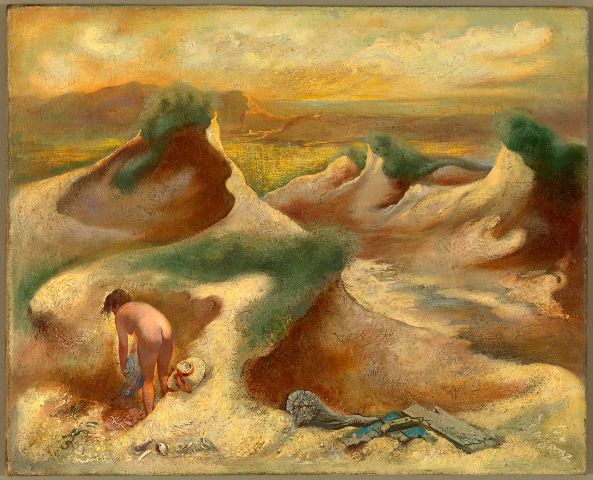
George Grosz, Nude in Dunes (1948), courtesy of David Nolan Gallery, New York

THE NEW CRITERION
October 2009

Gallery chronicle
by James Panero

On “George Grosz: The Years in America: 1933–1958” at David Nolan Gallery; “Mel Kendrick: Markers” in Madison Square Park; “Conrad Marca-Relli: The New York Years 1945–1967” at Knoedler & Company; “Leon Polk Smith” at Washburn Gallery; “Carole Feuerman: Swimmers, Bathers & Nudes”at Jim Kempner Fine Art; “Carole Feuerman: Swimmers, Bathers & Nudes” at Jim Kempner Fine Art & “Color-Time-Space” at Lohin Geduld and Janet Kurnatowski Galleries.


Many people have asked me how the art world is doing in the economic downturn. I am sorry to report that the art world died in early August. This tragic event was not unexpected, nor was it unwelcome. The previous several months had been rough. The end came as a blessing.

After the death of the art world comes its afterlife. The silly season that stretched for nearly a decade will give way to more sober reflection. Galleries will continue to close. But we also know that some galleries will survive, thanks to their intelligence and sensitivity to the emerging mood. Several are off to a good start.

One artist whose antennae were always attuned to changing situations was the German Expressionist George Grosz. The artist is now the subject of a museum-quality exhibition at David Nolan. The business of good gallery-making begins with the education of the eye. With twenty-nine Grosz paintings and drawings and a 280-page catalogue, David Nolan is now running his own class in Grosz anatomy.[1]

In the 1920s Grosz lampooned the excesses of the Weimar Republic, corrupt and blind to Germany’s darker forces. He singled out Adolf Hitler for ridicule when the Führer was little more than a failed artist. A one-time member of the Communist Party, Grosz also repudiated his leftist allegiances after a visit to the Soviet Union. Hitler and Stalin came to appear to him as two sides of the same war machine. Rightly so. Yet perhaps most surprisingly, Grosz developed an unalloyed exuberance for the United States. This romanticism emerged first through his reading of popular American literature and developed in dialectical opposition to his pessimism towards the deteriorating European climate.

When an invitation came in 1932 to teach a summer course at the Art Students League, Grosz booked passage the next month on the ocean liner New York. He arrived to the fanfare of the American press. He wrote back to his wife: “I love you, America. I feel like this is my country, I belong here.” He soon decided to emigrate with his family to New York and did so early the next year. Two weeks after his arrival, SA troops stormed his flat and studio in Berlin and declared him an enemy of the regime.

Anti-Hitler, anti-Stalin, pro-America—the trifecta of political astuteness, but a victory that has complicated Grosz’s legacy. Anti-Hitler, good. Anti-Stalin, tolerable. Pro-America, beyond the pale. As Klaus Mann, an exile in Paris, complained in 1936: “He has changed; a very long, very passionate battle has left him tired. He has become apolitical—or is at least trying to be… . He no longer draws: he paints.”

Grosz lived and worked in the United States for twenty-five years. He became one of the earliest high-profile refugees from Hitler. Yet while his audience expected the caustic illustrator to turn his pen against his new homeland, Grosz went about exploring other sides of his artistic vision. The nudes and landscapes that resulted are the revelations of the Nolan show, along with the dense allegorical work he developed in paint.

Grosz could apply his talents for drafting to many styles. The show ranges from black-and-white wartime illustrations to satirical send-ups of Hitler (So Smells Defeat [1937]). He worked his way through the Old Masters, Breugel in particular, by creating pressure-cooked paintings like the infernal Retreat (Rückzug) (1946) with swirling fires, twisted barbed wire, and a shot-up brick wall that has a three-dimensional texture in oil. In Cain or Hitler in Hell (1944), a pile of human skeletons climbs up Hitler’s leg.

That Grosz had a flip side to his dark vision makes him a more complex and interesting artist. His “romantic” American landscapes are as true to their own time and place as are his dystopian images of Europe. Grosz lived on Long Island and vacationed on Cape Cod. He adored the beaches and often painted his wife, Eva, in nude and sometimes erotic scenes in the dunes. The rolling sand and wispy beach grass in Grosz’s landscapes become fecund allegories for a land of milk and honey. As he wrote to his brother-in-law in 1950, “What do you have against the dune paintings and nature studies, they are part of the whole oeuvre—if I hadn’t done them (with passion and love, too), I would not have been able to paint my imaginative pictures, because ‘invention’ is only derived from nature.” He was right. Drawings like Dunes at Wellfleet (c. 1940) and Dunes Cape Cod (1939) are among the best works in the show, and to be blind to them is to be blind to Grosz’s entire vision.

Several shows this month deserve far more attention than space allows, so here are the best of them, however briefly. When I last reviewed the sculptor Mel Kendrick, another David Nolan artist, I objected to the diminutive scale of the work on view. Kendrick is a constructivist who carves an abstract shape from a wood block, then places the result on top of a base made of the leftover pieces. For an artist who likes to show his hand, sometimes the process gets the better of the product. Not so for a set of monumental sculptures now on view in Madison Square Park.[2] Derived from many of the same forms at his last Nolan show, these outdoor giants executed in poured black-and-white concrete are playful exceptions to the cloying piles that normally pass for public sculpture. To appreciate their power, just visit the park with children around. By climbing through every hole and jumping off every shape of Kendrick’s work, they understand the fun of these structures without the need for further explanation.

The New York School artist Conrad Marca-Relli brought collage to Abstract Expressionism. Some of his best work is now on view at Knoedler.[3] In 1967 the critic William Agee noted that Marca-Relli “accepted the potential risks inherent in collage and developed it as a complete pictorial system.” Unlike earlier artists who used collage as fragmentary elements in larger paintings, Marca-Relli created entire collage abstractions. An untitled work at Knoedler from 1952 serves as an example of what he could do. With a white surface covering a black background, Marca-Relli cuts a swirling line across the canvas and pulls the gaps open exposing the black beneath, sometimes turning and re-pasting a white chad back onto the surface. “The limitations of the material acted two ways,” the artist once said. “It confronted me with a problem of solving the shape and reducing it to the simple form that I was looking for. On the other hand, a collage has always been to me a kind of discipline.” It was a discipline that Marca-Relli perfected.

From Malevich to Albers, the square has long been a focus of abstract attention. Sometime in the 1960s, the circle began to receive its due. The simple drawings of Leon Polk Smith from 1968 now on view at Washburn—along with one much larger, shaped canvas—pay homage to the celestial.[4] On a white background Smith collects a handful of colorful circles together in multiple iterations. These dots act as singular objects, but we can also read them as portholes onto larger circles beneath. Smith leaves these forms to be rounded out in our minds, a dynamic that never loses energy.

It is no secret that twentieth-century modernism had a bad body image, as everyone from Picasso to Giacometti beat a psychological reading into the classical form. Look at the healthy bodies of Augustus Saint-Gaudens and realize the beauty that was lost when art turned away from the idealized nude. The sculptor Carole Feuerman has been confronting this development for decades by reevaluating the classical nude in a contemporary way. Her work is now on view at Jim Kempner.[5] Unlike other hyper-realist sculptures, Feuerman is not afraid of idealized form. She specializes in female swimmers. According to the modernist playbook she does everything wrong. Her work indulges in sentimentality. Her materials include hair and plastic resin, which she splashes on her figures like drips of pool water. Not to mention the fact that we haven’t seen bodies this fit since the Fascist summer-carnival sculpture in Zell am See. On the one hand, for all of her technique, I found some of the polychromy, especially in the faces, a little waxen. On the other, a work like Tree (2009), with its swimmer standing on a tree trunk in nothing but a leafy bathing cap, seems like an art nude for the twenty-first century, real and of the moment.

Last June, I mentioned the upcoming exhibition of Tim Bavington’s hard-edged abstraction at Jack Shainman Gallery with some enthusiasm. Having now seen the show, I can say it was a disappointment.[6] Bavington is out to revisit the optical art of the 1960s. Unfortunately, he approaches this task with the gauzy reserve of Gerhard Richter. Bavington’s optical effects are referential rather than internal to his painted form. He reinvestigates the synesthetic link between color and music, but the connections he draws are facile. For one painting, Fell in Love with a Girl (2009), Bavington informs us the work was “named for a White Stripes song” but “inspired by Missoni fabric.” Please, someone send this artist a Scriabin CD.

The abstract painters Joanne Freeman and Kim Uchiyama have organized an excellent group show over two galleries with eye-popping work by Jennifer Riley and Thornton Willis, among others.[7] Allow me to single out my new favorite painting. It is My Beautiful Laundrette (2008) by Stephen Westfall. The colorful work is based on a grid design the artist has been developing for years. What separates Westfall from the old serialists is the way he fits his pieces together, with his square corners coming together slightly out of alignment. One’s darting eyes pick up the differences and animate the frames. Color, texture, and form all come together. It is a mesmerizing spectacle and a vision, I hope, of things to come.

New Yorkers came out by the thousands for the season’s gallery openings, and several galleries mounted strong exhibitions. The death of the art world may be the best thing to happen in years.

Notes
Go to the top of the document.

  1. “George Grosz: The Years in America: 1933–1958” opened at David Nolan Gallery, New York, on September 16 and remains on view through October 31, 2009. Go back to the text.
  2. “Mel Kendrick: Markers” opened in Madison Square Park, New York, on September 17 and remains on view through December 31, 2009. Go back to the text.
  3. “Conrad Marca-Relli: The New York Years 1945–1967” opened at Knoedler & Company, New York, on September 12 and remains on view through November 14, 2009. Go back to the text.
  4. “Leon Polk Smith” opened at Washburn Gallery, New York, on September 10 and remains on view through October 31, 2009. Go back to the text.
  5. “Carole Feuerman: Swimmers, Bathers & Nudes” opened at Jim Kempner Fine Art, New York, on September 17 and remains on view through October 31, 2009. Go back to the text.
  6. “Tim Bavington: Up in Suze’s Room” opened at Jack Shainman Gallery, New York, on September 11 and remains on view through October 10, 2009. Go back to the text.
  7. “Color-Time-Space” opened at Lohin Geduld and Janet Kurnatowski Galleries, New York on September 10 and remains on view through October 11, 2009. Go back to the text.