Gallery Chronicle (April 2010)

Ph_as01
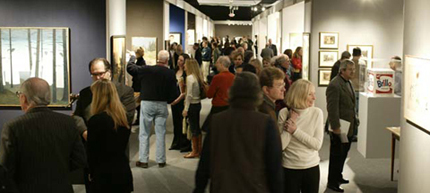
The Art Show. Photo by Holger Thoss, courtesy of ADAA

THE NEW CRITERION
APRIL 2010

Gallery Chronicle
by James Panero

On The Armory Show at the Chelsea Piers, ADAA’s Art Show & the Winter Antiques Show at the Park Avenue Armory, “William Bailey: New Work” at the Betty Cuningham Gallery & “Milton Avery: Industrial Revelations” at Knoedler & Company.

Has the art world forgotten the recession? The contemporary art fair known as The Armory Show, which took place inside two terminals on the Hudson River piers in March, certainly tried to ward off the onset of sobriety.[1] Rather than downsize, Armory went even bigger this year. The vibe was very 2007, when the art world’s money-crazed carnival was still in full swing. Nearly 300 international galleries set up shop in this warren of exhibition space. A record 60,000 visitors showed up for the five-day run. The artist Reed Seifer attempted to capture the zeitgeist with a two-ounce perfume called “Spray to Forget,” which was for sale for $25 just outside the “VIP Lounge.” Concealing current troubles with a pleasing body spray, the fair sought to remind us of the art world’s former self-intoxication and self- regard. You may have had a bad year, but, rest assured, you could still be a VIP here, along with thousands of other very important people flashing their own all-access cards.

Why should we want to jump-start the art market by embracing the tackiest commercial practices of the past? Are we concerned that new art cannot last without artificial stimulation? Art could benefit from a period of retrenchment; art that thrives in the wilderness can be the most enduring. I wish the twelve-year-old Armory Show would revisit its more humble roots, when exhibitors first rented rooms in the old Gramercy Park Hotel. Instead, it has become an unruly bazaar, dividing its extensive goods between contemporary art in the cavernous hanger of Pier 94 and modern art inside the long Pier 92—an afterthought of exhibition space that seemed decidedly less impressive than even a year ago, when this extension of the fair began.

The Armory Show has come to anchor an art extravaganza that spans the city, from a constellation of fairs to star-studded museum openings like the Whitney Biennial and an exhibition at The New Museum curated by Jeff Koons. At the same time, in a very different way, the Art Dealers Association of America hosts its own art fair known as “The Art Show” at the Park Avenue Armory. In previous years I have commented on these competing powerhouses. Both the ADAA Art Show and The Armory Show are commercial “art fairs”—ticketed conventions where galleries rent exhibition booths. Yet one manages to emphasize art (ADAA) while the other (Armory) puts a spotlight on spectacle.

Art fairs serve the purposes of art only when they seek to develop new collectors rather than make quick sales. Unlike the vast expanse of the piers, the limited acreage provided by the Park Avenue Armory—aided perhaps by the venue’s patrician environs—seems to focus the numerous fairs that rent space there each year, from the IFPDA Print Fair in November to the AIPAD Photography Show in late March.

In addition to the change in venue, what distinguishes The Art Show at the Park Avenue Armory from The Armory Show at the piers is The Art Show’s selection of exhibitors.[2] The Art Dealers Association of America, the sponsor of The Art Show, is an invitation-only member organization of America’s leading commercial galleries. Membership in this 170-gallery organization already guarantees a level of seriousness. Of these galleries, only seventy or so make the Art Show’s cut each year. Securing an exhibition space here is competitive. The result is a fair that brings together the best American galleries under one roof, each presenting excellent mini-exhibitions.

If The Armory Show is about horse-trading and blockbuster openings, the more collegial Art Show is about building relationships. The galleries are on display as much as the art on their walls. The best exhibitors at ADAA assemble focused shows, either around formal themes or single artists.

This year June Kelly presented “The Primacy of Color” with a show-stopping new abstraction by James Little. Hans Kraus was back, this time with nineteenth-century photographs of open landscapes. The solo shows ranged from Shirley Jaffe (Tibor de Nagy) to April Gornik (Danese), Jacob Lawrence (DC Moore), William Kentridge (Marian Goodman), Martin Kippenberger (David Nolan), and Alighiero e Boetti (Sperone Westwater). Galerie St. Etienne featured an exhibition of nude drawings by Gustav Klimt and Egon Schiele, where the confidence of Schiele’s late line (from the 1910s) still astonishes.

The Art Show wasn’t the first excellent fair at the Park Avenue Armory in 2010. That distinction belongs to the Winter Antiques Show, which ran for more than a week in late January.[3] This fair only gets better as it expands its range year by year. The Winter Antiques Show has long offered everything from antiquarian books (Bauman) to arms and armor (Peter Finer), American folk art (Giampietro), master portraits (this year, Rembrandt Peale’s George Washington at Hirschl & Adler), and Indian art of the Pacific Northwest (Donald Ellis).

By not limiting the work to just paintings or prints, the fair allows its vendors to turn their booths into complete domestic spaces, filled with furniture and decorative objects. The best exhibitors create full dioramas of their pieces in private settings. Hostler Burrows, which specializes in Scandinavian furniture and houseware, decorated its booth with wallpaper by the mid-century Swedish designer Josef Frank. Hans Kraus Fine Photographs put together a museum-quality show of the photographs of William Henry Fox Talbot that included a replica of the oriel window at Talbot’s Wiltshire home, Lacock Abbey—the subject of one of Talbot’s first photographs from 1835—as well as a handful of haunting photographic etchings.

This year the fair wisely advanced its cut-off date to include collectible work made through the late 1960s. The move allowed the first-time exhibitor Lost City Arts to display a remarkable selection of hand-made metal sculpture by Harry Bertoia, including a few of his “sonambient” sculptural instruments.

Whether by luck or by design, many galleries around the city seem to schedule their more important shows around the March run of the fairs. Woodward Gallery mounted a shimmering survey of recent abstractions by Natalie Edgar, an artist who once studied with Mark Rothko and Ad Reinhardt. Lesley Heller Workspace brought some of Austin Thomas’s Bushwick artists to the Lower East Side. The ambitious large paintings of Noah Landfield and Sara Klar went up at Sideshow Gallery.

Betty Cuningham Gallery featured its third exhibition of nudes and still lifes by the painter William Bailey.[4] This artist’s limited subject matter and reserved paint handling have often been seen as conservative challenges to the orthodox radicalism of modern art. The meaning of Bailey’s work as it relates to the history of art has been a subject of debate since his painting first appeared on the cover of Newsweek in the early 1980s. At the time Bailey was hailed as one of the new artists “of the real.” For me, such discussions have limited utility. They may give Bailey an aura of relevance, but they do little to explain the mysterious power of his work.

Like Giorgio Morandi, another great modern realist, Bailey imbues quiet paintings with intense energy. The latest Cuningham show, with its equal pairing of still lifes and nudes, pointed me to the sensuous sources of Bailey’s dynamics. Bailey’s work is so surprising, so novel, when compared to the canon of modern art because its fecundity shows no limit or irony. The egg shape that appears repeatedly in his still lifes and reappears in his nudes and figurative work, for example as the door knob in House by the Sea (2009), comes across as a central motif. The egg recalls the curved vessels of his still lifes and the rounded faces of his figures. One could even say the motif appears again in the egg-shell finish Bailey meticulously applies to every square inch of his canvas.

As a teacher at Yale, Bailey trained a generation of younger artists to paint in the realist mode. The Cuningham show suggests that more than merely reviving lost technique, Bailey’s lasting legacy may be his concern for the sensuousness of the female form. Artists like John Currin and Lisa Yuskavage never inherited their master’s fine hand, but they took Bailey’s primary theme and made it their own through exaggeration and farce. Bailey may not be as well-known as some of his pupils, but his simple work is all the more extraordinary and enduring.

A revelatory exhibition at Knoedler of Milton Avery’s work from the 1930s called, appropriately, “Industrial Revelations ” examines the machine-age origins of this modernist painter of color and countryside.[5] A poor artist searching for subject matter beyond his Upper West Side studio, Avery roamed New York in his early years. He settled on the railroad tracks, bridges, and waterways at the edges of the city. Absent bright colors and his signature hatched paint handling, the work that came out of these wanderings reveal the artist’s uncanny understanding of composition. Avery distilled each landscape down to squares and curves. Over a solid square structure, the arcing bridges, railroad beds, water towers, and tugboat wheelhouses bend the eye across the canvas. The result is an artist already working in an essential mode.

I had always thought Avery did not hit his stride until the 1940s, but the Knoedler show suggests he reached a mature style much earlier. I doubt the gritty results will win over those who expect salmon landscapes, but paintings like Under the Bridge (c. 1930) and Railroad Yards (1931) and watercolors like Under the Bridge/Houseboat (c. 1930s) are treasures. They also remind us that this great artist once gazed along the banks of the Harlem River, looked out over the West Side El, and changed the course of American art through what he saw by building a bridge from the American Scene to the abstract art of mid-century.

It should be noted that the name of Knoedler’s former director Ann Freedman does not appear in the show’s catalogue, but her fingerprints seem to be all over it; while “Industrial Revelations” is extensive, her departure from the gallery last fall leaves this show with its only absence.

Notes
Go to the top of the document.

  1. The Armory Show 2010 was on view at Piers 92 and 94, New York, from March 3 through March 7, 2010. Go back to the text.
  2. The Art Show was on view at the The Park Avenue Armory, New York, from March 3 through March 7, 2010. Go back to the text.
  3. The Winter Antiques Show was on view at the Park Avenue Armory, New York, from January 22 through January 31, 2010. Go back to the text.
  4. “William Bailey: New Work” was on view at Betty Cuningham Gallery, New York, from February 18 through March 27, 2010. Go back to the text.
  5. “Milton Avery: Industrial Revelations” opened at Knoedler & Company, New York, on February 18 and remains on view through May 1, 2010. Go back to the text.

The Hudson River School Revisited

Pier 2009 3 1-2 x 10 inches oil on board
CATALOGUE ESSAY
The Hudson River School Revisited
by James Panero

"Dee Shapiro: The Hudson Line" is on view at Andre Zarre Gallery, New York, from April 27 through May 29, 2010

Where do we come from? What are we? Where are we going? Gauguin's unanswerable questions are modern art's catechism. We begin with certainties but end in mysteries. Dee Shapiro's enigmatic work star ts in places we think we know only to lead us from conclusions. Up river, down tracks, nothing coming, nothing going. What's missing amid the water, bridges, boats, stations, docks, and towns are the narratives that might satisfy our attention and permit us to move along.

Paintings are inert when they leave us alone. The energy of a work comes from how it engages us. Shapiro keeps her paintings open so we might complete them. In between the nouns we supply the verbs of our own stories. Why do we look at these stations and docks? Are we leaving on a train? Waiting for a ferry? Has someone just departed? Have we just arrived? Or are we just watching? Are we seeing a vision through someone else's eyes? The more we look the less we know.

Shapiro has been drawing small her entire career. In the landscape work of the last several years, she has compressed a CinemaScope vision into diminutive scale. The resulting images, in exquisite detail, contain as much information as you might expect from much larger paintings. What differs is our proximity to it. Shapiro compels us to look at her work up close. The absence of monumentality, like the ambiguous narrative, pulls us in, encouraging a personal exchange with the work. When we approach, we come to occupy the painting, physically, with our own size.

Each decade of art in New York has its own spirit. The ar t of the 1970s, when Shapiro came of age, had a soul. The cool supremacism of the 1960s gave way to a studio-based culture that reconnected with the processes of making art. Since the Bauhaus, modernism has sought to elevate craft to the level of painting. In New York the legacy of the Bauhaus weavers combined with a new interest in homespun folkways to create a movement called Patterns and Decoration, or P&D. The 1970s women's movement gave P&D a political timeliness. An artist working in abstract geometric pattern, Shapiro became a founding member of Central Hall, the first women's gallery on Long Island. Her early work, exhibited at Andre Zarre Gallery in the mid-1970s and now in the collection of the Guggenheim Museum, used the artist's own color system to draw and paint intricate abstract patterns based on the Fibonacci Sequence, the numerical basis for Golden Spirals and Rectangles. The process, laid on a grid, recalled textile designs and needlepoint.

P&D was a more tradition-bound movement than its political associations might suggest. It was not radical enough to be sustained by academic theory, nor bold enough to be noticed in the macho celebrity culture that took over art in the 1980s. Yet the extreme of the middle, as Jack Tworkov called it, has well suited Shapiro. Today, she continues to develop the artistic idioms she first took up forty years ago.

Shapiro’s interest in small detail that we find in the early abstractions continues through her representational paintings. The smallness of the paintings recommends them to intimate environments. Unlike the Hudson River School landscapes of the nineteenth century, with their imperial awe, Shapiro's paintings seek out the more quotidian emotions of modern life. In response to Gauguin, one might only say, we come, we are, we go. Little else is certain.

For a PDF of the entire exhibition catalogue, click here

Gallery Chronicle (March 2010)

BlackHorses
Anna Mary Robertson (“Grandma”) Moses, Black Horses (1942) © Grandma Moses Properties Co., New York.
Private Collection. Courtesy Galerie St. Etienne, New York

THE NEW CRITERION
March 2010

Gallery chronicle
by James Panero

On "Seventy Years Grandma Moses" at Galerie St. Etienne, New York & “Carolanna Parlato: Vortical” at Elizabeth Harris Gallery, New York.

Grandma Moses deserves more than a Hallmark greeting. The paintings by this self-taught artist should be in any museum that lays claim to the history of American art. An extensive loan exhibition on view at Galerie St. Etienne endeavors to make the case that the elderly woman behind millions of Christmas-card reproductions is a pivotal American artist.[1]

Moses’s personal story is compelling, in turn amplifying and diminishing her artistic reputation. She lived from the age of Abraham Lincoln to the presidency of John Kennedy. She was born Anna Mary Robertson in upstate New York in 1860, the third of ten children. At twelve she left home to work as a maid on a nearby farm. She spent most of the next fifteen years as a farm girl, obtaining scattered schooling alongside the children of her employers. In 1887, at twenty-seven, she married Thomas Salmon Moses, a farmhand. Relocating to Virginia, they farmed in the Shenandoah Valley, where Moses gave birth to ten children, losing five in infancy. Eighteen years later, in 1905, the family returned to upstate New York, this time to Rensselaer County, just south of her birthplace, to a farm they called Mount Nebo, near the hamlet of Eagle Bridge. The landscape of the surrounding countryside formed the underlying topography of her subsequent artistic output.

It was not until the mid-1930s, following the death of her husband in 1927, that Moses began to paint in earnest. “I had always wanted to paint, but I just didn’t have time until I was seventy-six,” she later said. Arthritis led her to give up needlework in favor of oil on board. She submitted her first work to the county fair, but she took home a prize for her preserves rather than her paintings. Then, in 1938, a collector named Louis Caldor spotted Moses’s artwork in the shop window of W. D. Thomas’s pharmacy in the town of Hoosick Falls, New York. He purchased as many works as he could carry and returned to New York City. The next year Caldor landed three of the paintings in a members’-only group show at the Museum of Modern Art in New York. A year later Caldor convinced Otto Kallir, a Jewish refugee from Austria with a newly opened commercial gallery in New York, to mount the artist’s first one-woman show. The name of Kallir’s shop was St. Etienne; the gallery, now run by Hildegard Bachert and Jane Kallir, Otto’s granddaughter, has represented Moses ever since.

Otto Kallir may have been the first to call her “Grandma” Moses, a name journalists have delighted in ever since. His gallery has shepherded Moses’s career from obscurity to popular success. A painter beloved in reproduction, she was abandoned by the artistic establishment. By the time of her death in 1961 at the age of 101, Moses had met presidents, appeared on the cover of Life, been visited by Edward R. Murrow, and seen her licensed images appear on 100-million Christmas cards. Yet the initial critical support she received at the time of her first show in 1940 was soon eclipsed, as Regionalism, Primitivism, and the American Scene fell out of favor with sophisticated taste. Moses’s work never entered the collection of the Museum of Modern Art, the site of her first exhibition.

“One of the first artists to be hailed as a media superstar,” notes Jane Kallir, “and possibly the most successful female artist of her era, Moses is nevertheless surprisingly invisible when it comes to histories of postwar American painting.” Moses never found a place in America’s projection of postwar international style. Nor was she taken up by the theorists of the 1970s, despite her success as a woman painter.

The misunderstanding of Moses hinges on her initial status as a primitive, unschooled artist. Rural living in fact provided Moses with its own aesthetic education. The crafts of farm life—needlework and quilting—gave Moses an appreciation of bold colors and a neo-Impressionist sense of paint application. Three of the earliest pieces in the show—Mt. Nebo on the Hill (1940), Untitled (House and Barn in Landscape) (c. 1940), and Shepherd Comes Home from the Hills (c. 1940)—are “worsted pictures” made of embroidered yarn and fabric.

Like other resourceful self-taught artists—Henry Darger and John Kane come to mind—Moses freely appropriated imagery from prints and photographs. She transferred figures from Currier and Ives and popular advertisements to her paintings by tracing them with carbon paper. Several of her more “realistic” paintings from the early 1940s are based entirely on the compositions of colored lithographs. When Leaves Turn (1943) follows a series of paintings she made called Autumn in the Berkshires—one of them painted directly on top of a commercial print. A Fire in the Woods (1940) and The Burning of Troy (c. 1939) are similarly based on documentary material. Moses’s historical knowledge of local events provided its own narrative template, further drawing on documentary illustrations. The Battle of Bennington in 1777, the burning of Troy, New York in 1862, and the Checkered House inn, built in 1765 on the nearby turnpike road, are all recurring motifs.

Moses had taken up mapmaking in childhood. As she combined a technique born from folk traditions with an intimate knowledge of local history and geography, she distinguished her art with a unique sense of pictorial space and an urge to record her world. She put equal weight on foreground activity and on distant topography. Her sensibility to represent all space with even focus resembles cartography more than conventional painting based on visual perception.

In her paintings, Moses did not simply reproduce geographical reality. She crafted diagrams of rural life, often drawing from the pre-industrial past. One can see a mapping instinct in every decision she made, down to the way she reproduced buildings. Like architectural isometric projection, she unfolded shapes so that right-angle planes were equally drawn out. The results are didactic representations rather than illustrations in single-point perspective. Moses loaded her paintings with such information to create visual maps of a shared rural memory. The people in these scenes—traced and transferred figures performing various tasks like sugaring, catching the Thanksgiving turkey, and riding a sleigh to grandma’s house—are not faithfully depicted. Rather they stand as representations of activity: more like street signs than cognizant human beings.

That St. Etienne would mount a museum-quality exhibition of Moses while actual New York museums continue to ignore her ies noteworthy. It is also noteworthy that an extensive show called “Grandma Moses in the 21st Century,” which toured through six national museums in 2001, never found a New York venue. Writing at the time in the New York Observer, Hilton Kramer called the omission a scandal.

Regardless of Moses’s aesthetic achievements, her place as a popular artist commands our attention. Yet as the St. Etienne show makes clear, Moses’s work can be exceptionally good. Certainly, it wasn’t always great. Sometimes her untrained hand got away from her, or her compositions became over-filled with genre figures. While there are elegant exceptions, her late work with its more impressionistic line seems crude. But certain paintings, especially her expansive landscapes, can hold their own in the history of art, beyond her designation as a self-taught outsider.

Black Horses (1942), on display in the current show, is the work that convinced Kallir to appreciate Moses as a serious artist. This painting can do the same for us today. Moses is much more than a footnote to an artistic movement. With her memorialization of a rural past, she transcends even the history of American art. She has become, simply put, a national treasure. The time has come for the art world to understand what the rest of the world realized decades ago.

I predict that the art of the 1970s will find new relevance in the coming years. The expressionist 1950s returned in the 1980s. The pop 1960s struck back in the last decade. Now the legacy of the 1970s has reemerged to hash it out in another recessionary period. What matters is how this decade gets remembered—for its theory or its practice. The Conceptualism of the decade has long been championed by the cultural establishment, while the rigorous studio practice of 1970s painters has been ignored.

This oil-on-canvas generation never disappeared. The artists who came of age in that decade continue to work and, in many respects, get better. What didn’t change was their sense of community and, regrettably for them, often the price of their work. The public has yet to catch on. This past month, a large group show at Sideshow Gallery in Williamsburg brought several artists of this generation together under one roof with many younger painters and even some older ones. By last count, 380 works climbed the walls in a Barnes-style hanging. At times the cement bunker of a gallery, run by Richard Timperio, seemed like the Alamo of 1970s process painting. It was an outstanding group show, with studio painters in conversation across the generations. A work on paper by Jake Berthot was a standout. I was also excited to see Ronnie and Noah Landfield, father and son, in one room. A promising recent graduate of Hunter, Noah is now up for a solo show at Sideshow.

One artist at Sideshow—younger than the 1970s generation but with a shared sensibility—was Carolanna Parlato. She now has a solo show at Elizabeth Harris.[2] Working in bold acrylic, Parlato seeks to collaborate with her paint rather than over-manipulate it. She pours her paint onto her canvas and tips the wet surface back and forth. She allows the drips to run. The happy accidents that result come out of Parlato’s understanding of paint’s chemistry. Through her own experimentation, Parlato now uses extra medium, even soaps, to encourage the controlled movement of her pigments, which she layers over one another. Sometimes the compositions become overpopulated. Coronal Loop (2009) has too much going on—although particular details, like the sweep of brush, are beautiful effects.

In her best work, the fields of paint, often juxtaposed in two different forms, have an energy of their own. Undercurrent (2009) pairs a shape melting down with another dripping up. Orbital (2009), the best painting in the show, has an oozing amoeba foregrounding an explosive burst of green and red, reacting together in a bath of clear medium. Building on each new painting, the work develops through Parlato’s own process. Like all good artists, she is her own best teacher.

Notes
Go to the top of the document.

  1. “Seventy Years Grandma Moses: A Loan Exhibition Celebrating the 70th Anniversary of the Artist’s ‘Discovery’” opened at Galerie St. Etienne on February 3 and remains on view through April 3, 2010. Go back to the text.
  2. “Carolanna Parlato: Vortical” opened at Elizabeth Harris Gallery, New York, on February 11 and remains on view through March 13, 2010. Go back to the text.