Gallery Chronicle (June 2011)

DSCN9936
Installation shot from “Matthew Miller: the magic black of an open barn door on a really sunny summer day, when you just cannot see into it,” courtesy of Famous Accountants.

THE NEW CRITERION
June 2011

Gallery Chronicle
by James Panero

On “Matthew Miller: the magic black of an open barn door on a really sunny summer day, when you just cannot see into it” at Famous Accountants, Queens; “Don Voisine” at McKenzie Fine Art; “Stephen Westfall: Seraphim: Paintings and Works on Paper” at Lennon Weinberg; “Jules Olitski: Embracing Circles 1959–1964” at FreedmanArt, New York; “Jacob Collins: New Work” at Adelson Galleries; and “Exhibition of Contemporary American Realism” at the National Arts Club, New York.

The summer doldrums are not what they used to be, in art as in everything else. New York now barely takes a break before the September push. Still, it seems the galleries often save the best for late spring. It’s a vestige of an old cycle, one that wanted big just before the un-air-conditioned city ran for the water in the dog days of summer. It’s no different this year, with many shows now to see, little time to do it, and (in my case) about 1,800 words left to review them. So here goes.

In life, dark is the absence of light. In painting, black has a presence all its own. Black can be a force, both a profundity and a tangible thing holding court on the canvas. The title of Matthew Miller’s current solo show is “the magic black of an open barn door on a really sunny summer day, when you just cannot see into it.”[1] When you have 1,750 words left in your review, that’s quite a title. But this show’s name, taken from the artist’s notebook, helps illuminate the spectacular blacks that mark this young artist’s iconic work.

Born to a Mennonite family in Pennsylvania, Miller draws on the primitive portraiture of his region, where he encountered the work of itinerant Amish painters. As a star student at the New York Academy, a proving ground for realist painters, Miller channeled this influence through his own native talent. Here he developed a signature style of portraiture that places his subjects in a field of jet black. This black functions as its own enveloping shape as well as a dark void contrasting with his blindingly bright figures.

Miller sometimes depicts other people in his portrait program, but he has become his own best subject. I wouldn’t call his self-portraiture a vanity project. It’s more like an unsparing self-examination. In successive paintings laid down in numerous layers of glaze, Miller tugs, presses, mashes, and pulls at his own physiognomy. The results are haunting, psychological illustrations—Neue Sachlichkeit by way of Pennsylvania Dutch.

The Famous Accountants gallery has assembled five of these self-portraits in its narrow space, each called Untitled, ranging in date from 2008 through 2011. Carved out of the basement of a tenement brownstone by the artists Ellen Letcher and Kevin Regan, FA (as it’s known) has proved to be the most innovative art space in Bushwick, Brooklyn, while actually existing just over the borough border in Ridgewood, Queens. The gallery specializes in obsessive, chilling, high-wire installations—one artist (Andrew Ohanesian) recently re-assembled an actual airport jetway in the space; another (Meg Hitchcock) wrote the Book of Revelation on the wall using letters individually cut out and re-pasted from a Koran. In Miller’s case, the eyes of his portraits come alive and black performs its particular magic in this must-see exhibition.

Black is the muscle in Don Voisine’s abstract work. In his show at McKenzie Fine Art, each painting follows a similar program: on two opposite edges, a thick band and narrow vein of color; in the middle, a black and white design.[2] By removing his hand from these hard-edged oils on wood, Voisine lets the shapes define themselves. The simplicity of his designs gives them their force. Voisine is a precisionist, an abstract technician who uses the textures of matte and glossy paint to signal shifting volumes, and planes stacked one on top of the other. In all of the designs, the edge colors compress the compositions while the black pushes out. In Pan (2011), a small horizontal work, the blacks seems to bend around an edge, thanks to shifting textures and subtle changes to the angle of edges. Volume (2010) similarly looks like a cube in sideways view. In Otto (2010), the black is pneumatic and ready to pop. In all of these works, blacks bump, stretch, and twist with tense energy, subjects in themselves.

Stephen Westfall is a patternist who always seems to unlock the dazzle in repetition. A few years ago in these pages, I called My Beautiful Laundrette (2008), his work I saw in a group show at Lohin Geduld Gallery, “my new favorite painting.” It’s still up there, but Westfall’s latest exhibition at Lennon Weinberg might give it some competition.[3] “Seraphim: Paintings and Works on Paper” is the result of Westfall’s year as a fellow at the American Academy in Rome. Clearly the stay was worth it. Westfall says he drew particular inspiration from the tenth- and eleventh-century floors of Cosmatesque churches. The paintings that result have dispensed with some of the subtle brushwork and idiosyncratic pattern placement of his earlier designs in favor of bold patterns on a grand scale.

Wise One (2011) is built from four squares of diagonal bands of color arranged in a diamond. Westfall’s particular knack for variation comes into play in its color program. One can see connections oscillating among all of the color bands, but just as patterns emerge—a spiral here, a mirror there—Westfall mixes it up. Subiaco (2010), with its greens and yellows and reds, seems lifted right off the tiles of a Roman wall. Westfall balances this design so well that x-shapes, crosses, diamonds, and squares all emerge from the same arrangement, as though different frames on a flickering screen. Then there is Ariel (2011), the largest work in the show, and one that turns out to be latex painted right on the gallery wall. I’m not the first to suggest a comparison here to Sol LeWitt, but considered against the dull, flat work of that conceptualist, Westfall leaves nothing to chance. His lively paintings are the products of a master craftsman.

In an age of gallery closings, it’s nice to welcome an opening, especially when the opener is the inimitable Ann Freedman, the former director of Knoedler and Company. Freedman-Art is her new venture with several familiar names. The artists Frank Stella and Lee Bontecou have joined her, along with the dealer Per Jensen, also of Knoedler. The fact that she situated her new gallery right above the best cappuccino shop in New York, at Madison and Seventy-third Street, could be viewed as another masterstroke.

FreedmanArt’s inaugural show brings out rarely seen work from the estate of Jules Olitski, the other thoroughbred in her stable.[4] Olitski is having a moment right now, with a major survey at the Kemper Museum underway, curated by E. A. Carmean, Alison de Lima Greene, and our own Karen Wilkin (Houston, Toledo, and Washington are up next on the tour).

FreedmanArt’s exhibition focuses on the period from 1959–64. Much to his credit, Olitski never developed a signature style. Instead, he consistently tested the limits of paint, which pushed him to innovate with new techniques and materials—sometimes towards indecent compositional ends. In the early 1960s, he stained some large canvases with acrylic, laying down intense color combinations in biomorphic shapes. Known as his “core” paintings, ten of these works are now on view at FreedmanArt. The colors resonate against each other. Medusa Pleasure (1962) is the simplest, with one blue circle vibrating in a field of red, a color that fills the eye. Most of the others have two circles glancing off each other, as though in cellular division. It’s appropriate that all these shapes have an embryonic form, because this work gave birth to the artist’s next creations. If anything can be said against them, it’s their relative comportment. These paintings only hint at the mad experiments to come.

Jacob Collins is significant not only as an artist but also as an educator. This teacher is at the leading edge of a movement to revive the artisanal crafts of traditional painting. Born in 1964, he has already trained a generation of painters, who now teach their own disciples, through his off-the-grid schools and ateliers (most recently, his own Grand Central Academy).

Collins is still at work on his own self-education. Now at Adelson, the blue-clip gallery a block from the Metropolitan Museum, where he set about studying the Old Masters two decades ago, we can find his recent portraiture, still lifes, and landscapes mixed in with half-finished graphite studies on paper.[5]

A revealing self-portrait in pencil at the gallery entrance shows the intensity of an artist in middle age—thin, slightly hunched over, haggard, with wire-like hair, puffy eyes, and the shine of a furrowed brow caught in white chalk. Collins is at his best drawing the surface of the face and the knots of the skin. This mastery is the result of an intense regimen that first focuses on sketching plaster casts. His finest paintings occur when he can transfer these drawings to canvas. So his nudes, lifted from life drawings, are often his most successful and arresting works, almost shocking in the intimacy of their finely rendered flesh.

Even here, however, Collins’s observational techniques do not always move flawlessly to canvas. As he builds up his light areas with paint, his darks are left thin, often receding into the warp and weft of the linen. The left hand of the stunning Reclining Nude Morning (2011), although dangling over some bright sheets, seems to sink below the surface of the surrounding pigment, especially around the fingers. Seated Nude Dusk (2011) is more problematic, as a face in shadow becomes almost illegible, burned out against the bright light of the arms and legs. I get the feeling that Collins is aware of these issues of contrast. Across some work, he can be seen experimenting with his treatment of light, working up identical landscapes at different times of day.

Much of the best work to come out of the realist camp, with heavy representation by Collins and his former students, was on view for a brief two-week stay last month at the National Arts Club in New York.[6] In a survey of highlights, I thought that two by the young Joshua LaRock, a Collins protege, were showstoppers. The exhibition was presented by a new organization called the America China Oil Painting Artists League (acopal). The alliance hints at the geopolitics that may prove to be a game changer for this school of American traditionalists. The Chinese inherited their Old-Master techniques from the Soviets, who used realism as a tool for propaganda. Unlike Beaux Arts in the West, in the East traditional training and the taste for realism never fell out of favor. That’s why most contemporary Chinese artists, including those exported to the West, paint so effortlessly in a realist mode. It also explains why the rise of China might shift the balance of artistic taste in the global market, with outsider American realists recast as central players. If this comes to pass, Collins might well be considered their mentor—and, as a painter, still a first among equals.

[1] “Matthew Miller: the magic black of an open barn door on a really sunny summer day, when you just cannot see into it” opened at Famous Accountants, Queens, on April 30 and remains on view through June 5, 2011.

[2] “Don Voisine” opened at McKenzie Fine Art, New York, on May 5 and remains on view though June 11, 2011.

[3] “Stephen Westfall: Seraphim: Paintings and Works on Paper” opened at Lennon Weinberg, New York, on April 26 and remains on view through June 11, 2011.

[4] “Jules Olitski: Embracing Circles 1959–1964” opened at FreedmanArt, New York, on May 13 and remains on view through Summer 2011.

[5] “Jacob Collins: New Work” opened at Adelson Galleries, New York, on May 11 and remains on view through July 28, 2011.

[6] “Exhibition of Contemporary American Realism” was on view at the National Arts Club, New York, from May 17 through May 26, 2011.
Tom Otterness: Dog Killer

576px-Tom-otterness
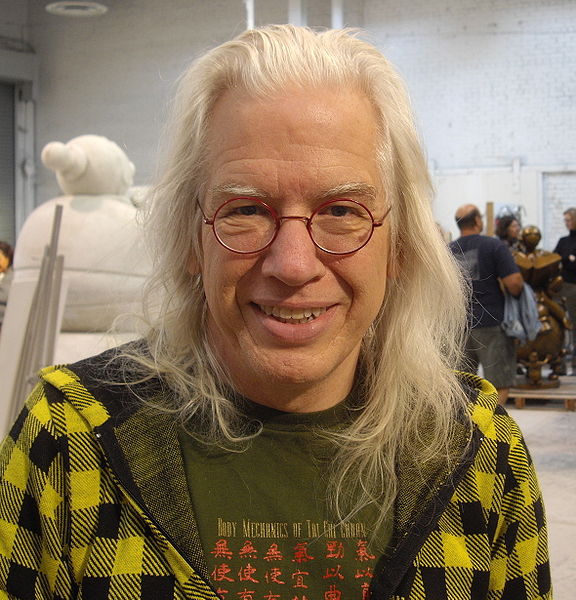
Tom Otterness in his studio in Brooklyn, NY. Photograph by Dmadeo

NEW YORK DAILY NEWS
May 11, 2011

Tom Otterness: Dog Killer
by James Panero

Cute sculptures disguise artist's cruel past

Last month, a New York community board approved a $750,000 installation by artist Tom Otterness for a public library in lower Manhattan: lion sculptures, paid for by a private donor, in a public space. Now, a cry has gone round the neighborhood to reject the work.

You may not recognize his name, but if you've spent much time in New York you've probably seen Otterness' cartoonish bronze men and animals. Largely thanks to public art funds--paid for with public revenue--he often places his sculptures near schools, playgrounds, parks and libraries.

His little guys can be seen throughout the 14th St. subway station at Eighth Ave., hiding in nooks and crannies. He has made pieces for Europe and Asia and even designed a float for the Thanksgiving Day Parade. With a seemingly inoffensive cast of characters, Otterness has proven irresistible to art world bureaucrats, who continue to give him commissions.

But now, Otterness is being exposed as a killer. In 1977, he made a film in which he "rescued" a dog from a shelter, tied it up and, as the animal wagged its tail, shot it dead. The movie, which Otterness called "Shot Dog Film," repeatedly shows the brutal execution.

Otterness has been apologizing for his despicable act ever since it came to light a few years ago and began to threaten his lucrative public support. In 2008, he said, "Thirty years ago, when I was 25 years old, I made a film in which I shot a dog. It was an indefensible act that I am deeply sorry for. Many of us have experienced profound emotional turmoil and despair. Few have made the mistake I made. I hope people can find it in their hearts to forgive me."

We were all young once, but most of us didn't shoot dogs and call it art. Through news reports and an online petition, enough people learned of Otterness' past to question the members of Community Board 1, which nevertheless voted to support the new downtown installation.

Many observers have been wondering why Otterness has yet to make a significant public donation to animal welfare to atone for his misdeeds. Meanwhile, the New York Public Library has, for its part, disowned any involvement in the project, claiming that the Battery Park City Authority has sole jurisdiction. "We in no way solicited this project, and are learning much of the detail in public meetings," the NYPL said in a statement.

Otterness' supporters may think that his cuddly sculptures are a lifetime apart from his violent past. In fact, his critics are right to expose his more recent work to closer scrutiny.

Otterness' sculptures might seem sweet, but they are meant to leave you with a bitter political aftertaste, because Otterness continues to be the angry artist who once executed a defenseless creature. His work remains a meanspirited comment on the "evils" of capitalism.

For example, at the 14th St. station, the little figures of "Life Underground" (2004) really make up a diorama of class struggle. Fat cats with bags of money roll over smaller worker-men. A mean-faced cop leers over a sleeping bag lady. A rat chews on a penny. A triumphant woman reads a book over a dead Monopoly Man, with coins spilling out beneath him.

Otterness has owned up to his radical politics. "I just want to be somebody who is talking straight-up in a public forum about sex or class or race," he said in 2006.

The Metropolitan Transportation Authority spilled a lot of pennies - $200,000 - to pay for "Life Underground." The fact that Otterness now uses public venues and funds to preach his angry politics is not a vindication of his past, but just another example of his depravity.

The Hudson River Destruction Project

Hudson
WILLIAMWALDRON/GETTYIMAGES

CITY JOURNAL
Spring 2011

The Hudson River Destruction Project
by James Panero

How the EPA is harming nature and ruining communities

Visit Fort Edward, 200 miles up the Hudson River from New York City, and you’ll find the waste hard to miss. That isn’t because General Electric once used polychlorinated biphenyls, the chemicals known as PCBs, to manufacture electrical equipment at two local plants. Rather, the waste on display in Fort Edward—now boasting a 110-acre “dewatering” facility built on once-fertile farmland and dozens of ugly barges bobbing on the river—is the wastefulness of the Environmental Protection Agency, which is imposing a costly river cleanup that is both unnecessary and environmentally destructive.

By ordering a dredging operation along 40 miles of the Hudson, the EPA has created a disaster of governmental proportions in this quiet upstate community. For six months in 2009, floating clamshell diggers shoveled day and night, pulling sludge from the river bottom around Fort Edward and depositing it onto barges. Six days a week, 24 hours a day, these barges, containing a total of 286,000 cubic yards of sediment mixed with old PCBs, were offloaded into that massive dewatering facility. There the soggy material was treated and squeezed in giant presses. The cakes of compacted sludge were then moved by truck onto 81-car trains, parked on a new spur of the Canadian Pacific Railway extending into the site. Five of these trains were in constant rotation, circulating the 4,400-mile round trip between the facility and the final dump site in Texas.

It was a Herculean attempt at remediation but one that actually increased PCB levels in the Hudson for a time; it also wreaked havoc on locals’ lives and imposed huge costs on General Electric. And all this work was only “Phase I” of the EPA’s plans. The government is now compelling GE to spend billions of dollars on Phase II, an even larger and longer operation. Dredging will recommence this spring.

The mighty Hudson once secured New York City’s commercial dominance, linking it to Canada, the Great Lakes, and the American heartland via the Erie Canal. For centuries, the river also served as the drainpipe for companies in the Empire State—more often than not, with the government’s blessing. From 1947 until 1977, General Electric’s plants at Fort Edward and nearby Hudson Falls discharged up to 1.3 million pounds of PCBs—the overflow waste of production—into the Hudson, and they did so with the full approval of state and federal agencies, which issued GE all the necessary permits.

This complacency wasn’t surprising, because PCBs had long been regarded as miracle compounds. Developed as a by-product of gasoline refinement and licensed by the Monsanto Company in 1929, PCBs were oily substances that conducted heat but were also fire-retardant. They were mixed into everything from road pavement and carbonless copy paper to household caulking and insulation. Because of their fireproof properties, the power industry found PCBs especially useful as safe coolants for electrical generation and distribution. The chemicals therefore replaced organic, more volatile oils as insulators for electrical components—for example, in the cooling liquids found in those metal cylinders that you see atop telephone poles. The rapid, safe expansion of electrical transmission, which brought prosperity and lifesaving energy to all corners of the United States, took place in a bath of PCBs—sometimes, in fact, through components manufactured at the two GE plants on the upper Hudson.

But the chemicals’ renowned stability also rendered them an environmental hazard. PCBs break down slowly in nature. Soluble in oil but not in water, they can “bio-accumulate” in animals and be passed up the food chain, probably posing health risks to people who ingest them in high enough quantities. But the exact nature of those risks has never been identified. A recent New York Times description pushes the perils of PCBs as far as the fact-checkers allow: “In high doses, they have been shown to cause cancer in animals and are listed by federal agencies as a probable human carcinogen.” So the direct human-cancer link of PCBs is unproven, and the description “probable human carcinogen” comes from the federal agencies that, as we will see, have a vested interest in maligning the chemicals.

Congress banned the manufacturing, sale, and distribution of PCBs in 1976. A year earlier, New York State’s commissioner of environmental conservation had sued General Electric, arguing that state law prohibited the company’s discharge of PCBs into the river regardless of the permits that the state had issued. In the landmark settlement adjudicated by Abraham Sofaer, at the time a professor at Columbia University and now a senior fellow at the Hoover Institution, GE and New York divided responsibility on how they would clean up the remaining PCBs: GE undertook the remediation of its plants, and New York—because it had, after all, approved the original discharges into the Hudson—would deal with the PCB sludge in the river. The settlement specifically stated that GE would not be liable for any future river cleanup.

The company met its mandate well, scrubbing its plants clean and even digging out an ingenious network of tunnels beneath the bedrock of one of its plants to capture every last ounce of PCBs that had seeped into the ground. Meanwhile, the Clean Water Act of 1972 had already begun regulating the discharge of pollutants into American waterways. As the waste pipes were shut off along the Hudson’s banks and sediment began to cover the deposits of PCBs and other chemicals spread out along its bottom, the river began to clean itself, and the recovery of its water became an environmental success story. The federal standard for PCBs in drinking water is capped at 500 parts per trillion; the river now regularly flows with 30 to 50 parts per trillion in the upper Hudson and a tenth of that downriver. The river became cleaner of other pollutants as well. Fort Edward locals remember a time when the Hudson was tinted the color of whatever pigment a nearby paint plant was processing and discharging; today, the water is safe enough to swim in. Some towns along the river even began relying again on the Hudson for their municipal tap.

New York didn’t hold up its end of the 1976 decision as well as GE did. When the state’s Department of Environmental Conservation first tried to clean up the Hudson PCBs in the 1970s and 1980s, it went looking for a convenient dump site for dredged-up pollutants. It eventually settled on a 100-acre dairy farm located near the Champlain Canal, which would allow for easy transportation of the sludge. Sharon Ruggi still lives on the farm, where her husband was born in 1935. One “supper time in October” of 1985, she recalls, state regulators showed up and sat down at the kitchen table. They laid out their papers—agreements to sell—and told the Ruggis to sign. If the Ruggis resisted, the agents warned her, the state would seize the property by eminent domain—but just the farmland. The Ruggis would be left with their house, rendered worthless by its sudden proximity to a toxic dump site.

Despite the threats, Ruggi showed the regulators the door. She then became a full-time activist, joining a farmer-led anti-dredging group called Citizen Environmentalists Against Sludge Encapsulation (Cease). She notified her town about the regulators’ heavy-handed tactics. She wrote to her representatives and testified before Congress about the negative impact of a large-scale PCB cleanup. And she won the day. Without its dump site, New York State had to back off from its cleanup commitment.

But New York had a brilliant idea: passing the buck right back to GE, despite the terms of the settlement, through the new federal law known as Superfund. Officially called the Comprehensive Environmental Response, Compensation, and Liability Act of 1980, the Superfund legislation empowers the Environmental Protection Agency to pursue whatever chemicals it deems unsafe and to force the “responsible party” to foot the bill for a cleanup, regardless of whether that party was a willful polluter or a good citizen discharging waste with the government’s approval. (Usually, the “responsible party” winds up paying after years of wasteful litigation: one-fourth of Superfund expenses go to “transaction costs,” fees to lawyers and consultants whom even the New York Times once described as “federal officials who spun through Washington’s revolving door to trade their Superfund expertise for private gain.”)

And so in 1984, New York got the EPA to declare the entire 200 miles of Hudson from Fort Edward to New York City a Superfund site. But the EPA also at first decided against dredging the river bottom, deeming it a risky, invasive approach that might stir up more PCBs. In 1989, however, New York appealed the decision, and 13 years later—the wait time alone testifies to federal inefficiency—the EPA finally agreed, calling on GE to conduct extensive dredging.

Its reasons were novel. The concentration of PCBs in the river water had dropped to safe levels, after all. So the EPA, searching for another justification for pursuing massive remediation, settled on PCB accumulation in the river’s fish. PCBs in river water, plants, and sediment could pass in incremental amounts to the fish around them (through ingestion and respiration) and then pass to the people who eat the fish, the EPA reasoned. But here, too, the river was showing stark improvements. In 1975, before the chemicals were banned, the concentration of PCBs in Hudson fish averaged 17.39 parts per million and could go as high as 50.7 parts per million, according to John Cronin, an environmentalist who worries about the dimensions and impact of the dredging project. By 2007, the mean concentration was 0.89 parts per million—well below the two parts per million that the Food and Drug Administration has set for commercially sold fish—and the maximum was 3.56.

Through the calculus of bio-accumulation, however, the EPA has learned to claim that even infinitesimal amounts of PCBs in the environment are major health concerns. A potential exists, says the agency, for PCBs to build up through gradual ingestion, even if that would require a superhuman consumption of a single food source for years on end. This was the argument that finally allowed the EPA to compel the multibillion-dollar cleanup of the Hudson by GE. As Hudson fish were already approaching acceptably safe levels for moderate consumption, the EPA set a new target of 0.05 parts per million in the river’s fish. Such numbers, argued the EPA, would allow for “unrestricted consumption” of Hudson fish by what the agency called “subsistence fishers.” It would be an undeniable achievement to restore the river to its antediluvian glory, with fish safe to pluck and eat at every meal. And the way to achieve that goal, said the EPA, was a massive dredging of the river bottom.

At what cost would such a pristine state be achieved? The dredging in Phase I alone cost General Electric about $500 million. If GE had contested its obligations to dredge, Superfund would have allowed the EPA to conduct the cleanup itself and then collect four times the cost from the company. “If it costs the state $1 billion, we could collect $4 billion, so that’s a pretty heavy stick,” says David King, director of the EPA’s Hudson River field office.

In addition to the $500 million, GE says that it has paid the EPA another $90 million so far to cover the agency’s oversight of the cleanup. In other words, the Superfund program produces windfalls for the government agencies that enforce it at both the federal and state levels. By mandating that GE dredge the Hudson, regulators who oversee the project can submit their own expenses to the company for reimbursement. Indeed, “what propelled the PCB case to the forefront is not just the toxicity of PCBs but also the significant financial resources of General Electric,” Cronin wrote in the New York Times. Superfund only works, needless to say, when there is a viable company to pay for it. (The Hudson site is one of 50 or so Superfund obligations that GE currently faces throughout the country.)

The cost of the EPA’s quest wasn’t just financial. Strolling through Julie Wilson’s daylily garden in Fort Edward last fall, I almost forgot the enormous dewatering facility that the federal government had located next door. This area of farmland, with Vermont’s Green Mountains rising in the distance, can be particularly radiant. Nearby, a steady stream of sailboats with lowered masts floated south from Canada through the last locks of the Champlain Canal into the Hudson. Thanks to regular watering, a mountain of chemical-laden dirt, dredged from the Hudson and still awaiting pickup just over the rise behind Wilson’s flowerpots, was releasing acceptably low levels of dusty contaminants in my direction.

When the facility was in full operation during Phase I, life for Wilson was quite a bit worse. Dredging is a dirty business. Because the river bottom was being disrupted, PCB levels in water, air, and fish all rose dramatically and exceeded federal limits. By every measure, the health of the river and the surrounding community deteriorated, at least temporarily, through the EPA’s intervention. The messiness of the operation was a necessary evil, the agency maintained, the collateral damage of doing good.

Such assurances mean little to Wilson, now 72, as she contemplates the start of Phase II. Even before the processing facility went into high gear, when the neighboring farm was stripped of its topsoil to make way for the construction of the dewatering facility, she had to confront clouds of dust. Her asthmatic daughter still can’t visit on bad days. As he was dying of cancer, Wilson’s husband, James, had to leave the homestead, overcome by the commotion. “There were so many noises, clanging and banging and shouting, motors and unloaders and dump trucks dropping rocks,” Wilson tells me. “You have no idea what it is like. Twenty-four hours a day. It can drive you crazy. The stress level can affect almost every function—cardiac, gastrointestinal, and elimination.” The beeping of the vehicle backup alarms, she says, was the worst.

Wilson’s property value is now down 50 percent. Keeping clients interested in her flower business has also been difficult. “I tried to do garden tours until I could no longer compete with the noise. When you have to raise your voice to shouting, you lose the effect of the tour.” She adds that birds and other wildlife have abandoned her property. “I have such a love of the land here that when I see the site over there, I could just weep.” The sentiment puts her in an unusual position. What do you do when the organization responsible for destroying your environment is none other than the Environmental Protection Agency?

Little stands in the way of Phase II; certainly the EPA itself isn’t likely to cancel the project. Under administrator Lisa Jackson—“the agency’s most progressive chief ever” and “one of the most powerful members of Obama’s Cabinet,” according to an admiring Rolling Stone profile headlined eco-warrior—the EPA has been flexing its regulatory muscle as never before. Because of its own “endangerment finding,” the EPA is attempting to regulate carbon dioxide emissions under the Clean Air Act, a move that could have a profound effect on American industry. The agency has also been raiding New York City public schools in search of PCBs in fluorescent lighting; it recently called for a remediation plan that could, the city initially said, cost up to $1 billion. The EPA is even attempting to impose regulations on the dairy industry by arguing that the Spill Prevention, Control and Countermeasure program, designed in 1970 to prevent oil discharges in waterways, also applies to milk fat spilled on farms.

The agency’s regional administrator in charge of evaluating the Hudson dredging project, Judith Enck, is another eco-warrior. Before taking on her federal post, Enck was head of a New York environmentalist lobby tasked in part with pursuing PCBs. One wonders if an activist—someone who has spun through that “revolving door” described by the New York Times—can be a judicious regulator of a multibillion-dollar project.

The regulators also have a formidable (and tax-exempt) public-relations wing. In 1966, the folksinger Pete Seeger built an antique-style sloop, the Clearwater, to ply the Hudson’s waters and draw attention to its contamination. Since then, Seeger’s environmental group, also called Clearwater, has been joined by Riverkeeper, Scenic Hudson, and the National Resources Defense Council, all of which raise funds by preaching the evils of PCBs.

Nor will GE itself be able to resist the EPA’s plans. Jack Welch, the company’s chairman and CEO from 1981 to 2001, occupied a middle ground, cleaning up the plant sites but arguing that extensive dredging would cause more harm than good. When Jeffrey Immelt, these days a top Obama economic advisor, succeeded Welsh, however, he rebranded the company with the term “ecomagination” to highlight GE’s innovations in green technology. A year later, GE signed on to the EPA’s decision to dredge the Hudson, and in 2005, it filed a consent degree in court to undertake the project. The company did quietly contest the rollout of Phase II, on the grounds that PCB resuspension in the river water during Phase I far exceeded the EPA’s own standards. But just as it pushed down its targets for PCB concentration in fish in order to compel the cleanup, the EPA reset its standards for resuspension, allowing PCB levels in river water to spike above federal safety levels during dredging.

After GE gave me a tour of the dredging operation, I found it difficult to doubt the company’s commitment to the project. Out on the Hudson, our pontoon boat passed by the long row of barges tied up and waiting for the start of Phase II. Downriver, we approached a vessel collecting core samples of sediment to be sent off for an analysis of contamination depth—one of 50,000 data points taken along the waterway. GE divers were rebuilding the pulled-up river bottom, an underwater ecosystem destroyed through the EPA’s mandate, by painstakingly restocking it with 70,000 individual plants, mainly wild celery and American pondweed harvested from local sources.

Once ashore, I looped around to the dewatering facility bordering Julie Wilson’s property. The site was empty and resembled an airless lunar base, with a manicured pile of PCB-laden sediment at the center. The facility’s main task at the time I visited was collecting and processing the rainwater that falls on the site. Not a drop here enters the earth. A sheet of plastic runs beneath the entire facility, collecting the water and feeding it through the same colossal filters used during active dredging to “polish” the water squeezed out of the dredged material.

When Phase II begins, General Electric will again employ 500 workers here and on the river. Once more, Wilson will watch as GE excavates tons of river muck, now buried under 30 years of sediment, and stages it for processing and transportation next to her residential neighborhood. “I view it as creating a new environmental disaster,” Ruggi says, and history suggests that she may be right. In one early dredging attempt, New York State created a PCB dump site at the tip of Rogers Island, just downriver of the plant. That area has now become its own toxic hazard requiring remediation.

“Government looks very good taking corporate USA to task,” Ruggi adds. “It makes great headlines. The sad part is the health of the Hudson loses out. We grow up thinking the government works for us. To come to the realization that it can work against us is shocking.”