Gallery Chronicle (February 2012)

The Ocean Rooms

THE NEW CRITERION
February 2012

Gallery Chronicle
by James Panero

On “MIC:CHECK (occupy)” at Sideshow gallery, Brooklyn; “Gabriele Evertz: Rapture” at Minus Space, Brooklyn; “Lori Ellison” at McKenzie Fine Art, New York & “Halsey Hathaway and Gary Petersen: New Paintings” and “Paintings by Rob de Oude” at Storefront Bushwick, Brooklyn.

I am not the first to suggest that Extraordinary Popular Delusions and the Madness of Crowds, the study of price bubbles and other mass misconceptions written by the Scottish journalist Charles Mackay in 1841, has something to say about present circumstances. Men “think in herds,” wrote Mackay. “It will be seen that they go mad in herds, while they only recover their senses slowly, and one by one.”

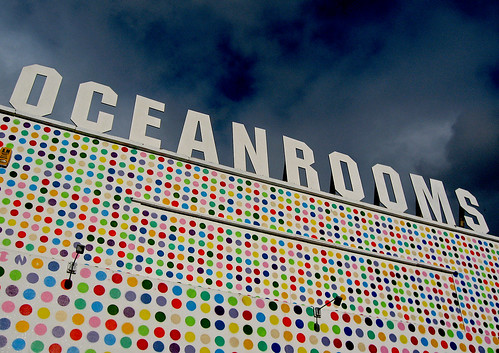
Before the downturn of 2008, Damien Hirst appeared to ride the wave of irrational exuberance. Here was the artist of the mad herds. In 2007, he fabricated a diamond-encrusted skull, which he called For the Love of God, and made headlines attempting to sell it for 100 million dollars. Then months before the crash, he unloaded his stock for top dollar at Sotheby’s. Just in time, it seemed, he cashed out in an art world example of the “greater fool theory,” with sorry speculators left holding the bag of his worthless
gewgaws.

For anyone who thought Hirst popped louder than a Vegas exurb after that auction, the past month has been a reminder that there’s still air left in the pneumatic Brit. The dealer Larry Gagosian has scheduled an exhibition of Hirst’s “spot” paintings in all eleven of his galleries spread across eight cities on three continents, with a total of 331 works on display worldwide. Regarding these canvases of colored dots painted by Hirst’s studio assistants, the finest comment has come out of a viral video by the internet personality Hennessy Youngman, who called them a “perfect storm of banality.”

Unlike many of our other toxic assets, Hirst somehow avoided the downgrade of 2008. He has positioned himself as a bubble about a bubble, madness about madness, as much of a statement on popular delusion as a product of it. He designs his artwork to appear valueless—blown-up baubles, useless pills, the trinkets of a carnival midway writ large—then sits back as his prices plump up against all reason. What matters is the way we respond to them. Amplified through a feedback loop of supposed meaning, popular reaction builds into a deafening noise that Hirst and his supporters point to as evidence of his ability to resonate with mass hysteria.

Brilliant, right? Except for one thing: I always thought Hirst was worthless, and I’ve yet to meet anyone who thought otherwise. So where is the madness? It doesn’t exist. It never did. The Hirst bubble was never the product of mass delusion. It was something far less interesting—a fake bubble puffed up and maintained by a syndicate of gallerists, museum professors, PR flacks, art gossip reporters, and moneyed collectors. The only madness surrounding Hirst is the hype they generate for him and our exasperation at the inanity of the spectacle.

And, of course, we always knew that. As the critic Will Brand recently wrote: “I’m going to lay this down, just to clarify, so that nobody from the future gets confused: We hate this shit. Everyone hates this shit. These spots reflect nothing about how we live, see, or think, they’re just some weird meme for the impossibly rich that nobody knows how to stop.”

The Gagosian shows are merely groundwork for Hirst’s retrospective at Tate Modern this spring. The Tate will then promote future sales at Gagosian. And so on. That’s the insidious thing about the Hirst bubble. Unlike a real bubble, we never want to buy in, yet somehow we end up holding the goods anyway, in this case through our public institutions. We did not willingly inflate anything. Instead, the Hirst bubble blows up by knocking the air out of the rest of us. It comes down to a battle over air rights. So many artists are making vital work today. They could resonate the spots off Hirst. They just need their air back.
NC PANERO
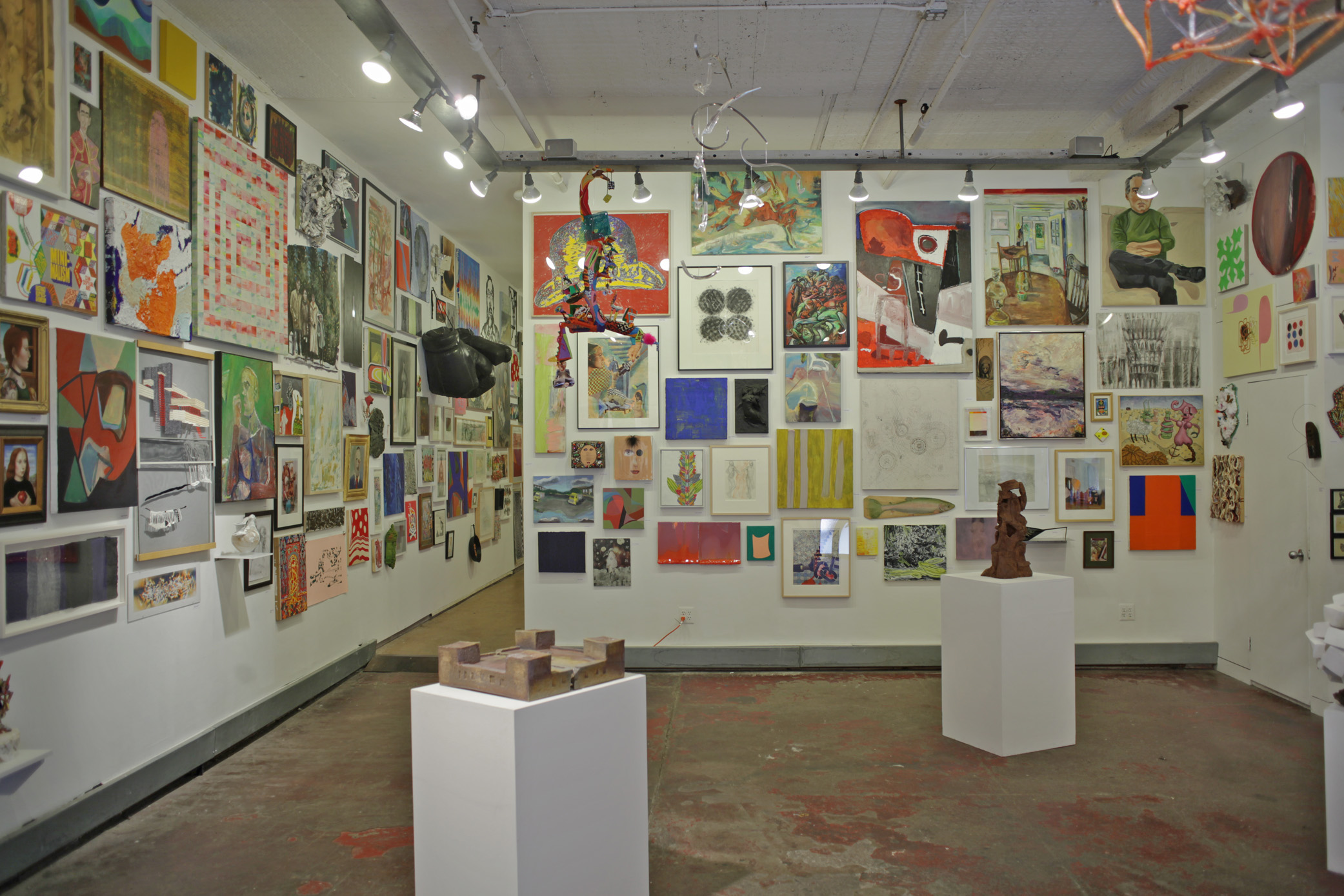
Sideshow Gallery, Williamsburg, Brooklyn (installation view)

Art abhors a vacuum. It needs atmosphere to bounce its energy around. That’s why artists, writers, and videographers are slowly building their own infrastructure to support an alternative ecosystem for serious art. They are finding ways to nurture the art they value most. And little would be possible without alternative galleries to exhibit this work. I have written many times in this space about the galleries in Bushwick, Brooklyn. Yet before Bushwick was even on the map, there was Sideshow Gallery, founded in 1999 by Richard Timperio in the nearby neighborhood of Williamsburg.

For the past twelve years, Timperio has hosted a regular group exhibition at Sideshow that has become a main event in alternative art. Timperio reclaims some air from the establishment’s machine with a spectacle of his own. His group show is a demonstration of the power and the numbers of the art scene gathering across the East River on New York’s Left Bank of Brooklyn—the rising Montparnasse. For this year’s show, on view through February 26, he has gathered over four hundred artists to exhibit their work across every square inch, floor to ceiling, of his gallery’s two-room home.1

The artists here are tied together in more ways than one. This is not some museum curator’s idea of what’s hip this season but rather an organic network that has long been showing and working together, in some cases for over half a century. These artists do not exhibit here expecting to sell. They give their work over to Sideshow to demonstrate their affinity with the alternative scene. On opening night, the line goes around the block, even without advertising or coverage in the mainstream media.

I have never seen a larger gathering of work by great contemporary artists, with many I have previously covered in this column, including Lori Ellison, Tom Evans, Gabriele Evertz, Bruce Gagnier, Dana Gordon, Ronnie Landfield, Loren Munk, Carolanna Parlato, Peter Reginato, Paul Resika, Lars Swan, Kim Uchiyama, Don Voisine, Louisa Waber, John Walker, and Thornton Willis. Then there are artists whom I know better in their other roles—as the critic Mario Naves, the gallery owner Janet Kurnatowski (who, a few blocks away, is now exhibiting her own annual exhibition of works on paper), and Lauren Bakoian, the director of Lori Bookstein Fine Arts.

Evertz111
Gabriele Evertz, Six Grays + B/W (2002, acrylic on wood, 16"x16")

With its crowded bodies and crowded walls, Sideshow offers a must-see exhibition that is a challenge to view. It is an annual conference of alternative art as well as a card catalogue of artists to follow throughout the year. Of particular note this year is the small panel by Evertz, an example of this colorist’s investigation into gray that was the subject of a breathtaking show at Minus Space.2 Landfield’s small canvas reveals the lyrical abstractionist at his finest. Uchiyama’s watercolor on paper was a spare standout. Gordon is a Sideshow regular whose Orphic investigations into shape and color have led him to create some of the best paintings of his career. More of his work will be on display this month at the Triangle Arts Association in a group exhibition called “What Only Paint Can Do,” curated by our own Karen Wilkin.
LE10068F
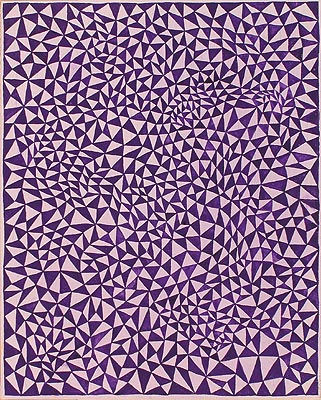
Lori Ellison, Untitled (2011, Gouache on wood panel, 10 X 8 inches) 

Through exhibiting at Sideshow and Valentine Gallery in Ridgewood, Queens, Lori Ellison is one artist who has used both social media and the alternative galleries to land, after many years, in the catbird seat of public acclaim. For decades she has made wondrous, intimate drawings and panel paintings from the sidelines. Now she is enjoying a solo show at the superb Chelsea gallery McKenzie Fine Art that is a tribute to her dedication and a testament to the emerging dynamics of a new and more open contemporary scene.3

McKenzie has matched Ellison’s recent geometric and biomorphic pen drawings and gouaches on wood with a series of arabesques from a decade ago, some painted in glitter glue. The comparison is interesting. While remaining idiosyncratic, Ellison has clearly distilled out the cuteness over the years, refining her geometry and color sense to create the crackling abstractions we see today. While her works are nothing if not obsessive, they have evolved in a way that speaks to the seriousness of her studio practice and explains how she now comes to have our undivided attention.
BetterMeThanYou_Halsey_Hathaway
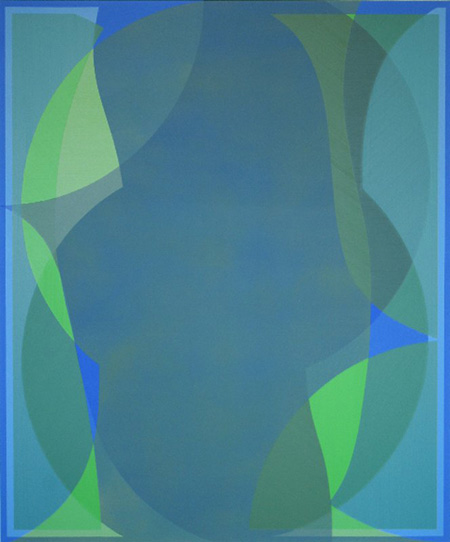
Halsey Hathaway, Better Me Than You (2011,  60" X 50" acrylic)

Meanwhile in Bushwick, the Sideshow artist Gary Petersen has found a home at Storefront Bushwick. This is the new gallery opened by Deborah Brown housed in the same location as the groundbreaking space she co-founded with Jason Andrew two years ago—simply called Storefront. As a curator, Brown is a matchmaker, drawing on an extensive network to pair artists across generations. Her first show is a visual stunner, with Petersen’s hard-edged dynamos of swirling stripes matched with Halsey Hathaway’s overlapping disks and, in the back room, Dutch-born Rob de Oude’s moiré patterns of meticulously painted lines.4
Freedman7-1-425x340
Lee Bontecou, Sandpit (2011; mixed media; 24 x 19 inches)

Finally this month offers up our last chance to see the art world’s original alternative in her current show. Lee Bontecou always refused to be taken in. After bursting onto the scene in the 1960s with her singular and haunting wall sculptures of layered canvases, often stitched around gaping voids, she retreated entirely from public view. Yet she never stopped making art. Now in her eighties, she is as inventive and singular as ever. Her exhibition of drawings and sculptures on view at FreedmanArt through February 11 is not to be missed.5

While Bontecou has always been reluctant to explain her work, for her retrospective in 2003 she briefly relented. “The natural world and its visual wonders and horrors,” she explained, “man-made devices with their mind-boggling engineering feats and destructive abominations, elusive human nature and its multiple ramifications from the sublime to unbelievable abhorrences—to me are all one.”

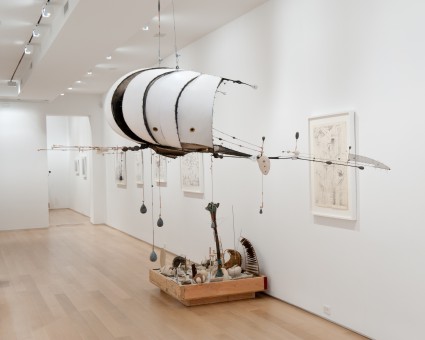
Bontecou works at the intersection of man, nature, and machine. Her neo-Gothic, steampunk, post-apocalyptic aesthetic owes something to her upbringing: her father invented the first aluminum canoe; her mother wired submarine transmitters. But even here she resists easy labeling, seeking to occupy “all freedom in every sense.” At FreedmanArt, creations are more undersea than overhead, with delicate ocean crafts suspended from the ceiling and odd plant- and mollusk-like creatures peering up from sandbox dioramas, all paired with drawings of waves, flowers, and eyes.

When Donald Judd wrote that Bontecou can reference “something as social as war to something as private as sex, making one an aspect of the other,” he hit on only two of her many readings. Dore Ashton offered an elaboration. “Far more significant than the obvious sexual connotations so often invoked for her work,” she observed, are the mysterious and ultimately “inexpressible sources of her imagery.”

1MIC:CHECK (occupy)” opened at Sideshow gallery, Brooklyn, on January 7 and remains on view through February 26, 2012.

2 “Gabriele Evertz: Rapture” was on view at Minus Space, Brooklyn, from November 5 through December 17, 2011

3 “Lori Ellison” opened at McKenzie Fine Art, New York, on January 5 and remains on view through February 11, 2012.

4 “Halsey Hathaway and Gary Petersen: New Paintings” and “Paintings by Rob de Oude” opened at Storefront Bushwick, Brooklyn, on January 1 and remains on view through February 5, 2012.

5 “Lee Bontecou: Recent Work: Sculpture and Drawing” opened at FreedmanArt, New York, on October 27, 2011 and remains on view through February 11, 2012.

Gallery Chronicle (January 2012)

Cathy
Cathy Nan Quinlan with "My Collection." Photograph by Su Friedrich.

THE NEW CRITERION
January 2012

Gallery Chronicle
by James Panero

On “My Collection” by Cathy Nan Quinlan at www.thetemporarymuseum.com and by appointment in Bedford-Stuyvesant, Brooklyn; “Re-Telling” at Nurture Art, Brooklyn; Ahram Jeong” at Momenta Art, Brooklyn & “Concrete Sound” at Norte Maar, Brooklyn.

Manhattan is the center of the art world. So why schlep to the outer reaches of Brooklyn to see art? My wife has asked me that question more than once on a weekend night, standing on the platform of a subway line we didn’t know existed or waiting to buzz up to an apartment gallery beneath the shadow of a cement plant. So what brings us back weekend after weekend? It’s a good question, and to suggest that we find a pied-à-terre in Bushwick to avoid the hour-long commute back home is not the best response.

Nor does the answer have to do with the appearance of what we see in these out-of-the-way venues. Bushwick, the neighborhood that is now shorthand for New York’s alternative art scene, offers up realism and abstraction, sculpture and painting, all in equal measure. The group shows that make up the bulk of Bushwick’s exhibition program often range across several styles as if refusing to settle on a single look.

While Bushwick lacks a style, I have learned that it shares a substance, in that most of the things you see there are made to take home. Bushwick certainly did not create the commercial art market. It did not invent art that could be purchased, traded, moved, and hung on a living-room wall. Instead, Bushwick’s contribution has been to construct a commercial art scene of its own that is ad hoc and where almost anyone can participate. It offers up art that we can all purchase, trade, move, and hang on our own living-room walls.

Bushwick has gone against the grain, not by turning against the commodities of art, but by turning art into a commodity that is local, much like the many other do-it-yourself craftsmen and cottage industries that have helped this borough become a hub of innovation. By going local, Bushwick does not rail against the art establishment of museums, auction houses, mega-collectors, and celebrity Chelsea galleries. Instead it sets up a viable, alternative culture of arts patronage. Rather than produce large, high-tech, or conceptual work for museums and the rich, it offers up small objects for any wall and every budget. Here the prices asked for individual pieces—in the hundreds of dollars—could not even pay to keep the lights on in a Chelsea gallery. In Bushwick, with art clustered on row-house walls or presented in apartment galleries, the locals make it work. Bushwick’s vitality is in its collectability.

Cathy Nan Quinlan is a painter who for several years has made a side project out of what it means to collect art. Her discoveries, by turns charming, allusive, and funny, can tell us much about the joys of living among the works of artists you know and admire.

From 2005 through 2008, Quinlan ran what she called The ’temporary Museum of Painting (and Drawing) out of her loft apartment in Williamsburg, Brooklyn. With her play on the word “contemporary,” Quinlan aimed “to exhibit and discuss contemporary painting in all its various forms, whether fashionable or unfashionable (at the moment). It is our opinion that a painting, by virtue of its compact, intense stillness, is the perfect object for both contemplation and conversation.”

For Quinlan, The ’temporary Museum was a turnkey institution. One day, she says she decided to invite other artists to exhibit their work in her home. She then put a sign outside and started keeping regular museum hours. She organized exhibitions out of what she called her “Impermanent Collection.” By 2008, she had exhibited ninety-six artists in a space that had become the definition of a local, DIY institution.

When she gave up the lease on her Williamsburg loft to buy a row-house with her partner Su Friedrich, an independent filmmaker, Quinlan closed the museum, but she maintained the website with its record of exhibition programs. Now at her home in the Bedford-Stuyvesant neighborhood of Brooklyn, Quinlan has launched what she calls a “new wing” of The ’temporary Museum called “My Collection.” As we might gather, this wing exhibits the work in Quinlan’s own art collection, which she now hangs salon style in her living room. Following an opening party in December, “My Collection” will be maintained as an online project on The ‘temporary Museum website, redesigned by Friedrich and edited by Barbara Epler, the president of New Directions Publishing.1

Quinlan’s website features a page on each work and tells a story about them, much as she might discuss her collection with a friend. “Very little money went into amassing these works;” she explains, “they were mostly gifts and trades, and one or two were just never picked up from shows I curated at The ’temporary Museum.”

Several of the artists here—Sharon Butler, Loren Munk, Adam Simon—will be familiar to the gallerygoers of Bushwick. Others might be new, such as Kurt Hoffman, whose Eastern-inspired landscapes on rice paper, painted en plein air in Central Park, will be exhibited this spring at Valentine Gallery in Ridgewood, Queens.

What distinguishes Quinlan is not only the interest of her collection but also the interesting things she writes about it. “How often I have looked at these paintings while thinking about something else, or glanced at them in passing,” she says. “I have looked at them during arguments, when bored with people or with life, in happiness, misery, and while waiting for the water to boil. I started to think about how different living with a painting is than visiting one in a museum (or gallery) and how pleasurable.”

It is impossible not to see a connection between Quinlan’s collecting project and the paintings she makes in the room next door. The latest series of her work, which will also be exhibited at Valentine this spring, are paintings inspired by the prints of Giorgio Morandi. Some are closely rendered approximations of Morandi’s well-known series of natura morta. Others are more abstract experiments, where the objects nearly become lost in a thicket of painted hatch-marks while also referencing Optical Art and the flickers of a television screen.

Both her collection and her paintings find delight in the pleasures of home. Quinlan understands how art, woven into the fabric of life, can provide another form of domestic comfort. Through The ’temporary Museum, we are fortunate to be invited in to take part in these conversations around a living room filled with art.

Quinlan’s observations come to mind when considering the recent development of a building at 56 Bogart Street in Bushwick. Steps away from the Morgan Street subway station, Bushwick’s arterial node to the not-so-reliable L Train, 56 Bogart is an old industrial loft that recently offered its first floor over to gallery use. Several institutions, some coming in from other neighborhoods, jumped at once to take over this prime space, with over half a dozen galleries and exhibition spaces opening last fall and more to follow. Meanwhile the blue-chip Chelsea gallery Luhring Augustine is turning its nearby back-office into a satellite exhibition space, perhaps signaling the arrival of other established names to a neighborhood that most art-world insiders still cannot locate on a map even if their driver has learned to find the restaurant Roberta’s next door.

Located in the heart of Bushwick, these new spaces present a challenge to the local ecosystem. One issue is whether this new concentration of venues will pull people out into the wider network of apartment galleries or draw resources away from those scattered, shoestring spots. As these ventures set up shop and benefit from Bushwick’s vitality and reputation, the question remains as to how they will mix with the neighborhood’s existing artists and gallery owners and their own institutions, including their network of collectors.

The building’s opening night was Friday, October 21. Gallery 10 hosted a talk with Bushwick habitués Paul D’Agostino, Adam Simon, Sharon Butler, Austin Thomas, Matt Freedman, and Frances Richard on the subject of alternative spaces, artist prices, and the avant garde. A small venue by the building entrance, called Agape Enterprise, plans to exhibit a rotating salon of intimate works, host artist talks, and feature a “gift shop” in the building’s preserved wood-paneled front office, all meant to serve as an antidote to the white-box gallery. Another space, called The Bogart Salon, aims to organize both exhibitions and participatory performances. Its first concept, which offered a live mock-up of Manet’s Déjeuner sur l’herbe (nude model included) and brought artists in to sketch, became something of a spectacle. Meanwhile, down the hall, Interstate Projects presented two video installations by Jesse McLean.

Much attention has been paid to two nonprofits that anchor the building. Nurture Art, known for hosting monthly arts talks and welcoming guest curators, moved from Williamsburg to the basement space of 56 Bogart, opening a few weeks after the other venues. Its inaugural exhibition, curated by Melissa Levin, was called “Re-Telling” and promised “a discreet revision of a history, a landscape, a narrative, a body; often a response to the initial telling being a gross glorification and romanticization.”2

The other is Momenta Art—an institution founded in 1986 by Eric Heist, now the proprietor of Agape—that moved from Williamsburg to the first floor. Its opening show featured Ahram Jeong, an artist born in Korea and now living in Brooklyn.3 In one room, Jeong positioned participants on two carpeted disks, attached heart monitors that activated cameras and flashbulbs, and projected the resulting images on the wall. In another room, she showed videos that recorded the sound of her own heartbeat as she dug a grave, which she translated into digital percussion and notation. She also filmed a drummer interpreting the music from inside the grave pit.

These two nonprofit exhibitions were high concept. Momenta Art’s was high tech. Both seemed out of step with the rest of the neighborhood. In his essay “Museum Without Walls,” André Malraux saw how “the effect of the museum was to . . . divest works of art of their functions. . . . Each exhibit is a representation of something, differing from the thing itself, this specific difference being its raison d’être.” Whatever efforts they made to connect with the local community, these shows seemed too wrapped up in their own raisons.

Across the neighborhood, Norte Maar, Bushwick’s original arts nonprofit and the apartment gallery of Jason Andrew, offered up an exhibition that showed how high concept can interact with the low-tech limitations of the neighborhood. Audra Wolowiec is an interdisciplinary, Brooklyn-based artist who works with sound and created much of the score for Andrew’s ballet “In the Use of Others,” reviewed in these pages in May 2011. For her installation at Norte Maar called “Concrete Sound,” she arranged hundreds of hand-cast tinted sculptures on a table in a pattern that referenced the foam sound insulation found on the walls and ceiling of recording studios.4

Rather than absorb ambient noise, Woloweic’s concrete forms resonated with the room’s sound environment, at least metaphorically so. Andrew arranged for local readers to perform around the object. He also commissioned a chapbook featuring the poems of Christine Shan Shan Hou echoing Wolowiec’s statements. In a final resonant note, he underwrote the project by selling off small blocks of the installation to collectors. Now this installation will continue to live through living-room conversations long after the closing of the exhibition.

1 “My Collection” opened on December 4, 2011 and remains on view at thetemporarymuseum.com and by appointment in Bedford-Stuyvesant, Brooklyn.

2 “Re-Telling” was on view at Nurture Art, Brooklyn, from November 11 through December 16, 2011.

3 “Ahram Jeong” was on view at Momenta Art, Brooklyn, from October 21 through December 5, 2011.

4 “Concrete Sound” was on view at Norte Maar, Brooklyn, from October 28 through November 20, 2011.

Art and Urban Density

The-Bowery
Loren Munk, "The Bowery and the New Lower East Side" (2008-2010), 60" x 36", Oil on linen

CITY JOURNAL
December 2, 2011

Art and Urban Density
by James Panero

Loren Munk’s work celebrates New York’s ever-changing art scene.

When you’re considering the history of a great city, the history of its art deserves special attention. Recently, a gallery exhibition on Manhattan’s Lower East Side provided a unique visualization of the way art gets woven into the New York fabric.

Loren Munk, the artist behind “Location, Location, Location: Mapping the New York Art World,” which showed at Lesley Heller Gallery in September and October, is a Brooklyn-based painter who studies the effects of urban geography on artistic development. Believing that art is as much a social practice as a solitary one, Munk creates paintings made up of colorful, detail-laden maps and flow charts with thousands of data points indicating the placement of artist studios, the addresses of galleries, and the location of art critics within the urban grid. Munk’s information comes out of his own archival research as well as access to a community of artist friends. The look of the paintings, along with the selection and spelling of artists’ names included in them, is idiosyncratic. Yet the complexity of the networks that Munk constructs, often painted over many years, makes a compelling visual argument: that urban density plays a key role in artistic innovation.

In several paintings, Munk focuses on one of New York’s “arts” neighborhoods, often no more than 10 blocks square. In Soho Map (2005–06), he identifies the studios of nearly 100 artists—including Richard Serra, Donald Judd, Frank Stella, Thornton Willis, and Peter Pinchback—along with the addresses of almost as many galleries. Soho Map shows this neighborhood at its most concentrated, a time in the 1980s when the area had become the focus of the art world. In fact, Munk identifies one building in the middle of his map, 420 West Broadway, as “the center of the center of the art world universe.”

The rise of Soho was a phenomenon of the 1960s and 1970s, when artists disregarded fire and zoning codes to carve up studio and living spaces out of derelict cast-iron factory buildings. From their large-scale studios emerged large works—Stella’s monumental canvases and Judd’s walk-through minimalist sculptures. Today, the names of the galleries on Soho Map might be familiar, but not their addresses. In the 1990s, nearly all went out of business or relocated northwest to Chelsea and the art world’s newest retail hub between Tenth and Eleventh Avenues, now centered around 25th Street. Just as the galleries departed, most of the artist pioneers on Munk’s map have since cashed out on the gentrification they started and sold their studios as multimillion-dollar lofts. A documentation of this recent history, Soho Map reminds us of how so much “big” art once emerged from such a small section of New York—and how little comes out of it today.

Munk’s other maps track similar neighborhood movements. In The Bowery and the New Lower East Side (2008–10), Munk paints a note into the work that explains: “During the nascent phase of Minimal and Conceptual Art, a coterie of artists living close to each other on or near the Bowery (several of whom also worked at the Museum of Modern Art) began to form. They were identified by Irving Sandler in ‘American Art of the 1960s’ as the Bowery Boys.” In Village of the Damned (2004–05), Munk follows “the rise and fall of an art scene,” as he calls it, in the East Village between 1981 and 1987. “Rise and fall” is something you see repeated in each of these neighborhoods. One cause of the changing fortunes of arts areas may be economic: artists are independent manufacturers often willing to trade safety and convenience for cheaper rents and bigger spaces. It’s commonly argued that artists become victims of their own gentrification, getting priced out of the neighborhoods they’ve made attractive to others. But Munk’s paintings suggest another explanation: that artists are drawn together by density itself. The laws of economics might suggest that artists spread out in relation to the price of real estate; instead, they come together even as prices rise. They seek out neighborhoods with a rising concentration of other artists and a low number of non-artists, and they move in flocks as those density numbers change.

A century ago in Paris, the life of the bohemian was far harder than in today’s New York, yet artists from around the world still went there to live and work. They followed migratory patterns similar to those that Munk finds in New York. In Paris, artists’ flats had no heat or hot water. The problem of pestilence and disease was a fact of everyday life. “Poverty was a luxury,” said the playwright Jean Cocteau of his neighborhood of Montparnasse. Still, artists crowded not just into Paris but even into certain neighborhoods and, if they could, specific buildings. In Montmartre, north of the city center, the Bateau-Lavoir—a low-slung building that resembled the laundry boats used along the Seine—became the studio residence of Picasso in 1904 and the meeting place of the poet Guillaume Apollinaire, the playwright Max Jacob, and the critic André Salmon. Yet by the end of the first decade of the twentieth century, the picturesque charms of Montmartre had flooded the neighborhood with tourists and pleasure-seekers.

Once the Nord-Sud Metro opened in 1910, Montparnasse to the south quickly replaced Montmartre as the new artist hub. Here a studio building known as La Ruche, literally “the hive,” became the center of artistic activity, with 200 artist beds tucked into apartment studios arranged in the round housing Marc Chagall, Chaim Soutine, Jacques Lipchitz, Alexander Archipenko, Ossip Zadkine, Amedeo Modigliani, and Ardengo Soffici. Picasso himself, a Spanish transplant with a keen understanding of the way geography aids artistic innovation, relocated to Montparnasse in 1912.

It would be a mistake, however, to attribute artistic innovation to a few brilliant loners in a garret. Rather, it was the thousands of artists living and working next to one another in these two packed neighborhoods in Paris that sparked the rapid development of modern art there. “To a greater extent than any time since the Renaissance,” wrote the historian Roger Shattuck of Paris at the turn of the century, “painters, writers, and musicians lived and worked together and tried their hands at each other’s arts in an atmosphere of perpetual collaboration.”

The same holds true in Munk’s New York, where artistic movements and schools waxed and waned within specific neighborhoods. The history includes the “Tenth Street Touch,” as one critic called it, of 1950s New York, and the subsequent rise and fall of the Bowery in the 1960s, Soho in the 1970s, and the East Village in the 1980s. These days, we see the changing fortunes of Brooklyn enclaves like Williamsburg, which Munk, writing for the Brooklyn Rail, recently declared “over. . . . The inevitable move east on the L line by artists seeking cheaper studio and living space has birthed Bushwick/Ridgewood, which amounts to Williamsburg 2.0.”

Density accelerates the spread of information. Artists seek out highly concentrated areas for the same reason that other innovators do. In 1890, the economist Sir Alfred Marshall first recognized that in cities, ideas are simply “in the air.” He saw how the interactions of city dwellers have a unique effect on innovation. These interactions were a direct result of urban density, where people live and work in close proximity. Greater density translates into a higher chance of unplanned encounters and conversations, whether on the street, across the studio hallway, or in the gossip of restaurants and cafés and gallery openings. These encounters, known as dynamic externalities, take place at no cost and result in the phenomenon of spillover. In exchange for struggling in the crowded city, the poorest artist can be enriched by the ideas circulating for free.

The vibrancy of New York’s current arts neighborhoods—Chelsea and the Lower East Side with their galleries and East Williamsburg, Bushwick, and Gowanus with their sprawl of studio lofts—suggests that Marshall’s spillover effect continues, even as artists connect through the newer networks of social media. Artists move and settle in tight patterns—always outside the controls of central planning and, in fact, usually under the radar of existing housing codes (“Loft Laws” are after-the-fact forms of legislation used to legalize the artists already residing in manufacturing zones).

It’s worth noting that Munk himself, as part of his artistic project, has become something of a new-media phenomenon. When not painting his maps, Munk films the openings of gallery exhibitions and has posted over 500 of them to YouTube under what he calls “The James Kalm Report.” Recently he has also cast a skeptical lens on the Occupy Wall Street protests and posted them to his page of more immediate reporting, “James Kalm Rough Cuts.” Each of these videos, which can attract viewers in the thousands, has exposed New York’s gallery shows to a wide audience while creating an invaluable archive for future Loren Munks. Biking from one exhibition to the next, Munk demonstrates how new media merely supplement, rather than replace, the brick-and mortar-experience of artists packed into the city’s grid. The title of Munk’s recent exhibition says it all: if you want to be an artist, or for that matter any kind of innovator, “location” still matters most.