Coming Home

THE NEW CRITERION, March 22, 2022

Coming home

On “Nuestra Casa: Rediscovering the Treasures of The Hispanic Society,” at The Hispanic Society of America, New York.

In the January issue of The New Criterion I wrote about The Hispanic Society of America, New York’s treasure house of Spanish art, literature, and more. This 1904 Beaux-Arts creation on Audubon Terrace at 155th Street and Broadway, in Washington Heights, is my favorite local institution. No other collection in the New World can rival certain strengths of its holdings. Yes, the institution is underfunded and in need of restoration. At the same time, the Society’s remote location and self-contained mission have allowed it to focus on the business of preserving, presenting, and acquiring great works of Spanish culture beyond the political pressures of today’s museum mainstream.

Francisco de Goya, Duchess of Alba, 1797, Oil on canvas, The Hispanic Society of America, New York.

So it was with a degree of consternation that I received an invitation to the Society’s latest exhibition, called “Nuestra Casa: Rediscovering the Treasures of The Hispanic Society.” Here is an exhibition, we are told, that

comes at a moment when it is necessary for our traditional art historical hierarchies to be reassessed to fully incorporate the diverse populations to whom our public institutions belong, showing that the HSM&L’s collection extends much beyond the artwork of El Greco, Goya and Sorolla, to masterpieces within a range of mediums by relatively unknown Latin American artists, at times still unidentified, who have previously received little recognition.

Reassessing our “traditional art historical hierarchies”? Moving beyond the artwork of El Greco, Goya, and Sorolla to “masterpieces” by “relatively unknown Latin American artists . . . who have previously received little recognition”? Por favor, when you are the Hispanic Society, such boilerplate should be unnecessary. This is the institution that wrote the book on inclusion. The Society’s founder, Archer Huntington, took a serious interest in the works of both Spain and the Spanish diaspora at a time when Italian painting was regio. And indeed, contra the claims of “little recognition,” this exhibition of works from the collection reveals how much the Society was in fact at the forefront of appreciating the diversity of Hispanic culture from its inception. We are all now playing catchup to what Huntington collected and valued a century ago—and what his institution has been doing ever since. 

El Greco, Saint Jerome, ca. 1600, Oil on canvas, The Hispanic Society of America, New York.

Curated by the visiting scholar Madeleine Haddon, the exhibition fortunately offers more than what these first impressions might suggest. In fact, the show ably tells the story of Huntington’s enlightened collecting interests: 

Huntington was prescient in his understanding that a museum of Hispanic culture should be deeply grounded in Latin America. It was after attending a formal dinner given by President Porfirio Díaz in Chapultepec Castle while on a business trip to Mexico with his parents at age nineteen that, for the first time, Huntington made the decision to establish a “Spanish Museum.” 

Huntington’s remarkable mother, Arabella, is rightly given credit for inspiring her son’s pursuits. The Society curators who carried forward Archer’s vision also get their due: Elizabeth du Gué Trapier, Beatrice Gilman Proske, Alice Wilson Frothingham, Florence Lewis May, Eleanor Sherman Font, and Clara Louisa Penney. (To point out that these curators “comprised almost entirely women” is another box that should not need to be checked.)
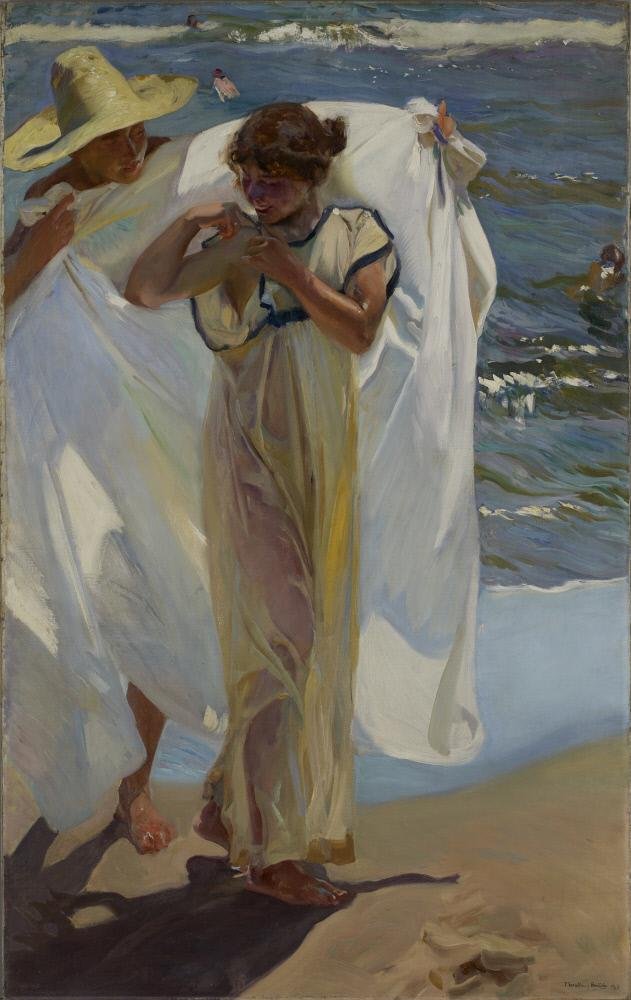
Joaquín Sorolla, After the Bath, 1908, Oil on canvas, The Hispanic Society of America, New York.

As the permanent-collection galleries remain closed for renovation, this exhibition comes during a brief break in the international tour of the Society’s treasures. That means New Yorkers have just three more weeks to see such genuine masterpieces as Velázquez’s Portrait of a Little Girl (ca. 1638–42), Goya’s Duchess of Alba (1797), El Greco’s Saint Jerome (ca. 1600), Zurbaran’s Santa Emerentiana (ca. 1635–40), and Sorolla’s After the Bath (1908). These works have been out of town since 2017. They will soon hit the road again for the Art Gallery of Ontario and London’s Royal Academy of Art. Our close proximity to The Duchess is alone worth the price of admission—which is free. Notice the full (and potentially romantic) drama of her hands and feet: the “Alba” printed on her ring, and her finger pointing to “Goya,” written, as though by her, in the sand at her feet.    

These masterpieces are paired, at times artfully, at times not, with an eclectic assortment of paintings, books, and artifacts from the collection. All are remarkable, including a cookbook from sixteenth-century Spain with the first published recipe for paella. Yet are these all “masterpieces”? An opening pairing of the Velázquez with El Costeño (ca. 1843), a sweet but simple portrait by the Mexican genre painter José Agustín Arrieta, seems especially forced. The comparison does a disservice to both works, while the gallery lighting, it should be said, is especially unflattering to Arrieta. 
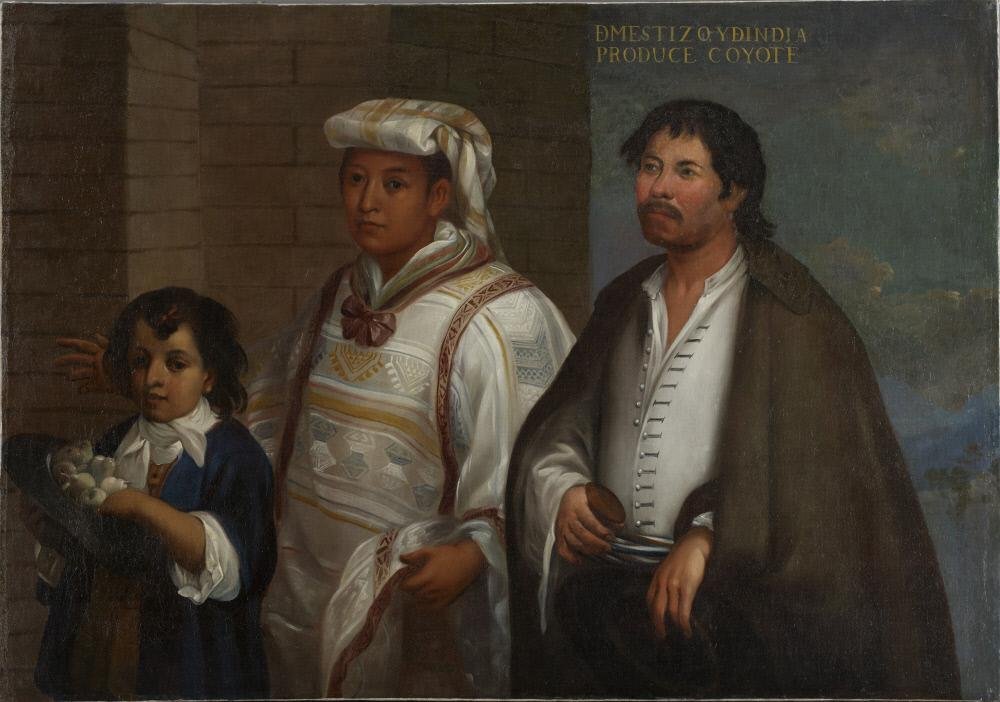
Juan Rodriguez Juarez, De Mestizo y de India produce Coyote, ca. 1715, Oil on canvas, The Hispanic Society of America, New York.

Still, they are interesting to see. The same goes for Juan Rodriguez Juarez’s De Mestizo y de India produce Coyote (ca. 1715), a study in racial typology. Miguel Viladrich Vilá’s Man and Woman from Montevideo, a pair of genre portraits from 1923–25, call out for a greater appreciation of this artist with over two dozen works in the Society’s collection. 

Let’s just appreciate such works for what they are—filling out our understanding of Hispanic culture—rather than pretending to offer up its greatest achievements. 
Exile in Florida

THE SPECTATOR WORLD EDITION, March 17. 2022

Exile in Florida

Palm Beach is more than Mar-a-Lago and hedgerow snobbery

For the New Yorker, touching down in Palm Beach is like visiting Taiwan from the People’s Republic of the Upper West Side. I am here for a few days. So is much of the American conservative movement. We are all fleeing to the sunny island like a government in exile.

Palm Beach is more than Mar-a-Lago and hedgerow snobbery. With a room at The Breakers now running $2,000 a night, I opt for a Vrbo at the Palm Beach Hotel. The old pile designed by Mortimer Dickinson Metcalfe in the Mediterranean Revival style in 1925 reminds me of the faded glory of the Grand Budapest Hotel in its Sovietized incarnation. The exterminator is a regular presence, but the price is right, and I like the overgrown pool deck. I watch a banana blossom shed its petals in the deep end as I read copy for the next issue of the New Criterion. For dinner I join friends by the fountain at Café Boulud, some fifty feet from their room at the Brazilian Court, the Sicilian castle designed by Rosario Candela in 1926. The air is wet with tropical fruit and old money. We admire the pecky cypress boards decorating the building like lace.

Back in the big city, just before my trip, I stumbled through the Columbus Circle subway station. A Putin apologist, a LaRouchite no less, then shoved a pro-Putin petition in front of me: “Will Carnegie Hall Denounce Nazism in Ukraine?” I lined up in the freezing cold on desolate 57th Street — Billionaires’ Row — for the check of my booster status. “How about your third shot?” the interrogator asked me, as I fumbled for my identification and medical papers. I felt like those huddled masses on Ellis Island awaiting the buttonhook to the eyelid to clear them of trachoma. As I arrived at my $250 seat to hear the Vienna Philharmonic, I convinced myself that Rimsky-Korsakov’s “Scheherazade” is worth it.

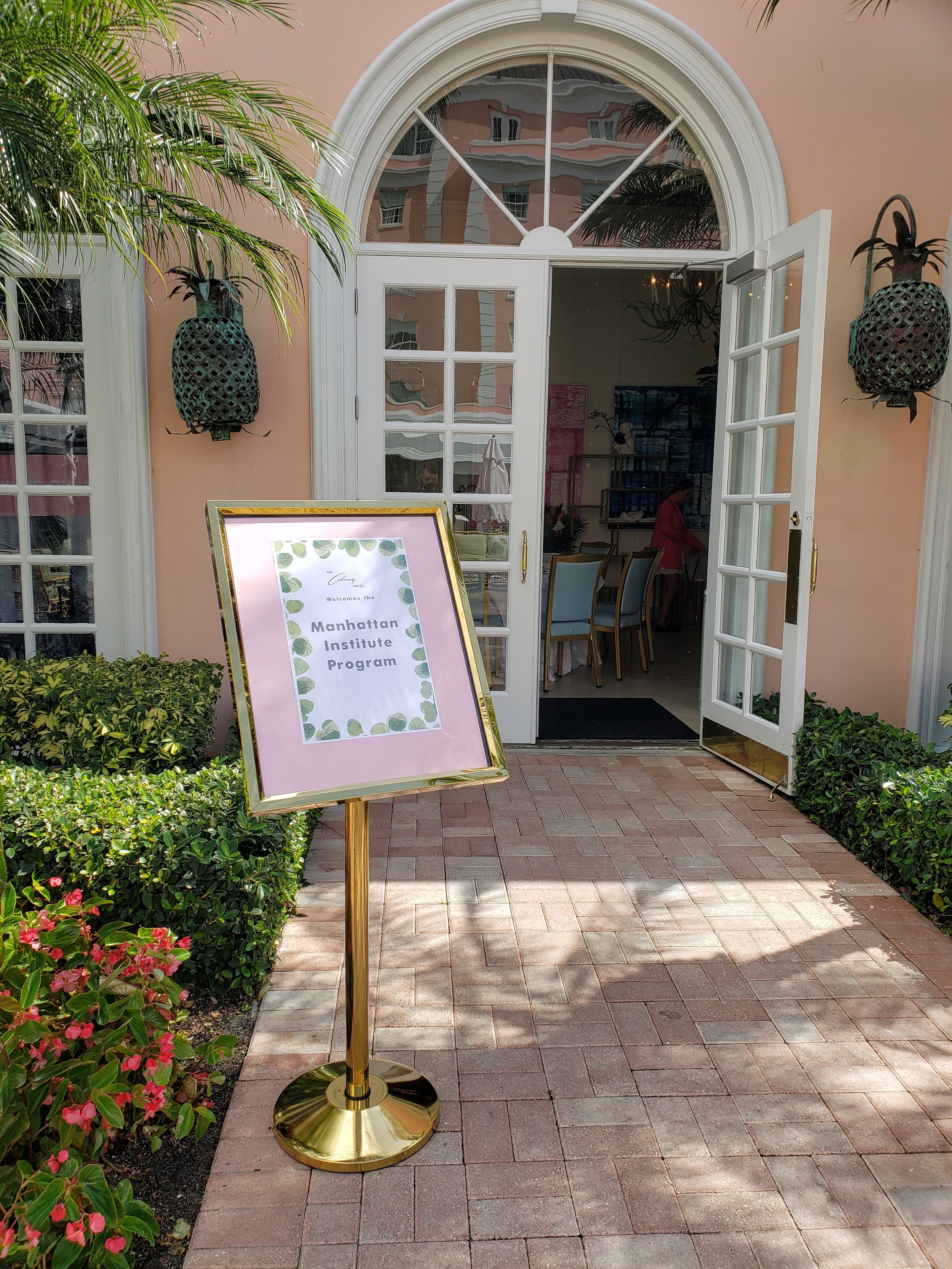
Now I am having second thoughts. It is 78 degrees and sunny and my first morning on the island. I am off to an “Ideas Summit” organized by the Manhattan Institute at the Colony Hotel. A colony of New Yorkers is more like it. I spot MI president Reihan Salam wheeling in his suitcase. “I’m a New York bitter-ender,” the Brooklynite tells me. “What do you need to do to get a crowd down here?” quips MI chairman Paul Singer. “Raise taxes in New York City.”

MI has brought down the heavyweights for its two panel discussions. For “Understanding America’s Cultural Revolution,” Heather Mac Donald rails against an obsession over structural racism in the museums: “There has not been a single institution that has pushed back against the lie. Even still lifes are coming under attack. They are still lifes, you idiots!”

Christofer Rufo, the David to the Critical Race Theory Goliath, says that Fortune 500 companies are repeating the same mantra: “A series of euphemisms to bully you into submission.”

Douglas Murray then suggests that “America is a projection device. You have to fight over every detail,” or else, “the rest of the world suffers for it.”

“We are headed to civilizational self-cancellation,” Heather concludes.

For a panel on “The Panic Pandemic,” John Tierney suggests that, “Using public health to grow government power and tell people what to do is a terrible precedent. It’s the left’s ‘long march through the institutions.’”

Dr. Joseph A. Lapado, Florida state surgeon general, agrees that it’s been wrong to ride out a pandemic on the lives of the young. At just that moment, I get a message from my daughter’s school that its mask mandate is ending. For the past year I have been insinuating that when her generation rises up to slaughter its elders, she should know that I was against all this. “Burn it,” I text her with a picture of a mask.

That evening, my colleagues and I gather for a cocktail reception at the home of friends. It is Fat Tuesday. A pianist starts playing some Rodgers and Hammerstein. I launch into my rendition of “Oklahoma.” Another singer joins me for some Cole Porter before I realize these are both professionals brought in for the evening and that this is not a group singalong. After the party and a casual dinner, we try to tune in to the State of the Union address. The horrific specter of war hangs over our entire visit, but Ukraine has already become the new superficial virtue signal of the Establishment, which will surely only hurt the cause of Ukraine. We lose our steam just as Joe Biden’s vitamin injections run low. Roger Kimball quotes that famous line from The Leopard, the great conservative novel by Giuseppe Tomasi di Lampedusa: “If we want things to stay as they are, things will have to change.”

The next morning, I walk out to the beach only to be blown inland by a sudden squall. It is Ash Wednesday, and Palm Beach is clearly not as anti-Catholic as it was once thought to be. At the intersection of Sunset Avenue and North County Road, I walk by St. Edward, the elegant 1926 church designed in the Spanish Renaissance style. Edward is one of the patron saints of difficult marriages. As the light changes, I spot a Mercedes with a license plate that says DON. I am reminded of the deposed ruler at the far end of the island. Will he run? Should he run? Will DeSantis run? A vote for “moving on” seems to be winning my straw poll, even if that means the former president should merely move on from the last election to focus on the next one.

Besides, we don’t want to give up DeSantis. Over lunch I see Karol Markowicz, Park Slope’s most famous dissident and a new Boca Raton transplant. She reflects the attitude of many Floridians who have reaped the benefits of their governor’s war with the pandemic status quo. “The moving vans only seem to be moving in one direction,” I observe. Over our lunch with media-in-exile, including David DesRosiers’s team at RealClearPolitics, we give thanks for the wisdom of federalism and the healthy competition of our states. It helps that Danielle Moore, the mayor of Palm Beach, is as cool as a Florida cucumber. I joined Dani for dinner and she tells me about her pet pig.

With what time remains, I take in the galleries on Worth Avenue and get a tour of the upstairs of Findlay, which had the foresight to settle here sixty years ago. I then head over to the Henry Morrison Flagler Museum. Whitehall, designed by Carrère and Hastings in 1902, is one of the most lavish extant mansions of the Gilded Age. This splendid house museum of the industrialist, railroad tycoon and hotelier speaks to the Gilded origins of Palm. Whitehall also serves as the genius loci of this golden island, where the gilding has never tarnished and the sun has never set.

New York is lucky that I like the cold.

The Pan Handler

THE SPECTATOR WORLD EDITION, March 2022

The Pan Handler

In our anemic age, cast-iron pans are just what we need to re-enrich the American bloodstream

I have become a pan handler — a handler of cast-iron pans. I can think of few hobbies that are as rewarding as collecting and cooking on cast iron. Skillets, griddles, muffin tins, Dutch ovens, waffle irons, corn-stick pans and much else: there was a time when America produced the finest cast-iron cookware in the world. The iron ore was abundant. So was the coal to melt it. Foundries went up across this great land. American cuisine developed around it. From fried chicken to cornbread, the American menu should still be cooked on cast iron. Southern cooks never forgot this. The same goes for soul food; black America has always prized its cast-iron inheritance. Now I find I have little need to cook on anything else. I prepare my food in the same pots and pans as my ancestors did a century ago.

My father introduced me to cast-iron twenty years ago, before its recent wave of popularity. One day, he started cooking on some inexpensive pots and pans from Lodge, the one major American cast-iron company that remains in operation today. I was not alone in my skepticism. It was a time when I still believed in “the new,” especially when it came to the kitchen. And cast iron seemed old. It was heavy. It required coats of oil. It wasn’t “nonstick.” It never really even got clean. Dishwashers, microwaves, and soap were all too newfangled for the old cast-iron technology.

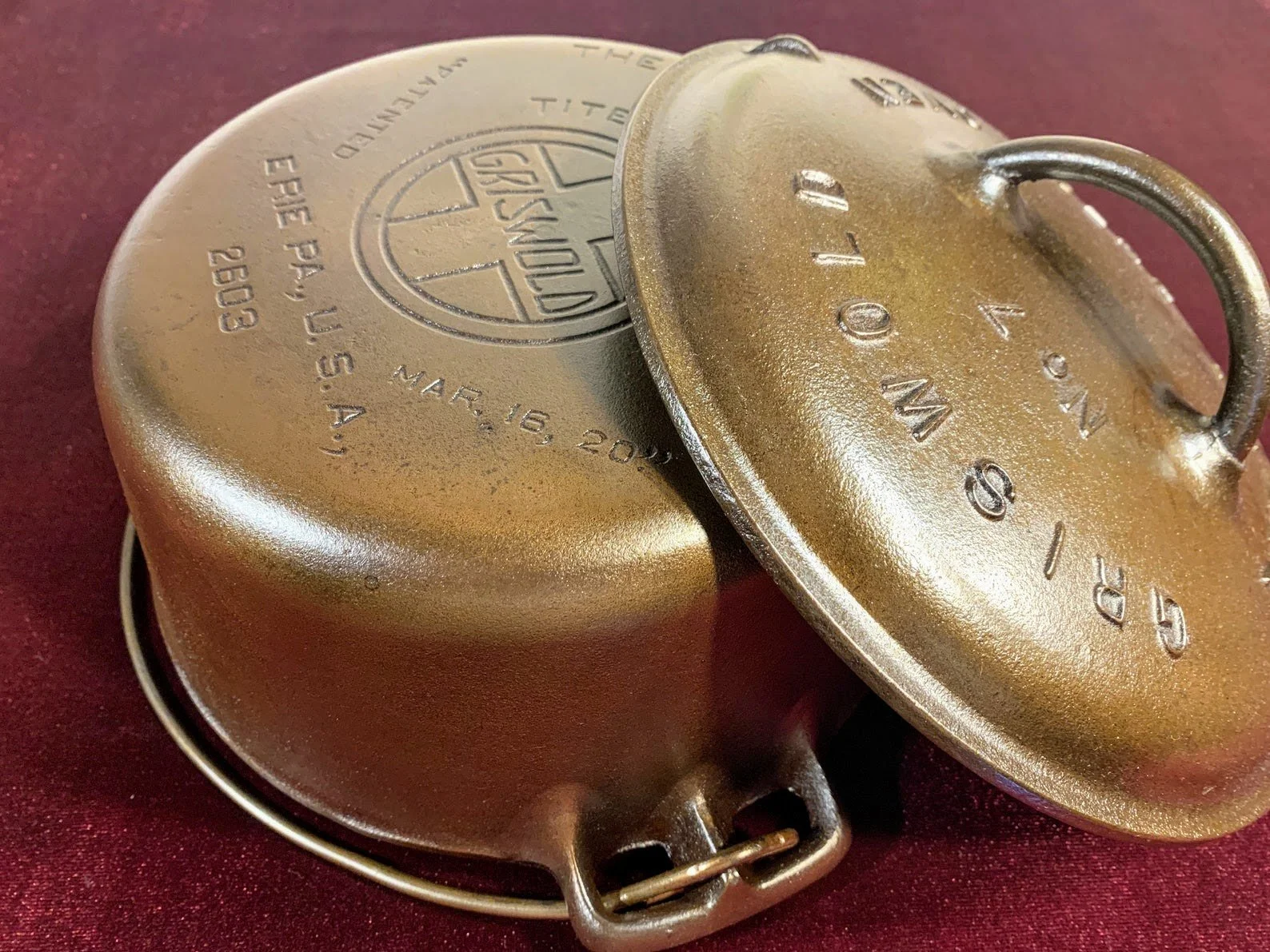
Griswold #7 cast-iron Dutch oven, produced by the Griswold Manufacturing Company, Erie, Pennsylvania, between 1910 and 1940.

But what a difference it makes with your food. You can sear meat like nothing else. You can make eggs that don’t taste like plastic because they are not cooked on plastic. You can take it from stovetop to oven to outdoor grill. You can broil, deep fry, stew, braise and bake with impunity. The more you use it, the better it gets. Unlike the modern pan that becomes a flaking chemistry experiment after a few short years — doing who knows what to your own insides — cast iron makes you stronger the more you lift it, scrape it, oil it, cook on it and season it. All the while, the healthy iron from the pan is entering your food. In our anemic age, cast-iron pans are just what we need to re-enrich the American bloodstream.

For over a decade, I have been cooking on my own basics from Lodge. My twelve-inch skillet and reversible griddle are my workhorses, as is my Lodge Dutch oven — a wedding gift from my father. At this point they are caked with seasoning, far from Instagram ready, but they get the job done without hesitation. At the latest sign of flaking, I will rub another coat of lard on them, wipe them down and bake them at 500 degrees for an hour in my oven. I am sure to keep my kitchen exhaust on high and get the kids out of the house (or better yet, use the outdoor grill) for the operation. It is the smoking of the lard that reveals the magic of the pan, as the fat polymerizes with the iron to create its own nonstick coating. Far from a chore, the proper seasoning of cast iron is one of its most satisfying traits as the pan is restored through fat and fire. You can’t do that with aluminum and Teflon.

Griswold #10 cast-iron muffin tin, produced by the Griswold Manufacturing Company, Erie, Pennsylvania, between 1910 and 1950.

“One is considered fortunate nowadays if by chance one of these iron utensils is handed down to them from the second to the third generation,” wrote Aunt Ellen, the popular correspondent of the late, lamented Griswold Manufacturing Company of Erie, Pennsylvania. For those of us with a broken chain of cookware, with the lightweight throwaways of the second half of the twentieth century interrupting our proper inheritance, there is now a robust market for vintage cast iron.

Griswold is the gold standard, with many variations and permutations of design to captivate the collector and help identify model and age. From a simple primitive “Erie” trademark, Griswold started employing a slanted-letter logo, a block-letter logo, and finally a smaller (and less desirable) branded logo. It produced skillets with heat rings and then flat bottoms. All along, Griswold’s manufacturing was more like artisanal sculpture-making than industrial mass production, as molten iron was poured into hollow sand molds. Cast iron is still made the same way today, but Griswold did it more delicately than anyone else, with crisp lettering and polished surfaces that left no trace of the textured sand.

Square waffle iron with high base, patented February 22, 1910, produced by the Wagner Manufacturing Company in Sidney, Ohio.

To add to the intrigue, as Griswold upgraded its designs, its old molds might be reused by another company, resulting in “ghost Erie” markings appearing behind the logo on Wapak and other pans. Sometimes foundries would also mold and cast competitor pans. These old recasts (and, increasingly new, counterfeits) can be easy to spot through their rougher textures. Whether you are a collector of Wagner Ware or smaller manufacturers such as Sidney or Piqua, to help differentiate there are website forums like castironcollector.com that can get as granular as the molding sand that formed these many marvelous items.

There’s much to be found on Ebay, but I have discovered the better dealers on Etsy, where you are a little more assured of a well-restored and documented item. Sure, some of these purchases can run to the hundreds of dollars. But every weekend I now get to use my No. 9 Griswold slant-logo waffle maker for family breakfast. You will never taste a better waffle than the one that emerges from these pristine stovetop paddles that were “pat’d Dec 1, 1908,” as they say right on their face. To these I have added a Griswold No. 7 Tite-Top Dutch Oven, a Griswold No. 10 muffin tin, a Griswold No. 5 skillet, and a Griswold cornstick pan — a gift from my aunt’s mother. What might I go for next? Perhaps an old Erie, or a Sidney Hollow Ware skillet, or a Wapak. Whatever I choose, the great luxury of cast iron collecting is the luxury cooking I can do on it.

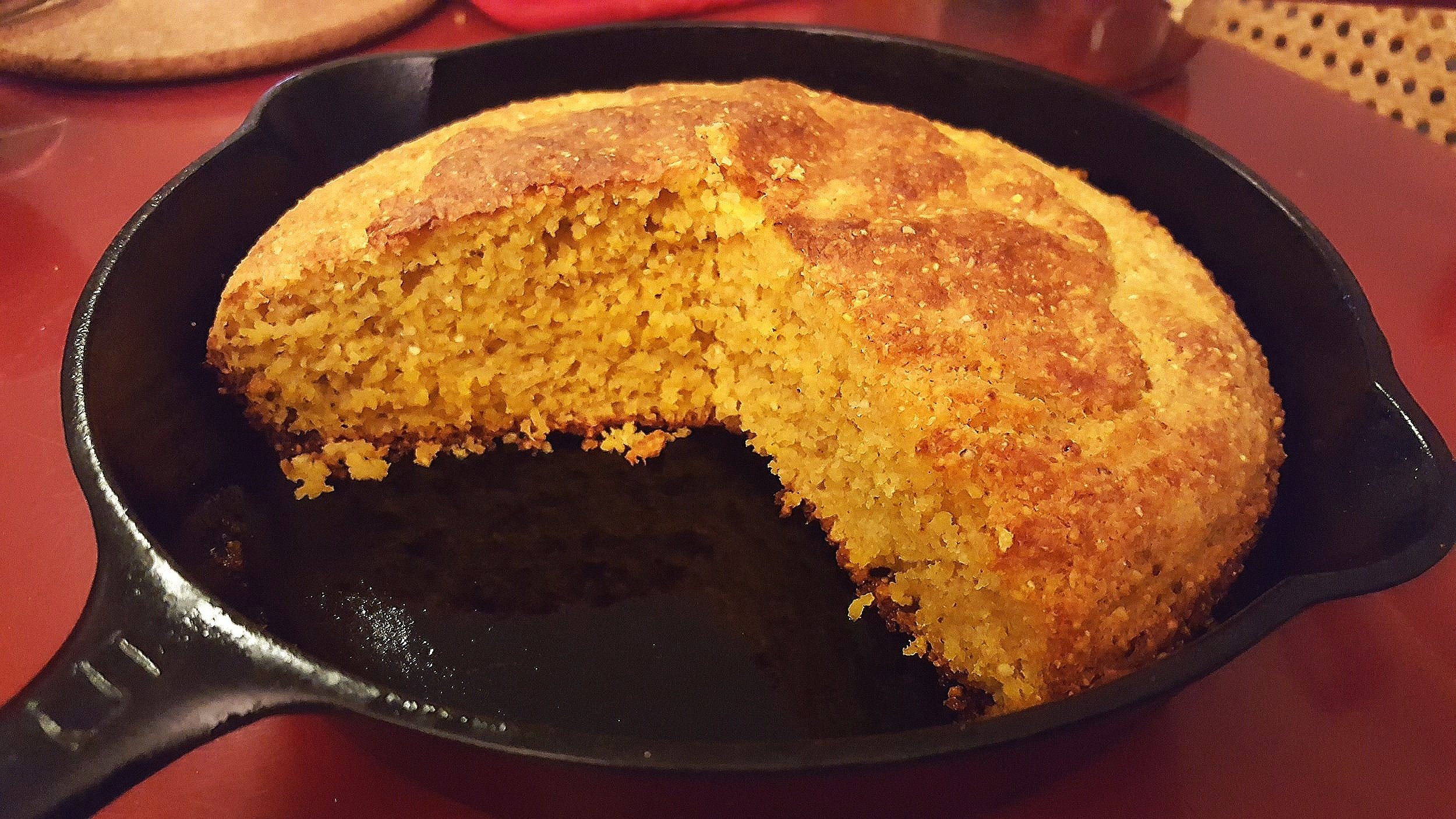
Fry bread baked in a #5 Griswold cast-iron skillet.

Cast-iron fry bread:

Ingredients

¼ cup bacon drippings, filtered through a fine sieve or coffee filter
1½ cups coarse-ground cornmeal,
½ cup all-purpose flour
½ teaspoon baking powder
½ teaspoon baking soda
pinch of salt
1 egg
1½ cups buttermilk

Instructions

I use my No. 5 Griswold skillet for this one. Any smaller size cast-iron pan will do. Scoop the bacon fat into the skillet and heat both together in a 450°F oven. As it heats up, whisk together the cornmeal, flour, baking powder, baking soda and salt in a bowl. In a separate bowl, combine the egg and buttermilk and pour into the center of the dry mix. Stir until just combined. Now (wearing an apron and shoes) remove the smoking hot skillet from the oven, put it down, and carefully pour in the batter. Return to the oven and bake for twenty-five minutes. Serve hot, even from the skillet, and you will never taste a better cornbread.