Spanish Lessons

THE NEW CRITERION, September 2023

Spanish lessons

On “1923–2023 Sorolla / Soto Centennials” & “Jewels in a Gem: Luz Camino at the Hispanic Society Museum” at the Hispanic Museum & Library.

The Hispanic Society of America was founded over a century ago to reflect a gilded vision of Spain and the Iberian peoples. Since 1904, this institution on Broadway and 155th Street has faced much harsher realities. The small independent entity—one of scholarly and artistic significance—has struggled so far removed from the limelight of New York’s Museum Mile. To this day the Hispanic Society remains the greatest New York collection few have ever heard of. Now, after a six-year closure to address its aging infrastructure, the museum and library have partially reopened with a renewed vision for the future. Just how much this vision aligns with the foresight of its remarkable founder, Archer Milton Huntington, is a picture still coming into view.

Archer Huntington was the stepson, and most likely illegitimate offspring, of Collis Huntington, one of the Big Four founders of the western railroad. Even more remarkable was his mother, Arabella, a significant collector of European art and a social outcast whose marriage to Huntington scandalized New York society. Arabella’s sense of independence encouraged her only child in his intense cultural pursuits. In 1882, while embarking on a Grand Tour at age twelve, Archer purchased a copy of The Zincali, George Borrow’s 1841 “Account of the Gypsies of Spain,” in a Liverpool bookshop. The book was one of several famous stories that informed the century’s Romantic affinities for primitive Spain—joining Victor Hugo’s Hernani of 1830, Théophile Gautier’s Voyage en Espagne and Richard Ford’s Handbook for Travellers in Spain, both of 1845, and Georges Bizet’s Carmen of 1875.
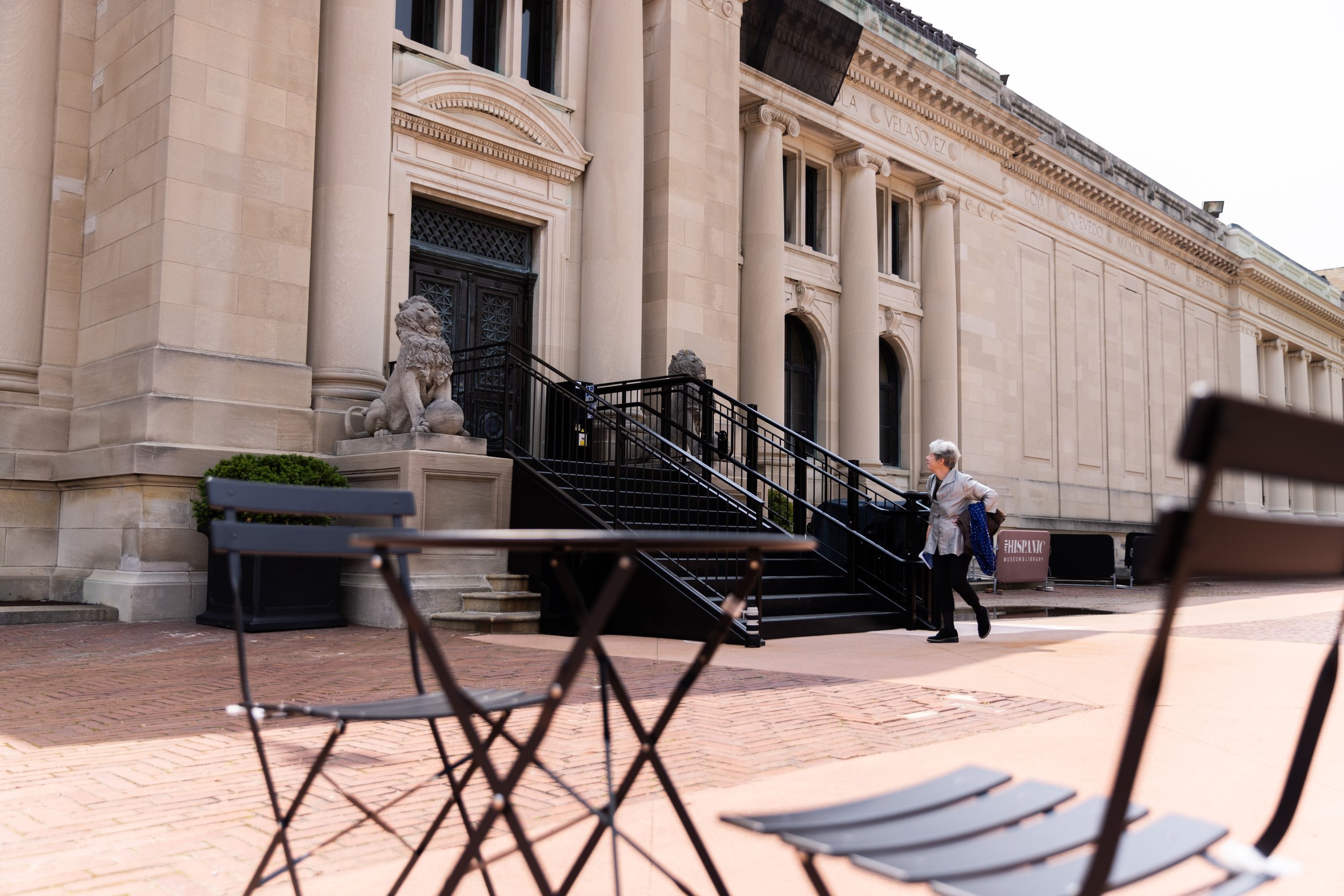
View of the entrance to the Hispanic Society Museum & Library. Photo: Alfonso Lozano.

As Huntington continued on to London and Paris, he was already envisioning an art collection along the lines of Sir Richard Wallace’s, paired with a library akin to the National Gallery’s, dedicated to the cultures of Spain and the Spanish diaspora. In 1891, to understand better the history of Al-Andalus, he even hired a tutor to teach him Arabic, at a time when no American institution offered classes in the language. On tours through Spain in 1892, 1896, and 1898, he purchased trunks of Spanish photographs while studying the country’s art and culture (the society now has 175,000 such images). In 1902 he acquired the bibliographic collection of Manuel Pérez de Guzmán y Boza, Marqués de Jerez de los Caballeros, who was his mentor. Soon Huntington had the most important collection of Spanish books and manuscripts outside of Spain, a collection growing to two hundred thousand manuscripts and more than three hundred thousand printed books, including over fifteen thousand volumes from before 1700. He paired this collection with paintings by Spanish masters—Velázquez, Goya, Zurbarán, El Greco—which he was determined to purchase only from the international market, so as not to deplete the country’s own cultural patrimony.
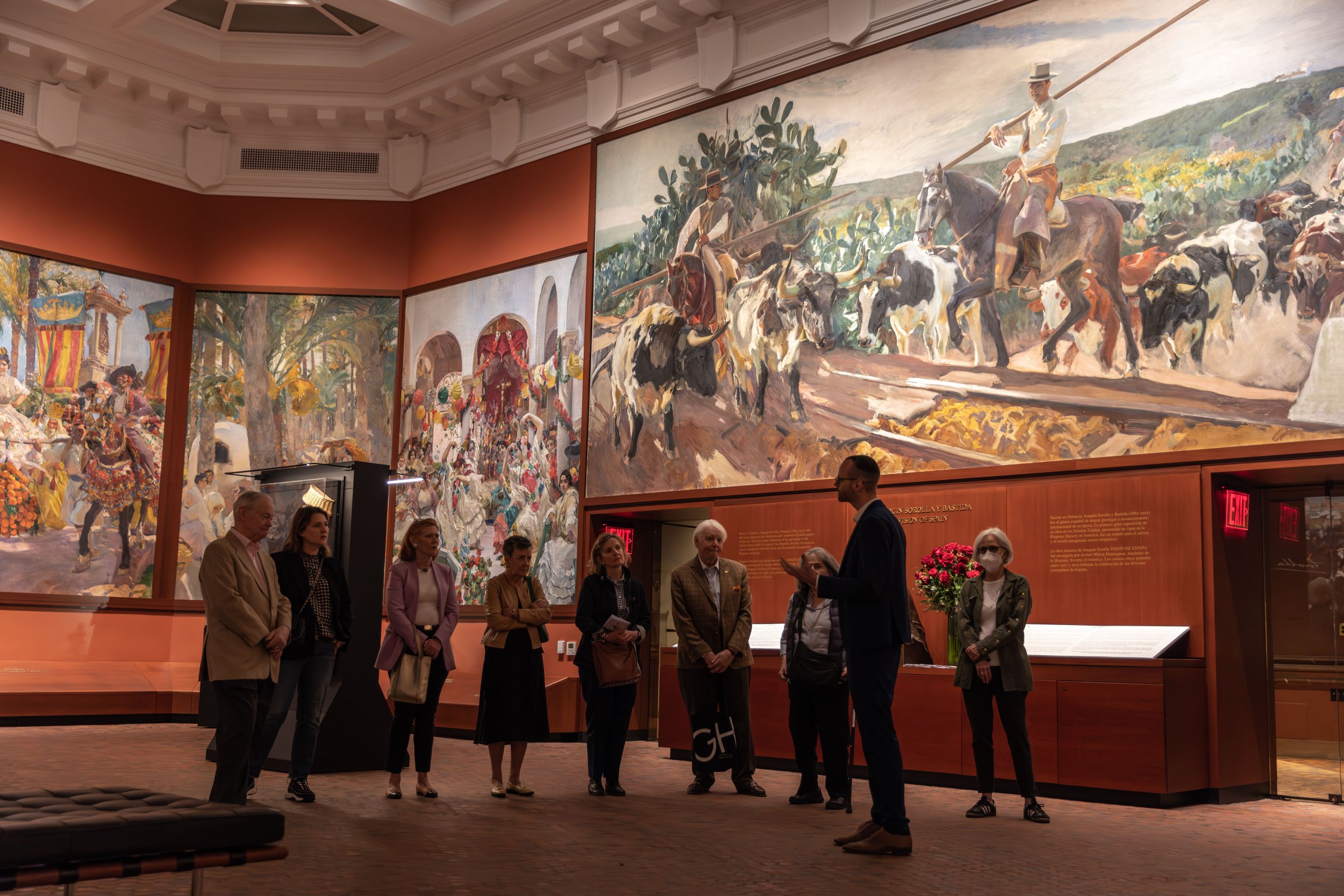
Installation view of “Jewels in a Gem: Luz Camino and Jewelry” with Sorolla’s Visions of Spain (1913–19) above. Photo: Alfonso Lozano.

In 1908 Huntington opened his collection to the public in a Beaux-Arts building on Audubon Terrace, so named for being at one time part of John James Audubon’s estate. The building was nearly contemporaneous with Isabella Stewart Gardner’s Venetian vision in Boston’s Back Bay and equally novel, though less flamboyant. As the capstone to the collection, in 1911 Huntington commissioned Joaquín Sorolla to paint a mural of multiple “panneaux” of various Spanish regions, which he installed in its own purpose-built octagon-shaped wing. This impressionistic cyclorama of traditional Spanish culture was called, appropriately, Vision of Spain (1913–19), reflecting Huntington’s own dreamy vision for his new institution.

After Huntington’s death in 1955, there were times when it seemed the lid to his jewel box was bolted shut. When it wasn’t being shouted down as “racista”—as happened to one of its directors in the 1990s while he was chased across Audubon Terrace—the Hispanic Society put little of its energies into its own forward-facing persona. Part of this was an extension of Huntington’s own self-effacing style. “To place one’s name on a donation be it a building or subscription is an artificial and flimsy door to fame,” he once said. “The human race is full of creators, but it is their acts . . . which are interesting.”

Instead, the society continued to focus on scholarship and filling out its permanent collection of books, art, artifacts, and sculpture, in particular from the Spanish New World and Spain’s onetime Pacific colonies. Today the collection has grown to include four-thousand-year-old ceramics from the Bell Beaker culture of the Tagus river estuary, Roman statuary from Seville, Islamic pottery and Alhambra silk, Hebrew manuscripts, a map by Giovanni Vespucci, and Renaissance and Baroque ironwork on up through the Symbolist paintings of Hermenegildo Anglada Camarasa. Last year, as its main building remained shuttered, two temporary exhibitions revealed the great depth of this collection: “Gilded Figures: Wood and Clay Made Flesh,” an exhibition curated by Patrick Lenaghan with his Hispanic Society colleague Hélène Fontoira Marzin, on the history of Spanish polychrome sculpture; and a display at the Grolier Club of highlights from the society’s library, organized by the society’s former director Mitchell A. Codding and the curator John O’Neill. (See “Visions of Spain” in The New Criterion of January 2022.)
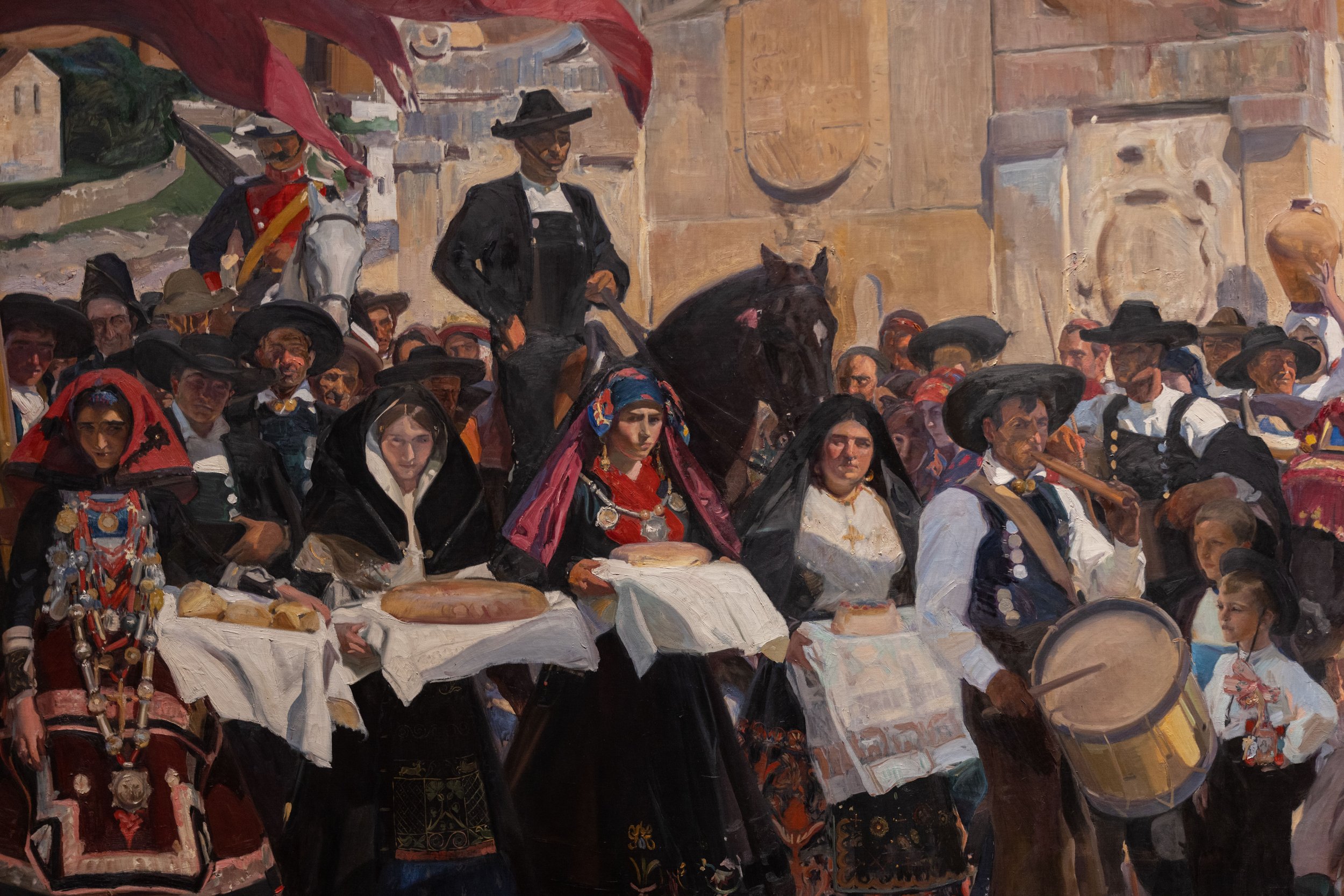
Joaquin Sorolla, Detail from Visions of Spain, 1913–19, Oil on canvas, Hispanic Society Museum, New York. Photo: Alfonso Lozano.

By some stroke of historical luck, the venerable but heavy hinges of the Hispanic Society were never forced open against the will of its founder. One could easily imagine the society’s takeover by a larger institution, the breaking of its indenture of trust along the lines of the Barnes Foundation, or, at the very least, a relocation downtown. Many such options were considered at various times in its existence, which in part may account for the deferred maintenance on its Audubon Terrace infrastructure.

Under the leadership of Philippe de Montebello, who was elected chairman of the society’s board in 2015, the institution has instead decided to double down on its Audubon campus. This has first meant upgrading the building’s aging envelope, designed by Charles Pratt Huntington, and bringing its systems, in particular its climate control, up to modern standards. The museum has also developed a strategic plan with Selldorf Architects to renovate the campus with the executive architects Beyer Blinder Belle and the landscape architects Reed Hilderbrand. An adjoining building to the east, originally the headquarters of the Museum of the American Indian, is being incorporated into the Hispanic Society campus, allowing for ada access to the Main Court galleries while introducing a new conservation studio, a wheelchair entrance, and spaces for special exhibitions and education. This longer phase of the project is still tens of millions of dollars and several years away.
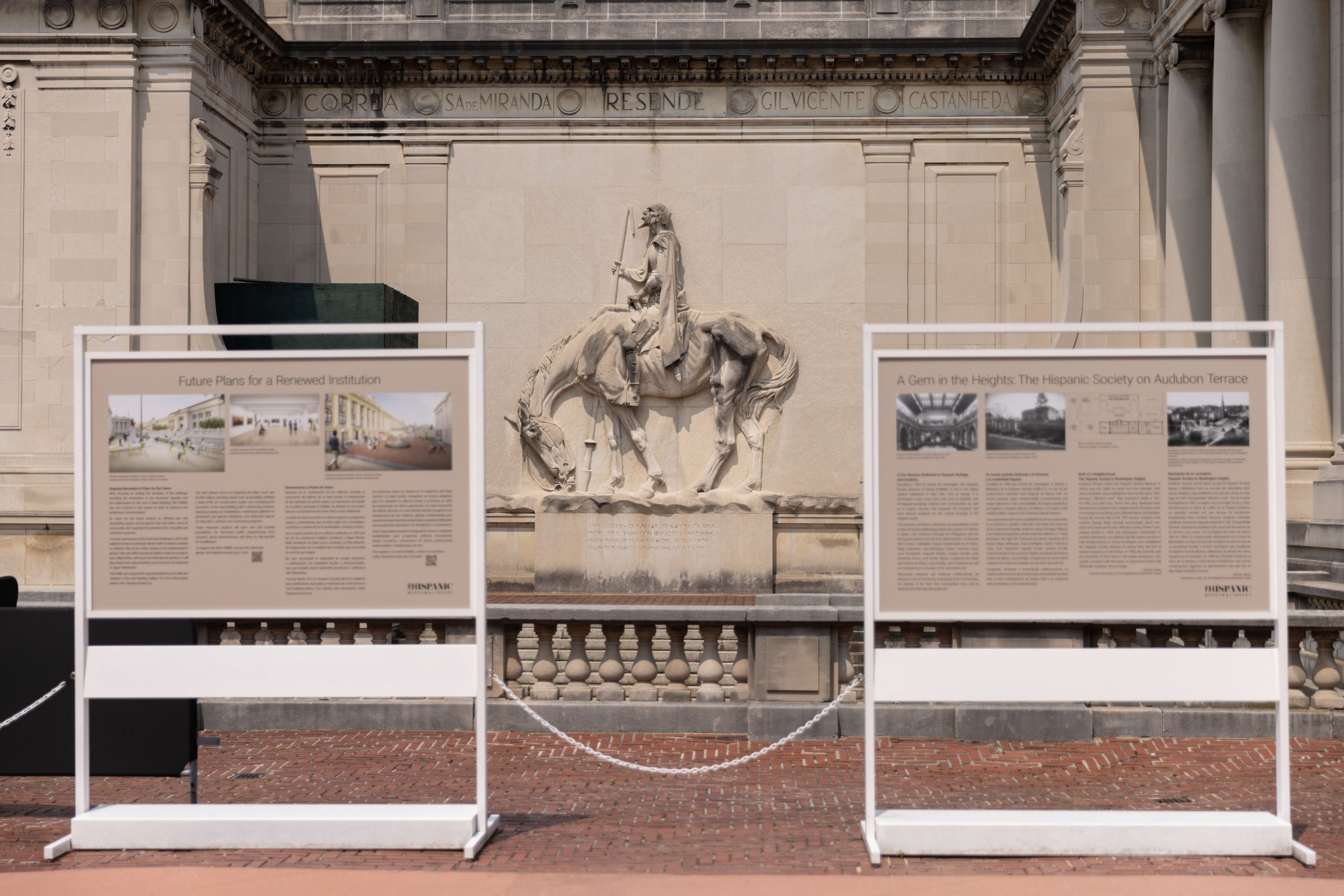
View from Audubon Terrace. Photo: Alfonso Lozano.

Fortunately, even with the introduction of a new entrance in the east building, the society says the door of the Main Court will remain unlocked. Since the society is, and has always been, a free institution, Audubon Terrace is well suited to be an open campus with outdoor seating and concessions—and access to its other remaining cultural institution, the American Academy of Arts and Letters, just up the courtyard. “If you are a regular, and you have a ten-minute lunch break,” says Guillaume Kientz, the society’s new director, “and you want to see the Duchess of Alba, you can do that.” The terrace’s program of Spanish-themed statuary—depictions of Don Quixote and El Cid created by Huntington’s remarkable wife, Anna Hyatt Huntington—is also an integral part of the society’s cultural program and best observed from the Main Court landing.

This past summer, the Hispanic Society reopened its Main Court after its six-year restoration, the first phase of the renovation project. While the treasures of its collection are still on tour through the summer, the museum dedicated its main gallery to the centennials of two artists: Sorolla (1863–1923) and the Venezuelan sculptor Jesús Rafael Soto (1923–2005), born in the year of Sorolla’s death.1 Through the fall, visitors to the terrace will continue to encounter Soto’s Penetrable (1990), a large cube of steel, aluminum, and plastic hoses on long-term loan from the Colección Patricia Phelps de Cisneros—a work that trades Soto’s usual optical delicacy for crowd-pleasing interactivity. While Sorolla’s portraits of Spanish life and the genre scenes of his Vision of Spain have little to do with Soto’s kinetic abstractions, the assembly spoke to the breadth of the society’s mandate while also allowing us to open the lid, after a painfully long wait, of the institution.
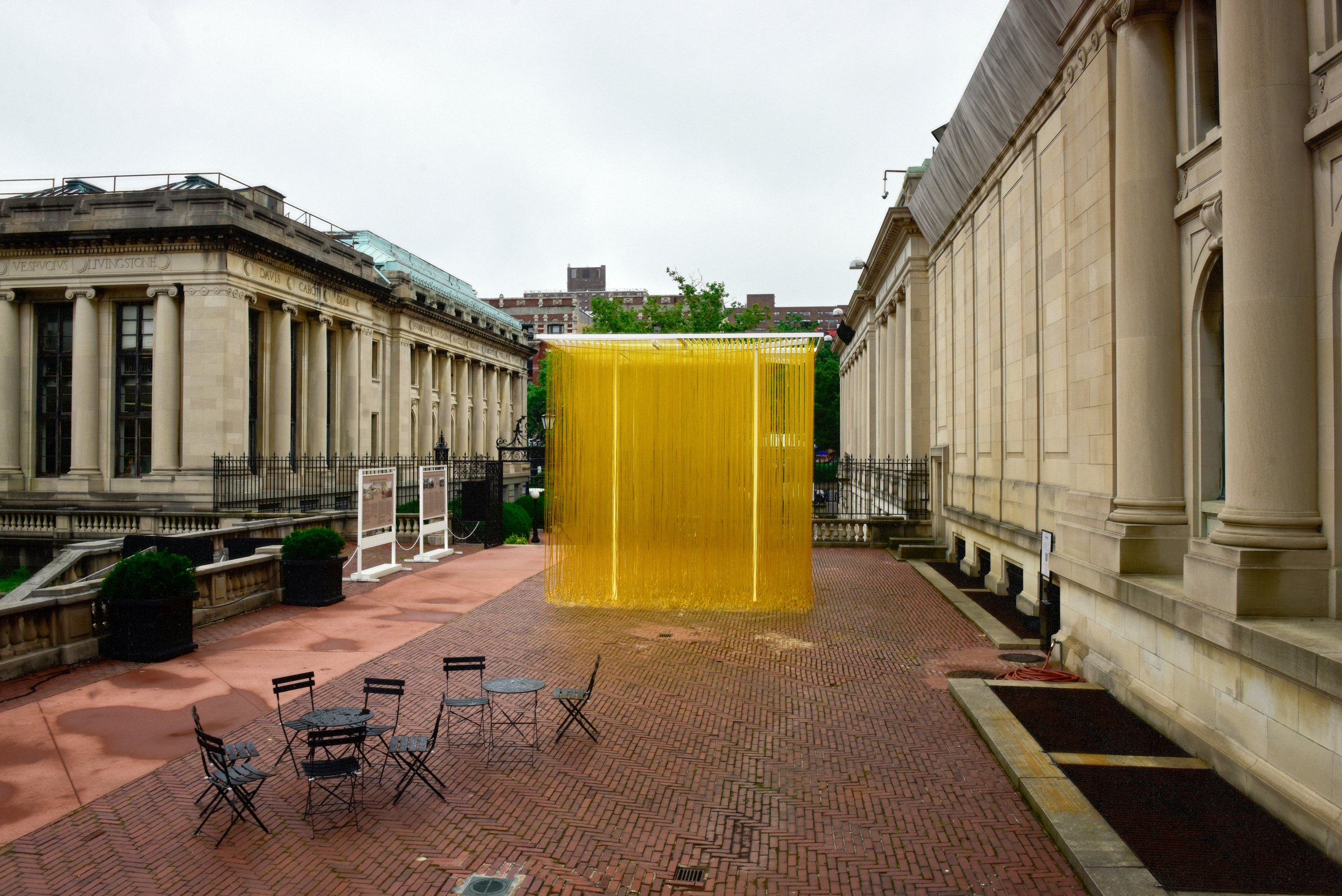
Jesús Rafael Soto, Penetrable, 1990, Steel, aluminum & plastic hoses, Colección Patricia Phelps de Cisneros. Photo: Courtesy of the Hispanic Society Museum.

Yet those of us expecting a full return to form will have to sit tight. What are described as essential repairs to the roof have now covered over the skylights in the Main Court and Sorolla galleries. The darkened result, interspersed with retina-burning spotlights, is heartbreaking for those of us who recall these formerly dreamy spaces. This is especially true when trying to appreciate the Main Court’s intricate terracotta walls and its imagined sense of a sunlit medieval cloister. While the society maintains that plans are in place to install artificial laylight behind the skylight glass, the remediation could not come soon enough. A public-spirited philanthropist could do worse than to underwrite the improvement of gallery lighting. As the Old Masters were almost all painted under natural light, their happy viewing calls out for equivalent illumination.

Installation view of “1923–2023 Sorolla / Soto Centennials.” Photo: Alfonso Lozano.

The inclusion of modern and contemporary work also suggests something of a change in the priorities of the institution. While it is true that Huntington for a time embraced the contemporary Spanish art of his day—collecting Sorolla, Ramon Casas, Joaquin Mir Trinxet, Santiago Rusiñol, and Ignacio Zuloaga—he came to distance his Hispanic Society from the art of his own time. “Modern art is not our intention to show in exhibitions,” he declared. “That is a dealer’s affair and not, in my opinion, one for museums.”

Starting September 15, the treasures of the society’s collection are finally returning to its walls, but the installation will no longer be a fixed display of highlights as we experienced in the past. Certainly, with a collection of three-quarters of a million objects, there is a lot to show here. Some shuffling around would be welcome and refreshing. Yet as with most every other museum—including the venerable Frick Collection—today there seems to be an urge to put historic collections in “dialogue” with contemporary art. These interventions are often forced and merely there to serve some political or commercial end—a “dealer’s affair,” in Huntington’s choice words.
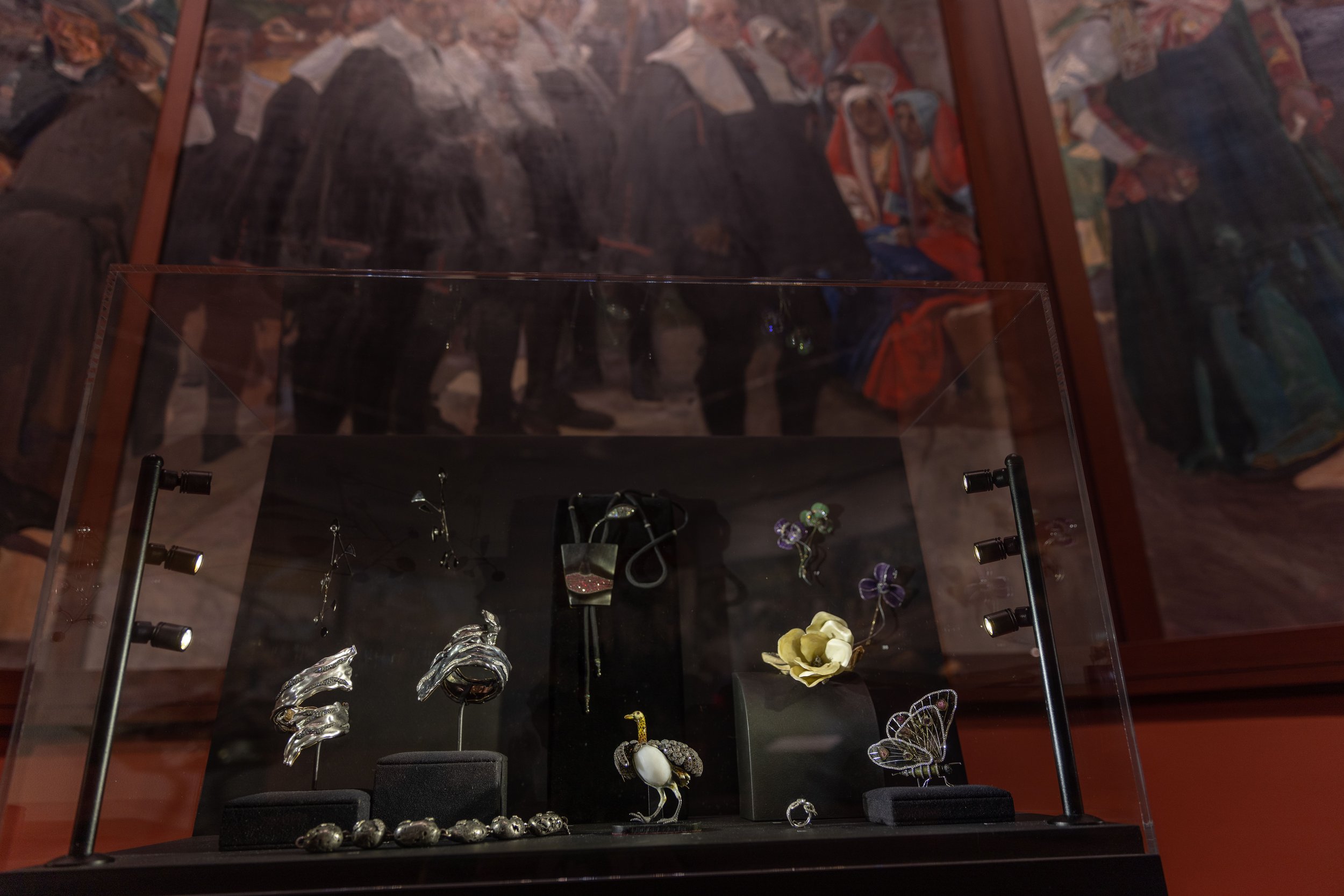
Installation view of “Jewels in a Gem: Luz Camino and Jewelry.” Photo: Alfonso Lozano.

The society’s summer display of contemporary jewelry by Luz Camino was one such letdown.2 Filled with loans from a Who’s Who of rich collectors, the exhibition was no doubt designed to stimulate the philanthropic glands of the society’s major donors. Even worse, the exhibition’s gaudy displays were all positioned directly in front of the panels of Sorolla’s Vision of Spain. The cases obscured their view and fully blocked their labels. Despite its wide embrace of Spain and Spanish culture, the Hispanic Society shouldn’t need to include Las Vegas in its purview.

Acentury ago, Archer Huntington set out not to record the Spanish world of the present but to preserve a vision of its past, one that was already fast disappearing. His interest may have been based on a Romantic fiction, but there was a time when we could embrace the power of fiction to triumph over everyday fact. “We can only be grateful to the boy who discovered Spain in a Liverpool bookshop,” says the Hispanic Society curator Patrick Lenaghan, “and, thus inspired, created this extraordinary museum and library.” Even today, we should be able to dream the impossible dream that is the Hispanic Society of America.

  1.   “1923–2023 Sorolla / Soto Centennials” was on view at the Hispanic Society of America, New York, from May 25 through July 15, 2023.

  2.   “Jewels in a Gem: Luz Camino at the Hispanic Society Museum” opened at the Hispanic Society of America, New York, on May 25 and remains on view through September 3, 2023.

The Inside-Out Diorama

THE NEW CRITERION, June 2023

The inside-out diorama

On the new Richard Gilder Center at the American Museum of Natural History.

Anyone who has walked through the American Museum of Natural History might have sensed something was wrong. Just go through its Hall of Gems and Minerals, or its Hall of South American Peoples, or its Hall of Pacific Peoples. At the end of each of these long rooms, which were only reached through other long rooms, you found nothing less than a dead end. In a way, the reason was by design: the master plan of this museum, founded in 1869 and first envisioned by Calvert Vaux and Jacob Wrey Mould in 1872, has never been fully realized. Much like the Metropolitan Museum of Art, the Brooklyn Museum, and other grand nineteenth-century American edifices, New York’s natural-history museum was laid out on a massive cross-in-square plan, which has only been partially built out over time.

Beyond merely the dead ends, what this means is that, over a century and a half after its founding, the street-facing façades and infill architecture of this museum have been created in a progression of styles that have reflected, for better and worse, the ideals of their times. The museum began on the southern side of its four-block quadrangle bordering Central Park, carved out of the street grid of the then-undeveloped Upper West Side. From 1874 to 1877, Vaux and Mould extended their pastoral vision from Central Park to break ground on the museum’s first wing in the Gothic Revival style; from then until now, this building, which was soon surrounded by future construction, has housed the museum’s Northwest Coast Hall.

An aerial view of the American Museum of Natural History’s campus. Photo: Iwan Baan.

The plan to extend this Gothic language across the four seven-hundred-and-forty-foot sides of the envisioned museum was quickly eclipsed by changing architectural taste. In 1897, a new plan emerged to complete the museum in a Romanesque Revival style. The Seventy-seventh Street façade, designed by Cady, Berg & See and constructed between 1890 and 1900, and the southwest wing, designed by Charles Volz and built between 1906 and 1908, gave the museum its fanciful red turrets and first distinctive appearance.

The need for natural light and air at one time called for four internal open courtyards located within the circulating wings, all radiating out from a domed central tower. In the twentieth century, with advances in artificial light and ventilation, these open spaces began to be modified and built in. Rather than a dome, the central building became the museum’s lecture hall, designed by Cady, Berg & See in 1900. Wings for ocean life and education filled in the southwest and southeast courtyards in 1924 and 1928. A power and service building of 1930–35 infilled the northwest courtyard. Meanwhile the art-deco Hayden Planetarium, designed by Trowbridge & Livingston, was constructed in the northeast courtyard in 1934–35. At the same time, between 1931 and 1936, the museum’s eastern façade fronting Central Park West received John Russell Pope’s Roman Revival grand vision for the Theodore Roosevelt Memorial Rotunda, complete with a triumphal arch, coffered vaulted interiors, and an equestrian statue of our twenty-sixth president mounted at the center of a monumental entry plaza. Then, over half a century later, a year-2000 addition by Polshek Partnership, which replaced the Hayden with the Rose Center for Earth & Space, stayed within this original master plan while again departing in style, this time resulting in a celestial sphere (housing the new planetarium theater) suspended in an illuminated glass cube.

Despite over a century and a half, and the construction of some twenty-five buildings, the museum has still only filled out about two-thirds of its original master-plan footprint. This incompleteness has been most felt on its western side facing Columbus Avenue, where existing wings have ended abruptly, resulting in many of those back-tracking dead ends. A central building that connects these wings, on all four of the museum’s floors, has long been overdue.

The Columbus Avenue entrance to the Richard Gilder Center for Science, Education, and Innovation. Photo: Alvaro Keding / © AMNH.

The Richard Gilder Center for Science, Education, and Innovation, over a decade in the making and opened to the public on May 4, set out to do just that. (For more, see “Old museums, new tricks” in The New Criterion of February 2017.) Filling in a void along the museum’s western edge, the 230,000-square-foot wing creates some thirty new access points to the museum’s twenty-building complex. It also generally continues the massing of the original master plan while extending the museum’s central axis west from the Roosevelt Rotunda, resulting in a new façade that now lines up with Seventy-ninth Street.

Funded by one of New York’s great latter-day philanthropists, the Gilder Center is named for the late Republican financier who once teamed up with none other than George Soros to found the Central Park Conservancy. Among the other New York–based beneficiaries of Richard Gilder’s largesse before his death in 2020 were the Gilder Lehrman Institute of American History, the Manhattan Institute for Policy Research, and the magazine you are now reading.

Early on the Gilder Center was designated to expand the museum’s educational mission, with additional classroom space as well as room to display more of the museum’s permanent collection of objects and scientific specimens, of which only 2–3 percent might ever be on view at any given time. Rising over three stories, these new displays, called the Louis V. Gerstner Jr. Collections Core and the Macaulay Family Foundation Collections Gallery, are among the Gilder Center’s most beneficial new additions. Behind the vitrines we can see the new rolling-stack storage shelves where some 12 percent of the museum’s collection, or four million specimens, has been, or is being, relocated. These displays, by Ralph Appelbaum Associates, reveal the breadth and depth of the museum’s holdings while also, for the first time, giving us a window onto its activities as a working scientific institution.

The development of open storage has been an undersung initiative of recent museum practice, one that in fact revives the object-based focus of the Renaissance Wunderkammer, the precursor of our nineteenth-century museums. At the Gilder Center, touch screens and detailed labels tell us much about these slices of the museum’s varied collection. In one area are displays of antique lantern slides, eastern box turtles, giant extinct mammals, wasp nests and galls, cleared and stained fish, New York rocks, Gaia astronomical data, Korean pottery, Maasai beadwork, and even a selection of Vladimir Nabokov’s butterflies. Another floor contains handmade African toys, bats, insects and spiders, parrots, astronomical instruments, amphibians, field documentation, a hadrosaur footprint, crinoid fossils, and the bones of a giant grouper. Still another houses Pueblo pottery, Maya bricks, Camarasaurus vertebrae, animal horns, drill core samples, trilobite fossils, sea-snail shells, megalodon teeth, ammonite fossils, and a captivating display of corals and echinoderms. Nearby, yet another new storage room and study center, visible through a window, now contains a sizeable percentage of the museum’s 3.1 million specimens of moths and butterflies. The one discordant note in all this is “Housewares of the Mao Era,” a display of Communist agitprop that describes the Cultural Revolution as merely a “sweeping campaign to reshape and reeducate Chinese society.” By sweeping away the death of some thirty million Chinese, the museum might satisfy ccp censors, but the appalling omission should not escape our notice.

The David S. and Ruth L. Gottesman Research Library and Learning Center at the Richard Gilder Center. Photo: Alvaro Keding / © AMNH.

A new library and reading room on the top floor, called the David S. and Ruth L. Gottesman Research Library and Learning Center, continues the spirit of open storage with walls of books and artifacts. The library is another achievement of the Gilder wing, bringing the museum’s extensive bibliographic collection out from a hidden location off of the dinosaur hall into wider and more welcoming public view. A wall of floor-to-ceiling shelves called the “Great Range” contains models of a polar bear from 1912, of a Camarasaurus from circa 1919, and of HMS Beagle from circa 2005. Also here is a crate from the museum’s Congo expedition (ca. 1909–15), a museum flag from its land exhibition of 1941, and a lunar tire prototype from 2011. Nearby, for the first time, the library has an alcove to exhibit a selection of its rare books, objects, and manuscripts, such as a 1705 edition of Maria Sibylla Merian’s Metamorphosis Insectorum Surinamensium.

One of the wing’s new permanent exhibits is the five-thousand-square-foot Susan and Peter J. Solomon Family Insectarium. The ground-floor display makes the best case for our buggy acquaintances, whether they be vectors for our diseases—by a wide margin, the mosquito has been the most lethal animal to human life—or the essential pollinators of our food supply. Here the focus is an elaborate terrarium of live leaf-cutter ants walking across ropes and bridges with their snipped loads. A floor up, the Davis Family Butterfly Vivarium relocates the museum’s live butterfly room from its digs in the Whitney Memorial Hall, with historical dioramas Pacific bird life that will now hopefully be restored and reopened, to a more permanent home.

Life’s interconnectedness is a recurring theme of the Gilder Center. A twelve-minute immersive video called “Invisible Worlds,” designed by Tamschick Media+Space with Boris Micka Associates, is a remarkable feat of interactive projection. Still, I am not sure how much insight can genuinely be gleaned from its ambient soundtrack and ASMR narration—“humans have created digital networks to extend the reach of our ideas. How many texts have you sent today?” asks a breathy female narrator. More thought-provoking are the touch-screen quizzes in the film’s entry hall, asking whether we are more closely related to mold or moss (the answer is mold, by a difference of some five hundred million years) or sea sponges or starfish (starfish, by two hundred million years).

The Invisible Worlds Immersive Experience at the Richard Gilder Center. Photo: Iwan Baan.

The Gilder Center has tucked its many exhibits and displays around a five-story entry atrium designed by Jeanne Gang that is presented as the showpiece of the project. On the building’s exterior, blocks of Milford pink granite—the very same stone used on Pope’s Roosevelt Rotunda—have been cut by computer into sedimentary wave-like patterns. On the interior, shotcrete, a spray-on concrete used primarily for tunnel construction, has been slathered and scraped onto rebar molds to form the walls and ceilings. The architect has described the forms of this space as being inspired by slot caverns, riverbank canyons, melting blocks of ice, and prehistoric cave dwellings. Its construction is presented as ecologically sensitive in every conceivable way; talk of climate change is never far from the sales pitch. The result is a cross between Antoni Gaudí and Fred Flintstone. This is not to suggest the forms are not arresting. The atrium leads onto a grand staircase by way of Castle Grayskull. Pseudo land-bridges connect the upper floors. The shotcrete surfaces, left scraped and raw, have the look of tufted wool from afar and the feel of coarse-grit sandpaper up close. The walls can catch the raking sunlight in a satisfying sculptural way. In contrast, any knee or hand that catches its sharp and crumbly surface will feel most unsatisfied. I can only imagine how this rough aggregate will age once the first cup of coffee spills down its side and gum sticks to its surface. I fear starchitects, especially those bearing eco-pablum.

The staircase in the Kenneth C. Griffin Exploration Atrium of the Richard Gilder Center. Photo: Iwan Baan.

For all of its nature-like forms, this shotcrete architecture is also the most artificial aspect of the new facility. The American Museum of Natural History is known for its historical dioramas. One way to see this design is as a diorama turned inside out, one where we are the specimens on view. It is interesting to note that shotcrete was invented by no less than the naturalist Carl Akeley, the pioneer of the museum’s historical dioramas.

But now the diorama frame is gone. So too is all of the historicized architecture, washed away in the same progressive deluge that recently toppled the Roosevelt statue from the museum’s front stairs. What results is a museum wiped down to the bone. Here is a post-apocalyptic vision where we are no longer the civilized masters of the universe but cave dwellers once again. In our self-obsessed age, perhaps it is appropriate finally to be the subject of this museum’s latest and largest diorama. Just what the five-story display says about the future of humanity is a label yet to be written. If I had my way, to borrow a line popularized by William F. Buckley Jr., I might simply suggest, Don’t immanentize the eschaton. The anthropocene will never kill us, but scientism just might.

Higher Authority

THE NEW CRITERION, May 2023

LETTER FROM THE GOLAN

Higher authority

On security in the Golan, Israeli politics & settler culture.

Israel’s judicial woes exploded just as we were approaching Ben Gurion Airport for our flight home. This time, it wasn’t Syria or Lebanon, Iran or Egypt, or any of the other bad actors surrounding us making trouble, but Israel itself. The protesters became more numerous throughout the day as we neared Tel Aviv. Almost all of them were against the judicial reforms promoted by Prime Minister Benjamin Netanyahu. They took to the highway overpasses and often to the highways themselves. They shuttered the national parks and even staged walkouts at many of the country’s McDonald’s—cutting off our visit to the archeological site of Caesarea, and my family’s meal options, before takeoff.

That the general strike then closed down Ben Gurion International for several hours speaks to the long shadow of the country’s short history. As the founding prime minister of the State of Israel, David Ben-Gurion had more pressing concerns in 1948 than load-testing his nascent country’s governmental architecture, and he left it without a proper constitution. The proposed judicial reforms, and the controversy surrounding them, are the consequences of this legislation delayed, legislation denied, now quickly boiling over into an un-constitutional crisis, right as the country is about to celebrate its diamond jubilee.

It was with some irony that we largely avoided the protests during our final days in the country by touring the Golan Heights. To this day this northeast corner of Israel, taken from Syria in the Six-Day War in 1967, remains contested Israeli territory by all but the United States. In March 2019, President Trump affirmed Israel’s claim to the region. The move elicited condemnation from the European members of the U.N. Security Council and much celebration here. In honor of the U.S. announcement, Netanyahu broke ground on a new settlement named Trump Heights (Ramat Trump) east of the Jordan River, on the road to the former Syrian military headquarters, which has become a brutalist ruin now covered in graffiti. A monument to Trump marks the entrance to the settlement with the sculpture of a bald eagle taking flight from a menorah.

A sign in the Golan warning of the presence of land mines. Photo: James Panero. 

The contested status of the Golan has left the region, which in a brief span borders Lebanon, Syria, and Jordan, largely unpopulated since the disruptions of 1967. The battle-scarred hills are still littered with Syrian bunkers and unexploded mines, over which there now falls a contingent peace. One morning we took an old Land Rover up from the Hula Valley into the Height’s rutted dirt roads. “Where are we?” I asked our driver, Royi. “You are in the Middle East,” he replied.

Wildflowers now grow around the rusted barbed wire that crisscrosses the hillside and the numerous signs that read “danger mines!” Mustard flowers, poppies, and tall grasses provide abundant food for the mix of bees, cattle, and wild animals that now call these slopes home. Beef from the Golan is free-range, save for the minefields, and results in some of the most flavorful steak you can find—one evening I dined on a local T-bone and Golan wine at a horse ranch just north of ancient Capernaum on the Sea of Galilee.

Once up on the heights’ plateau, we pulled over. We got out of the vehicle, being sure not to wander off the road. Royi brewed a tea of Golan lemongrass on a camp stove he balanced on the hood of his vehicle. He peeled and handed around slices of local orange—the smell of orange blossoms is a particular treat when walking through the groves in the valley. A hoopoe, the national bird of Israel, with its orange crown and a winged jacket of black-and-white feathers, foraged in a bush by the side of the road. In the distance, we spotted a family of boar circling in the shade of a tree. A herd of Nubian ibex, a vulnerable species that has found its own refuge in Israel, ran along the ridgeline.

An Iron Dome launch site in the Golan, with Mount Hermon in the distance. Photo: James Panero. 

As we continued up to the present Syrian border, we passed Israeli bases and active IDF training grounds. “Iron Dome,” Royi pointed to our right. There they were: mobile sand-colored missile launchers just off the side of the road, trained in the direction of Lebanon. “TANK CROSSING” read another sign nearby. It is a warning that I learned needs to be taken at its word. Our guide during our Israeli stay, a spritely Golan homesteader named Lior, lost all of his bees six years ago when an Israeli tank ran over his forty hives during nighttime training maneuvers. He restored a few of the hives and gave us a jar of his personal supply to take home. He would need the rest in this land of milk and honey for his growing family of “only four” children, as he likes to say.

For lunch we stopped at a farm in central Golan at Moshav Kidmat Tzvi, one of those Jewish cooperative communities, founded in 1981, still deemed illegal by what Israel’s antagonists like to call “international law.” Here the owners, Tami and Babi, served a meal of local abundance: platters of fish and pasta, hummus and cheese, and fruits and vegetables, paired with their homegrown olive oil and wine. The building is made entirely of recycled materials. Tami sits down at our table to explain their history as her cat rubs against my leg. The walls are covered with homemade glass and artwork. A tree trunk grows up in the middle of the room and exits to the outdoors through a hole in the ceiling. Babi offers me a brandy distilled from his own apples. From the charoset and maror of the Passover seder plate, food has always held a central place in Jewish symbolism. Now a fresh cornucopia, shared at this Israeli table, replaces the bitter herbs of Egypt with the succulent fruits of aliyah, or “going up,” to Zion.

This frontier attracts settlers with the same pioneer spirit that you might have found in Oklahoma Territory over a century ago. These are times when Israel resembles nothing less than a young and vibrant United States. Today the settlers vary in their politics. Some are old leftists, the secular holdouts of the kibbutzim. Others are religious idealists, fulfilling what they see as their own manifest destiny. What they share is a spirit for Zionism, the civic virtue that has propelled this nation, despite its conflicts and divisions, to astonishing heights in under a century.

Up at the border, the contrast with these achievements can be most striking. Through its industry and energy, against the odds, Israel has shocked the world with its successes. The triumphs have only brought shame to its Arab neighbors, who have mainly shown themselves to be impotent and corrupt. Beyond the demilitarized zone, the abundance of the Golan ends in a sharp line and gives way to the denuded hills of Syria and Lebanon. On the flank of Mount Avital, with the snow-covered peak of Mount Hermon in the distance, I felt a cold wind blowing across the ridgeline. Here in the late afternoon we overlooked Camp Ziouani, the DMZ outpost operated by the United Nations Disengagement Observer Force—the “useless nations,” as Israelis call them. From all around, a chorus of manic laughter emanated out of the grass. “Jackals,” Lior told me. I was unsure if he was referring to the animals or the Hezbollah bases just beyond.

The Israeli border, with Syria in the distance. Photo: James Panero.

For anyone who doubts the strategic necessity of the Golan to Israel, just visit the old Jewish settlements clinging to the hillsides to the west of the Jordan River. Before 1967, the Syrian border ran right in front of them, straight down the middle of the Hula Valley. The line split the region in two and placed Israeli villagers within sniper range of the militarized Syrian positions overshadowing their settlements from the east. As it is, the region can still be besieged by rocket fire from Lebanon and was under heavy bombardment as recently as 2006. At the time, Hezbollah was firebombing Israel with over two hundred rockets a day. Israel’s aerial fire brigade flew out of Mahanayim airfield, just down the hill from our bed-and-breakfast in Rosh Pina.

The charming village of our stay, a stone’s throw from the city of Safed, is something of the Plymouth of Zionism. The village was settled in the 1880s as one of the first Jewish homesteads in what was then the Ottoman Vilayet of Beirut. The name Rosh Pina, meaning “cornerstone,” refers to Psalm 118:22—“The stone the builders rejected has become the cornerstone.” It speaks to the foundational aspirations of its pioneers. Baron Edmond de Rothschild underwrote the town’s agricultural development, purchasing land to grow crops, which made it one of the region’s first self-sustaining Jewish communities. The eminent Victorian Laurence Oliphant, who gathered support from Christian Zionists for such settlements, visited soon after in 1886, writing:

These consisted of twenty-three Roumanian and four Russian families, numbering in all one hundred and forty souls. The greater number were hard at work on their potato-patches when I arrived, and I was pleased to find evidences of thrift and industry. A row of sixteen neat little houses had been built, and more were in process or erection. Altogether this is the most hopeful attempt at a colony which I have seen in Palestine.

The future of Israel now seems a world away from these pioneers. The risk today is that many in the younger generation, increasingly wealthy and cosmopolitan and centered around the booming tech corridor of Tel Aviv, are seeking to align themselves with the same liberal international order that has proven to offer false shelter for the Jewish people time and again. When they appeal to “democracy” in protesting Netanyahu’s judicial reforms, for example, what they really oppose is his attempt to rein in an unaccountable judicial elite; part of Netanyahu’s proposed reforms would align their nominating process with something closer to the democratic American system. In opposing the legislation of the Israeli Knesset—put forward by its elected members—Israel’s overreaching judiciary has long weakened the country’s borders and thwarted its efforts at counterterrorism. In 2007, Judge Robert H. Bork even noted that Aharon Barak, the former president of the Supreme Court of Israel, had written “a textbook for judicial activists.”

The Golan plateau. Photo: James Panero.

Beyond such policy disagreements, the mass protests are really an attempt to oppose the Netanyahu government through mob rule by drawing on the progressive shock tactics of Antifa and Black Lives Matter. “Whatever individual protesters may have told themselves, the real purpose of the uprising was not to stop judicial reform. It was to get rid of Netanyahu,” wrote Melanie Phillips in the Jewish News Syndicate. “Protesters absurdly claimed that the reform program—proposed by a democratically elected government—was a ‘coup.’ . . . That is the antithesis of democracy.”

Nation-building is tough business. Israel’s burden has been to build one under a contemporary spotlight while being reprimanded by many of the same world powers whose actions necessitated the creation of the Jewish State in the first place. Here is a country the size of New Jersey that is regularly under attack by one or more of its neighbors. Israel’s unabashed struggle for self-survival has been a defining characteristic of its history and the fire fueling its great successes. As Golda Meir, Israel’s iron-lady prime minister, famously said: “If we have to have a choice between being dead and pitied, and being alive with a bad image, we’d rather be alive and have the bad image.” In the Golan Heights, at least, that spirit lives on.