The Lightness of Jack Bush

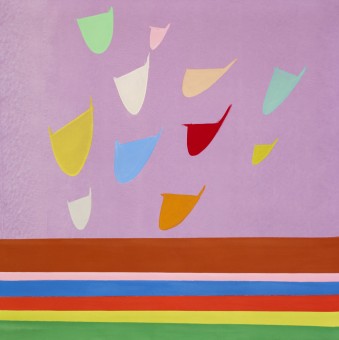
Onslaught_Bush_2012_01_23-16980-339x340

Jack Bush, Onslaught (1969); Acrylic on canvas; 55 1/2 x 55 1/2 inches, Private Collection

James writes:

These days some of the best abstract painting is also the most fun. In the 1960s, the lightness of Jack Bush was seriously ahead of its time. Born in Toronto, Canada in 1909, Bush took the low road to high modernism and largely bypassed the heaviness of European abstraction. Eventually he entered the orbit of the Color Field painters and Clement Greenberg, who became a champion and placed him alongside Hans Hofmann, Adolph Gottlieb, and David Smith.  

"Bush could draw, and 'place,' and design, like an angel," Greenberg wrote. "There was also his playfulness. He put into his pictures such things as travel souvenirs, flags, road signs, emblems, knowing well enough that they weren't supposed to belong in canonically abstract art. ... he took the risk of looking eccentric."

Flute-Passage-447x340

Jack Bush, Flute Passage (1975); Acrylic polymer water-based on canvas; 32 1/2 x 43 inches

Greenberg once said that Bush's "apparent awkwardness" made him "one of the most eye-testing artists of our time." This claim was put to the test in "Jack Bush: New York Visit," the exhibition at FreedmanArt.    

Sing-Sing-Sing-Cropped-455x271

Jack Bush, Sing, Sing, Sing (1974); Acrylic on canvas; 68 x 114 3/4 inches

Bush's awkwardness seems more natural today than it did when new, but his work is no less "eye-testing." His colors are battery powered. His paint application is luminous. His shapes are unashamed. Bush was an artist who came of age relatively late in his career, but he somehow managed to keep that long gestation from weighing him down. He was a mature painter who found a way to make playful and seemingly naive art. 

Smallup-174x340

Jack Bush, Three Up (1968); Acrylic on canvas; 82 x 42, Collection Art Gallery Ontario, Toronto. Gift of Mrs. Alison Fisher, 1988.

It's little surprise that Bush, who died in 1977, is now cherished up north, where one of his paintings recently made it onto a Canadian stamp. Regrettably he's far less known here. All the more reason to give his eye-testing appearance in New York a serious look. 

Bush-Lilac-20403-1-279x340
Jack Bush, June Lilac (1972); Acrylic on canvas; 74 1/2 x 65 3/8 inches, Private Collection

Last Chance: "Jack Bush: New York Visit" opened at Freedman Art, New York, on February 18 and remains on view through today, April 28, 2012. (73rd Street; above Via Quadronno and the best cappuccino in town.)

Supreme Court should have taken the Harmon rent control case


Do you have the right "real estate karma" to rent here? The UWS Harmon house with its three rent-regulated tenants. 

NEW YORK DAILY NEWS
April 24, 2012

Supreme Court should have taken the Harmon rent control case
by James Panero

Current law allows for lavish living, practically for free

On Monday, the U.S. Supreme Court refused to hear an appeal from James and Jeanne Harmon, the owners of two townhouses on West 76th St. who have challenged the constitutionality of rent control.

In Harmon v. Kammel, the Harmons claimed that such controls meant that the government has essentially made them the private funder of a welfare program. It had also illegally taken their property in violation of the 5th Amendment, which reads that “no person shall be . . . deprived of life, liberty, or property, without due process of law; nor shall private property be taken for public use, without just compensation.”

Rent control, they argued, has taken their private property “without just compensation.”

When the Harmons took ownership of their two small buildings, which had been in the family since 1949, they also got the tenants occupying three rent-controlled apartments. By law, these tenants now lease their apartments at 59% below market rate with lifetime tenure and generous succession rights.

A decade ago, one of Harmon’s tenants even bragged to a newspaper that he lived there “practically free” due to his great “real estate karma.”

Monday’s Supreme Court decision might only sound like a setback for landlords like the Harmons, but really it’s bad news for our entire city, which has long been the victim of a disastrous and near fatal experiment in price fixing. This is especially true for neighborhoods like the upper West Side, where I have been a lifelong resident.

Rent control was an “emergency” measure put in after World War II that stayed on the books for political convenience, even as it nearly bankrupted our city’s aging housing stock. These laws, which came out of a fear of the dangers of the free market, in fact demonstrated how government-manipulated pricing could be far more destructive than market forces.

With rents, services and evictions all regulated by the legislature and the courts, the city and state became the absentee landlords of neighborhoods like the upper West Side.

Power flowed from a politician’s apparent ability to depress rental rates for existing tenants while “taking on” the buildings’ now captive owners for diminishing services.

The city’s price controls, among the most stringent in the country, meant that the rate of apartment turnover plummeted. This created an artificial apartment shortage that continues to raise the rental rates of new construction. Since lower rent also meant that existing owners had less revenue for upkeep, for years aging buildings decayed for lack of funds, meaning that politicians could exert even greater rhetorical leverage over their “slumlord” conditions.

Historically, rent control has exacted its heaviest toll on the very tenants it purports to serve. The wealthy could maintain multiple residences while keeping their sprawling and under-used rent controlled apartments off the market.

Corrupt tenants learned to manipulate their rents even further by calling in phony complaints to the Department of Buildings and suing for bogus “diminution of services” in order to tie up rate increases in litigation (the practice remains commonplace today). Meanwhile, average, honest renters became hostage to the artificially depressed rents of their apartments as rent control diminished surplus and drove up the prices of alternative rental apartments.

Even as their building and their neighborhood collapsed around them, they were often unable to afford to relocate and became increasingly captive to the whims of a political class that purported to have a say in rental rates.

What saved New York wasn’t rent control. It was the cooperative revolution. Stocked with rent-controlled and rent-regulated tenants, the aging buildings in neighborhoods like the upper West Side, despite their grandeur, became next to worthless to their owners.

In the 1970s and 1980s, non-eviction plan coop conversions finally allowed owners to sell shares of their buildings to their own rent-controlled and rent-stabilized tenants, who could then invest their capital and sweat equity into the restoration of the neighborhood. Rather than taking on the landlords, as landlords themselves they took on the squalor of their neighborhood and restored areas like the upper West Side to what we see today.

Despite the damage done to our neighborhoods, rent control and rent regulation still feeds our city’s political machine. In 2008, Rep. Charlie Rangel, with a reported net worth of $566,000 to $1.2 million, was even caught taking up four rent regulated apartments for his personal use.

If the courts won’t take it on, the time has come for New Yorkers to do the right thing in the voting booth and say no to a system that has given their politicians a free ride while damaging their neighborhoods almost beyond repair.

A Visit to the New York Transit Museum

NY_Transit_Museum_sta_J48_jeh

James writes:

Following up on my essay "What's a Museum"? and the discussion on The Brian Lehrer Show, I've been on an informal tour of museums large and small looking for what works and what doesn't. One of my first stops was the New York Transit Museum in downtown Brooklyn, a childhood favorite. My return confirmed why I've always had a soft spot for this special place.

In my article, I write about how the big business of today's museums has been causing them to lose sight of their founding principles. Museums are getting bigger, but are they getting better? A "museum industrial complex" has been turning museums into "tourist attractions, department stores, civic centers, town squares, catalysts of urban renewal, food courts, licensing brands, showcases for contemporary architecture, social clubs, LEED-certified environmentally conscious facilities, and franchise opportunities." While enriching their administrators, museums are often losing sight of what makes them special as places that preserve and display our nation's treasures. 

The Transit Museum has been largely immune from these recent trends. Now owned by the Metropolitan Transit Authority, it operates outside of today's museum culture, and the difference can be felt right away. The low admission price is the first indication that something here is different. At many New York museums, the ticket price for adults now tops $25. At the Transit Museum, the charge is $7.

One reason the admissions charge is so low is that the museum doesn't have a multi-million-dollar climate-controlled glass wing to maintain or any plans to build one. There are no restaurants on site or other distractions attractions (just picnic benches). Instead what you get is simply a great collection of trains and transit artifacts lovingly maintained by a dedicated staff in a facility that very much tells its own history: the decommissioned subway station at Court Street.

IMAG0667
At the New York Transit Museum, historical subway cars are on display on the working tracks (including a live third rail) of a decommissioned Brooklyn station.

The Transit Museum is largely staffed by MTA employees (rather than career administrators) who have a deep knowledge of the particular artifacts on display. The Museum also attracts additional volunteers and staff who clearly love their subject matter.

The history of New York's subways is a history of the city itself. The subway began as three separate corporations--Interborough Rapid Transit (IRT), Brooklyn-Manhattan Transit (BMT), and Independent Subway System (IND). The IRT opened first in 1904 with a lavish station beneath City Hall designed in the Romanesque Revival style by Heins & LaFarge. The station is now decommissioned but open through special tours operated by the museum.

Although the IRT and BMT were private companies, the city maintained price controls on what fare they could charge. For decades, the fare stayed at 5 cents. This eventually drove the companies to bankruptcy and allowed the city government to take them over and consolidate the system in 1940 (at which point the city promptly raised the fare). With its ups and downs, it's hard to argue that city and state government has done a better job than private enterprise. Expansion plans all but ceased for half a century following consolidation. For years, dilapidated trains became the symbol of urban decay before a turnaround in the 1980s and a city-wide revival led by Mayor Giuliani in the 1990s.

The Transit Museum glosses over the bad years of the MTA--one of the weak spots of the institution (the museum's website could also use some help; the wikipedia entry for the museum is much better). Still, as I discovered, its free tours, which last well over an hour, can be spellbinding and frank. My tour guide, Katherine, even made her own low-tech map out of pipe cleaners to depict the city's original IRT route. 

IMAG0659
Transit Museum tour guide Katherine holding her own low-tech map made of pipe cleaners to depict the city's original IRT route. Is that a tattoo of a subway rat on her arm? 

The Court Street station, which was once meant to be the terminus of the 2nd Avenue Subway Line, contains two levels. The midlevel contains the museum's collection of turnstiles, track parts, ticket booths, and buses (where you get to sit in the driver's seat). Downstairs are a hundred years of subway cars all perfectly restored and electrified, complete with vintage ads. Many of these trains are still operational and will occasionally come out from runs through the system to pick up regular passengers (a few years ago, I was lucky enough to step on one).     

IMAG0660

Katherine discusses the history of subway turnstiles. Just off screen: the dreaded "Iron Maiden" gate known to trap subway passengers.

I found the museum to be great for all ages. With its smart and interactive displays, the museum can captivate a newcomer to the underground while more than satisfying the subway nerd. But be warned: while there is now a wheelchair lift, strollers still need to be carried down the stairs of the museum's main subway entrance (all for that authentic MTA experience).

The museum also has a gift shop that, many years ago at least, made for a fun trip back home for me. When I asked the clerk if there was any more subway memorabilia beyond what was on display, he showed me to a back room with old change collectors and authentic subway signs, including one from my home station that must have been 8-feet long. I bought one. A friend then helped me bring it home on the subway--exiting, of course, at the station where I lived. During the trip, I was apprehended twice, first by a police officer and second by someone making a "citizen's arrest." Fortunately, I had my receipt from the Transit Museum and I still have my (legally acquired) subway sign proudly on display.

What's a museum? Running on all tracks, the New York Transit Museum has a moving answer.

IMAG0666
You won't see this at MOMA: Meet Sadie, the Transit Museum's resident cat and a hard working employee. There's a reason this station is rodent free!