The Whiff of a New Blacklist

THE WALL STREET JOURNAL
February 12, 2015

The Whiff of a New Blacklist
by James Panero

Recent protests at the Met Opera and Carnegie Hall signal a new turn in the relationship between art and politics.

With his ties to Vladimir Putin , the government patron and old acquaintance ultimately behind his St. Petersburg-based Mariinsky Theatre, conductor Valery Gergiev has become, for some, a proxy figure representing the anti-Western turns of the Russian state, both in human rights and geopolitics. These tensions first took center stage in 2013. Following Mr. Putin’s suppression of gay rights, protesters lined up outside Carnegie Hall and the Metropolitan Opera House with signs that read “Gergiev Choose: U.S. Dollars or Putin’s ‘Morals.’” Inside, just as Mr. Gergiev raised his hands to conduct, they shouted him down, yelling “Valery, your silence is killing Russian gays!” Performances were halted until security could remove the disrupters.

With the 2014 Russian incursion into Crimea, Ukrainian sympathizers have joined the chorus of dissent. The Georgian violinist Lisa Batiashvili publicly declined Mr. Gergiev’s invitation to perform in St. Petersburg while also indicting Western audiences for supporting his music. At the premiere of “Iolanta” at the Met two weeks ago, a Boston-based, pro-Ukrainian protester even leapt onto the stage at curtain call with a banner depicting Mr. Gergiev, the Russian headline soprano Anna Netrebko, and a Hitler-inspired image of Mr. Putin with the slogan “Active Contributors to Putin’s War Against Ukraine, Free Savchenko” (after the parliamentarian and former Ukrainian officer imprisoned by Russia in 2014).

Protesters shouting down concertgoers; musicians silenced by hecklers; agitators taking the stages of our performances. All this represents a new turn in the relationship between arts and politics. There’s even the whiff of a new blacklist. At the continuing picket line outside the Met, protesters are distributing fliers that accuse Mr. Gergiev and Ms. Netrebko of using “their artistic standing to support and promote war and aggression... We call upon the institutions to review their policies and to consider appropriateness of allowing vocal supporters of aggression to perform on their stages.”

Current events have now claimed a front seat on the culture, and it’s time to stop them at the gate. Let’s put aside the obvious security threats that political agitation can pose to audiences and performers: It was in a Moscow theater in 2002, we should remember, that Chechen militants left 130 people dead. In 1987, members of a radical group known as the Jewish Defense League pleaded guilty to a series of bombings that targeted Russian performers as they toured the U.S., including the firebombing of a stage door of Avery Fisher Hall and releasing tear gas into the audience at the Met, an attack that hospitalized 20 people.

A banner today may be a weapon tomorrow. Concert houses clearly need to do more to keep us safe, and the Met has since increased security for subsequent performances of “Iolanta,” which have proceeded without incident. But more than that, they must speak up more forcefully for the integrity of the arts and its performers outside of politics. As Russian-American relations continue to deteriorate, it may be tempting for those of us who are justifiably critical of Mr. Putin to join the protests. But by blacklisting artists over not professing the right beliefs, the only guaranteed victim is the art itself. Moreover, such censorship is bad policy toward the causes we might hope to advance.

Mr. Gergiev’s response to such interruptions has been to focus more intensely on his music. “I cannot comment. It’s a silly, silly new invention, silly, ugly, what else can I say here?” he said as he boarded a flight south to conduct in Florida. “People come to the concert hall, the opera house. They are searching for beauty, for a very exceptional journey with the artists. They want to hear great music played well, sung well, staged well. I think that’s all they expect.”

And that’s the point. During the Cold War, when both tensions and the stakes were even higher, culture was used as a bridge, not a wedge. Between 1958 and 1988, 50,000 Soviet citizens visited the U.S. through our initiatives of cultural exchange. While some Americans at the time feared this Soviet influence, Oleg Kalugin, then a KGB general, later said such exchanges were a “Trojan Horse” within the Soviet Union. As Soviet performers brought their Western stories back to Russia, “They played a tremendous role in the erosion of the Soviet system. They kept infecting more and more people over the years.”

Today, no Russian figure promotes cross-cultural exchange more than Mr. Gergiev. Last month, he brought 300 members of his Mariinsky Theatre, which included over 75 musicians, 50 chorus members, and just as many dancers, to a residency at the Brooklyn Academy of Music and various appearances in Chapel Hill, N.C.; Ann Arbor, Mich.; Palm Beach, Naples and Miami, Fla.; and Washington, interspersed with his own conducting for the Metropolitan Opera and the Philadelphia Orchestra. He had a role in bringing “Iolanta” and “Bluebeard’s Castle,” the new Tchaikovsky-Bartók double bill, to the Met in partnership with the Teatr Wielki-Polish National Opera. Tens of thousands of people will see him conduct during this latest American tour, which Mr. Gergiev notes marks his 25th anniversary performing in the U.S.

And the conductor is also responsible for promoting cultural exchange back in Russia. In June, he will helm the next Tchaikovsky Competition, the same international contest that Van Cliburn, an American pianist, famously won at the height of the Cold War in 1958. Today, “big countries like the U.S. and Russia are sending competitors,” says Mr. Gergiev, “but also smaller countries like Georgia, Uzbekistan, Armenia. Last time, an Armenian cellist took gold. Armenian. It’s not a huge country, as you know. It was a surprise.”

What unites all of these initiatives is great music. Two weeks ago, I was at Carnegie Hall as Mr. Gergiev led his Mariinsky Orchestra through Shostakovich’s Symphony No. 4. Despite vocal protests outside, it went off without interruption. In fact, after a gripping hourlong performance that sounded like an approaching subway train, he held the packed audience in silence for nearly a minute before the house erupted in applause. “Symphony No. 4 requires concentration. The audience was really good,” he told me. “This symphony, somehow, naturally, goes to some mysterious world, which cannot be interrupted.”

Exactly. Such music deserves to be heard for what it is. Most of us still understand this is possible only by putting differences aside in the communion of a concert hall.

Gallery Chronicle (February 2015)

Far-Away (1)

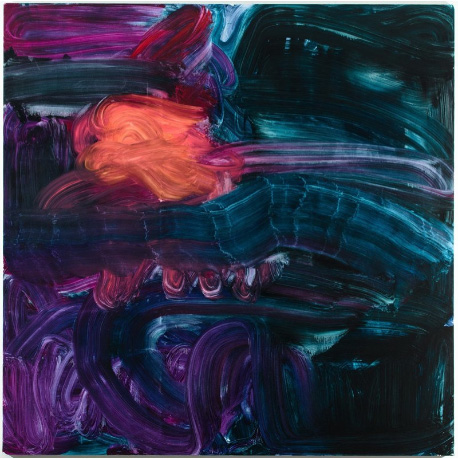
Gary Petersen, Far Away (2014), acrylic on canvas, 20 x 16 inches, Theodore:Art.

THE NEW CRITERION
February 2015

Gallery Chronicle
by James Panero

On “Gary Petersen: Not Now, But Maybe Later” at Theodore:Art, “Philip Taaffe” at Luhring Augustine, “Through the Valley: New Paintings by Devin Powers” at Lesley Heller Workspace, “Fran O’Neill: Painting Her Way Home” at Life on Mars, “Sideshow Nation III: Circle the Wagons” at Sideshow Gallery, and “Paperazzi IV” at Janet Kurnatowski Gallery.

Geometric abstraction is painting at full volume, electrified, supremicized. It’s a manufactured nature, an artificial light, a polished gemstone. It can also be overwrought, and not for everyone, but it’s rarely dull, even if we have come to recognize its terrain of colorful shapes and sharp angles. That modern painting has long employed geometry for its own ends hasn’t taken the dazzle out of these forms. On the contrary, as artists have tapped geometry’s kaleidoscopic potential, the mode has been energized by refracting its own history. Kazimir Malevich could describe his “ascent to the heights of nonobjective art” as a pioneer, watching as “the familiar recedes ever further and further into the background.” Contemporary geometrists can take their inspiration from beside and behind them just as much as they can from far out front.

Writing about “What Abstract Art Achieved” for the New York Times Magazine in 1985, Hilton Kramer observed that, “By rigorously eliminating any trace of a recognizable subject matter in art and giving a radical priority to the most impersonal aspects of pictorial form, the creators of geometric abstraction have redefined the nature of esthetic experience.” As a result of this redefinition, “On the design of everything from the built urban environment to the most mundane objects of commercial and household use, forms deriving from the vocabulary of geometric abstraction have had a powerful and unremitting impact. The contemporary scene is literally unimaginable in isolation from its pervasive influence.”

Today’s geometric painting can therefore be both a vision of Malevich’s pure feeling and a reflection of some form of nostalgia for that sensation. At its best it might be a combination of the two and more. Now with a solo show at Theodore:Art in Bushwick, Gary Petersen mixes the geometries of classical modernism with space-age memories and feel-good color.1

In the days before his opening, Petersen created two site-specific wall paintings, floor to ceiling, that bracketed the view looking into the gallery and served as highway invitations to the show. Painted with a background of bubble-gum-pink acrylic, they each employ forms that will be familiar to those who have followed Petersen through his many recent group exhibitions: tapered lines leading to rectangular vortexes of color. The forms are hard edge, but the colors are cream puff. The baby blues, lime greens, and grape purples have a Drive-Thru palette, while the shapes are TV hypnotic—Josef Albers by way of “Laugh-In.” They are rigorous and fun, lively and controlled, and advertisements for the latest models of smaller Petersens hanging on the showroom walls.

These smaller works on canvas, all from 2014, all of which could fit under your arm, reveal Petersen’s technical control over his sharp angular forms along with his willingness to give them room to develop and transform one to the next. Ovals, triangles, arcs, and rectangles assemble and rest over a secondary scrim of background shapes. The compositions are Piet Mondrian and Fritz Glarner mixed with Eames-era optimism. They give off a sense that our best times are still ahead of us, or at least we remember a time when they still were.

Glyphic_Field_srgb01

Philip Taaffe, Glyphic Field (2014), mixed media on canvas, 110 3/8 x 249 3/8 inches, Luhring Augustine.

Just a block away at Luhring Augustine’s cavernous Bushwick outlet is Philip Taaffe, a painter who made his name as a pioneer of “Neo Geo,” a 1980s term for a “new geometry” that filtered geometric forms through pop sensibilities.2

To me, Taaffe’s paintings convey more geometric awe than pop irony, even as they employ some cool seriality and sly encoding. At Luhring Augustine, what’s first striking about them is their size and skill. Taaffe uses every possible process imaginable to stamp, stencil, marble, collage, and silkscreen his canvases with colorful symbols that look beyond the recent abstract canon to draw on a worldwide history of geometric form. The work serves as reminder that geometry has been a foundation of all art, from primitive hieroglyphics to single-point perspective, long before modernists like Malevich rediscovered it.

Taaffe seems particularly interested in mining totemic shapes and alchemical images, with each canvas seeming to coalesce around a different set of cultural and historical touchstones, whether it be architectural ornamentation, Renaissance tilework, or fountain design. His largest canvas, Glyphic Field (2014), over nine feet tall and twenty feet wide, is also his most captivating. Its debt to Matisse’s cut-outs is unmistakable. Yet rather than fish up the forms of the Mediterranean, Taaffe excavates the glyph carvings of prehistory. His painterly effects remove them from the dusty past and seem to reanimate them with a certain glowing power. As a reward for close viewing, there are even a few extra surprises that come to the surface of the glyph soup. A modern clip-art image of an eagle? Taaffe isn’t saying what it means. Yet as with all of his forms, we feel it must mean something.

JAMES_Powers

Devin Powers, Woden (2014), oil on carved wood, 30 x 24 inches, Lesley Heller Workspace.

"Breakthrough” might be an overused word, but at Lesley Heller Workspace on the Lower East Side the painter Devin Powers has done just that.3

For his second solo show at the gallery, Powers takes the sharp facets of his geometric compositions, previously rendered in oil and ink for his first exhibition at the gallery, and carves them in wood, creating wild abstract reliefs that sometimes break and burn right through the picture plane. The evolution feels experimental, but also essential when perceived against the topography of his flat designs, where you just want to dig in. Powers is driven by an intuition that quite literally cuts against the mathematical programs of his compositions.

His works rests on the point between control and expression. The precision of his crystalline form is balanced against the rough feel of the carved wood, which he tools by hand. Sometimes his facets get carved out, while other times he leaves them painted and flat. Symmetries and programs work against the free forms and sparkling colors of these reliefs as they break out of the square frame, spiraling out across the wall with an internal energy fed by a crystalline imagination.

At times this energy can be too much—too big, too busy, too much flashing color—as the spiraling patterns get away from us. Best are the examples that settle into some final resolution, such as the muted crystals of Cathedral(2014). Powers may sense this too. My favorite work here is, from what I understand, also his most recent. In Woden (2014), warm taffy twists of color and shape cool into a squared-off whole. It’s a perfect confection that finishes off one exhibition and tempts us for the next.

Fran

Fran O'Neill, g's sunset (2014), 84” x 84”, oil on canvas, Life on Mars.

At the opening for the painter Fran O’Neill at Life on Mars, another gallery, like Theodore:Art, along the always-rewarding main drag of Bushwick’s 56 Bogart building, I found myself puzzling over an important question with the artist Dee Shapiro and anyone else who would listen in.4

How does she do it? What I meant was, how does Fran O’Neill achieve what I consider to be her signature sweep of color across canvases over six feet square? A sponge? Some kind of squeegee? We had our theories, but none of them seemed quite right, and indeed they weren’t. The textures of her line, especially where they skip a beat, are somehow too natural, too “shimmery” (to take a title from her best work), for any of those tools.

The answer came when the artist arrived and I asked her myself. She pointed to the underside of her arm. After a few moments of mental processing, the gracefulness of O’Neill’s paint handling made much more sense to me. For her big strokes, O’Neill uses nothing more than herself to push oils across canvas. It’s a uniquely physical process, one sized to the canvas and her own frame, and results in something I now see, in part, as a set of movements captured in one long exposure. This is not at all to suggest her work is merely the result of some actionist happening. Her paintings are nothing like Yves Klein’s raunchy “human paintbrush” performances, which would today certainly land him in the court of microaggressions.

A native of Wangaratta, Australia, O’Neill started off as a landscape painter. The turbulent thunderstorms of her former home are never far from her work, helping to explain the title of this exhibition and also her increasingly gestural paint handling, as she finds a way to tap her own physical atmospherics. Sometimes these movements can get messy. Perhaps that’s the idea behind Meeting You, a two-paneled work joined as one from 2014. Best are the works that sweep the mess away with one final flourish.

Sideshow

Installation view at “Sideshow Nation III: Circle the Wagons,” Sideshow Gallery. Photo: Vincent Romaniello.

If you could see just one painting show this year, the annual group exhibition at Richard Timperio’s Sideshow Gallery in Williamsburg, Brooklyn should be top of your list.5

I have written about this increasingly adventurous annual blowout just about every year. Yet with over six hundred artists represented from floor to ceiling and in every space in between, the exhibition is a one-stop shop—or a final stand, given the title—for what’s happening now, casting an ever wider net over the greatness of the borough and beyond (um, hello, Brooklyn Museum). This year, in what is a natural synergy, some younger Bushwick painters are mixed in with the older generation of studio artists who came of age in Soho in the Sixties and Seventies and beyond, including some surprisingly big names for an outer borough show.

Kurnatowski
Installation view of “Paperazzi IV,”
 Janet Kurnatowski Gallery. Photo: Vincent Romaniello.

Concurrently, on a smaller scale, and with many of the same names, is the return of “Paperazzi” at Janet Kurnatowski Gallery in nearby Greenpoint—the equivalent omnium gatherum for works on paper.6 With most of the works now directly pinned to the walls rather than spreading out in matted frames, the evenness of this exhibition has never been greater. Taken together, the efforts of these two small independent galleries have accomplished more than any museum department or curatorial committee has done in showing us the energy of the artist’s studio today.

1 “Gary Petersen: Not Now, But Maybe Later” opened at Theodore:Art, Brooklyn on January 10 and remains on view through February 22, 2015.

2 “Philip Taaffe” opened at Luhring Augustine, Brooklyn, on January 17 and remains on view through April 26, 2015.

3 “Through the Valley: New Paintings by Devin Powers” opened at Lesley Heller Workspace, New York on December 14 and remains on view through February 1, 2015.

4 “Fran O’Neill: Painting Her Way Home” opened at Life on Mars, Brooklyn on January 16 and remains on view through February 15, 2015.

5 “Sideshow Nation III: Circle the Wagons” opened at Sideshow Gallery, Brooklyn on January 10 and remains on view through March 15, 2015.

6 “Paperazzi IV” opened at Janet Kurnatowski Gallery, Brooklyn on January 16 and remains on view through February 15, 2015.

Gallery Chronicle (January 2015)

Fox Gallery installation view with work by Claire Seidl and Kim Uchiyama

THE NEW CRITERION
January 2015

Gallery Chronicle
by James Panero

On “Claire Seidl and Kim Uchiyama: Plain Sight, Selected Paintings, Prints and Photographs” at Fox Gallery, "Eleventh Street Arts: Inaugural Group Show" at the Grand Central Atelier, "Tom Goldenberg: Landscapes” at The Graduate Center, The City University of New York, and “Todd Gordon, Tom Goldenberg” at George Billis Gallery.

An apartment gallery is just what it sounds like: a gallery in an apartment. The concept barely needs explaining, but the obviousness of it only became apparent to me in recent years. Of course, the traditional commercial gallery as we know it—that storefront of art, now almost always stripped down to a white cube—is, in fact, a modern creation. Art has been decorating the places where we live since before the first cave drawings at Lascaux. No doubt someone sometime in the Pleistocene was the first to trade a zigzag clam carving kept beside a stone pillow for entrails from the mammoth hunt. Hence the first apartment gallery sale was made.

But for whatever reason, from perhaps 15,000 years ago until sometime in 2008, apartment galleries have been far too exotic for most of us to pay them much mind. It could be that some prehistoric prohibition exists in mixing commercial transactions with a place of domicile; the art on the walls where you live should reside on the walls where you live and shouldn’t be up for sale. Most municipalities indeed have some regulations against operating a commercial space from home, and presumably this includes an art gallery. I wouldn’t want Gagosian West run out of the apartment across the hall from where I live, either. Yet there have been many famous and wonderful apartment galleries that worked out just fine for everyone. In January 2012, I wrote about the “ ’temporary Museum of Painting (and Drawing)” that the painter Cathy Nan Quinlan ran out of her loft in Williamsburg. These have largely been alternatives to the mainstream; out-there spaces not for everyone (although, in fact, they could be far more inviting than chilly white-box storefronts).

This all changed with the declining fortunes of the art world after 2008. As the economics of all but the largest commercial galleries suffered setbacks, the nimble apartment gallery, often artist-driven, often in unusual locations, took on a new leading role. It might be added that social media, the flattening of information, Google Maps, and a new appreciation for the “sharing economy” all played a role in these developments. Apartment galleries in Bushwick such as Norte Maar and Centotto began rigorous and regular exhibition programs in the wall spaces next to the kitchen and above the bed. But more importantly these changes in venue brought with them a sense of liberation. With gallery costs presumably now covered through other means—the best of them are living spaces first and exhibition spaces second—the lights stay on whether anything sells or not. So apartment gallerists (if we can call them that) have the freedom to show what they want, not what they need to sell.

Another discovery of apartment gallery-going is how interesting it can be to see art in a domestic setting. You can just about put anything in a white-box gallery and it will seem like art as it takes on the artificial aura of the venerated space around it. In a home, art must rise to the occasion. The art that passes this test looks even bigger and better than on a whitebox gallery wall. This is incredibly helpful, of course, in deciding if this is art you want to live with yourself. Apartment galleries also give us a sense for the seller’s own taste, ideas for our own home, and a more direct connection (too direct, for some people) with the creative community we might be buying into.

These thoughts went through my head as I visited Fox Gallery NYC, an apartment gallery run by Annette Fox since 2009. Located in her apartment at 101st Street and West End Avenue on Manhattan’s Upper West Side, and open by appointment, Fox Gallery delights from the street. Just look up at the intricate and now forlorn Art Nouveau façade of one of George & Edward Blum’s signature apartment buildings from a century ago. The faded Gilded Age grandeur continues through the apartments inside, where a hundred years of landlord paint has built up over the picture moldings and French doors.

Watercolors by Kim Uchiyama, Fox Gallery NYC

In Fox’s apartment, this frosty white craquelure only adds to the texture of the space and resonates with the bold abstract paintings now on view by Claire Seidl and Kim Uchiyama.1 Both painters create an enigmatic sense of color, layer, and light—Uchiyama through horizontal bands; Seidl in a scumble of scrapes and lines. As natural light fills much of this classical living space, their work breathes and converses like exotic figures lounging in the living room or sitting with you at the dining room table. The Swing of Things, an aqueous square canvas by Seidl at the end of the entry hallway, invites a deep dive in. A set of matching watercolors by Uchiyama finds her horizontal bands bending and resting against one another and connecting through the panels in the series. Fox effortlessly folds her own excellent collection in this mix while also showing the range of each of these artists’ output: in the hallway, print editions by Uchiyama; in the bedroom, haunting long-exposure black-and-white photographs by Seidl of cabin dinners and lake swimming. This art settles us into a special place, like this gallery, where you just want to linger.

Jacob Collins in his new Grand Central Atelier

When most artists want to learn to paint, they enroll in school. When he couldn’t find a school to teach him, Jacob Collins created his own. For over twenty years, a scion of intellectual New York—he is related to Meyer Schapiro (1904–1996), the Columbia professor and one of America’s most formidable art historians—Collins has developed his own teachers, peer group, and disciples as he seeks to revive the teachings of the Beaux Arts and unlock the secrets of the Old Masters. From Water Street in Brooklyn to his home studio on the Upper East Side to a floor in the General Society and Tradesmen Building just west of Grand Central Terminal, the School of Collins has grown into a movement.

Installation view of GCA's Eleventh Street Arts; landscapes by Jacob Collins

This fall, Collins opened his newest and biggest campus in a converted warehouse in Long Island City, a block from the MOMA satellite PS1, on 11th Street and 46th Avenue. At 12,500 square feet, four times larger than his previous location, Collins’s Grand Central Atelier, as it’s now called, is an art school, an art incubator, and an artist clubhouse for fifty or more painters who have come out of Collins’s intense multi-year program and the hundreds of students who now flock to their classes.


Devin Cecil-Wishing's cast drawing of Saint Jerome and painting of a playing card and egg at Eleventh Street Arts

In the front rooms of the new school is a gallery for their work called Eleventh Street Arts. Through January, open with regular hours on weekends, Collins has mounted an “Inaugural Group Show” for the new space.(2) The venue is less than abundantly marked—the letters “GCA” are unremarkably stenciled on the front door—but the unassuming exterior makes what’s inside seem all the more remarkable. The hundred-odd works here include some of Collins’s own landscapes and demonstrate the intense skills he has promulgated. Many of the names will be familiar to those who have followed Collins through the years, as his best students have gone on to become teachers themselves. This is especially true of Joshua LaRock, a young apprentice when I first met him some years ago who has gone on to paint portraits that could be straight out of the Northern Renaissance. Edward Minoff and Tony Curanaj, former graffiti artists who became some of Collins’s earliest students, now paint singular seascapes and trompe-l’oeil miniatures. Another trompe-l’oeil artist on display is Devin Cecil-Wishing, who displays what might be the finest technique of the whole ensemble in a cast drawing of Saint Jerome that seems to float in space and a painting of a playing card and egg seemingly perched in a shadow box. Anthony Baus was new to me; he creates exquisite drawings of architecture. I also liked Sam Worley’s Study in Yellow (2011) and Patricia Watwood’s Fallen Angel (2012) for bringing their own candor in mixing old and new—Worley with a still life of a yellow soap bottle next to ancient glass, and Watwood with a modern angel smoked out of a blackened urban sky. Like this new school in the heart of industrial Queens, these works of timeless technique fully inhabit the present day.

Sam Worley Study in Yellow (2011) at Eleventh Street Arts

For all we can see on the walls of our museums, there’s much more that rarely makes it onto public view, mainly staying in the storage of permanent collections. This can especially be the case for works on paper. New York has a vast archive of historical material, but most never makes it out of the flat files. It’s true that intimate works on paper don’t lend themselves to the light and space requirements of modern public viewing. Yet what few of us realize (until recently, myself included) is that much of this work, even at our most esteemed museums, can be viewed by appointment in their drawing libraries.

For over a decade the artist Tom Goldenberg has led a peripatetic class called “Drawing on Collections” that has organized small groups to gather and discuss these works behind closed doors. Visiting the drawing library of a different museum or private collection each week, magnifying glass in hand, he and his students call up, pore over, and talk through the lines and marks. As someone who has tagged along for a handful of these workshops, I can report that seeing such works laid out on a table, without the separation of glass, just a few inches from your eye, conveys a unique appreciation of the artist’s touch and left me with an uncanny impression of what I’d been shown.

Tom Goldenberg Digital Trees at The Graduate Center

Back in his studio, Goldenberg has worked through similar impressions in his own landscapes. A display of his drawings is now on view in “Tom Goldenberg: Landscapes” in the Exhibition Hallway of The Graduate Center of The City University of New York.3 At the same time, at George Billis Gallery in Chelsea, Goldenberg is showing the latest selection of his large painted landscapes.4

Occupying a long set of cases in a busy hallway, the exhibition at The Graduate Center demands close viewing. Concentrating on the rural hills, fields, streams, and vegetation of upstate New York, Goldenberg employs a wide range of perspective, materials, and techniques—charcoal, walnut ink, pastels—that clearly draws on those classical collections.

Yet with a background in abstraction, Goldenberg seems to remain just as interested in his mark-making as what he’s made. Many of his best drawings hinge at the point of recognition, where a thicket of lines and a section of empty space come together to reveal the reflections of light in a wooded brook. This impulse is now even more apparent at George Billis, where Goldenberg has stepped back from his verdant realism to test his experiments-on-paper writ large.

Tom Goldenberg, Smithfield at George Billis Gallery

Here George Billis smartly contrasts Goldenberg’s rural intimacy with the hardscrabble cityscapes of Todd Gordon. In Gordon’s work, it is hard not to see the painter Rackstraw Downes, who also employs snaking train tracks and fish-eye realism to give sight to the urban unseen. Yet Gordon stands on his own, especially in a painting such as The Green Barn, a scene of corrugated metal siding and graffiti that has the transporting sense of a modern ruin.

For Goldenberg, his latest paintings are more like drawn canvases, with layered sketches on a pulpy painted ground. Of course, the mechanics of drawing on paper do not automatically translate to oil on canvas. A handful of paintings here feel unfinished, while in others the dashing lines and bold colors may distract from the overall image. But the best, such as Sandro’s Hill, convey both an image and the sense of an image. Here is a perfect layering of impressions, drawn out over time and space.

1 “Claire Seidl and Kim Uchiyama: Plain Sight, Selected Paintings, Prints and Photographs” opened at Fox Gallery NYC on October 22, 2014 and remains on view through January 31, 2015.

2 "Eleventh Street Arts: Inaugural Group Show" opened at the Grand Central Atelier, Queens, on December 5, 2014 and remains on view through January 25, 2015.

3 “Tom Goldenberg: Landscapes” opened at The Graduate Center, The City University of New York, on September 22, 2014 and remains on view through January 18, 2015.

4 “Todd Gordon, Tom Goldenberg” opened at George Billis Gallery, New York, on December 16, 2014 and remains on view through January 24, 2015.