Next Stop

James Panero, the Executive Editor of The New Criterion, discusses the history of Pennsylvania Station and the new Moynihan Train Hall in Manhattan.

THE NEW CRITERION, February 2021

Next Stop

On New York’s new Moynihan Train Hall

The demolition of McKim, Mead & White’s Pennsylvania Station proved to be the great architectural trauma of New York. It was arguably the worst destruction the city endured in the past hundred years before the attacks of 9/11; its effects altered the urban fabric just as much. At Penn, the promise of “progress” was, in fact, the terror that leveled that civic temple of 1910 and replaced its soaring classicism with the soul-crushing modernism of today’s station. In 1965, a sign on Seventh Avenue announced the “redeveloped” station with the cheery slogan, “on the way to you.” Just behind it, as commuters continued to board their trains, the station’s exterior colonnade and vaulted interior were bashed to bits and carted off as landfill to the New Jersey Meadowlands.

The tragedy signaled an ignominious end to New York’s classical era. The indignities it introduced have become a daily reminder of what was lost. That’s because, for the sake of expediency while developers disfigured what had to remain an active transportation center, the old station was leveled rather than excavated. To keep the trains running, on through if not on time, the tracks, the east–west submarine tunnels, and the platforms were all kept, even as they were covered over with an oppressively low new ceiling. Like a blister in the sun, the awful new Madison Square Garden rose above these ruins. (To add insult to injury, the sports complex was named after the original palace where Harry K. Thaw had murdered Stanford White.) Commuter and intercity rail passengers—up to 600,000 a day spread across Amtrak, New Jersey Transit, and the Long Island Rail Road—were crushed down into what remained of the increasingly urine-soaked passages beneath. The ingenious double-decker platforms of old Penn, originally created to distinguish the path of arriving and departing passengers, now just added to the underground mayhem.

Aerial view of the old Pennsylvania Station from the northeast, between 1910 and 1920. Photo: Library of Congress.

Aerial view of the old Pennsylvania Station from the northeast, between 1910 and 1920. Photo: Library of Congress.

Interior view of the head house and train platforms in the original Pennsylvania Station.

Interior view of the head house and train platforms in the original Pennsylvania Station.

From the Baths of Diocletian, one of the classical models for the original station, to a modern-day sewer, old Penn has haunted the city’s conscience just as its replacement has remained a blight on the urban landscape. “One entered the city like a god,” the architectural historian Vincent Scully famously observed. “One scuttles in now like a rat.” Over the years, even as much else in the city has improved, new Penn’s warren of dingy tunnels and onrushing crowds has remained astonishingly grim.

In my own underground transfers, I too have learned the many twists and turns it takes to walk from the Seventh Avenue subway to an Amtrak train. I pass through one sickly tile corridor after another, beneath the stained ceilings perfumed with stale pretzels, on up to Penn’s departure concourse, only to wait among a scrum of passengers jostling one another over the announcement of their departure track. The one solace of this subterranean passage is the glimpse of old Penn that occasionally flashes in the light like an artifact kicked up in the rubble. A old handrail here and a staircase there—a few remnants of the original station remarkably remain intact amid the latter-day squalor.

Some three decades ago, looking up from the back of Penn Station on Eighth Avenue, Daniel Patrick Moynihan, the iconoclastic senator from New York who died in 2003, made a similar discovery on a much larger scale. What he saw was not exactly old Penn, where as a boy he had once shined shoes, but there to the west was a building with striking similarities to the original station. And indeed, occupying an equivalent two-block space, the General Post Office Building, now known as the James A. Farley Building, still rises as a shadow of old Penn. In fact, McKim, Mead & White designed the facility, which opened in 1914 and was expanded to its current size in 1935, to complement the station. The Olympian building ringed with Corinthian columns and pilasters at one time served the same central role for mail as Penn did for passengers. At the time that Moynihan gave it another look, changes in postal distribution were upending the rail-based facility, just as the car and airplane had done to old Penn.

Moynihan had a vision to reuse the old postal building as a new passenger station. Starting in the early 1990s, he began negotiating with a tangle of federal agencies to secure the permissions and funding to get the idea on track. Like much else at Penn, the arrival of this initiative, what is now called the Daniel Patrick Moynihan Train Hall, has been delayed. With New York still in partial lockdown, the hall’s January 1, 2021, opening came and went with little fanfare, even as the completion of the 255,000-square-foot transit hub has cost $1.6 billion and taken a generation to reveal.

Moynihan Train Hall with Madison Square Garden in the background. Photo: Lucas Blair Simpson © SOM.

Moynihan Train Hall with Madison Square Garden in the background. Photo: Lucas Blair Simpson © SOM.

That the Moynihan Train Hall offers improvements over Penn’s existing facilities is a low bar to clear. At its best, the new train hall indeed finds ways to echo the grandeur of the original station, just as the late senator had envisioned. As adapted by Skidmore, Owings & Merrill, the train hall hints at what was lost next door. In the original Penn, the station’s classical Seventh Avenue head house opened to the west onto a glass-enclosed train shed. Just as that station’s façade and waiting room took inspiration from the past, its crystal concourse looked ahead, revealing the splendor of the machine age. Exposed cross-braced steel piers kept massing to a minimum while terraces of glass maximized the light within. Around the open stairways, natural illumination filtered all the way down through the levels, even reaching the trains passing beneath.

In the reuse of its original structural steel, now selectively left exposed, the new train hall reveals the DNA it shared with the departed station while recalling some of the forms of that crystal-palace shed. The train hall’s new main concourse has been carved out of the post office’s former central work room. As originally designed by McKim, Mead & White, this large central sorting area, just behind the post office’s retail windows, was glazed with its own sunken skylight that spanned the entire space. Blacked out during World War II, this back-of-the-house open acre was modified and divided more than once, yet the roof retained its steel superstructure.

In the thirty years it took to develop the new train hall, many proposals were put forward for reglazing this space. Some called for new skylights at the building’s upper roofline. The final decision to keep the original trusses while cutting down the concourse to street grade has created a lofty new space that still reaches back to an important past. The core of the train hall makes the most of its original structural elements, opening up its massive trusses and cross-braced columns and walls that, in the original post office design, were left unseen. At its center, a new four-sided pendant clock, designed by Peter Pennoyer Architects in 20th-Century-Limited moderne, ties the space together with a nod to the analog Benrus clocks suspended inside the original station.

New skylights now fill in among the old trusses in barrel-vaulted form with some extra fizz. These custom-engineered glass baubles are the station’s nod to the future, but one wonders if simply restoring the original glazing would have had a similar illuminating effect while freeing up resources for other improvements. For while the train hall’s central concourse looks sharp in battleship gray, with nicely illuminated rivets, its integration with the trains running beneath—the whole purpose for its creation—seems to have been an afterthought.

Beyond its uplifting forms, it is still an astonishing fact that the function of a century-old train station should be better than anything created today. At the original Penn, glass tile brought illumination to all levels. Step on one of Moynihan’s slick new escalators down to the platform and you descend from light to near-total darkness. Here, the light is only skin deep. An earlier proposal calling for glass flooring, both inside and out, went nowhere. Now beyond signaling their newness, those fancy new skylights are all form and no function.

That’s not all the signaling here. Move beyond the historical features of the main concourse and this train hall most resembles a high-end mall. In attempting to create a new retail and commercial hub, the surfaces mistakenly look west, to the flailing emporium at Hudson Yards, rather than east, to the spirit of old Penn. A colleague of mine calls this slick consumer finish the “international duty-free style.” With a smart but tiny waiting area designed by the Rockwell Group tucked under a side of the concourse, one wonders where trains even ranked in the level of importance for this train hall. The answer may be near the bottom, just a half step above its original use as a post office, which continues but with little integration now with the rest of the complex. The recent leasing of much of the building to Facebook, with new retail and restaurants planned just beneath them, speaks more to the design’s underlying interests.

Unfortunately, as a hall for trains, the new Moynihan Train Hall more than once goes off track. The hall’s street-level avenue entrances, to the north and south of the grand post office stairwell, are the opposite of inviting. Positioned at the far western end of platforming trains, the new concourse also presents an added inconvenience for the majority of passengers coming to the station from the east. As I noticed the day I visited, the new concourse was deserted compared to those oppressive waiting areas across the street at Penn, which are still better positioned over the center of the trains. When I asked a Moynihan ticket-taker about this, he wondered why anyone would walk an extra block west just to have to walk back the other way on the platform. He also suggested that Amtrak was making a tally of those still boarding from Penn and those from Moynihan, and would eventually stop listing the trains in the old location, forcing passengers to use the new hall.

For the rail commuter, the addition of Moynihan merely adds an extra length of turns to get from the subway to the Amtrak train. A pleasant concourse at the extreme end of a rat maze merely compounds an unsavory overall experience. The poor integration of typography, wayfinding, and pathways with the rest of Penn Station remains a joke, now made cruel with this reminder of what there once was. It is all the more remarkable that som’s own new underground waiting area, the West End Concourse, with overworked signage by Pentagram, which opened in June 2017, shares no stylistic similarity with the austere Moynihan concourse directly above.

Beyond the trains, the last missing piece of the Moynihan Train Hall is Daniel Patrick Moynihan. Until recently, the new rail center was supposed to be known as Moynihan Station. Then in 2017, the first signs went up calling it Penn Station West. It could be that cancel culture finally caught up with the trailblazing studies of this senator who wrote “The Moynihan Report,” the 1965 paper concerning the high out-of-wedlock birthrate of black Americans and its negative economic consequences. A simpler answer is that the New York governor only ever wants to credit a civic project to a Cuomo. Andrew Cuomo now plans to build a new station, in a new style, over the entire Penn complex, and he would prefer to retain the naming rights.

As the National Civic Art Society and others have argued, the real solution for Penn Station is Pennsylvania Station: the demolition of Madison Square Garden and the rebuilding of McKim, Mead & White’s lost masterpiece over the extant tracks. Daniel Patrick Moynihan felt that loss deeply and dedicated his final years to finding it. By looking to the past, his new train hall should now inspire others not to make the same mistakes of fifty years ago all over again.

Don't Sweat It

THE SPECTATOR USA

Don’t Sweat It

From the Baths of Caracalla to the Baths of Tenth Street

I miss my shvitz. At least once a week before the shutdown, I went to the Russian & Turkish Baths on 10th Street in Manhattan’s East Village. I saw it as my connection to the ancients. Here was a tiny remnant of classical bath culture surviving in the modern city. Or so I liked to believe. Like much else in New York, I now sweat for its return.

Back when I was studying classical archaeology, I spent a week or so crawling through the ruins of the public bath house of Ostia, Italy. Even in that Roman port town, something like the Brooklyn of the empire, bath design exceeded anything in the post classical world. Each room had its own distinct shape and purpose. After the apodyterium, you pass through the solarium, then the tepidarium, on to the caldarium, finish off in the frigidarium and do it all over again. The architecture and even the brick were designed for optimal bathing performance. The walls were hollow to allow the furnace fueled gasses to radiate from all sides in a system we now call hypocaust heating. Olive oil served in place of soap, with a tool called a strigil used for scraping off the dust of the Campania. No one in history was better bathed than a Roman.

The line of descent from the Baths of Caracalla to the Baths of 10th Street might represent the decline and fall of the bathing empire. From Rome to Byzantium to the East back West by way of the Pale of Settlement — to here, a dank, century-old New York City basement. Like the memory of Rome, the achievement of the Russian and Turkish Baths is that it has survived at all.

The Russian and Turkish Baths, photograph by Weegee

The Russian and Turkish Baths, photograph by Weegee

I’ve become known here as ‘professor’. The other regulars are mostly hipsters, oldsters and Jewish Orthodoxers. Before the shutdown, and hopefully again soon, I would go for a late lunch of borscht and Baltika beer. The unassuming canteen off the check-in desk served up highly respectable Russian fare surrounded by the fading autographs of television newscasters, Finnish diplomats and the stars of Superman II. As my order was prepared, I entered the changing room of mismatched lockers to the smell of cooked socks and put on the provided robe, which was more like a scratchy black sheet. The more you go, the more you know to opt out of the shorts and shoes they give you and bring your own swimsuit and shower slippers. I also started carrying my own Russian banya hat. It is a felted affair of elvish shape with Cyrillic lettering that I was once told reads ‘Queen of the Baths’. Oh, well. The sides curl up to transfer the water dumped on your head into a cooling trickle.

They say the Russian & Turkish Baths date back to 1892. The condition of the establishment leaves little doubt of its antiquity. The building is a tenement walkup with a basement long ago converted into a set of highly overheated rooms. In the 1980s, the bath’s two Russian owners, Boris Tuberman and David Shapiro — the latter died in May while planning the reopening — purchased the establishment and soon thereafter split their ownership to run it on alternating weeks. The unusual arrangement confused many and caused divided loyalties among the patronage, to which I remain a neutral party. But it also introduced the necessary inertia to ensure that few concessions were ever made to the changing times, including our own.

Everyone there knows what to do, or soon learns, with their own bathing ritual moving from one room to the other. I always start with the Aromatherapy Room, a steam room where someone covers the light with a wet towel and douses the spigot with essential oils. From there I head to the Turkish Room for the hot, wet heat. Inside are walls of overactive steam radiators surrounding three tiers of splintering bleachers. By the door is an ice shower, which contributes to the dankness and no doubt the spalling rust of the vaulted cement ceiling.

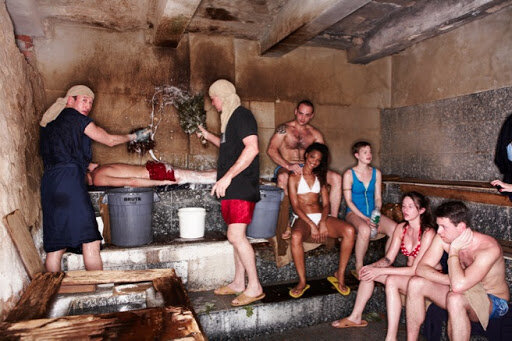
Last comes the Russian Room. It is the darkest and most Chernobyl-like. The temperature reaches over 200 degrees, fed by its own oven. When the oven door is left open, the radiant sensation has to exceed 3.6 Roentgen. Again there are tiers of benches, this time made of sizzling stone. I know not to take the top row on my own. Too hot. I like to leave easy access to the water trough, where you can cover yourself in buckets of ice water for some relief.

The “platza” as administered in the Russian Room of the Russian & Turkish Baths

The “platza” as administered in the Russian Room of the Russian & Turkish Baths

On most visits I order up a service called the platza. Viktor, the bath’s most famous attendant, knows me well. His special treatment resembles the sensation of traveling through a car wash while being waterboarded. Administering the platza also greatly pleases Viktor, which is good because he must perform these duties in the burning heat. Into the Russian Room we go, cooling an upper corner bench by the oven with a towel soaked with a bucket of water for me to lie upon. Another towel then goes over my head, which Viktor splashes with water at semi-regular intervals when he is not cooling himself.

The platza proceeds for some 15 minutes. The ablutions involve the application of oakleaf branches that have been soaked in oily soap. During the procedure Viktor says little aside from ‘Yes’, ‘Good’, and ‘I kill you’ as he brushes and smacks the branches across the skin. The action removes the body’s toxins and just about everything else. The sensation also makes everything seem even hotter and, in fact, induces a temporary fever in the body, which I understand can have salutary benefits. Fortunately, Viktor also has a special sense for just when the body is about to become sous vide, and so he will splash you once in a while with a little cold water.

When it is all over, and Viktor congratulates your strength and requests your tip, I head to the cold plunge. This dark, refrigerated pool with a chemical smell is cooled to 40 degrees. It feels like it. The feet hurt the most. But the experience has also inured me to extreme changes in temperature. It is a good reminder that we are not created to be reptiles; we are warm blooded creatures. I have since taken my cold plunging to Coney Island, where I have sometimes joined the Polar Bear Club on their Sunday swims. The body’s reaction to cold water is flight, then fight. After a few minutes of dizzying unpleasantness, the flesh energizes with rushing blood and starts to feel warm. But the experience is best left to knowledgeable companions. If you are in there too long past the 10- to 15-minute mark and start to feel overly excited, it is time to get out.

At the Russian & Turkish Baths, the experience is complete with a brief rest on the roof deck. At one time this area was modeled on a Russian dacha, or country house. There are some fading murals to attest to this, but with benches made of broken plywood and torn foam, the area now resembles a squatters’ encampment. No matter: whatever the season, after the baths, the atmosphere here always feels ideal.

Like the Russian & Turkish Baths, the bath houses of Rome were cultural pavilions, even more so than in Greece, where this bathing culture originated. The Roman baths had restaurants, performance spaces, massage areas and gymnasiums. The Egyptians can keep their great pyramids. Rome’s real achievements, the gravity-fed aqueducts that moved 300 million gallons of water a day, created the world’s best baths. At one time there were 900 bathhouses in Rome alone. The Baths of Caracalla covered 27 acres and were the inspiration for New York’s original Pennsylvania Station. When one Roman emperor was asked why he bathed once a day, he replied it was because he did not have the time to bathe twice a day. When I return to the 10th Street Baths, I know I’ll feel the same way.

Gallery Chronicle (January 2021)

THE NEW CRITERION, January 2021

Gallery Chronicle

On “Sam Gilliam: Existed Existing” at Pace Gallery, New York, “Martin Puryear” at Matthew Marks Gallery, New York, “Jack Whitten: I Am the Object” at Hauser & Wirth, New York & “Rico Gatson: Ghosts” at Miles McEnery Gallery, New York.

The experience of art is never more vital than in times of crisis. During the Blitz, Kenneth Clark’s “picture of the month” restored one masterpiece at a time to the walls of the National Gallery. Myra Hess’s lunchtime concerts returned live music to bombed-out London. So far, our best response to World War C has been outdoor dining. We could have been a little more spirited and inventive in our emergency initiatives. Yes, it is true that in today’s New York we can eat our meals in boxes built above the gutter. What we should be seeing are concerts in every park and theater on every corner.

The city’s commercial art galleries have been the exception to this rule. They too could have remained dark, all covered in the finest grades of low-knot plywood. Instead the galleries have returned to become the city’s great free cultural resource at a time when there are far too few alternatives. With timed tickets available in advance or, in most cases, simply when you walk in, the vitality of art remains a barcode-scan away. As the galleries have restored their cycles of new exhibitions, the experience of gallery-going has become salutary. In these times of clandestine gatherings, the shared encounters even feel revolutionary. Just imagine, actually seeing something with someone outside of Zoom. I just hope it lasts until the time of publication.

This season, in Chelsea, the interest of New York’s blue-chip galleries has coalesced around a selection of what we might now call black-chip art. In particular, this has meant the exhibition of several simultaneous shows by a generation of black male abstractionists who have each reached new levels of veneration and value. The contemporary art market can be notoriously ill-calibrated, of course, and one could attribute this latest trend to just another passing interest. In this case, however, the attention is well deserved. Before the mega-galleries ever got involved, long before the upheavals of last summer, certain galleries and dealers had been exploring the loose affinities of these artists who use the language of abstraction in new and profound ways.

At the age of eighty-seven Sam Gilliam showed, through last month, his latest work for the first time at Pace.1 Over half a century ago, Gilliam emerged out of the Washington Color School to bring a new spirit of alchemy to paint on canvas. He experimented with stained canvases and unusual media. Resisting agents, metallic powders, fluorescent pigments, and just about anything that could make colors swirl and sizzle went into his mix. He folded his loose, wet canvases to develop Rorschach-like effects. He then hung them out to dry in startling new ways. In some cases he stretched his canvases over beveled stretchers to create relief-like works. In others he suspended them as garland-like buntings in catenary curves. In all he tested the boundaries between painting and sculpture. He also merged the personal with the universal. The son of a seamstress, born in Tupelo, Mississippi, Gilliam draws on childhood visions mixed with the archaic, classical, and Renaissance influences of art history. Memories of clothes drying on the line flutter together with the colors of Titian and the forms of Dürer.

For anyone familiar only with Gilliam’s youthful work of the 1960s and ’70s, it remained to be seen what the 2020s would bring for this mature artist. The answer, at Pace, should have put octogenarians and just about everyone else on notice. At least one of us has had an astonishingly creative pandemic year.

The term “gallery” does not quite give mega-operations such as Pace their full due. This juggernaut of an enterprise is spread across two buildings on West Twenty-fifth Street and includes a new museum-worthy tower. Gilliam needed every square inch of Pace’s two ground-floor spaces to display the full range of his recent achievements. Of the two, the better venue to start with was the one down the block, towards Eleventh Avenue. Here Gilliam revisited the beveled canvases that first brought him to international attention. (In 1972, in a group invitational exhibition organized by Walter Hopps, Gilliam became the first black artist to represent the United States at the Venice Biennale; Hilton Kramer singled out Gilliam for his “strong showing.”)

Sam Gilliam, The Mississippi “Shake Rag,” 2020, Acrylic on canvas. Pace Gallery, New York.

Sam Gilliam, The Mississippi “Shake Rag,” 2020, Acrylic on canvas. Pace Gallery, New York.

Gilliam’s new beveled work may be similar in form to the old. What differs is the relative humidity of this latest series. Unlike the wet-on-wet soakings of earlier work, today Gilliam’s canvases can seem extra dry. With titles such as The Mississippi “Shake Rag” (2020), these canvases are each at least eight feet in one dimension. Two of them maxed out at twenty feet. A mottled, complex, sand-like encrustation covered every square inch and invited closer viewing. Where things got messy, as in some of the darker compositions, the materials never quite reacted to alchemical effect. In the better examples, surface scratches gently agitated the canvases into radiant lines. Substrates of reds and yellows seemed to come up from beneath the light, sandy sprinkling. Further hidden in the mix, tile-like circles, squares, and rectangles shook their way up to the surface. The beveled stretchers all gave extra depth to these hanging works. These intricate compositions felt like a constellation buried in a sandbox.

Up the street, the second part of this exhibition reveled in the full permutations and combinations of Gilliam’s penetrating sense for form and function. Pyramid-shaped sculptures on caster wheels were rolled about in one room. Circular forms of similar make hung in another. In a side gallery, a range of solid colors was soaked into large square works on paper. At first, it was not at all clear what to make of the assembly. Online images of these works looked silly. In person, the primary forms seemed to tease out Sphinx-like riddles. As you walked around them, the pyramid shapes flattened in optical effects. By the entrance, Gilliam even included two small, wondrous wall sculptures—Color Abacus and White Abacus—seemingly there to calculate the solutions.

The revelation of this display was how it connected to Gillian’s canvases down the street and his full, bound-together body of work. Constructed of wood, aluminum, die-stain, and lacquer, the intimately crafted pyramids were divided into strata and sub-strata. Taken one way, they were those beveled canvases laid flat. Or they were the accumulation of those stained papers stacked one on top of the other. The circles on the wall reflected the caster wheels beneath. Or something like it. The connections were dream-like, suggestions rather than conclusions meant to be sensed rather than thought out. Thank goodness they were there for us to conjure with through our confounding times.

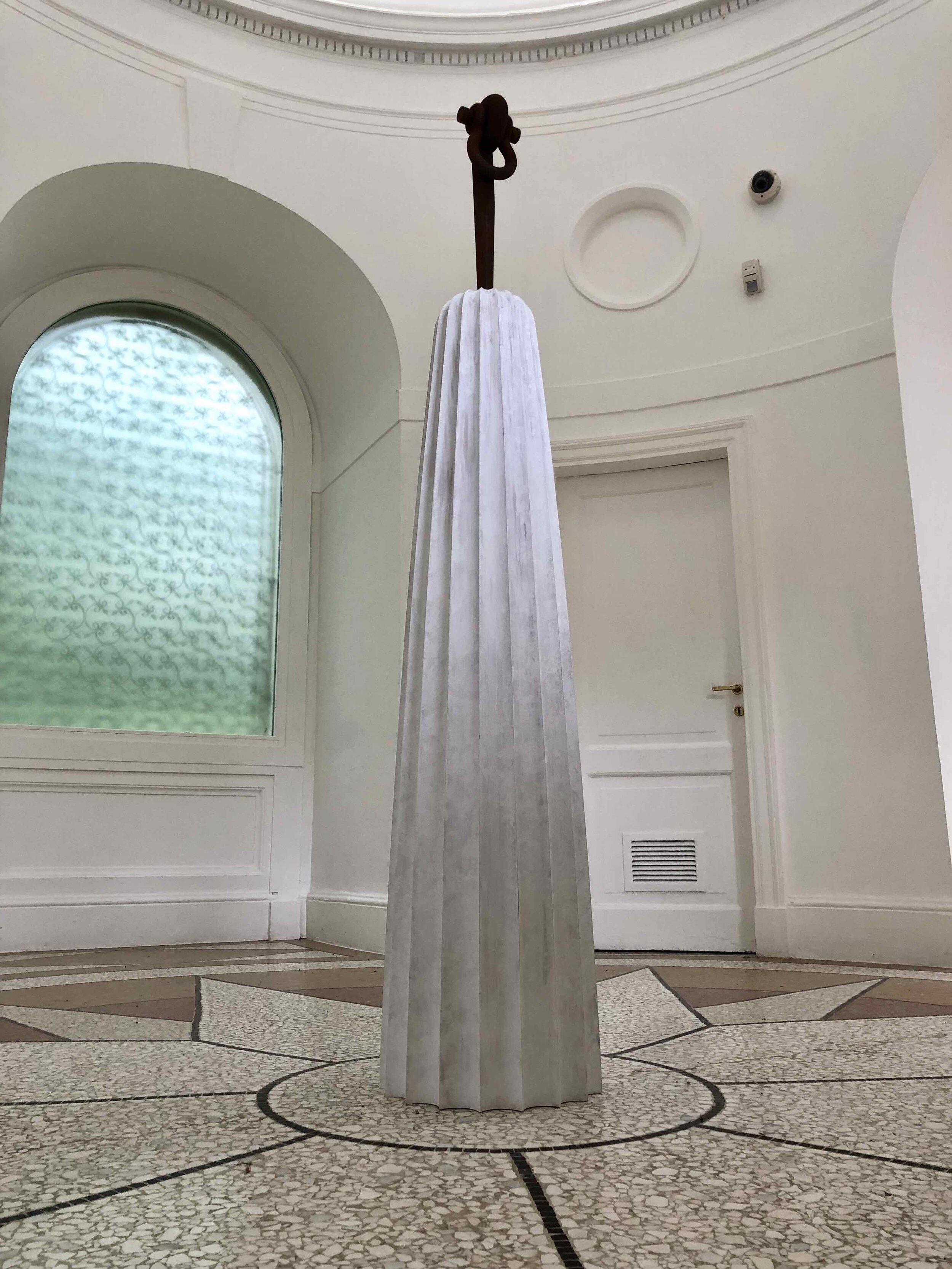
When Martin Puryear represented the United States in the 2019 Venice Biennale, the form and facture of his enigmatic, surrealistic sculptures first appeared as reliquaries for some forgotten feast day. Look closer and it turned out the pageantry of this meticulous work was rooted in the lives of our own saints and sinners. Now at Matthew Marks, a selection of six of these sculptures is on display stateside for the first time.2 Just what Puryear creates is part dream, part nightmare, all made real through the obsessive craftsmanship of his constructions. In Venice, deposited in the neoclassical American pavilion, the works seemed like the floats of some parade gone by. In the white cube of a Chelsea gallery, the individual forms appear in greater relief. Tabernacle (2019) recalls the hat of a Union soldier made extra large. Peer inside this strange work—of red cedar, American cypress, pine, makore veneer, canvas, printed cotton fabric, glass, and steel—and you see a decorated space complete with cannon and silver ball.

Martin Puryear, A Column for Sally Hemings, 2019, Cast iron and painted tulip poplar. United States Pavilion at the Venice Biennale, Venice. Photo courtesy Matthew Marks Gallery.

Martin Puryear, A Column for Sally Hemings, 2019, Cast iron and painted tulip poplar. United States Pavilion at the Venice Biennale, Venice. Photo courtesy Matthew Marks Gallery.

A Column for Sally Hemings (2019) is similarly freighted with signs and symbols. A shackle of rusted iron rises from a finely finished, white wooden base in the shape of a classical column. The lower form could be the architecture of Monticello, or perhaps the ribbings of a skirt. The upper can take on human form, or maybe it is a flower sprouting out of the hard earth. Repeated forms come to haunt Puryear’s œuvre, as the rusted shackle here recalls the golden hardware of his monumental sculpture Big Bling, on display in Madison Square Park in 2015.

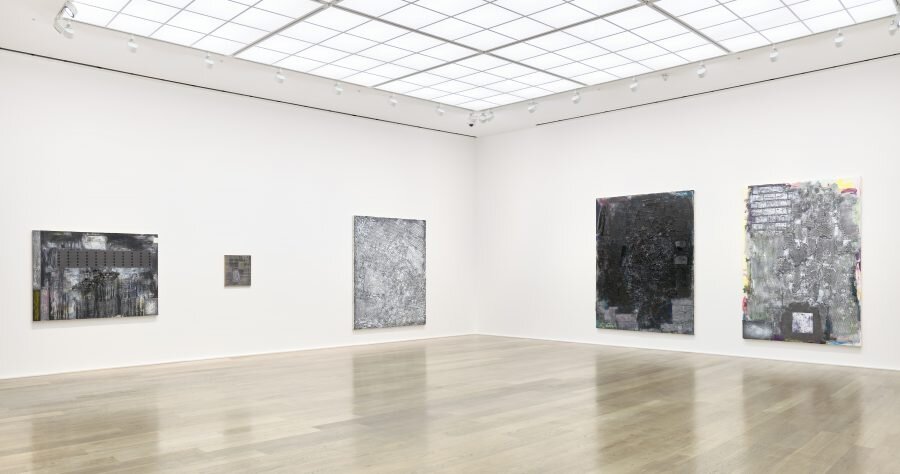
There is an impurity in such abstraction, one that, done right, creates an expressive alloy able to convey the personal and the political bonded to the pictorial. The durability of such art relies on the particular mix of reflection and reference. For art to be about something else, of course it first must be about itself. Now at Hauser & Wirth, an exhibition of the work of the late Jack Whitten reveals where this chemistry can come up short.3

Installation view of “Jack Whitten: I Am the Object” at Hauser & Wirth, New York. Photo: Courtesy of the artist and Hauser & Wirth, London. Copyright Jack Whitten. Photo by Alex Delfann.

Installation view of “Jack Whitten: I Am the Object” at Hauser & Wirth, New York. Photo: Courtesy of the artist and Hauser & Wirth, London. Copyright Jack Whitten. Photo by Alex Delfann.

Over a large tableau, especially in his later work, Whitten could piece together dried paint fragments, which he called tesserae, into a profound whole. Such compositions convey both surface form and deep excavation. At Hauser & Wirth, a preponderance of smaller mosaic work from the 1990s, meant as totems for famous figures, largely fails to find the same map and territory. Of archival interest, the selection mainly serves to reveal the development of Whitten’s unusual process. In one, Mask III (1991), early fragmentary components begin as cracked eggshells and hair. In larger compositions such as Natural Selection and Memory Sites, both from 1995, we can see haunting figures emerging from the tessellated assembly—it will just take some work to get there.

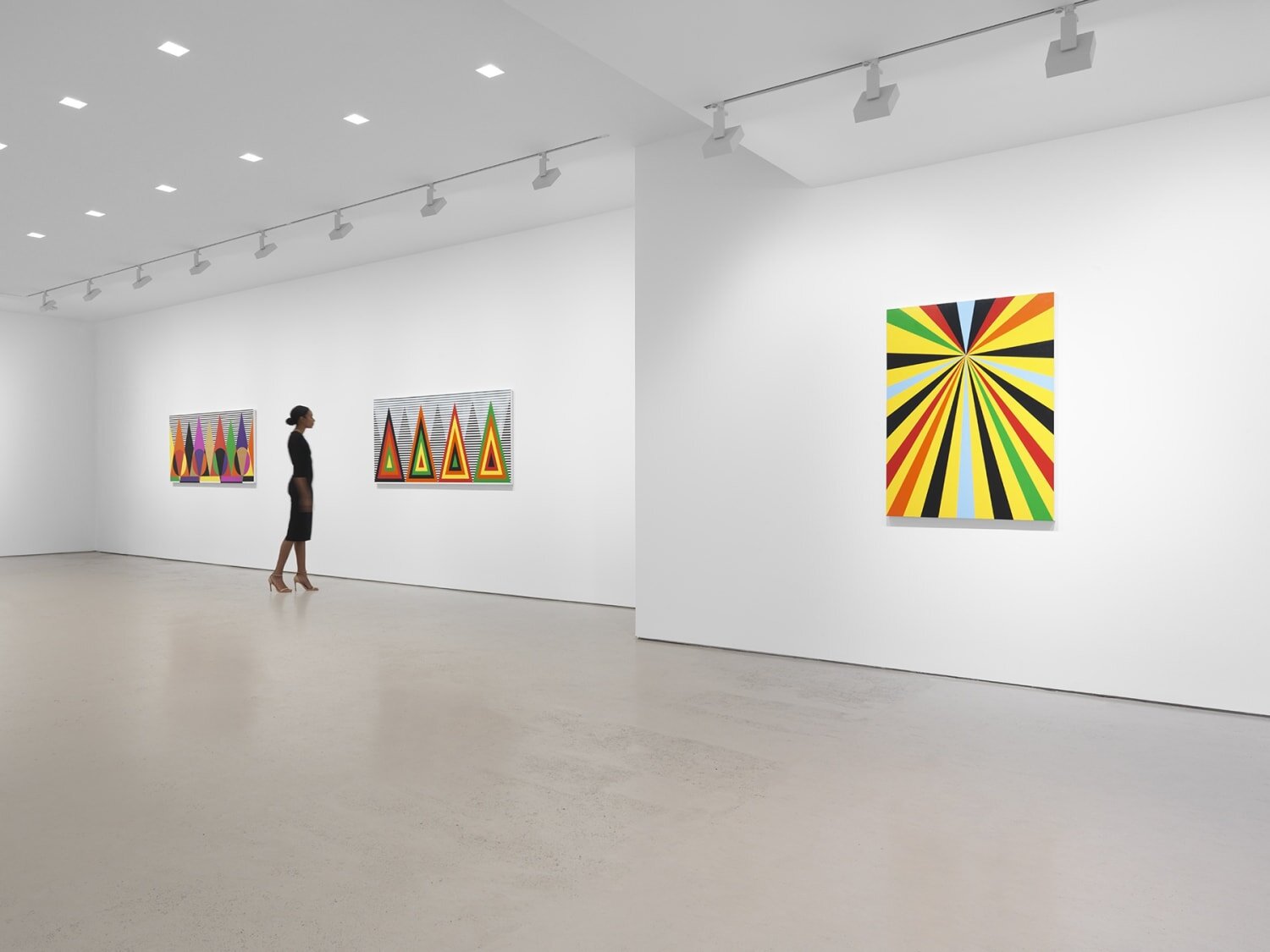
At Miles McEnery Gallery, a captivating exhibition by Rico Gatson revealed the power of pure abstraction to impure effect.4 A generation younger than the black abstractionists on view elsewhere in Chelsea, Gatson has been even more forthright in exploring the confluences of color in his work. In “Icons,” a series on paper that he began in 2007, Gatson uses radiating lines to depict the power of black figures, images of whom he has affixed to the work. The series has a sonic quality that is all horn, a tone well represented in a recent retrospective at The Studio Museum in Harlem. In the latest exhibition, Miles McEnery Gallery presented a selection of them. More are now on permanent display as art-in-transit mosaics in the 167th Street subway station.

Installation view of “Rico Gatson: Ghosts” at Miles McEnery Gallery, New York. Photo: Miles McEnery Gallery.

Installation view of “Rico Gatson: Ghosts” at Miles McEnery Gallery, New York. Photo: Miles McEnery Gallery.

In his abstractions, Gatson has tended to work with pan-African patterns and colors. The merging of modernism and Africanism is one that groundbreaking artists such as Aaron Douglas pioneered a century ago. Of course, one may even say that modernism itself represents a confluence of African and European artistic traditions.

Through his new abstractions at Miles McEnery, Gatson seemed freer than before in going his own way, unencumbered by particular references to time and place. His geometric arrangements of circles, lines, and triangles were like radiant peaks atop mystical mountains. The graphic excitement of his earlier work is still here, just now made personal. After fifteen years of depicting famous icons, this time the iconography is his own.

1 “Sam Gilliam: Existed Existing” was on view at Pace, New York, from November 6 through December 19, 2020.

2 “Martin Puryear” opened at Matthew Marks Gallery, New York, on November 12, 2020, and remains on view through January 30, 2021.

3 “Jack Whitten: I Am the Object” opened at Hauser & Wirth, New York, on November 5, 2020, and remains on view through January 23, 2021.

4 “Rico Gatson: Ghosts” was on view at Miles McEnery Gallery, New York, from November 19 through December 19, 2020.