The New York City Ballet 'Family Saturday'

Slide-02
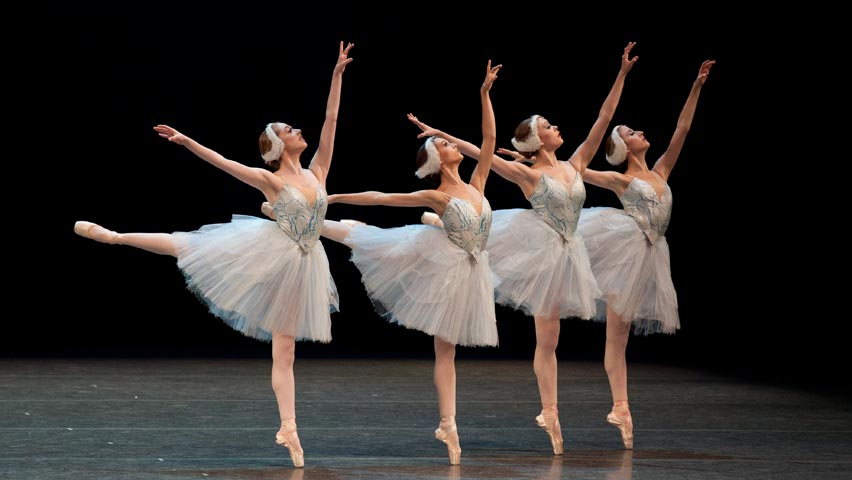
Corps de ballet members performing an excerpt from Peter Martins’s Swan Lake as part of a NYCB "Family Saturday."

James writes:

A cultural highpoint of classical music must be the development of engaging programs for children. Such events combine just the right mix of performance and narration to captivate and educate future generations (while also delighting the parents in tow).

The "Young People's Concerts" series at the New York Philharmonic offers the best, longest, and most consequential example of how this can be done right. The YPCs started as weekend children's matinees back in the late nineteenth century, became a regular feature in 1926, and reached their zenith (and "the Zenith") in the televised broadcasts of Leonard Bernstein starting in 1958. Some years ago, I watched the full run of these TV broadcasts, which is now available in a nine-DVD set from Kultur video, and wrote about it here.

I grew up attending the children's concerts at Lincoln Center (just after the Bernstein era). Now that I have a young daughter, I am back again. But as we've found, just because they are aimed at children, such concerts are not easy to perform well. A good children's concert is not a short, poorly orchestrated, dumbed-down version of an adult concert, which was what we unfortunately found last summer on the lawn at Tanglewood. All the Boston Symphony Orchestra did with that performance was drive a generation away from live performance, or at least the BSO's approximation of it, and back to YouTube. (If you didn't already know, some of the most captivating classical performances for children can now be found online. Just take a look at our current favorite--the Mariinsky's Nutcracker in flawless HD).    

Coming off the BSO experience, we were unsure what we'd find at last weekend's New York City Ballet "Family Saturday." Billed as a one-hour presentation "designed especially for family audiences," the performance promised "short works and excerpts from New York City Ballet's diverse repertory" with narrative instruction by NYCB artists "offering insights on the music and choreography." 

The answer was the finest children's performance I could imagine. Kept to a captivating, fast-paced hour, the NYCB performed excerpts from the season's repertory. This meant Emeralds with music by Gabriel Fauré, The Concerto Barocco with music by J. S. Bach, Who Cares? with music by George Gershwin, Barber's Violin Concerto, Dances at a Gathering with music by Frédéric Chopin, Todo Buenos Aires with music by Astor Paizzolla, and excerpts from the second and third acts of Coppélia with music by Léo Delibes.

Of the entire selection, the opening performance of Emeralds was the one letdown. At least one of the dancers was off a beat, and viewed from left orchestra, some of the staging was obscured by the musicians who were performing stage right.    

Screen Shot 2014-02-24 at 12.36.31 PM

But it all came together as soon as the morning's emcee, Silas Farley, stepped on stage. Farley may for now just be a young member of the corps de ballet, but his star quality can already outshine the principals of the company. My daughter and I first got to know about him through the NYCB's new online reality show, a high-production-value if slightly clichéd web series produced by AOL of life inside the company, with Sarah Jessica Parker narrating and ballet master Peter Martins acting as the heel (he would make a great villain in a 1970s-era James Bond film).

Here's a tip for next season's videos: less talking, more dancing. But between the catty gripes, the show did give us a glimpse of Farley, who was filmed the moment he received his contract to join the company. Taking bets now: With his great poise and bright attitude, Farley may one day be, what, Principal Dancer? Ballet Master? President of the United States? Until then we were lucky to catch him leading the NYCB's Family Saturday.

On stage, Farley's enthusiasm for dance was infectious as he (and the show's writers) made intelligent and fun comparisons between the programs--such as the differences between the choreography of George Balanchine in Jewels (with its performance directed at the audience) and Jerome Robbins in Dances at a Gathering (played more towards the other dancers on stage). He helped us appreciate the fun of Martins's choreography in the Barber Violin Concerto (with ragdoll moves by Megan Fairchild). He introduced us to an accordion-like instrument called the Bandoneon, played by JP Jofre, in Todo Buenos Aires. Finally, for Coppélia, with its robotic doll, he had the children of the audience stand up and move like marionettes.

It seems to be just the right metaphor. Here was a concert that pulled every string to further a child's appreciation of ballet.  

The NYCB's next Family Saturday is May 10, 2014, hosted this time by Principal Dancer Daniel Ulbricht. Tickets are for general admission and $20 each.  

Pete Seeger's symphony of bad ideas

THE NEW YORK DAILY NEWS
January 29, 2014

Pete Seeger's symphony of bad ideas
We should learn to appreciate a man's artistry even when we despise his politics
by James Panero

No other singer could connect with an audience of different ages quite like Pete Seeger, who passed away in New York this week at age 94. The night before he died, my mother, my daughter and I all happened to find ourselves gathered in my living room listening to “Pete Seeger and Brother Kirk Visit Sesame Street,” the 1974 album that was the soundtrack of childhood for my Upper West Side generation and, now, continues to be loved by the next.

What else brings a family together quite like a sing-along to Woody Guthrie’s “This Land is Your Land” with Kirk, Big Bird and Seeger — whose soft voice and rooted instrumentation, so recognizable, will continue to be welcome for generations?

That I have come to see the message behind Seeger’s musicality to be so wrong, often terribly wrong, has only made me appreciate his musicianship more. I seem to spend much of my career editorializing against the full range of mistakes he made. From world politics to the environment of New York State, the innocent idealism communicated through his songs would only be destroyed, I would argue, if we were to act on the positions he took in his lyrics. Seeger’s beliefs began with big-C Communism and ended in little-c communism. The fact that his music could be so inviting despite the many bad ideas that went into it speaks to the power of his artistry.

Great artists don’t always have great politics. If we let the politics dictate the art, we let the politics win out. Richard Wagner’s anti-semitism shouldn’t deprive us of the Overture to “Tannhäuser.” Sergei Eisenstein’s Soviet sympathies shouldn’t detract from our appreciation of “Battleship Potemkin.”

The same goes for Seeger. He was politically effective precisely because his music was that good.

Despite his hardscrabble, rail-riding demeanor, Seeger was the Harvard-educated son of an American musicologist who studied how to push his ideas out in the guise of a well-tuned folk vernacular.

Some years ago in City Journal, the journal of the conservative Manhattan Institute where I am also a contributor, Howard Husock wrote that, “Given his decisive influence on the political direction of popular music, Seeger may have been the most effective American communist ever.”

This is true especially in the way Seeger could package leftist anthems as children’s songs. Husock does a line-by-line analysis of the political messages in Seeger’s lyrics. For example, “If I Had a Hammer,” Husock writes, “was an extraordinary anthem. It pulled off, with great aplomb, the old Popular Front goal of linking the American revolutionary past with the communist revolutionary future, joining the Liberty Bell with the hammer and sickle.”

Writing in the New York Sun in 2007, Ron Radosh, a one-time student of Seeger’s who has been arguing against Seeger’s ideas longer than I have, struck a similar note: “He never pauses to criticize the communist regimes he once backed, nor the few that still exist, like Castro’s prison camp in Cuba. Mr. Seeger’s cries for peace and his opposition to every American foreign and military policy (even ousting the Taliban from Afghanistan) show that he has learned little from the past.”

(To Seeger’s credit, he responded to Radosh in a letter expressing remorse for his youthful Stalinism: “I think you’re right — I should have asked to see the gulags when I was in [the] USSR.” This story was recounted by the Sun’s editors in a tribute to Seeger this week — one that also pays tribute to his musical legacy separate from his politics.)

Beyond Seeger’s Stalinism and his isolationism, there was also his environmentalism. A resident of Beacon, New York, Seeger had long lamented the pollution in the Hudson River. In “My Dirty Stream (The Hudson River Song)” Seeger wrote of “Sailing down my dirty stream/ Still I love it and I'll keep the dream/ That some day, though maybe not this year/ My Hudson River will once again run clear.” In 1969, he constructed a sloop called Clearwater as an icon of advocacy and went on to fashion an organization around it to campaign for the river’s remediation.

Seeger was right that the Hudson needed help, but his advocacy has at times made it worse. One of Clearwater’s main targets have been the PCBs that General Electric legally discharged into the Hudson from its electrical-equipment plants in Ford Edward and Hudson Falls, New York. GE ended this practice decades ago and had undertaken its own cleanup, leading to dramatically improved river conditions.

Yet river advocates including Clearwater pushed for extensive dredging of the river bottom, which the current EPA compelled GE to do through an interpretation of contamination levels that was more punitive than prudent.

“General Electric’s dredging to clean up 30 years of deposited PCB’s from the river is a direct result of Clearwater activism,” the organization boasted in a tribute to its founder.

Yet as I wrote in a study of this action, the cleanup is “both unnecessary and environmentally destructive . . . Because the river bottom was being disrupted, PCB levels in water, air, and fish all rose dramatically and exceeded federal limits. By every measure, the health of the river and the surrounding community deteriorated, at least temporarily, through the EPA’s intervention.”

The same goes for fracking for natural gas from New York’s shale reserves. As its obituary reminds us, Clearwater is “also active in the battle to pass moratoriums on hydrofracking in the region.” Just last year, Seeger himself marched on Albany to keep fracking out of state. “If you take the money that they want to give you for going along with fracking and injuring people for generations to come,” Seeger says to Gov. Cuomo in a YouTube address, "you will go down as perhaps the worst [governor in the history of New York].”

Once again, Seeger came out on the wrong side his own ideals. New York’s fracking moratorium is actively hurting the poor workers of New York’s depressed Southern Tier, as opposed to just the fictional ones Seeger liked to sing about. Environmentalist opposition to fracking, based on a host of dubious claims, also negatively impacts the environmental gains that would result from further gas exploration, especially when it comes to airborne pollutants.

“Displacement of coal-fired power by gas-fired power . . . is the most cost-effective way of reducing CO2 emissions in the power sector,” concluded a recent study by MIT. As I recently documented, the gas from fracking in fact “helps protect the environment by replacing coal in power plants, since gas produces far less carbon dioxide, sulfur, carbon monoxide, and ash than coal does.” The same would go for converting the dirty basement boilers in New York City from oil to gas — if only environmentalists wouldn’t stand in the way of gas exploration and distribution.

If you really want to understand the appeal of disagreeable positions, there's sometimes no better way than through its art. In this regard, Seeger could be a teacher without equal. The simplicity of his songs, perfect for a child's call and response, is also what made them ill-equipped to deal with complex issues. It is certainly true that his artistry was dictated by his politics. That doesn’t mean we must be dictated by it, too.

Put the pedal to the metal to save pedestrians' lives

9yr-old-boy-killed-tractor-trailer-queens

Noshat Nahian didn’t have to die.

NEW YORK DAILY NEWS
January 16, 2013

Put the pedal to the metal to save pedestrians' lives
But 'Vision Zero' is a shared responsibility; don't leave it to de Blasio and Bratton alone
by James Panero

Crossing the street shouldn’t cost you your life. But that’s just what happened to two New Yorkers last Friday evening, blocks away and within an hour of each other on the Upper West Side.

Alexander Shear, a 73-year-old father of two, was walking to dinner when a tour bus ran him over as he crossed at 96th St. and Broadway. The bus dragged his body to Amsterdam Ave. before horrified witnesses were able to hail down the driver.

A half-hour later, Dr. Richard Stock, a radiation oncologist, was holding the hand of his 9-year-old son, Cooper, when a taxi making a left turn from 97th St. onto West End Ave. struck both of them in the crosswalk. Cooper’s body was crushed when the cab rolled over him, according to a witness account, and Stock cradled his son as he bled out on the street.

For a city of walkers, New York has long allowed drivers to dominate its streets. The result has been a tragic disregard for public safety. In 2012, according to police data, motorists killed 150 pedestrians in the city and injured more than 11,000. Annual totals declined over the Bloomberg years, but that’s small comfort to the thousands whose lives were affected.

Many of these crashes took the lives of children. A study by Transportation Alternatives and the Drum Major Institute reports that being struck by a car is the most common cause of injury-related death for city children.

Last February, a truck killed 6-year-old Amar Diarrassouba in a crosswalk in East Harlem. Last June, 4-year-old Ariel Russo was walking with her grandmother on W. 97th St. near Amsterdam Ave. when a teenager in an SUV, who was fleeing police, jumped the curb and struck them both, seriously injuring the grandmother and killing Ariel. In December, a truck killed 8-year-old Noshat Nahian in a crosswalk in Queens.

On Wednesday, Mayor de Blasio, Police Commissioner Bill Bratton and other officials promised a new, “comprehensive road map” to eliminate deadly crashes. It’s inspired by a movement called Vision Zero — with the goal of eliminating traffic-related death and serious injury.

The mayor formed a task force, due to report back to him in a month, and Bratton has devoted more resources and manpower to combatting traffic fatalities.

Good. Urgent action, with follow-through, is in order.

The first step is aggressive policing of traffic laws. Even in cases of serious pedestrian injury and death, law enforcement has rarely charged drivers with serious crimes. According to Streetsblog, nearly half of all drivers who take the life of a pedestrian or motorist in New York do not even receive a citation for careless driving.

In Albany, police unions have stood in the way of allowing speed cameras on city streets. After a decadelong battle, the first cameras have only recently been installed around a handful of school zones in a five-year pilot program. De Blasio wants more, and said that those already in place would immediately start issuing tickets.

The second step is redesigning traffic laws to reduce the number of vehicles cruising the city — and to redraw the streets to take into account their full uses by drivers, bikers and pedestrians.

De Blasio plans to push for more residential streets to come down to a 20-mph speed limit, and that can make a difference.

The most dangerous places for pedestrians are not a mystery. In 2008, an extensive study conducted by the Upper West Side Streets Renaissance campaign identified the very corners and very turns where Alexander Shear and Cooper Stock lost their lives, recommending traffic calming measures to slow cars down.

These are vitally important steps. But ultimately, there’s a third — and for this, the onus is shared. Creating safer roads means changing the behavior of those who use them — to ensure that those who speed, or drive carelessly, or even, as bicyclists and pedestrians, veer into traffic, keep one another in mind.

To get to Vision Zero, we must all rethink our relationship to shared space and put safety first, even if it costs us a few extra minutes on the road.