Outside the frame

GoldLeaf

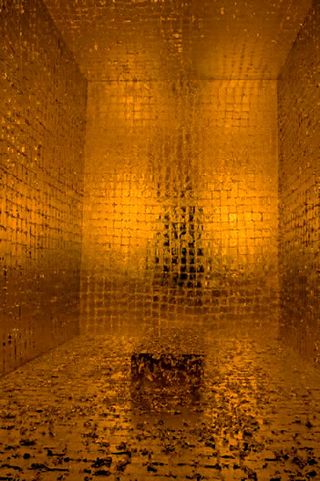
 The Death of James Lee Byars, 1982/1994, by James Lee Byars

HUMANITIES MAGAZINE
March/April 2009

"Outside the Frame"
by James Panero

How Asia changed the course of American Art

On July 8, 1853, four black warships under a cloud of smoke entered the waters around Edo, now known as Tokyo, the center of power in feudal Japan. The American commander, Commodore Matthew Perry, carried a letter from President Millard Fillmore for the Imperial Emperor. Under the policy of sakoku, or “closed country,” in effect since 1639, the ports of Japan had been forbidden to foreign transit but for a Dutch harbor in Nagasaki. Fillmore's long and even chatty letter, brimming with American optimism ("Great and Good Friend!" it announced to the Emperor), sought to overturn this policy and forever alter the United States' relations with the East.

“Friendship, commerce, a supply of coal, and provisions and protection for our shipwrecked people” were Fillmore's requests. His hope was to ensure the safe passage of the American whaling fleet, then fishing off the Japanese coast, and for American vessels en route to China.

Yet it wasn’t the persuasiveness of Fillmore’s letter so much as the intelligence of the American commander and armaments and technology of Perry’s gunboats, consisting of two steam frigates and two sloops, that guaranteed an audience with the Tokugawa Shogunate and Japan’s acquiescence less then a year later. With the signing of the Convention of Kanagawa, Japan was open.

Perry’s voyage, however, had a reciprocal effect. With the opening of Japan, the East began to exert its own cultural influence on the United States. For those who merely expected a one-way spread of the Christian gospel and Western culture to “heathen” lands, the result was unexpected. Nevertheless, as Perry approached Edo harbor, one might say a Japanese black fleet of its own, outfitted with Eastern philosophy and Oriental ornament, made its slow way to the cultural shores of the United States. The period of Asia’s colonization of American imagination was about to begin.

The influence of Eastern thinking over American artistic culture is now the subject of a sprawling 250-work exhibition at the Guggenheim Museum in New York entitled “The Third Mind: American Artists Contemplate Asia, 1860-1989.” The show sets out to survey the East’s cultural reflections in American art in the same dreamy manner that American artists often appropriated Eastern themes. A meditative peel of bells, courtesy of the artist Ann Hamilton, circles Frank Lloyd Wright’s spiraling rotunda and sets the tone for an exhibition that seeks to be both didactic and contemplative, Western and Eastern. The exhibition rises and falls on the same themes as the work it contains. The show “does not illustrate its textual sources; it embodies them,” announce the curators.

Cogito ergo sum,” or “I think, therefore I am.” Rene Descartes summarized a strain of Western classical thought when he wrote this maxim in 1644. His declaration of self-consciousness borrowed from Aristotle and the Nicomachean Ethics: “Whenever we think, we are conscious that we think, and to be conscious that we are perceiving or thinking is to be conscious that we exist.” For the arts of the West, this philosophy of self-awareness established formal boundaries between the artist or observer or conscious subject and the passive window-like art object.

Traditionally, the Western artist imposed an extension of the rational world on a painting through the illusion of perspective. The artist’s studied draftsmanship used the West’s particular knowledge of representational technique to translate the visual world to the picture plane, all the while concentrating almost exclusively on the positive space within the boundaries of the frame.

But what about the space outside the frame--not just the physical space, but the spiritual and relational space between art and artist and viewer? In the past hundred and fifty years, the philosophies of the East have exerted their strongest influence over this negative, numinous region. Meanwhile, the artists of the West have observed, imagined, and even made up what the East has to say about this liminal area, filling in with their own dreams, spirituality, meditations, and politics. Influenced by Hinduism, Buddhism, Taoism, and Asian art and performance, Western artists “deliberately abstained from European empiricism and utilitarianism and looked toward Asia to forge an independent artistic identity that would define the modern age--and the modern mind--in a new transcendentalist understanding of existence and consciousness,” writes Alexandra Munroe, the curator of the Guggenheim show.

Dream House (1962--present) by La Monte Young/Marian Zazeela and The Death of James Lee Byars (1982/94) by James Lee Byars, two of the most memorable works at the Guggenheim, both use Western means to affect this Eastern sensibility. Dream House came about in the early 1960s when Young combined his interest in North Indian classical raga music with Zazeela’s studies in light art. Both became followers of a North Indian vocalist named Pandit Pran Nath and lived with him as disciples in a traditional gurukula manner. The result of their work at the Guggenheim is a carpeted meditative room (no shoes allowed) off the side of the main gallery, filled with colored light and deceptive shadows and sounds that pulsate in deep, repetitive electronic tones. Young and Zazeela’s art cannot be isolated as single elements to be observed—a beam of light, strips of paper, a movement of music--but instead concerns itself with enlivening the spectator through acute sensory stimulation.

The Death of James Lee Byars operates through similar means. From 1958 to 1968, Byars lived in Kyoto, where he taught English to Buddhist monks and studied Noh theater, “a highly abstract spectacle whose dramas explore the intersection between the human and supernatural worlds,” writes Monroe. Through this Japanese influence Byars developed a metaphoric performance practice that carried meaning over to form. The Death of James Lee Byars, now on display in the first large gallery room of the Guggenheim, is composed of a monumental hollowed-out cube covered in glittering gold leaf. In the center is a platform on which the artist once performed as the dead figure of himself. Today, small shimmering crystals rest on the slab in his place. The work of art here is less concerned with sculpture in itself than in the resplendent gold void contained within it, a special space of its own that evokes the spirit of the artist.

The earliest American interest in Eastern expression emerged in New England, where the transcendentalists Ralph Waldo Emerson and Henry David Thoreau read Hindu texts in the 1840s. Here Eastern art connoisseurship arose out of the China trade, and a community of Asian scholars developed around Harvard University. The most influential of these was Ernest Fenollosa, who became the curator of Japanese art at the Museum of Fine Arts, Boston, in 1890 and wrote the canonical two-volume Epochs of Chinese and Japanese Art (1912).

The transcultural assimilation of Asian thought in Western art and culture was never merely an American phenomenon, however, and it did not begin with Commodore Perry. In 1827, Georg Wilhelm Friedrich Hegel linked Arthur Schopenhauer’s “cult of nothingness” to the Buddhist nirvana. In the latter half of the nineteenth century, in what was known as japonisme, the French Impressionists took up the formal qualities of Japanese wood-block prints, called ukiyo-e. The flattening of the picture plane, which became a central feature of modernism, owes much of its development to the styles found in this Japanese art.

Fenollosa directly influenced at least two important artists, Arthur Wesley Dow of Massachusetts and John La Farge of New York, who had both studied painting in Paris and taken an early interest in French japonisme. Dow worked with Fenollosa at the Museum of Fine Arts and published Composition: A Series of Exercises Selected from a New System of Art Education (1899) based on his interest in Japanese prints, which emphasized the rhythmic spacing of forms. Both artists traveled to Japan, and La Farge, through his wife, had a familial connection to Commodore Perry. His close-cropped images of flowers, in their high horizon lines and color choices, resemble Edo-period paintings. After traveling with Henry Adams through Japan, La Farge helped design a memorial, now in Rock Creek Cemetary in Washington, DC, for Adams’s wife with the sculptor Augustus Saint-Gaudens and the architect Stanford White. This important work, which evokes both Symbolist iconography and Eastern quietude, “is likely the most public artwork of the nineteenth century to refer in such significant ways to Eastern sources,” writes Monroe. There is a cast of it in the Guggenheim show.

It is appropriate that the Guggenheim Museum, with its renowned collection of abstract paintings by the Russian artist Wassily Kandinsky, should be the institution to hold this survey. Beyond a mere formal influence on the look and style of modern art, the East had its most profound effect on the philosophies of art, no more so than in the early development of abstract painting, which arrived in America in a roundabout way from Asia by way of European intermediaries (who themselves drew on the publications of New York-based spiritualist circles).

Kandinsky’s debt to Theosophy has been a long-standing source of embarrassment for those who prefer to see only a positivist, materialist origin to abstract art, often examined only through the lens of French modernism. The occultist practice of Theosophy, founded by Madame Blavatsky in New York in 1875 and continued by Annie Besant and C. W. Leadbeater, borrowed extensively from Eastern religious practices, in particular Hindu and Buddhist teachings and cosmograms used as visual tools for achieving greater consciousness. Besant and Leadbeater’s book Thought-Forms, which promised a “glimpse of the forms natural to the astral or mental planes” through the synesthetic mixing of the senses, visualized a Gounod chorus, for example, as an “oblate spheroid” of colors rising “six hundred feet” in the air. Kandinsky’s own book On the Spiritual in Art borrowed extensively from Thought-Forms, as did his formal experiments in paint.

Kandinsky’s abstract “compositions” did not set out to represent an external reality so much as “to effect a spiritual awakening in the viewer’s consciousness,” write Kathleen Pyne and D. Scott Atkinson in the Guggenheim catalog. “Kandinsky drew from Theosophy to develop his revolutionary claim that abstract art (the formless form) had the greatest potential for expressing cosmic laws,” adds Monroe. “The notion of art as a mystical inner construction charged with the power to transform the viewer’s state of mind had a profound impact on American vanguard artists, on whom Kandinsky’s debt to Asian logic for his theories of abstraction was not lost.”

The first generation of American artists to arrive at abstraction came through Kandinsky’s indirect Eastern influences. Marsden Hartley met Kandinsky in Berlin in 1913. Alfred Stieglitz, the center of New York’s early avant-garde, ran excerpts of Kandinsky’s On the Spiritual in Art in Camera Work that same year. Arthur Dove, Georgia O’Keeffe, and the Synchronists Morgan Russell and Stanton Macdonald-Wright reflected Kandinsky’s interest in synesthesia, an artistic belief, related to Richard Wagner’s “total work of art,” that the senses could be brought into harmony, with colors that can be heard and music that can be seen. These artists also absorbed Fenollosa’s books and Hindu and Buddhist texts (Hartley’s Musical Theme [Oriental Symphony] is a synthesis of all these influences). “The example of Kandinsky highlights the hybrid context of the introduction and reception of the East in American modern art,” writes Monroe.

One might think that the calligraphic brushstroke of the second generation of American abstract painters, the Abstract Expressionists, was equally Asian influenced, but these artists were on the whole less accommodating to Eastern roots. The critic Clement Greenberg insisted that Franz Kline, one of the more obvious candidates, has no more “than a cursory interest in Oriental art.” Robert Motherwell claimed he wanted “no fake Oriental work for me.” As occult practices became too closely associated with the rise of fascism and Nazism during the war (and Japan itself was, of course, an Axis power), across the board, abstract painting in the second half of the twentieth century sought to dry out and desacralize much of the mysticism that went into abstraction's origins.

American poetry took its own cue from Eastern sources from an early date, most importantly in Ezra Pound’s 1915 publication of Cathay, containing translations of Fenollosa’s notes on Chinese classical poetry. After the Second World War, the Beat writers took up the mantle of Eastern aesthetics, although often more philosophically than through actual textual interaction. The title of the show, “The Third Mind,” refers to a cut-up work by Beat writers William S. Burroughs and Brion Gysin that combines text and images in random collage.

Interestingly, in 1958, Alan Watts, the preeminent American advocate of Zen, distanced himself from his artistic cult followers, including the Beats. He accused them of using Zen to rationalize “sheer caprice in art, literature, and life [to] revolt against culture and social convention.” He went on: “Today there are Western artists avowedly using Zen to justify the indiscriminate framing of simply anything—blank canvases, totally silent music, torn-up bits of paper dropped on a board and stuck where they fall, or dense masses of mangled wire.”

The composer John Cage, whose 1952 composition “433 ” consists of three movements in which no notes are played, came in for his own criticism from Watts. Cage became famous for translating Eastern philosophy into twentieth-century Western music in what the Guggenheim calls “Cage Zen,” although Cage’s affinities for indeterminancy are closer to I Ching, a book of divination that is one of the five classics of Confucianism, than to Buddhist Zen. “What I do, I do not wish blamed on Zen,” responded Cage, whose approach to the East, as with the Beats, was predominantly philosophical. Nevertheless, even as his Eastern influences were not always directly drawn out, Cage found a way to articulate the Eastern importance of negative space better than anyone: “Formerly, silence was the time lapse between sounds, useful towards a variety of ends. . . . Where none of these or other goals is present, silence becomes something else—not silence at all, but sounds, the ambient sounds.”

Despite often dubious misappropriations of Eastern philosophy, and maybe even because of them, Western artists were drawn to produce some of the most important work of the modern period. “Misreadings, misunderstandings, denials, and imaginary projections emerge as important iterations of this individual, transcultural process,” admits Munroe. They also left plenty of second-rate examples, where the lessons of Eastern space failed to translate into the frame of Western art. For from the dreams of astral consciousness, this is what Western artists must make and what Western museums must display: works in frames. The work that endures in “The Third Mind” respects its Western demands. The art that fails holds out for a vision where none appears. In either case, the effect can be enlightening, in both an Eastern and Western way.

Gallery chronicle (March 2009)

NEVELSON
Louise Nevelson, Untitled (1968)
Photo by: Bill Jacobson / Courtesy PaceWildenstein, New York

THE NEW CRITERION
March 2009

Gallery chronicle
by James Panero

On “Louise Nevelson: Dawns and Dusks” at Pace Wildenstein, New York, February 13–March 14, 2009.

The sculptor Louise Nevelson was the idol of art’s own silent screen, the creator of evocative, cinematic work who also lived like the sirens of early film. An excellent selection of nearly twenty of her large wall sculptures from the 1950s through the 1980s is now on view at Pace Wildenstein in Chelsea.[1]

Nevelson used the syntax of Constructivism to plumb the depths of Romanticism and Symbolism. Hilton Kramer rightly praised her work as a “realm of enchantment.” Now Pace further reminds us how Nevelson refined allusion and mystery to make her own powerful contributions to twentieth-century modernism.

She was born Louise Berliawsky in Kiev, Russia in 1899, the daughter of Jewish parents. At four she moved to the United States and grew up in Rockland, Maine. Her father worked in the timber business; her mother dressed like a Park Avenue grande dame; Louise, meanwhile, developed a persona best suited for her sense of artistic destiny. “I’ve always had to overcompensate for my opinion of myself,” she said. “I had to run like hell to catch up with what I thought of myself.” Her grandiose pronouncements went hand-in-hand with her particular artistic achievement.

“I knew I was a creative person from the first minute I opened my eyes,” she claimed. “I knew it, and they treated me like an artist all of my early life. And I knew I was coming to New York when I was a baby.” She maintained the aura of a successful artist even before she was one. In her life and demeanor she rejected down-and-out bohemianism in favor of celluloid glamor. In 1920 she came to New York and married a shipping magnate named Charles Nevelson. “My husband’s family was terribly refined,” she complained. “Within their circle you could know Beethoven, but God forbid if you were Beethoven.” She had a son two years later. In 1931 she divorced, refusing to accept the complications of marriage. “I learned that marriage wasn’t the romance that I sought but a partnership, and I didn’t need a partner.” For many years she managed to live well, but also as an art world outsider. Over time she filled her palazzo-like homes with her large sculptures—first at a Murray Hill townhouse in Manhattan, and later spread through multiple buildings on Spring Street in Soho. She even discarded her home furnishings and other distractions to focus on making art.

She spent a quarter-century in the artistic wilderness. In the early 1930s, she went off to Munich to study with Hans Hofmann. She worked as an extra in films in Berlin and Vienna. She then became an assistant to Diego Rivera, whose sense of scale and technique of storytelling through sequential frames would make a lasting impression on her art. She also developed a lifelong fascination with modern dance and drew from Martha Graham a sensibility for movement: “Dance made me realize that air is a solid through which I pass, not a void in which I exist.”

Nevelson did not emerge onto the public stage until 1958, when the Museum of Modern Art acquired and exhibited Sky Cathedral, a wall-sized object of open wooden boxes containing recovered bits of architectural molding, dowels, and spindles, all painted a uniform black. Sky Cathedral, constructed on a system of box frames she had developed a year before, brought Abstract Expressionist scale and Cubist space into sculptural high relief. It also represented but a fraction of the work lining the walls of her home. Nevelson always exhibited the confidence of someone who was expecting the artistic spotlight. She was fifty-nine years old when it started shining on her.

It wasn’t long before Nevelson became a public eminence in the mode of Salvador Dalí and Andy Warhol. She wore gypsy bandanas and jockey helmets, sporting inch-long eyelashes and a riot of Incan and Persian jewelry. “I am what you call an atmospheric dresser. When I meet someone, I want people to enjoy something, not just an old hag,” she said. She smoked cigars. She appeared on magazine covers wrapped in furs. She rolled off one-liners and maintained the absolute position of her own artistic greatness. “In Maine, and at the Art Students League in New York, and then in Munich with Hofmann, they all give me 100 plus,” she said, often referring to herself as the builder of an artistic empire. “I am not very modest,” she admitted. She remained prolific up to her death in 1988. In the 1970s and 1980s, particularly after Alexander Calder’s death in 1976, she began receiving numerous commissions for public sculpture.

Most of us, regrettably, now first encounter Nevelson’s work through this public art. She was never at her best sculpting monumental stand-alone objects, nor does her work show well outdoors. “The very basis of Nevelson’s environments is enveloping rather than object-delineated,” wrote Arnold Glimcher. Gather her wooden sculptures in the right room, however, and the experience is altogether different. For the exhibition, Pace Wildenstein smartly displays some of Nevelson’s sculptures on blackened walls. Upon entering the show, I felt like the writer Joe Gillis when he meets Norma Desmond in Sunset Boulevard. “You used to be in pictures. You used to be big,” says Gillis. “I am big,” replies Desmond. “It’s the pictures that got small.”

Nevelson’s own larger-than-life persona would be of little interest were it not so tied to her sculptural practice. Her theatricality helps define her use of form. Hilton Kramer, in his introduction to a 1983 Nevelson catalogue, recalls a studio visit he made to her Murray Hill townhouse in the 1950s: “the most extraordinary of all my encounters with artists and works of art.”

Here one entered a world of shadows, and it required a certain adjustment in one’s vision simply to see even a part of what there was to see… . It was also, as one came afterward to realize, intensely theatrical. Emerging from that house on this first occasion, I felt very much as I had felt as a child emerging from a Saturday-afternoon movie. The feeling of shock and surprise upon discovering that the daylight world was still there, going about its business in the usual way, was similarly acute.

Nevelson arrived at a sculptural form that conveyed the darkness of the movie house by way of Richard Wagner’s “total work of art.” “Theater, dance, music, films—the whole world of theatricality had long been one of Nevelson’s passionate interests,” Kramer remarked. Nevelson never drew formal boundaries between the arts. Everything became absorbed into her sense of overall creativity. Like the movies, which are a vulgar descendant of Wagnerian opera, Nevelson’s dark, musical work has more in common with advanced nineteenth-century art than the distilled classicism of twentieth-century high modernism.

Nevelson’s lush persona seemed far removed from the existential angst of the Abstract Expressionists at mid-century and the chilly serialism of the Minimalists a decade and a half later, even as her career took her through both worlds. In assembling her sculpture from wooden cast-offs, Nevelson became a spiritual actor. Her creative process had as much to do with nineteenth-century occult practices as twentieth-century formal concerns: “I feel that what people call by the word scavenger is really a resurrection. When you do things this way, you’re really bringing them to life. You know that you nursed them and you enhance them, you tap them and you hammer them, and you know you have given them an ultimate life, a spiritual life that surpasses the life they were created for.”

At Pace, the division of staked crates that make up Untitled (1964), turned open on their side, forms the frames of a larger moving image. Taken alone, each box displays an inanimate still life: table legs, pieces of shoes, all perfectly blackened and plunged in a bath of darkness. When read sequentially, though, the box frames become animated. The objects and the black spaces between them start to dance, one box to the next.

Nevelson refined this animating practice in her work in the 1970s, when she ceased relying on found-object crates and began contracting out for more uniform boxes. The result was an orderly constructivist grid, one that reflected the art world’s new measure of Minimalism but without a loss of animated action. For End of Day Nightscape (1973), the best work in the show, Nevelson further divided her grids into smaller and smaller units to arrive at a result so overwhelming it seems to become that total work of art, no longer the product of a single artist. The sculpture can be read differently at multiple distances. From up close it looks like the topography of a city; from farther away, one hears the tones of a contrapuntal fantasia. “The eye is fed such a rich diet that it can never quite take everything in at once,” Kramer remarked in a review of Nevelson’s work in 1976. The divisions have to be “read as a series of sequences, and as we give ourselves over to it, we are enclosed in its magic spell.”

Cascade VII (1979) zooms in on the action, with multiple lines of hinged box doors that open and close as you read down. Cascade VIII (1979) is a perfect open grid of six-by-five boxes where sticks of wood further divide the space and reflect frame to frame. The “Mirror-Shadow” series from the mid-1980s explodes the grid, using it now as open armatures for free-floating objects in suspended space. Here one sees the box-like forms of earlier work mixed in with the allusive stand-alone elements of carved bed frames and musical instruments.

Nevelson’s handful of unpainted assemblages of mixed media from the 1980s at Pace, academic exercises in synthetic Cubist collage, come off as interesting counter-examples to her painted work but in the end fail as experiments in colorization. A few stand-alone sculptures from the same period, which resemble oversized golf bags containing loose strips of wood, also convey little of the evocative authority of her black wall sculptures. Nevelson is best in black and white with wall screens that are halfway between picture windows and stand-alone sculptures. Like much of her outdoor sculpture, the failed works at Pace risked variations that became too object-specific.

Louise Nevelson should be remembered for her artistic tenacity in lean times as well as her prolific output in flush. She understood the world in cinematic form, one that spoke in the silent stop-action of a flickering screen. “I feel in love with black; it contained all color,” Nevelson remarked in her best Norma Desmond imitation. “It wasn’t a negation of color. It was an acceptance. Black is the most aristocratic color of all, the only aristocratic color. For me this is the ultimate. You can be quiet, and it contains the whole thing.” Fortunately for us, late in life, Nevelson was able to see herself become the star of her own spectacular in black and white.


Notes
Go to the top of the document.


  1. “Louise Nevelson: Dawns and Dusks” opened at Pace Wildenstein, New York, on February 13 and remains on view through March 14, 2009. Go back to the text.

The long journey

41NR9O9v1uL__SL160_

THE NEW CRITERION
February 2009

The long journey
by Dara Mandle

A review of The Journey by H. G. Adler.

H. G. Adler wanted to be a writer, but history intervened. He was born in 1910 in Prague. In 1942 he was deported with his wife to Theresienstadt, the camp that acted as a way-station for Central European Jews. Before his liberation in 1945, Adler was imprisoned in several other camps, including Buchenwald and Auschwitz. Despite having lost eighteen family members, including his parents, his wife, and her family, Adler, near death, returned to Prague. He emigrated to London in 1947, where he was finally able to build up a life as a freelance writer. In 1950, in a period of ferocious intensity, he wrote Eine Reise, now translated by Peter Filkins as The Journey.

Adler wrote in isolation, and even in his lifetime he was never an easy writer with a large audience. Members of the “Prague school,” the tradition of Kafka to whom Adler was indebted, were gone. In the years immediately following the war, Germans did not want to read about the horrors of the camps, the ostensible subject of Adler’s book. Many publishers rejected Eine Reise. Elias and Veza Canetti, to whom the book was dedicated, admired the manuscript, as did Heinrich Böll. Still, the famous German publisher Peter Suhrkamp vowed that the book would never see the light of day while he was alive. Sure enough, it wasn’t until a year after Suhrkamp died in 1961 that Eine Reise found a home at a small German publisher.

When the translator Peter Filkins unearthed Eine Reise in a small bookshop near Harvard, he was amazed at his discovery. Here was someone writing in German, a Jewish survivor of the death camps, who had forged an innovative way to discuss the Holocaust and yet remained unknown in the United States. Filkins could not put the book down. He resolved to translate it. Its publication by Random House marks the first time any of Adler’s six works of fiction have been brought into English. The translation of The Journey is a publishing-world event for other reasons as well. As Filkins notes in his Introduction, “the number of novels published by Jews who had direct experience of the camps and lived to write fiction about them in German comes to a grand total of four.”

Given its uneven publishing history in Germany, the decision by Random House to publish the English translation is a pleasant surprise. That the revered German writer W. G. Sebald admired Adler’s work mitigated the publisher’s doubts. Before his death in a car crash in 2001, Sebald, a generation younger than Adler, made his career out of writing about the Holocaust. Adler’s thousand-page volume Theresienstadt 1941–1945, the book for which he is best known, is a study that describes in exhaustive detail the structure and organization of the camp. Peter Filkins realized that Sebald had featured Adler’s study in the climax of his highly acclaimed novel Austerlitz and that this connection would create a built-in audience for The Journey.

Filkins has delivered an accomplished translation. A professor at Bard College at Simon’s Rock and an award-winning translator of Ingeborg Bachmann’s poetry, Filkins here tackles a complex prose style that, in his own words, employs “montage in jumbling its sense of time and place” and blends “philosophical speech with poetic imagery, [and] pointed political insights with oblique imagist renderings.” Filkins does especially good work with this “philosophical speech,” which he makes haunting and direct.

Though Adler was clearly writing about the death camps, he refused to use the words “Jews” and “Nazis.” As his son Jeremy Adler notes in his Afterword to the English edition, “It was the very polarization of such groups that led into the abyss.” Instead, in The Journey, H. G. Adler calls Jews “the forbidden.” In a moving passage at the book’s start, Filkins translates:

We are all forbidden because we are not what we wished to become, and we are not what we wished to become because we’ve been turned into something unwanted.

This circular logic underscores the pernicious absurdity of the Nazis’ Final Solution.

The Journey displays Adler’s inventive, challenging style. The saga centers on the Lustigs (based on his wife, Gertrud’s, family), whom we infer to be a Jewish family imprisoned by the Nazis. We meet the patriarch Leopold Lustig, a doctor, his wife Caroline, and her sister Ida Schwarz. We also get to know Zerlina and Paul, Caroline and Leo’s grown children. All perish but for Paul. Instead of writing in his own voice, the author became the brother of his wife, Gertrud-Zerlina. She was murdered in Auschwitz when she “chose to join her mother on ‘the bad side,’” as Adler’s son writes in his Afterword.

In telling his story, Adler omits the kind of markers that help readers gain purchase in a tale. We encounter no chapters. The third-person narrator does not signal to the reader when a scene or speaker changes. The characters’ voices blend together. The effect of these narrative subversions is discomfort. And that is precisely their point. Adler suffered through the most unspeakable atrocities known to man. Our own disorientation as readers resonates with the chaos of the Shoah.

The appeal of Adler’s novel depends on your tolerance for experimentation. If you are a fan of Kafka’s terrifying fables or of W. G. Sebald’s oblique storytelling, The Journey will be an important addition to your bookshelf. And you will be in luck—Random House has just commissioned Peter Filkins to translate another of Adler’s books. (Before his death in London in 1988, he penned twenty-six.) Next up: Panorama, Adler’s first novel, written in 1948 and not published in Germany until twenty years later. It is now forty years past that date, and H. G. Adler is finally getting his due.