Why the bubble won't pop for Pop.
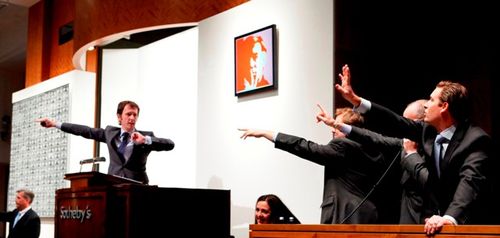
Sale of 200 One Dollar Bills,
Sotheby's, November 11, 2009, c/o Sotheby's
THE NEW CRITERION
December 2009
The art market explained
by James Panero
As the auction commenced on the evening of November 11, 2009, the elbows of Tobias Meyer, the auctioneer and Worldwide Head of Contemporary Art at Sotheby’s, ascended to a position in line with his shoulders. “600,” he said in his steely continental accent. His right arm pointed in the direction of the current bid—$600,000. His angular face turned in the opposite direction. His left arm ratcheted back close to his chin like a spring-loaded trap, palm out. Led by his forehead, Meyer’s torso leaned towards a potential bidder. It seemed as though he was attempting to pull up the current bid by a long string wrapped over his left forearm. As he entered maximum tilt, a 66.6-degree angle formed between his right hand, his head pointing to the left, and the button at the center of his bespoke suit, which had puffed out slightly around the lapels.
“650!” Meyer’s arms immediately reversed directions. He tipped the other way. On the auction block, Tobias Meyer moves only in equilateral triangles.
“Not your bid, China… . Against you, Ollie… .”
The wall of art to Meyer’s right rotated like a game-show display revealing each new lot. Gentlemen and ladies on telephones with extra-long novelty handset cords gesticulated from the side boxes. Whether watching in person from the auction room or by live webcast several continents away, the art world hung on Meyer’s chain of numbers, his bouncing figure, the specter he was conjuring up.
By the end of the evening, the Sotheby’s auction of contemporary work had added another chapter to the story of the art market. The auction house had kept the estimates artificially low. Their “buyer’s premium,” which is not factored into price estimations but counts in all reports of final sales, gave the final numbers an extra boost. Syndicates of investors can try to control an artist’s prices. Shill bids and chandelier bids always give the false sense of competition.
An art auction is less transparent than it might appear, but appearances are what mattered on November 11. Defying expectations, even after the fall of Lehman Brothers, the price bubble that had been inflating for post-war and contemporary art refused to pop for Pop. A silkscreen by Warhol, 200 One Dollar Bills from 1962, a large canvas of facsimiles of dollar bills arranged across it, brought in over $43 million, far exceeding the pre-sale estimate of $8–12 million and more than five times the price paid for any other lot. Four other artists attained record prices for their work. In a human-interest angle, a small self-portrait that Warhol had given to his young secretary, Cathy Naso, forty years ago, and which she kept in a closet, went for over $6 million, more than quadrupling the pre-sale estimate of $1–1.5 million. “Andy has made me famous for fifteen minutes,” Naso told the auction house, “and I’ve come to realize that fifteen minutes of fame is more than enough.” In total, the auction brought in over $134 million. The pre-sale estimate had been only $67.9–97.7 million.
The best explanation of the art market may be that it is inexplicable, which is one reason its alchemy continues to fascinate and capture headlines. In no other market do we lavish wealth on such useless and arbitrary things. Advanced systems of trade that are usually the facilitators of market intelligence—international public auctions and historical price indexes—only offer a false sense of comprehension while further distorting art’s valuation.
Yet if such things could be measured in degrees, the art market of today seems more unexplainable than ever. The prices paid for certain types of post-war and contemporary art continues to outpace prices for older work as well as recent art of greater nuance. Tens of millions of dollars may still chase after art of dubious formal qualities—factory-made work by Jeff Koons and Damien Hirst, smears by Francis Bacon and silkscreens by Warhol.
Big money’s relationship to “cheap” contemporary art is a recent phenomenon. It began in the 1960s, as Pop Art commercialized the avant-garde—not just selling the avant-garde, but also involving commercialism in defining the avant-garde. Whereas many Abstract Expressionists died before striking it rich, several of the avant-garde artists who came of age in the 1960s experienced a more profitable fate. In 1968, in a lecture at MOMA, Leo Steinberg prophetically observed:
Avant-garde art, lately Americanized, is for the first time associated with big money. And this is because its occult aims and uncertain future have been successfully translated into homely terms. For far-out modernism, we can now read “speculative growth stock”; for apparent quality, “market attractiveness”; and for an adverse change of taste, “technical obsolescence.” A feat of language to absolve a change of attitude. Art is not, after all, what we thought it was; in the broadest sense it is hard cash. The whole of art, its growing tip included, is assimilated to familiar values. Another decade, and we shall have mutual funds based on securities in the form of pictures held in bank vaults.
Steinberg may have been wrong about many things, but he was correct about art’s direction. The point of sale, rather than the point of creation, came to take precedence in determining the primary meaning for certain works of art. In fact, price took on a more prominent concern in evaluating all works of art. More importantly, the art that proved to be most amenable to market manipulation was often work of the most uncertain initial value. Art depicting quick punchlines of cheapness and death shot up in price, while more traditional work, which might unfold through years of visual contemplation due to the complexity of its formal qualities, did not experience the same market uplift. Profit-minded artists like Warhol understood the difference. The crudity and ubiquity of Warhol’s silkscreen process, for example, removed the artist’s well-studied commercial hand from what is today his most valuable work. Warhol’s choice of demotic and lurid subject matter—dollar bills, soup cans, photographs of car-crash victims—further left the value of his art to be determined by his collectors rather than by critics and connoisseurs.
A consequence of this dynamic is that certain work—especially art unencumbered by a density of formal concerns—continues to attain new meaning with each turn on the open market, no matter the age of the piece. Top dollar has long been paid for work by living artists, but this is different. A Titian is a Titian regardless of the price. Today’s $300,000 Warhol is transformed into tomorrow’s $40-million Warhol, and a painting as significant as a $40-million Warhol must be worth $50 or $60 million at least. Certainly, it may be more desirable to explain the contemporary art market as a speculative investment or a tax dodge, some extension of intelligent investing, but the reality is tied up more intimately in the recent history of the avant-garde.
This history officially began at another Sotheby’s evening: October 18, 1973. Amid a circus of publicity and protest, Sotheby Parke Bernet, as the auction house was then known, held its first major auction from the collection of Robert C. Scull, a parvenu who had married into a taxi-cab fortune. The event marked not only the rise in prices but also the dominance of money in any discussion of contemporary art.
The prices achieved at the Scull auction may be a pittance by today’s standards, but many were records for the artists on the auction block. Each new bid was met by a cheering audience: Jasper Johns’s Double White Map, originally bought by Scull for $10,500, went for $240,000, the largest sum at the time for a living American artist; a Cy Twombly, originally purchased for $750, went for $40,000; Rauschenberg’s Thaw, purchased in 1958 for $900, went for $85,000; Warhol’s Flowers, originally acquired for $3,500, went for $135,000; the night’s total take came to $2,242,900. But the numbers tell only half the story. The other was the public spectacle of rapid profit-taking by a shameless self-promoter and his wife—Robert and Ethel Scull, known as Bob and Spike. “The Sculls learned everything they know from Andy Warhol,” wrote Barbara Rose, reporting on the auction for New York magazine:
They learned, for example, how to turn themselves into objects through packaging (Mrs. Scull appeared to have had everything lifted for the occasion), media exposure, and sheer, unadulterated chutzpa. The Sculls transformed their banal, nouveau riche selves into personalities by not being afraid to own up to being all that was considered lowbrow, déclassé, grasping, and publicity-seeking. They made a thing out of being vulgar, loud, and over dressed. They were, in short, shameless; and it was their shamelessness that finally got them the spotlight they ached for.
The artist Jack Tworkov made a similar observation of the Sculls in his journal back in 1962: “New People, like cheap bright aluminum pots. For whom is ‘Avant-Garde’ art intended… . They [are] embarrassed with their own status, eager to acquire through culture what has been denied to them because of family background, race, religion or the unaccustomed use of recently acquired wealth.”
Spectators at the auction were equally dismissive. Drivers from Scull’s taxi service protested in the sleet outside with signs that read “Never Trust a Rich Hippie,” and “Robbing cabbies is his living. Buying artists is his game.” Some artists purchased snow shovels at a local hardware store and began selling them in mock sales outside—a reference to the work of Marcel Duchamp and a commentary on the neo-Dada art- ists being horse-traded within. One neo-Dadaist at the heart of the auction, Robert Rauschenberg, allegedly arrived drunk and furious. “It was only love. This is the divorce,” he remarked of the sale. He shouted at Robert Scull: “I’ve been working my ass off just for you to make that profit.” Scull responded: “It works for you too, Bob. Now I hope you’ll get even bigger prices.” According to Ethel Scull, Rauschenberg then punched her husband in the stomach and walked off. The two never spoke again, but Scull proved to be right. Although the night’s sale did not directly benefit the artists, the consequential rise in prices for future work made Rauschenberg, Johns, and Warhol rich men. Warhol, the market savant, was singularly elated by his prices at the auction, and disheartened only that other artists had done better.
The late dealer André Emmerich was among the many luminaries in attendance that night. Recalling the event, Emmerich remarked: “In my life there have been very few watershed moments. One was the Goldschmidt sale [the 1957 London auction of eight Impressionist paintings that put Sotheby’s on the map], which I attended as a very young dealer. The Scull sale was a comparable watershed. I felt awe and shock—that pictures could be worth that much money. And a certain embarrassment—that the Sculls should have to sell in this way.”
A bubble with unique physical properties surrounds certain types of contemporary art. This fact becomes apparent when the November 2009 auctions are processed through the memory of the 1973 Scull sale. The contemporary art bubble has been inflating for nearly forty years. The larger this bubble gets, the more indestructible it seems. Of course, the bubble inflates for some but not for others. In 1973 not all artists fared as well as Warhol, Rauschenberg, and Johns. The abstract painter Dan Christensen had done well, but the temporary rise in prices only flooded the market for his lyrical work, which eventually tanked. This was a typical price bubble—a short-lived over-evaluation, followed by a crashing correction.
While the market came to agree upon a certain value for Christensen’s painterly content, art determined by the context of sale remains open-ended. Recent history demonstrates that the prices paid for Pop-style work show little sign of letting up. On the upside, great art of the highest traditional quality, from representational to abstract, continues to be available at very reasonable prices. On the downside, the resulting growth of market-driven art looks less like a bubble and more like a contagion, threatening to overtake more traditional styles of art. This process occurs in several recognizable ways.
In 2006, Tobias Meyer infamously remarked that “the best art is the most expensive because the market is so smart.” The quote received wide circulation because of its patent absurdity. A market is only as smart as the people who control it, and the art market has proved to be a dull creature when it comes to appreciating a broad range of artistic qualities. But to give Meyer credit, the market can be very smart about the art that speaks to it.
The art market has a unique talent for promoting art about the market. Since exhibition history enhances value, the collectors of what we might call “market art” have a vested interest in seeing their work take up space in traditional public collections. They often have the financial leverage to make it happen. In this way, the hedge-fund collector Steven A. Cohen could place Damien Hirst’s shark tank on temporary loan at the Metropolitan Museum. The oversized trinkets of Jeff Koons start appearing at the same time in the museum’s rooftop gallery.
Curators defend such expensive contemporary work as relevant to the commercialism of the age: the market gives meaning to the art. Through their acquisitions, international collectors can demonstrate their membership in the social club of market excess. Many museums will even sell off low-priced traditional art in their permanent collections in order to purchase a single overpriced contemporary piece. The public meanwhile gravitates to such contemporary art because the public sees its own profligacy reflected in it—an attitude that the public then feels justified in maintaining.
From toxic assets to deficit spending, representations of value can be more appealing than the solidity of wealth. The irony of the November 2009 Sotheby’s sale is that the returns were buoyed by the weakness of the dollar against the relative strength of international currencies. Warhol’s 200 One Dollar Bills—which was originally owned by “the legendary collector” (according to Sotheby’s) Robert C. Scull, and sold at the Scull estate auction in 1986 for $385,000—is more appealing to its new undisclosed collector than the $43 million dollars given in exchange for it. In the sale of 200 One Dollar Bills, could it be that representations of representations of wealth mean more than money itself—even more than the supposed national treasure that money signifies? As the dollar continues to depreciate, a crude illustration of money becomes a highly prized representation of value. Warhol’s 200 One Dollar Bills goes up in price by tens of millions of dollars. Two hundred actual one dollars bills, meanwhile, become more and more worthless—just like the excellent art that $200, $2,000 or $20,000 can still purchase. Take that to the bank.
