Symbolic Ground Zero

WTC_LOBBY3-753x344
A model lobby from Twin Towers II

James writes:

As we mark the ninth anniversary of the September 11 attacks, the controversy of the Ground Zero Mosque has given rise to a conversation that should have occurred many years ago. Beyond question of the proposed Islamic community center’s proximity to Ground Zero, the debate has also brought to light several unanswered questions about the nature of Islam and its relation to terror: Given the radicalization of mosques and Islamic community centers in Europe, how do we know such meeting houses will not foment such behavior here? If the American Islamic community is immune to radicalization, what differentiates it from such communities in the Netherlands and France? How has the moderate American Muslim community reckoned with attacks carried out in the name of its faith? In sum: To what extent is Islam itself to blame in the extremism of the “Islamist” terrorists?

Following 9/11, a certain dogma of permissible rhetoric took hold that did not allow such questions to be answered or even to be asked. Criticize Islam and you recruit more terrorists. Have faith in moderate Islam and you destroy al-Qaeda. Maximal tolerance from us, it was thought, equals minimal hate from them.

A similar dogma took hold in the plans to rebuild Ground Zero itself. These beliefs quickly played out in the strong-arming of a sacred site by the ideologues of tolerance. Long before the attacks of 9/11, so-called enlightened urbanites bemoaned the outsize scale of the Twin Towers. They resented the superblock of the World Trade plaza for interrupting the street grid. The buildings, to them, were symbols of hubris. They objected to the same monumentality that the terrorists set out to destroy.

When an unelected claque of bureaucrats called the Lower Manhattan Development Corporation nominated itself to redesign the site immediately after the attacks, they sought to undo all of the wrongs of the people who had designed the original towers. They redrew and replaced the street grid, ensuring that the World Trade Center would not be reconstructed as it had been. They tapped a grief-mongering architect, Daniel Libeskind, to design the new buildings. They selected the falling water design of Michael Arad  for the 9/11 memorial--when completed, a monument of negation that will aestheticize the sight and sound of the falling towers into a permanent replay of the attacks.

I used to assume that the redesigners of Ground Zero were oblivious to the symbolism of the site. But of course they were fully engaged in replacing the Twin Towers with a symbolism of their own: that of maximal tolerance. Thanks to them, they believed, no longer would the sins of the Twin Towers attract the ire of terrorists.

The problem with this approach is that it began with a dangerously untested premise--that maximal tolerance does indeed lead to minimal hate. But does the radicalized Islamic world capitulate to tolerance? Or is tolerance perceived as our own form of capitulation, engendering further attacks? Do we defeat Islamic terrorists by defending Islam--the conventional wisdom? Or would questioning Islam as does Ayaan Hirsi Ali break a code of silence that engenders radicalization? We never got the opportunity to ask.

So too with the designs for Ground Zero. Polls taken after the attacks of 9/11 showed that a majority of Americans wanted the Twin Towers rebuilt as they once stood. Meanwhile a team of architects independently submitted plans for new Twin Towers that could withstand future attacks. I regret that in 2002 we could not have engaged in the conversations we are having today. Had we I believe that Twin Towers II would have been built through popular mandate--because a vast majority of Americans understand their greatest defense is a strong offense. To rebuild the offending Twin Towers, stronger and taller, would have left us with a monument to unflinching national character, rather than a washbasin of grief.

The defenders of the “Ground Zero Mosque” have relished taking up the arguments of tolerance in advancing the community center. At least one prominent writer I have read wants a mosque moved inside the new World Trade complex itself. But this time a vocal majority, uneasy with the symbolism, I believe, of Ground Zero’s general redevelopment, has started to ask the unanswered questions. I regret this process did not begin in time to rebuild the Twin Towers. Yet on a tragic anniversary, I am still thankful for the new national conversation.

Gallery chronicle (September 2010)

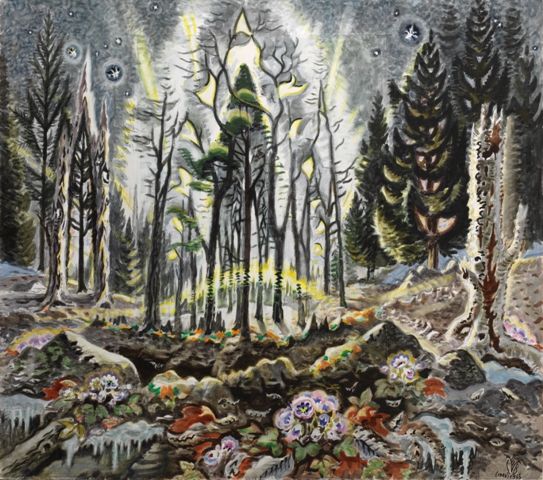
Dawn in Early Spring

Charles Burchfield, Dawn in Early Spring (1946–66), courtesy DC Moore Gallery, New York.

THE NEW CRITERION
September 2010

Gallery chronicle
by James Panero

On “Heat Waves in a Swamp: The Paintings of Charles Burchfield” at the Whitney Museum of American Art, New York & “Charles Burchfield: Fifty Years as a Painter” at DC Moore Gallery, New York.

There may come a time when postwar American painting will be regarded much as Chinese contemporary art is today—the overhyped products of national exuberance. The New York School was a charming fraternity, inheritors of the School of Paris’s little black book. Yet a dozen or so unstylish artists of the pre-war years deserve the real credit for the flowering of American modernism. Charles Burchfield (1893–1967) was one of them. His extrasensory visions of the American landscape are now on view in two must-see exhibitions at the Whitney Museum of American Art and DC Moore Gallery.[1]

Burchfield’s annus mirabilis was 1917, what he called his “golden year.” A promising graduate of the Cleveland School of Art, he returned home to Salem, Ohio, after burning out in his first afternoon at the National Academy of Design in New York. “A curious mental depression assailed me, and I worked constantly to keep it down,” he recalled. “Surrounded by the familiar scenes of my boyhood, there gradually evolved the idea of recreating impressions of that period, the appearance of houses, the feelings of woods and fields, memories of seasonal impressions, etc.”

Burchfield emerged an illustrator, nearly always working in watercolor and bent on capturing nature’s unseen forces—an American Edvard Munch. “My chief aim in painting is the expression of a completely personal mood,” he said. One of the first rooms at the Whitney show contains abstract doodles from 1917, emoticons of marker on paper with fantastic titles like “The escape from the banal everyday life to the world of the ideal,” “The Fear of loneliness,” “Fear, Morbidness (Evil),” and “Fascination of evil.”

Each of these drawings comes out of a notebook Burchfield titled “Conventions for Abstract Thoughts.” Taken together, they formed a visual vocabulary, or, as Burchfield called it, a “graphic shorthand of youth.” That same year he incorporated these doodles into an outpouring of landscapes. Phantom winds radiate out of familiar terrain. “As the darkness settles down,” he wrote of one painting, The August North (A memory of childhood), “the pulsating chorus of night insects commences swelling louder and louder until it resembles the heart beat of the interior of a black closet.” 

In 1930, Alfred Barr singled out these paintings for “Charles Burchfield: Early Watercolors 1916 to 1918,” the first solo artist exhibition ever to be held at the Museum of Modern Art. The current Whitney show, in its opening room, has attempted to recreate Barr’s exhibition of twenty-seven works as closely as possible. Barr rightly identified a young artist in the first flush of modernist experimentation. He may have been working in a provincial town in a provincial country, but Burchfield incorporated influences ranging from Hokusai and Hiroshige—to whom he was exposed in art school—through Yeats, Rabindranath Tagore, the Ballets Russes, and Aubrey Beardsley. In his depiction of sound, Burchfield was, like Arthur Dove, a master of synesthetic vision. “It seems pertinent to me to insert here some thoughts on how interwoven music is with my painting,” he noted later in life. “To many works, and even for whole periods of time, a definite piece of music or composition seemed to belong, though there might be no connection whatsoever between the music and what I was doing.” In The Insect Chorus (1917), sounds appear to swirl and shoot out of the trees and grasses beside a shingled house. In The Song of the Katydids on an August Morning (1917), a ballet of black Vs jumps out from the grass of a country home. In The Night Wind (1918), which became the cover of Barr’s catalogue, black clouds with yellow, ghost-like eyes rise up to haunt a snowbound house.   

Barr’s mid-career retrospective served to remind Burchfield of his golden year of 1917, even as he retreated through the 1920s and 1930s into a more realistic mode of landscape. His sojourn in the railyards and factory towns came to associate him with the regionalism of the American Scene, a style that was the bugaboo of postwar modern art. While the animus towards the period may be undeserved, in Burchfield’s case Barr was right. The Whitney features a few chilling examples, in particular Ice Glare (1933) of a solitary black car driving through a frozen mill town, but many of Burchfield’s paintings from the period are just dreary, ashen illustrations concerned only with a sad and silent world.

The applied art Burchfield produced during the same years is far more illuminating. In 1918 he was drafted into the army, where he was assigned to the camouflage department. The Whitney features at least one illustration from the time, reproduced on the catalogue cover—a wheeled device disguised in swirls of green, yellow, black, and blue, blowing with its own phantom wind. In 1921, he joined the wallpaper firm M. H. Birge & Sons Company in Buffalo, New York, and remained in the area with his family for the rest of his life, far removed from the art capital of Manhattan. Here he rose through the company, becoming head of design in 1927. Both the Whitney and DC Moore, which represents the Burchfield estate, feature some of his remarkable wallpaper designs. The Whitney show even salvages a couple of the printing rollers and some ad copy, as well as recreating one wallpaper pattern throughout an exhibition room.

It helped that Burchfield emerged from art school with the skills of an illustrator. He was as suited to watercolor’s practical uses as to its application in fine art. “I think any artist should take pride in being able to earn an honest living and not be dependent on a whimsical patronage,” he wrote. I would go so far as to say Burchfield’s commercial work, taking a cue from Art Nouveau and William Morris, was also some of his most advanced production, and carried him through a fallow period. “An artist I believe should have more than one outlet for his creative energies and wall-paper designing has provided one for me,” he said. “There are ideas that come to me that can be interpreted only in terms of patterns, and I derive much pleasure in working them out.” More than a way to support his family, Burchfield’s wallpaper work directly influenced his great second period of creativity.

Burchfield quit his job at Birge & Sons in 1929, but more than a decade passed before another artistic crisis gave way to new direction. Stand in one room midway through the Whitney show and the transition is clear. On one wall is Two Ravines (1934–43); on the other is The Coming of Spring (1917–43), from the collection of the Metropolitan Museum. Burchfield labored over both for years. Both feature a nearly identical motif—two mountain streams coming together in a shaded pool. DC Moore also has one study of the motif, Retreat of Winter, of Little Beaver Creek in Salem, from 1938. Yet Two Ravines, for all its illustrative detail, looks frozen stiff compared to The Coming of Spring, where the composition pulsates with life. Reaching back to his golden year of 1917, going so far as to bind earlier work into the larger later compositions, Burchfield tapped into a new animating force with The Coming of Spring. Drawing on his experience in wallpaper design, he took his original pattern book, those haunting glyphs from “Conventions for Abstract Thoughts,” and grafted them into composite masterpieces like Song of the Telegraph (1917–52), Gateway to September (1946–56), and Autumnal Fantasy (1916–1944), on view at the Whitney show, and Dawn in Early Spring (1946–1966) at DC Moore. The spread of years in each of these works indicates the range of material Burchfield folded into them, allowing earlier pieces to grow into larger, resounding visions. “How slowly the ‘secrets’ of my art come to me,” Burchfield noted in 1964. “When I said this to Bertha, she said ‘Aren’t you thankful that at 71 new secrets are being revealed to you?’ And I certainly am.”

From 1943 until the end of his life, Burchfield let the forces of nature have their way with the internal dynamics of his watercolors. Many of the results were wild, sometimes verging on synesthetic kitsch, yet today they still seem unique and vibrant, wholly apart from his genre work of the 1920s and 1930s. Burchfield recognized the need to escape his association with the American Scene, and he considered it libel whenever someone called him a practicing member. Art history has now seen fit to rescue him in the same way as well.

Today Burchfield gets spun as a psychedelic madman inside the body of an actuary. It is no accident that the Hammer Museum, from which the Whitney exhibition originated, selected the contemporary sculptor Robert Gober, whose work includes human legs and industrial sinks in dislocated situations, as its guest curator for the show. The museum also called in the shaman Dave Hickey to conjure up a catalogue essay. I wonder if Burchfield benefits from the spit-shine of a critic who recently described modern art as something that “just makes a bunch of Jews a bunch of money,” or a curator whose claim to fame is five Whitney Biennial appearances, making him the undefeated heavyweight champion of Geek Town. I would note that the catalogue from the DC Moore show, which quotes Burchfield’s own words extensively, is far more illuminating.

That said, Gober and Hickey both do well in positioning Burchfield as the hermit genius, whose true talents lay hidden away in a bog far from his peers and even, for a time, from himself. The title of the Whitney exhibition—“Heat Waves in a Swamp”— comes from a work that does not appear in the show. Gober goes further, painting Burchfield as a swamp-man by quoting this passage in his introductory essay: “I like to think of myself—as an artist—as being in a nondescript swamp, up to my knees in mire, painting the vital beauty I see there, in my own way, not caring a damn about tradition, or anyone’s opinion.”

On the back cover of the Whitney catalogue, Gober chooses to reproduce a newspaper clipping from 1966 with the headline “Artist Honored: Home Robbed.” The article reports how Burchfield’s house was burgled on the day a center for his art opened at Buffalo State College. “There was something dark and bitter and almost funny about the conjunction of the two events,” writes Gober, “and there was a metaphor embedded in that short headline that I couldn’t ignore and that I felt certain Burchfield would understand.” I doubt Burchfield found it “almost funny,” but we get it. Even in praising Burchfield, Gober seems to say, society saw fit to screw him. In reality, America’s pre-war culture served him well. Burchfield matriculated at a moment in American art that was ripe with potential. He found commercial work that sustained him and produced art for two decades that fed his family and saw him to his second awakening in the 1940s. The irony is that art pseudo-sophisticates, Gober’s predecessors, were the ones who turned their backs on this supposed provincial. Now Gober is there to say Burchfield is one of us. We should instead aspire to be one of him.

Notes
Go to the top of the document.

[1] “Heat Waves in a Swamp: The Paintings of Charles Burchfield” opened at the Whitney Museum of American Art, New York, on June 24 and remains on view through October 17, 2010.

“Charles Burchfield: Fifty Years as a Painter” opened at DC Moore Gallery, New York, on June 10 and remains on view through September 25, 2010.

The Pursuit of Prints

IMG_9408
Print collectors Les and Jo Garfield in their Upper East Side apartment.

ART & ANTIQUES
September 2010

The Pursuit of Prints
by James Panero

Jo and Leslie Garfield have built their home around a seminal collection of modernist works.

Here in their high-rise Upper East Side apartment with sweeping views of Central Park, Leslie and Johanna Garfield, the husband-and-wife collecting team, could always use that extra square foot for their latest acquisition. Six years ago, in order to accommodate their growing collection, the apartment underwent a four-year renovation before the couple moved in. Today the home doubles as a private gallery, with specially constructed hallways and sliding walls, conservation space, and an office for an in-house cataloger and registrar. Still, there never seems to be quite enough room. “Hanging and getting things in place is not an easy thing to do,” says Jo. Fortunately, that lack of wall space has never prevented them from going after the next print. The passion of these two residents for their collection—and for the art of collecting—shows little interest in such trivial considerations.

“When I bought my first print in 1954, by Erich Heckel—a woodcut illustration for Dostoevsky in 1915—things burst all over me,” says Les. “The primal scream became a part of my life.” He encountered his first print in a Munich gallery while in the army. “That led to me to a 10 or 12-year period of collecting black and white German expressionist prints.” Les now hangs that first print among his many others from the period on a wall by the front door.

But Les has Jo to thank for leading him in a different direction, one that has today resulted in an acclaimed focus of the collection. In the early 1980s, Jo saw an example of the color-rich work of the then under-appreciated Provincetown Printers, an early American avant-garde circle on Cape Cod centered around Blanche Lazzell, a pioneer of the “white-line” woodblock print. She knew they had to go for it. “They just made me feel good, and the German Expressionist ones didn’t,” Jo recalls. “You fall in love with something and like the work, and you pursue it,” explains Les. “And that’s exactly what happened with Provincetown. It was Jo who saw the first print, and this mad chase was on to locate dealers and people who had this work.”

The chase led the couple from galleries to knocking on the doors of Lazzell’s relatives in West Virginia. “Over the years, I was able to get the block and the print from a relative, then the drawing for the print, then a watercolor for the print, and I love it,” says Les. “I guess that’s why I never sold anything.” Les says he refused to bargain-hunt, paying top dollar even when the sellers were unaware of market value. “I had a good relationship with various relatives and, quite frankly, was able to acquire really limited editions. These were works that were never seen. I took the position that when you see some of them, just go for them, because if you don’t go for them, they cannot be collected en masse. I just pursued them whenever I could.” In 2002, the heart of the Garfield’s collection formed the exhibition “From Paris to Provincetown: Blanche Lazzell and the Color Woodcut” at the Museum of Fine Arts Boston, which traveled to Cleveland and the University of Wisconsin, where the couple met as undergraduates.

“A visit to the home of Leslie and Johanna Garfield confirms both their passion for the prints of Blanche Lazzell in particular, and their interest in complementing her work with fine examples of her Provincetown contemporaries,” noted MFA director Malcolm Rogers at the time of the show. “Multiple impressions with different colorations, as well as numerous drawings and carved woodblocks, constitute a collection of glowing examples from one of the most extraordinary print productions in the years between the two world wars.” Much of the Garfields’ print collection, which they say will never be sold, is promised to the MFA along with other institutions. Some prints have already left the apartment. “We have given some to some museums,” says Jo. “It’s like sending a child away to boarding school.”

For Les, the energy for the chase separates him from the ordinary art buyer. It also speaks to the energy he has exhibited in his professional life. From canvasing door-to-door in the Bronx for potential home sellers, Les built his own boutique real estate firm, Leslie J. Garfield & Co., which specializes in brokering high-end New York buildings and townhouses. Jo is an acclaimed journalist and memoirist who both directs the collection and casts a writer’s eye on her husband’s collecting drive. “I often think if he had to give up me or the collection, I’m not sure which he would choose,” she says, noting that Les’s father, an avid collector of shells and toy cars, started Les on a stamp collection. “Collecting runs in the blood. He’s like that about things. If he’s interested, he is intensely involved.”

“Once we’ve localized who we’re interested in, it’s just about going after them and showing them to Jo,” Les says of his method. “Over this period of years, we’re in sync with each other.” Together their collecting tastes have taken them through the prints of Jasper Johns and David Hockney, the British pop artist Richard Hamilton, and other contemporary British artists. Through the Provincetown artists, they discovered a circle of British printmakers working between the wars known as the Grosvenor School, with dynamic colorful works and today the jewel in the crown of the collection. These works by the artists Cyril Power, Sybil Andrews, C.R.W. Nevinson, Edward Wadsworth and others took the conventions of Futurism and Cubism and applied them to depicting the energy of British life between the wars. “We both latched onto the Grovensor School with mutual enthusiasm,” says Les. In 2008, the Garfields’ Grosvenor prints formed the heart of the eye-popping exhibition “Rhythms of Modern Life: British Prints 1914–1939,” which was on view at the MFA Boston and at the Metropolitan Museum of Art in New York.

“No other collector in the United States has continued to pursue this area with as much energy and single-mindedness,” noted curator Stephen Coppel of the British Museum. “Long before the current high visibility of contemporary British art, the Garfields were collecting British avant-garde prints, at a time when American museums were generally reluctant to acquire them.”

“The Garfields were exceptional in that they could follow their own hearts ahead of the museums. Now the museums have caught up,” says the New York dealer Mary Ryan, who first met them three decades ago as they were collecting the Provincetown prints and continued working with them on the Grosvenor school. “There are always many people interested to collect what is hot at the moment, but it is thrilling when you have a collector who wants to build a collection over a lifetime. They both enjoy the solo process of collecting and the pleasure of living with art. It’s a constant pursuit. Their interest hasn’t waned over the years; it’s expanded and deepened.”

And the reason for that continued interest? Simple, says Jo. “Collecting is a form of madness. It’s not a bad obsession. It’s not a drug addiction. It’s a good obsession. It keeps you out of trouble.”