
No media standards at The Huffington Post

Metropolis_maria_robot

Arianna Huffington, center, with staff at The Huffington Post

Yesterday my friend Sharon Butler posted a version of her response to My Jerry Saltz Problem on The Huffington Post. With a business model that I find problematic, Arianna Huffington's site is one of my new-media bugaboos. Like you know who on you know what, HuffPost relies on the unpaid content of its writers to add to the cumulative luster to its owner. I'm not the first to say this. Mayhill Fowler wrote the definitive HuffPost protest essay.

Metropolis_drones

Shift change for writers at The Huffington Post

With these thoughts in mind, I wrote a response to Sharon's post that addressed my concerns and uploaded it as a comment on The Huffington Post. It read:

Hi Sharon, I'm glad to see you get to pull the oars at The Huffington Post for some stale breadcrumb­s and the pleasure of the lash (a quote from my article). What still concerns me are those qualities we lose in the migration from print-styl­e production to online. What I mean is the system of editors and fact checkers and a print publication's self-impos­ed brand standards, which serve to guide critical behavior. And then there is print's ability to provide income to the writer. On the upside, the great benefit of online writing and social networking is its low barrier to entry. I also enjoy using new media (and have become addicted to Twitter in particular­). On the downside, online writing offers few of the qualities that have made print great, in particular the ability to provide financial support for people who write for a living. I wrote a summary about the responses to "My Jerry Saltz Problem" (including this essay) here. http://www­.supremefi­ction.com/­theidea/20­11/01/my-j­erry-saltz­-problem-a­ny-solutio­ns.html Also in my forthcomin­g in the February issue of The New Criterion I discuss the upside of online writing for the world of art. Look for it at newcriteri­on.com on February 1.

After an invasive registration process, I pushed the comment button at The Huffington Post last night and waited. And waited. First my comment showed up in the HuffPost's "pending" category. As I waited some more, plenty of other comments went up singing the praises of new media (and by extension The Huffington Post). 
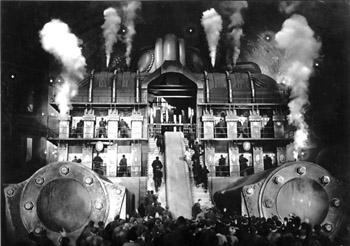
Metropolis-0238 The office of comment moderation at The Huffington Post

And then this morning, my comment disappeared. Poof! For a time, the staff moderators at HuffPost refused/deleted/turned my comment to soylent green. Just what aspect of their moderation policy did I violate? I am still not sure. Could my comment have disappeared because it was critical of the site? Who knows. It was only after I contacted Sharon directly that HuffJokePost pulled my letter from its shredder and posted it. Erroneously, it said that I had posted it yesterday, even though the comment had just gone up.

Are these the journalistic standards we can expect in the new media revolution? As Lincoln Steffens remarked upon returning from a trip to the Soviet Union in 1919: "I have seen the future, and it works." Not. 

Department of Homeless Services Runs Scared From CB7 Protest


Aaron Biller, president of the community group Neighborhood in the Nineties, speaks out against the homeless shelter at the community board protest.

James writes:

Hundreds of Upper West Siders packed the small conference room of the Community Board 7 tonight for what was supposed to be a face-to-face with New York City's Department of Homeless Services and Samaritan Village, the people attempting to open a 200-bed men's shelter in a tourist hotel on West 94th Street. The hotel is being forced to close thanks to disastrous legislation in Albany that had been trumpeted by this community's local representative, Councilwoman Gale Brewer. (Go here for the complete story.)

Peter Thorne from WPIX Channel 11 showed up, along with several newspaper and online writers--only thing is, the Department of Homeless Services and Samaritan Village declined to appear. The meeting therefore did little to answer residents' concerns about why a shelter has been proposed for a family neighborhood, a block from a school, that is already saturated with such facilities (and where few residents but the politicians had a problem with the tourist hotels). As one resident, Miriam, said in her statement to the board: "this has become a middle-class family neighborhood. People have put their blood, sweat, and tears into this neighborhood." Why, she wondered, should taxpayer money go to undermine the sweat equity and investment that residents have spent restoring their neighborhood by paying for a homeless shelter to move in?

One answer came from a representative from the office of Congressman Jerry Nadler, once a resident of 94th Street himself. City government is able to offer lavish deals to landlords to use their buildings as "emergency" shelters because the city can tap into Federal money from the US Department of Housing and Urban Development. Such a story goes to show the damage that wasteful federal dollars can do to a local population when used to override market conditions. Through federal taxpayer money, each of the SRO's tiny rooms could be rented for homeless use at thousands of dollars a month, above market demand. That's a powerful calculus. As one resident put it to me, associates in his law firm can't afford to live on the Upper West Side, but thanks to sweetheart deals from the Feds, a large homeless population can.

Councilwoman Brewer herself declined to show for the meeting. Several questions therefore remain unanswered, for the DHS, and for Brewer:

1. Can the shelter be fought on legal grounds? Is the shelter consistant with the requirement of "permanent housing" stipulated in Albany's legislation?

2. Could anything be done, through rezoning, to allow the hotels to continue operation? If tonight's protest is any indication, only the SRO Law Project (Brewer's advocacy group) and the hotel workers union have a problem with them.

3. What can be done to have the permanent tenants of the hotel stay put, which could prevent the shelter from moving in? Some have been offered $50,000 each to vacate their apartments.

4. How much did Gale Brewer know, and when? Faced with community unrest, Brewer has attempted to reposition herself as an opponent of the facility. She should be applauded for taking this position, but Homeless Services has reported that Brewer's office was in communication about the proposal before it was first announced to the public.

5. If Brewer knew about it, why did she do nothing to stop it before it became a done deal? Were her actions guided by union pressure or a backroom deal with the city to deliver the shelter to DHS, which has now backfired. 

6. The Upper West Side has become a centrist community. When will the neighborhood start seeing local and state representation that is more in line with their interests (rather than merely the interests of trade unions--see Brewer's own friends list). The radical control of the Upper West Side's Democratic Clubs cannot be sustained now that the neighborhood's voters have realized the damage that bad legislation, proposed by their representatives, can do.

IMAG0094
The tense scene at tonight's meeting. 


Peter Thorne has filed an excellent report on the DHS disappearing act for WPIX 11. Full story here:
 

UPDATE! Reports continue to come in:

Leslie Albrecht of DNAinfo on the DHS no-show (including a cameo by yours truly in the brown plaid shirt)

Gina Lee of the Columbia Spectator

Winter Hiking in the Pemi

James writes:

The snowy weather has us thinking back to our winter hike in the White Mountains in northern New Hampshire. The Appalachian Mountain Club maintains a unique string of huts along the ridge line of the Appalachian Trail over the Presidential Range south into the Pemigewasset Wilderness. In the winter, most of these huts are inaccessible, but a few remain open for winter overnights. One of these, my favorite, is Zealand Hut. They can all be booked through the AMC's online reservation site.

Dara and I rallied two friends, Jamie and Sara, to take it on. The visit was my second time to Zealand in winter and third stay overall. The drive from New York is about 6 hours, all highway, and Friday night we stayed in the AMC's Highland Lodge in Crawford Notch--a slightly soul-less new facility but a good staging ground for hikes in the area. We picked up topo maps, bars, and other supplies here before heading off.

The winter trail head is a short drive from Highland--there is a large parking lot on the side of the road. In winter the hike in is six miles with a steady up grade. It takes several hours, so we left early to arrive at the hut in daylight. Half of the trail is over a snow-covered road, and the first section crosses several snowmobile trails, which is tedious. (In the video below, Dara calls it "interminable.") The excitement starts over the second three miles, where the trail narrows and follows an old logging railroad bed, which is today nearly covered in a dense woods. We dressed warm as though skiing, and used snowshoes lashed to our winter boots. We also brought thick sleeping bags (actually two each to double up one in the other), ski poles, water, and enough food for dinner and breakfast at the hut and lunch on the trail.

The most challenging section of the hike comes in the last few hundred feet. Zealand is located on the side of a waterfall, and the trail goes steeply up. In the winter with the snowpack, we needed the spikes of our snowshoes to dig in our footing.

The Hut comes as a welcome sight. Unlike in the summer, when the huts are staffed with a half dozen 'croo,' in winter there is only one care taker. He tends to a pot belly stove in the main room and the gas lights. The kitchen is self-serve. It's very wet and cozy. 

Here's Dara at the hut:

The main room is warm, especially around the stove, but the bunk rooms get down to around freezing at night. We snagged the bunks against the back of the kitchen wall, which are slightly warmer. We also used the stove and overhanging racks on pulleys to warm up as much of our clothing as possible. The rest we stuffed in our bags at night.

Most of the other overnighters at the hut were part of organized groups, but from what we saw some of them were far less prepared than we were on our own (one group even started a day late). The kitchen can be a scramble for space, so we booked our stove time early upon arrival.

Thanks to its waterfall location, Zealand offers the best winter view in the hut chain, with beautiful sunsets and sunrises over the Pemi. The hike out is a treat with its steady down grade, and many people (including our friends) bring cross-country skies for the ride out. With its moderate trails and beautiful scenery, Zealand offers an excellent introduction to the joys of winter hiking, as it was for Dara. It's also a fun place to visit again. 

Here's Dara during our morning departure from the hut:

TNtrack