THE COMMON
January 9, 2016
Review: "Bastards of the Reagan Era" by Reginald Dwayne Betts
by Dara Mandle
In his biting, insistent book of poems, Bastards of the Reagan Era, Reginald Dwayne Betts lets the reader know he will not depict the ghetto in the feel-good manner of the early ’90s films he references, Menace II Society and Boyz n the Hood. From the solid black cover to the desolate landscape contained therein, light rarely penetrates his bleak book, in which the “boyz” are “bastards” abandoned by Ronald Reagan’s misguided war on drugs. Just as Betts claims “there is more than a dead black / man in the center” of his book, there is more to the author than someone who grew up in a tough neighborhood, sold drugs, and went to jail.
Dwayne Betts was an honors student taking AP classes in Suitland, Maryland, just south of Washington, D.C., when, at 16, he started smoking pot and fell in with the wrong crowd. One day, he and a friend went to a mall looking for trouble. When they found a man asleep in his car in the parking lot, they carjacked him. Their joyride was short. Betts was soon arrested and sent to prison. Betts was a juvenile, but since he used a gun, he was sentenced as an adult and spent over eight years in prison, sometimes in maximum security facilities, where he did stints in solitary. At a time in life when a young person seeks his identity, Betts’s was stripped away in the dehumanized environment of prison, “the country / Where life is cheaper than anywhere else.”
In his second book of poems, Betts confesses his regrets: “I peddled crack to pregnant women / And this cell is my reminder of the wages.”
Betts fought to hold onto his humanity. He has said that, ironically, time in solitary proved productive, allowing him to read, which he did voraciously, devouring the African-American canon. As Betts recounted to The New Yorker in 2010, the judge who sentenced him said, “‘I don’t have any illusions that the penitentiary is going to help you, but you can get something out of it if you want to.’” Betts completed high school in prison. When he got out, he earned a BA from the University of Maryland, an MFA from Warren Wilson College, and a 2012 appointment by Barack Obama to the Coordinating Council of the Office of Juvenile Justice and Delinquency Prevention. Betts wrote a memoir and his first book of poetry. He applied and got in to the country’s best law schools, including Harvard and Columbia, chose Yale, and now lives in New Haven with his wife and two children.
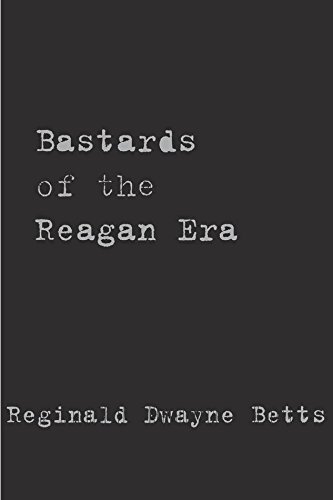
Prison did not rehabilitate Betts. Books did. In Bastards of the Reagan Era, Betts makes clear that prison was a “purgatory.” Still, the crushing repetition and despair he experienced there gave shape to his most recent verse, in terms of content and form. The first poem, “Elephants in the Fall,” invites us in with two luminous moments: the births of the author’s sons, Micah and Miles. Betts charms us with his capacity for lyricism. With the very next poem, he cools things down: it is an elegy that opens, “Many gone to grave.” While Betts calls the first poem a “Prologue,” it is really an epilogue, coming after the other events the book describes. You get the sense that the birth of his children engendered the birth of this devastating chronicle. Betts writes of the birth of his first son, Micah: “you were smiling then, / as if you knew you were the first song / that found me worthy.” That validation facilitated Betts’s poetic creation.
In “Elegy With a City in It,” one of many mournful songs in the book, Betts writes: “I sing this awful / tale,” which reminds us of the beginning of Greek and Latin epic poetry. At several points Betts refers to a blood-stained street as “the wine-dark asphalt,” using Homer’s epithet for the Aegean Sea. A mini-epic constitutes the book’s centerpiece and shares its title. “Bastards of the Reagan Era,” the best poem in the collection, spans 15 pages and nine parts. The poem details not only life in prison, but also the life Betts had before he was incarcerated, when
The hustle courted us. And we were down.
It’ll take you to ruin moms would say,
As if disaster wasn’t that damned place:
Those afternoons and all their sirens blare.
The book also contains another epic called “For the City That Nearly Broke Me.” Interestingly, instead of making this one long poem with sections, Betts breaks it into 11 different poems, all with the same title, and scatters them throughout the book. As a reader when you turn the page you’re denied the surprise of a new poem, echoing the oppressive monotony of prison.
Behind bars, there must have been moments here or there of reprieve. How else could Betts have gone on to accomplish so much? Betts chooses not to elucidate these. Rather, he wants the reader to feel trapped. There is something breathless, fast, and tight about Betts’s writing: “This guard, he yanks against the chain so hard / I buck, then buckle, a man against a leash.” The alliteration and internal rhyme help structure the free verse, as does the repetition of motifs, such as the “toothless crackhead.” This reliance on repetition, if not the image itself, resonates with epic poetry.
Betts blends ancient and modern in other ways. Take his use of the ampersand. Throughout the book Betts uses this symbol instead of writing the word “and.” The ampersand may have descended from a combination in Latin of “e” and “t,” since “et” means “and” in Latin, and apparently a secretary of Cicero’s invented the shorthand. 20th-century American and African-American poets such as Amiri Baraka used the symbol to indicate they were experimental and outside the academy. The symbol also offers a visual treat on the page.
But it is sound that triumphs in Betts’s book. In an interview produced by his publisher and put on YouTube, Betts says his book is about music and rhythm. Rap music as much as epic verse informs Betts’s writing. In one of the “For the City That Nearly Broke Me” poems, he implores the reader:
Stress this: the lit end
of anything will
burn you. & that is just
just a slick way of
saying: running will
never save you. This man’s first son caved, fell
to the pressure, to
the barrel’s indent
against his temple.
A percussive rhythm adds emphasis to Betts’s exhortation.
From rap, Betts borrows the technique of sampling, taking a part of one song and using it in another as a form of homage. His title poem features two lines quoted almost verbatim from the Russian emigré poet Joseph Brodsky, which Betts has noted elsewhere are extremely important to him: “I have / Braved, for want of wild beasts, steel cages. / Carved my name on bunks and rafters.” To name the nine sections of “Bastards of the Reagan Era,” Betts uses song titles from the second studio album of the rap group Public Enemy, who famously sampled everyone from James Brown singing to Malcolm X speaking. Betts doesn’t attribute these lines, but neither did artists of an earlier era, who did not worry as much about copyright infringement as they do today.
With It Takes a Nation of Millions to Hold Us Back, released in 1988, just the time period about which Betts writes, Public Enemy intended to make a socially engaged work of art. Betts’s book, too, is certainly political, invoking and excoriating the Republican president in its title and addressing profound issues such as racism, the war on drugs, and the mass incarceration of black men. You could say Betts’s book bears witness. Carolyn Forché, who coined the term “poetry of witness,” would call poems such as Betts’s “poems as evidence.” In fact, in prison, as a recent article in The Huffington Post notes, Betts “called himself Shahid. ‘I thought that was perfect. I was in a situation where I was seeing things that I never had any expectation of seeing. That’s what writers do. They pay witness to the world.’”
With his book, Betts gives us an inside view of the epidemic of incarceration and the tragedy of poor children who fall through the cracks. He asserts:
[...] there is a secret to why the small boy
can step into the street & no one notices
as it swallows him whole, a mathematics
for the hold that Newports have on men
struggling with child support & probation.
Not many other contemporary American poets know these men and boys as intimately or write as eloquently about them. Of a fight in a neighborhood school, Betts observes,
[...] & fuck it
all as the mob of students and teachers
watching wonder what we hunger for
in the center of this ghetto.
The tricky syntax and the density of a phrase like “watching wonder what we hunger for” make us read several times to understand the multiple meanings a situation might carry.
Betts keeps us on our toes and specifies his grievances. He indicts de facto segregation and “decades of racist housing / policies.” He connects the violence he’s experienced not only to hateful policies of the 20th Century, but also to slavery, using words to apply to his shackles such as “coffle,” meaning slaves fastened together. Elsewhere Betts puts prison vernacular in his verse, words such as “bid” (prison sentence), “twenty sac” (bag of weed), and “sally port” (controlled entrance). By situating this vernacular in a book that draws inspiration from epic poetry, Betts repositions the language of the streets.
Betts’s epic shares with such war stories as Beowulf grisly battles and copious bloodshed. Betts tells of gunshot wounds and the ravages of crack cocaine. After riding a “caravan to hell,” all he wanted was “his body whole.” At one point in his ancient tale, Beowulf contradicts Unferth, who doubts his strength. Speaking of his exhausting but successful attempts to vanquish sea monsters, Beowulf notes, “Often, for undaunted courage, / fate spares the man it has not already marked.” Fate seemed to have marked Dwayne Betts, but with courage he transformed those markings.