The Case Against Buckley

THE UNIVERSITY BOOKMAN, October 2025

The Case Against Buckley

A review of “Buckley: The Life and the Revolution That Changed America,“ by Sam Tanenhaus

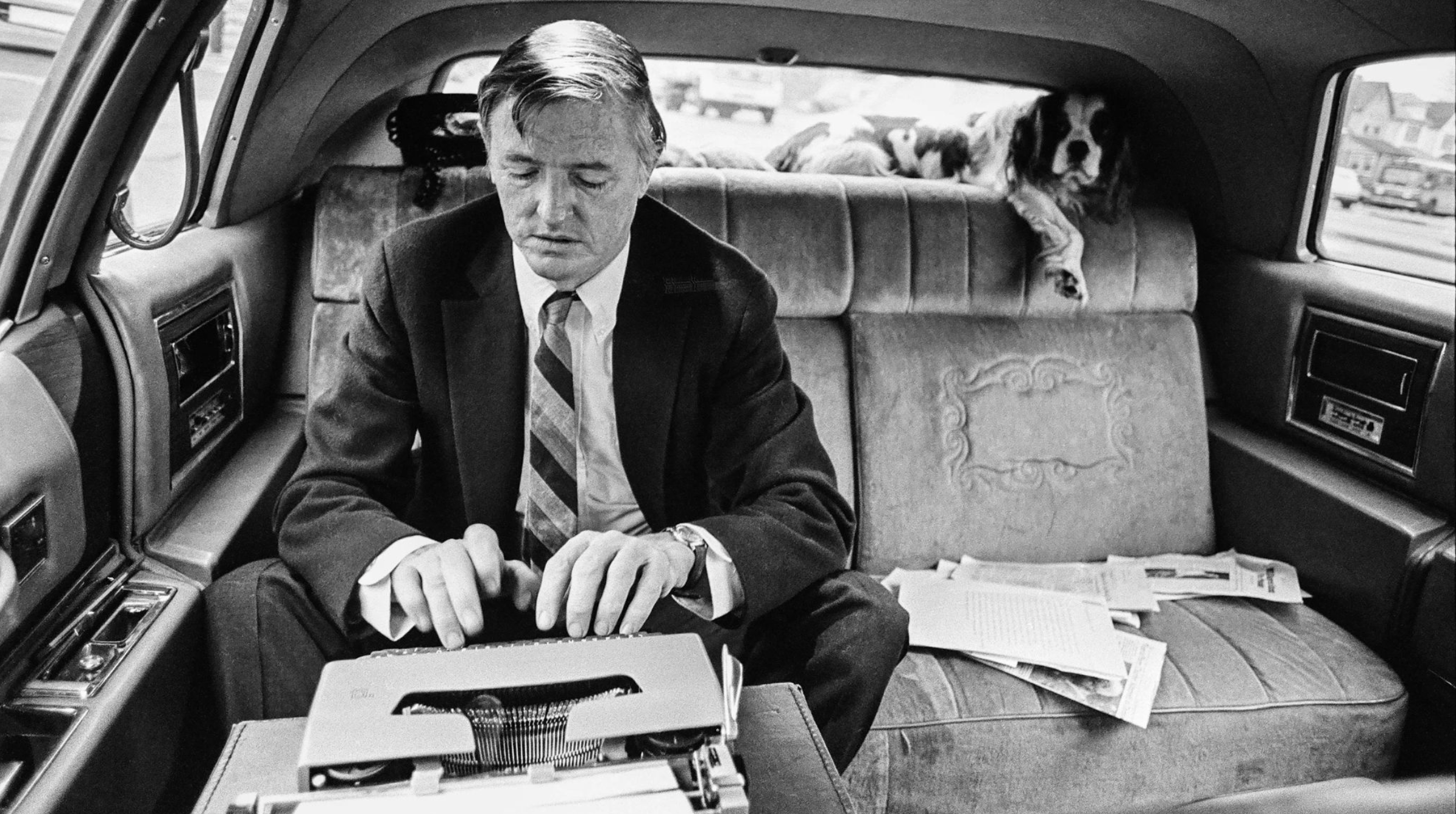
Less than a mile separates the Catholic cemetery of Saint Bernard, the burial site of William F. Buckley Jr., off Sharon Valley Road, from the heights of the old Sharon Burial Ground. Yet the distance could not be more pronounced. The geography of this northwest corner of Connecticut explains much of the social and spiritual counter-insurgency that defined this father of modern American conservatism. Buckley: The Life and the Revolution That Changed America, the long-awaited biography by Sam Tanenhaus, does compelling work here in Sharon, in its early chapters describing Buckley’s large Catholic family engaged in its own forms of guerrilla warfare against the town’s Protestant establishment.

Despite the appearances of old wealth, the Buckleys were upstart outsiders. The patriarch William Frank Buckley Sr. (Will, as opposed to his namesake Bill) was the son of a Texas sheriff who gambled big on foreign oil exploration. After losing their homestead in Mexico to a leftist insurrection, the Buckleys decamped to New York, where Bill was born, and then to Sharon’s Taconic highlands by way of Paris and London.

Settling into an estate off South Main Street that he named Great Elm, Will and his wife Aloise just about reached the physical heights of town, but the working-class Irish who inhabited Sharon Valley remained their spiritual kin. In the eighteenth century, the valley’s Webatuck Creek powered the first Sharon mills. A century later, iron production came to the valley along with the laborers to work its kilns. When the Buckleys arrived in 1923, they “worshiped in pews alongside the descendants of Sharon’s working class,” as Tanenhaus writes, “who in earlier times had been drawn to the Northwest Corner by jobs in its iron industry.” 
Today the Buckleys are mostly gone from Great Elm. The estate was subdivided and sold over the years after Will’s death, along with his diminishing financial legacy. The family’s unassuming plot in the back of Saint Bernard is what remains of their eternal presence. Will and Aloise are depicted on a central memorial stone as the roots of an elm. Markers of their ten children, including the sister Mary Ann who died two days after birth, are the fallen leaves surrounding them. Only here do we find the flat headstone of William F. Buckley Jr and his wife, Patricia. Christopher Buckley, their satirist son and only child, still much alive, has already added his own marker to the assembly. His epitaph reads: “TOMB IT MAY CONCERN.”

Isolationist, Anglophobic, and anti-Progressive, Will and Aloise were the family’s conservative font. Aloise, from New Orleans, who maintained a winter home with Will in Camden, South Carolina, presented a confederate spirit. Will was a man who “worshiped three earthly things: learning, beauty, and his family,” as Buckley said of his father. He was also a Texas gambler, one who was burned in a game newly rigged by Woodrow Wilson, Franklin Roosevelt, and their class of managerial Protestant elite. Tutored by contrast in the contrapuntalism of Bach, raised as a family in semi-seclusion, several of his children became involved in conservative journalism and politics: Pricilla as managing editor of her brother’s National Review; James as United States senator on the New York Conservative Party line and federal judge; Patricia as a founder of the Catholic magazine Triumph and spouse to Brent Bozell, who was Bill’s Yale co-conspirator, co-author of the book McCarthy and his Enemies, and ghostwriter of Barry Goldwater’s Conscience of a Conservative

Across his 1040 pages, Tanenhaus is exhaustive and exhausting as the many bodies in Buckley’s orbit get their due. The chapter on the creation of the 1960 Sharon Statement of conservative principles by a hundred Young Americans for Freedom members convened by Buckley for the weekend at Great Elm is especially compelling. The YAF member who collected the notes and typed them up through the night back in her room at the Hotchkiss Inn was Annette Courtemanche, a sophomore at Molloy University. Four years later, she became Mrs. Russell Kirk.    
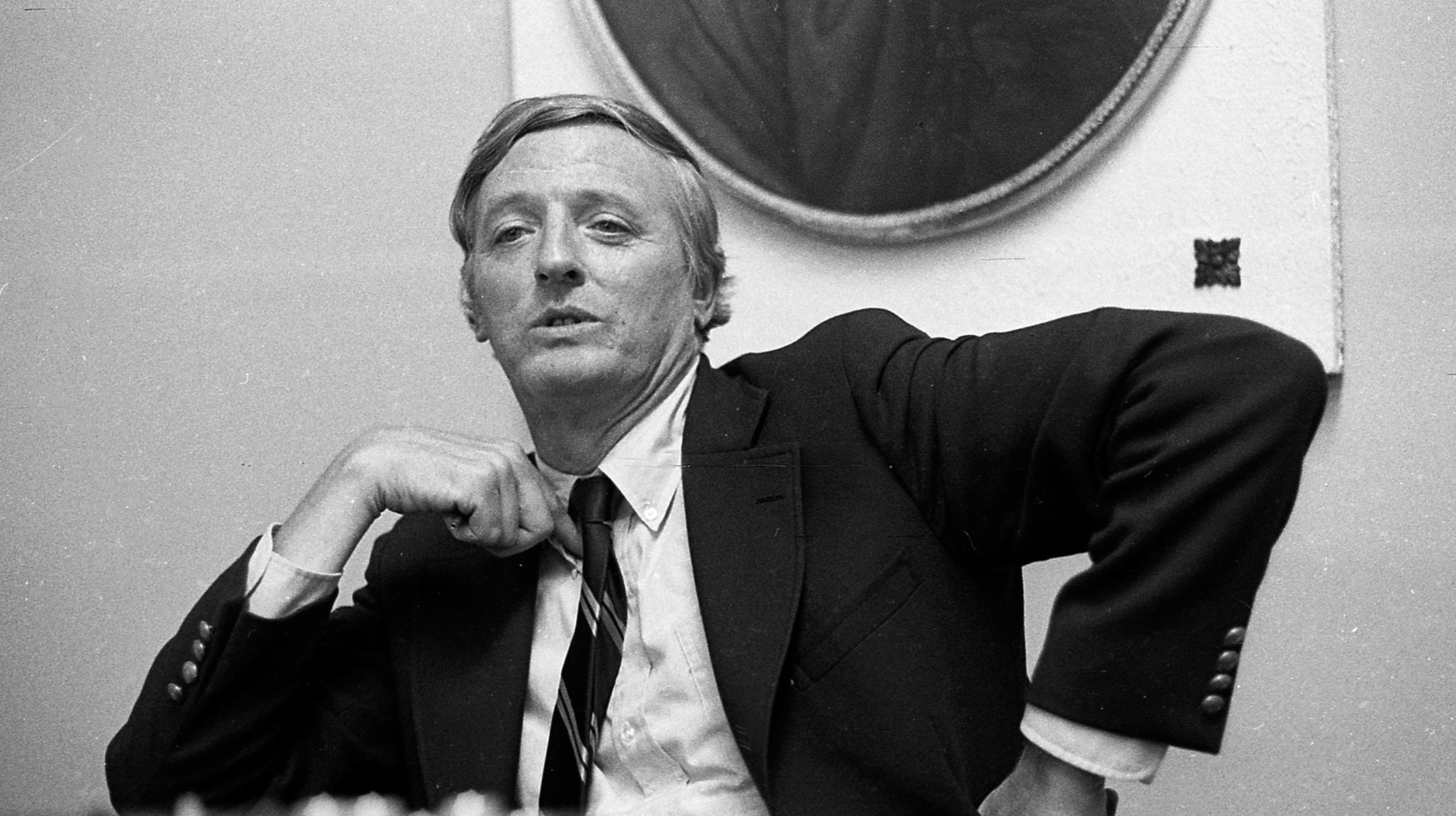
Albert Jay Nock, Willmoore Kendall, James Burnham, Whittaker Chambers, and Frank Meyer each exerted their own gravitational pull on Buckley’s trajectory as the conservative isolationism of America First gave way to Cold War anti-Communism. Founded in 1955, Buckley’s National Review meanwhile mentored a generation of younger writers, including no less than Arlene Croce, Joan Didion, John Leonard, Renata Adler, Garry Wills, Hugh Kenner, and Guy Davenport. An undergraduate Betty Friedan (née Goldstein) makes a cameo as the Buckley sisters’ protector at Smith. At the same time, a nineteen-year-old Sylvia Plath appears at Maureen Buckley’s debutante ball at Great Elm.  

Readers of this book may have differing opinions about where its narrative turns against its subject. In the endless section on civil rights, there are hints that Tanenhaus intends to burden Buckley in his missteps, distractions, and peccadilloes. At a certain point, Tanenhaus seems to turn his focus on everything Buckley should have done but didn’t, such as finishing an ambitious book project titled Revolt Against the Masses rather than attending to his many novels (I was his writing assistant for one of them), columns, and television appearances (and the yearly income he needed to maintain National Review). As he aligns himself with Richard Nixon and Henry Kissinger, Buckley, in Tanenhaus’s telling, falls short of his intellectual promise and softens in the trappings of power and prestige.    

There is ultimately less “life” here than a focus on the “Revolution That Changed America.” As the chapters roll on, Buckley appears increasingly inert, passive, and surprisingly silent—a reactive presence within unfolding events. A charitable interpretation would be to say that Tanenhaus rejects the “great man” theory of history, that we are merely the sum of historical forces applied to us. In elevating Buckley’s faults over his features, more likely than not, this book is designed to impugn the American conservative movement by diminishing the singular leader who created it. 

In any case, by the end, it becomes clear that Tanenhaus never really gets Buckley, no matter how many words he deploys to describe the revolution around him. The long delay in this book’s completion, some twenty-seven years in the making, is just one indication of a biographer who loses the thread of his subject and becomes increasingly indignant as he looks over the remaining stitches. 
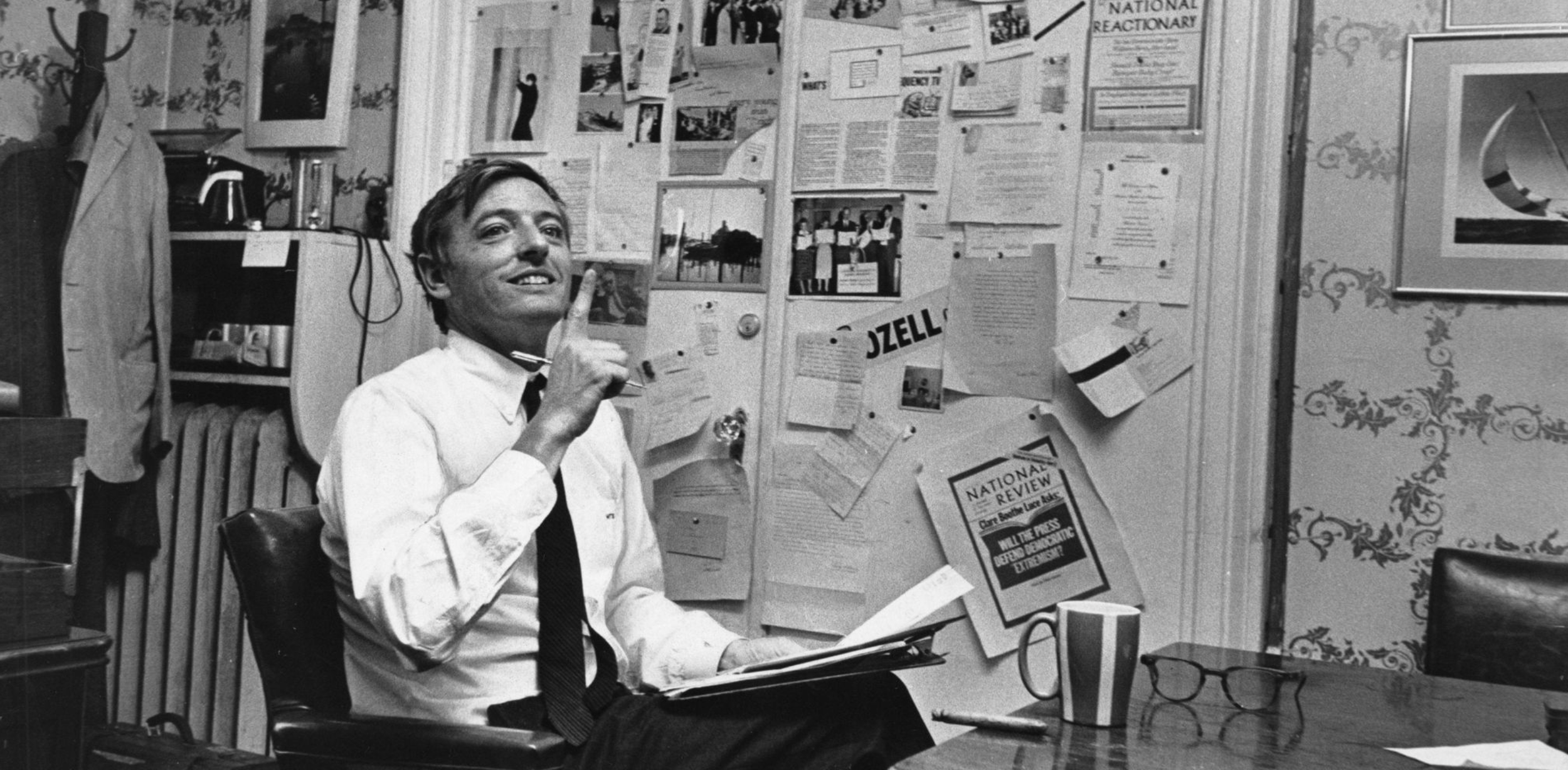
From the geography of Sharon to the faculty at Yale, Buckley took on an entrenched progressive elite. His greatest achievement was to manifest an alternative American aristocracy, a counter-elite that took full form in the presidency of Ronald Reagan. Buckley was a “Catholic aristocrat of the Spanish persuasion,” as a friend once said. He understood the spiritual dimension that informed America’s social and political dynamics. His famous quip about preferring to be governed by the first 2,000 people in the Boston telephone directory than by the 2,000 people on the faculty of Harvard University was more a slam against the progressive Ivy League than a positive appraisal of the average Bostonian. At the time Buckley attended Yale, the school maintained admissions caps on Jewish and Catholic applicants in equal measure. So when Yale University sent its plenipotentiary, McGeorge Bundy, out to slam God and Man at Yale, Buckley’s 1951 broadside against the school’s progressive professoriate, Bundy centered his attack on Buckley’s Catholicism.

Buckley may have never finished Revolt Against the Masses, his answer to Ortega y Gasset. Instead, life itself, fully lived, became his revolt played out across a multitude of media. From restoring God to “man at Yale” to taking on Godless Communism, Buckley waged a holy war aimed at the highest levels of American society—and he largely won. Nevertheless, Buckley: The Life and the Revolution That Changed America is a tome that proves the progressive elite still exists, and that not everyone has been won over by his revolution that changed America.
Mock stars

NEW YORK POST, October 14, 2025

Mock stars

The famous forgers who fooled everyone — even the experts

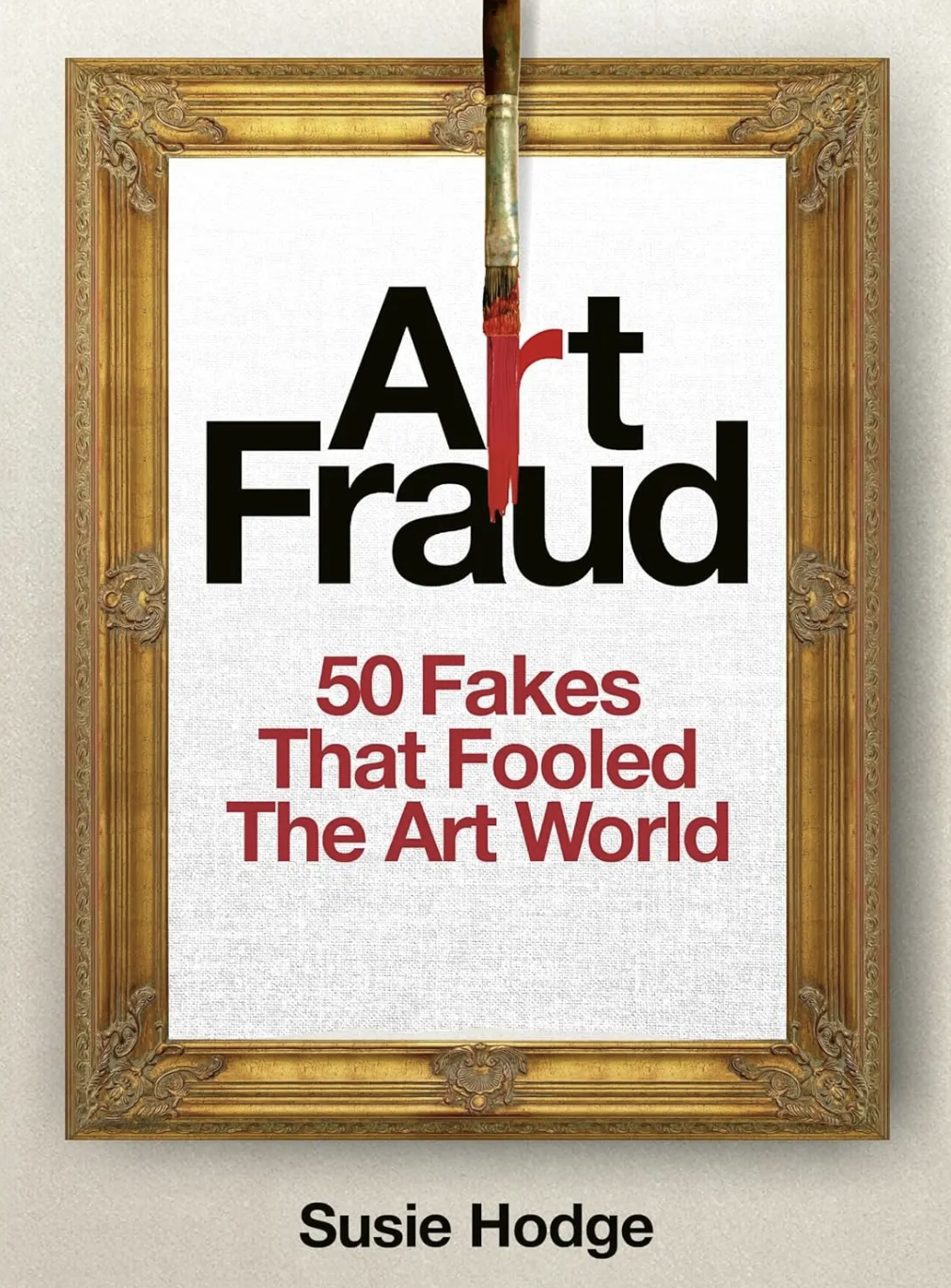
In the words of Cole Porter, “Is it the good turtle soup or merely the mock?” Art Fraud: 50 Fakes That Fooled the Art World,” the new book by Susie Hodge, will leave you wondering whether any work of art is the real McCoy. “Art fraud is rife,” Hodge begins. “Many experts believe that as much as 50 per cent of all art on the market today is forgery.”

If the 50% statistic sounds phony, you don’t know the half of it. “Art Fraud” casts a gimlet eye on the most famous forgery cases to reveal the truth behind the art world’s worst-kept secret. From the greatest experts on down to the most naïve online bidders, just about anyone can, and will at some point, be duped by the mock.

Of course, artists have always traced out the styles and techniques of others. The ancient Romans made such a business of copying Greek sculptures that scholars still cannot chisel out the source of one discus thrower from the next. Even the greatest artists played the copy game. In the Renaissance, Michelangelo passed off one of his cupids as a Roman original. Canova painted a fake self-portrait by Giorgione. And so on.

“Good artists copy; great artists steal,” said Pablo Picasso, an artist well known for taking up other artists’ innovations as his own (bonjour, Georges Braque).

The Louvre has a longstanding tradition of artists who come to copy the works on the museum’s walls. Manet even met Degas when he was copying a Velázquez painting. But there’s a difference between just duplicating a work of art and passing it off as someone else’s. At the Louvre, a copy must be stamped and cannot be created in the same size as the original. The strict French regulation tells us much about the slippery slope between copy and fraud and the latter’s temptations.

“Art Fraud” offers quick sketches of the range of famous fakers who went that extra step and succeeded in passing off their art as someone else’s, at least for a time. (Of course, it’s very possible the best of them have never been caught.) “Art Fraud” considers their various techniques and motivations — and frankly will leave you with a newfound respect for the fraudulent arts.

Often, it’s not just about the money. Ego plays a role as forgers pass off their own work as the creation of a master, whether old or modern. Sometimes forgers want to expose the art market and disrupt the way works are collected and esteemed, creating forgeries in the process that are designed to be exposed. And sometimes the forger is just another victim, paid a pittance by unscrupulous dealers to create fakes under false pretense, not even aware their creations are being used to defraud.

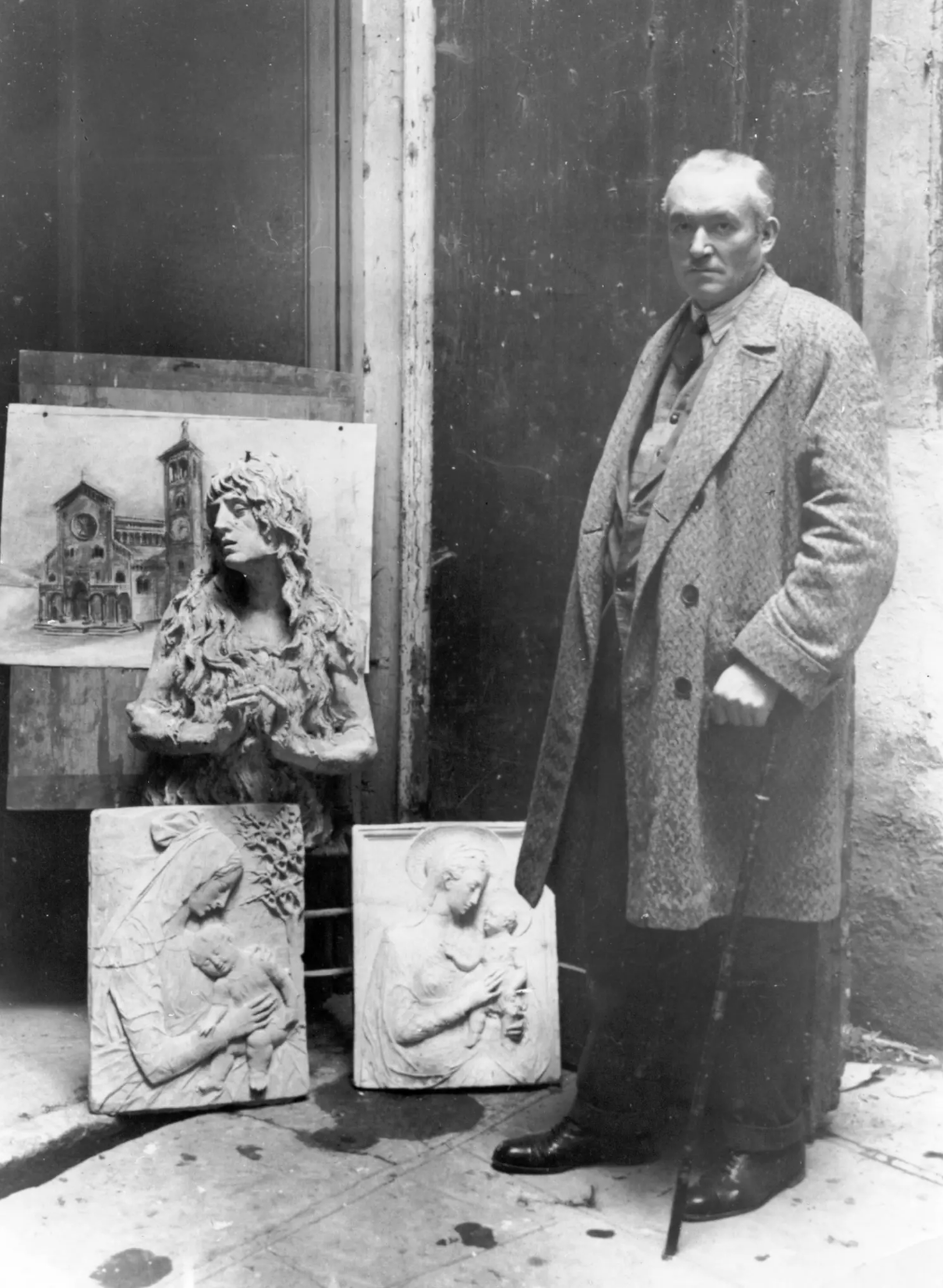
Alceo Dossena didn’t know dealers were passing off his recreations of Gothic and Renaissance sculpture as the real deal.

The Italian sculptor Alceo Dossena (1878-1937) was one such sad case. A student of the Old Masters, in the early 20th century he demonstrated an uncanny ability to carve sculptures in the Gothic and Renaissance style and artificially age them in a way that could fool even the top experts of his time. Two Roman dealers, Alfredo Fasoli and Romano Palesi, ordered up plenty from Dossena, convincing him he was creating work for an American church that had requested new statuary that looked old and weathered.

Carving in the styles of Simone Martini, Giovanni Pisano, Donatello, Michelangelo and Giambologna, Dossena artificially aged his creations in baths of urine. He scraped them, baked them and darkened their finishes to add 500 years of wear to order. Fasoli and Palesi paid Dossena a fraction of the millions they took in as his misattributed work made its way into the collections of Helen Clay Frick, the Cleveland Museum of Art, the Metropolitan Museum of Art and the Louvre. Only when new X-ray technology was applied to his sculpture, revealing modern nails, did the ruse begin to come to light.

In another era, Dossena might have been hailed as an esteemed artist in his own right. “We had witnessed the reincarnation of a Renaissance master and an Attic sculptor,” said the German art historian Hans Cürlis once the deception was discovered. Alfred Frankfurter, the editor of Art News, wrote of the “quality of sincerity in Dossena, the almost incredible ability of the man to have worked without affectation and without malevolence in the spirit of the dead past and its masters.” Dossena was cleared of any crime and continued to sculpt, but few wanted his work once the world learned the artist behind it was not an Old Master but just old Alceo Dossena.

The Dutch painter Henricus “Han” van Meegeren (1889-1947) had no such illusions. The most famous faker of all, he tossed off dozens of Vermeers and other works purportedly from the Dutch Golden Age and made the equivalent of tens of millions of dollars. At one time the Dutch art expert Abraham Bredius praised the work, declaring, “It is a wonderful moment in the life of a lover of art when he finds himself suddenly confronted with a hitherto unknown painting by a great master, untouched, on the original canvas, and without any restoration — just as it left the painter’s studio. And what a picture!”

American soldiers found in a Nazi leader’s home the work “Christ and the Adulteress” — which everyone wrongly believed Vermeer painted.

As van Meegeren sourced old canvases and ground his own pigments, his work convinced even the dreaded Nazi Hermann Göring, who traded away genuine looted art for a van Meegeren fake. Only after the war, when van Meegeren faced the death penalty for despoiling Dutch heritage during Nazi occupation, did he admit to his deception. Painting a fake Vermeer in front of an audience, he proved the only loser in his deception was the dead Reichsmarschall.

Han van Meegeren paints a “Vermeer” before an audience — proving he was a forger, not a Nazi collaborator.

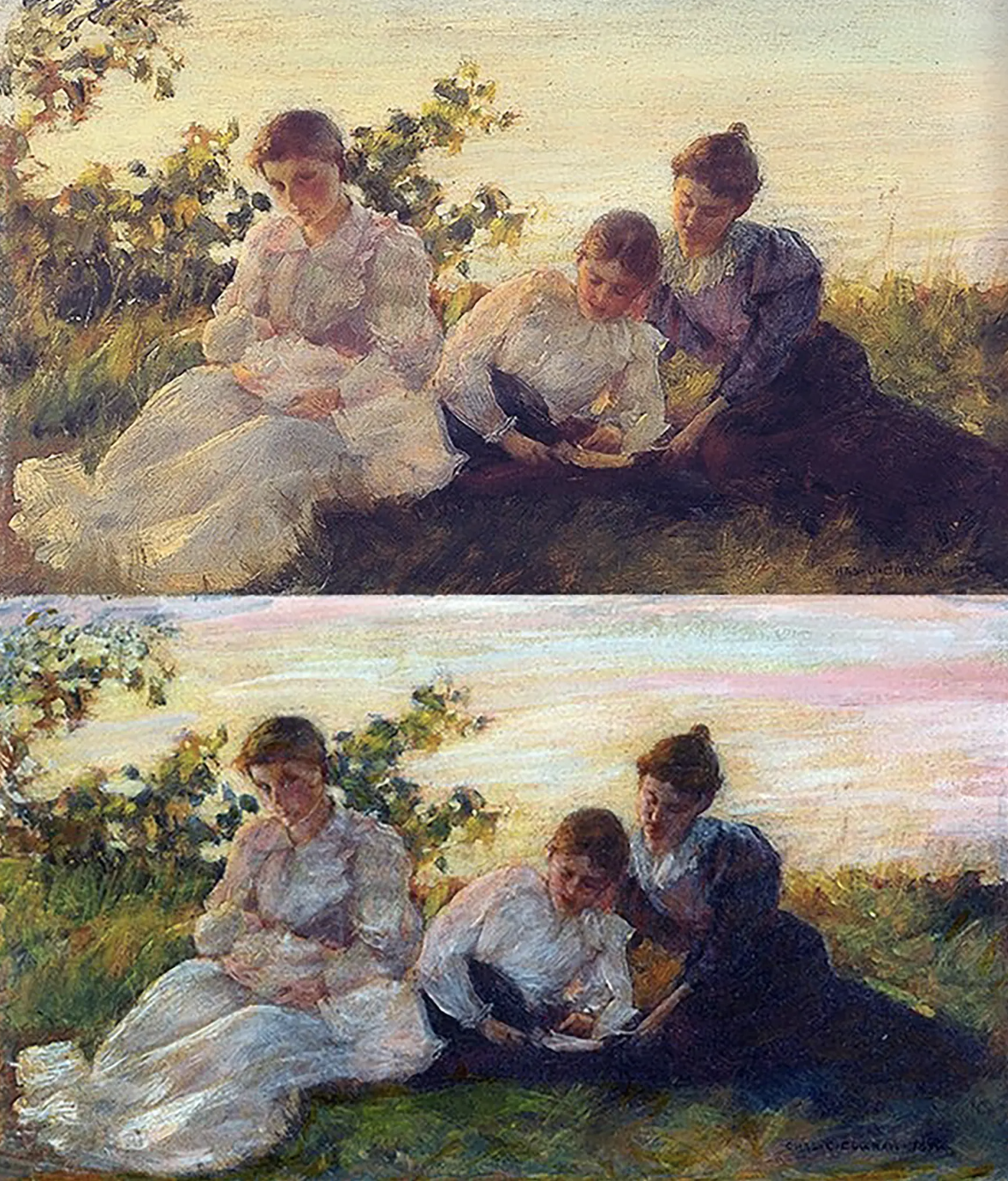
Through van Meegeren’s use of modern Bakelite plastic to harden his paints, subsequent false canvases continue to turn up, most recently at London’s Courtauld Institute in 2011. The case of the American forger Mark Landis (b. 1955) is particularly compelling. Never interested in money, he created fake pictures and fake personas to enjoy the attention that would be lavished on him as a museum donor. Drawing works in a matter of hours with materials purchased at Walmart, he stated, “I felt an impulse to give away pictures. I’d watched so much TV and learned about philanthropists — wealthy people who gave to others — so I gave a picture away, and I was treated with so much respect and deference and friendship. Those are things I had never experienced before. I really liked it, and I got addicted to it.”

Mark Landis quickly made copies (bottom) of famous works like Charles Courtney Curran’s “Three Women” (top).

To pass off a fake, forgers need not only period materials and a convincing style but also a plausible backstory or what the art world calls provenance. The British painter John Myatt (b. 1945) at one time advertised himself as a copyist for hire. His materials were far from historical — emulsion paint and K-Y jelly. Nevertheless, his accomplice John Drewe created convincing backstories by adding fake documents to artist archives and replacing pages in art catalogues, creating historical records for work that in fact never existed.

The most recent headline case of art fraud, involving the loss of tens of millions of dollars and shuttering of New York’s oldest art gallery, now reads like a copy of Alceo Dossena. The art dealer Glafira Rosales claimed to have discovered a trove of modern masterpieces. Her source was a mysterious “Mr. X Junior,” whose father, she said, had secretly collected the work through a gay liaison.

The reality was far more prosaic: Pei-Shen Qian, an immigrant living in Queens, unknowingly painted the abstractions in a garage to order. Like that modern nail in Dossena’s statue, an ahistorical pigment was the nail in the coffin.

Art frauds can be easy to spot in retrospect but are far more challenging in the moment. Nowadays, few would say a van Meegeren is anything but a van Meegeren. The stories in “Art Fraud” reveal how people believe what others believe. We accept labels and defer to experts. This is especially the case when there’s little to gain from exposing the lie aside from knowing the truth.

Today, as we look to a future of generative artificial intelligence and “deep fakes,” the only real certainty is the unreliability of anything we may see. Copy that.