A Taste for "Hansel and Gretel"

When it comes to Christmas-time family fare, there may be no equivalent to The Nutcracker, Tchaikovsky’s ballet warhorse. In the world of opera, Engelbert Humperdinck’s Hansel and Gretel comes the closest. This fairytale opera of the story by the Brothers Grimm was first performed on December 23, 1893, with Richard Strauss conducting in Weimar. The opera has been associated with the Christmas season ever since, including at New York’s Metropolitan Opera House, which broadcast its first complete radio performance of the opera on Christmas Day, 1931.

Yet this tale of witches, cannibalism, and abandoned children is hardly a sojourn in the Land of Sweets. Starting this week through January 6, the Met presents seven family performances in English of Richard Jones’s 2007 production that enlarges the story’s unsavory bits into an absurd, surrealist staging of giant fish-heads, baked witches, and triumphant children, with Donald Runnicles in the pit.

When considering the stories we tell children, I am generally in favor of more Brothers Grimm, not less. The nineteenth-century folktales can horrify parents as much as they delight children, who still retain an innocence around play and metaphor—realism being an invention, of course, of modern adulthood. The same goes for the elements of the Met’s Hansel and Gretel. An opera that begins in harsh reality ends in sweet fantasy—in this case, with a child-eating witch baked into a loaf of gingerbread.

Lisette Oropesa and Tara Erraught in Hansel and Gretel. Photo: Marty Sohl / Metropolitan Opera

Lisette Oropesa and Tara Erraught in Hansel and Gretel. Photo: Marty Sohl / Metropolitan Opera

The first act, set in a dingy cottage, is straight out of Tobacco Road. Mother Gertrude (Dolora Zajick) returns from work to find her hungry children, Hansel (Tara Erraught) and Gretel (Lisette Oropesa), eating a jar of cream. She punishes them by sending the siblings to the forest, as her husband, Peter (Quinn Kelsey), arrives home drunk. The staging is bleak, and the social commentary is heavy-handed, as Gertrude is turned from a wicked step-mother (who actually dies at the end of the original Grimm story) into an aggrieved spouse.

The facts of this first act are then put in contrast with the fantasy of the second and third—but, for mixed-aged audiences, a little more surrealism up front might have tempered the heavy realism of the social pageant.

Ask any child about “Hansel and Gretel” and the first thing they mention is the trail of breadcrumbs. But you won’t find a single crumb here, at least in Jones’s production. Rather than a forest, the children wander through a Magritte-like hall, with leafy wallpaper, an antler chandelier, and trees dressed in suits. After a sprinkling for the sandman (Rihab Chaieb, needlessly creepy), the children enter their Traumpantomime. Then the fun begins.

“I love this part,” my seven-year old whispered to me, as the hall door opened in a beam of light. Fourteen angels make their entrance—here as giant-headed chefs, resembling those you might find in Maurice Sendak’s “Mickey in the Night Kitchen.” The chefs lay out a feast for the hungry children as the fish-headed major duomo, in tailcoat and fins, emerges from a trap door to light the candelabras. There is much to love at this moment, as Humperdinck’s music swirls and swells under Runnicles’s baton. In person, the absurdity of the staging makes perfect sense.

Lisette Oropesa, Tara Erraught, and Gerhard Siegel in Hansel and Gretel. Photo: Marty Sohl / Metropolitan Opera

Lisette Oropesa, Tara Erraught, and Gerhard Siegel in Hansel and Gretel. Photo: Marty Sohl / Metropolitan Opera

The third act is a return to reality, of sorts, this time not as tragedy but farce. After long preludes defined by increasingly frightening screens—a plate becomes a mouth becomes an opera dentata—the siblings awake in The Witch’s kitchen. This time the setting is a dingy industrial floor, complete with roll-down shutters and stained metal appliances. Propped up against the walls of this Bowery torture chamber are mummified children—The Witch’s previous victims, all baked into loaves of gingerbread.

Gerhard Siegel as The Witch in drag plays up the camp, and a food fight with funneled sweets cuts the Paul-McCarthy-like mawkishness of what would otherwise be a truly horrific scene. Finally tricked into her own oven, The Witch re-emerges as a steaming breadloaf. The gingerbread children are freed from their spell, and a youth chorus signals the end of this childhood redemption story of yearning hunger ultimately satisfied in a spine-tingling finale. 

So, is this “family” performance appropriate for children? Of course it is. The kids get it; my seven-year-old loved it. The real question should be, Do today’s helicopter parents still have a taste for “Hansel and Gretel”?

Andrew Wyeth Forever

THE NEW CRITERION, December 2017

Andrew Wyeth Forever

On the career of Andrew Wyeth and the traveling exhibition, “Andrew Wyeth: In Retrospect.”

Andrew Wyeth was born a century ago this year. To mark the centennial, the United States Postal Service issued a series of stamps and keepsakes, with a launch ceremony last July in Chadds Ford, Pennsylvania, the place of Wyeth’s birth and, along with Cushing, Maine, a lifelong focus of his art. With a selvage that includes a photograph of the young artist in his Chadds Ford studio from the 1930s, the $5.88 sheet features a pane of “twelve Andrew Wyeth Forever® stamps” that reproduce Wyeth’s paintings of rural and coastal life in a five-inch adhesive grid. Here in miniature are the billowing curtains of Wind from the Sea (1947), the milk-cooling bath of Spring Fed (1967), the old schoolhouse that became My Studio (1974), the North Light (1984) of the next-door studio of his famous father, the illustrator Newell Convers (N. C.) Wyeth, and various interiors and exteriors of hardscrabble rusticity—Big Room (1988), Alvaro and Christina (1968), Frostbitten (1962), Soaring (1942–1950), and Young Bull (1960). Also included is a stamp of Wyeth’s most well-known painting, Christina’s World (1948)—acquired by Alfred H. Barr, Jr. fresh from a gallery wall in 1949, it became Wyeth’s only work to enter the collection of the Museum of Modern Art, where it remains today on extended if unceremonious view.

Andrew Wyeth in 1983. Photo: Bruce Weber / Agence France-Presse—Getty Images

Andrew Wyeth in 1983. Photo: Bruce Weber / Agence France-Presse—Getty Images

The issuing of commemorative stamps is an honor that has been bestowed on other twentieth-century painters, of course, but the occasion might seem all too fitting for Andrew Wyeth, an artist who posted a popular alternative to the onrush of modernity with what many considered to be the timeless correspondence of rural American life. Widely reproduced thanks to the commercial savvy of his wife, Betsy, Wyeth’s paintings have endlessly circulated in a way that has long enthralled the public—who have flocked to his exhibitions and collected his posters—and infuriated his critics—who have regarded his philatelic reputation as a postage-sized legacy.

“An image of American life—pastoral, innocent, and homespun—which bears about as much relation to reality as a Neiman Marcus boutique bears to the life of the old frontier,” is how my late colleague Hilton Kramer saw Wyeth in 1970, at the time of a retrospective at the Museum of Fine Arts, Boston, that broke records for attendance. Six years later came the Metropolitan’s own blockbuster “Two Worlds of Andrew Wyeth: Kuerners and Olsons,” organized by Thomas Hoving, the museum’s director, after his curators passed on the exhibition. Remarking on Wyeth’s “monochrome vision of the world,” here Hilton wondered “if there is not in this art a hidden scatological obsession. How else can one account for the excremental quality of this palette, which censors out anything that might complicate its ‘earthy’ view of nature and human experience?”

Beyond false realism, a near unanimity of critics has accused Wyeth of trafficking, it might be said, in a false consciousness of American life. Wyeth’s images of “frugal, bare-bones rectitude” may be “incarnated in real objects” wrote Robert Hughes in the New York Review of Books, but they have been “glazed by nostalgia . . . which millions of people look back upon as the lost marrow of American history.” A “kitsch-meister” of “dreary vignettes” that “celebrate . . . cultural and social immobility” (Robert Storr), Wyeth painted “formulaic stuff not very effective even as illustrational ‘realism’ ” (Peter Schjeldahl) in a palette of “mud and baby poop” (Dave Hickey). “Not a great artist.” “The press noted when he voted for Nixon and Reagan” (Michael Kimmelman).

Indeed, it does not take long to sense something false, even sinister, in Wyeth’s most famous painting, Christina’s World—so long as you can find the work hanging in the Museum of Modern Art. Following its acquisition, the anti-modernity of this vastly popular image, a standard dorm-room appurtenance for a generation of liberal-arts majors, has long been a bugaboo for the museum’s curatorial staff, who excommunicated the painting from the collection halls to the museum’s utility spaces.

Andrew Wyeth, Christina’s World, 1948, Tempera on panel, The Museum of Modern Art.

Andrew Wyeth, Christina’s World, 1948Tempera on panelThe Museum of Modern Art.

Wyeth’s painting of a woman crawling up a weedy hill towards a forlorn house has itself moved up, from hanging outside one moma restroom to another. Christina’s World is these days found surrounded by a constellation of information desks, elevator banks, escalators, and baby-changing areas. Yet the public still seeks it out, for its celebrity as well as its strangeness—lingering, as I observed, over the painting’s details long after taking the requisite photograph.

Christina’s World presents several mysteries. The first is any sense of how it could have been created with such exacting detail. Tempera, Wyeth’s medium of choice, is an ancient and challenging concoction of egg yolk and mineral pigment. From Roman times until the sixteenth century, egg tempera was the primary medium of painting. The advent of oil then brought about a more flexible and forgiving medium that allowed for the use of lightweight canvas instead of heavy and stiff wooden panels. N. C. Wyeth, Andrew’s father and teacher, was an oil painter. Peter Hurd, an apprentice to N. C. who became Andrew’s brother-in-law, introduced tempera to Andrew as an antiquarian curiosity in the 1930s. In 1938, the two attended a demonstration of tempera painting in the Early Renaissance manner given by Daniel V. Thompson at the Philadelphia Museum of Art. Wyeth went on to study Old Master paintings in the museum collection, especially information-packed compositions in the style of Pieter Bruegel I, the Flemish artist who painted in both tempera and oil.

Fast drying, tempera also allows for far greater detail than oil. Much like drawing in paint, one thin line at a time, tempera permitted Wyeth to deploy his full talents for draftsmanship—inherited from his father—to his final compositions. Tempera also distinguished Andrew’s body of work from the more expected look and faster pace of the paintings of N. C., who created illustrations on commission for such books as Treasure Island. Whereas N. C. once dismissed his apprentice son’s experiments in the medium, it was the alchemic deployment of tempera that came to define the unreality of Andrew’s slowly produced final compositions, such as Christina’s World. He even found a favorite egg, the Extra Large from the local Wawa convenience store, which he used for its yolks while feeding the whites to his dogs.

Christina’s World purports to display a far greater degree of information than a painting should possibly contain. Every dried blade of grass, on up to the ridgeline, seems to be present and accounted for. The same goes for the warped clapboard siding and stained roof shingles of the minutely detailed buildings, cutting into the horizon line with uninterrupted drama, far up along the crest of the hill.

Yet, for all of its detail, the painting communicates only the most elusive of narratives. Who is Christina? What is “her world”? What accounts for her oversized, talon-like hands tearing at the dirt, or her thin, chicken-like arms holding her up? With her face turned away, what does she even look like? Why is she on the ground at all, tense and twisted against our view? What of the house’s treeless desolation, the sorry ladder leading up to its roof, the tattered clothing on the line, the murder of crows flying out of the hayloft, the tire tracks unaccountably cutting through the field, or just the general, sepia-toned sense of disrepair? And what are we, as viewers, meant to make of our own role in surveying this captivatingly maudlin scene?

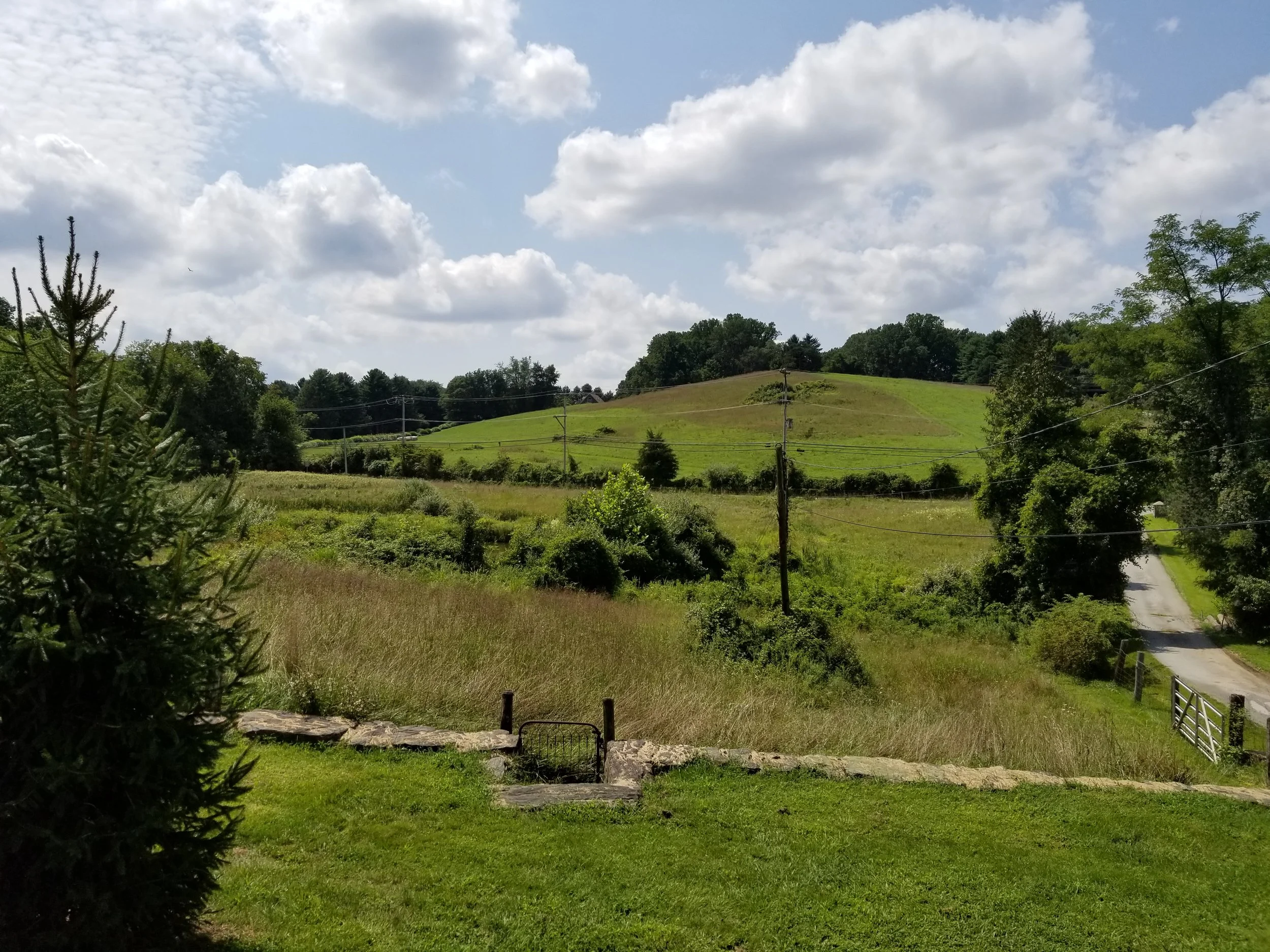
The view today of Kuerner’s Hill from Kuerner Farm. Photo: James Panero

The view today of Kuerner’s Hill from Kuerner Farm. Photo: James Panero

Hilton was right to conclude that Wyeth “offers the world a dream that it cherishes—a pastoral alternative to what both art and life normally afford—and the world will beat a path to the door of whatever institution makes it available.” A recent blockbuster exhibition in Chadds Ford at the Brandywine River Museum of Art, “Andrew Wyeth: In Retrospect,” for the first time allowed the close comparison of a large selection of Wyeth’s body of work with the very places that informed his working—his own studio and the studio of his father, along with “Little Africa” and Kuerner Farm, the home of his portrait subjects Karl and Anna Kuerner and the workplace of Helga Testorf.1 Only recently entering the public trust, and now administered by the Brandywine Conservancy, these sites and the history that surrounds them illuminate the dreamy brand of realism that Wyeth so expertly, if excruciatingly, captured.

As this exhibition now travels on to the Seattle Art Museum, the Brandywine’s partner institution, such comparisons must be made over longer distances, but they remain equally compelling. For what becomes apparent, walking the same back roads that Wyeth walked for some nine decades (he died in 2009 at the age of ninety-one), is how vastly circumscribed his version of “realism” truly must have been, especially in his seemingly hyper-realistic tempera on panel. Despite all of the details they include, compared to on-the-ground reality, Wyeth’s compositions are most significant for what they leave out, with restrictive editing that imbued his minimal and even abstract paintings with a desolate aura.

This is certainly true for Christina’s World (which did not travel for the show and remains at moma). The coastal Maine property indeed exists, and an infirm Anna Christina Olson did live there. In 1989 the fourteen-room colonial was put up for sale by then–Apple ceo John Sculley for $1.25 million. It was eventually donated to the Farnsworth Art Museum. But the reality of Wyeth’s scene ends there. The model for the painting was in fact Wyeth’s able-bodied wife, Betsy. Her shoes were costume props. The trees obscuring the ridgeline were stripped away, while the depth of field of the hillside was greatly extended. And the painting’s palette was thoroughly scrubbed of its blues, as in a photographic process.

Take another famous Wyeth hill, Winter 1946 (1946), this one in the current exhibition: Same tawny colors. Same sharp ridgeline and depth of field. Same mysterious figure in the foreground—this time, a boy twirling down. Even the same tire tracks cutting through the grass. The actual location Wyeth depicted here is Kuerner’s Hill, across from Kuerner Farm. But the reality of its shapes and colors is unrecognizable when compared to the painting—despite, again, Wyeth’s persistence of supposed detail.

Still from King Vidor’s The Big Parade. Photo: Jeff Rapsis

Still from King Vidor’s The Big Parade. Photo: Jeff Rapsis

The most compelling aspect of “Andrew Wyeth: In Retrospect,” as explored in a catalogue essay by the art historian Henry Adams, is the artist’s fascination with American movie-making. In particular, this meant silent movies, and, specifically, the 1925 blockbuster The Big Parade, about three American GIs of differing backgrounds sent to the Western Front in World War I. Later in life, Wyeth reached out to King Vidor, the film’s forgotten creator, with a mash note and invitation to visit:

I consider your war film The Big Parade the only truly great film ever produced. Over the years I have viewed the film many, many times and with each showing the certainty of its greatness deepens. I have always viewed it with awe and I must tell you that in many abstract ways it has influenced my paintings.

Wyeth wasn’t kidding about his interest in this movie. At the time of Vidor’s visit in 1975, Wyeth had watched The Big Parade some 180 times. By his death some thirty years later, the number of showings, according to Adams, had reached 500. Adventure films in general were of interest to Wyeth. When I recently toured his preserved studio, the canistered reels for Captain Blood were still on the bookshelf. But Vidor’s cinematic innovations were Wyeth’s great artistic inheritance: the perspective lines reaching to an unobstructed horizon, the feeling for scarred battlefield landscapes, and the use of visual symbols such as shoes to signify meaning. Much like Wyeth’s own foreshortening of narrative, Vidor himself imagined a cinema of the future “without a story. By that I mean a production in which the main interest will center about the atmosphere and background rather than in the acting or the plot.”

Wyeth manipulated his compositions much like a silent film director. His captions were his allusive titles. He used real people and real places but cast them in his own scouted locations, working extensively through preparatory drawings and watercolors to distill the vision in tempera. In his lack of authenticity and his chilly sentiment, Wyeth was decidedly unmodern. His artifice might be considered postmodern, even contemporary, as he processed the idioms of one medium through the materials of another, pressing it all together in the dying light of illustration and the lingering moods of Symbolism and the American Gothic.

At the same time, the approach was far from superficial for Wyeth. His compositions largely emerged from personal, psycho-cinematic places. His figures and locations all conveyed a personal if sublimated feeling. For example, Wyeth first met the Olsons later on the same day he had met his wife—a psychological metonymy that helps explain why Betsy could serve as the model for Christina’s World. That same Cushing hill meant so much to Wyeth that he was buried in the Olson family plot at the location of the painting’s point of view (Wyeth had once observed Christina Olson delivering flowers to the same cemetery, a scene that inspired the painting and the figure’s dusty hands).

An even deeper sense of connection runs through Chadds Ford, and in particular the Kuerner Farm. In 1945, N. C. Wyeth and his three-year-old grandson and namesake— Andrew’s nephew—were struck and killed at a railroad crossing by an unscheduled mail train that ran on a track along the edge of the Kuerner property. The farm overlooks the site of the crash, while the hill obscures it. The impact was so catastrophic that N. C. was compacted in his vehicle, while the toddler was thrown from the car, dying when his neck snapped against an embankment. Allan Lynch, the boy Wyeth went on to depict in Winter 1946, is the one who first came upon the wreckage and kept the wild dogs from lapping up the blood.

The gruesome battle scenes of The Big Parade, which Wyeth first saw with his father in a Wilmington theater when he was eight, became the filter for this family tragedy. Wyeth depicted Karl Kuerner, who was a German machine gunner in the war, as his paintings’ menacing antagonist, often in full trench uniform. Meanwhile Wyeth himself might be seen as the movie’s upper-crust hero, Jim Apperson, a dandy figure despised by his father, but one who finds a cause fighting alongside his central-casting working-class friends: Slim, a construction worker; and Bull, a bartender.

Much like Jim Apperson in his war, Andrew Wyeth in his art was a coastal elite who romanticized but also valorized the struggles of the overlooked and the flown-over. His circle of collectors and friends included the Du Ponts, whose Gilded Age estates, including Winterthur and Longwood Gardens, surround Chadds Ford. Driven by personal struggle and a captivating fetish for the downtrodden, Wyeth painted out his own Hollywood redemption plot. His art was his artifice. Much like his extensive collection of toy soldiers, which still populate his studio shelves, his subjects were stand-ins. His sense for the magic of the movies may not have derived from a high-modernist manifesto. Nevertheless through his astonishing technique he managed to illustrate a personal story that has resonated with generations. If not empathetic, his compelling images still offer up a voyeuristic escape, all with the timeless stamp of inauthenticity.

1 “Andrew Wyeth: In Retrospect” opened at the Seattle Art Museum on October 19, 2017 and remains on view through January 15, 2018. The exhibition was previously on view at the Brandywine River Museum of Art, Chadds Ford (June 24–September 17, 2017).

Hall of Flame

THE NEW CRITERION, November 2017

Hall of Flame

On Stanford White’s Hall of Fame for Great Americans.

Among the summer flush of de-memorialization, one target called out with particular alacrity: Stanford White’s Hall of Fame for Great Americans. A monument to remembering now largely forgotten in the University Heights neighborhood of the Bronx, the Hall of Fame saw a flash of notoriety this past August. A website reported that the busts of “two slaveholding Confederate generals sit unperturbed on the grounds of Bronx Community College.” Local politicians on up to the governor of New York issued swift condemnations. The president of the college released a brief statement: the school remains “committed to reflecting its values of diversity and inclusion in all of its actions and statements. Embracing difference includes creating space where all people feel respected, welcomed, and valued. To that end, we will be removing and replacing the busts.” By that evening, all evidence of the figures—two bronze busts and their accompanying bronze tablets—had been pulled from view, leaving empty pedestals and a denuded landmark that now returns to historical obscurity.

In a city that celebrates William Tecumseh Sherman with a gilded equestrian statue at the corner of Fifty-ninth Street and Fifth Avenue, it was certainly curious to find busts of Robert E. Lee and “Stonewall” Jackson included in a “hall of fame for great Americans.” More curious still was their appearance in a bucolic but overlooked corner of the Bronx, on the campus of a community college few have heard of—which was once headed by a veteran of the Tuskegee Airmen who sought funding and acclaim for the architectural legacy in his charge. Or that, included among the nearly hundred “great Americans” arranged around these two Confederates, were Harriet Beecher Stowe, Booker T. Washington, Henry Ward Beecher, and George Washington Carver—and, for that matter, Lincoln, Grant, and Sherman.

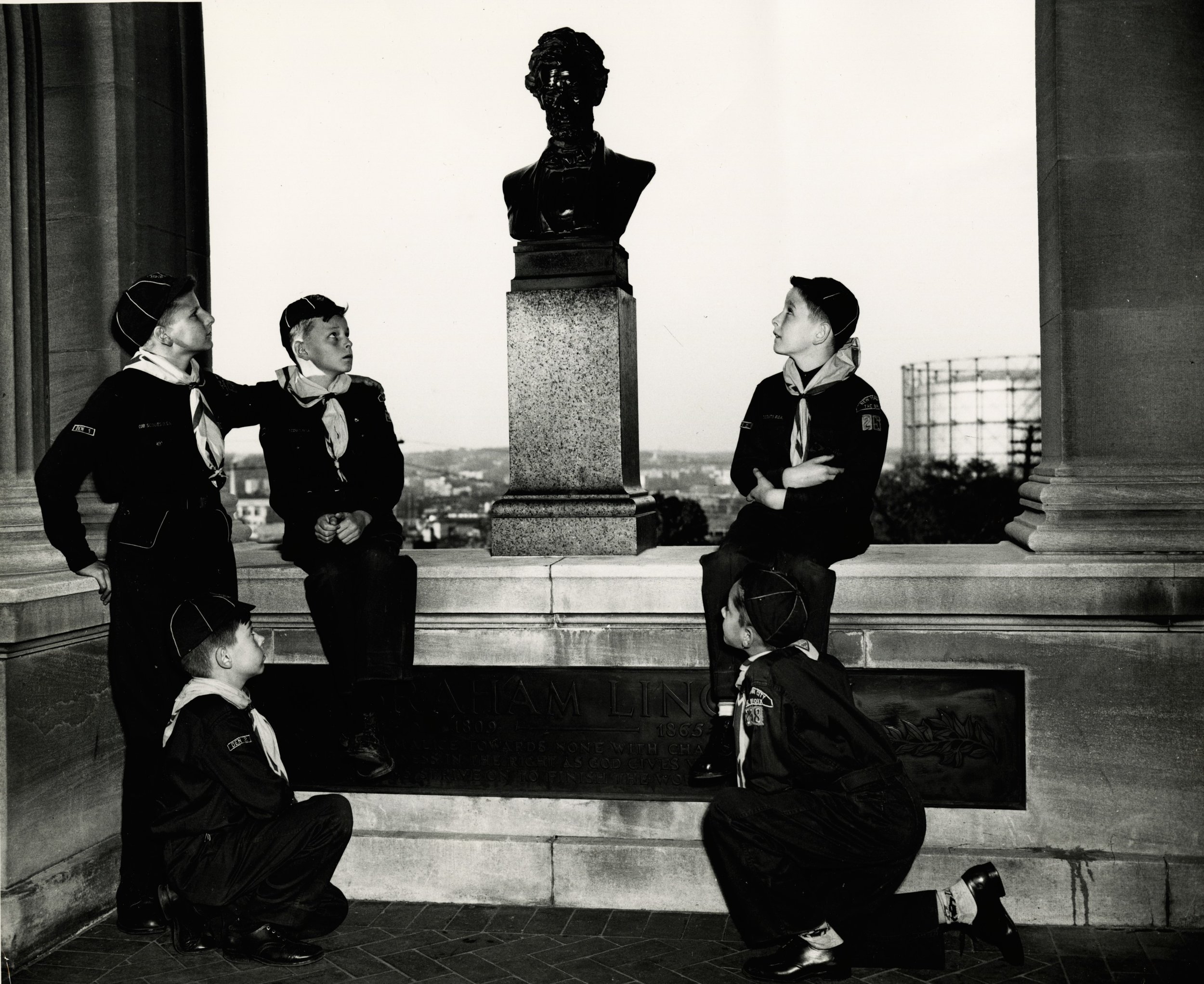
Boy scouts admire the bust of Abraham Lincoln in an undated photograph. 

Boy scouts admire the bust of Abraham Lincoln in an undated photograph. 

The Hall of Fame for Great Americans has never been a Confederate monument, or even a monument to Confederates. A relic of urban history, it is rather one of the city’s most remarkable memorials to beaux-arts design and turn-of-the-century aspiration, the shadow of one university and the responsibility of another, now nearly unknown beyond the students and faculty who keep it alive. Its defacement, however expedient or politically charged, is an alteration of a city landmark without review, or even public comment, as to its legality. Such intervention is also the latest affront in a half-century of neglect and abuse for a site that should be a focus of architectural and cultural acclaim.

The Hall of Fame for Great Americans records a time when cultural energy and grand form combined in the flowering of the Beaux Arts and the effervescent theater of its greatest interpreter, Stanford White. Driven by the city’s economic engine following the Civil War, two small downtown colleges nearly simultaneously sought to create ambitious new campuses uptown. Columbia looked to the heights of Morningside. New York University, meanwhile, captured the highest promontory of the Bronx, on a bluff above the Harlem River. The forty-acre estate of the nyu alumnus H. W. T. Mali, with sweeping views across northern Manhattan to the Palisades of New Jersey, was transformed into nyu’s new University Heights campus.

Stanford White’s Gould Memorial Library soon after its completion. Photo: New York University Archives

Stanford White’s Gould Memorial Library soon after its completion. Photo: New York University Archives

Both schools selected the firm of McKim, Mead & White to design their campuses. Each were anchored by libraries that spoke to the grandeur of the schools’ classical inheritance and their own academic ambitions. Unlike Columbia, however, New York University determined to maintain two academic centers. University Heights became its new uptown campus. Its older site, around Washington Square, remained in simultaneous operation. This arrangement continued for three-quarters of a century, until the university abandoned the Bronx and reconsolidated in 1973.

The creation of the University Heights campus was the initiative of Henry Mitchell MacCracken, a Presbyterian minister and writer who became the chancellor of nyu in 1891. MacCracken believed his move uptown “would fulfill more nearly the American ideal of college.” His vision for his school, and the role of art and architecture in his new campus, made him an active, if not altogether welcome, partner to its master architect, Stanford White.

Unlike Columbia’s uptown campus, which occupies a high plain, nyu’s University Heights campus terminates in a steep slope behind the site of its western anchor, Gould Memorial Library, a structure funded by Helen Miller Gould Shepard, the daughter of Jay Gould and herself an alumna of the University. Faced with the challenge of the site, White made the most of its topography and impressive views by designing a 630-foot terrace and colonnade, built atop a high, curving retaining wall that wrapped around the back of his new library.

It was MacCracken’s genius to turn this open-air promenade, with its classical columns and Guastavino-tiled ceiling, into a new institution, and a growing monument, dedicated to American achievement. Inspired by such predecessors as Munich’s “Ruhmeshalle,” Poets’ Corner in Westminster Abbey, the National Statuary Hall at the United States Capitol, and the Panthéon in Paris, he created America’s “Hall of Fame”—the original, and the one that has now led to countless others in sports and entertainment. MacCracken believed that not only statesmen, but also soldiers, jurists, writers, and artists should be honored together in this one American pantheon. He also created a mechanism for public engagement, with open nominations to be sent up to a blue-ribbon jury of one hundred electors. New “Hall of Famers” were to be added by majority vote every five years.

McKim, Mead & White original architectural plans for Gould Memorial Library. Photo: New York University Archives

McKim, Mead & White original architectural plans for Gould Memorial Library. Photo: New York University Archives

The Hall of Fame quickly caught the public’s imagination, with the election of new honorees becoming a sensational event. The initial selection began in 1900 and continued until the late 1970s and its era of national uncertainty. Each new addition was marked by a bronze tablet, created by Tiffany Studios and mounted to the wall of the promenade, which recorded the name, the date of birth, the date of death, and a notable quote. Funds were subsequently raised for the commissioning of each of the portrait busts, which have been designed by Daniel Chester French, Frederick MacMonnies, and Augustus Saint-Gaudens, among others. The busts were often dedicated decades after induction, as funding allowed. Franklin Delano Roosevelt, elected in 1973, was the last to receive one, with a bust by Jo Davidson dedicated in 1992. Louis D. Brandeis, Clara Barton, Luther Burbank, and Andrew Carnegie still await their own commemorative statuary.

The Hall of Fame may be just as notable for its idiosyncratic collection of Americans as it is for the busts on display. It speaks, in a unique way, to the figures of importance in America at the time of their election. Today there are still numerous familiar faces, from Daniel Chester French’s haunting image of Edgar Allan Poe to Augustus Saint-Gaudens’s downturned visage of Abraham Lincoln. Yet there are many Americans along this vaulted empyrean who are now far from household names. How about Hall of Famer Elias Howe, the inventor of the sewing machine (elected 1915)? Or Matthew Fontaine Maury, who charted ocean currents (1930)? Or Charlotte Saunders Cushman, Shakespearean actress (1915)? Or Phillips Brooks, who wrote “O Little Town of Bethlehem” (1910)? Any visit to the Hall of Fame is an education in American history and in American hagiography—and in American forgetfulness—with the names, quotes, dates, and busts all forming a unified whole.

It is within this context that the removal of Lee (1900) and Jackson (1955), and any notice of their long-time inclusion, speaks to a lessening of design and loss of a historical record. Figures in the Hall operate in visual dialogue not only with us but also with one another. Grant looked across the colonnade at Jackson, and Farragut at Lee. Both Confederate busts were underwritten by the Daughters of the Confederacy, like many of the country’s now controversial monuments, but their inclusion was regarded by the Hall’s Northern overseers as a nod to national unity—in 1900, just thirty-five years from the end of America’s bloodiest war. The busts may have indeed represented the very “values of diversity and inclusion . . . embracing difference” that today’s leadership says they offend. Now that they are gone, we no longer are able to interpret their historical meaning for ourselves.

The Rotunda of Gould Memorial Library. Photo: James Panero

The Rotunda of Gould Memorial Library. Photo: James Panero

The diminishment of the Hall of Fame for Great Americans undermines an ever greater architectural whole, one centered around White’s crowning masterpiece, Gould Memorial Library. Circling around it, the Hall of Fame represents the radiant American outcome of the timeless knowledge contained within. Architecturally, Gould Memorial Library also serves as a stunning counterpoint to the more grounded classicism of Columbia University’s Low Memorial Library, designed by White’s partner, Charles Follen McKim. Compared to McKim’s “architecture of weight and gravity,” writes Richard Guy Wilson in his history of their firm, White “remained tied to a pictorial vision of architecture, dazzling surface effects of light, texture, color, and ornament.”

The pedastal that formerly held the bust of “Stonewall” Jackson, soon after its removal. 

The pedastal that formerly held the bust of “Stonewall” Jackson, soon after its removal. 

Drawing on both the Pantheon in Rome and Thomas Jefferson’s Rotunda at the University of Virginia, White’s Gould Memorial Library opens in yellow Roman brick and an imposing east portico of six Corinthian columns. And like the original Pantheon, White gives little impression outside of the spaces within. Two monumental bronze doors (now a memorial to White himself, created as a tribute by his own artisans in the 1920s) lead onto a steep, barrel-vaulted internal staircase, through which White delays the reveal even more. When we finally arrive, the heart of Gould Library opens up as a dizzying, celestial golden rotunda, with a spiraling coffered dome originally illuminated by a large glass oculus (made larger at the insistence of MacCracken). Tiffany glass at one time added to the effect by shining dappled light in a kaleidoscope of colors onto the library collection, which once lined both the inside and outside of the rotunda walls. The names of great thinkers are imprinted in gold throughout, while hidden doors lead onto what was once classroom space for the school’s academic disciplines.

University Heights was already a diminished campus when New York University sold it in 1973 for what became Bronx Community College. nyu’s subsequent consolidation and self-enrichment built out the corpus for that school’s growth into the neoliberal empire it is today. Gould Memorial Library had already been decommissioned before the departure. The books had been removed to another building in a campus expansion, overseen by Marcel Breuer in the 1960s, that attempted a flat-footed jump from the Gilded Age to the Space Age. In contrast to nyu, it is important to say that Bronx Community College has worked diligently to maintain its Gilded Age patrimony, and it keeps its doors open to all visitors, every day and free of charge. In 2012, an even newer library, this one designed by Robert A. M. Stern, opened on the campus in a style that majestically engages White’s original vision.

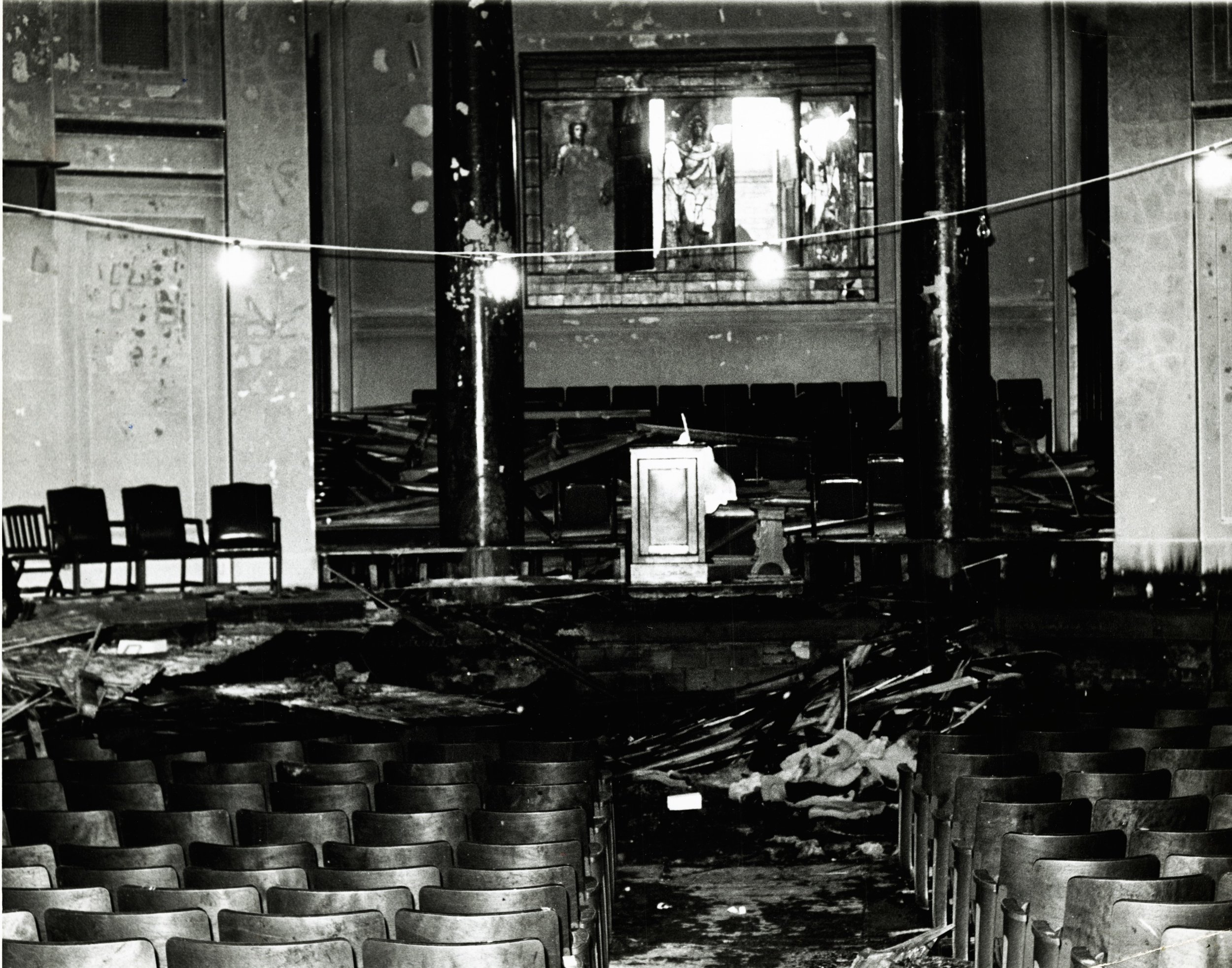
The auditorium of Gould Memorial Library in 1969, after being firebombed during student protests. Photo: New York University Archives

The auditorium of Gould Memorial Library in 1969, after being firebombed during student protests. Photo: New York University Archives

Why then intervene in a landmark campus by altering its statuary? The answer may be found in the basement auditorium of Gould Memorial Library. Directly below the rotunda, White created another domed space, again illuminated by Tiffany glass and a skylight that reached up through the rotunda floor. In 1969, as the campus was engulfed in protest, an arsonist threw a Molotov cocktail into this auditorium. The fire, which nearly burned down the entire library, fully destroyed its lower level and shattered its Tiffany glass on up to the oculus.

Half a century on, even before Bronx Community College could shuffle Lee and Jackson off to storage, vandals had already defaced the busts and tablets with paint. The specter of leftist violence still haunts University Heights. Radical unrest remains the ultimate threat to a campus that Bronx Community College has worked to preserve for over forty years. That such a complex could be so swiftly and unquestionably effaced must serve as a monument to our time. Its empty pedestals are now the memorials to our own iconoclasm.