Gallery Chronicle (October 2017)

THE NEW CRITERION, October 2017

Gallery Chronicle

On three exhibitions at Paul Kasmin Gallery, “Mel Kendrick: Woodblock Drawings” at David Nolan Gallery, “The Thing Unseen” at the New York Studio School Gallery, “Christopher Wilmarth” at Betty Cunningham Gallery, “Eric Brown: Punctuate” at Theodore:Art, “Brenda Goodman: In a New Space” at David&Schweitzer Contemporary, and “Meg Hitchcock: 10,000 Mantras” at Studio 10.

Following its summer aestivation, the New York gallery scene returned with strong openings all September. Galleries are the new museums—places where art can still speak for itself. But galleries are also a dying breed—dying not for our sins but our distractions. These days any gallery that finds a way to survive into another season seems like a triumph in adversity. Some still triumph mightily.

Consider the three-show, three-venue lineup at Chelsea’s Paul Kasmin, which continues through October. At the gallery’s 293 Tenth Avenue location, “Robert Motherwell: Early Paintings” examines the lesser-known, experimental abstractions of the artist’s pre-“Elegy” years.1 Around the corner at Kasmin’s 515 West Twenty-seventh Street venue, “Caro & Olitski: 1965–1968, Painted Sculptures and the Bennington Sprays” looks to the personal friendship and creative dialogue between sculptor and painter.2 And finally, up the block at the gallery’s 297 Tenth Avenue address, in “The Enormity of the Possible,” the independent curator Priscilla Vail Caldwell brings the first generation of American modernists together with some of the later Abstract Expressionists—Milton Avery, Oscar Bluemner, Charles Burchfield, Stuart Davis, John Marin, Elie Nadelman, and Helen Torr, among others, with Lee Krasner, Jackson Pollock, and Mark Rothko.3
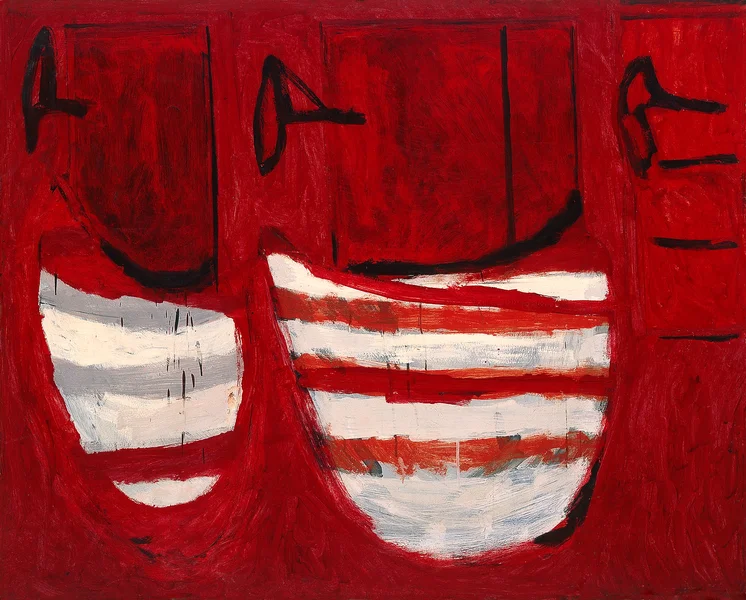
Robert Motherwell, The Hotel Corridor, 1950, Oil on masonite, Paul Kasmin Gallery

Robert Motherwell, The Hotel Corridor, 1950Oil on masonitePaul Kasmin Gallery

Judging from the examples in “Early Paintings,” Robert Motherwell displayed graphic confidence and innovative range from the very start. In the early 1940s, Motherwell was encouraged out of the classroom and into the studio by Meyer Schapiro, his doctoral advisor at Columbia University. He visited the painter Roberto Matta in Mexico City and, back in New York, saw Piet Mondrian’s first solo exhibition at the Valentine Gallery. Both were influential. By his mid-twenties, where this exhibition begins, a dual sense for narrative mood and pictorial space already infused his work, with geometry often concealing and imprisoning the forms underneath.

The Spanish Prison (Window), from 1943–44, explores the ominous undertones of abstract line and form, in a work that Motherwell later said was the first of his “Spanish Elegies.” The paintings that follow here, through the early 1950s, further distill this abstract mood, with formal structure evolving into ever-more-expressive deployments of color and paint-handling—the siren flash of Orange Personage (1947), the blood and bones of The Hotel Corridor (1950).

“Caro & Olitski: 1965–1968, Painted Sculptures and the Bennington Sprays” is a revelatory exhibition for the many resonances it finds between the British sculptor and the American painter, who each joined the art department of Vermont’s Bennington College in 1963.

Both artists famously explored the abstract potential of industrial tools and materials— Caro’s oxyacetylene welding equipment; Olitski’s spray guns. They also thought similarly of color and line, exploring not only new materials but also the new shapes they found in their painted and sculpted forms. The lines at the edges of Olitski’s paintings frame the airy voids of his sprays, while the welded metal of Caro’s sculptures traces out shapes in space. Their shared sense for seamless industrial texture, with Caro’s toothy enamels and Olitski’s cloud-like sprays, makes this a perfectly paired show.

Installation view of  “Caro & Olitski: 1965–1968, Painted Sculptures and the Bennington Sprays” at Paul Kasmin Gallery

Installation view of  “Caro & Olitski: 1965–1968, Painted Sculptures and the Bennington Sprays” at Paul Kasmin Gallery

There may be no greater joy than seeing the first generation of American modernists in Chelsea, where anything made before 1945 is pre-history, and the American modernists are the neglected Old Masters. “The Enormity of the Possible” gathers the best of them—the haunted forms of Elie Nadelman, the jazz syncopations of Stuart Davis, the moody mountainscapes of Milton Avery.

Charles Burchfield never painted a bad picture, and Lilacs No. 2 (ca. 1939–63) must rank among the best of them, as flowers, trees, and house all reveal animating forces in a living, breathing verdure.

Many of the individual works here sing, but as a whole the exhibition is overhung and overthought, taking on more than the storefront space might allow with a show that wants to spread out, and with fewer lines than one might wish drawn between the generations. The installation feels like the booth at an art fair, and perhaps in a way it is—a cubicle of American art history on display, for too short a time, on a corner of contemporary Chelsea.

Charles Burchfield, Lilacs No. 2, 1963, Watercolor on pieced paper, Paul Kasmin Gallery

Charles Burchfield, Lilacs No. 2, 1963Watercolor on pieced paperPaul Kasmin Gallery

Mel Kendrick has staked his career on exploring the positive and the negative in drawing, printmaking, photography, and sculpture. With the eye of a photographic plate, he finds the black in the white, the projection in the emulsion, the print in the press, and the shape in the void. Most known for his sculptures carved out of blocks that form their own pedestals, Kendrick has a varied studio practice that may find his stamps turned into sculptures turned into photographs, all in a flipping, tumbling performance of process and materials.

Now at Chelsea’s David Nolan Gallery, “Mel Kendrick: Woodblock Drawings” reassembles a series of large-scale woodblock prints created in 1992 and 1993 along with a single spidery wooden construction.4 What from far away resemble surrealist drawings are revealed, upon closer inspection, to be enormous paper sheets printed with equally enormous plywood stamps. Closer still and the manufacturing of these stamped objects becomes apparent, with the swirling jigsaw cuts and metal hardware, down to the Phillips-head screws, that must have held the stamps together. In the paper print of this wooden matrix, cuts become lines and woodgrain becomes shading, with the wood’s textural variations now transformed into the stark contrast of a black print on white paper. Kendrick calls these prints “drawings,” and in the silky lines of the woodgrain they draw out a startling impression.
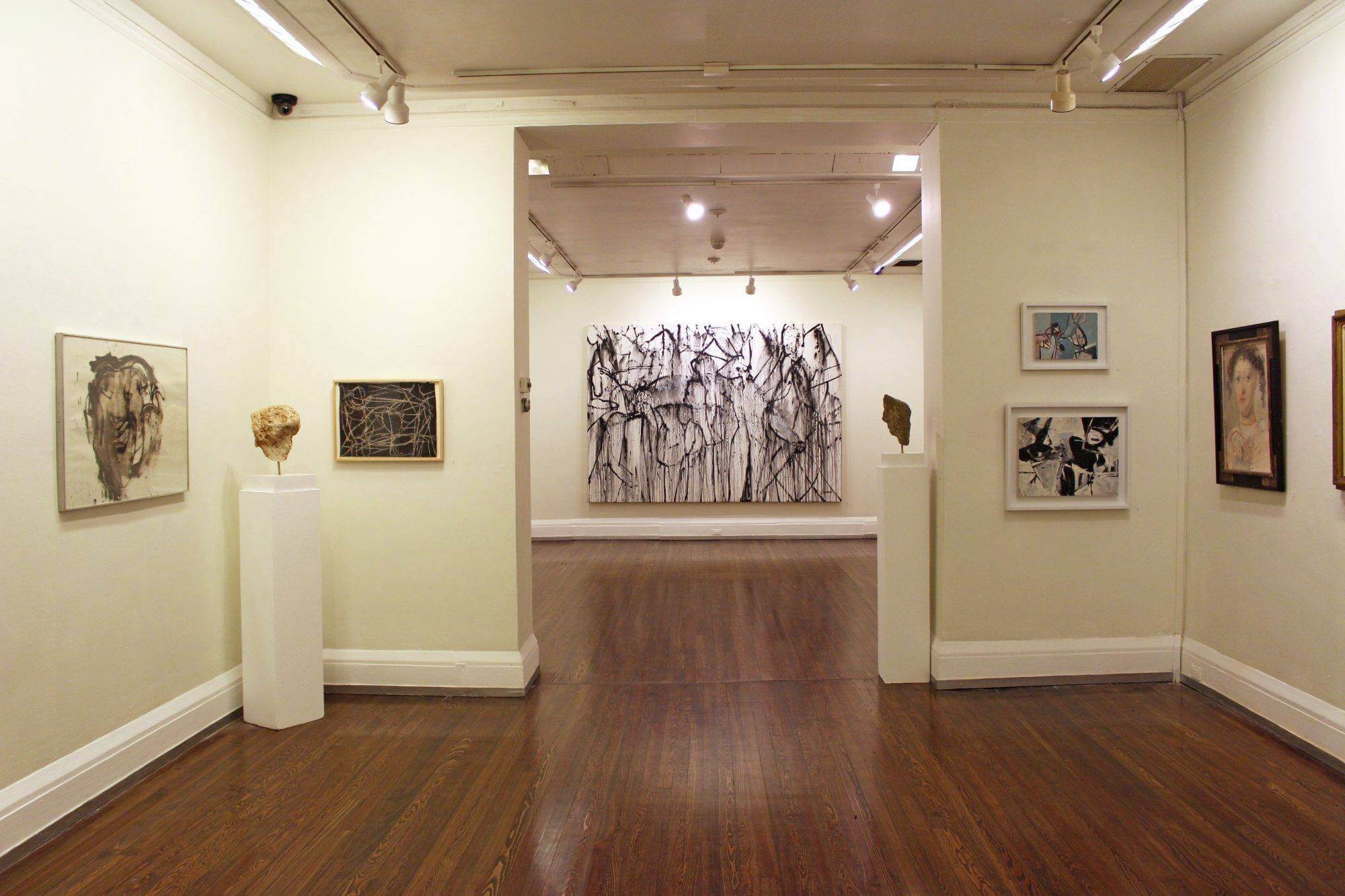
Installation view of “The Thing Unseen: A Centennial Celebration of Nicolas Carone.” Photo: the New York Studio School.

Installation view of “The Thing Unseen: A Centennial Celebration of Nicolas Carone.” Photo: the New York Studio School.

In his long and remarkably productive life, Nicolas Carone (1917–2010) worked through the full history of American modernism. In the 1940s and ’50s, as a young man he painted and sculpted on the cusp of modernist invention. In the 2000s, into his nineties, he created some of the most striking pictures of his career. This amazing range is now on display at the gallery of the New York Studio School, where he was a founding member of the faculty, in “The Thing Unseen: A Centennial Celebration of Nicolas Carone.”5

A classically trained artist who studied at age eleven in the Leonardo da Vinci Art School, the same atelier that Isamu Noguchi attended, which was created for New York’s working poor in Alphabet City, Carone went on to become a member of the first generation of Abstract Expressionists. Along the way Carone never gave up on the figure. His work oscillated between abstraction and figuration, drawing equally on the push–pull lessons of Hans Hofmann and the classical faces he found in Italy while painting there on a Fulbright after the war.
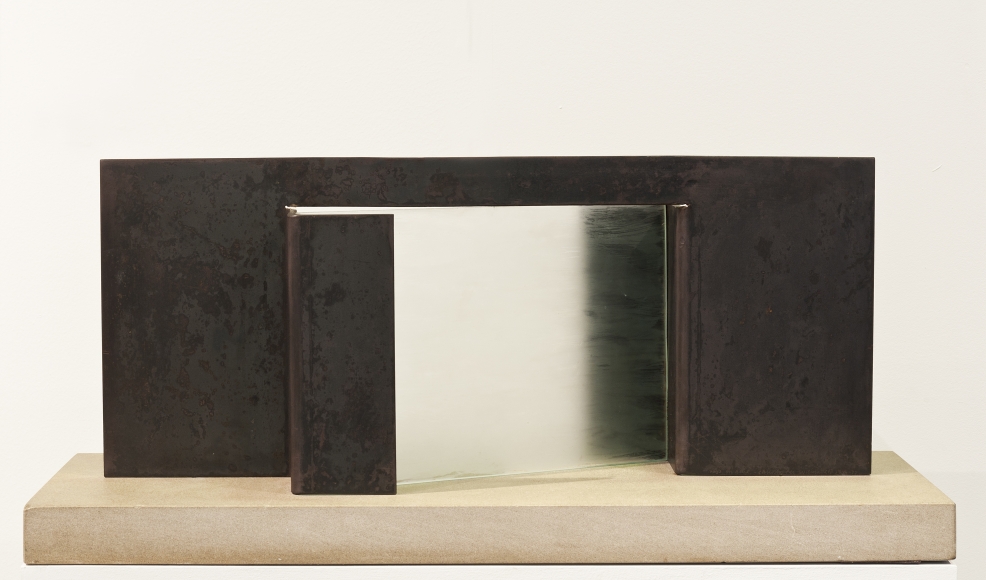
Christopher Wilmarth, Macquette for “Days on Blue”,  ca. 1974, Glass and steel, Betty Cunningham Gallery

Christopher Wilmarth, Macquette for “Days on Blue”,  ca. 1974Glass and steelBetty Cunningham Gallery

Curated by Ro Lohin, “The Thing Unseen” itself oscillates between periods and styles. The exhibition shows the breadth of Carone’s work while also revealing his non-linear progression, with classical charcoal studies and fragmentary portraiture mixed in among abstract lines and forms. Most arresting, and illuminating, are the large black-and-white paintings that face each other across the show’s two rooms. Shadow Dance and Sound of Blue Light are each aggressive confrontations of marks and drips—paintings that belong in major museums—in which fugitive figures emerge and disappear in an abstract fog. Separated by fifty years, these two paintings, from 2007 and 1957, remain unified in Carone’s timeless vision.

Don’t be surprised if you walk into Betty Cuningham’s Lower East Side gallery, looking for the sculptures of Christopher Wilmarth, and find Tibor de Nagy’s exhibition of Larry Rivers instead. I expect we will see much more consolidation of New York galleries—especially the best ones—as the serious business of art gives way to name brands and celebrity culture. Midtown’s historic Tibor de Nagy has now joined Betty Cuningham downtown to share resources on Rivington Street, alternating between Cuningham’s main gallery and the project space next door. It is here that we find Wilmarth (1943–1987), the minimalist sculptor of the maximal.6

It was Wilmarth’s great innovation to find the spiritual dimension in metal’s hard edge. In the 1970s, using etched glass, he filled the spaces of his metal sculptures with an ineffable, cloudy mist. Wilmarth set out to “make sculptures that evoke a spiritual disembodied state close to that of reverie; the kind of perfection that I have found during my ‘revelations’ or ‘epiphanies,’ ” as he said in 1980. In the early 1980s, inspired by seven poems by Mallarmé, in a translation by Frederick Morgan, Wilmarth furthered this exploration of glass and air in a series called “Breath.” The minimalist angles of the 1970s and the breath-filled curves of the 1980s are both on display at Cuningham in sculptural maquettes and works on paper. The artist’s suicide in 1987, at the age of forty-four, still haunts the show, as it does all of Wilmarth’s somber and emotive work.
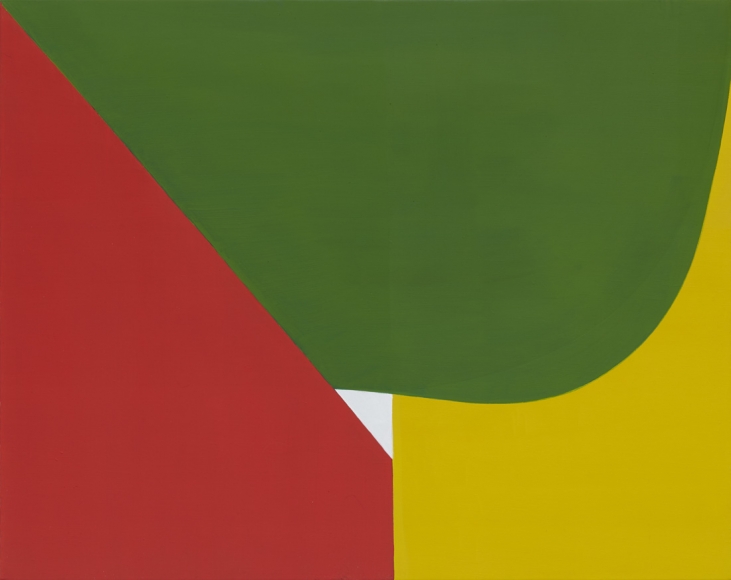
Eric Brown, White Triangle, 2017, Oil on linen, Theodore:Art

Eric Brown, White Triangle, 2017Oil on linenTheodore:Art

Finally, a word on Bushwick, Brooklyn. The neighborhood hosted its eleventh Open Studios weekend in late September. It also continues to display a vital energy in the face of Manhattan’s retrenchment. I suspect the fifteen-month shutdown of the L Train in 2019 may put an end to that, but for now the galleries of 56 Bogart Street alone, off the Morgan Street stop, continue to outdo themselves.

At Theodore:Art, Eric Brown, in “Punctuate,” examines the tension of figure and ground in paintings that are fun and funny—caprices of 1960s Color Field art.7 At David&Schweitzer, the esteemed Brenda Goodman finds expression in the working and reworking of her materials, with etched-over abstractions that read as psychological portraiture.8

Meg Hitchock, King of Prayers, 2017, Mixed media, Studio 10

Meg Hitchock, King of Prayers, 2017Mixed media, Studio 10

Meanwhile, in “10,000 Mantras,” at Studio 10, Meg Hitchcock continues to use collage as a meditative practice through the reformulation of cut letters taken from holy (and not-so-holy) books.9 Here, the flat shapes of earlier work give way to increasingly complex stacks of letters. Incense sticks are used to burn holes in grids, ten thousand at a time, increasing the dimensions of her works on paper. Undoubtedly, the moma crowd would prefer to see Dadaist nonsense in such recombinations, not spiritual yearning. But the intensity of the work speaks to the intensity of her pursuit. Here is art that is serious and unabashed, finding a way to exist.

1 “Robert Motherwell: Early Paintings” opened at Paul Kasmin Gallery, 293 Tenth Avenue, New York, on September 7 and remains on view through October 28, 2017.

2 “Caro & Olitski: 1965–1968, Painted Sculptures and the Bennington Sprays” opened at Paul Kasmin Gallery, 515 West 27th Street, New York, on September 7 and remains on view through October 25, 2017.

3 “The Enormity of the Possible” opened at Paul Kasmin Gallery, 297 Tenth Avenue, New York, on September 7 and remains on view through October 28, 2017.

4 “Mel Kendrick: Woodblock Drawings” opened at David Nolan Gallery, New York, on September 7 and remains on view through October 28, 2017.

5 “The Thing Unseen: A Centennial Celebration of Nicolas Carone” opened at the New York Studio School Gallery, New York, on September 5 and remains on view through October 15, 2017.

6 “Christopher Wilmarth” opened at Betty Cuningham Gallery, New York, on September 6 and remains on view through October 29, 2017.

7 “Eric Brown: Punctuate” opened at Theodore:Art, Brooklyn, on September 8 and remains on view through October 22, 2017.

8 “Brenda Goodman: In a New Space” opened at David&Schweitzer Contemporary, Brooklyn, on September 8 and remains on view through October 1, 2017.

9 “Meg Hitchcock: 10,000 Mantras” opened at Studio 10, Brooklyn, on September 8 and remains on view through October 8, 2017.

New Podcast: David Pryce-Jones on "Miłosz Among the Ruins"

David Pryce-Jones joins me to discuss "Miłosz Among the Ruins," David's essay from the September 2017 issue of The New Criterion.

David Pryce-Jones and James Panero discuss "Miłosz Among the Ruins," David's essay from the September 2017 issue of The New Criterion. https://www.newcriterion.com/issues/2017/9/milosz-among-the-ruins-8799

Death of Taste in Venice

THE NEW CRITERION, September 2017

Death of Taste in Venice

On the 2017 Venice Biennale and Damien Hirst’s “Treasures from the Wreck of the Unbelievable.” at the Palazzo Grassi, Venice.

“Ah, Venice! A magnificent city! A city full of irresistible attraction to the well-educated, both due to its history and its present charms!” So says the boatman at the start of Aschenbach’s ill-fated sojourn to the Most Serene Republic, “almost as if he feared the passenger might waver in his determination.” With its “putrid smells,” “febrile effusions,” and “revolting sultriness,” the Venice of Thomas Mann was “part fairy tale, part tourist trap, in the putrid atmosphere of which art used to blossom luxuriously.”

A century after Death in Venice, a city that was “ailing and kept it secret because of its lucre” presents the updated symptoms of the same malaise. Ephebic boys and cholera-infected strawberries give way to poisonous floodwaters and deadly selfie sticks. Two-thirds of the historic city’s residents have left, shrinking from a population of 175,000 in 1951 to 50,000 today. Meanwhile twenty million tourists descend on the lagoon each year. Some stay in one of the city’s 2,500 hotels, others rent out a vacated palazzo. But more than two million now come by the shipload. A plague of ocean-liners settles over La Serenissima, with little hope of containment in sight. The floating condos cruise past the Bridge of Sighs by the hundreds through the summer months, disgorging five-thousand “eat-and-flee” passengers per boat, each with bagged lunches destined for the piles of refuse whirling by the Campanile and the Palazzo Ducale.

In mid-June a protest group called “No Grandi Navi” organized a local referendum to close the lagoon to cruise ships. Out of 18,000 respondents, 98.7 percent voted in the affirmative. Yet the Venice Port Authority shows little interest in passing up the “lucre” of the cruisers: the taxes and port fees are too good to ignore.

Vota Si . . . per salvare Venezia: the desperate posters were plastered across Dorsoduro, the sestiere by the Peggy Guggenheim Collection where I stayed during the 2017 Venice Biennale.1 Just across the Accademia Bridge, somewhat contained from the flurry of San Marco, the neighborhood survives like much of Venice, the aging queen of the Adriatic, with small restaurants and pensioni sprinkled between the Grand Canal and the Zattere. On the final morning in my hotel, waiting for the water taxi to Aeroporto Marco Polo, I was surprised to learn that the quiet nonna clearing the continental breakfast was in fact the inn’s proprietor, a descendant of the palazzo’s seventeenth-century owner.

There are today many noble efforts to preserve the city’s culture, not least of them Save Venice, the nonprofit dedicated to Venice’s artistic treasures, which was hosting its “Gran Gala a Venezia” the week I was there. Frederick Ilchman, a brilliant curator at mfa Boston and the group’s chairman, tells me he is organizing a year of Tintoretto exhibitions in Venice starting in fall 2018, around the five-hundredth anniversary of the cinquecento artist’s birth.

Mark Bradford, Installation shot, “Tomorrow is Another Day,” 2017. Photo: Francesco Galli, © La Biennale di Venezia

Mark Bradford, Installation shot, “Tomorrow is Another Day,” 2017. Photo: Francesco Galli, © La Biennale di Venezia

Yet among the exhortations to save Venice, the city’s declining fortunes are themselves a point of fascination. The anachronism of Venice presents, in its own way, an “advanced” city, in the sense of being well advanced towards its own demise. Venice serves as an urban memento mori and a reflection of our own cultural decline.

Such decay was the recurring theme at this year’s Biennale. The national pavilions, spread across the Giardini, the park at the eastern tip of Venice, frequently become the subject as well as the site of various displays of creative, or not so creative, destruction. “Faust,” Anne Imhof’s installation at the German Pavilion, which won the Golden Lion for best national exhibit, may have been a sleek offering over the preview days, when lithe performers slithered around with dogs beneath a glass floor in Helmut Lang–like fashion. When I saw it, the pavilion’s dirtied-up walls did little, while a pack of dobermans, caged outside and on call for the duration of the run, already seemed bored by the show.

Mark Bradford, the artist representing the United States, arrived with much anticipation—perhaps too much anticipation, as The New York Times published photographs of his installation in advance of the public opening, which Bradford blasted in a public-relations kerfuffle as “bootleg . . . no one let me have a voice.”

Anne Imhof, “Faust,” 2017. Photo: Francesco Galli, © La Biennale di Venezia

Anne Imhof, “Faust,” 2017. Photo: Francesco Galli, © La Biennale di Venezia

Bradford must be the Horatio Alger story of South Los Angeles, an artist who went from styling hair in his mother’s salon to exhibiting at the mega-gallery Hauser & Wirth. A sharp abstractionist who embeds fraught meaning and found materials in his paintings, he produced an installation in Venice called “Tomorrow is Another Day” that ultimately seems overthought and underwhelming. One part of the pavilion he covered in torn advertisements, found in his neighborhood in Los Angeles, for predatory cellphone dealers. Another room he meant as commentary on aids. Meanwhile the building itself, a 1930 Palladian-style structure by Delano & Aldrich, has been deliberately roughed up, a stand-in for Monticello and the collapsing legacy of Thomas Jefferson—a harbinger of our current wave of national iconoclasm.

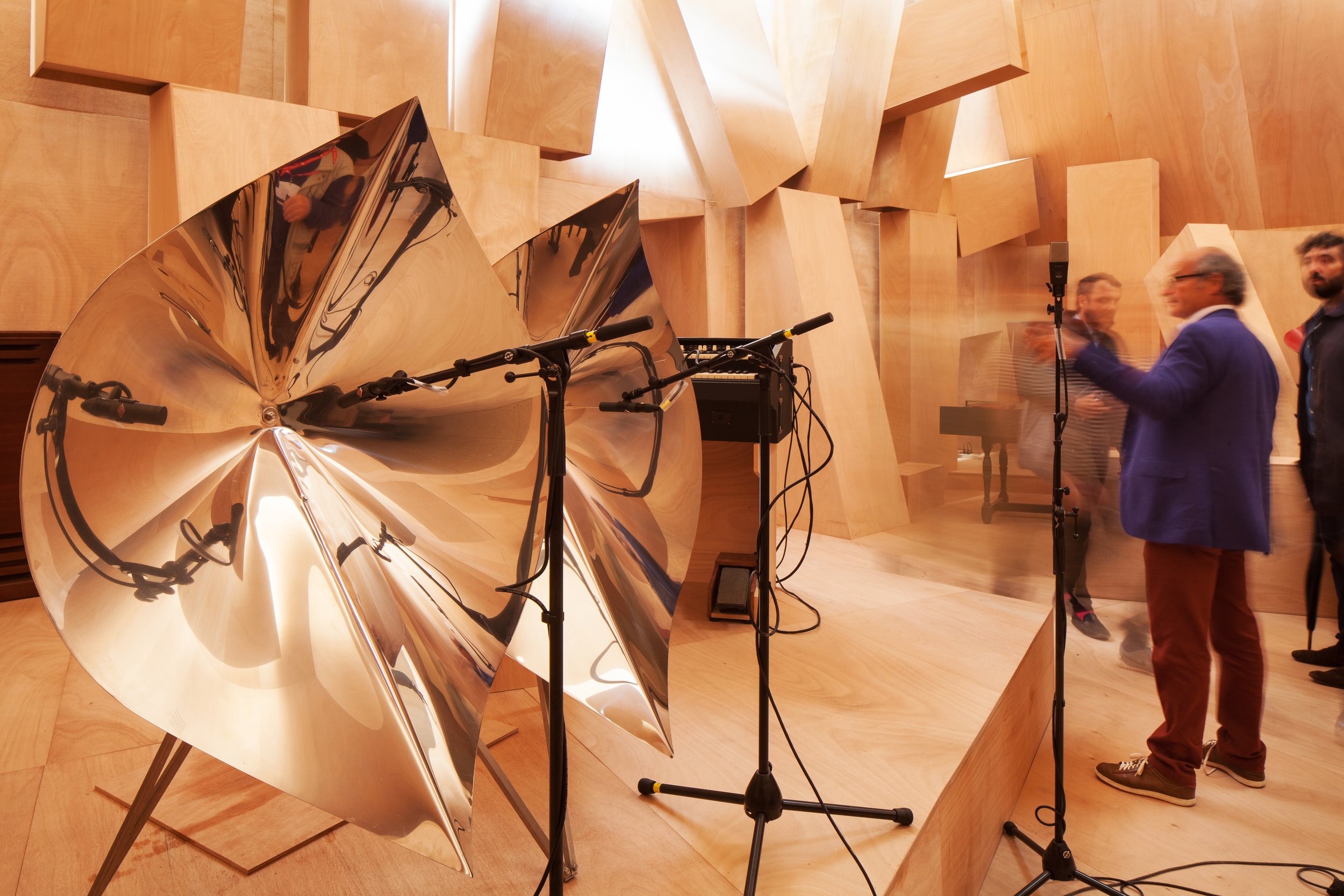
Elsewhere, sculpture still shows well in the visual din of the Biennale. Phyllida Barlow’s “folly” fills the British Pavilion with an overgrowth of organic forms. Carol Bove’s sleek modernism stands smartly at the Swiss Pavilion, even without the justifying commentary around women and national identity (which somehow involves Giacometti). Meanwhile the French continue to evince more charm and confidence than their Biennial neighbors. A decade ago it was the love letters of Sophie Calle. This year, for “Studio Venezia,” Xavier Veilhan transforms France’s national pavilion into a wood-paneled music hall, with angular walls and classical instruments that recall the Merzbau of Kurt Schwitters. Curated by Christian Marclay and Lionel Bovier, the pavilion hosts free performances throughout the run that enchant the remarkable interior in a work that should have been best in show.

But destruction rather than production is the Biennale’s dominant key. “Influenza: theatre of glowing darkness,” the installation by Kirstine Roepstorff, reimagines the Danish Pavilion as a verdant modernist ruin. Meanwhile Geoffrey Farmer blows the roof off the Canadian Pavilion with a malfunctioning fountain and other jeux d’eau, an installation with much humor and little subtlety.

Beyond the national pavilions, the invitational group show, usually the focus of the Biennale, with its acreage of space at the center of the Giardini and throughout the factory buildings of the Arsenale, is remarkable this year for its unremarkableness. Curated by Christine Macel of the Centre Pompidou, the show called “Viva Arte Viva” promised “a Biennale designed with artists, by artists, and for artists.” Back at the press launch in New York, the exhibit sounded like the welcome return of ars gratia artis. Yet even with 120 artists from fifty-one countries—and over a hundred of them new to the Biennale— Macel somehow managed to assemble a cross between a diffuse thesis exhibition and an academic conference with break-away sessions. Her section titles—“Pavilion of Artists and Books,” the “Pavilion of Time and Infinity”—only underscore the ponderousness of the glorified craft show.

Xavier Veilhan, Installation shot, “Studio Venezia,” 2017. Photo: Francesco Galli, © La Biennale di Venezia

Xavier Veilhan, Installation shot, “Studio Venezia,” 2017. Photo: Francesco Galli, © La Biennale di Venezia

Venice is a “place made sacred by buildings,” writes Roger Scruton—a wondrous man-made ecology in need of its own preservation. Many of us will lament its despoliation, but there are those who revel in its destruction. A decade ago I watched a horde of sportscar drivers revving their engines around the Piazzale Roma. Like the cruisers at the lower end of the economic spectrum, they come to Venice to get rather than give: to take home their selfies from San Marco; to take away the serenity of La Serenissima with the crack of their machines.

It must be against this background, of a death of taste in Venice, that Damien Hirst has decided to mount his comeback performance with an exhibition called “Treasures from the Wreck of the Unbelievable.”2 The show has been much derided, a £50 million flop underwritten by Hirst’s private fortune and the mega-collector François Pinault, whose “museums” now occupy two prime Venetian sites.

But in Hirst’s latest pratfall I see more than abject failure. Gucci, Yves Saint Laurent, Balenciaga, Alexander McQueen, Bottega Veneta, Boucheron, and Brioni are all divisions of Kering, Pinault’s luxury empire. Converse shoes, Samsonite luggage, Château Latour, the Vail Ski Resort, and Christie’s auction house are also variously under his control. And so is much of the contemporary art market. The Pinault Collection boasts of being “invested in supporting the work of contemporary artists.” Investment is right, as Hirst’s Venetian spectacle has been designed to produce a maximum of return—a billion dollars, it might be calculated, if this “museum” of Hirsts sells out.

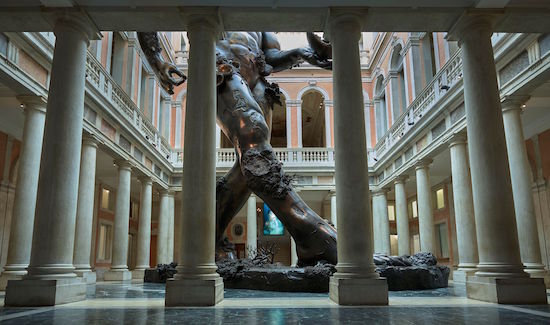
What impresses about “Treasures from the Wreck of the Unbelievable” is also what disturbs: its scale, its brazenness, its execution. Spread across two massive venues, Hirst has created, or rather had manufactured, a sumptuous suite of 189 “treasures,” supposedly salvaged from an ancient shipwreck. The exhibition begins with a mock underwater documentary of their rediscovery, perfectly executed in pbs-like tones. It continues with Demon with Bowl (Exhibition Enlargement), a sixty-foot colossus seamlessly inserted into the Palazzo Grassi’s atrium. This venue alone continues with twenty-three rooms of Hirst.

Damien Hirst, Demon with Bowl (Exhibition Enlargement), 2017, Bronze, Palazzo Grassi. Photo: Prudence Cuming Associates © Damien Hirst and Science Ltd. 

Damien Hirst, Demon with Bowl (Exhibition Enlargement), 2017, Bronze, Palazzo Grassi. Photo: Prudence Cuming Associates © Damien Hirst and Science Ltd. 

The work is purported to be sculptures from antiquity, from Greek and Roman through Far Eastern and Mesoamerican. All have been covered in some kind of encrustation, with tidy presentations of coral and cockle shells. An additional carapace of explanatory text surrounds the fraud: “It seems more likely that the figure served as a guardian to the home of an elite person,” we are told about the “Ancient Mesopotamian” demon.

And on and on, carried through to the former customs house of the Punta della Dogana, with five editions for each work exquisitely manufactured out of bronze, granite, silver, or gold. Thrown in the mix are models of the purportedly wrecked ship, “The Unbelievable” (get it?), works on paper of the treasures, as well as many anachronistic salvages: Walt Disney with Mickey Mouse, a toy “Transformer” robot, portrait busts of pop singers, and several references to Hirst’s own work, including a fragmentary sculpture of the artist himself.

Damien Hirst, Sphinx, 2017, Palazzo Grassi. Photo: Prudence Cuming Associates © Damien Hirst and Science Ltd.

Damien Hirst, Sphinx, 2017, Palazzo Grassi. Photo: Prudence Cuming Associates © Damien Hirst and Science Ltd.

Like Jeff Koons, his American corollary, or the Japanese artist Takashi Murakami, Hirst is nothing without the macroeconomics of contemporary art: the collaborations with the purveyors of luxury goods, the fetish finishes to sell the thin conceits, the consuming scale of the operations. Like the advent of cinema’s summer blockbuster, the results are all special effects with little true drama—an all-encompassing escape that becomes its own false reality. Here, in the town of Titian, among the genuine treasures of culture, Damien Hirst has furthered the decline of art into artifice with his fraudulent spectacle.

Just as Las Vegas now has a casino called The Venetian, with a pastiche of Renaissance monuments, Venice becomes a little more like Las Vegas, with its flood of modern effluvium.

1 The 2017 Venice Biennale opened on May 13 and remains on view through November 26, 2017.

2 “Treasures from the Wreck of the Unbelievable” opened at the Palazzo Grassi and the Punta della Dogana, Venice, on April 9 and remains on view through December 3, 2017.