Eric Gibson, art critic for The New Criterion and the Arts in Review editor of The Wall Street Journal, joins me to discuss the work of Alberto Giacometti.
Who will take the noise out of sport?

SPECTATOR USA, September 7, 2018
Who will take the noise out of sport?
I can’t hear myself watch
The US Open Tennis Championships concludes this week. ‘Let’s make some noise!’ Or better yet, let’s not.
Sport is losing its appeal to me: I can’t take the noise. Endless chatter obscures what we see on the courts and fields of play. A set of earplugs should not be required equipment of the game.
Like much else, the first mention of earplugs appears in The Odyssey. As Odysseus is lashed to the mast, his crew packs their own ears with beeswax to save them from the Siren’s Song. Whenever I attend an amplified event, I’m reminded that Homer was on to something about epic wax. As we do battle against the sirens of the street and the Siren Song of the culture, earplugs and other noise-cancelling devices have become a booming industry, worth half a billion dollars a year.
Good sound is essential to great sports. What is skiing without the schuss of the snow, or sailing without the snap of the wind? The martial crunch of football is underscored by the military precision of the halftime show. At its best, baseball is an organ recital — or, in humbler settings, nature’s symphony of summer — punctuated by the crack of a bat.
Contemporary sport gets lost in the noise. Good games are ruined by bad sounds. The 2010 World Cup was drowned out by the mind-numbing buzz of tens of thousands of vuvuzelas. These horns, emitting a deafening 113 decibels at a distance of six feet, were originally used to send signals between towns. Likewise the atonal timpani of indoor basketball, that acid jazz of squeaky sneakers, pealing whistles and pneumatic rubber, is increasingly lost amid the roars of the court and the brays of the announcers. Broadcasters now rely on spy-like microphones and electronic filters to isolate the true sounds of the game, but those in the stadium, and the players in particular, enjoy no such relief.
Tennis has always understood the importance of quiet play. That’s one reason for its continued appeal. Two years ago, the United States Tennis Association heard an earful when this code of silence was broken. The problem was the acoustics of the US Open’s reengineered centre court. When the Arthur Ashe Stadium opened in 1997 at the National Tennis Center in Flushing Meadows, Queens, it became the largest-capacity tennis stadium in the world.
Unfortunately, it was built on the swampy ground of a former salt-water marsh, the dump site that was the model for F. Scott Fitzgerald’s ‘Valley of Ashes’. The ground did not lend itself to building a fully enclosed stadium. The new stadium had no roof, and the storms of late summer had a nasty habit of disrupting play. In 2016, the USTA covered its centre court with a $150 million retractable canopy made of lightweight, translucent material. The new roof kept out the rain, but it also kept in the noise.
‘Fans inside Arthur Ashe Stadium no longer need umbrellas,’ read a report in the New York Times. ‘They might, however, need earplugs.’ The new roof was projecting the noise of spectators seated in the upper decks back onto the court. The pitter-patter of rain bouncing the roof’s diaphanous shell was also sending down cascading waves of sound, drowning out important sonic information in the game’s play — the timing of a bounce, the nature of the thwack of an opponent’s racket against the ball, the ever-informative grunts of the players.
The noise flummoxed the players, as well as the US Tennis Center, which had to bring in acousticians to study the problem. The situation also raised the alarm over the role of sound both for professional players and those of us who hope to enjoy the game. ‘We use our ears when we play,’ said the player Andy Murray. ‘If we played with our ears covered or with headphones on, it would be a big advantage if your opponent wasn’t wearing them.’
This year’s US Open is having a better encore performance. The culprit was indeed noisy fans — the fans inside the stadium’s air conditioning system. Along with some buzzing cellular transmitters, this humming rooftop equipment, bouncing off the new roof, was found to be the underlying cause of much of the additional courtside sound. Still, the US Open sounds a lot louder than it once did, even on TV.
Tennis plays out in a Cartesian space set apart from the chaos of life. Wimbledon is a classical concert performed in a stadium of near total silence; a word midpoint may get you ejected from the stands. Played among some 20,000 Americans, not to mention opinionated New Yorkers just a stone’s throw from LaGuardia Airport, the US Open has never quite sounded like Wimbledon’s contrapuntal fugue, but here the crowd’s abated potential can make the points all the more thrilling. ‘There’s that tension that everybody feels,’ says Venus Williams. ‘The more important the moment, that silence says it all.’
Williams has it right. Sport is a concert, and great sport needs its silence too. The noise-making of today’s games only adds to the din of modern life. But who can still the sounds of mass entertainment? New balls, please.
WSJ: Seeing Her Worldview in a Circle
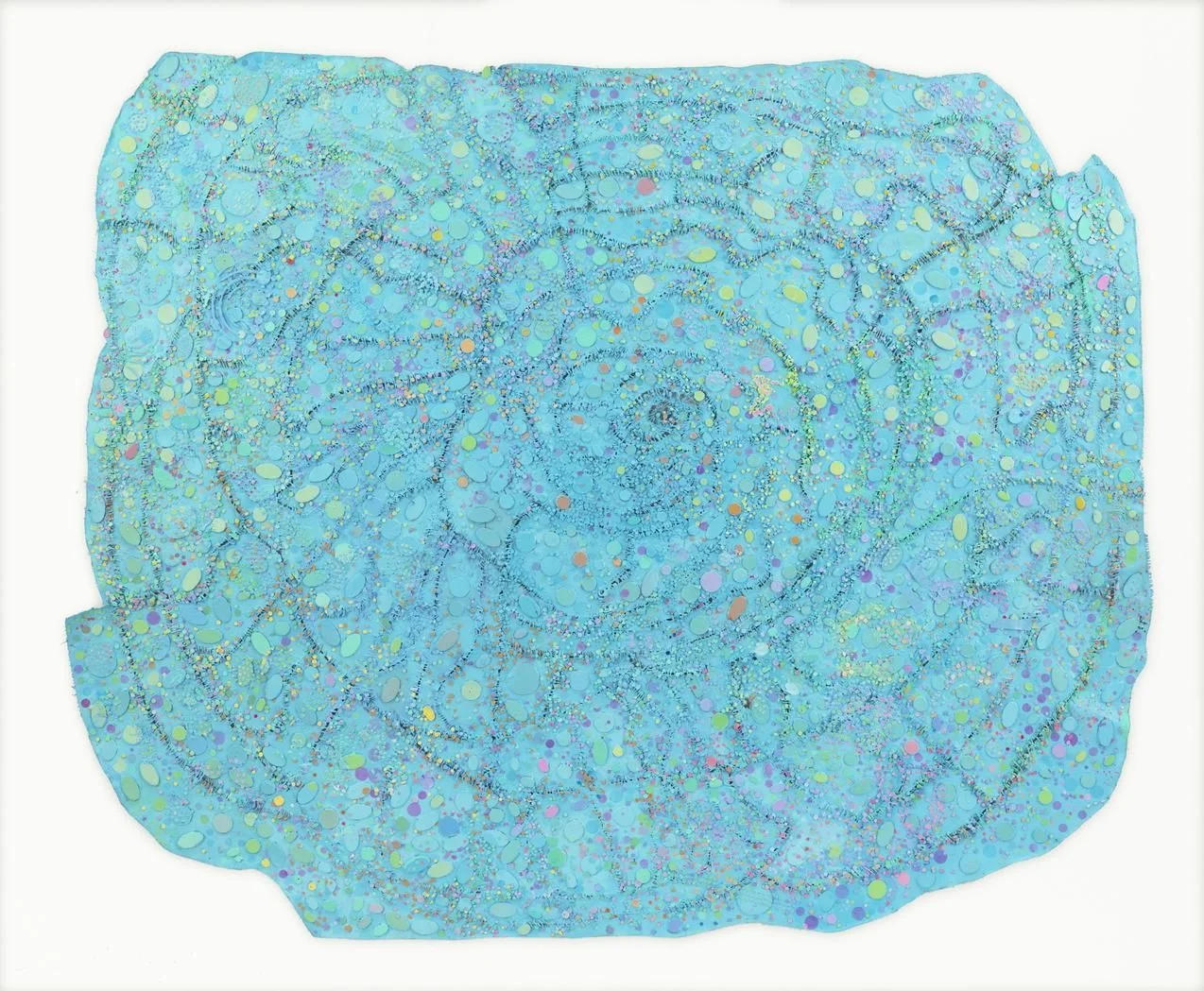
Howardena Pindell’s ‘Night Flight’ (2015-16) PHOTO: HOWARDENA PINDELL/GARTH GREENAN GALLERY, NEW YORK
THE WALL STREET JOURNAL, September 4, 2018
Seeing Her Worldview in a Circle
Howardena Pindell’s long career defies easy categorization, but a recurring motif connects a childhood memory to much of her work. A review of "Howardena Pindell: What Remains to Be Seen" at the Virginia Museum of Fine Arts, Richmond, Va. Through Nov. 25
The art of Howardena Pindell comes back around to the circle. In “What Remains to Be Seen,” her 100-work retrospective now on view at the Virginia Museum of Fine Arts, there are brushed circles, sprayed circles, and circles punched out of paper. There are paper disks, thousands of them numbered by hand, and the holes from which they were cut. And there are depictions of stars and planets—in her 40s, Ms. Pindell took up the study of astronomy: Orbs of color and light cluster together in dense, spiraling constellations of collage.
In her life, as in her work, Ms. Pindell resists the easy fit. As a black woman, in 1967, she became a pioneering graduate of the Yale School of Art. While continuing to paint, she joined New York’s Museum of Modern Art as its first black female curator. “We owe our vocation as career curators to the trail blazed by Pindell,” write this exhibition’s organizers, Valerie Cassel Oliver of the VMFA and Naomi Beckwith of the Museum of Contemporary Art Chicago, where the show originated. (On Jan. 24, 2019, the exhibition will open at Brandeis University’s Rose Art Museum in Waltham, Mass.)
With her wide-ranging style and broad use of materials, Ms. Pindell has long been a round peg in a square hole. Enigmatic at times, didactic at others, she is an innovative abstractionist who also works in photography and video.

Howardena Pindell’s ‘Untitled #5B (Krakatoa)’ (2007) PHOTO: HOWARDENA PINDELL/GARTH GREENAN GALLERY, NEW YORK
Ms. Pindell, now age 75, says the recurring motif of the circle, connecting much of her art, goes back to a childhood memory. While traveling with her father—a mathematician who influenced her own interest in statistics—she stopped at a root-beer stand and looked down at the red circle painted on the bottom of her mug. The symbol designated the mugs for use by blacks only. “I see that as the reason I have been obsessed with the circle,” Ms. Pindell recounts in the exhibition catalog, “using it in a way that would be positive instead of negative.”
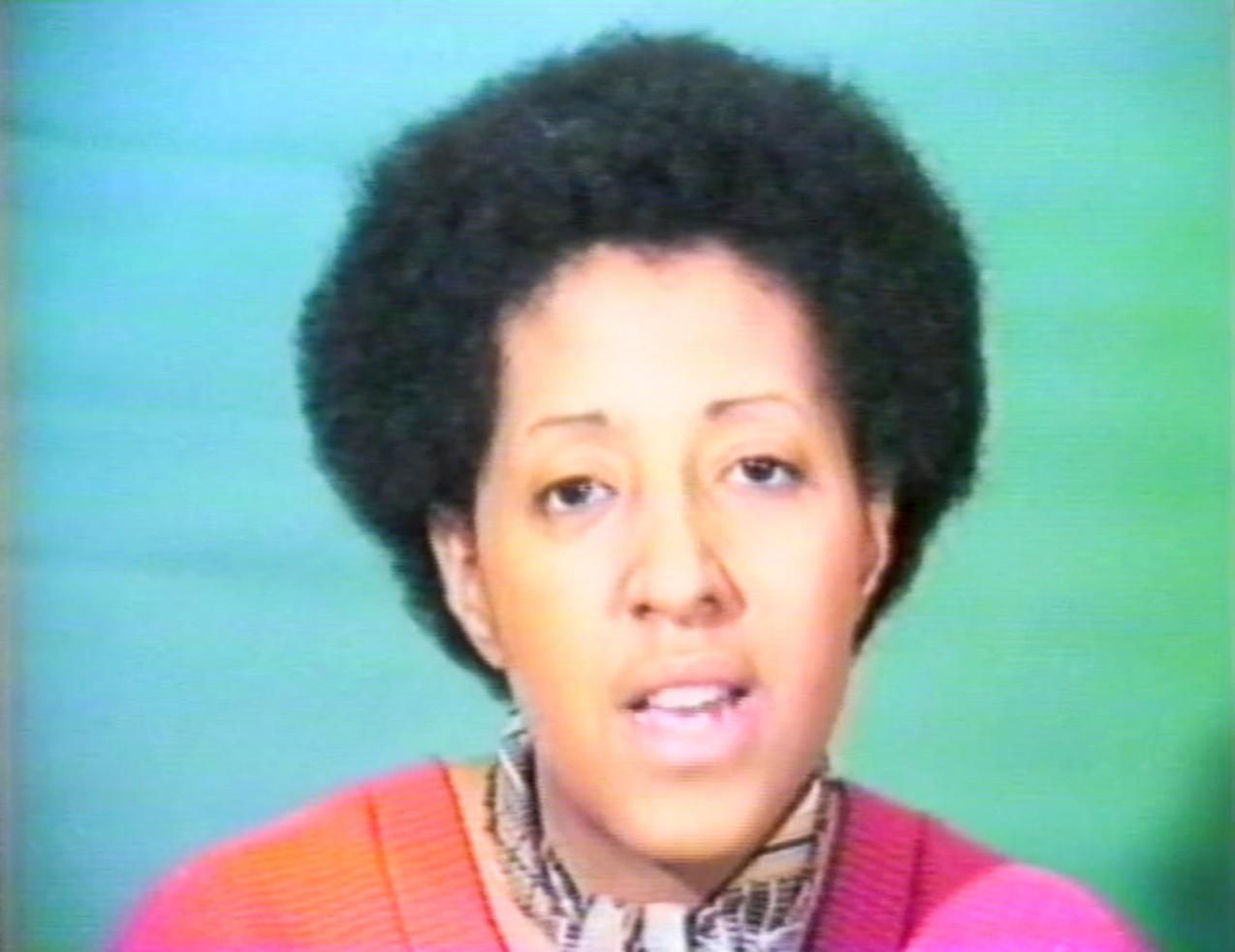
Howardena Pindell in her ‘Free, White and 21’ (1980) PHOTO: HOWARDENA PINDELL/GARTH GREENAN GALLERY, NEW YORK
In Richmond, where this exhibition is divided between two sections at opposite ends of the museum, the show opens in a gallery that follows Ms. Pindell’s circular developments on canvas. In her early paintings, such as “Space Frame” (1969), circles appear to orbit in square grids. By the early 1970s—for example in a canvas recently purchased by the VMFA—the circles have become dots, sprayed through the holes of handmade templates, while the hole-punches themselves reappear as dappled chads pasted on the canvas
surface.
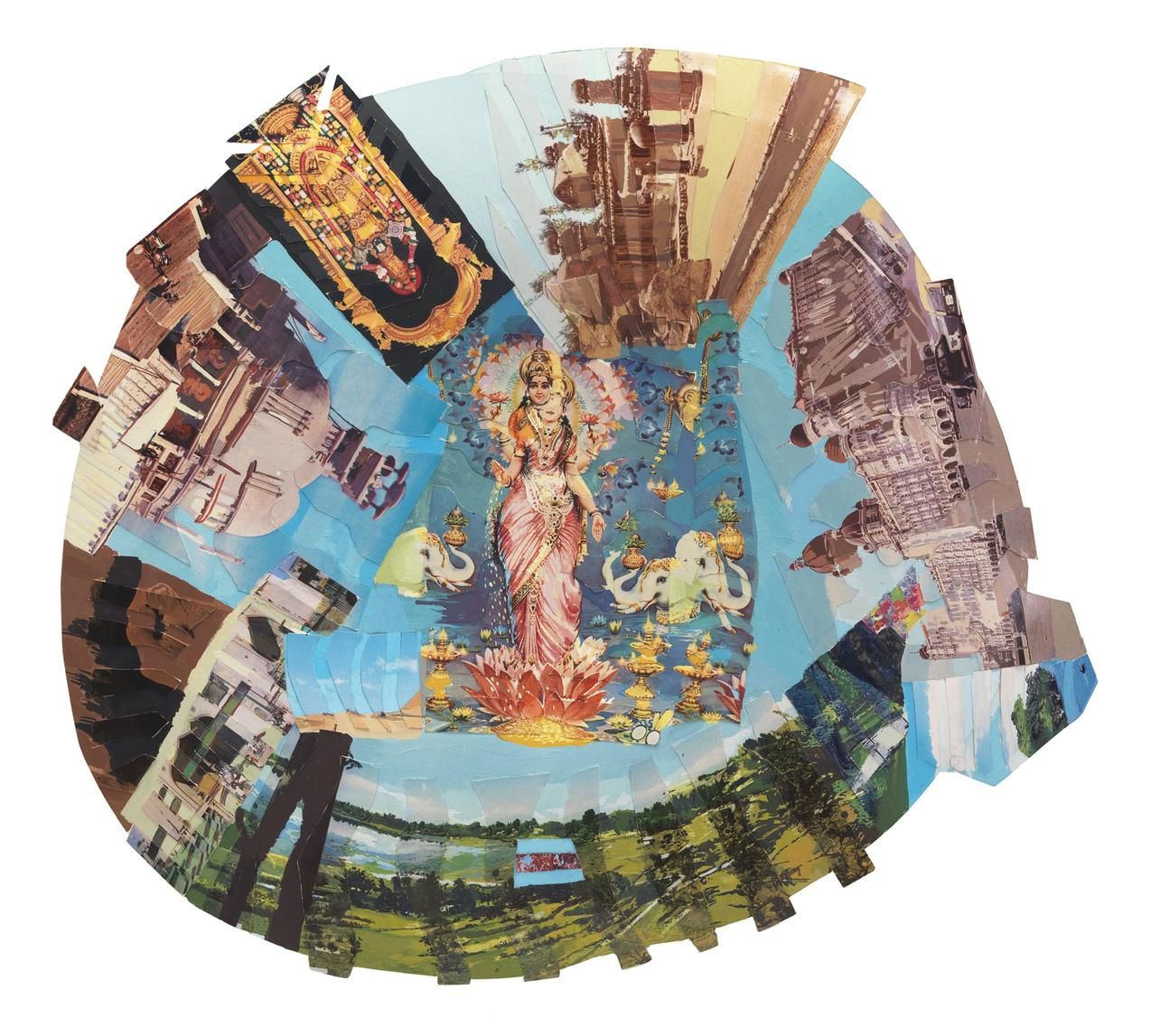
Howardena Pindell’s ‘Autobiography: India (Lakshmi)’ (1984) PHOTO: HOWARDENA PINDELL/GARTH GREENAN GALLERY, NEW YORK
In 1979, Ms. Pindell’s art pivots around two events: her departure from MoMA for a professorship at Stony Brook University, where she continues to teach today, and a serious car crash that affected her memory and sight. Politics, once sublimated in her abstractions, bubbles up to the surface. Words and images appear in her compositions with increasing stridency. Her canvases, now left unstretched, are cut up and stitched back together.

Howardena Pindell’s ‘Untitled #58’ (1974) PHOTO: JK BROWN AND ERIC DIEFENBACH, NEW YORK
While the first section of this exhibition displays Ms. Pindell’s range on canvas, the second shows her diversity of media. Here, works on paper are encrusted in shimmering material. Watercolor, gouache, crayon, ink, punched papers, spray adhesive, and thread may appear in a single composition. Collages made out of postcards from her many travels are cut into mesmerizing designs. Meanwhile, a suite of video work demonstrates the range of her art. In the mid-1970s, and again in 1988, Ms. Pindell took photographs of her television set, which she appended with cryptic notations on sheets of acetate adhered through static to the screen. “Free, White and 21,” a harrowing 12-minute video performance piece of 1980, speaks to her work’s confessional turn, as her biography became her subject matter.

Howardena Pindell’s ‘Space Frame’ (1969) PHOTO: HOWARDENA PINDELL/GARTH GREENAN GALLERY, NEW YORK
“Things cycle back around in Pindell’s work,” note the co-curators of this exhibition. While it may have complicated her career, her art’s nonlinear progression speaks to her aesthetic independence and suits the divided arrangement of this show. I could have used a trail of chads to connect the two sections, but a walk through the VMFA’s encyclopedic collection hints at the many sources of Ms. Pindell’s elliptical art, from Washington Color School painting to African textiles. As her latest works at one end of the museum—swirling abstractions such as “4C the Planets” (2007) and “Night Flight” (2015-16)—recall her earliest paintings at the other, we see her art come full circle.