David Yezzi, poetry editor of The New Criterion, joins me to discuss the 2019 poetry issue, followed by a reading by Nicholas Friedman, winner of the New Criterion Poetry Prize.
A Master’s Arrival
THE WALL STREET JOURNAL, March 26, 2019
The big, energetic, unwieldy paintings of Tintoretto come to Washington, spectacularly.
National Gallery of Art
Through July 7
You don’t forget the look of Tintoretto. I don’t mean the way his art appears, although with its surface energies and tumbling depths that too is hard to shake. What I mean is the way he looks at you.
In “Tintoretto: Artist of Renaissance Venice,” now at the National Gallery of Art, the artist locks eyes the moment you enter this celebration of the cinquecento Venetian painter. In his young “Self-Portrait” (c. 1546/47), Tintoretto looks back over his right shoulder as if he just turned to face your arrival. His black hair and raffish beard curl in the twisting movement. A raking light illuminates his right temple and furrowed brow. His expression challenges you with the same eyes that challenged the Venice of Titian nearly five centuries ago. It’s Tintoretto’s time now.
And what a time it is for this most Venetian of Venice’s 16th-century painters, a man who filled just about every local church and scuola, or confraternity, with his fevered vision. Last fall, Tintoretto exhibitions marking the 500th anniversary of his birth stretched from the Palazzo Ducale and Gallerie dell’Accademia in Venice to the Morgan Library and Metropolitan Museum of Art in New York. Now the attention converges on Washington. Three complementary Tintoretto exhibitions, focusing respectively on paintings, drawings and prints, have just opened at the National Gallery.

Tintoretto ‘Self-Portrait’ (c. 1546/47) PHOTO: THE PHILADELPHIA MUSEUM OF ART/A
John Marciari of the Morgan Library and Museum has organized “Drawing in Tintoretto’s Venice,” while Jonathan Bober of the National Gallery has assembled “Venetian Prints in the Time of Tintoretto.” Robert Echols, Tintoretto scholar, and Frederick Ilchman, chair of the Art of Europe department at the Museum of Fine Arts, Boston, are the curatorial team behind the painting exhibition, the first ever large retrospective of the artist in America. With nearly 50 canvases, it manages to communicate a comprehensive sense of the artist’s achievement despite the inevitable absence of such must-see works as his “Crucifixion” at the Scuola Grande di San Rocco in Venice.
It is all a sight to behold. Those eyes in the young “Self-Portrait” do not just announce Tintoretto’s arrival. They also acknowledge our presence in his journey to get here. Tintoretto’s paintings of Christian stories and mythological scenes are not the ideal visions we see in Michelangelo. They are not the elevated and perfected scenes we see in Titian. His achievement—through compositions that are big, energetic and unwieldy—was to break the fourth wall of Renaissance art. He brought narrative art down to the real world with figures that look, fly and flop out of his paintings into our own space. And through his fulminating brushwork, drawing in paint, his high-wire scenes dare us to look away.

Tintoretto’s ‘The Origin of the Milky Way’ (c. 1577/79) PHOTO: THE NATIONAL GALLERY, LONDON
Born in either 1518 or 1519, the son of a Venetian dyer (tintore), Jacopo Robusti, who called himself Tintoretto, ranked poorly against the sensuous Titian and his own unruly talents until his breakthrough composition of 1548, “The Miracle of the Slave.” This painting of St. Mark flying into the picture space as if from above and behind us announced the artist’s own arrival. This image of a Christian slave saved from a doubting mob remains at the Gallerie dell’Accademia. Reason to visit Venice after Washington.
The artist’s uneven early abilities, seen in such works in the opening galleries in Washington as his turbid “Conversion of St. Paul” (c. 1544), only deepen the mystery of how this breakthrough occurred. The whimsical “Venus and Mars Surprised by Vulcan” (c. 1545/46) hints at his developing sense for spatial dynamics. As Venus’s husband, Vulcan, searches for evidence of infidelity, only a barking dog (and you, the viewer) notices Mars hiding under the bed.

Tintoretto’s ‘Paradiso’ (modello) (c. 1583) PHOTO: MUSEO NACIONAL THYSSEN-BORNEMISZA, MADRID
As his paintings got bigger and the arrangement of his figures more complex, through experimentation Tintoretto grew even more aware of point of view. Rather than map out his depictions of space in the studio, he studied how the placement of his canvases and our own point of view affected light and perspective on site. In “St. Augustine Healing the Lame” (c. 1549-50), we seem to kneel on the road of crippled figures. In “St. George, St. Louis, and the Princess” (1552), the shiny armor reflects a revealing glimpse of the princess that is lost on St. Louis but that we as viewers do not fail to see.
Tintoretto’s style ranged as far and wide as his furious abilities could take him. In his devotional paintings he went for every blockbuster effect his brush could produce. Jean-Paul Sartre justly called him “the first film director.” His c. 1583 modello, or proposal drawing, for the 72-foot-wide “Paradiso” at the Palazzo Ducale is technicolor magic. In its immersive tableau his “Last Supper” of c. 1563/64 could be virtual reality. His mythological scenes, such as “The Origin of the Milky Way” (c. 1577/79) and “Tarquin and Lucretia” (c. 1578/80), are cinematic masterpieces. Meanwhile his portraits of Venetian contemporaries are sober revelations of character. “No painter ever had such breadth and such depth,” observed Henry James.
“Tintoretto” ends as it begins, bookended with his only other extant self-portrait. Manet called Tintoretto’s late “Self-Portrait” (c. 1588), with its flowing white beard and sunken face, “one of the most beautiful paintings in the world.” His eyes had seen it all. Tintoretto worked up to his death in 1594. After half a millennium, all eyes now turn to him.
Norman's Conquest
THE NEW CRITERION, March 2019
On the expansion of the Norton Museum of Art in West Palm Beach.
You might have expected the $100 million expansion of the Norton Museum of Art, in West Palm Beach, Florida, to go wrong. Just consider the backstory: An ambitious director (Hope Alswang) and an embarrassed trustee (Gil Maurer) come together to lament the state of their outmoded institution. They wonder aloud how their tired facility (a 1941 Art Deco pile encumbered with additions, now resembling a bankrupt shopping mall) could be “expanded and transformed in a dramatic way.” The trustee says to the director: If you could ask any architect to do this expanding and transforming, who would it be? The director gives the name of a starchitect at the center of the celestial firmament (Lord Norman Foster). The trustee responds: That starchitect happens to work in my building (they are meeting on the forty-third floor of New York’s Hearst Tower; Maurer is then the coo of the Hearst Corporation; Foster designed that building in 2006; and Foster + Partners maintains a New York office there). The trustee calls up the firm. An architect (Michael Wurzel, a partner at Foster + Partners) comes down. They begin to “muse about the possibilities.”
A story of museum musings that began on a winter day in New York in 2010 reached its conclusion on a winter day in Florida in 2019, when the Norton Museum of Art reopened to the public. You might have expected it to go wrong—and yet this expansion has gone surprisingly right. How it went right is a triumph for South Florida. It should serve as a lesson for museum planners everywhere. If today’s museums must grow, grow they must. The Norton checks all the boxes of a museum’s new-car mandates (new restaurant, new lounge, new shiny surfaces), yet it stays remarkably sensitive to art and to the history of the institution that has held the art in trust.
On approaching the Norton’s new entrance from the South Dixie Highway, as most everyone in car-centric West Palm now must do, the first growth you notice is not the museum but a tree. This is not just any tree. It is the tree. Known as “the banyan,” but in fact a ficus altissima, the six-story-tall tree is the focal point of the new west-wing façade. Photographs do not do justice to its outsize presence. Foster calls the tree his “protagonist.” Indeed, it drives much of the plot of the new design. Forty-three feet up, elevated on cloud-white blocks, an aluminum canopy extends forty-five feet over a new entrance plaza. The canopy is a sharp horizontal, made of reflective panels like an airplane wing. From afar, the form seems to cut across the middle of the sixty-five foot tree, a slashing antagonist in an architectural drama. Yet the protagonist wins out. The canopy pulls back at just the right places so that the hundred-twenty-foot-wide tree can continue to grow and spread above the new roofline.
Up close, outside the new museum entrance, the sculptural qualities of this massive tree are striking. The banyan is its own work of art, a dizzying abstraction above, a gothic mystery below, with multiple trunks that have grown out of the many “prop roots” sent down over decades by its own bending limbs. And rather than compete with the tree, up close the aluminum roofline works with it to extend the shade of the natural canopy, adding welcome relief from the Florida sun.

The banyan tree along the South Dixie Highway entrance to the Norton Museum of Art. Photo: Nigel Young.
The symbolism of this thriving tree is well appreciated by Foster. His architectural deference to its living history reveals something about his own approach to imposing new designs on living institutions—as he did successfully with Hearst Tower, which rises out of a 1928 base, and most famously with his additions to the Reichstag and the Great Court of the British Museum, completed in 1999 and 2000.
“The protagonist of the project was planted just before Ralph and Elizabeth Norton planted their seed,” he said at the museum reopening. The flourishing tree represents a flourishing institution in its increasing complexities. Rather than cut it down, the new design frames its growth for us to see. It protects rather than rejects history. It allows an organism to thrive through deep roots and existing branches. The challenge now of caring for the banyan reflects the challenge of caring for the museum. Since the tree’s failure would cause Foster’s design to fail, they are both closely interconnected. This is a fact not lost on the museum’s attentive arborists.
The plaza cleverly features another large sculptural form: Typewriter Eraser, Scale X(1999), by Claes Oldenburg and Coosje van Bruggen. This 2017 donation to the museum by one of its trustees, Ronnie Heyman, was sought out by Foster, and with good reason. With its upturned brush resembling the branches of a tree, the Oldenburg serves as a symbolic pendant to the banyan. While allowing for growth, Foster has had to do some judicious editing of the Norton’s existing structures. The Eraser happens to touch down next to a part of the building that had been one of those loquacious later additions. Edited down, while still providing upstairs gallery space, this wing now fits into Foster’s concise five-paragraph essay of architectural form.
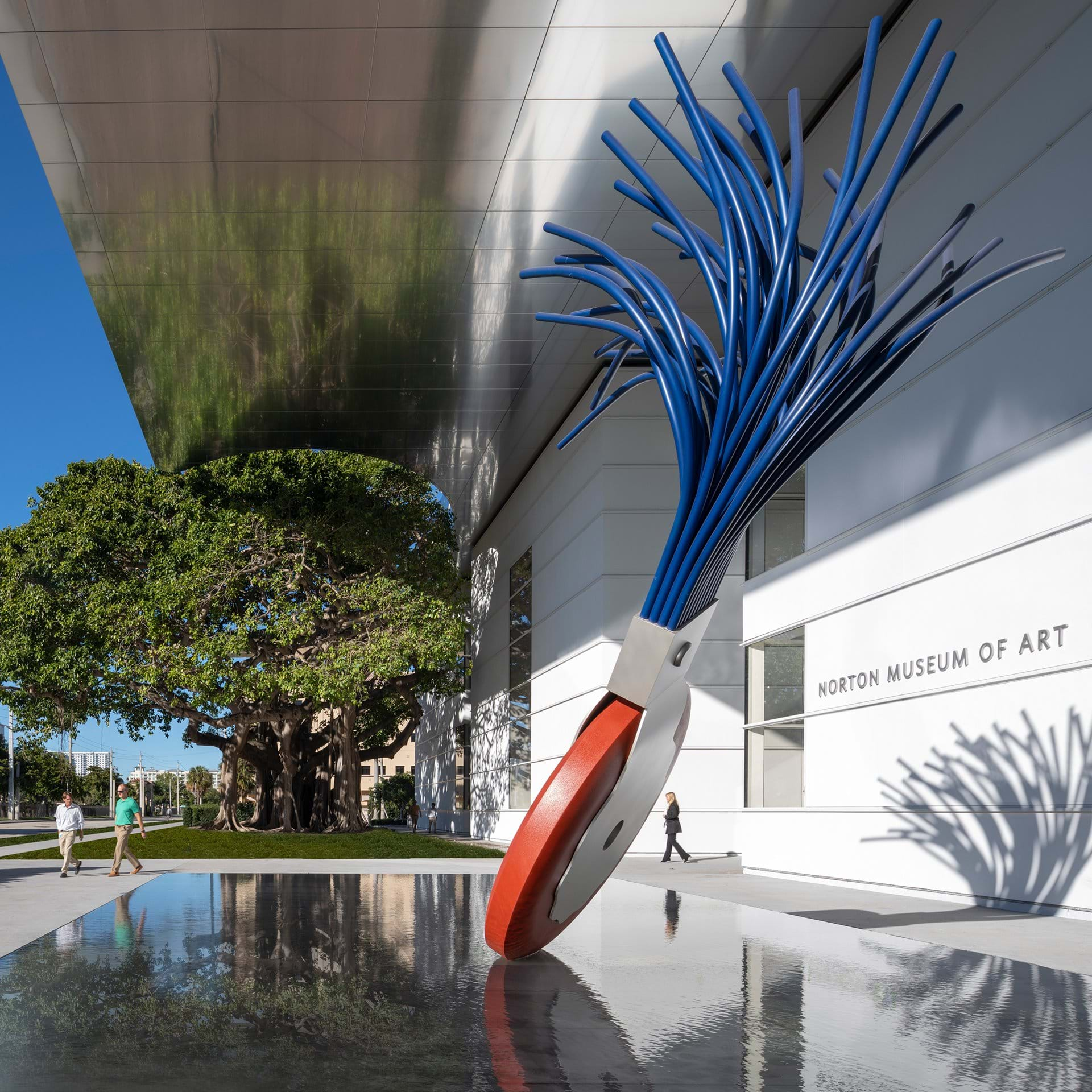
Typewriter Eraser, Scale X(1999) by Claes Oldenburg and Coosje van Bruggen (foreground) and the banyan tree in front of the Norton Museum of Art. Photo: Nigel Young.
A convincing seamlessness of old and new, living and man-made, has been achieved through an uncanny awareness of existing ties and a balance of existing structures. “It started with two people, Ralph and Elizabeth Norton, in 1941,” Foster said of the museum. All such projects should begin with an appreciation of an institution’s founders. Too few do. Here such respect for the couple who bequeathed their collection to the public trust, with its particular strengths in American and European modern painting and drawing, as well as Chinese art, ultimately informs the overall design.
Re-established as the center of the institution is the Norton’s original 1941 museum building, which, like the banyan, determines the shape and placement of the new entrance. Designed by Marion Sims Wyeth as an Art Deco pavilion surrounding a central courtyard, the building’s original symmetry and sight lines have been restored by cutting back the infelicitous additions from 1997 and 2003.
As Foster creates his new façade facing the banyan tree to the west, he preserves the original front façade to the east. He also restores the ground floor’s east–west axis after it was disrupted by the earlier expansions that turned the museum entrance to the south. Now someone standing outside the new building can see all the way through to the old front door and on to the shimmering Intracoastal Waterway beyond.
I only wish the acoustics of this new entry plaza were as appealing as its form. On the day I visited, the noise of the South Dixie Highway, combined with the screech of a nearby rail line, was deafening. It might be said that every contemporary building “learned from Las Vegas.” A structure must now not only shelter the individual on foot, but also flag down the passing motorist on the road—functions that are often in conflict. But what happens in Vegas should stay in Vegas. While Foster’s aluminum canopy protects the entrance from the sun, it also acts like a bandshell to concentrate street noise on the exposed plaza. While it might take away from the museum’s billboard qualities, additional screening between the highway and museum is in order.
Perhaps already understanding the need of an added buffer between outside and in, Foster brings the visitor into the new wing slightly off axis. A quick turn to the left after the ticket booth then brings you into a new Great Hall (as it is called) and back into alignment with the original museum. Every great building needs a “great hall”—a place to decompress from the outside and adjust to the expectations within. The Norton has dubbed this space its “living room.” In its tasteful modernist furniture and bleached tones, it might just double as a Knoll showroom. It is indeed a pleasant enough room to linger, if not to live in.

The Norton Museum of Art’s Great Hall. Photo: Foster + Partners.
At the same time, with its maximum square footage designed for maximum flexibility, the hall lacks intimacy. All that tasteful furniture is easily moveable so that this Great Hall can serve as a flex space for great donor cultivation. A white box with gray accents (someone said that Foster designs in “fifty shades of gray”), the Great Hall is also topped with an oculus that looks squinty. Round skylights call for round rooms, not rectilinear ones. I wish Foster had rolled the dice and gambled on an interior that was more daring than another white cube—one that might also reflect the octagonal shape of the original eastern entrance.
At least by adding this large new space, and fulfilling the museum’s new-car mandate, Foster could then restore and renew the many smaller adjoining galleries from the 1941 building. Of the museum’s 130,000 square feet, it is interesting to note that only about 10,000 of that are truly new. The preservation of older spaces allows for substantial “recycling,” as Foster says. The original 1941 hardwood floor, for example, has been brought back to life after being covered in decades of carpeting. The Art Deco entry also looks wonderfully preserved—although I wish outdoor access to the east were also restored so we could easily see the Norton’s two outdoor commissions by Paul Manship, which flank the original front door.
The preservation of historical space preserves “the memory of time,” Foster says. This is also how a museum overhauled by a world-famous architect can still come in at $100 million, while the price tag for a new wing at the Metropolitan Museum is slated to cost upwards of $600 million. The best spaces here are the ones that have been brought back to life from the original building, where gallery proportions and arrangements were designed to best complement the art on view. I was very glad to see highlights of the Nortons’ bequests of European art arrayed front and center in one of these galleries. Here Monet’s Gardens of the Villa Moreno, Bordighera (1884) and De Chirico’s Sailors’ Barracks (1914) are presented with works by Klee, Soutine, Picasso, Braque, and Brancusi—all donated by the Nortons—and supplemented with bequests by later donors. Other galleries display the Nortons’ gifts of paintings and drawings by the Ashcan painters and first-generation American modernists such as John Marin and Maurice Prendergast, along with Stuart Davis’s 1932 painting New York Mural, purchased through an acquisition fund established by Ralph Norton.
Taken together with the museum’s significant holdings in photography and Chinese art, you start to see that the Norton is not just a museum of art but a museum of significant art with an important core collection. Foster’s elegant and symbolic renovation brings that fact to the fore by allowing the museum to defer to this great art history.
There are already some signs, unfortunately, that the new museum may try to upstage its impressive historical collection with contemporary work. An ability to attract new donors and bigger crowds is the constant seduction of the contemporary Kunsthalle. The Norton could do better than its dopey wall-decal commissions by Pae White and Rob Wynne, for example, or Instagram-optimized art such as the promised gift of Sam Durant’s End White Supremacy (2008), which is better suited for woke selfies at Art Basel Miami Beach.
When everyone else wants art to shout, the Norton should seek art that sings in concert with its core collection and its harmonious building. As the Norton’s director Hope Alswang, who is retiring this month, rightly says of Foster + Partners: “They were not building a piece of sculpture. They were not building a monument. They were building a great art museum.”
It is indeed a great art museum, if you can keep it..