Conrad Black joins me from Toronto to discuss “Is America in Irreversible Decline?,” his lecture for The New Criterion and feature essay in the November 2021 issue of the magazine.
Hunter Biden, artist of modern life
The Spectator World Edition, October 2021
Hunter Biden, artist of modern life
Without vision, training or talent, Hunter Biden deigns to glue his crippling jewels onto the back of our society
Why do we keep hearing about Hunter Biden? Why is this disgraced political son and aspiring amateur pornographer now making art? Why must we even contemplate his creations? The reason is that much of our culture — at least its sanctioned, outward-facing elements — now operates ‘against nature’. I refer to that 1884 novel by the Symbolist author Joris-Karl Huysmans. À Rebours, known in English as Against Nature, is the book in which French literature dispensed with naturalism and its common-man struggles, and instead gave voice to the rot of the elite.
Before we dwell on Biden fils, let us briefly revisit Jean des Esseintes, the main character of Against Nature. He is the withered end of a once noble family. ‘Tortured by the present, disgusted with the past, terrified and desperate of the future’, des Esseintes retreats from Paris to live a life of aesthetic seclusion. He works best at doing little. He dabbles in perfumes. He grows poisonous flowers. He decorates the shell of a tortoise with so many jewels that the weight kills the animal. All the while, ‘it became perfectly clear to him that he could entertain no hope of finding in someone else the same aspirations and antipathies; no hope of linking up with a mind which, like his own, took pleasure in a life of studious decrepitude.’
It’s a Huysmans world out there. Des Esseintes would be right at home in this present moment. Our culture chastises the commoners, but it champions the decadence of our elites. For us, of course, aristocracy means a caste of celebrity, money and power. Quod licet Iovi, non licet bovi: what is permitted for Jupiter is not allowed for the ox. The noisomeness of the rot serves to remind the rest of us of what we cannot do.
That is precisely why we never stop hearing of Hunter Biden. The president’s 51-year-old son has been fulsome in his decrepitude and finds ever more depraved ways to express it. I cannot claim to have made a study of his decadence, but from what I gather, he luxuriates in foreign-influence money, through which he hires prostitutes, with whom he freebases cocaine in orgies, in which he records himself and them, whereupon he misplaces the files. And that’s just on Monday. The decadence of such a life would put des Esseintes to shame.
I would not mention such peccadilloes were they not central to this story and how Biden chooses to present himself to the world. Biden is an exhibitionist of his own wickedness. For oversharing his debasement, he is rewarded with glossy profiles, a Simon & Schuster book deal memorializing his decay, all that foreign-influence money, and the backing of those institutions, from the Secret Service to Twitter, that surround him. Quod licet Iovi…

The news that Hunter Biden has now taken up the brush aligns with the next chapter of his struggle Against Nature. His art-making has been written up more than once by the New York Times. That is twice more than most artists get and an easy tell of the elite press trolling the rest of us. ‘As an undiscovered artist, he is better situated than most,’ we read. You bet he is. We also learn that Biden lives in the ‘Hollywood Hills off Mulholland Drive, with a Porsche Panamera in the driveway, plenty of natural light and a pool house he has transformed into an art studio’.
Here in this lofty aerie, surrounded by red-tailed hawks, down the hill from David Hockney’s red barn, he creates work ranging from ‘photographic to mixed-media to abstract works on canvas, yupo paper, wood and metal’. His paraphernalia include a metal straw — not for drugs! Why would you think that? — through which he blows pigments across his compositions.
‘For me, painting is much more about kind of trying to bring forth what is, I think, the universal truth,’ he blabbers. The abstractions he creates, like the sentiments he conveys, are the stuff of dorm-room posters. ‘I don’t paint from emotion or feeling, which I think are both very ephemeral,’ he ponders. But of course it is all meant to be emotion and feeling, a look inside the mind of a Biden. Were it not, these creations would be little more than the illustrative tricks of a street artist.
More recently Biden has moved to mixed media and even more explicit images of himself. He starts with a distorted selfie — of which we have already seen plenty — and writes with gold ink around his dog tags and Rolex watch. He dilates on his dead brother Beau, his deceased mother and sister, his own travails: ‘I want to make it clear: I don’t see that tragic moment as necessarily resulting in behaviors that lent themselves to addiction. That would be a cop-out.’ These words are directly reproduced from his book, Beautiful Things, even down to the punctuation. Everything here is a self-portrait, all serving the scripted story of full disclosure. If Hunter Biden’s art belonged to a school, it would be post-exhibitionism.
This fall the Georges Bergès Gallery in New York will exhibit 15 of these masterpieces. I have never heard of the gallery, but the owner was once accused of assaulting a man with a knife. He pleaded no contest to making terrorist threats. ‘I was a kid; we all make mistakes,’ he explained. The gallerist is asking up to $500,000 per Biden. He promises an artist who ‘incorporates oil, acrylic, ink and the written word to create unique experiences that have become his signature’. Sales will be open to foreign nationals, and the gallery will ‘not share information about buyers or prospective buyers, including their identities’, according to White House press secretary Jen Psaki — all in the interest of full transparency.

A self-portrait by Hunter Biden. Credit...Hunter Biden and Georges Bergés Gallery
Critics of this White House rightly lambaste these dealings as an invitation to what, in more innocent times, we called ‘collusion’. But frankly, political corruption is de trop. Through his art, Biden promises a far more compelling prospect: cultural corruption. ‘No conflict, no interest’ has long been the mission statement of the art world. Biden has been in the vanguard of our public debauchery for decades. His designs, well illustrating his self-serving self-loathing, now place him squarely in the avant-garde of performative decadence. In a world that places exorbitant value on a floating basketball by Jeff Koons or a spin painting by Damien Hirst — in other words, on nonsense by nonentities — who is to say that Biden’s cloudsmoke effusions are not worth as much or even more?
‘All around him,’ Biden writes in one self-portrait, ‘beautiful things tangled colors cradled mercy made real rose up and he began again to write a new story.’ His turn to art, and the false profundity and faux-redemption he indulges in, are as irredeemable as the rest of this man’s privileged life. If his existence has a point, this is it. ‘His contempt for humanity grew fiercer, and at last he came to realize that the world is made up mostly of fools and scoundrels,’ Huysmans writes of des Esseintes.
Without vision, training or talent, Hunter Biden deigns to glue his crippling jewels onto the back of our society. We are the ones meant to be crushed under the weight of his self-regard. We may never plumb the depths of that infamous laptop, but we’ll always have Biden’s screensaver art, tinctured in freebase crackle.
Uncut Gems
THE NEW CRITERION, October 2021
On the new Allison and Roberto Mignone Halls of Gems and Minerals at the American Museum of Natural History, New York.
On the evening of October 29, 1964, a trio of beach boys sidled their white Cadillac up to the American Museum of Natural History. By the next morning, they had pulled off the biggest jewelry heist in U.S. history. Allan Kuhn, Roger Clark, and Jack Roland Murphy—a champion wave-rider known as “Murph the Surf”—had that rare combination of talents. By the time they targeted the museum, they were accomplished swimmers, aerialists, and burglars. Living in Miami, Murphy had helped popularize California surf culture on the East Coast. He had also used his aquatic skills to swim away from the many mansions he looted along the Intracoastal Waterway. Flush from these capers, the gang lived large in New York. They took up an expensive penthouse suite at an Upper West Side hotel as they patronized jazz clubs and passed around a copy of The Story of the Gems by Herbert P. Whitlock (who had been the curator of mineralogy at the museum from 1918 to 1941), all the while searching for targets. The museum’s J. P. Morgan Hall of Gems and Minerals, at the time an antiquated fourth-floor room of open windows and unalarmed cases, was an easy mark.

James A. Oliver, director of the Museum of Natural History, inspecting the case that held jewels stolen from the museum, 1964. Photo: Arthur Brower/The New York Times.
Scaling a fence at West Eighty-first Street, then an exterior staircase, then sidestepping along a hundred-foot-high ledge, at around 9 p.m. Kuhn and Murphy entered the fifth-floor office window of Colin Turnbull, a curator of African ethnology, who kept a harpsichord by his desk to play at lunchtime. As Clark stayed behind in the getaway car and communicated by walkie-talkie, Kuhn and Murphy timed the rounds of the museum guards. They then descended by rope through an open window into the Hall of Gems a floor below.
Through the gifts of J. P. Morgan and other Gilded Age benefactors, the collection of the American Museum of Natural History included some of the rarest gems in the world. Using a glass cutter, duct tape, and a hammer, the thieves took two dozen of the most valuable of them. Their haul included the 100-carat star ruby donated by Edith Haggin DeLong and the 116-carat Midnight Sapphire. They also carted away two engraved emeralds, two aquamarines, a number of uncut diamonds, and several bracelets, brooches, and rings. Their biggest prize was the Star of India, a 563-carat sapphire, the largest gem-quality star sapphire ever discovered, which had been donated by Morgan himself. After the two made their late-night escape, they brought their loot along in a bag to the Metropole Cafe in Midtown as they went to listen to Gene Krupa’s band.
Thanks to their high-flying lifestyle, the three were soon tracked down and apprehended, but not before fencing the jewels in Miami. A New York prosecutor named Maurice Nadjari made a deal with the thieves and escorted Kuhn from his New York jail cell as they tracked down the jewels in Florida. While the uncut Eagle Diamond was never found, the prosecutor remarkably recovered over half the goods. A friend of the museum paid a hefty ransom for the DeLong ruby. The Star of India eventually returned as the jewel in the crown of the museum’s collection. A 1975 film called Murph the Surf was made about the caper.

The Star of India (left), the DeLong Star Ruby (center), and the Midnight Sapphire (lower right), on view at the Allison and Roberto Mignone Halls of Gems and Minerals, The American Museum of Natural History. Photo: James Panero.
“These gems have life in them: their colors speak, say what words fail of,” George Eliot famously wrote of the power of jewels and the minerals that compose them. A decade after the robbery, in 1976, the museum sought to embed this jeweled allure in the new Harry Frank Guggenheim Hall of Minerals and Morgan Memorial Hall of Gems. Designed by Fred B. Bookhardt, Jr., of William F. Pedersen & Associates, this new combined exhibition hall filled a windowless cul-de-sac on the first floor of the museum. Replete with ramps, enclosed passages, and amphitheater seats, all covered in dark wall-to-wall carpeting, the design was praised at the time as “one of the largest and most ambitious exhibition halls the museum has yet attempted.” “I’ve been on many a mineralogical exploration,” said Vincent Manson, the curator of the hall, “and the atmosphere one feels in here is very much like that of going down into the earth to explore for minerals.”
“God sleeps in the minerals, awakens in plants, walks in animals, and thinks in man,” observed the nineteenth-century agriculturalist Arthur Young. Like some space-age mine dappled in prismatic light, the 1976 hall inspired more than a generation of museumgoers with its mysterious appeal. Its sensory approach epitomized a style of museum design that saw specimens elevated out of their cases into theatrical, immersive displays—a method pioneered by Carl Akeley fifty years before through his animal dioramas.
For this critic, first as a child and then adult, the 1976 hall was a favorite piece of museum culture. It was also a dated specimen that revealed more about the crystalline obsessions of the 1970s than the crystals themselves. For the latest generation of earth scientists who just want to tell the story of rocks, however, the hall had become a ridiculed romper room for the museum’s underage visitors. George E. Harlow, the museum’s curator for the physical sciences, says his staff called it “Nanny Hall.”

Amethyst geode on view at the Allison and Roberto Mignone Halls of Gems and Minerals, The American Museum of Natural History, New York. Photo: © AMNH.
Shuttered in October 2017, the Guggenheim and Morgan halls have been gutted and replaced, after some delays this past June, with the Allison and Roberto Mignone Halls of Gems and Minerals. Museum practices often swing like a pendulum. Curated by Harlow and designed by Ralph Appelbaum Associates along with Lauri Halderman of the museum’s exhibition department, the new hall blasts out any remnants of that indoor-outdoor carpeting. In its place it presents an open, 11,000-square-foot room of labels and display cases that more resembles the gem hall of 1964 than 1976. What the presentation loses in immersive appeal it makes up for in the miraculous forms it displays and the often interesting stories they tell.
The completion of the Allison and Roberto Mignone Halls of Gems and Minerals is but the first stage of a larger project to turn the unfinished western side of the museum facing Columbus Avenue into the Richard Gilder Center for Science, Education, and Innovation, a new wing designed by Jeanne Gang with exhibition spaces again by Ralph Appelbaum Associates. No longer a cul-de-sac, the Mignone Halls will eventually connect into this new space.
Rocks “are books,” claimed John McPhee, who wrote more than a few clunkers about them himself. “They have a different vocabulary, a different alphabet, but you learn how to read them.” While it is true that every rock tells a story, you don’t necessarily need to hear the story of every rock. The new halls of gems and minerals now tell many stories, certainly too many for a single viewing. A theory of evolution concerning not just animals and vegetables but also minerals has lately gained currency among geologists and now takes up much of the storytelling. “The diversity of minerals on our dynamic planet is directly connected to the evolution of life,” says Harlow—turning the “diversity” key even in the cylinder of this hard science. Fortunately, the presentation of these minerals and gems, aided by artful lighting and unobtrusive stands, nevertheless keeps the natural world mostly front and center. The information provided, about both their evolution and their discovery, also largely adds to their interest and appeal.
The new halls open with two amethyst geodes that, at nine- and twelve-feet tall, are among the largest on public display. New to the museum, these “giant geodes” from the Bolsa Mine in Artigas, Uruguay, began forming 135 million years ago. Gas escaping between the separating South American and African continental plates opened up cavities in the hardening magma like rising bread. Groundwater then flowed through the spaces, depositing silica that crystallized into quartz. Over millions of years, high energy radiation from the surrounding rocks turned the colorless quartz a deep purple. Out of the ground and no longer exposed to this radiant energy, the amethyst will slowly lose its purple hue.
It seems quite a fanciful story—Middle Earth stuff—but the crystals are there to prove otherwise. Interspersed among display cases are similarly captivating crystals in what the museum calls its new “crystal garden”: stibnite from China; a double-ended dravite from Australia; fluorite from Spain; beryls from the American Northeast; elbaite and fluorapophyllite from Brazil; rhodonite from New Jersey; labradorite from Madagascar; petrified redwood from Oregon; grape agate from Indonesia; and calcite, aragonite, and a massive block of blue azurite and green malachite known as the “Singing Stone” from Arizona. From rounded to prismatic, textured to smooth, red to green and creamy to black, the variety of colors and textures here reveal the great sculptural powers of the natural world.
While the display cases are now abundant, their dark appearance and the metallic armatures within (crafted in the same way as the supports for dinosaur bones three floors up) largely allow the stones to stay in the foreground. The smaller specimens are then grouped in ways that illustrate the stories of their creation and discovery. Some examples: the difference between simple and complex pegmatites; “the many colors of fluorite”; the hydrothermal environments of mineral development; “the fabulous tourmaline family”; how light affects the perception of minerals; “the Tin Islands and the Bronze Age in Europe”; the zinc deposits of New Jersey; the minerals employed in the modern world; “How Do We Use Different Salts?”; and the extensively excavated mineralogy of New York City. A wide-ranging selection of minerals from the “Copper Hills of Arizona,” all from mines around the town of Bisbee, reveals the remarkable forms of copper, gold, and silver buried below the Mule Mountains.
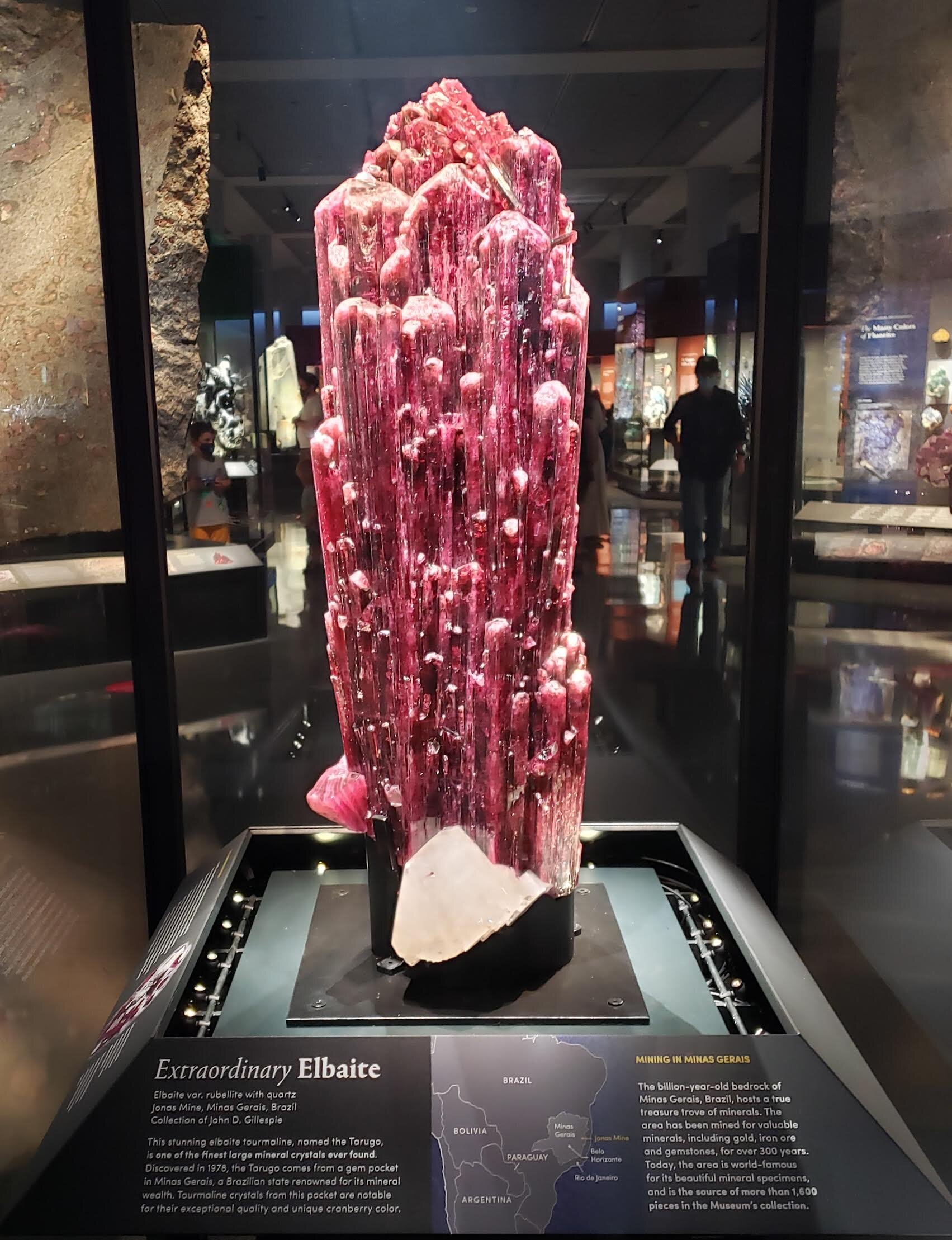
Elbaite on view at the Allison and Roberto Mignone Halls of Gems and Minerals, The American Museum of Natural History, New York. Photo: James Panero.
As a display for both minerals and gems (which are simply polished minerals), the new Mignone halls divide up the two in much the same way as the old Guggenheim–Morgan footprint. Alcoves along the right wall serve as specialty galleries. One small space reveals the fluorescence and phosphorescence of a stone slab from the Sterling Hill Mining Museum in Ogdensburg, New Jersey, that glows in ultraviolet light. Another serves as a temporary gallery, now used for an exhibition on “Beautiful Creatures: Jewelry Inspired by the Animal Kingdom.” The most sought-after space in the hall, this new gallery is just a half-step away from a Cartier showroom. Marion Fasel, the guest curator, is otherwise a commercial consultant with a “passion of telling jewelry and watch adventure stories,” according to her biography. This opening show’s connection to the specimens of flora and fauna elsewhere in the museum barely saves it from commercial oblivion as naturalistic pieces are divided in cases dedicated to mammal, insect, and aquatic forms. The stand-out examples are the pieces that bring out the concurrences of nature: in particular, Paula Crevoshay’s 2014 brooch of a Portuguese man o’ war, inspired by the resemblance of the 33-carat Mexican water opal at its center to the pneumatophore, or “float,” of that dreaded hydrozoan.
Between these two alcoves is the central, permanent showcase of gems, one that is surprisingly reserved in its display. One suspects that the designers of this gallery, unlike the special exhibition with its illuminated Fifth Avenue-like stands, wanted to undercut the sparkle of the spectacular. In deadpan fashion, wall-mounted displays present the museum’s rich collection of opal, topaz, garnet, quartz, ruby, emerald, sapphire, diamond, tourmaline, and other precious gems. Located in a standalone case in front of this alcove are those collection highlights that spent some unwanted time away from the museum back in 1964. For all of the stories told in this new hall, the tale of Murph the Surf is notably, but understandably, absent.