
THE NEW CRITERION, MARCH 2026
On The Winter Show, Sotheby’s “Masters Week,” Master Drawings New York & Viollet-le-Duc
You can correlate your barometer to The Winter Show. Whenever this annual antiques, art, and design fair appears for its weeklong run at the Park Avenue Armory, be assured a snowstorm is in the forecast. Its seventy-first season was no different.1 Fortunately, this storied fair still offers up some warmth for the cold spell.
Over the past few years, I have lamented the dilution of what had been known from 1955 until yesterday as the Winter Antiques Show (see my “Brown in town” in The New Criterion of March 2024). Founded by the folk-art dealers John Bihler and Henry Coger as a fundraiser for the East Side House Settlement, the fair has gradually moved away from what was once a focused exposition of American art and antiques to become more modern and international. The end result can now seem like a watered-down presentation of high-end curios, knickknacks, and anything-goes. As I noted two years ago, much like grandma’s cherished credenza, the word “antique” was even kicked to the snowbound curb and dropped from the fair’s title.
The organizers behind this deaccession are not entirely to blame. The market for Americana has been a central victim of our cultural amnesia and ritualistic self-loathing. For the afflicted, nothing must be quite so triggering as the chimes of grandpa’s grandfather clock. The best we might hope for in the younger set is that they toss some old gimcrack into their modern and contemporary mix.
Such was the notion behind this year’s “private study of an imaginary young collector.” The “immersive installation” (really, just another booth) curated by the art advisor Patrick Monahan presented a mash-up of works from twelve dealers that blended “objects across time periods and cultures—from Classical antiquities to contemporary ceramics.” Another such initiative was a display of “The American Chair: 250 Years of Form.” With eighteen chairs stacked in two three-by-three grids, from Shaker to Saarinen, the organizers were desperate to proclaim that diversity is our bench.
Fifty years ago, at the time of the U.S. bicentennial, interest in American art and antiques reached a high point. The same should be expected this year. Fortunately, at least some of the exhibitors at The Winter Show read the semiquincentennial memo. Elie Nadelman and Paul Manship, two exuberant American sculptors from the first half of the twentieth century, were front and center at Bernard Goldberg Fine Arts. Mixed in among Nadelman’s photographs and drawings, his Two Circus Women (ca. 1928–29), collected from the artist’s Riverdale estate, might have been familiar to balletgoers. The smooth, white-chocolate figures in papier-mâché and plaster, fused as though melted together in a giant pocket, served as a model for one of the two monumental enlargements made posthumously in Carrara marble to decorate the promenade of Lincoln Center’s New York State (David H. Koch) Theater. Meanwhile, Manship’s dynamic bronze Actaeon (transformed by Diana into a stag and pursued by his own hounds) and Manship’s storks and herons from the 1920s and ’30s remind us of the mythic range of this great sculptor beyond his Rockefeller Center Prometheus.
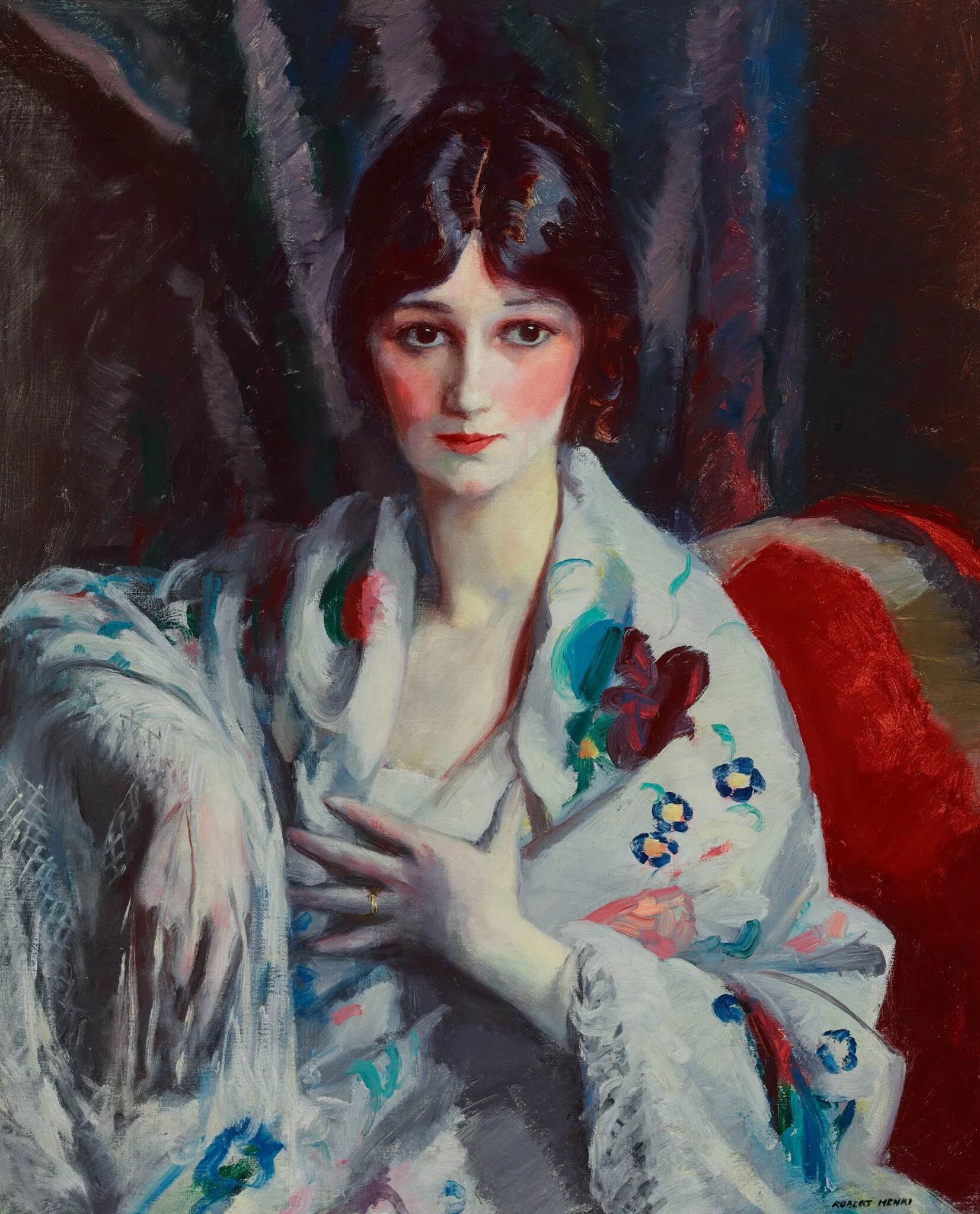
Robert Henri, Celestine, 1920, Oil on canvas, Avery Galleries.
Elsewhere a stoic bust of George Washington by the studio of Jean-Antoine Houdon watched over the Old Masters at Robert Simon Fine Art. There were several Americana Easter eggs decorating the displays at Hirschl & Adler. A smart presentation of “American Game Boards c. 1890–1940” revealed the modernist sensibilities behind checkers and parcheesi. Debra Force Fine Art featured Richmond Barthé’s dynamic figure Inner Music (ca. 1956) next to Milton Avery’s limpid watercolor portrait Artist by the Sea (1945). Jeffrey Tillou Antiques presented Anna Vaughn Hyatt Huntington’s Yawning Tiger (cast ca. 1917) alongside Murdoc Indian dolls from Northeastern California (ca. 1860–75). Meanwhile, portraits by Robert Henri adorned more than one booth; Henri’s Celestine (1920) at Avery Galleries was a highlight.
With an extra-long run—a notorious marathon for exhibitors—The Winter Show straddles the timing of the American-art auctions and the Old Master sales. This year, Sotheby’s brought its “Masters Week” auctions from York Avenue to Madison and its new headquarters at the old Whitney.
Last fall, for its inaugural sales at the venue, I was among the cast of thousands that flocked to the opening of Sotheby’s Breuer showroom. With lines wrapping around to Park Avenue, the new location certainly succeeded in bringing the auction season to the city’s broader consciousness. As a showcase venue with significantly less square footage than Sotheby’s former factory floors on York Avenue, however, the opening display also revealed the squeeze of the new site.
“For things to remain the same, everything must change,” wrote Giuseppe Tomasi di Lampedusa in his 1958 novel The Leopard. The same goes for today’s art market. With offices now offsite, Sotheby’s staff can no longer float between desk and showroom. Gallery walls must be torn out overnight to create the auction floor. Due to space constraints, minor works up for auction might be demoted to display at the York Avenue offices—a scarlet letter for sales that art advisors now try to preclude in their contracts. And even with these many contingencies, Sotheby’s Breuer still felt overstuffed. Ample room might have been cleared out for the top-line Lauder sales, but lesser works were packed floor to ceiling in a warren of tight passageways amid the building’s increasingly cramped upper floors.
With expectations diminished, however, I was surprised how well the 2026 “Masters Week” went off at the Breuer last month.2 The auction house must have learned a lesson or two from the fall. Works on paper, which I expected to be relegated to the Breuer attic, appeared lower down in prime real estate. Smaller works were still arranged salon-style but now in intelligent groupings, which helped to demonstrate how collections hang together. The presentation overall lived up to the promise of bringing the auction house from bedpan alley to a block from Museum Mile. Here is a new venue with ready access to significant work in constant rotation on free display—and free, moreover, of the turgid mandates of the museum world. It can even be yours, if the price is right.
Sotheby’s pegged this “Masters Week” to a few showstoppers: Antonello da Messina’s lachrymose double-sided Ecce Homo; Saint Jerome in Penitence (ca. 1460–65); a remarkably modern-looking Mummy Portrait of a Man from Roman Egypt (ca. late first century A.D.); Jean-Honoré Fragonard’s expressive Head of a Bearded Man (ca. 1770); and Rembrandt’s Young Lion Resting (ca. 1638–42), a small work on paper billed as “the most important drawing by the artist to appear at auction in half a century.” That final work came from the Leiden Collection, which Karen Wilkin covered in these pages in December. The collector Thomas S. Kaplan had put the piece up for auction to benefit Panthera, his nonprofit dedicated to the conservation of wild cats (with an auction-house estimate of fifteen to twenty million dollars).
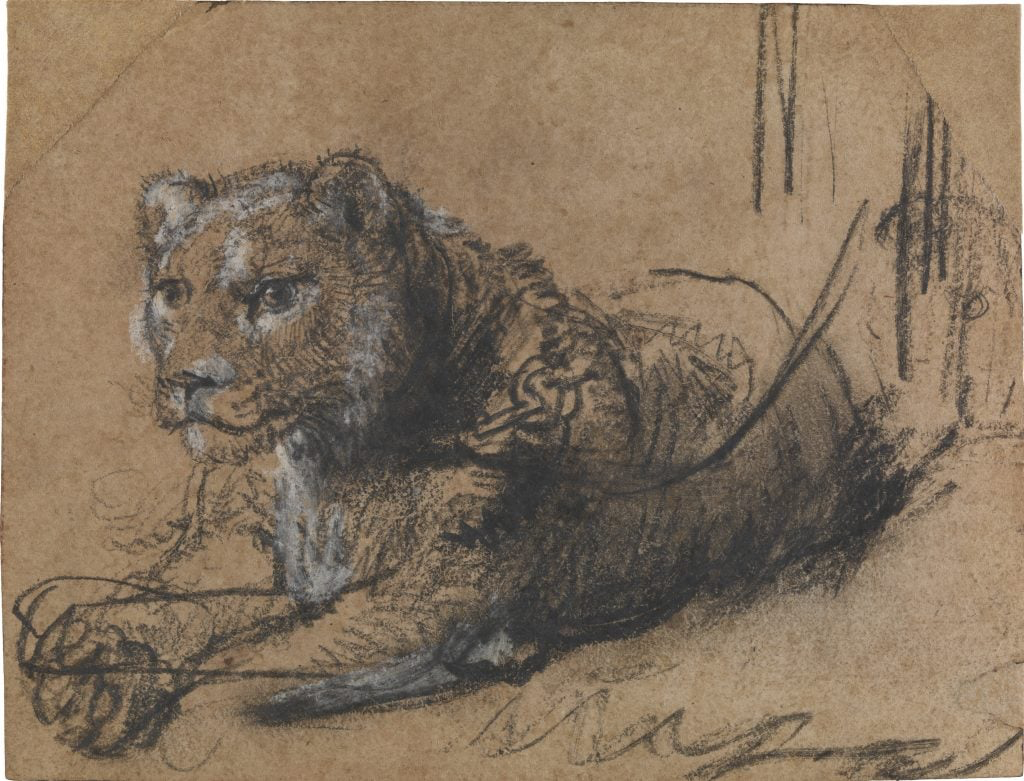
Rembrandt, Young Lion Resting, ca. 1638–42, Black & white chalk on paper.
There was much here to catch the eye beyond the headline sales in the few days it was all on view. An arrangement of elegant female figures had us in a game of cherchez la femme, in particular John William Godward’s stunning profile portrait Cleonice (1913). Jean-Léon Gérôme’s haunting and tender Madeleine Juliette Gérôme avec ses Poupées (ca. 1883), sun-kissed interiors by the Danish painter Peter Ilsted, and several satisfying Corots rounded out the auction of nineteenth- and twentieth-century European art. A selection of charming works by lesser-known lights to be sold online revealed the deep bench of nineteenth-century European painters that few museums would now choose to exhibit but which deserve renewed attention. For its auctions of “Master Painting and Sculpture from Four Millennia,” Sotheby’s featured several alluring standouts, such as its seventeenth-century Portrait of Barbara Urslerin van Beck—a Lombard School depiction of Europe’s most famous “bearded lady.” An auction of works on paper from the collection of the late Diane A. Nixon proved how a dedicated collector could still amass a significant collection of master drawings over just the past few decades.
With many attractions, it’s appealing to consider what most strikes your own fancy. As for me, I would have been happy to walk away with Pietro Paoletti’s seven shadow boxes of plaster casts. These early nineteenth-century travel souvenirs preserved the sights of the Grand Tour in cameo relief from the days before picture postcards and the iPhone selfie.
Timed to the winter auctions—“Masters Week” at Sotheby’s, along with the pendant “Classic Week” at Christie’s—Master Drawings New York comes each year as a highlight of highlights.3 Rather than taking over a single venue, this decentralized fair presents thirty-six dealers partnering together in a weeklong presentation spread across New York’s specialized Upper East Side galleries. Over the last decade, this loose confederation has transformed into a must-see destination for curators as well as a singular access point into the Old Masters for scholars and collectors. It can also turn the marathon of this cultural season into a decathlon event. You hurdle over snowbanks, wind-sprint up townhouse stairs, and elbow out your favorite curator for your own close-up look at what is on view. To see it all might not be impossible but is still unlikely unless you have freed up the full week of the run. Better to print out the street map of exhibitors and pick a few you know well along with a selection of the less familiar.
This year at London-based Guy Peppiatt Fine Art, on view at Arader Galleries, the selection of cartoons by Edward Lear were particularly enjoyable. So too Edward Burra’s Dancing Party. At Nicholas Hall and W. M. Brady & Co., Bernardo Castello’s drawing, Genoese Arriving in Jerusalem, warmed my irredentist heart. Paris-based Marty de Cambiaire Galerie, on view at Gerald Peters Gallery, featured the red-chalk Portrait of an Italian Girl, now confirmed to be an early drawing by Edgar Degas.
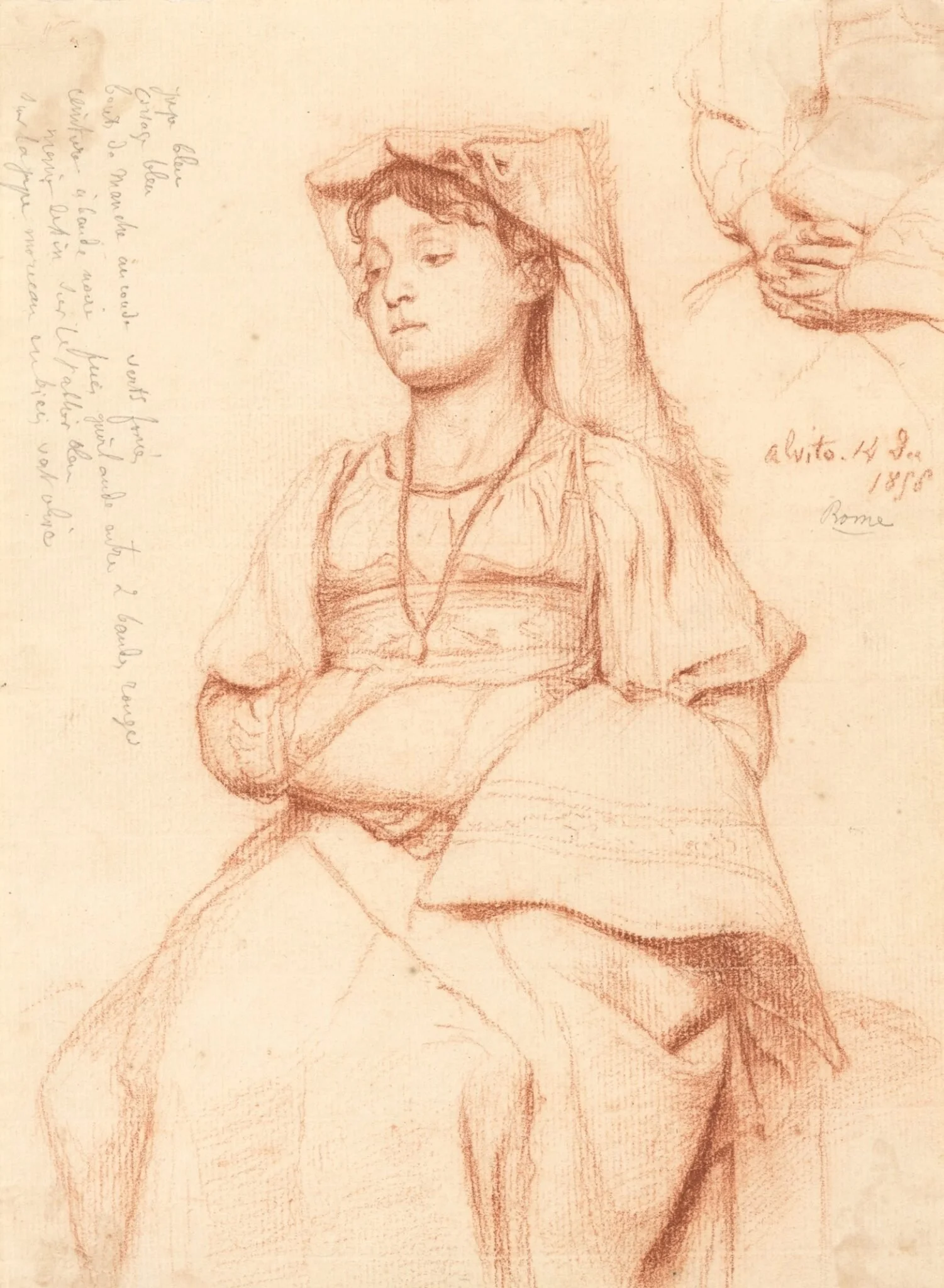
Edgar Degas, Portrait of an Italian Girl, 1856–57, Red chalk on paper, Marty de Cambiaire.
At Rome-based Miriam di Penta Fine Arts, on view at Robert Simon Fine Art, Leonor Fini’s expressive pen-and-ink portraits were hard to beat. Meanwhile, across the floor at Robert Simon, I was again delighted to see Anthony Baus’s contemporary drawing Manhattan Arch quietly added in the mix, a new master among the old.
London’s Abbott & Holder, on view at Kate Oh Gallery, featured two special collections among its selection of British works on paper. The first was the study collection of the late David Bindman, a professor of art history at University College London. The second: devastating sketches of the Dachau mortuary, crematorium, and gas chamber, recorded just a day after its American liberation in 1945, by Brian Stonehouse, a British artist and Nacht und Nebel prisoner who had been held at the death camp.
Last year at this time, with a show of European master drawings on view at the Wadsworth Atheneum, we saw how Masters Week serves to inspire serious exhibitions farther afield (see my “Good on paper” in The New Criterion of March 2025). This year, the great collateral benefit is “Viollet-le-Duc: Drawing Worlds” at the Bard Graduate Center Gallery, on Manhattan’s Upper West Side.4
If Eugène-Emmanuel Viollet-le-Duc (1814–79) had only overseen the mid-nineteenth-century restoration of Paris’s Notre-Dame, we would say Dayenu. If he had only renovated and reconstructed Vézelay Abbey, the Basilica of Saint Denis, Sainte-Chapelle, Château de Roquetaillade, and the medieval city of Carcassonne—Dayenu! But Viollet-le-Duc was also an astonishing illustrator, right up there with the greats of his age. The hundred and fifty works on paper, here mostly on loan from the Médiathèque du patrimoine et de la photographie, a department of the French Ministry of Culture, will be revelatory even to those who know Viollet-le-Duc well.
Spearheaded by the cocurators Barry Bergdoll and Martin Bressani, this first major U.S. exhibition of the French architect, artist, and master planner brings together his remarkable studies of Notre-Dame to prove just how much of the Gothic structure reflects his nineteenth-century interventions—now mostly restored after the devastating 2019 fire. The exhibition also collects his many mountain landscapes and imaginative historical reconstructions.
Following the upheavals of the French Revolution, Viollet-le-Duc set his life’s mission to make France beautiful again. In his valoration of the medieval, he saw the true face of the French soul. It is regrettable that this exhibition feels the need at moments to speculate on the “deep structures” of “climate and race.” A thinly argued section on his racial preferences feels like another poststructural prosecution of greatness. His views on universal suffrage or the gold standard, or whatever, may not accord with our contemporary sensibilities either. C’est la vie. At least his accomplishments on paper speak for themselves, not to mention his singular legacies in brick and stone.
The Winter Show was on view at the Park Avenue Armory, New York, from January 23 through February 1, 2026.
“Masters Week” was on view at Sotheby’s, New York, from January 30 through February 4, 2026.
Master Drawings New York was on view on the Upper East Side from January 30 through February 7, 2026.
“Viollet-le-Duc: Drawing Worlds” opened at the Bard Graduate Center Gallery, New York, on January 28 and remains on view through May 24, 2026.