THE NEW CRITERION, April 2026
On “Egon Schiele: Portrait of Dr. Erwin von Graff,” at the Neue Galerie.
The portraits of Egon Schiele (1890–1918) really get under the skin. “Skinned hares” is how Schiele’s model Liliana Amon (1892–1966), in fact, described his figures in her autobiographical roman à clef, Barrières, some two decades after the artist’s untimely death. “That can’t be! These people have no skin,” the book declares, concluding, “Egon saw the world in a special way; he saw it, so to speak, under the skin, and painted in green, blue, and red.”
Just how the Austrian artist went from painting reserved landscapes at the Akademie der bildenden Künste in Vienna, where he had been accepted in 1906 at the age of sixteen, to the flayed figures of his final decade is now the focus of a small but convincing exhibition at the Neue Galerie.1 Amon is the catalyst for the story. Living with the young artist, pregnant with another man’s child, she connects through Schiele with an obstetrician who takes her on as a charity case. That doctor is Erwin von Graff, a surgeon and gynecologist twelve years older than Schiele and the focus of the exhibition. A champion of the promising artist, Graff becomes a subject for a now well-known portrait and a conduit for an unsparing new line of subject matter for Schiele. With forty works from 1910 to 1918 centered around the Graff portrait, a sizable oil on canvas that lends its name to the title of this exhibition, these results are now gathered together in a one-room gallery off the second-floor permanent collection. The show has been organized by Renée Price and Janis Staggs, the museum director and curatorial director, respectively, of the Neue Galerie.
The Portrait of Dr. Erwin von Graff (1910), listed as coming from a private collection as well as being part of the Neue’s “extended” collection, makes frequent house calls to Eighty-sixth Street and Fifth Avenue. We last saw it in “Living Landscapes,” the Schiele exhibition I reviewed in these pages a year ago (see “Schiele’s living dead,” January 2025). The portrait has appeared some half dozen times on the walls of the Neue Galerie since Ronald S. Lauder opened his museum for German and Austrian art in 2001. Its image is unsettling, even confounding, but recent research into Schiele as well as the life of Dr. Graff now paints a newly penetrating picture of the arresting work, the output that surrounded it, and the figure it portrays. This show is a “portrait” in more ways than one.
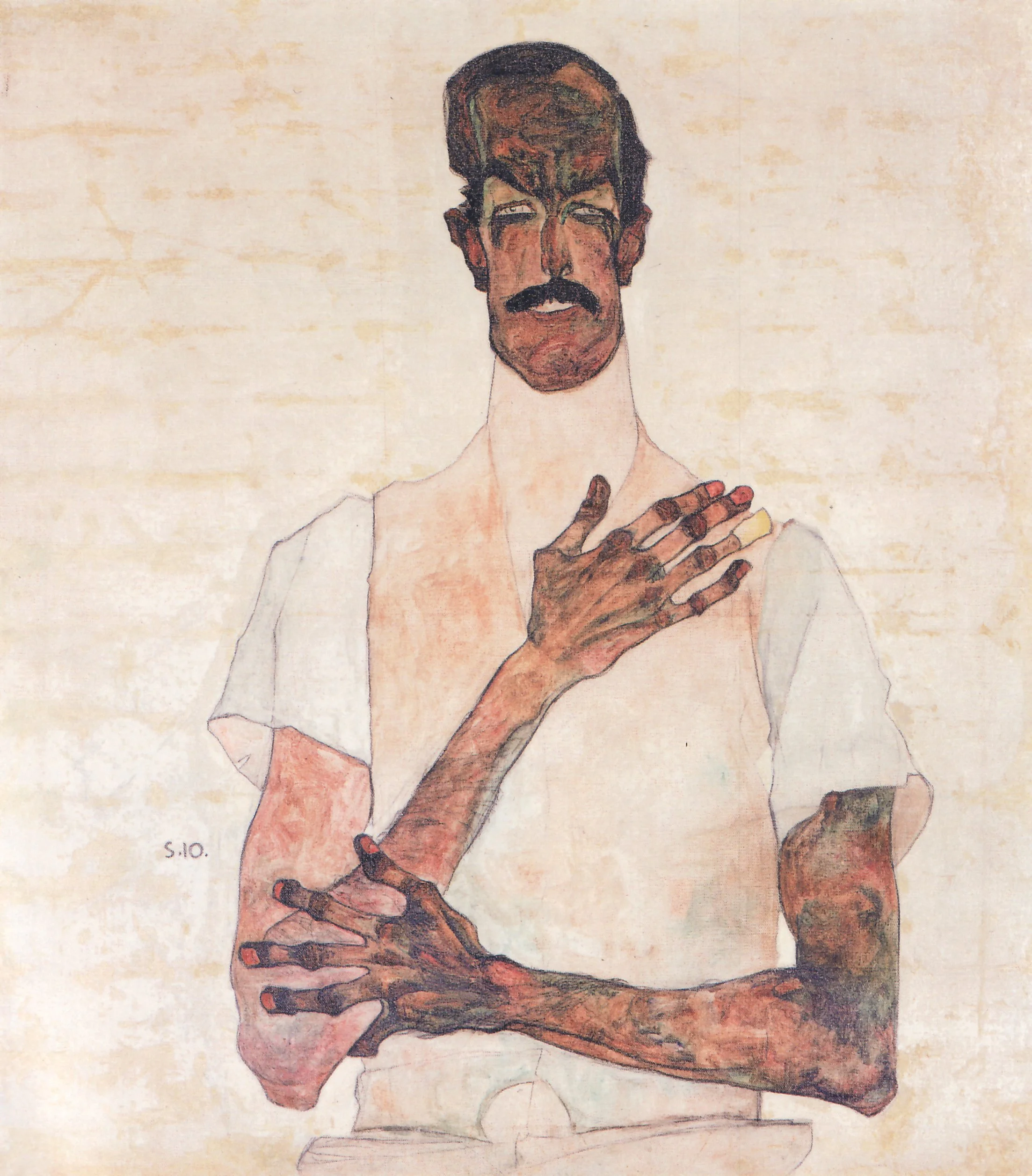
Egon Schiele, Portrait of Dr. Erwin von Graff, 1910, Oil on canvas, Private collection.
The painting first presents to us as an affliction of unknown origin. The gaunt doctor stands straight, staring back at us, in front of what we might take to be a wall of glazed white hospital tile. The atmosphere is clinical and blinding. The light of the painting washes out his short-sleeve surgical shirt and vest and nearly everything else surrounding him in white. Against the glare, what we see is Graff’s dark, exposed flesh—his thin face, piercing eyes, furrowed brow, and bony hands holding up his mottled right arm as though to keep it sanitary before examination. His fingernails appear to fall from his skin. A bandage is wrapped around the end of his right ring finger.
What are we to make of this skin? The blistered arms and cut finger? Is this a trustworthy doctor? Is this even sanitary? Writing about the painting in the 1970s, the Schiele scholar Alessandra Comini suggested the Graff appears as the “shrunken-headed cadaver in a state of rigor mortis,” his bandage a “grim joke.”
Graff seems burned, even irradiated. New research suggests that he was. Graff is now known to have experimented with the then-new technology of the X-ray at a time before the effects of its long-term use were well understood. Exposed to high doses of radiation, like other doctors and scientists of his time, he developed radiodermatitis. The effects of this skin condition can be closely matched to the scorched appearance in his portrait.
Now at the Neue, two studies for the portrait appear alongside the final painting, both here from private collections—one a trio of head studies in profile in charcoal on paper, the other closer in composition to the painting in pencil, charcoal, and wash on paper. Both studies are more academic and far less expressionistic than the final work. In the doctor’s burnt limbs, we can then say that Schiele grasped his future. Moving beyond the sentiment of the Jugendstil and his role model Gustav Klimt, with his luxuriant emphasis on surfaces, Schiele looked instead to the subcutaneous depths of modern life.
From here on out, this exhibition argues, Schiele’s portraits would be peeled raw. Through the clinical window provided by Graff, Schiele found a new direction for his own artistic experiments. “Schiele really came into his own as an artist in 1910, the year he completed the portrait of Dr. Erwin von Graff,” says Price, who views the painting as “one of the most important works in the extended collection of the museum.” She continues: “This is where Schiele really becomes Schiele.”
As Schiele became Schiele, Graff became a key patron and protector. It was a connection that continued through the day of the artist’s death eight years later. Graff, to start, saw Amon through to a healthy birth. He also arranged for her child’s adoption while convincing her to move out of the artist’s studio. As Schiele gave his portrait to the doctor as an expression of his gratitude, their relationship extended beyond the indigent young mother. Through a special arrangement, Graff also provided Schiele with access to other expectant mothers and newborn infants within his clinical orbit—subjects that make up most of the remaining works in this exhibition.
We can only speculate as to the exact nature of how Schiele encountered these figures and gained their acceptance as models, often in radically exposed and vulnerable positions. Neither Graff nor Schiele ever detailed the circumstances of their collaboration. Perhaps Schiele followed Graff on his rounds or took up a position in his operating theater. The results were not the remote clinical perspective we find in, say, Thomas Eakins’s Gross Clinic. Instead, we encounter models who appear close-up, cropped, and intimately engaged with the artist.
We know Schiele composed with swift intensity. Over his brief ten-year career, he created an astonishing three hundred paintings and three thousand works on paper. A few dashed lines of his models in pencil, crayon, or charcoal on paper could be filled in later with watercolor. For his unsparing observations, he drew on whatever inexpensive media was at his disposal. Crumpled brown paper appears in several works. He further cropped his figures in harsh and unsparing perspectives, exposing them in a new light. Confronted by naked and contorted bodies, Schiele employed his own penetrating vision.
His Newborn Baby of 1910, in gouache, watercolor, and black crayon on paper, here from an anonymous lender, serves as an example of Schiele’s new perspective on the human form. The baby twists on his back to the point where his head is out of the frame of the composition. Close examination of the paper reveals how subsequent owners attempted to fold and matte the work so that it would appear more centered. The Neue exhibition suggests that Schiele intended the work to be off-center. Seated Male Nude with Extended Arm, a watercolor, gouache, and black crayon on paper from the Neue Galerie collection, is similarly disjointed, with its twisted right arm, bent head, and brown skin that appears to tear away from the spine. So too is Pregnant Woman (1910), from an anonymous lender, with her green face and belly disconnected from her hands and feet.
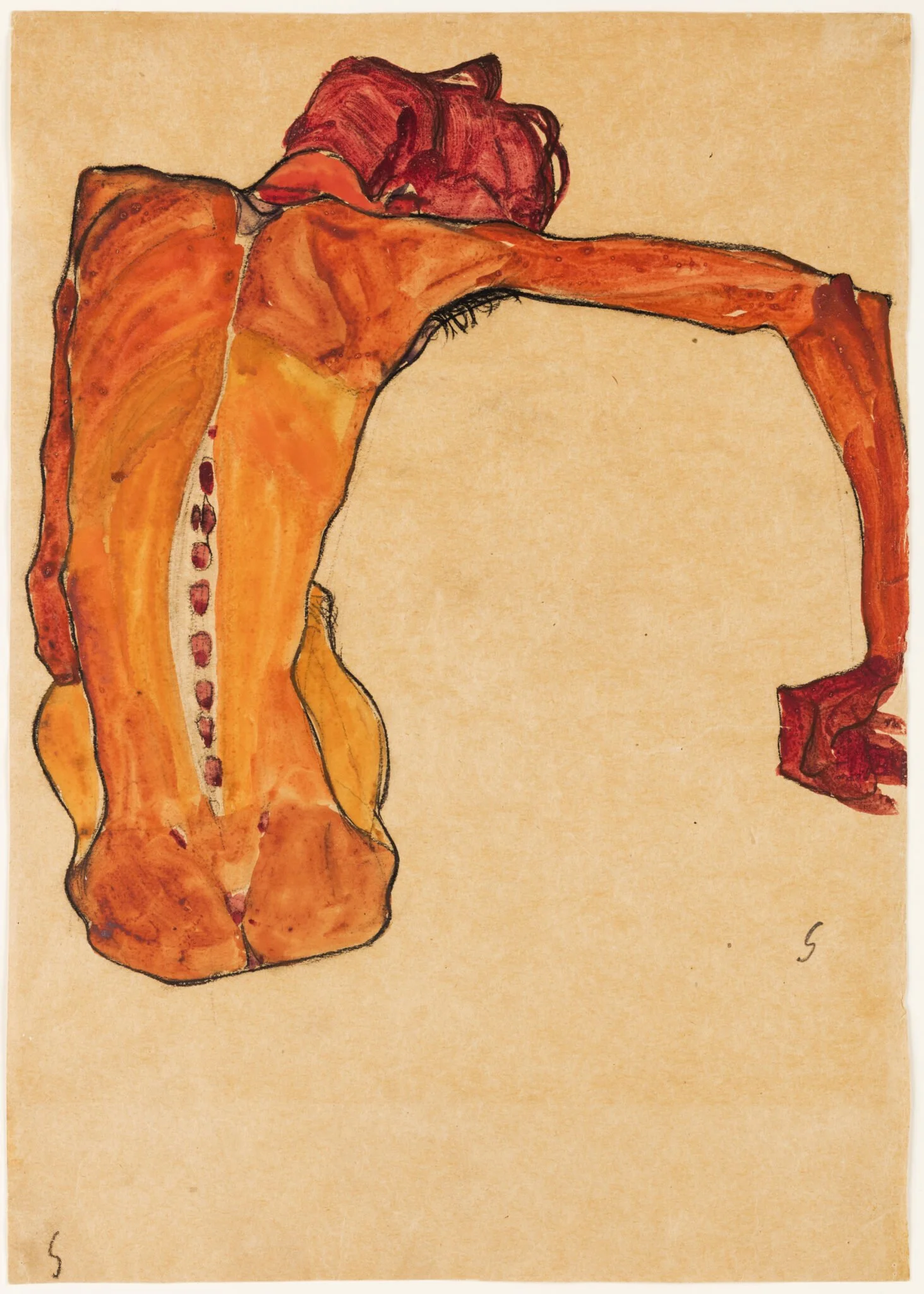
Egon Schiele, Seated Male Nude with Extended Arm, 1910, Watercolor, gouache & black crayon on paper, Neue Galerie. Photo: Hulya Kolabas.
The results of Schiele’s renderings are unsettling and often off-putting. Our initial reaction can be to tie the hospital gown and quickly shut the door. In all, some twelve drawings of pregnant women can be ascribed to the Graff clinic, along with Schiele’s portraits of newborns, sick women, and stillbirths.
Today these can seem sensationalist, exploitative—and probable evidence of a hipaa violation. In his time, Schiele connected his vision to the contorted forms of the Northern Gothic and its symbols of life, death, and renewal. In his penetrating stare, the flesh of a man, the bark of a tree, and the rooftops of a town might all call for mortification.
In the irradiated figure of Graff, Schiele also saw a modern figure for his own salvation. The catalogue for this exhibition, written by Elisabeth Dutz, the chief curator of the graphic-art collection at the Albertina Museum in Vienna, makes a deep study of Graff and documents his long career in Austria and the United States. An auxiliary doctor at Vienna’s Second University Women’s Hospital at the time of his first acquaintance with Schiele, Graff became an accomplished gynecologist and surgeon. He was also a cellist, a handball player, and someone who could prepare an “exquisite Italian risotto,” according to Dutz. He spent time teaching at the University of Iowa and maintained an office on New York’s Park Avenue. A comprehensive list of his publications and lectures from 1901 through 1939 give some indications of his fields of expertise, concluding with papers on the “Etiology of Prolapse,” “Bilateral Uretreovaginal Fistula: Successful Implantation of Both Ureters into the Bladder Seven and Eleven Months Following Total Hysterectomy,” and “Tubal Sterilization by the Madlener Technique.”
Despite these professional accomplishments, it was Graff’s visionary relationship with Schiele that today most defines him for us—a fact that Graff himself seems to have recognized as he collected the artist’s work, brought him into the trust of his patients, and attended to Schiele’s own life and death.
One of the final objects in this exhibition is Schiele’s death mask. A victim of the flu pandemic of 1918, the artist died three days after watching his sick and pregnant wife pass away. One of his last acts was to draw his fevered wife on her deathbed. Days later, just hours before Schiele’s own demise, Graff paid the artist a house call, most likely to administer a palliative dose of morphine. Schiele’s final vision was of the doctor who first inspired him eight years before.
“Egon Schiele: Portrait of Dr. Erwin von Graff” opened at the Neue Galerie, New York, on February 12 and remains on view through May 4, 2026.