THE NEW CRITERION, September 2026
On a pair of exhibitions at the Thomas Cole National Historic Site, Catskill, New York.
We don’t hear enough about our house museums. In the United States, we don’t even know how many we’ve got. The Pew Charitable Trust once put out a study estimating that there are some eight to fifteen thousand house museums spread across the country. That’s quite a range. The numbers speak to their ubiquity among our nation’s historical organizations as well as their often regrettably low profile.
It’s a shame, because the house museum can illuminate our understanding of history unlike anything else. There’s a reason that historians, at least the better ones, will set up shop where their subjects lived and worked. The lay of the land, the feel of a room, or the light from a window can say more than theorizing ever could. I remember the shock of recognition when I first visited Arrowhead, Herman Melville’s farm in Pittsfield, Massachusetts, where he wrote Moby-Dick. Out the window above Melville’s desk, the skyline peak of Mount Greylock breaches above the treetops, “a hump like a snow-hill.”
It is impossible not to feel a similar shudder when stepping onto the porch of the 1815 Main House of the Thomas Cole National Historic Site. The view to the west peers down to Catskill Creek and extends all the way up to the misty ridgelines of Kaaterskill High Peak and Round Top. It looks like a painting, and for good reason. Thomas Cole (1801–48) observed and depicted this vista of the Catskill Mountains more often than any other.
Cole was the least schooled of what later became known as the Hudson River School of painters. He was the movement’s animating force, but his artistic focus was wider and more varied than mere landscape painting. In a memorial depiction of Cole standing with the writer William Cullen Bryant at Kaaterskill Falls, the edenic overlook nestled in the heart of Cole’s mountain view, Asher B. Durand famously called the two men “kindred spirits.”
Cole’s animating spirit emerged from Bolton-le-Moors, the factory town in Lancashire, England, where he was born in 1801. Here the Industrial Revolution was more than just another chapter in the history books. The disruption wrought by mechanization on the traditional cottage industries of spinning and weaving was dire. In 1812, a cadre of former hand laborers and their sympathizers firebombed a factory of mechanized looms and terrorized the town. These “Luddites” styled themselves after “Ned Ludd,” a mythical enraged worker.
The Cole family was subsumed by the same technological wave. Thomas Cole’s father, James, failed at multiple manufacturing start-ups. Beginning at just the age of thirteen, his son sought local apprentice work as a designer of wood blocks for the printing of calico fabrics and soon after, in nearby Liverpool, as an engraver’s apprentice. In 1818 the family’s business failures convinced the Coles to set off for America, where they settled in Steubenville, Ohio. As James attempted to start a wallpaper-printing business, again unsuccessfully, Thomas found work as an engraver’s assistant in Philadelphia and, soon after, his artistic freedom in New York.
Just as Cole witnessed firsthand the effects of industrialization, the changing American landscape in the first quarter of the nineteenth century was on many New Yorkers’ minds. Washington Irving’s Rip Van Winkle, from the short story of 1819, famously slept for twenty years, missing the American Revolution and failing to recognize the many changes to his old Catskill village when he awoke. The opening of the Erie Canal in 1825, connecting Lake Erie to the Hudson River, cemented the Empire State’s imperial ambitions while drawing even more interest, and some concern, to the changing nature of its wilderness.
In 1825 Cole made his first painting trip up the Hudson to the Catskill mountains. The Catskill Mountain House resort had opened on a 1,600-foot-high cliff called Pine Orchard a year earlier. What he brought back included three paintings—Lake with Dead Trees, Kaaterskill Falls, and View of Fort Putnam. When shown in the window of William A. Colman’s bookstore, located on Broadway near Fulton Street in Manhattan, the paintings tapped into an urbanist fascination with the upstate region and became an overnight sensation. The painters John Trumbull and William Dunlap, along with Asher B. Durand, who had been trained as an engraver, purchased the lot. As the philosopher Francis Bacon said, “If the hill will not come to Mahomet, Mahomet will go to the hill.” Cole did just that, and brought the mountain back to Broadway.
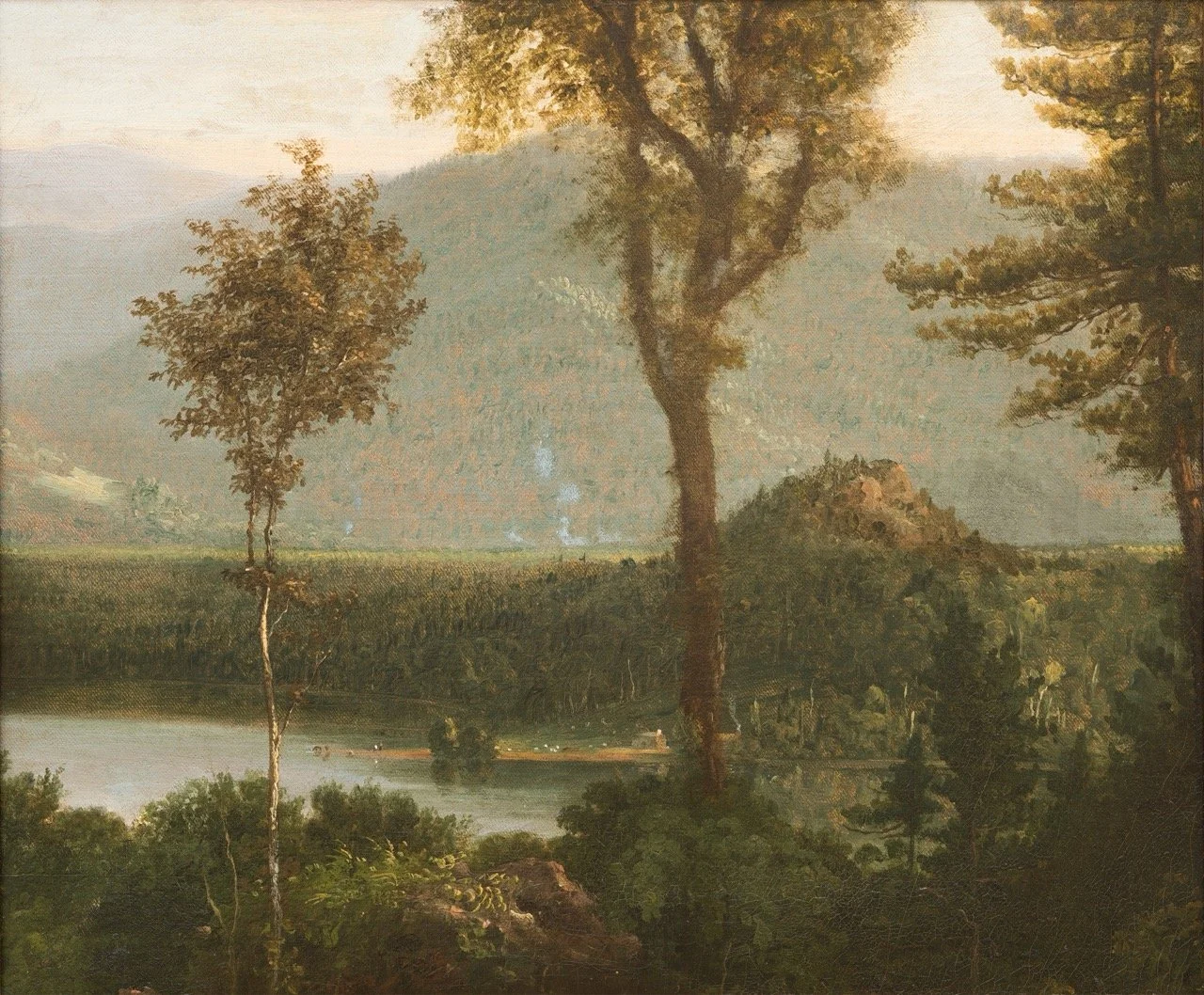
Thomas Cole, Catskill Mountain Landscape, n.d., Oil on canvas, Thomas Cole Historic Site.
Located some hundred and twenty miles up the Hudson River from New York City, the town of Catskill served as a gateway then as now to the dramatic mountain range to the west. When Cole returned here, he boarded at the Thomson family farm, positioned on a ridgeline above town, on an agricultural property that extended toward the Hudson River to the east and Catskill Creek to the west. The farm became Cole’s base of operations for his carriage rides into the mountains beyond, as well as the locus for his future family. In 1836, Cole married Maria Bartow, an orphan whose maternal uncle John Alexander Thomson owned the farm, and moved his studio into a corn storehouse steps from the main residence.
Now known as the Thomas Cole National Historic Site, the former farm is but a fraction of its onetime size but has been dutifully restored from a ruinous state over the past several decades. The highway approach to the appropriately named Rip Van Winkle Bridge of 1933 cuts through the northern corner of the site and would have destroyed the property entirely as first proposed. A crossing did not exist here in Cole’s time, but today at least it draws a physical connection to Olana, Frederic Church’s far more lavish estate across the river in Hudson, New York. That Hudson River School painter located his orientalist confection on a promontory where the two had sketched together, in homage to Cole. Today a signposted “Hudson River Skywalk” connects the two homes through a three-mile path beginning out back of the Cole property. The trail starts by what is now the facility’s parking area and a modern Jewish temple, built at the site of a cottage where Cole first stayed in the early 1830s. Even if one is not up for the walk, the view east is worth taking in, as Church’s fantastic 1870s creation keeps watch over the home of his mentor and the landscape beyond.
The Thomas Cole National Historic Site now opens with a new visitor’s center designed by Stephen Shadley—make that “Architectural Digest 100 Stephen Shadley,” as the site’s literature proclaims. The center is at least unobtrusive and makes much of its three oversized sash windows, which echo the fenestration of the 1815 Main House known as Cedar Grove. The center contains the requisite flex space, snack bar, and gift shop. One of the items available here for sale is a poster by the Guerrilla Girls that “reality checks” the Hudson River School as a “club . . . of white males” that did not afford the same recognition to “female painters like Susie Barstow and Sarah Cole.” Meanwhile, “successful black landscape painters . . . [could] never join the club” that “depicted a wilderness tamed by white settlers.” Why should they want to, we might ask, if such art merely appealed to “robber barons” by packaging an “Eden that never was” out of “romanticized and idealized . . . stolen land”?
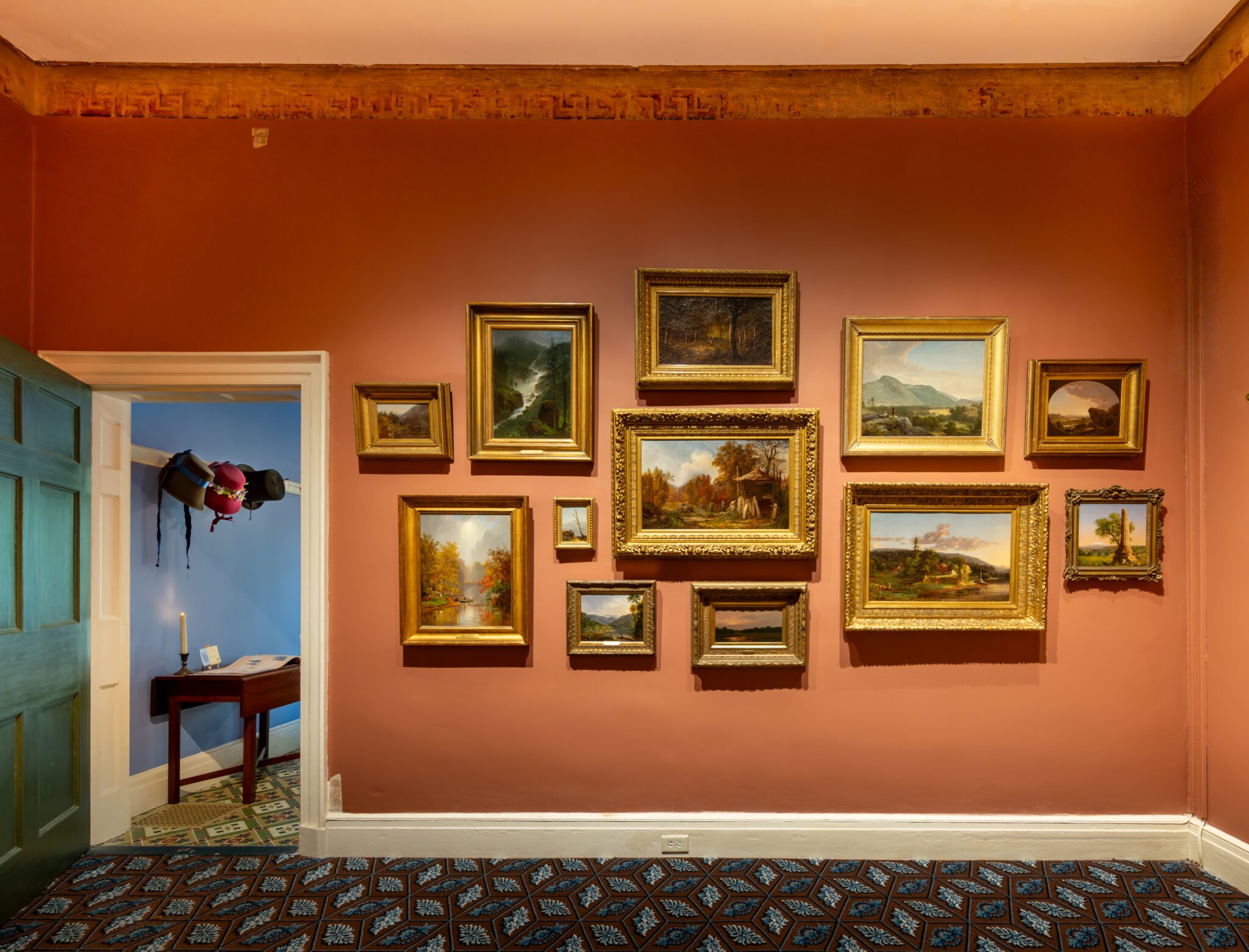
A view of “Circles of Influence: Thomas Cole and the American Landscape Movement.” Photo: Peter Aaron.
Exiting through the gift shop—should our racist, sexist, classist, and anti-indigenous nature compel us to continue—we are invited to tour grounds that include a garden, the corn storehouse with a re-creation of Cole’s studio, an outdoor privy, a reconstruction of Cole’s “New Studio” building of 1846, which had been demolished in 1973, and finally the Main House.
The residence of Cedar Grove continues to be a site of restoration as more of the building is turned over for public access and gallery use. The main rooms of the first floor have now been artfully arranged with reproductions of Cole’s most famous paintings as well as donated period furniture and family artifacts, many here on long-term loan from the Green County Historical Society. A vitrine with Cole’s top hat and case appears in the entry hall along with a family’s bevy of straw hats hanging from the wall. Reproductions of letters and newspaper clippings appear on a desk. A sign that reads “Thomas Cole sat here . . . so we kindly ask that you don’t” has been placed on several chairs that are otherwise not roped off. Meanwhile, an immersive video and some tabletop projections provide additional audiovisual context and multimedia razzamatazz. The house again feels lived in, with Cole and his family now back in residence, just with the television on.
In addition to the historical re-creations, several rooms have been converted into gallery spaces. On the second floor, “Thomas Cole: An American Visionary” serves as the inaugural exhibition of the site’s Richard Sharp Gallery.1 Through sixteen Cole paintings and related drawings and studio materials, the exhibition reveals the many artworks and artifacts that have been given to the Cole site over the past twenty years. As of press time, two more had just come in from Alexander Acevedo of New York’s Alexander Gallery.
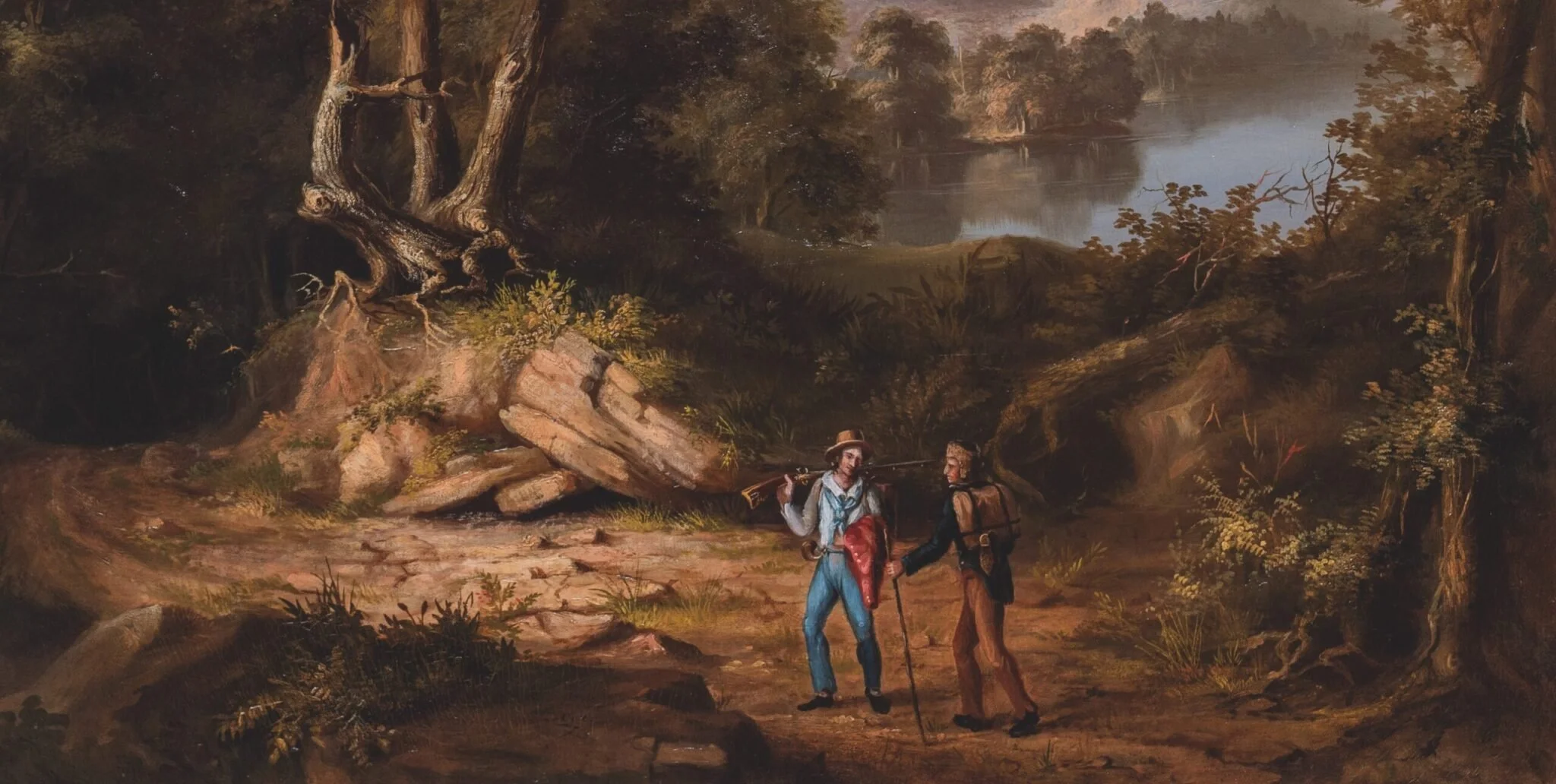
The show begins with Ruined Castle on a Rock, a paint-by-numbers watercolor from circa 1818–20 that reveals Cole’s origins in illustration along with his affinity for sentimental narratives. By 1825, in such paintings as Two Men Walking (Hunters in a Landscape), the compositions have become more complex but the narrative structure remains.
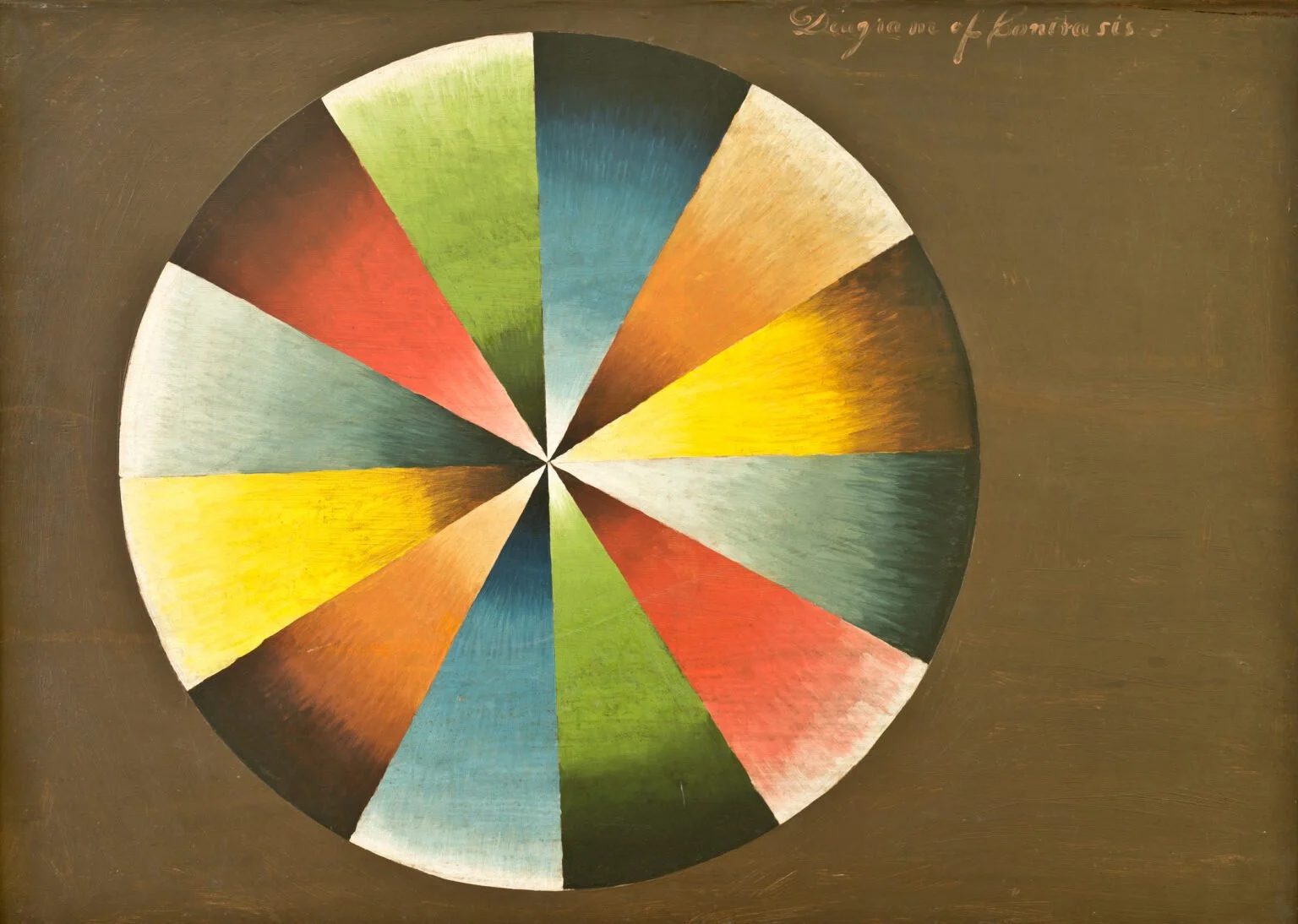
Thomas Cole, Diagram of Contrasts, 1834, Oil on panel, Thomas Cole National Historic Site.
A selection of studio effects speaks to the artistic education that Cole worked to impose upon himself. Thomas Cole’s Box of Minerals and Artifacts (ca. 1830–48) is a collection of local stones and natural specimens. His fascinating Diagram of Contrasts (1834) reveals his interest in color theory. Meanwhile a selection of plaster casts hints at the classical training he hoped to emulate. As much as he observed American nature with one eye, Cole looked to the Old Masters with the other and made a study of classical painting—the focus of the 2018 exhibition “Thomas Cole’s Journey: Atlantic Crossings” at the Metropolitan Museum of Art (see “Burning Cole,” my review in The New Criterion of March 2018).
Cole was a landscape painter with a point, one with a sharper edge than we otherwise see in his many followers. Also now at the Main House, “Circles of Influence,” focusing on “Thomas Cole and the American Landscape Movement,” presents many of these acolytes through a loan exhibition arranged in a salon-style display.2 Included here are small works by Church, Durand, and Jasper Francis Cropsey, the family members Sarah Cole and Mary B. Cole, and painters who drew inspiration from Cole, including Ralph Albert Blakelock, Albert Bierstadt, John Frederick Kensett, Worthington Whittredge, Mary Josephine Walters, and (yes) Susie Barstow.
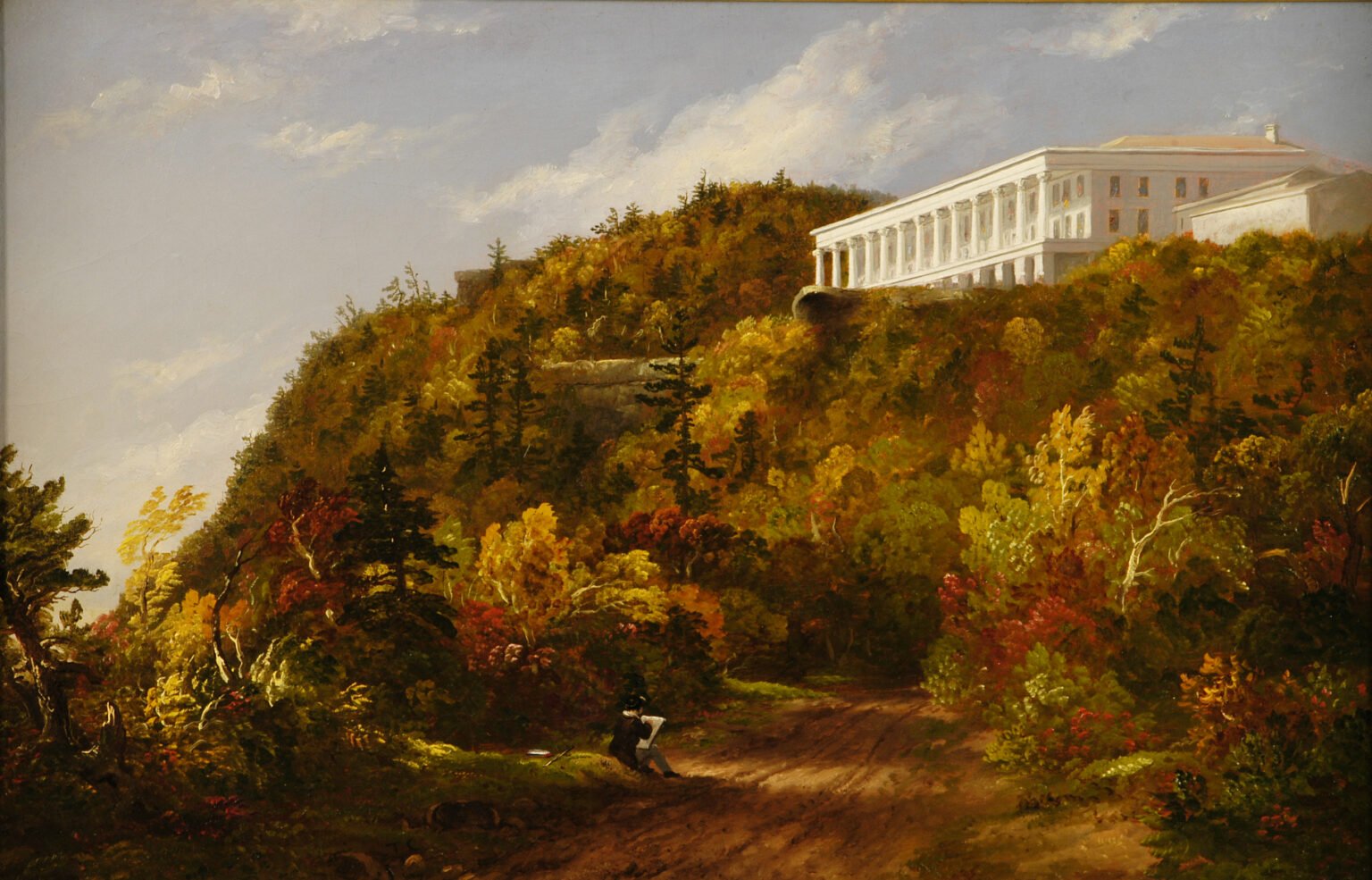
Compared to many of them, Cole lacked a facility for capturing form in space, such as we see in Durand’s magisterial Dover Plains, Dutchess County, New York (ca. 1848). Blakelock’s untitled landscape from circa 1869–72 is more atmospheric, and Bierstadt’s Colorado Waterfalls (ca. 1890) more awe-inspiring, than anything Cole ever produced. If Cole’s painting Catskill Mountain House (1846), included here, calls any other compositions to mind, it is The Course of Empire, his classical allegory from 1833–36 now in the collection of the New-York Historical Society and included in the main house in reproduction.
Thomas Cole, Diagram of Contrasts, 1834, Oil on panel, Thomas Cole National Historic Site.
Beginning with the dislocation and demise of his father’s businesses in England, Cole saw ruin whether he was painting a classical column or the Kaaterskill escarpment. Observing the changing Catskill landscape from his porch at Cedar Grove, he lamented the “copper-hearted barbarians” and “dollar-godded utilitarians” then driving a rail line through his viewshed. In many ways, Cole was the original Catskill NIMBY, that “not in my back yard” second-home owner who wants his weekend views unsullied by hydrofracking or data centers or whatever business prospects might still exist for this burned-over state, attitudes ironically accelerating the region’s decline and fall. At the same time, the very anxieties over American nature that first thrust Cole into the spotlight two centuries ago continue to resonate through his work today.
“Thomas Cole: An American Visionary” opened at the Thomas Cole National Historic Site, Catskill, New York, on April 25 and remains on view through December 2026. ↩
“Circles of Influence: Thomas Cole and the American Landscape Movement” opened at the Thomas Cole National Historic Site, Catskill, New York, on June 20 and remains on view through December 2026. ↩