'The critical moment'

  Greenberg Expression11b

Humanities, July/August 2008
Volume 29, Number 4

The Critical Moment: Abstract Expressionism’s Dueling Duo
BY JAMES PANERO

On the critics Harold Rosenberg and Clement Greenberg

What is art criticism today if not a muddied profession? How can we agree what criticism is if we cannot agree what art is? So the critic today contends with an unruly field. Art makes unusual demands on the viewer, and art criticism makes unusual demands on the writer, who must now fill several roles: that of a stock analyst at the art fairs and auction houses; a gossip columnist at the openings; a sports announcer at the museums and galleries; and a lifestyle guru in the popular press.

Compare this with sixty years ago. Modernism has an uncanny ability to break things down and isolate ingredients. Matisse with color, Picasso with form and line—the best modern art is radically fundamental before it is ever fundamentally radical, a distilled purification of art’s first principles. So it comes as little surprise that as American modern art reached its apex in the 1950s through the flowering of Abstract Expressionism, art criticism achieved a glittering purity of its own—a beautiful high criticism perfectly matched to the period of high art.

The writers who defined the parameters of this criticism were Clement Greenberg (1909-1994) and Harold Rosenberg (1906-1978). Greenberg & Rosenberg were like Ali & Frazier. They made up the protagonists in art criticism’s fight of the century—a Grapple in the Big Apple between personal and professional adversaries. It was also, undoubtedly, one of the few fights in art criticism to make it into the record books. Yet as the passions of their engagement have dissipated, and the art world has moved on to largely financial concerns, the Greenberg-Rosenberg rivalry has, in hindsight, come to seem of a piece. I say this as someone who has always been more in the Greenberg camp.

Greenberg and Rosenberg were diametrically opposed in their interpretations of Abstract Expressionism, but each interpretation was correct in its way. Their theories were not mutually exclusive, but instead opposite ends of a kind of dialectic. Through two forceful positions argued before the backdrop of Abstract Expressionism, in opposing language, together they laid out the full definition of modern art.

In The Birth of Tragedy, his youthful interpretation of Greek drama, written in 1872, Friedrich Nietzsche wrote that great classic art was predicated on the balance of Apollonian and Dionysian impulses—“Apollonian” after the sun god Apollo, with his “measured restraint, the freedom from the wilder emotions, that calm of the sculptor god”; and “Dionysian” after Apollo’s brother Dionysus, the god of wine, with “the blissful ecstasy that wells from the innermost depths of man, indeed of nature . . . brought home to us most intimately by the analogy of intoxication.”

“Wherever the Dionysian prevailed,” Nietzsche wrote, “the Apollonian was checked and destroyed. . . . Wherever the first Dionysian onslaught was successfully withstood, the authority and majesty of the Delphic god Apollo exhibited itself as more rigid and menacing than ever.”

Greenberg and Rosenberg were the checks and balances of American abstract art in this Nietzschean definition—Greenberg the Apollonian, Rosenberg the Dionysian. In 1947, Greenberg called for “the development of a bland, large, balanced, Apollonian art . . . in which an intense detachment informs all. Only such an art, resting on rationality . . . can adequately answer contemporary life, found our sensibilities, and, by continuing and vicariously relieving them, remunerate us for those particular and necessary frustrations that ensue from living at the present moment in the history of western civilization.”

And here was the Dionysian Rosenberg, writing in “The American Action Painters,” his most famous essay, in 1952: “At a certain moment, the canvas began to appear to one American painter after another as an arena in which to act—rather than as a space in which to reproduce, re-design, or ’express’ an object. . . . What was to go on the canvas was not a picture but an event.” And more: “The big moment came when it was decided to paint . . . just to PAINT. The gesture on the canvas was a gesture of liberation, from Value-political, esthetic, moral.”

“Action” versus “detachment,” “liberation from value” versus an art “resting on rationality”—an exhibition now at The Jewish Museum in New York called “Action/Abstraction: Pollock, de Kooning, and American Art, 1940-1976,” organized by Norman Kleeblatt, tracks these two critics and the ideals they represented through the artists they endorsed and the ephemera they left behind.

“Their initial theoretical outlooks were not that dissimilar,” Kleeblatt argues—persuasively, I might add—even though “many observers half a century ago viewed the opposed perspectives of Rosenberg and Greenberg as the only approaches to contemporary art. The two men’s impassioned writings often reduced the issues to either a formalist or an existentialist view, and each thought that his own view would prevail.” Kleeblatt calls this disagreement “the foundational dialectic of the era.” Morris Dickstein, the literary and cultural critic, maintains that Greenberg and Rosenberg “demonstrated the antithetical ways that Modernism would be assimilated to American cultural discussion in the years after World War II.”

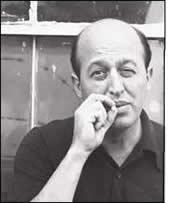
In terms of differences, you could see it in their faces. In photographs Rosenberg wears his expression like a mask—a primitive totem neither frowning nor smiling, an angular profile punctuated by a small mustache. In a picture of him looking to the side and up to the sky, we imagine the private reverie of a critic who privileged the subjective, the mythical, and the existential over the material. In his theories Rosenberg was influenced by Jean-Paul Sartre, Albert Camus, and Maurice Merleau-Ponty.

Compare this with Greenberg, who in most photographs pokes and squints and pinches his face. Greenberg, a positivist like Ludwig Wittgenstein, was concerned with materials and purity of form. Influenced by Roger Fry, Walter Pater, and Benedetto Croce, he advocated an “art for art’s sake” of internal laws and formal logic that operated outside of subjective concern. Engaged with the here and now of art, unlike Rosenberg who looked to the beyond, in photographs Greenberg radiates the worries and joys of the real world, his hooded eyes piercing rather than transcendent. “For Greenberg,” writes Kleeblatt, “the true work of art was one that exploited the uniqueness of each medium to express sensation as the essence of experience. The result was the evocation of emotion.” While for Rosenberg, “action painting was the psychic expression of the artist’s being and identity; the artist's creative process operated in the space between art and life. For Rosenberg this intimate and bold means of self-expression encouraged mythical interpretations of the artist’s ambitions.”

In the art of the era, their advocacy split right down the middle. Rosenberg’s man was Willem de Kooning, the classically trained Dutchman who delighted in making a mess in the kitchen of art. Greenberg backed Jackson Pollock. “Greenberg hadn’t created Pollock’s reputation,” Tom Wolfe wrote in his 1975 send-up of modern art, The Painted Word, “but he was its curator, custodian, brass polisher, and repairman, and he was terrific at it.”

Greenberg favored Pollock for the grand scale of his work, which brought painting down from the easel. The innovation of the drip technique furthermore detached Pollock from the canvas and flattened the image into a scrim, removing any sense of illusion and acknowledging the properties of the painting’s internal logic. Rosenberg, however, saw de Kooning as the ultimate psychic actor on canvas, an artist who would paint and scrape and repaint and whose work was a dynamic recording of artistic action. The two artists formed something of their own dialectic. In the early 1950s, with the drip, Pollock used drawing to create a painting. De Kooning, meanwhile, used painting to arrive at drawing-like cartoons.

See these artists together today and you probably notice the similarities before you see the differences. In fact, before he introduced subject matter into his paintings in the 1950s, de Kooning was an abstractionist admired by Greenberg. When photographs and movies of Pollock’s drip dance emerged in the 1950s, observers took him to be the ultimate Rosenberg action painter. (The critics themselves were not so clear-cut in their advocacy either. Both admired Hans Hofmann and Arshile Gorky, for example.)

The similarities between Greenberg and Rosenberg outweigh the differences. The critic Max Kozloff has written that “a good deal of the underlying agreement between them has been obscured,” and he is right. They were born to immigrant Jewish families in New York just years apart. They rose up through the political world of the 1930s to arrive at a Marxist-influenced aesthetic position that was ardently anti-Stalinist and pro-Trotskyist in the belief that “art can become a strong ally of revolution only in so far as it remains faithful to itself.” In their early years they both wrote for “little magazines” such as Partisan Review, Encounter, and Commentary. They hoped to insulate the high arts from popular culture with similarly influential essays: Greenberg wrote “Avant-Garde and Kitsch” for Partisan Review in 1939. Rosenberg wrote “The Herd of Independent Minds” for Commentary in 1948. And, of course, they both came to Modernism at a particular moment after 1940 to focus on the rise of American abstract painting. They tracked their disagreements through countering essays published over the next twenty years.

Their disputes played out in print through the early 1960s. In “How Art Writing Earns Its Bad Name,” Greenberg called Rosenberg’s “American Action Painters” a “misinterpretation that was also a fatality of nonsense.” In 1963, Rosenberg responded with “The Action Painting: A Decade of Distortion,” arguing that Greenberg’s formalism was an “academic concept” to “normalize” art by focusing on “line, color, form” rather than “politics, sociology, psychology, metaphysics.” Rosenberg accused Greenberg of distorting “fantastically the reality of postwar American art. This distortion is being practiced daily by all who may enjoy its fruits in comfort.” Greenberg assailed Rosenberg for “perversions and abortions of discourse: pseudo-description, pseudo-narrative, pseudo-exposition, pseudo-history, pseudo-philosophy, pseudo-psychology, and—worst of all—pseudo-poetry.” Rosenberg countered: “Formal criticism has consistently buried the emotional, moral, social and metaphysical content of modern art under blueprints of ’achievements’ in handling line, color, and form.” And so on. They even published countering anthologies just years apart: Rosenberg The Tradition of the New in 1959, and Greenberg Art and Culture in 1961.

“One indelible point,” says Kleeblatt, “that emerges from an examination of Greenberg’s and Rosenberg’s writings is that the two men saw clearly and at times even fiercely how much was at stake in their aesthetic and political views.” They were also both Jewish intellectuals who were “outsiders who faced discrimination in American society and in the ’established’ art world,” writes the critic Irving Sandler, “centered as it was in institutionally anti-Semitic museums and universities, they yearned for a brave new socialist world in which ethnic prejudice would disappear. They embraced Modernism, a marginal culture whose world was more open to them as Jews than were ’official’ milieus.”

Each critic published a single essay on the subject of Judaism. Greenberg wrote on “Self-Hatred and Jewish Chauvinism” in 1950, while Rosenberg asked, “Is There a Jewish Art?” in 1966. Greenberg voiced “a Jewish bias toward the abstract, the tendency to conceptualize as much as possible,” while Rosenberg advocated a “self-determined Jew” whose connection with the past “occurs not through his revival of forms which they [the ancestors] created—their doctrines, rituals, institutions—but through his own creative act which they inspire.”

Is there a Jewish art criticism? The art critic Donald Kuspit summed up the answer in this way: “For Rosenberg the American artist always faces a choice between being a true or false self. For Greenberg it is between being an avant-garde or kitsch artist. The essence of the choice is the same: to maintain one’s sacred integrity or to comply with society’s profane demands. The American artist is always in a Jewish situation, trapped between autonomy and assimilation.”

What eventually happened to the Greenberg-Rosenberg “family row” is indicative of the fate of culture in the latter half of the past century. It wasn't that one side won out; it was rather that art moved on. The Apollonian-Dionysian dialectic that at one point established the outer limits of art proved ill-equipped at containing and contending with the art of the 1960s and beyond. Both Greenberg and Rosenberg were flummoxed by neo-Dadaism, Pop art, and Minimalism. So art criticism lost its own internal logic. If culture could not agree on a definition of art, it could not disagree on the meanings contained within.

Greenberg went in for a particular drubbing beginning in the 1960s, as his Trotskyism and anti-Stalinism evolved into a codified form of Modernism and pro-Americanism. In 1966, just by example, a performance artist named John Latham organized a monthlong event called “Still and Chew,” in which participants bit off, masticated, and spat out pages of a copy of Art and Culture, which Latham had borrowed from his college library.

“Despite reams of politically savvy writings that condemn Greenberg,” says Kleeblatt, “his formalist theory of Modernism remains a point of departure (and contention) even in postmodern discourse. This is a foundation for some, a brick wall that needs breaking down for others.” Yet while “Greenbergianism” and “Clem” became epithets in the university art history programs in the 1970s (and remain so today), Rosenberg did not receive what might have been an expected boost to his own reputation. At a certain point, the reputations of Greenberg and Rosenberg were only serviceable in the negative—pillars to topple over. Rosenberg, whose criticism was less trenchant than Greenberg's, simply proved to be an easier challenge to overcome.

“A heroic phase of Modernist innovation . . . was soon to come to an end,” writes Morris Dickstein, “once the new became a marketing strategy rather than a life-altering encounter that mattered in its own terms.” What is art criticism today? I can tell you what it's not: Harold Rosenberg and Clement Greenberg. Some might call this progress. I call it a shame.

'Off the walls'

Asher_Durand_Kindred_Spirits
Asher B. Durand’s “Kindred Spirits” (1849), oil on canvas, 44 x 36 inches. The Hudson River School masterwork was deaccessioned by the New York Public Library for $35 million.

ART & ANTIQUES
August 2008

Off The Walls
by James Panero

By selling art from their collections, some museums are stirring up controversy and making donors nervous.

“You’re hitting me where it hurt,” says Tom Freudenheim, former assistant secretary for museums at the Smithsonian Institution. The Buffalo, N.Y., native still smarts over what went down at his hometown museum, the Albright-Knox Art Gallery. In November 2006, the Albright- Knox, a small institution in a cash-strapped city with a noted modernist collection, issued an excited press release. It announced that the museum was about to “deaccession”—or sell off from its permanent collection—“antiquities and other historical works.”

The statement included extensive quotes from agents of Sotheby’s, who would be acting on the museum’s behalf by auctioning off more than 200 lots in public sales over the following year. One expert praised an Indian figure of the dancing god, Shiva, as “arguably the best example of its kind.” A set of Chinese ceramics was “certain to spark competitive bidding, particularly from Asian collectors and mainland Chinese institutions.” Then there was the bronze Roman statue “Artemis and the Stag,” the highest-profile lot of all. Richard Keresey, worldwide head of antiquities at Sotheby’s, called it “among the very finest large classical bronze sculptures in America and the most splendid to appear on the market in memory. It would be a star in any of the great collections of the world, whether in a museum or private hands.”

A star, that is, except at the Albright- Knox. Half a century after acquiring “Artemis and the Stag,” the museum had decided to sell the masterpiece, along with dozens of other exceptional works, in order to raise money for its acquisition fund for modern and contemporary art— “a tradition that has been in place since the museum’s inception in 1862,” according to the press release. “I went ballistic,” Freudenheim recalls, “so I wrote an article for the Wall Street Journal.”

He took the Albright-Knox to task for “devoting more and more resources to acquiring large amounts of contemporary art, work about which the judgment of history—supposedly what museums are all about—is far from settled. Such acquisition policies may be acceptable, but not when done by getting rid of masterpieces whose importance has been validated by time and critical opinion and that provide a context for work in the present.” The article fired the first salvo in what turned out to be a losing battle to stop the Albright-Knox sales.

In the end, the criticism may have helped the auctions, which saw windfall profits. These days, Louis Grachos, the director of the Albright-Knox who oversaw the deaccessioning, chuckles when asked about the irony of the situation, though he declines to comment on it. The final take for the auctions came to $68 million, more than four times the $15 million estimate. The Artemis alone went for $28 million to an anonymous European collector, who has now temporarily loaned it to the Metropolitan Museum of Art in New York. “I took my son to see it there last week,” Grachos says. His acquisition endowment has swelled to $91 million, drawing $4 million annually, up from $1.1 million annually. He says he has already used some of the money to purchase work by Fred Sandback and Olafur Eliasson. He has previously said that he would like to use the funds to acquire works by Felix Gonzales-Torres, Bruce Nauman, Tracey Emin and Damien Hirst.

“I was surprised by the intensity of the response,” Grachos says of the vocal criticism from Freudenheim and others. “What was interesting is that so many people did not comprehend what the true mission of the gallery was. This was an institution to support and collect living artists.” As for the long-term effect of the public debate over the auctions, he says, “Our membership was in decline before the deaccessioning; now we’re on the way up.” However, he adds, such controversies “are not healthy for museums.”

Just how unhealthy they are is up for debate. Robert Flynn Johnson, the former curator-in-charge at the Achenbach Foundation for Graphic Arts in San Francisco, maintains that the Albright-Knox “traded old lamps for new, but they have also caused a sense of distress amongst potential donors, who don’t even tell the museum, ‘We were going to give our paintings to you, and now we’re not.’ They don’t know what they lost, because nobody informed them.”

With the art economy booming, it is very tempting for institutions to sell off parts of their permanent collections to fund acquisitions or to cover expenses. In 2005, the New York Public Library sold “Kindred Spirits” (1849), a Hudson River School masterpiece by Asher B. Durand, for $35 million to Wal- Mart heiress Alice Walton, who acquired it for her forthcoming Crystal Bridges museum in Bentonville, Ark. The revenue went to the library’s operating expenses.

Two years later, in order to fund a campus expansion, Thomas Jefferson University, a medical school in Philadelphia, announced plans to sell one of the most recognizable paintings in the United States, Thomas Eakins’s “The Gross Clinic” (1875), for $68 million, again to Walton, unless a local institution could match the price within 45 days. (Like the New York Public Library, the college justified its decision on the grounds that it is not an art museum.) The Philadelphia Museum of Art, with help from the Pennsylvania Academy of Fine Art and a bank loan, came up with the funds, but only though deaccessioning an Eakins painting and two oil sketches from its own collection. A public explanation for the sales quoted the instructions of Susan Macdowell Eakins, the artist’s widow and the donor of the works in 1929, who gave the go-ahead for the museum to exchange certain works for others so long as it was “favorable to the memory and reputation of Thomas Eakins.”

Lee Rosenbaum, a blogger and journalist who frequently writes for The New York Times and the Wall Street Journal, nevertheless questions the ethics of such a deal. “Trading up is not an appropriate collections management strategy,” she writes. “In my view, the ‘permanent collection’ is called that for a reason: Past acquisitions of museum-quality works should not be exploited as assets to bankroll high stakes plays by today’s curators who want a piece of the market action.”

Of course, museums have always quietly disposed of lesser pieces from their collections. By selling work otherwise halfforgotten down in storage rooms, they return art to the public and private domains. “This is a healthy process for the community at large,” says Marco Grassi, an Old Master restorer and dealer based in New York, who sees an upside to public work returning to private hands. “It keeps the juices flowing. Museums are far too acquisitive and retentive. I feel very strongly that works of art need to have a life outside of museums. When the stuff is in a vitrine it no longer has a life of its own.”

Among the earliest uses of the term “deaccession” in regard to museums was in 1972, when the New York Times art critic John Canaday wrote that the Metropolitan Museum of Art, then under the direction of Thomas Hoving, “recently deaccessioned (the polite term for ‘sold’) one of its only four Redons.” Hoving was the first museum custodian to conceive of his permanent collection as a source of capital. In 1970, he purchased a Velazquez portrait for $5.5 million but lacked the funds to cover it. He began looking for works to sell, and the bequest of the late Adelaide de Groot was his principal target. Against the heiress’s wishes that her collection remains in a public institution, Hoving sold off masterpieces from her donation—most notably “The Tropics” by Henri Rousseau— through Marlborough Gallery. The sale was so controversial at the time that the Met’s curator of European painting refused to sign the deaccession form. Hoving signed it for him.

Today’s museum directors have followed in Hoving's footsteps. “They have Champagne taste and a beer budget,” says Johnson, “and one of the ways they bring up the difference is to cannibalize the collection they are responsible for. They sell works of art that do not seem valuable or fashionable at the time. In my mind that is the worst thing a trustee or curator could do.” But don’t expect a change anytime soon. There will be an outcry whenever a non-profit, tax-exempt institution sells off work. It will remain controversial when trustees and directors raid collections for funds rather than rely on patrons. But so long as the art market stays bullish, deaccessioning shows no sign of letting up.

Donors of art to museums, meanwhile, are quietly taking note. While major collectors recognize deaccession as an important topic, they are reluctant to discuss the particular practices of museums, in which they often have an interest. One donor, off the record, says she only gives work to the National Gallery of Art in Washington, D.C., which never deaccessions. Johnson says that if he were a collector making a donation to a museum, he would stipulate that “you cannot go and sell my Chinese porcelain to buy a Jeff Koons.” But such stipulations are notoriously easy to overrule in the courts, especially after a donor has died. Freudenheim’s advice to his collector friends is, “If you really care about it, sell it while you are alive. If you think it will stay in the museum forever, then you are fooling yourself.”

'Art's Willing Executioner'

1401 THE NEW YORK SUN
June 4, 2008

'Art's Willing Executioner'
by James Panero

A review of 'Let's See' by Peter Schjeldahl

Art critics are like thoroughbred horses: They risk breaking down after a short period on the track. It came as a surprise, then, when the New Yorker appointed Peter Schjeldahl as its critic in residence 10 years ago: By 1998, Mr. Schjeldahl had already been around the course more than once. Born in Fargo, N.D., in 1942, he had been writing for the Village Voice since 1980, and before that for ARTnews, Seven Days, and the Arts & Leisure section of the New York Times. Back in the late 1960s, the New Yorker's hiring of the Abstract Expressionist critic Harold Rosenberg came as a temporary reprieve from the slaughterhouse. For Mr. Schjeldahl, one wondered if the job would be a similarly green pasture in which to natter on into oblivion.

But Mr. Schjeldahl found his second wind at the New Yorker. He has regularly filed tuneful columns of readable stories with tight structure and interesting twists of phrase informed by his years as both a journalist and a poet. (By the 1960s, Mr. Schjeldahl was already a published poet in the New York School; he abandoned poetry around 1980 to pursue criticism.) Mr. Schjeldahl's latest volume of selected writing, 75 essays from a decade at the New Yorker running through 2007, has now been published as "Let's See" (Thames & Hudson, 256 pages, $29.95).

Those 10 years make for an interesting case study of art, one framed by the unprecedented rise in the market value of postwar and contemporary work — now a global infatuation — and an art-world giddiness that seems untouched, or is perhaps even encouraged, by crises in the economy and the war on terror. The art critic of today must function as a gossip columnist, a stock analyst, and a lifestyle guru. Mr. Schjeldahl plays these roles with brio: At the New Yorker, he has kept up with the art of his times all too well.

At its best, Mr. Schjeldahl's craft produces one-liners that are pleasing and illustrative: "[Gauguin] had the kind of petty run-ins with local authorities that dog arrogant misfits in resort towns everywhere." "One doesn't so much look at a Friedrich as inhale it, like nicotine." Lucian Freud "is less a painter than 'the Painter,' performing the rites of his medium in the sacristy of his studio." "All Picasso's pictures are dirty." Such zingers are ready for Bartlett's.

But the anthology left me wondering how Mr. Schjeldahl's achievements, many but minor, stack up against his shortcomings as a responsible critic. It is not so much that Mr. Schjeldahl has bad taste. As a libertarian sensualist, he is rather preconditioned not to have taste at all, or at least to have sublimated his taste for the purposes of having his readers "engage with art of every kind," no matter how terrible or reprehensible the art might be. In fact, Mr. Schjeldahl belittles taste here as only a "sediment of aesthetic experience, commonly somebody else's." It is interesting to note, however, that in disregarding taste, he heads right for the tasteless — leading me to suspect that Mr. Schjeldahl knows what good taste is all along but chooses to ignore it.

At times, this tastelessness can be unnerving but relatively harmless. Mr. Schjeldahl's ceaseless promotion of the histrionic contemporary artist John Currin, for instance, would put a publicist to shame. He calls Mr. Currin "as important an emerging painter as today's art world provides," whose "virtuosity has overshadowed that of everybody else in the field." He also manages to name-drop Mr. Currin into essays where you would least expect it, including a review of El Greco, and one of Victorian fairy paintings.

Over the past decade, about the last thing the overheated art market needed was more praise for artists like Mr. Currin. But Mr. Schjeldahl sent his coals to Newcastle — or rather, to the Gagosian Gallery — at the expense of endlessly more deserving and underappreciated artists.

Too often in the decade covered here, Mr. Schjeldahl followed the money rather than good conscience. Faced with market forces, he bids "goodbye to critics functioning as scouts, umpires, scorers, clubhouse cronies, and occasional coaches." Rather than regret the loss of critical authority, he welcomes collectors to the driver's seat. "Preposterous amounts of money seem to concentrate the mind," he says. Yet considering the overvaluing of artists like Jeff Koons, Damien Hirst, and yes, John Currin, the facts just don't bear this out. I doubt Mr. Schjeldahl even believes it.

Far more damning than Mr. Schjeldahl's abdication of critical judgment, however, is his embrace of art used for violent ends. Mr. Schjeldahl came out of the Generation of 1968 with a weakness for violence, which often translates into an affection for fascist and Nazi imagery. He rightly bristles at politicized art, but I find his willingness to aestheticize politics just as disturbing. (There is a difference between the two: Walter Benjamin famously wrote that communism pursued the former strategy, while fascism adored the latter.)

"Art love does not accord with good politics, good morals," Mr. Schjeldahl said in a 2004 interview. "Hitler had rather good taste, certainly in architecture and design. I think the Nazi flag was one of the greatest design coups in history."

Such enthusiasm, a targeted irresponsibility, gets repeated more than once in the current collection. Mr. Schjeldahl describes "October 18, 1977" by Gerhard Richter, another son of the'60s, as "a suite of fifteen somber paintings [belonging] to a tiny category: great political art." Yet Richter's hagiographic icons (not all that well painted, by the way) simply mythologized murderous German thugs.

In fact, Mr. Schjeldahl reserves his highest praise for Der Führer himself, whom he describes as "masterly once he found his métier." Hitler, Mr. Schjeldahl informs us in a review of Nazi art, "embraced cleanly abstracted and geometric styles, which later informed his own design work (notably the stunning Nazi flag) and his shrewd patronage of the gifted youngsters Leni Riefenstahl and Albert Speer." I have deliberated over what is the most odious part of this remark, and I have settled on the use of the word "youngsters" to describe Riefenstahl and Speer. For Mr. Schjeldahl, it's as if Nazi propaganda was little more than after-school high jinks committed by the Little Rascals.

Mr. Schjeldahl's disagreement with the curator Deborah Rothschild in this same review is telling. He begins with a quote from Ms. Rothschild: "The union of malevolence and beauty can occur; we must remain vigilant against its seductive power." That sounds pretty reasonable, but Mr. Schjeldahl offers a quick retort: "I disagree. We must remain vigilant against malevolence, and we should resign ourselves to the truth that beauty is fundamentally amoral."

Why a critic should feel obligated to accept and even champion beauty in the service of wickedness is incomprehensible to me. Mr. Schjeldahl embodies the critic as an accomplice. At his best, he is gleefully sly. At his worst, he is art's willing executioner.