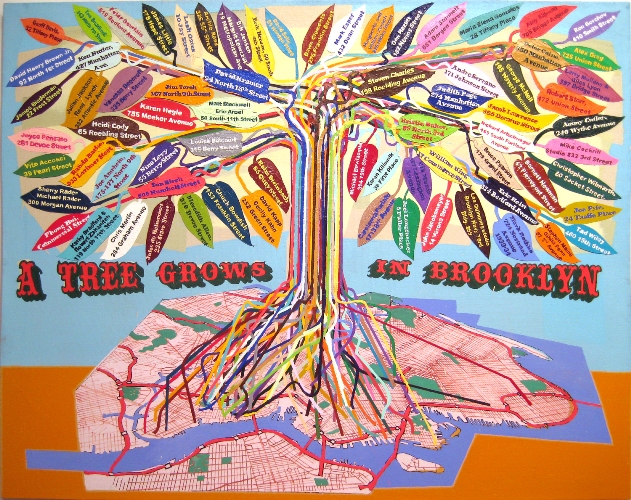
Loren Munk, A Tree Grows in Brooklyn (2006–10), courtesy of the artist
THE NEW CRITERION
February 2011
Gallery chronicle
by James Panero
On new media and the phenomenon of Loren Munk, whose work is on view at “New Year, New Work, New Faces” at Storefront Gallery, Brooklyn; “It’s All Good!!: Apocalypse Now” at Sideshow Gallery, Brooklyn; “Paper 2011” at Janet Kurnatowski Gallery; “I Like the Art World and the Art World Likes Me” at the Elizabeth Foundation for the Arts; and “#TheSocialGraph: An Evolving Exploration of Social Media Art” at Outpost gallery, Queens.
The art world that most people hear about is a dystopian one of auction headlines. It’s glossy features and gossip reporting. It’s the fast-food menu of celebrity artists arranged in starchitect-designed museum wings. It’s a world of power and money where taste gets issued by self-interested decree. And those are its better points. What makes this homogenized culture bad is how it obscures good art from public view.
A better art world revolves around nimble commercial galleries and non-profit spaces. Some of the best places for art are located in Chelsea, but many more are peripheral, alternative, and do-it-yourself (diy). Even if the art on display is sometimes bad, the vitality of this world is good, with its artist-packed openings and the chatter of conversation across a variety of styles.
The challenge for this world is how to broadcast and sustain itself with limited means in an environment that ignores it. A couple of issues back, I sounded a cautionary note about the intersection of criticism and new media. I was concerned about the messianism that accompanies new technology, especially when it’s employed by one of art’s most oxygen-depleting power brokers (see “My Jerry Saltz Problem,” December 2010).
That doesn’t mean we should disregard new media’s potential. The promise of new media is its ability to do an end-run around traditional networks of information. Facebook and Twitter have become essential tools for broadcasting shows and learning about art to see. Artists especially have benefited from becoming active online users, if only to take ownership and invest in their own representation.
For all of us, new media has elevated the issues of networking and connectivity from silent considerations into conscious actions. Thanks to Facebook, the word “Friend” is now a transitive verb. Those tools of social networking offer new ways to visualize our relationships while expanding our access to information.
Parallel to these developments, a school of art is now at work depicting the structures and connections of the art world in various graphic forms, while also using new media to draw attention to itself and the art of others.
I wrote about the paintings and video work of Loren Munk at the end of last month’s column, but they deserve further review. I am not the only one who thinks so. This is shaping up to be the Year of the Munk, as many more of us realize this quirky artist of strange diagrams and obsessive record-keeping is the prophet of a new art we are only starting to understand.
In addition to his exhibition at the gallery Minus Space, Munk has been invited to exhibit his paintings and videos in half-a-dozen recent group shows around New York. That list includes exhibitions at Storefront in Bushwick, Sideshow Gallery in Williamsburg, Janet Kurnatowski Gallery in Greenpoint, The Elizabeth Foundation in Midtown Manhattan, and an exhibition curated by the online editor Hrag Vartanian at Outpost gallery in Ridgewood, Queens, called “#TheSocialGraph: An Evolving Exploration of Social Media Art.”
Munk creates his online videos of gallery openings and studio visits under the pseudonym James Kalm. If you take away anything from this column, search for his videos on YouTube under “JamesKalm” and “JamesKalmRoughCut” and subscribe to his feed. I predict this singular record of diy clips, most of them ten-minute windows on the art of today, will be more important to art history than almost anything being written about the contemporary scene.
I didn’t always think so. When I first heard about Munk’s video project several years ago—which he described as an expansion of his artistic practice—it sounded like an obsessive excuse to get out of the studio. Munk says he started filming around 2006, when he accidentally hit the video switch on his point-and-shoot camera. He has now made 500 or so videos, all filmed with similar low-tech equipment and a large memory card.
When I initially saw them, the look of the videos seemed as weird as the concept. Each report begins with Munk arriving at his gallery destination by bike (heavy breathing is a constant as he narrates what he encounters). His scenes combine observations of the people he sees with close-up views of art and thumbnail sketches of the artists. Since he films the gallery shows unannounced and often unauthorized, he holds his camera out as if taking a digital picture. Other times the camera dangles from a strap around his neck. The shooting style appeared rough back in 2006. Today it resonates with the amateur videos we all seem to be taking with our smart phones and flip cameras.
The amateur idiosyncrasies of these videos ultimately make them inviting. Munk records and overlays the performances of street musicians to get around the limitations of professional copyrights. He also thanks his wife Kate at the end of each clip. These are great touches. As opposed to most video art, which attempts to destabilize and confuse, his videos become more sensible with each view. Watch enough of them and it’s professional programming that starts to seem strange. Amateur videos have become the new normal.
Munk’s videos relate not only to new media (technically, he has created a video blog or “vlog”) but also to social networking and indeed his artistic project. The James Kalm Report connects the dots between artist, artwork, and viewer. It relates one show to the next. Through filming out-of-the-way galleries and non-headline personalities, his work documents an artistic network we might not otherwise see and broadcasts it to the greater public, without costing a dime (and without so far earning him a penny).
Munk came to New York to paint. When he’s not recording videos or writing about shows for The Brooklyn Rail, he is painting in his studio. He has been living and working in the same Red Hook loft since 1979. This history gets reflected in both his style in oil, which is heavily impastoed, rough, and rich in color, and in the connections he now depicts in his work.
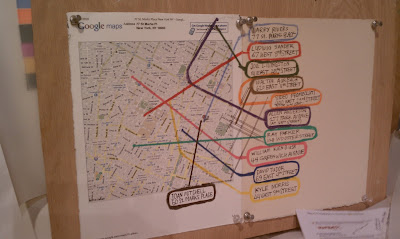
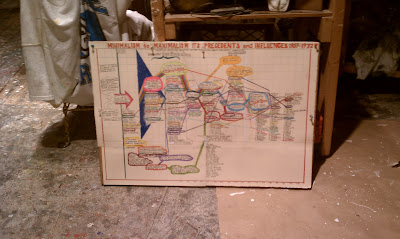
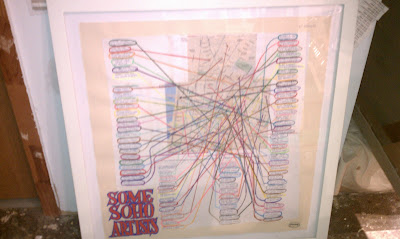
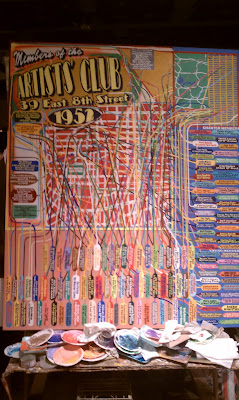
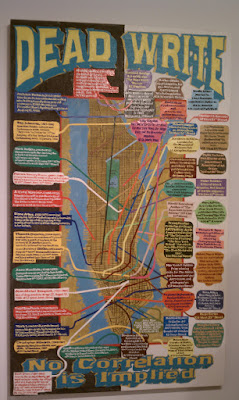
Munk makes the case that personal connections matter and have always mattered in the world of art. Our links to the past matter as much as our connections to the present. So his paintings record the New York art scene in maps and lists from 1900 to today and document the inter-connectivity of a city’s artistic culture. For Munk, social media art, his videos, and his writing are all extensions of a reverential urbanism. (Hint: The City of New York could do worse than employ this urban historian for some grand artistic project.)
Munk’s best work highlights the connections of the artistic world he is invested in. Of his paintings now on view, the example up at Sideshow, Symbolic Clusters (STUDY) (2009–10), was my least favorite, because its analysis of the influences of contemporary British art seemed the most remote to Munk’s own world. In contrast, A Tree Grows in Brooklyn (2006–10) at the Elizabeth Foundation is iconic. Here, lines of color rise up from a map of Brooklyn to form the trunk of a tree, which then open into leaves that serve as labels for the location of artist studios—the flowering of an art scene in Munk’s own back yard.
As for their composition, these paintings, much like his videos, can seem strange, almost garish, but their weirdness becomes welcoming. Munk makes a conscious decision to connect with the history of painting not only in his work but also through his medium. His influences include the English Occultist Robert Fludd and the modernists Alfred Jensen and Ad Reinhardt. Hans Hofmann and Clement Greenberg hover in the background and sometimes feature in the diagrams themselves. The eccentricities that creep into Munk’s style also make his paintings instantly recognizable. The colors and typography borrow the visuals of signage to state their messages as boldly as possible. They are the exclamatory paintings of a reserved artist.
The Elizabeth Foundation show, curated by the artist Eric Doeringer, offers a survey of many of the younger artists working in modes related to Munk’s own. Art Basel Miami Beach Hooverville, by William Powhida and Jade Townsend, is already a modern classic. This hyper-detailed drawing depicts a fictional shanty-town of artists, critics, dealers, and collectors congregated outside the gates of the Miami Beach Convention Center, where arguably the country’s most important and most superficial art fair takes place each December. Friends and enemies are identified by name. Inside jokes are everywhere. Recently someone said the work resembled the centerfold of an old issue of Cracked magazine, a description that hints at the work’s punk humor mixed with a fantasy view of adult depravity and adolescent triumph. In the back of the image, beneath a plume of smoke, the artists depict their own “Siege Tower” made of “wood, rope, steel, iron will” directed at the front gate of the fair.
Through visual criticism, appropriation, and humor, the message here is that the good art world is coming to take on the bad. Powhida, along with the artist Jennifer Dalton and the alternative gallery owner Edward Winkleman, are leading this charge through artistic projects and webcast symposiums called #class and #rank (those #s are Twitter “hashtags” used for online organization). Powhida, a high school art teacher, has even developed a bratty alter ego for deep cover in the boozy-money world of celebrity art.
Munk’s project, though less confrontational, ultimately seems more subversive. Rather than take on the power and corruption of the bad art world, Munk strengthens the networks of the good. At the very least, he shows us the art world alternative. We should take note that on February 3, Munk, Powhida, Dalton, and Doeringer will meet at the Elizabeth Foundation to discuss their influences and try to arrive at a common term to describe their art (Munk likes “Informationism.”)
If the Elizabeth Foundation show brings together the criticisms of the mainstream, the group show now at Sideshow Gallery reveals the triumphs of the alternative network. The Brooklyn gallery’s owner, Richard Timperio, is not dissimilar from Munk in his attraction to the artists of his local scene. His annual group show brings together everyone he knows. With something like 500 works arranged floor to ceiling, this exhibition breaks every rule of gallery etiquette. In doing so it becomes a fantasy show of artistic friendships. The art of modern masters like Paul Resika, Thornton Willis, Nicolas Carone, Dan Christensen, Ronnie Landfield, Larry Poons, Peter Reginato, and Tadasky gets positioned next to the work of people (husbands of artists, other gallery owners) that you didn’t even realize made art. Then there are those under-represented artists here like Dana Gordon, Lori Ellison, and Tom Evans whom you would like to see much more often. Loren Munk used to be one of them. Now, through the vision of his art and a lot of pedaling, he’s everywhere.