THE NEW CRITERION
September 2011
Exhibition note on "Simon Dinnerstein: The Fulbright Triptych & Selected Works” at The German Consulate General, New York.
by James Panero
Simon Dinnerstein’s painting The Fulbright Triptych has provoked many interpretations. Let me offer another.
When Dinnerstein was twenty-eight years old, he traveled to Germany with his wife on a Fulbright fellowship. His grant was to study printmaking—in particular, the printmaking of Albrecht Dürer. Yet when Dinnerstein settled into a spare attic apartment just outside of Kassel with his wife, Renée, he took up the brush instead.
At the time, in 1971, Dinnerstein was already an accomplished draftsman. He had recently composed a suite of realistic yet radiant charcoal portraits of family and friends—still some of the best work of his career. Printmaking would be the natural outgrowth of these skills; painting, not necessarily so. In fact, Dinnerstein had rarely painted before. But in what must have been a flash of creative compulsion, he conceived of and began laboring over a single monumental painting that occupied him for nearly three years.
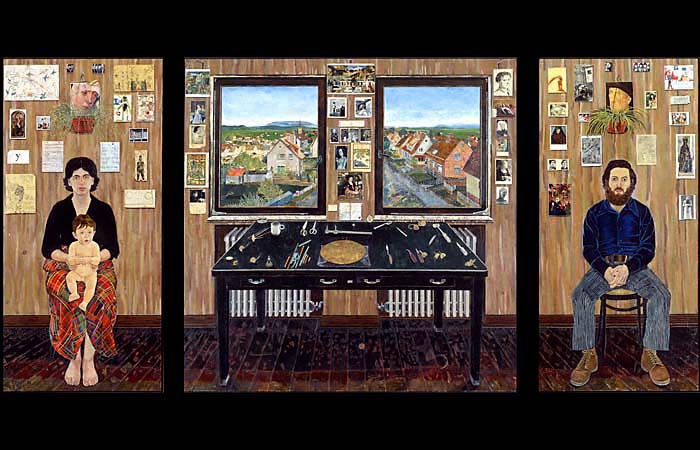
When completed back home in Brooklyn, the result was a head-scratching creation. At first glace, it appears to be a hyper-detailed vision of the artist’s German studio spread out over three panels—a square panel with two narrower sides—fourteen feet wide by six-and-a-half feet tall in total. But clearly there is something more going on here. In making the work rigidly symmetrical and inserting odd details, Dinnerstein created a jigsaw puzzle where the pieces start together and only make sense when they get pulled apart.
So what is The Fulbright Triptych? The Fulbright committee can sleep well. Dinnerstein studied printmaking in Germany after all. At its center, The Fulbright Triptych is about printmaking.
This is literally true. The middle panel of the Triptych depicts a black worktable with an engraving plate front and center. Beside it are the tools of the printmaker: the burnisher, scraper, burin, mat cutter, and lens. The plate itself is made of etched gold leaf, meant to stand in for copper. This appears to represent the plate used to create Angela’s Garden, a burin engraving of a leaf-covered backyard, viewed from above, that Dinnerstein had made in 1970. The current exhibition, which I saw in an earlier iteration at the Tenri Cultural Institute in New York’s Greenwich Village, includes this print on a wall facing the Triptych.
Out of this literal depiction emerges the Triptych’s figurative significance and the religious reverence with which Dinnerstein reveals the creative process. Surrounding the copperplate, which looks like a halo on an altar, Dinnerstein took the world around him in the early 1970s and stamped it in the work. This included the view of the German hamlet outside his attic windows, the metal radiators beneath them, and the scuffed floorboards, all rendered in obsessive symmetrical detail—symmetry here representing printmaking in its simplest binary form. Dinnerstein painted the wall of the room as a pinboard, with each hole created by pressing into the wet paint. He then depicted dozens of personal letters, drawings, and photographs as though they were tacked to this wall. The images include masterpieces by Vermeer, Holbein, Donatello, Degas, and van Eyck, charming child drawings, passport photographs, and handwritten letters and poems. Reproductions of reproductions, all this ephemera look less like objects rendered in space than images reprinted in paint on the canvas surface.
On the side panels are the family portraits, themselves stiffly pressed onto the painting. The artist appears on the right, his wife and young daughter on the left. At first they seem to be sitting together in their German apartment. But the timeline does not make sense. The family in the Triptych did not exist when Dinnerstein was in Germany. His daughter, Simone Dinnerstein—now an acclaimed classical pianist—wasn’t even conceived when the painting began.
The family dynamic of the Triptych can be read countless ways. The dislocation of the scene—that the Triptych isn’t about a particular time and place—lends an oddness to the arrangement and suggests a hidden meaning. In one sense, the solitary artist appears cut off from his family by the studio. He’s alone on one side, his wife and child are on the other, and his studio equipment separates the two sides. In another sense, the family is not so much a distraction from the artist’s work as a conclusion. For in the family arrangement it’s possible to see the echo of printmaking, with the printmaker’s table representing human reproduction, and the stamp of the parents imprinted on the child.
A midrash of discussion now surrounds the Triptych. This in itself speaks to the painting’s powers of multiplication. Timed to the exhibition, Milkweed Editions has published a collection of these writings called The Suspension of Time: Reflections on Simon Dinnerstein and The Fulbright Triptych. The one mistake of this publication appears on the cover of the book. Here only the right panel of the Triptych has been reproduced. Although obsessive, the triptych is anything but artist-centered—more like decentered—and so the publication wrongly appears to revolve around the artist.
The rest of the book gets it right. Over forty writers take front and center with essays and letters occasioned by the work. Their observations serve to propagate the painting much like the scraps and postcards reproduced on its surface. Like those scraps, often the smallest observations become the most rewarding.
Readers of this magazine may take particular interest in the several New Criterion contributors who appear in the book, including Daniel Mark Epstein, John Russell, and Guy Davenport—who observed that Dinnerstein “took the family to be the irreducible unit of civilization.”
“The Triptych was born at the same time I was, and it contains my parents’ dna just as much as I do,” writes his daughter Simone. “When I look at the Triptych I see where I come from. And if I wanted to tell someone who I really am deep inside, I would just need to show them those three panels.”
The composer George Crumb notes, “I love his sense of ‘time suspension,’ suggesting that all earlier times may coexist with the present time.” This observation not only lends its title to the book but also reflects the non-chronological assortment of material reproduced in it, with letters from the 1970s following more contemporary essays.
The current exhibition—a small survey of Dinnerstein’s work paired with the Triptych—will come down at the German consulate in mid-September. The Triptych itself will continue to hang in the consulate’s lobby near the United Nations through mid-March, on loan from the Palmer Museum of Art at Pennsylvania State University, which purchased it from Dinnerstein’s dealer George Staempfli in 1982. It’s too bad it ever has to leave town. Conceived in Kassel, The Fulbright Triptych seems to be such a product of the art of 1970s New York while managing to be timeless.