A Classical Illness

Pandemics are not always biological. Sometimes they are ideological. This summer certainly saw a plague of ruin descend over the cultural landscape. Even more alarming, there was little immune response against it among the institutions designed to stop its spread. Political viruses do have a way of evolving from seemingly inert strains into superbugs. Suddenly, they seize the brain, boil the muscles, and silence dissenting voices.

A cultural pathologist might conclude that anarchic strands have been sloshing around the fringes for decades. Their symptoms appeared in the World Trade Organization protests of 1999, in the Occupy Wall Street encampments of 2011, and on sundry other occasions. Undoubtedly, this sickness shares genetic makeup with the May protests of the Soixante-huitards, the radical affinities of the 1930s, and the many other anti-civilizational outbreaks in recent history. Ideologues have been tinkering with the infective code for a long time. Now in 2020, this virus develops a new mutation and latches onto the country’s sympathetic racial conscience.

Like most active viruses, we still do not fully understand it. A society in lockdown, a killing in a far-off state: the atmosphere was ripe for opportunistic infection. But an infection of what? In the pandemonium and the undermining of law and order, the summer riots could never have been about “black lives.” I doubt many know what they are spreading. I rather suspect they believe a new inquisitional disease, euphemistically called “cancel culture,” might be avoided if they first give the illness to others. They are wrong, of course; the revolution always eats its own as the choicest cuts of meat.

Still, there may be no other explanation for why figures and figureheads are being toppled in such violent manifestations. After all, online denunciations may require little, but it takes no small amount of energy to pull down a statue. In either case these are viral projections, a better you than me—and the yous are getting harder to find by the mes. That is why we keep seeing ever more fevered “canceling” and ever less regard for the “culture” these figures represent.

The spread of vandalism to just about every corner of the Western world might tell us something deeper about the pandemic we now face. This was never about Confederate monuments. That much is now clear. Statues of America’s Founding Fathers have been smashed and burned. More are on the chopping block. Christian iconography has been desecrated. Monuments to Gandhi and Churchill are under threat. Even memorials of the great emancipators and abolitionists—Lincoln, Grant, Matthias Baldwin, Hans Christian Heg, John Greenleaf Whittier, the Massachusetts Fifty-Fourth Regiment—have been defaced. What should we make of the coroner’s inquest over this death of reverence?

These attacks at the hands of our own vingtards have paralleled the tearing down of words and opinions that have been accused of animus regardless of true meaning. For example, this summer, by executive order, the governor of Rhode Island removed “Providence Plantations” from the full name of the state on official documents. “We can’t ignore the image conjured by the word plantation,” the governor said, of a “phrase that’s so deeply associated with the ugliest time in our state and in our country’s history.” It matters little that the actual providential plantation Roger Williams founded in 1636 was one of the more progressive jurisdictions in the world and the first colony, on paper at least, to abolish slavery.

The Surrogates Court Building on Chambers Street, Manhattan. Photo: Todd Maisel.

The Surrogates Court Building on Chambers Street, Manhattan. Photo: Todd Maisel.

It might be a fool’s errand to look for the patterns of the mob. Their targets are often arbitrary. Much of it is chaos for its own sake: glass to shatter, stores to loot, an attack on whatever is nailed down—an undermining of anything set in stone. In the sloshing, fluid dynamics of mob rule, the results are never static and never enough. Destruction leads to more destruction.

At the same time, while the figures have only become more disparate, the solid forms under assault have shown striking similarities. By and large, they are classical forms. In a way, their desecration is then an attack on the classical orders, and in particular the classical liberal order, they represent. This is not to suggest that today’s iconoclasts are dissident classicists. Nevertheless, the classical language of monuments and monumentality may remain more comprehensible to the attackers than the forgotten figures this language looks to honor. For the diseased spirit, classicism is a language calling out for cancelation.

Just look at the many recent images of vandalism. Classical plinths and pedestals have been covered in spray-paint. Classical order and law and order are conflated as the classical language of art and architecture is drowned out by anti-police slogans, epithets, and defilements. In downtown Manhattan, after they were allowed to settle into another encampment, vandals defaced the classical Municipal Building, the Tweed Courthouse, and the Surrogate Court Building—damage that Manhattan’s borough president said may now cost millions to clean. Meanwhile, New York’s radical mayor has cut the city’s anti-graffiti budget as he paints his own slogans across the avenues and appoints his wife, Chirlane McCray, to head his task force on racial redress.

As civilization from the Renaissance through the Enlightenment on to America’s founding has drawn on knowledge of the classical liberal world, the association of classical forms with an illegitimate order has long been a central tenet of anti-liberal ideology. Racism and whiteness have now been added to these accusations in an attempt to silence America’s classical language and to undermine the country’s classical inheritance. For example, “the primacy of Western (Greek, Roman) and Judeo-Christian tradition” is now considered one of the “aspects and assumptions of whiteness,” according to the Smithsonian’s own National Museum of African American History & Culture. In an astonishing display of racial bigotry, the museum adds the classical tradition to other “signs of whiteness” that include individualism, hard work, objectivity, the nuclear family, rational linear thinking, decision-making, respect for authority, delayed gratification, punctuality, and being polite. Similarly, earlier this year, after the Trump administration proposed a classical mandate for the design of new Federal buildings in keeping with Washington’s classical vernacular, Michael Kimmelman of The New York Times associated the proposal with “authoritarian regimes of the past” and a style that “dredges up images of antebellum America.”

Architectural plan from the 2013 renovation of Roosevelt Hall,  American Museum of Natural History, front view. Photo: Roche Dinkeloo.

Architectural plan from the 2013 renovation of Roosevelt Hall, American Museum of Natural History, front view. Photo: Roche Dinkeloo.

There have always been diseased notions and crazed actors. What is new is the abdication of leadership and the collapse of institutional vitality that have permitted their fevered actions to spread. Those at the top of our institutions are the first to sacrifice their cultural charge in order to protect their salaries and status. Curators and writers, students and teachers, the art on the wall and the architecture around it—everyone else and everything else is up for grabs.

This sad fact recently came into sharp relief at a dénouement on the steps of the American Museum of Natural History. File this under “closing soon”: as of this writing, there may be little time remaining to see the equestrian statue of Theodore Roosevelt. Located since 1940 in front of this New York institution, the statue serves as the focal point of the official state memorial to the naturalist, president, author, and statesman. In late June, museum leadership caved to protesters and requested that the city send the sculpture to pasture. Before politics runs roughshod over the Rough Rider, the work deserves another look in situ.

This sculpture by James Earle Fraser is based on Verrocchio’s grand equestrian statue of Bartolomeo Colleoni, finished in 1495 and located in Venice’s Campo Santi Giovanni e Paolo. Fraser’s work completes the classical arch designed by John Russell Pope that is both the museum’s entrance and another key part of the memorial program. The addition of the dignified American Indian and African guides that flank Roosevelt, now considered the most offending elements of the sculpture, were intended to symbolize the “continents of Africa and America, and if you choose may stand for Roosevelt’s friendliness to all races,” according to Fraser. Together the three figures lead a triumphal procession out of the arch, trailed this time not by the spoils of war but rather by the knowledge contained in the institution behind it. In his memorial proposal of 1928, Pope was right to consider the trio together as a “heroic group,” one that should be considered ahead of its time for including two non-Western people now guiding the equestrian figure. Without this sculpture at its center, the monument will be akin to the Lincoln Memorial without Daniel Chester French’s statue of Lincoln or the Jefferson Memorial (another Pope masterpiece) without Rudulph Evans’s statue of Jefferson.

Architectural plan from the 2013 renovation of Roosevelt Hall,  American Museum of Natural History, side view. Photo: Roche Dinkeloo.

Architectural plan from the 2013 renovation of Roosevelt Hall, American Museum of Natural History, side view. Photo: Roche Dinkeloo.

For years activists have targeted Pope’s grand classical monument to Roosevelt. In 2017 protestors stormed the museum’s Roosevelt Rotunda, designed by Pope as a hallowed Roman space on the other side of the arch. They denounced the memorial as an emblem of “patriarchy, white supremacy and settler-colonialism.” Vandals also defaced the statue’s granite pedestal with blood-red paint and labeled it a “monument to racial conquest.” Despite these episodes, in that year the city’s own commission tasked to investigate the statue’s history and iconography for racial offense chose not to recommend its removal. The commission even questioned the ethics, and legality, of altering this central part of Roosevelt’s official state memorial, which is closely tied to the history and forms of the entire museum.

These judgments ultimately meant little to Ellen Futter, the museum’s current president, and her trustees. Futter used the summer riots as an opportunity to rid herself of a problem at her doorstep while also handing an ideological victory to the mayor. “We have watched as the attention of the world and the country has increasingly turned to statues as powerful and hurtful symbols of systemic racism,” Futter said in a joint statement. To which the mayor added that the “problematic” statue “explicitly depicts Black and Indigenous people as subjugated and racially inferior.”

“Every statue and street and building has been renamed, every date has been altered. And the process is continuing day by day and minute by minute.” So George Orwell wrote in Nineteen Eighty-Four. “History has stopped. Nothing exists except an endless present in which the Party is always right.” The attack on history from a “museum of history” shows how this radical disease now infects the hearts of our institutions. Sometimes a plague is so deadly it dies of its own lethality. Something similar may happen to our own wave of viral politics. At the American Museum of Natural History, the institution’s own Theodore Roosevelt Rotunda tells the story of our twenty-sixth president in quotations and three monumental murals painted by William Andrew Mackay in 1935. One canvas depicts Roosevelt’s support for the then-controversial but ultimately correct theory that the mosquito, and not poor sanitation, was the cause of Yellow Fever in Panama.

Perhaps one day we will better identify and isolate the vectors of our own ideological pandemic. Until then, a quote by Roosevelt, also displayed in his Rotunda, might at least inspire some renewed resistance: “Character, in the long run, is the decisive factor in the life of an individual and of nations alike.”

Like the Plague

THE NEW CRITERION, May 2020

Like the plague

On the art of illness in Venice.

The history of culture is a history of plague. The Abrahamic religions were forged in it. The deity Horus might be a bigger bird today were it not for the ten plagues of Egypt. “The Egyptians shall know that I am the lord, when I have gained honor for Myself over Pharaoh, his chariots, and his horsemen,” we read in the Book of Exodus. Each spring, the Passover holiday marks the freedom of the Jews from Egypt by reenacting the Israelites’ salvation from the torments that plagued Pharaoh. The ten drops of wine ceremonially spilled in the Seder meal are meant to cast out the bloody water, frogs, lice, flies, pestilence, boils, hail, locusts, darkness, and firstborn death, the last of which “passed over” the Chosen People. Plague not only meant the exodus of the Jews and the beginning of the end of Pharaoh. Plague also meant the start of the world as we know it today.

Yet somewhere along the way to modernity these important lessons were lost if not willfully forgotten. Primary among contemporary fallacies is the belief that science alone offers salvation. Pandemics, to the contrary, and often quite inconveniently, remind us of the limitations of human power, and so are readily forgotten. For this reason, the Spanish Flu epidemic of 1918 quickly came to be regarded as a historical footnote rather than the world-defining event that it was—killing, as it did, more people than were killed in battle during World War I. There are few memorials to this Spanish influenza. The literature it inspired is scant. H. L. Mencken noted how the 1918 virus had “an enormous mortality in the United States and was, in fact, the worst epidemic since the Middle Ages,” yet it is “seldom mentioned, and most Americans have apparently forgotten it. This is not surprising. The human mind always tries to expunge the intolerable from memory, just as it tries to conceal it while current.”

We don’t have to look far and wide to see how disease has challenged and shaped our increasingly cosmopolitan world. The modern epidemics of cholera, typhus, yellow fever, measles, smallpox, and polio, among a host of other infectious diseases, might have better prepared us for our current crisis—if only their histories were better remembered and their dead and injured duly honored. In a more just world, London’s Broad Street pump and New York’s High Bridge would both be shrines to our cholera dead, one for marking a locus of contamination, the other for the delivery of clean Croton water.

Epidemics were a central feature of Venice, with its “putrid smells,” “febrile effusions,” and “revolting sultriness,” in the words of Thomas Mann, long before Death in Venice. From its swampy beginnings through its mercantile heights, the Most Serene Republic has been defined by disease. Yet rather than turning away from its fate, Venice has used illness as inspiration for its greatest works of art and architecture. Such thoughts have been on my mind since I toured the city one autumn not long ago with Frederick Ilchman, the curator and Tintoretto expert, whose exhibition of the cinquecento master was on view at the time at the Palazzo Ducale. Now with the Covid quarantine—which, in the West, began appropriately enough in Lombardy and the Veneto—Venice’s story of sickness and survival takes on renewed significance.

The author and company before the facade of the Chiesa di San Sebastiano, Venice.

The author and company before the facade of the Chiesa di San Sebastiano, Venice.

It is the deliverance of Venice from plague that should give us inspiration in our own age of pandemics and pandemonium. A center of maritime trade founded on the saltwater marshes of a lagoon, Venice has been hit hard by the diseases of ship and swamp. It was primarily the waves of bubonic bacterium, Yersinia pestis, that swept through Europe in the last millennium which affected the port city in ways that continue to shape its identity. A disease that infects the lymphatic system, the bubonic plague became known as the Black Death in its most deadly outbreak of the mid-fourteenth century for its ability to swell and burst the lymph nodes, further spreading illness before causing necrosis, fever, and death. Its horrific effects would put the novel coronavirus to shame. The plague could kill within days. Its signature boils became known as buboes, from the Greek word for groin, where they often appeared. From bubo, we may, in fact, have gotten the term “boo-boo.”

As the bubonic plague spread throughout Europe, killing upwards of fifty million people—over half the population of Europe­—the Venetians turned to the “plague saints” for protection. A central figure was Roch. The Golden Legend, a collection begun by the thirteenth-century archbishop Jacobus da Varagine and added to by subsequent church historians, includes a CliffsNotes version of his miraculous deeds. Saint Roch, known in Italian as San Rocco, was born around 1300 to a nobleman in what is now the southern French city of Montpellier. Taking a strict vow of poverty, he made his way to Rome to tend to the plague-ridden. When he became ill himself, he was cast out of town to die in the forest. Here he made a home of branches and drank from a miraculous spring. A hunting dog brought him bread and licked his wounds, restoring him to health. Roch then returned to his hometown only to be mistakenly imprisoned and die a spy. He did not want to be glorified by revealing his true identity.

Tintoretto, St. Roch Visiting the Plague Victims, 1549, Oil on canvas, Scuola Grande di San Rocco, Venice.

Tintoretto, St. Roch Visiting the Plague Victims, 1549, Oil on canvas, Scuola Grande di San Rocco, Venice.

In addition to being the patron saint of dogs and pilgrims, Roch became venerated for his ability to survive illness. In the sixteenth century, the plague-ravaged Venetians dedicated a new church and confraternity building, or scuola, to Roch, both to aid the city’s sick and to venerate his relics, newly brought to La Serenissima. The Scuola Grande di San Rocco has become known as the “Sistine Chapel of Venice” for its cycle of religious paintings created by its most famous member, Tintoretto. Yet in the church next door to the Scuola, often overlooked by tourists, the cinquecento furioso artist also created a set of four monumental scenes from the saint’s life. They remain some of the most affecting works in Venice for depicting Roch’s devotion in the face of an invisible scourge.

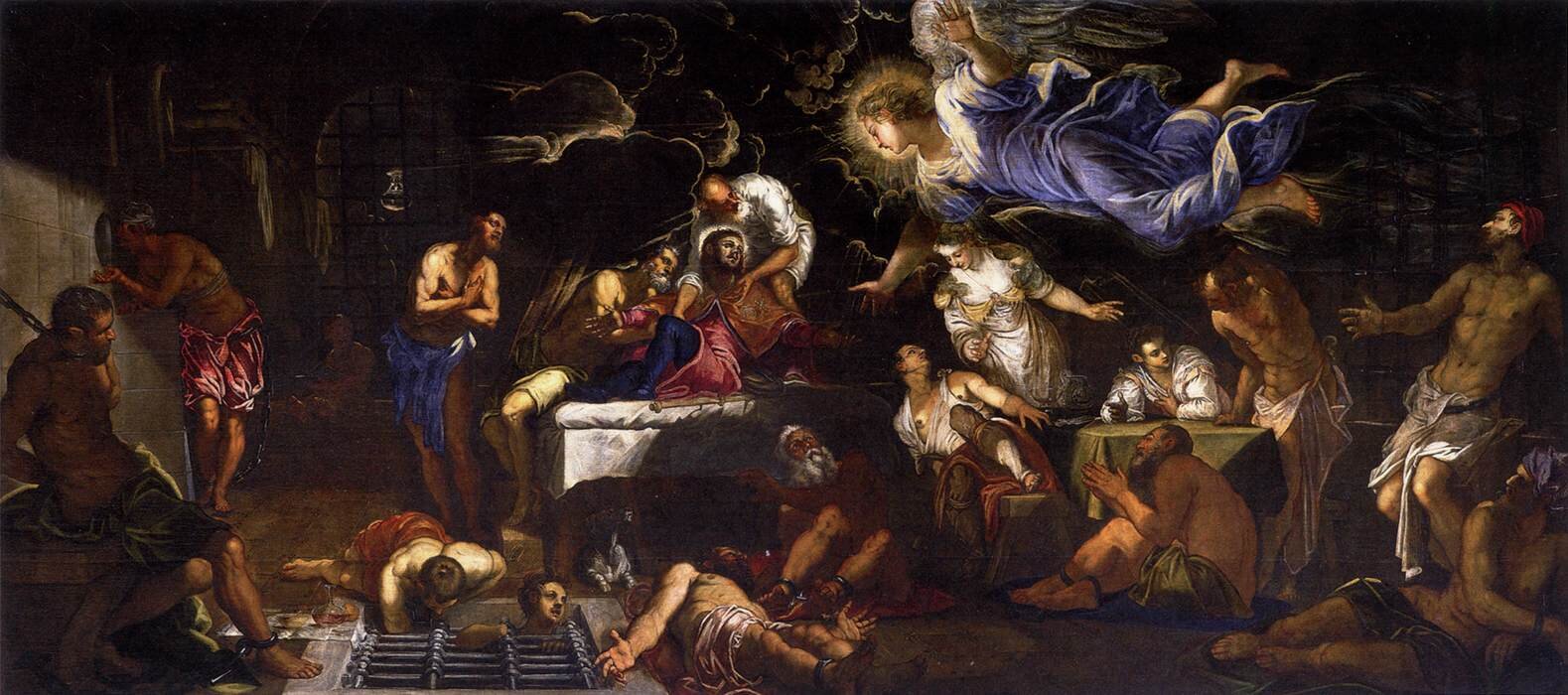
Here, for the chancel, Tintoretto conceived a cycle of four paintings from Roch’s final days to surround the saint’s remains. St. Roch Visiting the Plague Victims (1549) is arguably the first representation of plague in Venetian art. Facing this work is St. Roch in Prison Comforted by an Angel, completed near the end of Tintoretto’s overall work in the Scuola in 1567. Both are of cinematic scope—sprawling, dark, and filled with pathos. Tintoretto had a great feel for the placement of his compositions, considering the height and angle of a work to the viewer and maximizing those effects to narrative advantage. Here seen from below and to the side, each work spirals into view, drawing the eye up into both the fictive space of the painting and the real space of the reliquary-altar, where Roch’s body is preserved.

Tintoretto, St. Roch in Prison Comforted by an Angel, 1567, Oil on canvas, Scuola Grande di San Rocco, Venice.

Tintoretto, St. Roch in Prison Comforted by an Angel, 1567, Oil on canvas, Scuola Grande di San Rocco, Venice.

Not far away, in the sestiere of Dorsoduro, another plague saint gets his due. Built on the site of a medieval hospice, the church of Saint Sebastian, or the Chiesa di San Sebastiano, received its own cycle of paintings, this time by the Renaissance master Paolo Veronese. Sebastian may be best remembered for his willowy body pierced with arrows—long a favorite for artists. Many forget the early Christian martyr survived this first attempt at execution. With spent arrow in hand, as depicted by Veronese, Sebastian went to reprove Diocletian for his sins—an insult for which the pagan emperor finally had him clubbed to death and thrown in the Cloaca Maxima. Since buboes resemble arrow wounds, Sebastian became venerated as another saint to survive bodily torments.

In 1555, the church hired Veronese, then an emerging star of cinquecento Venice, to paint these frescoes and canvases for the ceiling, organ loft, and altar. A restrained technician in contrast with Tintoretto and his furious brush, Veronese filled every available space, from the golden-coffered ceiling on down, with paintings of Sebastian’s life and martyrdom among images of the Blessed Virgin, Esther, the Evangelists, and the martyrdoms of Saints Mark, Lawrence, and Marcellinus. Behind the high altar, Madonna in Glory with St. Sebastian and other Saints (1570)pulls the opulent program of heaven and earth together. This was the last work completed by Veronese for the church. After his unexpected death in 1588, the artist was buried here, joined by the remains of his family, a testament to his artistic achievements and this ethereal work.

Paolo Veronese, Madonna in Glory with St. Sebastian and other Saints, 1570, Oil on canvas, Chiesa di San Sebastiano, Venice.

Paolo Veronese, Madonna in Glory with St. Sebastian and other Saints, 1570, Oil on canvas, Chiesa di San Sebastiano, Venice.

As the Venetians turned to Sebastian and Roch, they also developed some of the first civic procedures for caring for the sick and curtailing the spread of epidemic disease. Long before our modern understanding of germ theory, in 1423 Venice began sequestering potentially sick visitors away from its populated islands. As thirty-day exclusions turned to forty, una quarantina di giorni gave us the word for “quarantine.” Our term lazaretto, for plague hospital, likewise comes from the name of the lagoon island by one of these early quarantine sites. And the Venetian “plague mask,” now a Carnevale favorite with its protruding nose, was the original medical prophylactic, encouraging “social distancing” while allowing space for perfumed sachets to filter out the airborne disease.

Venice’s grand institutions made no separation among faith, art, and medicine. All worked together in the power to cure. In the sestiere of Castello, the Scuola Grande di San Marco may have lost its famous paintings in the Napoleonic suppression of the lay confraternities. Tintoretto’s miraculous Miracle of the Slave, originally painted for the Scuola in 1548, now resides in Venice’s Accademia Gallery. But the opulent building, recently restored and now a medical museum, speaks to its early mission of charity and public health in the name of Mark, a healer-Evangelist. It is no coincidence that the Scuola now serves as the entryway to Venice’s modern hospital.

Saints and science still could not stop the return of plague to Venice in the sixteenth and seventeenth centuries. Between 1575 and 1576, some forty-six thousand Venetians, up to 30 percent of the city’s population, including both Titian and the painter’s son Orazio, succumbed to a particularly deadly episode. In 1630, another wave killed a third of the population. Yet the city survived. In thanks for this deliverance, the Venetian Republic erected two of its most notable landmarks: the Church of the Most Holy Redeemer, known as the Redentore, designed by Andrea Palladio on the island of Giudecca; and Saint Mary of Health, the grand domed church designed by Baldassare Longhena and known simply as the Salute, built on a million wooden piles by the Punta della Dogana at the entrance to the Grand Canal. Both transformed the skyline of the Renaissance city: one with classical order; the other with the celestial wonders of the baroque.

The Santa Maria della Salute in Venice. Photo: Moonik/Wikimedia Commons.

The Santa Maria della Salute in Venice. Photo: Moonik/Wikimedia Commons.

While most visitors are oblivious to the sources of its beauty, Venice still commemorates its history of death and salvation. As in the age of the Doge, a feast parade marks each plague. On the third Sunday of July for the Redentore, and November 21 for the Salute, temporary bridges cross the canals to bring the islands together. They are still wonders to see and cross—like walking on water, as I felt crossing to the Salute during my visit there over that recent November.

We are all Venetians now, even arguing over the nature of our illness and the costs of our quarantines, as Venice famously did in 1576. Yet as we contemplate our own modern-day plague, St. Science alone seems little able to bring our islands together. It helps to think of Sebastian, Roch, and Mary—or, at the very least, the art and culture they inspired.