Up the Riverside

THE NEW CRITERION, March 2023

Up the riverside

On New York’s Riverside Drive & Park.

Walking up New York’s Riverside Drive can be like visiting a lost civilization, like seeing the streets of Ostia Antica or Old Jerusalem. The curve of the drive, a departure from the street grid on the far west side of Manhattan, traces the landscape as it follows the bluffs overlooking the Hudson River. A procession of some two dozen monuments lines the road, memorializing the figures of history in a classical vocabulary. Apartment dwellings of nine to twelve stories in brick, terra-cotta, and stone recall the French, Dutch, and English Renaissance, with punctuations of the Gothic and the Châteauesque. Meanwhile a 370-acre park between the drive and the river offers several miles of recreation and waterfront trails while also accommodating a subterranean railroad and a vehicular parkway.

Riverside is the result of sixty years of urban development that ended abruptly less than a century ago. Yet it now seems as foreign to us as the product of another civilization. Its architectural language has since been largely abandoned. Its legacy of craftsmanship—its terra-cotta moldings and stone carvings and copper cornices—has mostly been lost. Thousands of residents still call it home and live among its relics—I count myself among them—but Riverside Drive could never be recreated today.

Despite its reputation as a “modern” skyscraper city, there are of course many old streets in New York, as well as other historic residential districts. Something of the innocent age of Henry James and Edith Wharton can be found in the townhouses of Greenwich Village. On the Upper East Side, Fifth Avenue and then Park Avenue led the parade of the city’s aristocracy uptown, while Central Park West faced them with some of the finest pre-war “hotel apartment” towers in the city.

The Schwab mansion and its surroundings on Riverside Drive, 1906–45. Photo: Irma and Paul Milstein Division of United States History, Local History and Genealogy, The New York Public Library. 

Still, for its harmony of landscape, function, and design, Riverside is a special achievement. “Heaven on the Hudson” is what the author Stephanie Azzarone calls the neighborhood in her new book on the “Mansions, Monuments, and Marvels of Riverside Park.”1 I would not disagree. “In this part of the city,” she begins,

there is so much that has always been the same and little that is new or modern. On the façades of buildings large and small, intricately carved details above doors and windows speak to character formed a century or more ago.

A full tour of Riverside would begin, as Azzarone’s does, at West Seventy-second Street, its southern border, and head north. At one time the drive extended from here all the way to Dyckman Street in Inwood, at the northernmost tip of Manhattan. Though a northbound section of the Henry Hudson Parkway now interrupts it, today you could still walk the drive some six miles to about 180th Street, to the ramps of the George Washington Bridge. Alternatively you can follow the park’s riverfront esplanade to the “Little Red Lighthouse,” the one confronted with the arrival of the “Great Gray Bridge” in Hildegarde Swift’s famous 1942 children’s book. Azzarone’s tour, complete with photography by Robert F. Rodriguez, ends at the start of the first Riverside Drive extension at West 129th Street, where the topography drops into Manhattan Valley and F. Stuart Williamson’s elegant elevated viaduct of 1898 connects the drive to the heights of 135th Street.

But first, take a detour south from Seventy-second Street to the new construction on Riverside Boulevard, a recent extension of the drive, and consider what we tend to build today. A row of postmodern high-rises leads to a cluster of glass-shard skyscrapers. These final fishbowl condominiums offer the latest in high-gloss finishes and amenities. Their modernist forms are impressive from afar and imperious up close. But of course they would not be built this way if they did not appeal to today’s apartment dwellers. Fully exposed to an elevated highway in front of them, their designs also reveal the two great shortcomings of contemporary development: the open floor-plan and the glass curtain-wall. Both tend to be coveted by the high-end condo buyer. It also happens that these features greatly reduce building costs, as fewer materials and on-site expertise are required to erect prefabricated glass components. As a developer once explained to me, their widespread appeal is the great lie of his trade.

North of Seventy-second Street it’s a different story. Rather than anticipate a future wiped clean of antique residue, Riverside Drive looked to the past to reflect the weight of history in the monumentality of its designs. Bookended by the 1902 Soldiers’ and Sailors’ Monument at Eighty-ninth Street and the General Grant National Memorial of 1897 at 122nd Street (see my “Monumental madness” in The New Criterion of April 2020), there are memorials dedicated to firemen, to women’s health, to Joan of Arc, and to a range of others that all add their own gravitas to the park and drive (see “Gallery chronicle,” January 2016). All are products of the “City Beautiful” movement of the turn of the last century. Stop by Warren & Wetmore’s Robert Ray Hamilton Fountain of 1906 at Seventy-sixth Street, designed for the watering of horses. Or walk to the John Merven Carrère Memorial of 1919 at Ninety-ninth Street, a small terrace dedicated to the architect of the main branch of the New York Public Library—Carrère died in an automobile accident just months before the library’s opening—designed by his partner Thomas Hastings.
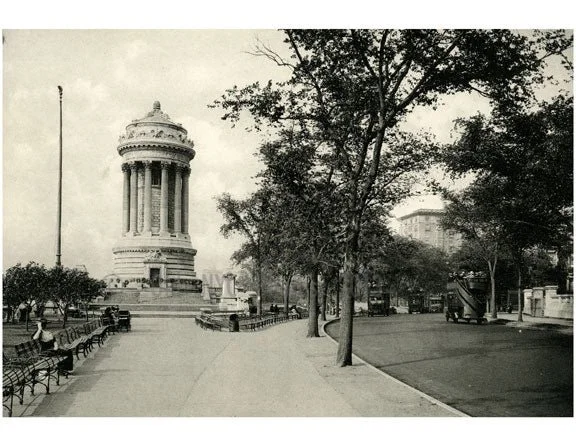
The Soldiers’ and Sailors’ Monument, ca. 1910.

Along the way, look up to the blue glazed terra-cotta window treatments of the Peter Stuyvesant Apartments of 1919 at Ninety-eighth Street, a building developed by James T. Lee, the grandfather of Jacqueline Kennedy Onassis. Consider the curving façades of the Colosseum and the Paterno, apartment buildings by the architectural firm of Schwartz & Gross, both completed in 1910, at a bend in the drive at 116th Street. Then look back to 103rd Street to the stepped finial—at one time a glistening copper-clad stupa—of the Master Apartments, originally built for the followers of the guru artist Nicholas Roerich (see “Gallery chronicle,” November 2013). This art-deco tower, one of the last constructed during the drive’s building boom, circumvented the city’s height and fire regulations by foregoing individual apartment kitchens and calling itself a hotel.

In the years after the Civil War, history weighed heavily as New York took on new responsibilities as a global capital. For a century prior, scattered farmhouses, villages, and “country seats” for downtown residents had gone up near the heights above the river. The early landowning families here, the De Lanceys, Apthorps, and Livingstons, still lend their names to modern Manhattan. Edgar Allan Poe wrote “The Raven” while renting the second floor of the Brennan Farmhouse next to what is now West Eighty-fourth Street in 1844. Yet even as the Commissioners’ Plan of 1811 laid down the Manhattan street grid, development was slow on the Upper West Side, where the rocky terrain was difficult to clear. This was especially true between Eleventh and Twelfth Avenues, where the steep and irregular drop from the heights to the river made conforming to the new grid especially challenging for residential development.

In 1866 Andrew Haswell Green proposed an act in the state legislature for the development of a park in the drop-off between these two avenues. Fresh from their successes to the east, the Central Park commissioners set about acquiring the land above Seventy-second Street from the heights to the river—or at least up to the riverfront railroad tracks laid down in 1848 to bring freight to downtown Manhattan (a railyard was located just south of Seventy-second).

In 1873 the commissioners wisely turned to Frederick Law Olmsted to design the project. Eleventh eventually became West End Avenue, while the docklands at Twelfth were absorbed into the park’s jurisdiction in 1894. In between, Olmsted used the contours of the heights to determine the sinuous shape of a new drive to bisect the two, carving out plots for development to the east that could overlook a park sloping down towards the river. His design made the most of the heights’ commanding views of the Hudson and the shoreline beyond. In two sections where the drop-off was too steep to connect his drive to the grid’s side streets, Olmsted split off a narrow carriage road, in the process creating extra “island parks.”

Olmsted “considered the existing grades and contours, the existing plantings and views, and designed a winding drive,” writes the Landmarks Preservation Commission. It was all a

seemingly simple, but for its time, remarkable design concept, which combined into a single unified design a picturesque park taking advantage of the natural attributes of a dramatic site and an urban parkway providing a landscaped environment for a residential community.

Starting in 1880, as the drive and park first opened, some twenty detached mansions went up, but this initial boom of the New York “Four Hundred” proved to be a bust. New York’s aristocracy mostly went to the Upper East Side. By 1902 a majority of the lots still remained vacant. Instead, it was the arrival of the Ninth Avenue Elevated and then the irt subway (now the 1, 2, and 3 lines) in 1904 that brought up from the crush of downtown a new business class eager for the drive’s riverside views. Developers were there to appeal to them, first with speculative row houses and, soon thereafter, with a proliferation of large rental apartments in multi-unit dwellings.

Outside of the overcrowded tenement, the apartment or “French flat” was a new concept for the upper-class New Yorker at the turn of the twentieth century. Beaux-Arts design helped to convey their respectability, as ornate lobbies and building attendants could now offer aesthetics and services surpassing those of a detached single-family home, with less expense.

The limestone façade of 190 Riverside Drive, constructed in 1908, at West Ninety-First Street. Photo: James Panero.

Over the following decades the class appeal of Riverside ebbed and flowed. During the Great Depression many spacious apartments were broken up into much smaller tenements, some even to single-room occupancy (SRO) units. It didn’t help that the open railroad tracks at the far edge of the park blocked the waterfront with an odoriferous cargo destined for the city’s meatpacking district.

It might be said that among developers, Robert Moses is now loathed by the Left nearly as much as Donald Trump. Both unabashedly appealed to the upper-middle-class city, and both focused on the future of Riverside. Moses’s great legacy here was to cover the Riverside tracks in a public-works project that cost nearly five times as much as the Hoover Dam. His 1934 West Side Improvement Plan brought in four million cubic yards of landfill and extended the shoreline 250 feet, doubling its size and turning Riverside into a genuine park while adding a new vehicular parkway. (More recently, even after federal funds had been allocated, a similar effort to bury the highway south of Seventy-second Street was blocked by Congressman Gerald Nadler due to his hatred of Trump, who controlled nearby development rights.)

Riverside’s final salvation came in the co-op conversion plans of the 1970s and ’80s. Hamstrung by the city’s market-killing rent regulations, landlords found ways to unburden their indebted structures onto their tenants. The process created thousands of small homeowners newly invested in the future of the neighborhood. As Riverside adopted a conservancy funding model in 1986 along the same lines as Central Park, neighborhood volunteers spread out every weekend to replant and fix up and tend to the dirt hills then covering the park’s grounds. Their efforts are still a defining characteristic of Riverside today.

Over time,” Azzarone concludes,

there have been multiple Riverside Parks. In the nineteenth century, Olmsted’s version was devoted to the pure enjoyment of nature. At the turn of the twentieth century, the City Beautiful’s park focused on monumental aesthetics. In the 1930s, Moses introduced the Riverside Park of recreation.

Any future for Riverside must still look to the past with reverence. Given present circumstances, such an impulse is the one most in need of renewal.

  1.   Heaven on the Hudson: Mansions, Monuments, and Marvels of Riverside Park, by Stephanie Azzarone; Empire State Editions, 240 pages, $39.95.

In Claude Monet’s Postmodern Garden

THE SPECTATOR WORLD EDITION, February 2023

In Claude Monet’s Postmodern Garden

on diving into an “immersive” exhibition

There are few topics that rankle the art critic more than “immersive exhibitions.” They must be second only to “nonfungible tokens,” whatever those are. I speak of the immersive spectacles where images of famous artwork are flashed on the walls and floors of a large white room in which you sit. Certainly, this should be outside the remit of my union card, I might think.

Until now, if you were looking for some opinion on this-or-that out-of-copyright projection venue slash tourist trap, I would simply say not my job. Maybe go see the real thing. Then we can talk.

And yet, with art on the walls, real or imagined, judgment always comes calling. Suddenly we seem to be immersed in immersion. It can be a challenge just to keep your head above the digital waters. This season, passing their subway ads and all sorts of other lures, I counted some half-dozen eye-poppers. There is, of course, The Original Immersive Van Gogh Exhibit, created by Massimiliano Siccardi. Visit the website and you will be invited to “choose your city.” Twenty American destinations are in the offing.

The same outfit, I read, also promotes Immersive Nutcracker and Immersive King Tut. Or there is Immersive Frida Kahlo: Her Life, Her Love, Her Art (nine cities for that one). Or how about Gustav Klimt: Gold in Motion, billed as “the first immersive exhibition at New York’s permanent digital art center” called the “Hall des Lumières.” Note that this exhibition should not be confused with Immersive Klimt Revolution, on view in four other cities.

So where to begin? New to these deepening waters, I decided to dip my toes into what was billed as the US premiere of Monet’s Garden: The Immersive Experience. (Kindly do not confuse with Claude Monet: The Immersive Experience, now touring eleven cities.) At Monet’s Garden, I was drawn in by the specter of an “unprecedented range of visual, phonic and olfactory stimuli” that promised a “complete and total immersion into the work and world of Claude Monet (1840-1926).” In particular, Monet’s Garden would be “enhanced by aromas of lavender wafting in the air and the romanticism of classical music to serenade visitors.” Take that, I thought, Museum of Modern Art. If you are going to offer a $47 “VIP FLEX ticket” to see a copy of Monet’s Water Lilies, when the real thing can be yours a few blocks uptown for just $25, at the very least it should smell good.

Monet’s Garden is the work of Immersive Art AG, a “Swiss creative lab,” in cooperation with Alegria Konzert GmbH. Seeing their schedule, it occurred to me that the ability to reproduce immersive shows across many continents simultaneously would make a museum curator shudder as they chase down the next Old Master loan. Maybe Walter Benjamin had it backwards all along. When it comes to the work of art in the age of immersive reproduction, like the taste of a McDonald’s hamburger that remains the same no matter where you go, ubiquity conveys an aura all its own.

The New York venue for Monet’s Garden was an event space at 30 Wall Street, across the street from the New York Stock Exchange. The anonymous environs conveyed the feel of a WeWork in receivership. Immersive shows, like sample-sale outlets and holiday-village markets, must make reliable subtenants for distressed real estate interests. And in fact, the hollowed-out floors of “Monet’s Garden” have a rich history.

In 1823, I discovered, an impressive neoclassical pile was erected here as the Branch Bank of the United States. In the 1850s the building became the US government’s Assay Office, designed to melt and measure the nuggets from the California gold rush. In the 1920s that building was demolished. The site’s last life was as a Seamen’s Bank. All that remains is the long escalator that once brought you to the loan officers on the second floor.

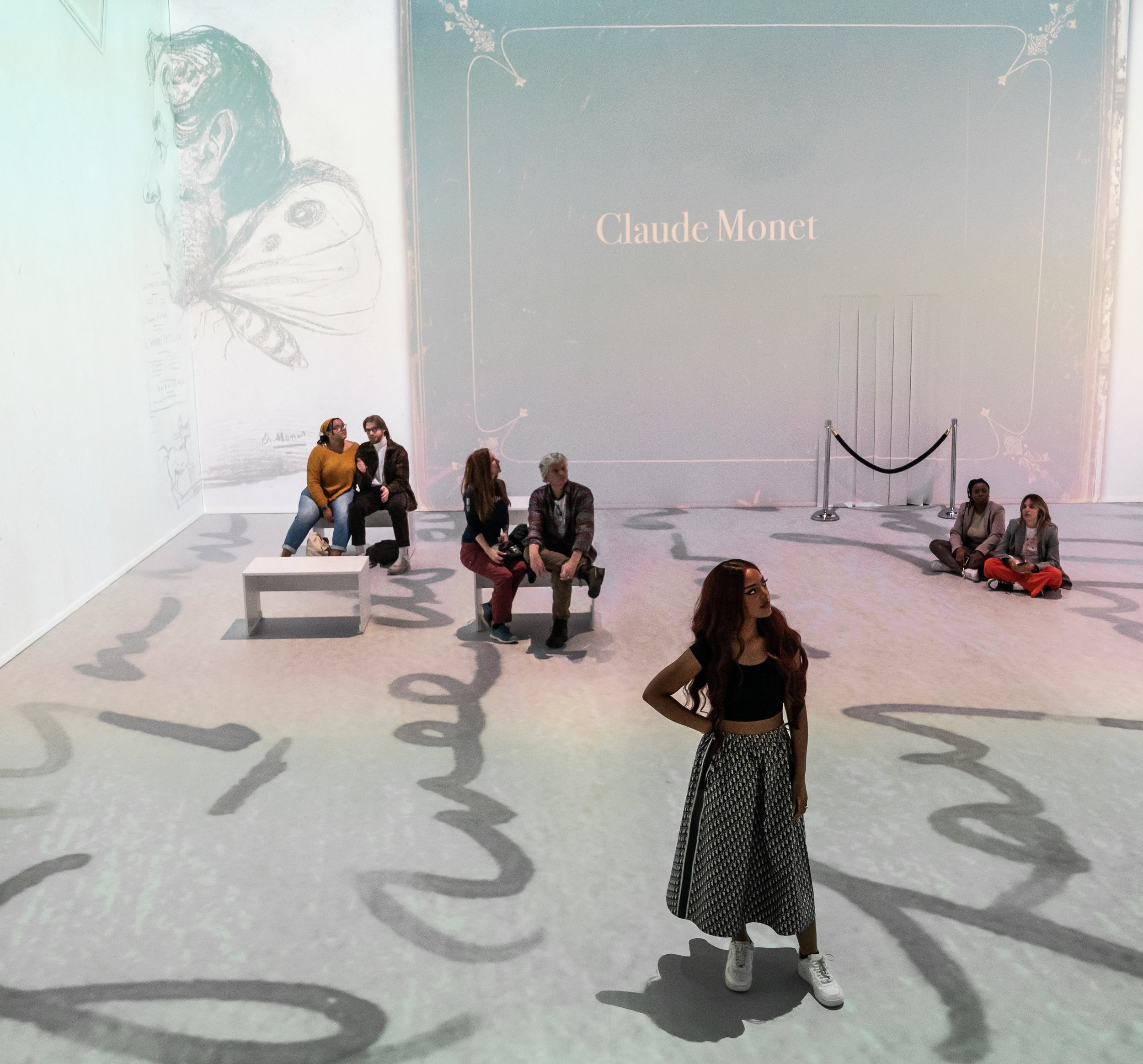
It is here that Monet’s Garden begins. And upon arrival, at first glance it all strikes one as a ridiculous scam. “Welcome to my studio” reads the introductory wall text. Reproduction Monet canvases — “Woman with a Parasol — Madame Monet and Her Son Jean Monet” (1875), from the National Gallery of Art, and “The Lunch in the Garden” (1866), from the Pushkin Museum, both available (I note) in high resolution from Wikimedia Commons — are arranged on easels for our inspection. There are visitor instructions throughout: “Pose,” “Photograph,” “Scan the QR Code,” “Immerse yourself and become part of the painting.”

The walls are covered with synthetic ivy. There is astroturf across the floor. Erik Satie plays. Theatrical lights are everywhere. A bed of fake flowers leads on to an arched Japanese “bridge.” Yes, it is that bridge, but in this case one that merely crosses a video of water projected on the floor. “Please do not jump in the pond,” reads a sign. What pond? For the first-time viewer, it takes more than a moment to understand what this is all for. Meanwhile I observed my fellow visitors — immersive veterans, no doubt — take to it right away.

I doubt these immersive experiences would be so ubiquitous without social media. For here, I came to realize, was the selfie floor — a liminal space presented in advance of the immersive video room. I watched as two millennial visitors, both immaculately kitted out, sought the room’s premier selfie spots. They knew just where to stand for the lights as they passed their iPhones back and forth, taking off their masks, tossing their hair and pouting over their shoulders.

I ended up spending longer here than expected. There were several wall labels featuring a half-decent timeline of Monet’s life. Projections of Monet paintings morphed into swirling pixels, some of which you could control by standing in front of them. Instagram filters were made available for selfie-taking, although I could not get them to work on my phone. But mostly, sitting on a bench, smelling the lavender, taking in the Satie, observing the fake flowers under shifting gradations of LED lights, I began to find the uncanny experience transporting.

Here, in this postmodern garden, I found my peace.

Back down the escalator was the immersive viewing room. I was handed a cushion and took a seat. The video installation cycled for forty-five minutes. I found it held my attention for the duration. The narrative followed the history of Monet through a holo-deck slide show of his paintings. At times, the animators added some motion to the works. The story focused on Monet’s artful construction at Giverny, where he lived for forty-three years from 1883 to 1926, building his famous garden.

The exhibition makes a compelling sensory case that the garden was the original immersive Monet experience. The artist’s opus now in Paris’s Musée de l’Orangerie — his eight monumental panels known as Les Nymphéas arranged in two oval rooms — was the painterly result of this immersive vision. Monet described these panels as “the illusion of an endless whole, of water without horizon and without shore.”

A day after my visit I happened to run across Woman with a Parasol — the real Monet — at Washington’s National Gallery. Did I feel ashamed of my prior day’s digital dalliance? Surprisingly, I did not. Rather, for a moment I sensed we had been immersed in the same nymphean waters. We had shared an “experience” together.

Carpaccio by the slice

THE NEW CRITERION, February 2023

Carpaccio by the slice

On “Vittore Carpaccio: Master Storyteller of Renaissance Venice” at the National Gallery of Art, Washington, D.C.

It is the contemporary fate of Vittore Carpaccio (ca. 1465–1525), the Venetian painter of the late fifteenth and early sixteenth centuries, now with a major new exhibition at the National Gallery of Art, to share his name with a popular dish of sliced raw beef.1 The joint appellation, as it turns out, is not a coincidence. In 1963 the Palazzo Ducale organized its first ever retrospective of this “master Storyteller of Renaissance Venice,” as the National Gallery dubs its current show. La Serenissima at the time was awash in Carpacciomania, so much so that Giuseppe Cipriani, the owner of Harry’s Bar, named his culinary invention after the reds of the appetizing painter.

The famous restaurateur was not alone in appreciating the taste of this last of the Venetian “Primitives”—one who was sandwiched, as it were, between the coolness of Giovanni Bellini and the maniera moderna warmth of Titian and Giorgione. A little over a century before Cipriani paid his respects, John Ruskin unearthed Carpaccio among his stones of Venice. The painter sent Ruskin into a “reverie” approaching a “delirium of fantasy.” Then as now the artist’s great appeal was his stunning architectural staging, one that sets his mythological, biblical, and historical storytelling in idealized Venetian cityscapes.

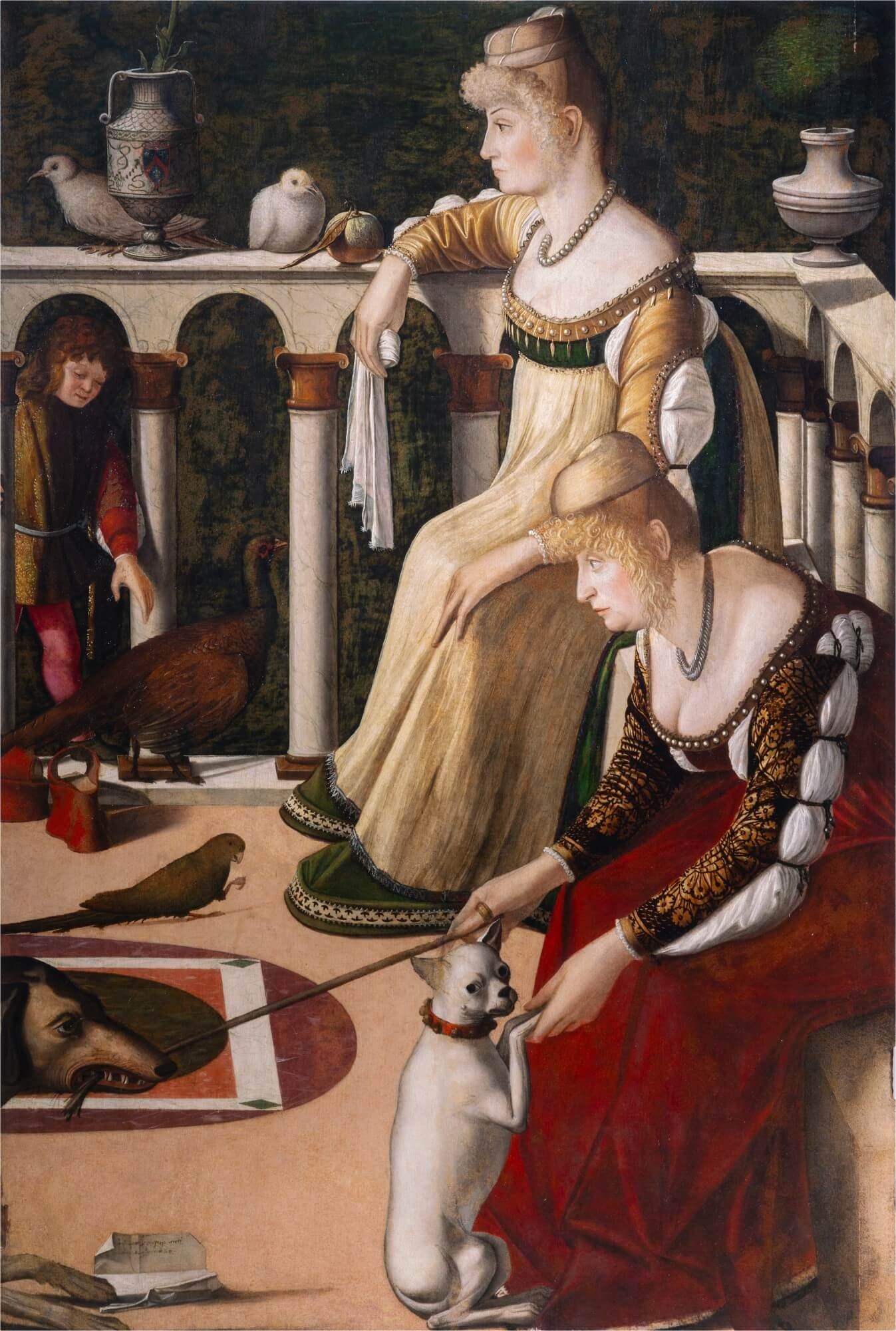
Vittore Carpaccio, Two Women on a Balcony, ca. 1492/1494, Oil on panel, Fondazione Musei Civici di Venezia, Museo Correr, Venice.

In his Guide to the Principal Pictures in the Academy of Fine Arts at Venice of 1877, Ruskin placed Carpaccio at the apex of Venice’s “classic and mythic” age. An honorary member of the Accademia, for weeks Ruskin sat and copied Carpaccio’s monumental cycle of paintings of Saint Ursula, the artist’s most famous set of works, originally created for the Scuola di Sant’Orsola confraternity. “I went crazy about Saint Ursula,” he said of the recently restored works in the Accademia museum. In St. Mark’s Rest, his epilogue to The Stones of Venice, Ruskin even bumped Bellini from his top spot to declare Carpaccio’s Two Women on a Balcony, in the Museo Correr across the Grand Canal, as “The best picture in the world . . . and I know no other picture in the world which can be compared to it.”

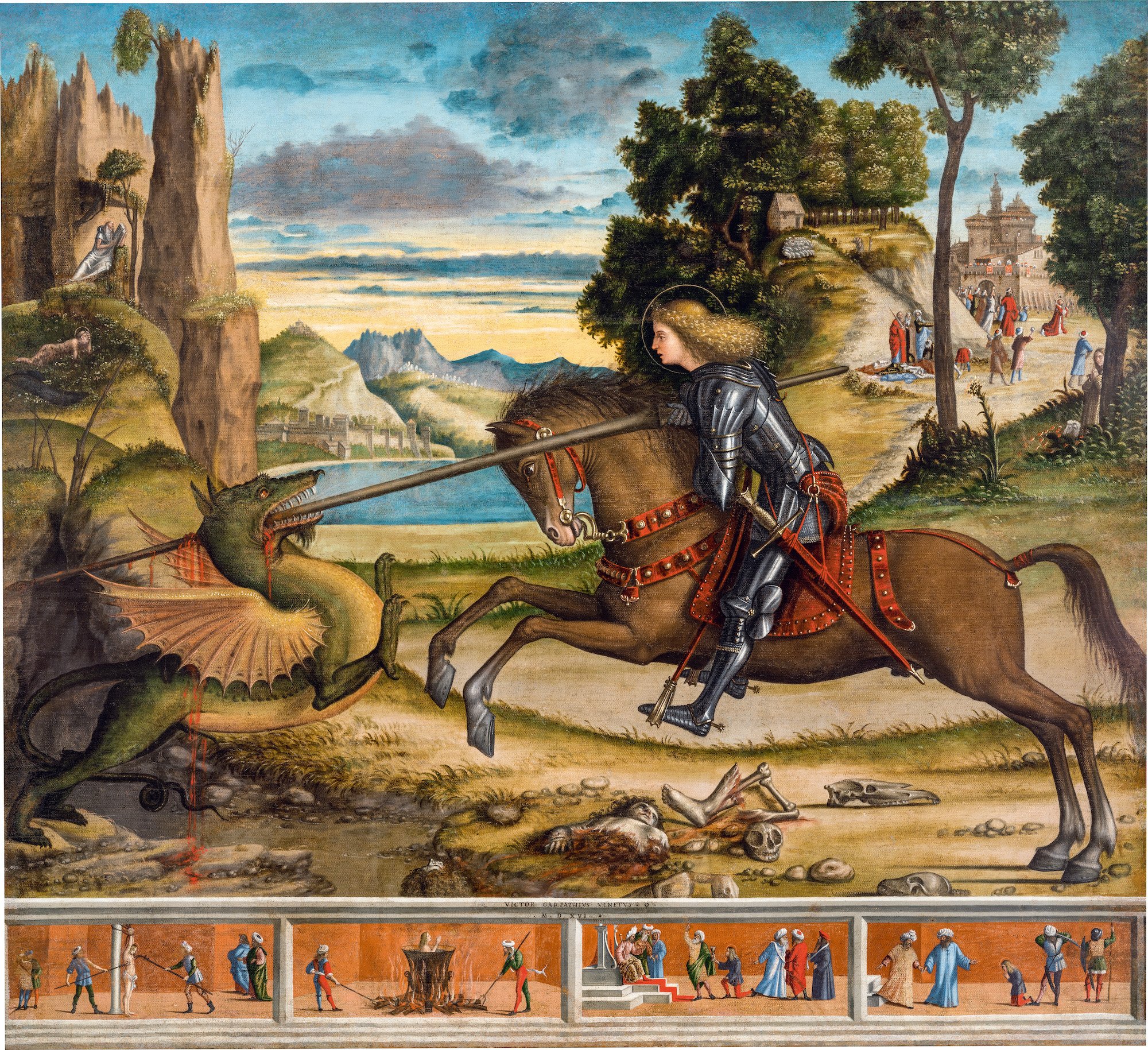
In 1882 Henry James set out on his own Venetian tour, Ruskin’s “generous lamp” in hand. In works such as Saint George and the Dragon and Saint Augustine in His Study, James found a “paradise of his own room.” Unlike the “vertical” pull of much of Italian art, James appreciated the “horizontal” window that Carpaccio opened onto the spiritual world, with the terrestrial and the celestial seeming to cohabitate in our own temporal space. Placing him among his favorites Bellini and Tintoretto, James declared that Carpaccio was the “most personal and sociable of artists” for his “care for human life at large.” The anchoring of Carpaccio’s safe harbors seemingly in the actual stones of Venice—with marble paving stones and building façades receding in perspective view—has appealed in many times of rebuilding and renewal: for example during the French Second Empire, through such artists as Gustave Moreau, and following World War I, in the neoclassical fantasies of Giorgio de Chirico.

The times must be right again for another Carpaccio rediscovery. Fortunately the National Gallery (and, undoubtedly, only the National Gallery) has the lending power to mount a major stateside survey of the artist. The first outside of Italy, the display should enkindle our own Carpacciomania. Curated by Peter Humfrey in collaboration with Andrea Bellieni and Gretchen Hirschauer, the exhibition is presented in partnership with the Fondazione Musei Civici di Venezia—which, as with their joint 2018–19 exhibition of Jacopo Tintoretto, will also mount the show at the Palazzo Ducale. In Washington, even without some of his most significant paintings on offer, in particular those from his expansive Saint Ursula cycle, “Vittore Carpaccio: Master Storyteller of Renaissance Venice” features forty-five paintings and thirty drawings. Gathering work from some forty-eight venues, the transporting exhibition leaves us with much to chew on.

Vittore Carpaccio, Saint George and the Dragon, 1516, Oil on canvas, Abbazia di San Giorgio Maggiore, Benedicti Claustra Onlus, Venice. Photo courtesy of Abbazia di San Giorgio Maggiore, Benedicti Claustra Onlus.

While little is known of the young Carpaccio, he clearly became intoxicated by three Bellinis: the brothers Giovanni and Gentile and their father, Jacopo. Together they developed and refined the Venetian understanding of single-point perspective. As an apprentice to the Bellini sons (whether he trained with Giovanni or Gentile or both is not entirely certain), Carpaccio inflated their compositional inventiveness to maximum volumetric effect. Never before had paintings breathed with quite so much fresh air.

Like the brothers Bellini, Carpaccio worked with oil on canvas rather than in fresco, as the new medium was far more resilient in the humid Venetian climate. The availability of printed books and woodcuts added elements of the northern Renaissance to Carpaccio’s cosmopolitan mix, with printed maps and depictions of distant lands informing his visual concatenations.

The results are indeed storytelling at its most masterly. And rather than overwhelming us with such monumental painting cycles as his Saint Ursula, which at nine feet tall by eight to twenty feet wide (and again newly restored) remains in situ at the Gallerie dell’Accademia, “Vittore Carpaccio: Master Storyteller of Renaissance Venice” helps us appreciate the painter on a more intimate scale with smaller works. Assembled here, the altarpieces, private devotional paintings, smaller confraternity commissions, and studies and cartoons that he made in preparation for his larger compositions all speak to the artist’s consummate craft and the particular interests of his Venetian patronage.

Carpaccio was the opposite of groundbreaking. In his compositional structuring, he was fortifying. His imaginative worlds were perfected 3D environments, premium-engineered with all Venetian-made parts. Into his spaces he arranged numerous figures far more occupied with one another than with our own subjective point of view. Unlike the later artists of the Venetian cinquecento, with Carpaccio there is no heavy artistic hand to draw us in. We instead get a self-contained universe, a sim-Serenissima where the activities exhibit the same ordered rules as the compositions’ single-point perspectives.

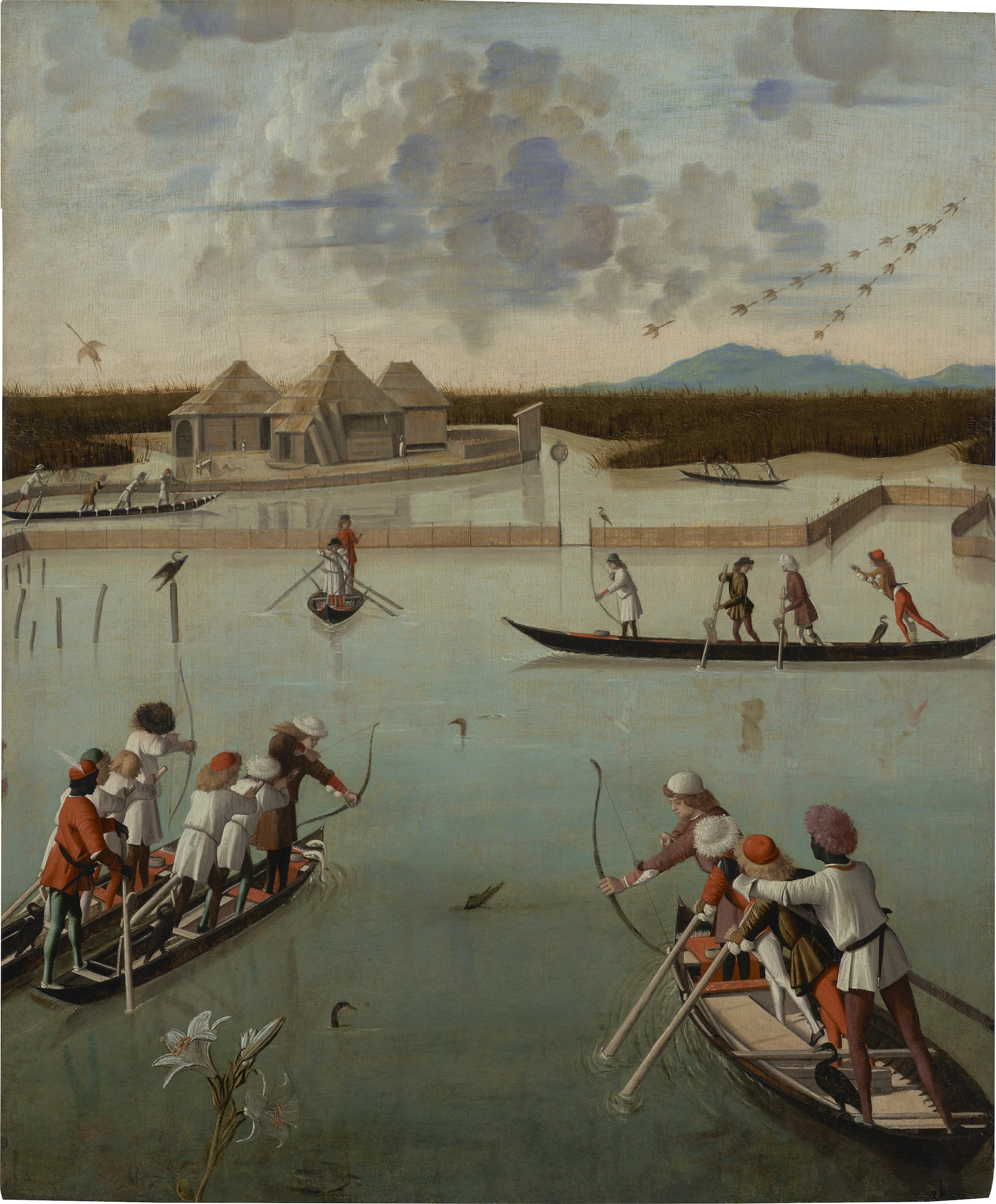
Vittore Carpaccio, Fishing and Fowling on the Lagoon (recto); Letter Rack (verso), ca. 1492/1494, Oil on panel, The J. Paul Getty Museum, Los Angeles. Digital image courtesy of the Getty’s Open Content Program.

The exhibition begins with Ruskin’s “best picture in the world,” the Two Women on a Balcony—but here presented even better than in Ruskin’s day. Sometime in the 1700s this small work, most likely part of a set of folding shutter doors painted for a Venetian palace, was divided from its upper half. The lower portion with the two women eventually went to Venice’s Museo Correr. The upper part, now titled Fishing and Fowling on the Lagoon, ended up at the J. Paul Getty Museum in Los Angeles. The panels, dated together to ca. 1492/94, were only reidentified as being part of the same composition after conservation efforts in the early 1990s. This exhibition now temporarily reunites for only the second time in recent history what was clearly intended to be a single whole—the line of a lily stem even connects the two parts. Their happy reunion begs to remain permanent, if only the Getty and Correr could arrive at a loan agreement to share the works.

In the lower panel, the women gather on a balcony filled with birds and dogs. The scene is busy with domestic activity even if the women (and their dogs) appear somewhat bored by the pet play. The upper panel suggests the reason for their tedium. Above and beyond them, the men have loaded onto their gondola-like boats for a lively hunting and fishing expedition out on the lagoon. The components together reveal the ordering of Venetian society in one view. As both groups contend with their animals, the women in the foreground, who seem little interested in what is happening below the balcony, add humor to the recreation of their husbands beyond. The clever division and animated activity of the entire panel reveal Carpaccio’s great ingenuity with composition, compressing and expanding space to his will to contain his full “care for human life at large,” as Henry James put it. That the scene is clearly cut off to the left would certainly suggest that some additional Carpaccio is still out there waiting to be rediscovered—just look for the matching balustrade and rear end of a brown dog. Adding to this intrigue, the verso of part of the known panel is painted with personal letters appearing to hang from a line in trompe l’oeil. As much as we might appreciate him by the slice, Carpaccio is best enjoyed whole.

The organization of Carpaccio’s compositions was no accident. His studies of faces, architecture, and perspective were exacting. His deliberative process might help explain why we are now left with more of Carpaccio’s preparatory work than almost any other artist of his time. The National Gallery presents thirty of these drawings both to let us appreciate his working methods and to help illustrate his larger paintings that cannot travel. Among these examples, a blue double-sided sheet from the Ashmolean Museum in Oxford is a standout. Titled Head of a Young Woman in Profile (recto) and Head of a Young Woman in Three-Quarter View (verso), the drawings from ca. 1488–89 served as studies for two of the numerous faces in Carpaccio’s Apotheosis of Saint Ursula, one of the paintings in the Accademia cycle. The drawings are not necessarily innovative. They even may have been copies of works by Pietro Perugino and Pinturicchio. Still, through their exquisite modeling created with hatch marks of white and black chalk and washes of brush and brown, they reveal a luminous grace.

Carpaccio’s extensive compositional planning did not necessarily serve him well as his reputation contended with the rise of the modern style of Titian and Giorgione. Even at the time of Ruskin, in 1871, Joseph Archer Crowe and Giovanni Battista Cavalcaselle wrote that Carpaccio was “without any poetry of fancy” in their History of Painting in North Italy. In her current catalogue essay, “Carpaccio as a Draftsman,” Catherine Whistler concurs that he was “overshadowed by the poetic genius of Titian.” Even Peter Humphrey writes that “set against the more heroic and classicizing art, the work of Carpaccio must have appeared staid, quaint, and irrelevant.” At the very least, Humphrey continues, “his narrative paintings and skills as a storyteller may be seen as a vital link in the continuous tradition in Venetian painting from the late Gothic style of the early fifteenth century to the late baroque of the eighteenth.”

But there is more to Carpaccio than merely his role as a historical connection between the painting styles of fifteenth- and sixteenth-century Venice. His appeal is in locating us in spiritual space and infusing this built environment with pious order. We can see why the scuole, those social and charitable organizations of Venice, all commissioned him to paint their lives of Saint George and Saint Stephen and Saint Ursula and the Virgin Mary. The worlds he envisioned were immersive. They could be entered, touched, and breathed. The paradise he creates is indeed “of his own room,” to which he extends a welcoming invitation.

  1.   “Vittore Carpaccio: Master Storyteller of Renaissance Venice” opened at the National Gallery of Art, Washington, D.C., on November 20, 2022, and remains on view through February 12, 2023. The exhibition will next be on view at the Fondazione Musei Civici, Palazzo Ducale, Venice (March 18–June 18, 2023).