The map & the territory

THE NEW CRITERION, September 2024

The map & the territory

On the life & work of Joe Zucker.

The art world never knew what to make of Joe Zucker, a painter who died in May at the age of eighty-two. Just as pirates became a recurring theme in his work, Zucker took a piratical stance on art history. He refashioned the flotsam and jetsam of pictorial space to raise his own Jolly Roger over the scurvy dogs of modernism in a way that fit nobody’s story of art but his own.

Like Augie March, Zucker was “an American, Chicago born.” Growing up Jewish on the city’s South Side, he spent his childhood at the museum of the Art Institute. His father was a scrap-metal dealer. His mother, a nurse, deposited him at the museum starting at an early age to avoid the ethnic warfare of the streets. Here he absorbed an aesthetic education that was democratic and particularly American, one that flattened chronology and place—a “Veronese one day, a de Kooning the next, Van Gogh’s Bedroom in Arles,” he said. Back home, through an affinity for literature and narrative, he further mixed high and low—Willa Cather with Studs Terkel, Herman Melville with N. C. Wyeth’s illustrations for Treasure Island.

Chuck Close, Joe Zucker, 1969, Gelatin silver print, Nelson-Atkins Museum of Art, Kansas City.

After a stint at Miami University of Ohio, where he played basketball, Zucker returned to Chicago. He enrolled at the School of the Art Institute, earning his undergraduate and graduate degrees. He joked that here he learned to draw a skeleton riding a bicycle from memory. As with much of Zucker’s artistic identity, this was fact and fiction mixed in a medium of dry wit. The tall tale reflects the degree of technical training he received without any particular sense for what to do with it, especially since he said he never wanted to be the next jock from the School of Paris flexing a Picasso brush. “My real love is being an artist and making art,” he once said. “Not advancing the myth of modernism.”

As he stared at his canvas, an early moment of doubt became Zucker’s first artistic breakthrough. Uncertain what to paint, he set about depicting the painting itself—in particular, the warp and weft of the canvas’s weave. His subsequent abstractions of interwoven rectangles brought to mind the rigors of Piet Mondrian but also the basket weaves of brightly colored plastic lawn chairs, which were then a ubiquitous feature of demotic Americana. Zucker’s interest in vernacular, in the elevation of craft and domesticity against the backdrop of high art, in grids and recursive rules, and in the conflation of process and product, were already apparent and continued throughout his career. His circular logic could be confounding, but Zucker flavored such Möbius strips like salt-water taffy—palatable, mysterious, and (as his last name might suggest) sweet.

After teaching at the Minneapolis School of Art, Zucker moved to New York in 1968. He soon fell in with Klaus Kertess and the iconoclastic artists he was showing at his Bykert Gallery, who included Lynda Benglis, Dorothea Rockburne, Barry Le Va, and Brice Marden. Among them was Chuck Close, who became Zucker’s loft neighbor on Prince Street and drinking buddy as they taught together at the School of Visual Arts. In one of his early portraits, Close depicted Zucker in horn-rimmed glasses and shirt and tie, with his hair slicked back in a way that resembled an overtaxed insurance salesman. A study for this work is now in the collection of the Nelson-Atkins Museum of Art.

Joe Zucker, Amy Hewes, 1976, Acrylic, cotton & rhoplex on canvas, Mary Boone Gallery, New York.

“Joe Zucker has consistently for over four decades been one of America’s most innovative artists,” Close wrote for Bomb magazine in 2007.

His paintings are personal, quirky, idiosyncratic, and often puzzling. His style is rooted in processes, some simple, others remarkably complex. . . . Pouring, squeezing and manipulating paint, he fashions paintings so personal it would be impossible to imagine anyone else having made them. This is the definition of personal invention.

Close went on to say of Zucker that there was “no greater influence on the way I think about painting, and no person who played a more important role in the formative period of my work and changed my mind about how paintings can and should be made.”

A decade later, when I assembled an exhibition of Zucker’s depictions of the sea for the National Arts Club, Close wheeled into the opening. As I plied him with martinis, he explained how he and Zucker together learned to develop processes to complicate and “de-skill” their means of representation. “This is something you and I have spent a lot of time doing, removing the taboo of talent,” Zucker said in response to Close in that 2007 interview. Here was a problem, I concluded, only for those specimens for whom pictorial talent comes too easily.

As might any artist who chooses to start his career by painting the materials of a painting, Zucker next set about working up an index for his oeuvre-to-be. The 100-Foot-Long Piece (1968–69) is the first work he made in New York. In the 2020 monograph on Zucker published by Thames & Hudson, Terry R. Myers wrote how the work was “like a catalogue of available merchandise (as he called it, ‘the Sears catalogue’),” one that “retains many of the material characteristics of life in the suburban Midwest.” Made up of rectangular strips in a range of styles, some abstract, others representational, created through a wide array of processes, the mixed-media work can resemble a row of linoleum patterns or wallpaper swatches. Faux fabrics are intermixed with a depiction of Billy the Kid. An illustration of the Charioteer of Delphi is featured alongside cones of mathematical plotting-paper sticking out from the picture plane. “One area was wood-burned,” Close approvingly remarked. “When was the last time you saw a work of art by a serious artist that was made with a wood-burning kit?” A young secretary at Kertess’s gallery dubbed the work “tossed salad.” That secretary, Mary Boone, went on to become a mega-gallerist of the 1980s and even represented Zucker for a period in the 2000s. “It was as if all my styles I made at once, rather than the more usual linear development of style,” Zucker remarked. “I made enough styles to last a lifetime.”

Joe Zucker, Paying Off Old Debts, 1975, Acrylic, cotton & rhoplex on canvas, Mary Boone Gallery, New York.

Writing an introductory essay for the 2020 monograph, John Elderfield noted that Zucker may have developed up to eighty different series through his career: “Having many sides is integral to his self-presentation as artist.” The 100-Foot-Long Piece featured a preview of the one that became his most consequential: his cotton-ball paintings. Zucker developed these works using Rhoplex, an acrylic binder developed in the 1950s by the Rohm and Haas chemical company for use in cement and spackle with an “exceptional pigment-binding capacity.” By dipping cotton balls in Rhoplex, which he then hand-tinted and adhered to canvas, Zucker devised a method of painting that resembled a pixelated screen, one that could convey a recognizable image.

At first Zucker used this labor-intensive process to draw a connection to Byzantine mosaics. Woman with Halo and Scepter (from Five Mosaics) (1972), which referenced the art of Ravenna, is now in the collection of the Art Institute. Five Amphoras (1972) is at the Modern Art Museum of Fort Worth. From a distance, the works read as recognizable images. Up close, the brightly colored cotton balls resemble piles of tufted carpet. “It took months to roll up the pieces of paint,” Zucker said of his process, “and then all of the paintings were finished in a minute.”

Zucker then looked to the history of cotton and the role of labor in its cultivation and trade. Drawing on photographs of riverboat freight from the American South, Zucker loaded his imagery with historical import at a time when few contemporary artists dared look beyond the clean surfaces of minimalism or the safety of pop aesthetics. Rendered in grisaille, reflecting old photographic source material, subjects such as the riverboat in Amy Hewes (1976), in the collection of the Hessel Museum of Art at Bard College, and the laborer in Paying Off Old Debts (1975), in the collection of the Art Institute of Chicago, convey a haunting presence, as if the history of American slavery were reaching out through the very cotton of the works.

By the time I first came across Zucker’s work, some twenty years ago, he had long since moved to East Hampton, Long Island, where he established a home and studio in the 1980s with his wife, Britta Le Va. Here he coached high-school basketball as a volunteer for the championship Bridgehampton team with players far removed from the area’s multimillion-dollar summer residences. (His efforts were featured in the 2017 documentary Killer Bees, produced by Shaquille O’Neal, about the team as it defended its state title.)
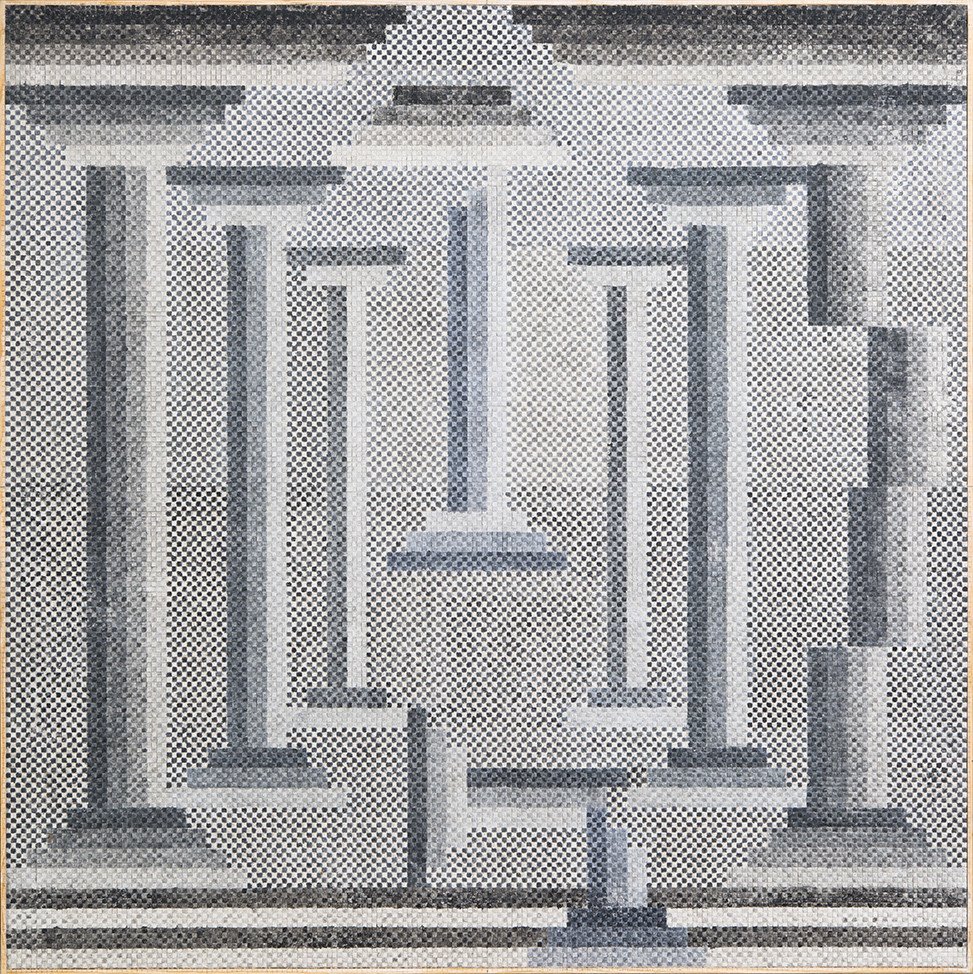
Joe Zucker, Russian Empire, 2012, Watercolor & gypsum on plywood, Mary Boone Gallery, New York.

Zucker was ahead of his time in his use of unorthodox materials and techniques, not to mention his resurfacing of fraught historical subject matter. Yet the Neo-Expressionists and the “Pictures Generation” of the 1970s and 1980s had little use for his involved and at times confusing work. Nevertheless he continued to develop new series, drawing on everything from pegboards and squeegees to the history of Joseph Smith, sometimes combining all three.

The work centered on shipping, marine life, and piracy could be his most satisfying. A 2008 exhibition at Nyehaus Gallery called “Plunder,” which featured rolls of canvas cut through with cannonballs, was particularly successful. For Zucker, the map was the territory. Allegory and allusion mixed with the concrete. “The ghostly spectre of the slaver Trinidad rises among the wrecks and reefs of Madagascar on a moonlit night during July of 1834,” he scrawled across a drawing from 1978, which I first saw at
Nolan/Eckman Gallery. On a diagrammatic image called Axe Lake (Legend) (1994), Zucker included a key that listed the fishing spots and mills along with his vodka martinis and gibsons.

Water served as a recurring theme in Zucker’s churned processes. He saw a connection between the surface of the painting and the “machinery depicted in the painting—objects that stir water, such as planes, windmills, ships, wheels.” It helped that Zucker was himself an accomplished fisherman—skills he developed through weeks-long expeditions to Minnesota and as the captain of a fishing boat he docked in Montauk harbor called The Rodfather. Following a few occasions when I paid studio visits to East Hampton, we motored out to the reefs off Montauk. Zucker knew just the right time and place to put down line for striped bass as he named the fish he caught. “Nancy Pelosi” was his keeper. I called mine “Mahmoud A. Bass.”

In East Hampton, Zucker developed several series that hearkened back to the warp-and-weft grids. I am unsure if one series involving mops dipped in paint, arranged on the wall as if woven together, has ever been fully executed. Another series, of gypsum board hand-scored and water-colored into tight grids resembling tesserae, recalled those earlier Rhoplex mosaics. He titled the 2013 exhibition of this series at Mary Boone “Empire Descending a Staircase.”
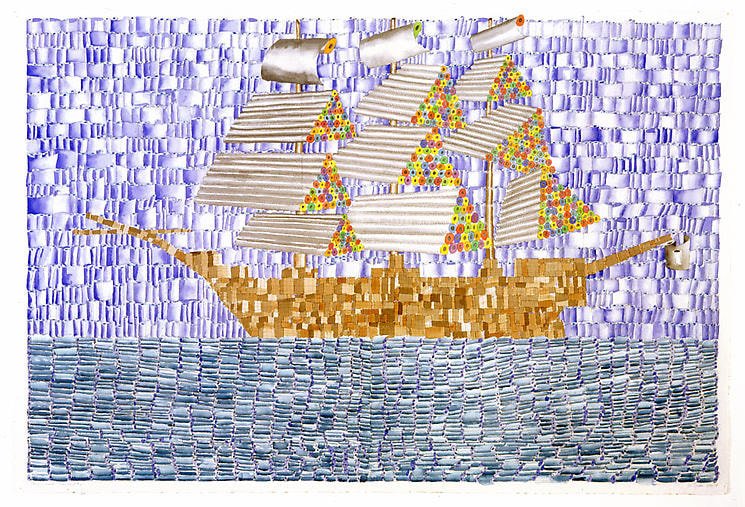
Joe Zucker, Robocrate Flagship #2 (1955–1960), 2004, Watercolor, ink & graphite on paper, David Nolan Gallery, New York.

Zucker’s final series was inspired by stories of the Pale of Settlement by Sholem Aleichem, which he read during the 2020 covid shutdowns. Made of cast-off studio trash, such as cardboard, towels, and rubber mats, the austere monochrome paintings of shtetl houses and abstracted snowmen, depicted in a chilling, white landscape, felt like a fresh airing of sublimated forces and materials. In the summer of 2022, I paid my final studio visit to see this work. Zucker by then had already suffered a series of health setbacks, including the consequences of a traffic accident and metabolic encephalopathy. As I slept on a cot in his spider-filled studio, I could hear Zucker in the other room narrating his own demise.

“There’s a surprise to his work,” the critic and poet John Yau explained as I sat down for an interview with him and Zucker in 2016. “The humor is very generous. If anything he’s self-mocking. He’s mocking the idea of being an artist, but in a kind of generous way.” In much of Zucker’s work, as in my final moments with him, you never know whether to laugh or cry.

Summer lights

THE NEW CRITERION, June 2024

Summer Lights

On “Klimt Landscapes” at Neue Galerie, “Wayne Thiebaud: Summer Days” at Acquavella Galleries & “Paul Resika: Ode to the Moon” at Bookstein Projects, New York.

A distinguishing feature of modern art has been its pursuit of light. Of course, all of visual art is concerned with light. What modernism did was dispense with the controlled light of the salon in search of bolder and brighter sensations. Modern painters looked to reflect not merely a sense of sight but also the feeling of radiance. So they explored direct light and, in particular, summer light, chasing the sun into the countryside with their trunks of painting equipment in tow.

Gustav Klimt (1862–1918) was one of those painters whose compositional innovations were charged by the summer sun. A recent survey at Neue Galerie titled “Klimt Landscapes” looked not only to the verdant visions he captured in the Austrian towns alongside the Attersee between 1900 and 1916, but also to the lush creative landscape that unfurled around him in photography, jewelry, and fashion.1

Gustav Klimt, Judith and the Head of Holofernes, 1901, Oil & gold on canvas, Österreichische Galerie Belvedere, Vienna.

Today Klimt is most renowned for his “golden style.” His bejeweled portraits reached their apotheosis in such works at Judith and the Head of Holofernes (1901), also known as Judith I, and The Kiss (1908–09), both in the Österreichische Galerie Belvedere, Vienna. His Portrait of Adele Bloch-Bauer I (1907), the “lady in gold” restituted from Vienna to the subject’s Jewish heirs, now forms the heart of Neue’s permanent collection. In these works, Klimt, the son of a gold engraver, combined the decadence of precious metal with a sense for mosaic-like composition, taking inspiration from the shadowless Byzantine iconography in Ravenna’s Basilica of San Vitale.

Yet Klimt was more than an iconographer. He looked to move beyond these studied, labor-intensive portraits even as he relied on them to provide income for his large domestic payroll (he fathered at least six children with three mistresses while supporting multiple members of his extended family, including his widowed sister-in-law, Emilie “Midi” Flöge, a fashion designer and his muse). Klimt found relief in the Salzkammergut region of Upper Austria, north of Salzburg. Each summer, after 1900, he traveled there from Vienna to paint along the lake towns of the Attersee.

Gustav Klimt, The Park, 1909, Oil on canvas, Museum of Modern Art, New York.

Organized by Janis Staggs, Neue’s director of curatorial and manager of publications, “Klimt Landscapes” took a welcome, wide-angle view of these creative sojourns. The exhibition brought together such masterpieces as The Park (1909, Museum of Modern Art, New York), Kammer Castle on the Attersee I (Castle in the Lake) (1908, National Gallery Prague), and Forester’s House in Weissenbach II (Garden) (1914, Neue Galerie). The survey assembled works dating back to Klimt’s academic training and continuing on through his many experiments with optics, providing along the way several examples of jewelry by Josef Hoffmann and Koloman Moser together with many photographic portraits of Klimt’s own projections of summer leisure.

Trained at the Vienna School of Arts and Crafts of the Imperial Royal Austrian Museum of Art and Industry, known today as the Museum of Applied Arts Vienna, Klimt proved to be a precocious academic talent. The exhibition began with his figure studies of 1880 and his Two Girls with Oleander (ca. 1890–92, Wadsworth Atheneum, Hartford), an astonishing vision of glowing Pre-Raphaelite women plucking flowers beside an egg-and-dart frieze.

Gustav Klimt, Two Girls with Oleander, ca. 1890–92, Oil on canvas, Wadsworth Atheneum, Hartford.

Seeing Klimt’s command of painterly illusion makes his modernist compression, developed just a few years later, all the more remarkable. A founding member of the Vienna Secession in 1897, he joined fellow academic painters to look beyond the style of the salon. Yet for all of its innovative surface application, Klimt’s subsequent golden style owed much to academic structure. Beneath the ornament, his shimmering portraits were essentially salon paintings. Part academic, part modern, these works were dismissed by the devotees of either camp. Klimt remained largely absent, for example, from the French-focused timeline of New York’s Museum of Modern Art. As such distinctions have diminished over time, however, the hybrid nature of these works has only made them more compelling. Today his Portrait of Adele Bloch-Bauer I has become known as “Austria’s Mona Lisa” and attracts commensurate crowds and Hollywood fanfare, serving as the focus of the 2015 biographical drama Woman in Gold.

The relief provided by the Attersee owed in part to the fact that Klimt had received little academic training in landscape painting, which was considered a lower genre than history painting and portraiture. This lack of schooling left Klimt free to experiment with the Stimmungsimpressionismus, or “atmospheric impressions,” that he felt during his Sommerfrische, “summer holidays.” Unlike his studied portraits, Klimt painted his landscapes without preparatory sketches. The unidealized composition of this “vacation work” helps underscore the leisure of their creation. Klimt viewed his landscape painting as a segment of his daily therapy. A letter from August 1902 outlines his summer workout routine:

Early in the morning, about 6 . . . I get up—if the weather’s good I go to the nearby wood—I’m painting a small beech wood there (if the sun’s shining) . . . that takes me to 8, then comes breakfast, then a swim in the lake, carefully of course—then I paint a little, perhaps a view of the lake by sunlight, or if the weather’s dull a landscape from my window—sometimes I drop this morning painting and study my Japanese books . . . Then comes midday, after lunch I sleep a little or read, and before or after tea another swim . . . After tea I’m painting again . . . . Every now and then I fit a bit of rowing into the day’s program in order to limber up.

A proponent of the Gesamtkunstwerk, Klimt saw himself as a piece of that “total work of art.” In the summer he dressed the part by dispensing with the cummerbund and donning a blue, caftan-style painter’s smock. (Early Christmas shoppers, take note: Neue’s gift shop features an “exact replica” of this full length indigo linen smock with “hand-embroidered white epaulets and front pocket.”) Klimt appears in repeated photographs around the Attersee in this getup, walking on docks and strolling on trails, even as the figures around him didn’t always get the caftan memo, appearing in more standard summer outfits.

Beech Forest in Autumn, 1898. Photo: Hugo Henneberg, Staatliche Museen zu Berlin.

One revelation of this survey was the extent to which photography influenced and shaped Klimt’s own artistic landscape. “It would be difficult to overestimate the sizable impact of photography on Klimt’s development as a landscape painter,” writes Staggs in the exhibition’s catalogue. The Austrian Camera Club of Amateur Photographers, later known as the Vienna Camera Club, was established in 1887. Klimt surrounded himself with photographers such as Moriz Nähr, Heinrich Böhler, and Emma Bacher-Teschner, and he regularly posed as their subject. Klimt developed his own unusual, square landscape format largely under the influence of their often-square images. He also used telescopes and photographic aids to help compose his paintings, flattening his landscapes and even drawing on the patterns of photographic emulsion. Just compare Hugo Henneberg’s photograph Birch Forest in Autumn (1898, Staatliche Museen zu Berlin) with Klimt’s Beech Forest I of circa 1902 (Galerie Neue Meister, Dresden), or Heinrich Kuehn’s Meadow with Trees (1897, Photoinstitut Bonartes, Vienna) with Klimt’s Pear Tree (Pear Trees) (1903, Harvard Art Museums). Klimt painted his landscapes in the style of this early photography.

Gustav Klimt, Beech Forest I, 1902, Oil on canvas, Galerie Neue Meister, Dresden.

The remarkable set of Autochrome Lumière color photographs that Friedrich G. “Fritz” Walker took of Emilie Flöge and Klimt, in the garden of Villa Paulick in September of 1913, then brought the exhibition full circle. Early photography, in particular color photography, was especially light-intensive and relied on the same summer sun as did Klimt. Here in colorful costumes he and Flöge appear as both subjects and objects—flattened into their own lush landscapes in these photographic “drawings with light.” From “lady in gold,” we end with artists in green.

The advent of summer can be particularly sweet when it comes with a helping of Wayne Thiebaud (1920–2021). The late grand-manner painter of American Century marginalia remains on view at Acquavella Galleries through mid-June with an exhibition that focuses on his warmest creations. “Wayne Thiebaud: Summer Days” gathers works from over six decades of the artist’s career, ranging from his bathers, beaches, and balls to his cola, confections, and cones.2

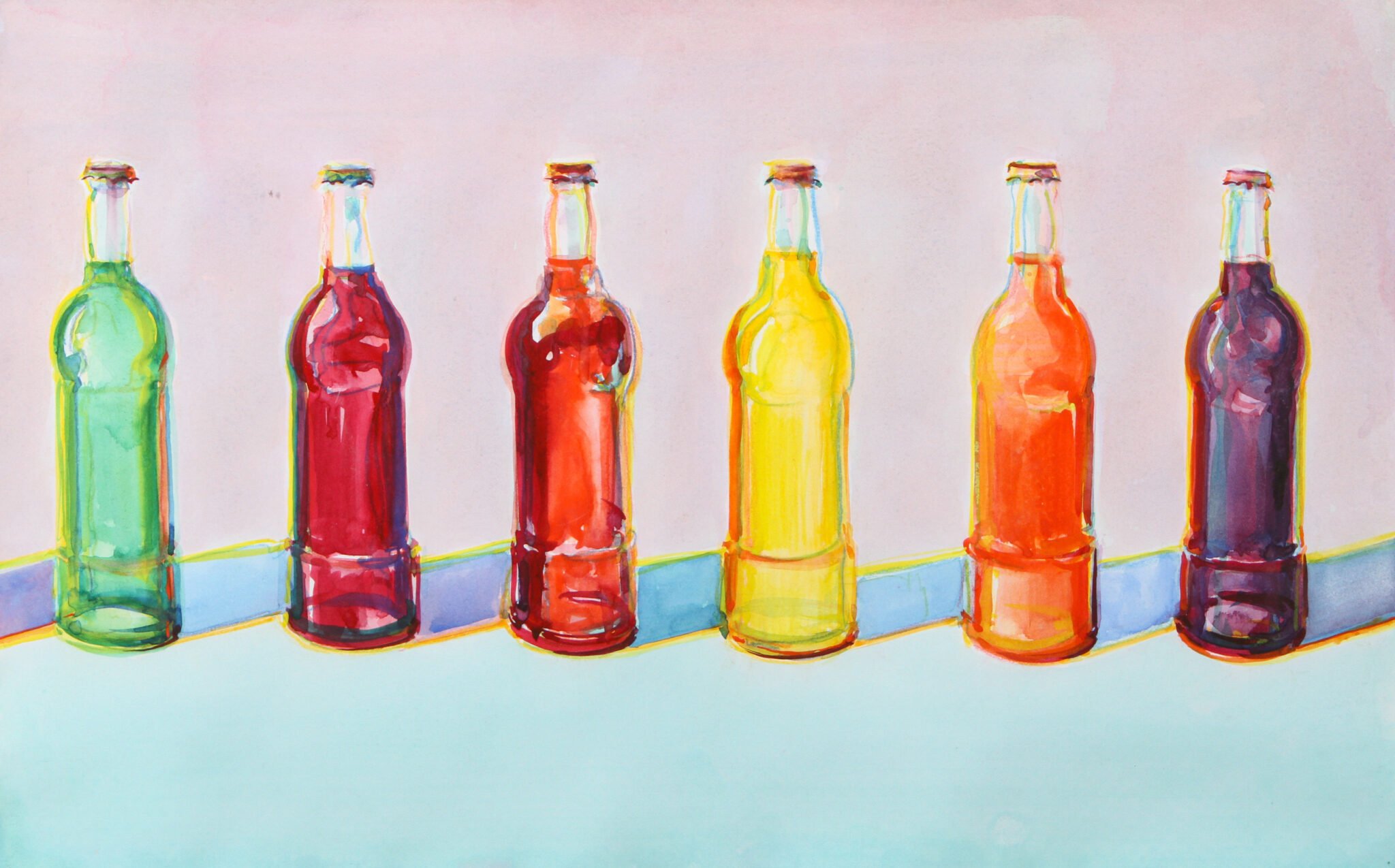
Wayne Thiebaud, Untitled (Six Soda Pop Bottles), ca. 1985, Watercolor on paper, Collection of Matt and Maria Bult.

Painted with a sugary impasto, this masterly work can seem fresh and ready to melt in the summer sun. Thiebaud was the American Giorgio Morandi for his uncanny ability to transform paint into the subjects he depicted. In part this is due to the halation effects along his edges, as shadows are broken into lines and fields of blue and red that become delicate frosting for his forms, as seen in such works as Strawberry Cone (1969) and Two Tulip Sundaes (2010) and even such portraits as Betty Jean (ca. 1965). Thiebaud was particularly attuned to the textures of his media. His thirst-quenching Untitled (Six Soda Pop Bottles) (ca. 1985) would only work as a watercolor on paper. His Cheese Display (1969) feels milky-smooth, while his Beach Gathering (2000–15) appears encrusted with sand. Due to this innate sense for intimism, I find his portraits and still lifes work better than his landscapes. Thiebaud was at his best when subject and painting could melt into one.

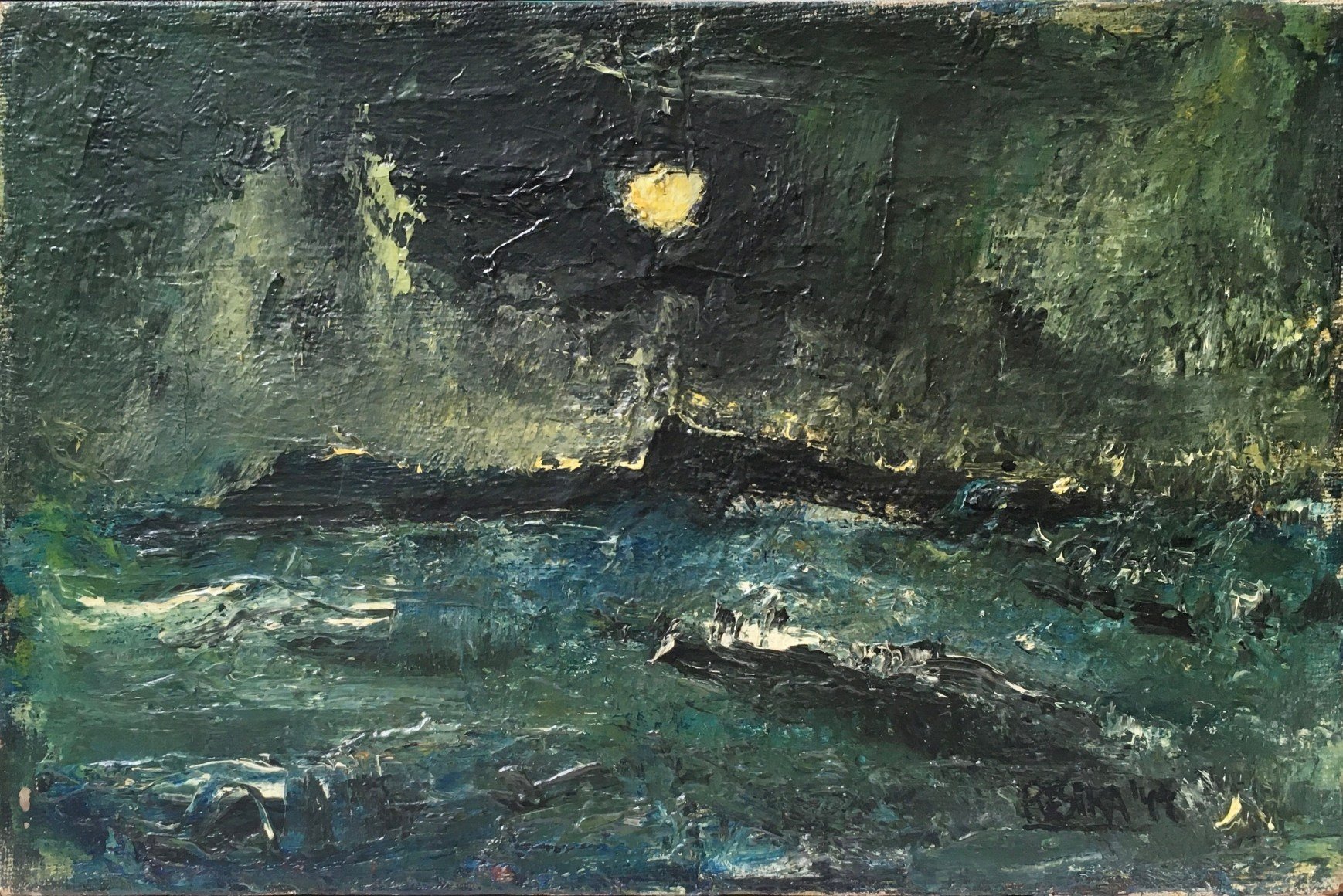
The paintings in “Paul Resika: Ode to the Moon,” on view last month at Bookstein Projects, spanned a remarkable eighty years.3 A suite of bold new work, of celestial bodies pared down to brushstroke, color, and form, all painted in Resika’s ninety-fifth year, was connected to Moonlight, a small landscape executed in 1943–44, when the artist was just sixteen years old. Beyond the official show, the gallery’s office also featured an extra work from the artist’s collection: Panorama of the Hudson (The Mermaid and the Factory) (1948), a wild composition of bridges, train tracks, and the ghost-like rollercoaster of the long-departed Palisades Amusement Park—painted at a time when the teenage artist could catch a ferry there just across town from his Central
Harlem studio.

Paul Resika, Moonlight, 1943–44, Oil on canvas, Bookstein Projects, New York.

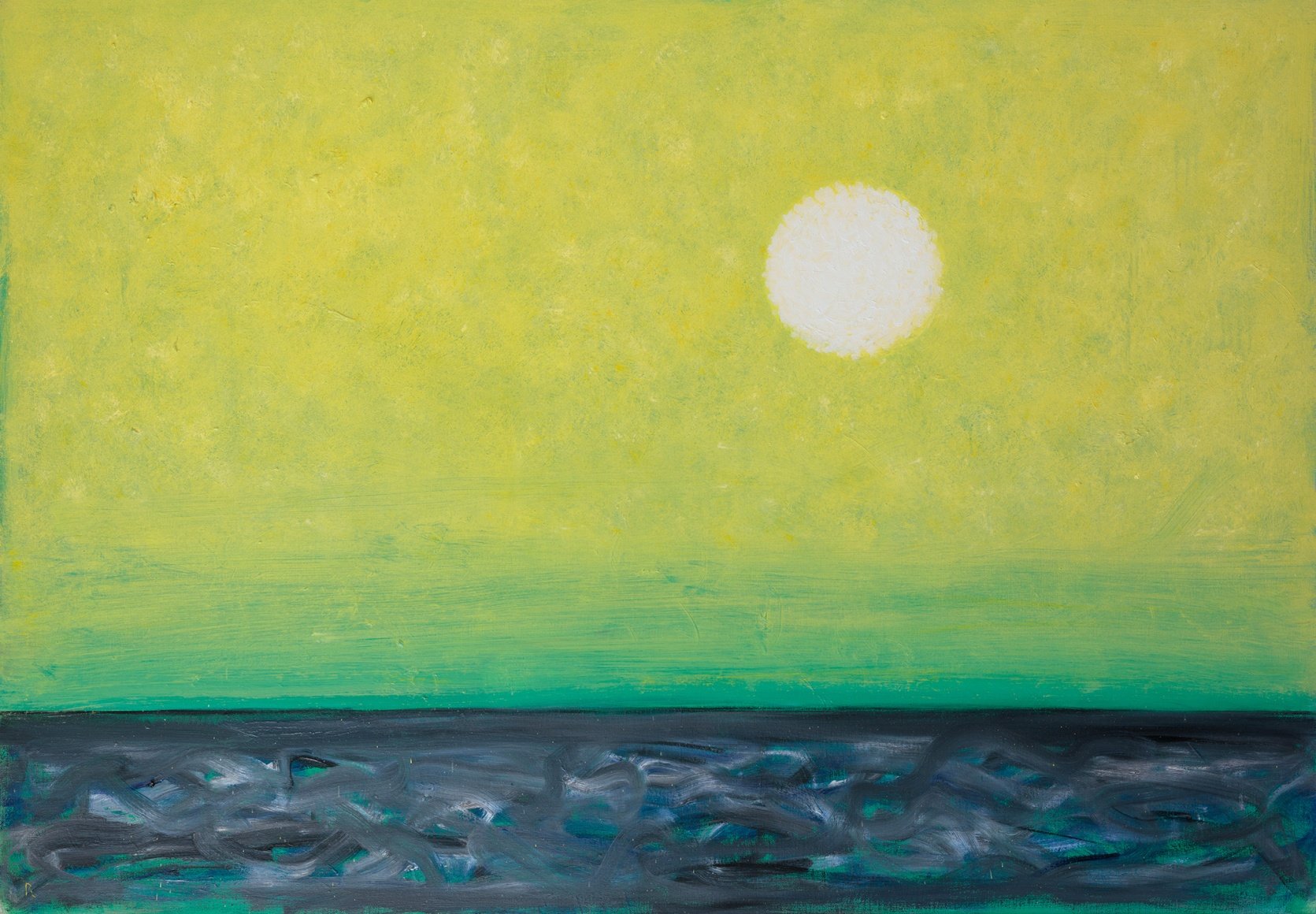
The brightness and compositions may have varied, but everywhere a minimum of line defined depth in what were otherwise blind, blinding, and turbulent sights. Illuminated across time, the full assembly revealed a consistency of vision and a connected sense for the bare essentials. Revisiting the illusion of light in paint, Resika in his latest work has doubled down on the experimental quality of what can be done with a minimum of means. In several canvases, a simple dash, placed just right, becomes a horizon line reflecting the luminous spheres above. These orbs, all of slightly different values, meanwhile appear to fill the canvases with various shades of glowing color. “Marcel Breuer told me never to paint a green picture,” Resika explained to me when I ran into him at the gallery. So he did just that. This painter, who has been bucking convention for eighty years, remains a guiding light for the daring possibilities of oil on canvas.

Paul Resika, End of the Day #12, Oil on canvas, 2023, Bookstein Projects, New York.

  1. “Klimt Landscapes” was on view at Neue Galerie, New York, from February 15 through May 6, 2024. 

  2. “Wayne Thiebaud: Summer Days” opened at Acquavella Galleries, New York, on April 26 and remains on view through June 14, 2024. 

  3. “Paul Resika: Ode to the Moon” was on view at Bookstein Projects, New York, from April 18 through May 31, 2024. 

Brown in Town

THE NEW CRITERION, March 2024

Brown in Town

On the Winter Show, Master Drawings New York, “Whodunit? Key Books in Detective Fiction,” “Judging a Book by Its Cover: Bookbindings from the Collections of the Grolier Club” & “Masters Week.”

In late January, The Winter Antiques Show returned to the Park Avenue Armory. Correction: make that “The Winter Show.”1 Five years ago, as this venerable exposition fell under new management on its sixty-fifth anniversary year, the word “antiques” was struck from its title. Like that brown furniture in your grandmother’s attic now scented with camphor and racism, the past has lost its market value to the present. Against the mystery cult of the new, who dares to appear antique?

And so, much of The Winter Show in recent years has felt like Terminal D Duty Free. Aisles of bangles, baubles, and beads make the presentation an ahistorical muddle. Maybe this is the point. How better to get “younger collectors interested in material culture at large,” in the words of expo leadership, at the Young Collectors Night DJ party? Fortunately, it has not all been out with the old and in with the new for what remains arguably America’s most important antiques fair. Now seventy years old, The Winter Show’s ten-day assembly of dealers should be seen as an heirloom event—one dedicated to benefiting the East Side House Settlement, now in the South Bronx, as it has since the fair’s founding in the 1950s.

John Vanderlyn Jr., Santa Claus, 1845, Oil on canvas, Jeffrey Tillou Antiques, New York.

Beyond the gewgaws, this year’s Winter Show presented a welcome homage to its own past. Mixed in among the booths of some seventy dealers, an exhibition titled “Focus: Americana,” curated by Alexandra Kirtley of the Philadelphia Museum of Art, brought together pieces from several of the show’s historical exhibitors, some of whom still participate, and others who left long ago. Taken together, this fascinating assembly spoke to the importance of The Winter Show in raising the profile of American antiques over its seven-decade run and made the case for their value today.

Highlights here were many, including a tall case clock by Major Timothy Chandler, circa 1810, along with a fire screen “with framed theorem still life,” circa 1830, both on view from David A. Schorsch–Eileen M. Smiles Fine Americana. Olde Hope offered up a pine overmantel panel with a vernacular painting of a white house from New York or New England circa 1820–40. Levy Galleries brought a Hepplewhite mirror with an original floral finial and an eglomise-gilded panel of a farm landscape, made in New York circa 1795. Jeffrey Tillou Antiques presented a portrait of Santa Claus “painted in 1845 by John Vanderlyn for the cabin on the river steamer Santa Claus—owned by Ezra Fitch,” according to a label on its verso. Allan Katz Americana brought a whirligig of a New York Seventy-ninth Infantry Regiment Highlander in tartan parade attire, the only known such carving in existence, from circa 1860–80. Meanwhile Kelly Kinzle Antiques presented “Richard Andrus, His Horn Made at Roxbury October 5th 1775,” a decorated powder horn attributed to the Simsbury Carver. Also from Kinzle was a miniature wall clock of mahogany and painted glass signed by David Brown, circa 1820, and a harvest face-jug by Charles Decker—an expressionist example of Tennessee’s Keystone Potter circa 1875. Altogether, the presentation of “Focus: Americana” revealed the wonder and strangeness of American craft, with pieces that rose to the level of fine art while retaining their folk traditions.

Simsbury Carver, Richard Andrus, His Horn Made at Roxbury October 5th 1775, 1775, Horn, Killy Kinzle Antiques, New Oxford, Pennsylvania.

With fewer collectors deeply invested in historical periods and styles, the hope today is that buyers will at least view such antiques as stand-alone works that can be mixed into more contemporary, Instagrammable settings. As with “Focus: Americana,” it was reassuring to see two current dealers dedicated to colonial, British, and American antiques flanking the show’s entrance. On one side, Cove Landing presented a George I “Mulberry Wood’’ bureau cabinet, circa 1725, with a mottled veneer that would put an abstract expressionist to shame. Meanwhile, across the entry hallway, Levy Galleries displayed a Chippendale tall case clock, circa 1770, next to a Federal eagle-inlaid tall case clock, circa 1800. Inside the booth, a Federal table attributed to the workshop of Thomas Seymour, circa 1805–12, spoke to the increasing interest in furniture designed for “lady’s work.”

Hirschl & Adler Galleries brought its own worktable “in the Sheraton Taste,” circa 1810, attributed to Thomas Seymour, with a similarly suspended fabric workbag for yarn and linen. This piece was paired with a burled-elm pier table with tole columns, circa 1815–19, along with paintings and watercolors by Thomas Cole and Edward Hopper. Nearby, Daniel Crouch Rare Books displayed John Mitchell’s fascinating Map of the British and French Dominions in North America, published in 1755, along with other cartographic curios, including the Adrian Naftalin collection of maps of the—checks notes—Jewish Holy Land.

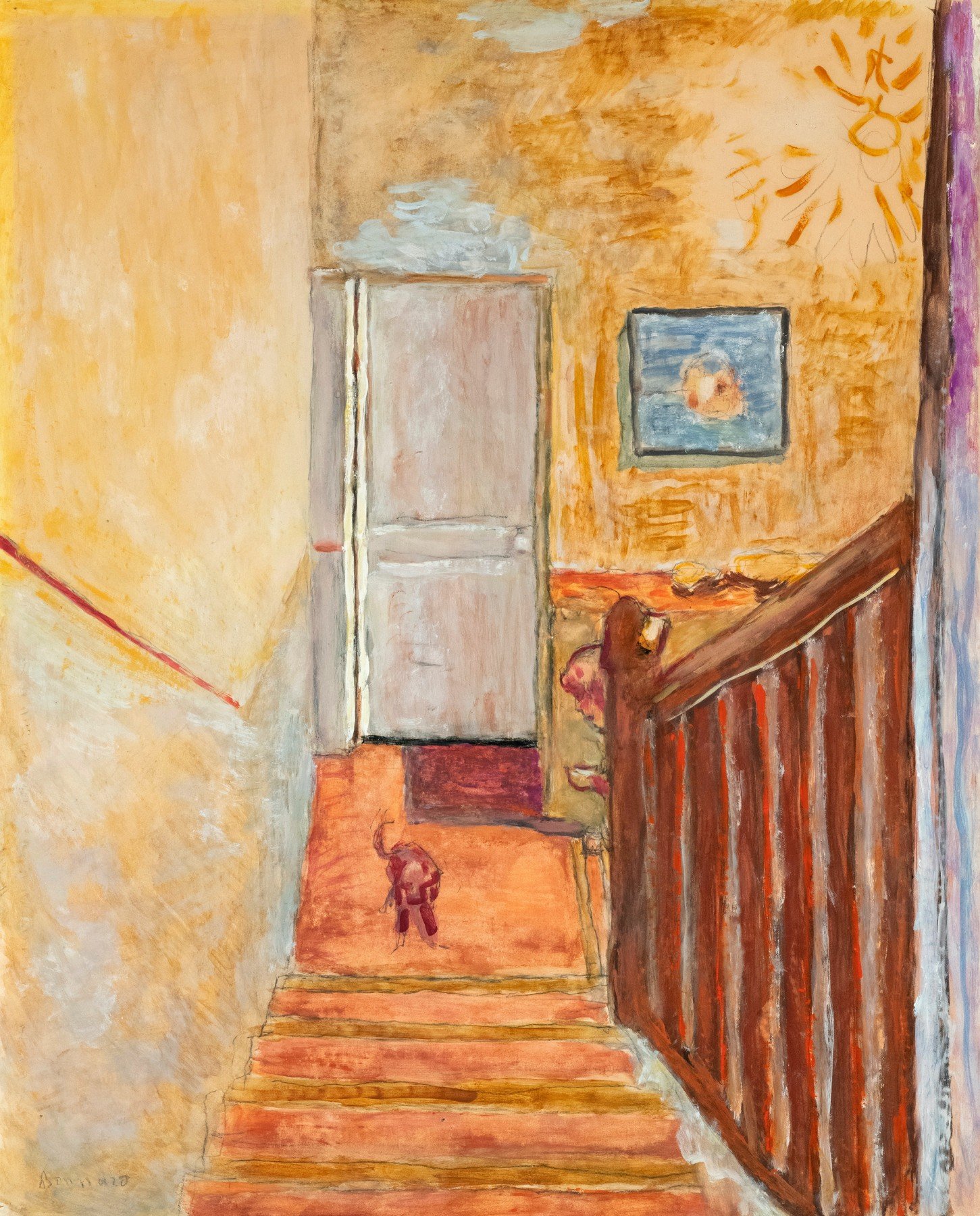
Pierre Bonnard, L’Escalierca. 1932, Oil & gouache on paper, Jill Newhouse Gallery, New York.

Rounding out these attractions was a pair of George III reverse-glass cabinets featuring Grand Tour vignettes, circa 1780, attributed to Ince and Mayhew, from Hyde Park Antiques; a sixteenth-century bowl with a painting of John the Baptist by Pontormo at Robert Simon Fine Art; a stag hunt by John Wootton and other sporting scenes at Red Fox Fine Art; fifteenth-century books at Les Enluminures; a circa 1932 oil-and-gouache of a pet dog by Pierre Bonnard at Jill Newhouse Gallery; and artifacts by Northwest Coast Indians at Tambaran Gallery. Such a collection of historical objects is almost enough to make you forget our present circumstances.

The Winter Show serves as a pendant to New York’s annual auctions for historical art and antiques, which take place the following week. Squeezed between the two is Master Drawings New York, an initiative that brings national and international galleries to the Upper East Side, where they partner with local venues for wall space.2 Now in its eighteenth season, this year Master Drawings New York came under the leadership of Christopher Bishop, a New York gallerist with an eye for misattributed work. Employing a similar sense of connoisseurship to this undervalued gathering of galleries and collectors, Bishop introduced a new level of organization and scholarship to the endeavor that presented a welcome abundance of work in seemingly every available corner of the neighborhood—with only a few days to see it all.

Lorenzo Balidessera Tiepolo, A Young Man Wearing a Studio Cap, Resting His Head on His Left Hand, ca. 1755, Black & red chalk, Nicholas Hall and W. M. Brady & Co., New York.

Clustered in galleries around the Metropolitan Museum and continuing down to Sixty-fourth Street, twenty-six exhibitors mounted these special exhibitions of works on paper from the fifteenth century to the present. Highlights this year included, at Nicholas Hall and W. M. Brady & Co., a portrait of the young Henry William Mathew by John Flaxman, dynamic studies by Il Guercino, drawings by Boucher and Corot, and an unpublished drawing by Lorenzo Baldissera Tiepolo. Abbott and Holder brought over forty-eight British works on paper from its London-based showroom, including a capriccio landscape by Robert Adam, a visionary bedroom sketch by William Blake, and a delicate J. M. W. Turner watercolor once owned by John Ruskin—along with a handsome printed catalogue. Colnaghi Elliott Master Drawings presented orientalist portraits by Jean-Léon Gérôme and Leopold Carl Müller alongside an exhibition of portraits and seascapes by the Spanish master Joaquín Sorolla. Meanwhile David Nolan Gallery, in collaboration with Donald Ellis, presented “Fort Marion and Beyond: Native American Ledger Drawings, 1865–1900,” an exhibition of seventy-five sketches by Arapaho, Cheyenne, Hidatsa, Kiowa, and Lakota artists from the nineteenth century.

The book trade remains a welcome gateway to the cultures of the past, with much of it accessible to a range of readers and collectors. Judging by the crowds at recent New York book fairs, the hard copy has become only more attractive in our digital world for its tactile pleasures and literary delights, while providing the ultimate backup to our evanescent bits and bytes. As collecting institutions have become radicalized by identity politics (see “A library by the book,” my essay in The New Criterion of December 2022), personal libraries are more essential than ever before.

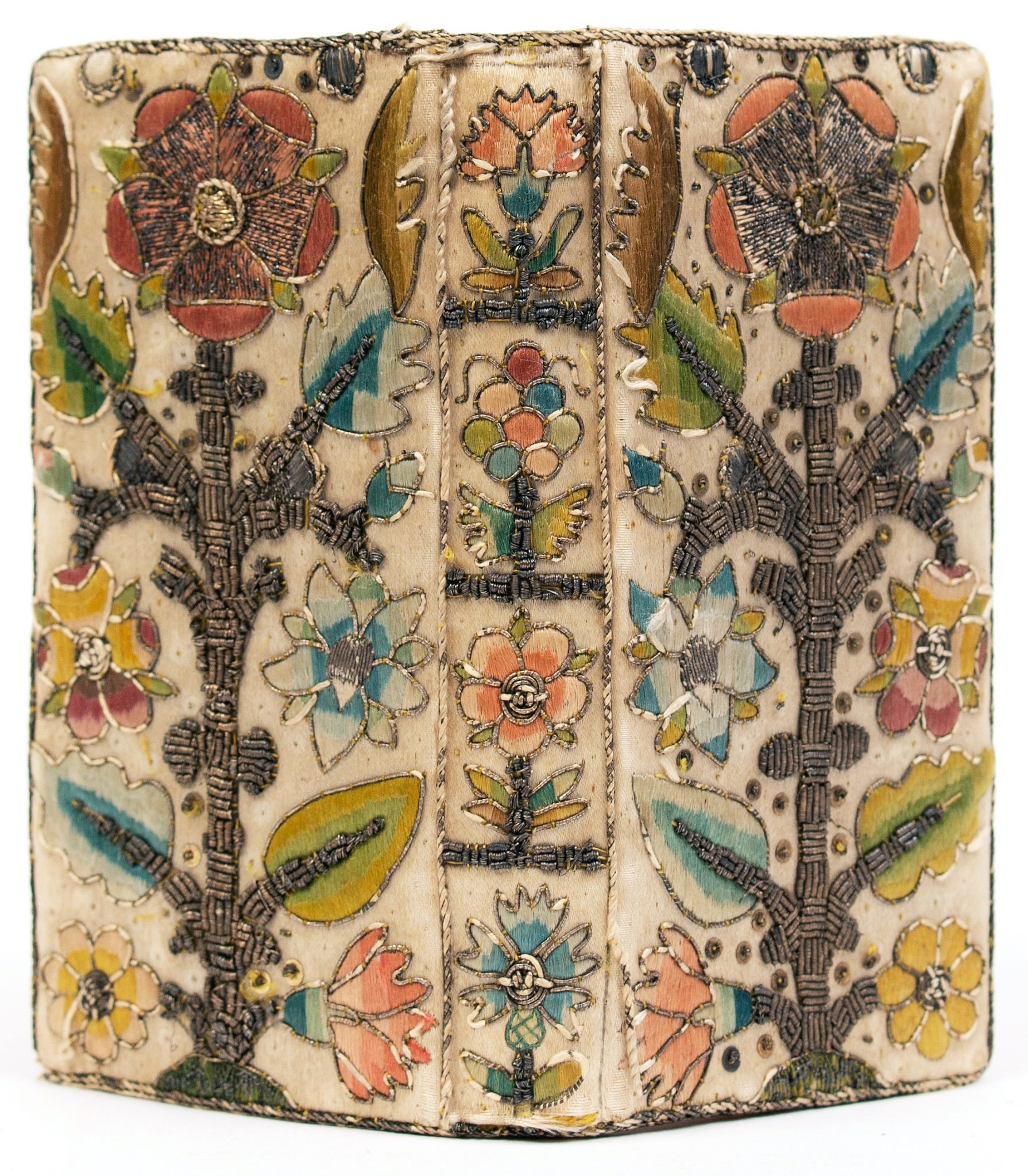
Cover, spine & back cover of The Whole Book of Psalmes, 1643. Photo: Nicole Neenan / Grolier Club.

Last September, the upstart Empire State Rare Book and Print Fair set up shop for the first time inside St. Bartholomew’s Church on Park Avenue. The show was a welcome competitor to the more established (and woker) International Antiquarian Book Fair, put on every April by the Antiquarian Booksellers’ Association of America. An extra pleasure of its ecclesiastical venue was hearing Paolo Bordignon, St. Bart’s organist and choirmaster, perform on the fair’s opening night.

This season, just up the street, the Grolier Club, America’s oldest society of bibliophiles, founded in 1884, continued its run of significant public programs with two must-see exhibitions on view at once. “Whodunit? Key Books in Detective Fiction,” installed in the second floor gallery, was a page-turner.3 With more than ninety books from the Grolier member Jeffrey Johnson’s collection of early detective novels, the exhibition featured standouts ranging from the first American edition of Memoirs of Vidocq (1834), to the first collection of Sherlock Holmes stories (1892), to Agatha Christie’s first novel (1920). Edgar Allan Poe, Charles Dickens, Wilkie Collins, and Anna Katherine Green were among the list of accomplices in a thrilling show that was criminal to miss. Especially appreciated was Johnson’s own testimony, provided in wall labels, of his discoveries as a collector.

A gallery view of “Whodunit? Key Books in Detective Fiction” at the Grolier Club, New York. Photo courtesy of the Grolier Club.

Meanwhile, on view through April in the club’s main exhibition hall, “Judging a Book by Its Cover: Bookbindings from the Collections of The Grolier Club, 1470s–2020,” reveals the Grolier’s advancement of bookbinding as both collecting interest and craft.4 Thanks to the creation of the society’s own bindery in the late nineteenth century, for example, club members no longer had to send their rare books off to France for treatment. Drawing on the society’s holdings, the exhibition pairs the club’s own work with a hundred examples of rare bindings, starting with a circa 1473 brass-and-pigskin volume of The Jewish Wars by Josephus and Ecclesiastical History by Eusebius, through a jeweled miniature Whole Booke of Psalmes (1673), on up to a gilded freehand design by Ulrich Widmann from 2019. Most rewarding are those bindings that speak to the contents within, for example, Ernest Lefébure’s Embroidery and Lace of 1888, with boards covered in green ribbed silk embroidered in delicate floral patterns.

To cap off the antiques season, in late January Sotheby’s filled out its multiple floors on York Avenue with its “Masters Week” sales.5 These days, works by, or of, non-whites and non-men are the hot commodities. Institutional buyers must pursue “diversity” or risk dei ire. That explains the run-up in prices for the saccharine paintings of Élisabeth Louise Vigée Le Brun, who has been achieving records at auction for her work as a female Old Master (Old Mistress?). At the same time, institutions must be seen delivering up their permanent collections to the deaccessioning of the vanities. In the latest Sotheby’s sales, the Metropolitan Museum offered paintings from its “permanent” collection by George Romney, Joshua Reynolds, Thomas Gainsborough, Henry Raeburn, and Johann Liss. With proceeds meant to “benefit the acquisition fund,” we might assume those returns will not be used to purchase more Romneys, Reynoldses, and Gainsboroughs.

Gustav Bauernfeind, The Western Wallca. 1890, Oil on canvas, Private collection.

Nevertheless, it may be good to get such art into the hands of collectors who will value it, and it is a pleasure to see these works as they go up for sale. In the February 1 auction titled “Master Paintings & Sculpture Part I,” The Western Wall (ca. 1890), a painting by Gustav Bauernfeind, bore detailed witness to the historical importance of that holy site. Equally interesting was a charming Swabian School altarpiece of Saint Ursula, circa 1480–90, which at one time passed through the hands of the Monuments Men, who restituted the work from the clutches of Hermann Göring. In “Master Paintings Part II,” a Veronese oil of the creation of Eve, circa 1570–80, sold off by the Art Institute of Chicago after nearly a century in its collection, could have been yours for the price of New York’s worst studio apartment. In the February 2 sale of “Old Master and British Works on Paper,” a sketchbook drawing of a bridge near Epsom by John Constable, circa 1806, was estimated at $5–8,000 but ended up selling for much more. Meanwhile, the sale of “Master Sculpture & Works of Art” remained particularly undervalued, with fourteenth-century ecclesiastical French sculpture going for four digits.

In fact, it is worth noting that the highest jump of Masters Week was the sale of six gym shoes once worn by Michael Jordan. As that suite of sneakers sold for eight million dollars, no Old Master can hope to be like Mike.

  1.   The Winter Show was on view at the Park Avenue Armory, New York, from January 19 through January 28, 2024.

  2.   Master Drawings New York was on view from January 27 through February 3, 2024.

  3.   “Whodunit? Key Books in Detective Fiction” was on view at the Grolier Club, New York, from November 30, 2023, through February 10, 2024.

  4.   “Judging a Book by Its Cover: Bookbindings from the Collections of The Grolier Club, 1470s–2020” opened at the Grolier Club, New York, on January 17 and remains on view through April 13, 2024.

  5.   “Masters Week” was on view at Sotheby’s, New York, from January 26 through February 3, 2024.