In search of Watteau

8187

THE NEW YORK SUN
September 17, 2008

In Search of Watteau
By JAMES PANERO

A review of Jed Perl's 'Antoine's Alphabet' (Knopf)

Who is your favorite painter? Jed Perl, the art critic for the New Republic, responds: "Whenever I'm asked to name my favorite painter I reply, without a moment's hesitation: 'Watteau.'"

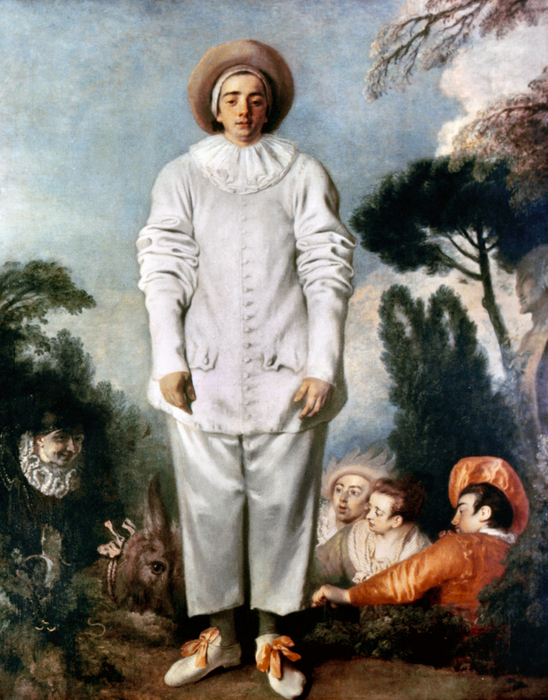
Come again? Watteau? A confection of the ancien regime, Jean-Antoine Watteau was born in 1684 and lived a mere 36 years, dying in 1721, the master of the fête gallant and the portraitist of the commedia dell'arte. It's not the answer you might expect to come out of a tough-minded critic on the contemporary scene.

But "Antoine's Alphabet" (Alfred A. Knopf, 224 pages, $25.95), a brief, deeply felt follow-up to "New Art City," Mr. Perl's muscular account of the New York art world at mid-century, defies expectations. "I may be perceived as being somewhat sardonic," Mr. Perl writes in his introduction, "or ironic, or even impish when I say that Watteau is my favorite painter, as if I were trying to mock the question, or were hiding my true feelings behind a dandyish façade."

Far from retreating from reality, however, Mr. Perl finds engagement with the present moment through Watteau. "This artist who said hardly anything about his paintings and struck most of his friends as something of a mystery man took as his essential subject the invention of self-consciousness, the struggle to feel fully alive." While this critic who rails against the commercialism of the contemporary art world makes no mention of today's art politics, one cannot help but see a counter-example in the fancy-free Watteau to the predetermined art that now fuels record sales at Sotheby's and is bought up by the oligarchs of Beijing, Moscow, and New York as cynical investments.

In its best sense, Mr. Perl sees the birth of the modern in Watteau's figures awakening to their own imperfections. "Watteau's young people seem to want, above all else, to feel at ease, somewhat at ease, in an uneasy world," he writes. In work such as Watteau's famous painting of "Gilles," the contemplative clown, Mr. Perl finds "doubts," though they are "clothed in the commedia dell'arte lightness of an improvisation or a folly." He calls Watteau "The man who practically invented the bohemian imagination." In his aesthetic wanderlust, his reveries of vagabond performers, Watteau did not follow the dictates of the church or a rich clientele, but pursued art for art's sake, the prototypical modernist.

"Antoine's Alphabet" is not a generic appreciation, or a typical brief history. Mr. Perl presents his volume as a primer, arranged as an alphabet: A is for actors, Anthony, and Art-for-Art's-Sake; B is for Backs, Beardsley, and Beginnings, and so on. "The power of certain great paintings," Mr. Perl writes, "no matter how much self-conscious craft the artist brings to the work, is the quality of a daydream, an orchestration of elements whose meaning remains ambiguous or contradictory." Mr. Perl follows the same daydreaming impulse in the footloose presentation of his book. Each definition examines an aspect of Watteau while also offering a meditation on the Watteau-esque — a glint of history, an inspiring theme, a personal rumination. For example, we get:

Beginnings: So much begins with intense yet fragmentary experiences. At the start of a friendship or a love affair there may be some acute recognition, some striking sliver of experience, although initially it's impossible to know where this will go, if indeed it will go anywhere. ...

Cappricio: Watteau is recklessly capricious, a weaver of arabesques who embraces the grotesque, not in the sense of gothic horrors but in the sense of curious divagations and transmutations.

My favorite is "Enough: One day in his studio, D said to me: 'I've always had enough. I'm tall enough, I'm good-looking enough. I have enough money.'" Enough said.

The literary games on display might, in the hands of another writer, come off as an indulgence, but here they serve a clear purpose: They not only describe the mood of an artist, but they let us inhabit his sensibility. The book speaks in the serendipitous language of Watteau's canvases — serendipitous, additionally, because we know very little about Watteau outside of his work. "At the time of his death," Mr. Perl writes, "Watteau was a famous figure in Paris, with his share of devoted friends. The nuggets of reliable information about his life, however, are few and far between, so that every attempt to construct a biography from what scattered facts there are appears bound to fail."

Mr. Perl is not the first to take an unorthodox approach to his history of this artist. Watteau's most successful biography, Mr. Perl recounts, came out of a fictionalized memoir by Walter Pater called "A Prince of Court Painters," which was published in 1885, and which, "in assembling and readjusting some of the facts of the artist's life ... constructs a fable about Watteau that is truer to what we feel when we're looking at his paintings and drawings than a more straightforward account could possibly be." In his story, Pater "imagines himself as a part of the eighteenth-century Pater family that actually knew Watteau."

Mr. Perl here does something of the same, going one step further. Rather than merely imaging himself an associate of Watteau, he becomes a Watteau in print. So am I crazy to see a resemblance between the portrait of Watteau drawn by François Boucher, reproduced in the book, and the photo of Mr. Perl on the dust jacket? Mr. Perl constructs his book around the arabesque, the daydream, and the fragment. "Much of the fragment's fascination has to do with its delicious air of possibility," he writes, "for a fragment provokes a partial experience that can leave us with a heightened awareness of what we are missing."

Many of those "experiences" are personal for Mr. Perl. But that does not mean they are artful dodges. Rather, Watteau allows this trenchant thinker — arguably our best art critic writing today — to show, for once, his own hand. We see the painted ceiling of his boyhood home in Brooklyn, and are given a manifesto of his desires in paint: "What I really want from art is a variety of qualities, a multiplicity of qualities, a kaleidoscope of qualities, the unpredictability of qualities, qualities that are as varied as the artists who create the works of art."

In its oddity, the book gambles and wins. I hope that "Antoine's Alphabet" will become a cult classic among artists, a call to caprice, in the way that Dave Hickey's "Air Guitar," a critic's libertarian riff, gave license to a generation of artists to forego politics for the rapture of the marketplace. In this capricious cross-pollination of history and memoir, Jed Perl does not merely show us how to live. Like Watteau, he illuminates the struggle to feel fully alive.

Mr. Panero is the managing editor of the New Criterion.
'Brother, Who Art Thou?'

Panero-190 THE NEW YORK TIMES BOOK REVIEW
June 29, 2008

Brother, Who Art Thou?
By JAMES PANERO

A review of 'APPLES AND ORANGES: My Brother and Me, Lost and Found,' by Marie Brenner. (Illustrated. 268 pp. Sarah Crichton Books/Farrar, Straus & Giroux. $24.)

If Marie Brenner and her brother, Carl, can learn to love each other, there might be hope for our divided America after all. She’s a hot-shot writer at large for Vanity Fair, an investigative journalist known for taking down corporations; her exposé of the tobacco industry became the 1999 movie “The Insider.” He is an apple farmer in Washington State with the N.R.A. sticker on his truck who complains about his sister’s “A.C.L.U. friends in New York.” Illness turns out to be this family’s cure. Carl is discovered to have cancer, and Marie flies to apple country to try to save him.

In less capable hands, a memoir of such reconciliation might become a tired on-the-road travelogue or, worse, a bedside tear-jerker. But in “Apples and Oranges,” Marie Brenner has delivered a majestic little book. She deepens a tragicomic story into a meditation on family and fate.

“Our relationship is like tangled fishing line. We are defined by each other and against each other, a red state and a blue state, yin and yang.” The history of sibling warfare between these Brenners goes back to childhood. When she was 3, Carl pushed Marie out a window, sending her to the hospital. In high school, Carl filled his room with “manuals of alleged Communists published by the John Birch Society” while Marie played Joan Baez records. One day Marie came home to find the records smashed. “She’s a subversive,” Carl told her. “I have it right here on my list.”

“Is anything in life an accident?” Marie asks. They both came from the same secular Jewish household, heirs to a chain of Texas discount stores called Solo Serve. So how could she become a liberal journalist in New York while her brother turned out to be a Bush-loving, Wagner-listening, evangelical “right-wing nut” growing apples on the other coast?

Marie Brenner brings the same journalistic arsenal to this question that she would normally reserve for an investigation of Big Tobacco. When her brother gets sick, research becomes her coping mechanism. “I am treating my brother as if he is a source,” she writes, “someone I have been assigned to interview.”

Brenner looks for answers in the relatively new science of sibling psychology. Questionable terrain, perhaps. “I want to investigate if sibling problems are passed down in families like blue eyes and brown hair,” she writes. She uncovers letters that reveal a rift between her father, Milton, and his sister Anita. “Did my father’s rage at his sister impact my relationship with Carl?” Anita went to Mexico to become an associate of Diego Rivera, Frida Kahlo and José Clemente Orozco; she posed for Edward Weston and knew Trotsky. Milton stayed in San Antonio to build up the company founded by their father, Isidor.

When Isidor left their mother for a much younger woman, Anita backed her father. Milton did not. “Don’t you see that you are laying the fuse for a tremendous bomb,” Anita asked Milton in 1932, “the results of which no one can foresee, and which will involve all of us?”

Marie hopes that understanding her father’s family can help her make sense of her own. “The term ‘coherent story’ keeps popping into my mind,” she writes. “Family therapists call this the genogram, the laying on of family theory.”

How do we end up the way we do? Marie is the compulsive rationalist looking for the missing piece in her brother’s story, the key to the mystery. Her faith, like Anita’s, is in enlightened salvation. “I was stitching facts out of what I learned, trying to come up with a grid to lock together all of the following events,” she writes. “Where was the pattern? How did it link?”

Like his father, Carl is ever the skeptic. “It doesn’t connect,” Carl responds. As soon as Marie develops a leitmotif, Carl undermines it. We are led to believe that Carl was in the Marines, where “officers are trained to run through smoke and fires.” Ah, we say, maybe that caused Carl’s adenocarcinoma. But this cannot be the case. “After all that tough-guy posturing in college,” Brenner writes, Carl “never got to the Marines.”

In Brenner’s sympathetic portrait, Carl becomes a nuanced conservative character. “Sometimes you do not get to understand everything,” she concludes. Family trumps politics, and Marie comes to accept her brother’s tough love. One day, brother and sister climb “through the Galas, up through the Bartletts, the valley stretched out before us. We’re standing in a row of saplings, just planted in this sandy loam soil that he has named after our father. The Milton bloc. ‘This is where I want my ashes scattered,’ he says. ‘Are you listening to me?’” Marie was listening closer than Carl ever imagined. His ashes are scattered throughout this mystical book.

'Art's Willing Executioner'

1401 THE NEW YORK SUN
June 4, 2008

'Art's Willing Executioner'
by James Panero

A review of 'Let's See' by Peter Schjeldahl

Art critics are like thoroughbred horses: They risk breaking down after a short period on the track. It came as a surprise, then, when the New Yorker appointed Peter Schjeldahl as its critic in residence 10 years ago: By 1998, Mr. Schjeldahl had already been around the course more than once. Born in Fargo, N.D., in 1942, he had been writing for the Village Voice since 1980, and before that for ARTnews, Seven Days, and the Arts & Leisure section of the New York Times. Back in the late 1960s, the New Yorker's hiring of the Abstract Expressionist critic Harold Rosenberg came as a temporary reprieve from the slaughterhouse. For Mr. Schjeldahl, one wondered if the job would be a similarly green pasture in which to natter on into oblivion.

But Mr. Schjeldahl found his second wind at the New Yorker. He has regularly filed tuneful columns of readable stories with tight structure and interesting twists of phrase informed by his years as both a journalist and a poet. (By the 1960s, Mr. Schjeldahl was already a published poet in the New York School; he abandoned poetry around 1980 to pursue criticism.) Mr. Schjeldahl's latest volume of selected writing, 75 essays from a decade at the New Yorker running through 2007, has now been published as "Let's See" (Thames & Hudson, 256 pages, $29.95).

Those 10 years make for an interesting case study of art, one framed by the unprecedented rise in the market value of postwar and contemporary work — now a global infatuation — and an art-world giddiness that seems untouched, or is perhaps even encouraged, by crises in the economy and the war on terror. The art critic of today must function as a gossip columnist, a stock analyst, and a lifestyle guru. Mr. Schjeldahl plays these roles with brio: At the New Yorker, he has kept up with the art of his times all too well.

At its best, Mr. Schjeldahl's craft produces one-liners that are pleasing and illustrative: "[Gauguin] had the kind of petty run-ins with local authorities that dog arrogant misfits in resort towns everywhere." "One doesn't so much look at a Friedrich as inhale it, like nicotine." Lucian Freud "is less a painter than 'the Painter,' performing the rites of his medium in the sacristy of his studio." "All Picasso's pictures are dirty." Such zingers are ready for Bartlett's.

But the anthology left me wondering how Mr. Schjeldahl's achievements, many but minor, stack up against his shortcomings as a responsible critic. It is not so much that Mr. Schjeldahl has bad taste. As a libertarian sensualist, he is rather preconditioned not to have taste at all, or at least to have sublimated his taste for the purposes of having his readers "engage with art of every kind," no matter how terrible or reprehensible the art might be. In fact, Mr. Schjeldahl belittles taste here as only a "sediment of aesthetic experience, commonly somebody else's." It is interesting to note, however, that in disregarding taste, he heads right for the tasteless — leading me to suspect that Mr. Schjeldahl knows what good taste is all along but chooses to ignore it.

At times, this tastelessness can be unnerving but relatively harmless. Mr. Schjeldahl's ceaseless promotion of the histrionic contemporary artist John Currin, for instance, would put a publicist to shame. He calls Mr. Currin "as important an emerging painter as today's art world provides," whose "virtuosity has overshadowed that of everybody else in the field." He also manages to name-drop Mr. Currin into essays where you would least expect it, including a review of El Greco, and one of Victorian fairy paintings.

Over the past decade, about the last thing the overheated art market needed was more praise for artists like Mr. Currin. But Mr. Schjeldahl sent his coals to Newcastle — or rather, to the Gagosian Gallery — at the expense of endlessly more deserving and underappreciated artists.

Too often in the decade covered here, Mr. Schjeldahl followed the money rather than good conscience. Faced with market forces, he bids "goodbye to critics functioning as scouts, umpires, scorers, clubhouse cronies, and occasional coaches." Rather than regret the loss of critical authority, he welcomes collectors to the driver's seat. "Preposterous amounts of money seem to concentrate the mind," he says. Yet considering the overvaluing of artists like Jeff Koons, Damien Hirst, and yes, John Currin, the facts just don't bear this out. I doubt Mr. Schjeldahl even believes it.

Far more damning than Mr. Schjeldahl's abdication of critical judgment, however, is his embrace of art used for violent ends. Mr. Schjeldahl came out of the Generation of 1968 with a weakness for violence, which often translates into an affection for fascist and Nazi imagery. He rightly bristles at politicized art, but I find his willingness to aestheticize politics just as disturbing. (There is a difference between the two: Walter Benjamin famously wrote that communism pursued the former strategy, while fascism adored the latter.)

"Art love does not accord with good politics, good morals," Mr. Schjeldahl said in a 2004 interview. "Hitler had rather good taste, certainly in architecture and design. I think the Nazi flag was one of the greatest design coups in history."

Such enthusiasm, a targeted irresponsibility, gets repeated more than once in the current collection. Mr. Schjeldahl describes "October 18, 1977" by Gerhard Richter, another son of the'60s, as "a suite of fifteen somber paintings [belonging] to a tiny category: great political art." Yet Richter's hagiographic icons (not all that well painted, by the way) simply mythologized murderous German thugs.

In fact, Mr. Schjeldahl reserves his highest praise for Der Führer himself, whom he describes as "masterly once he found his métier." Hitler, Mr. Schjeldahl informs us in a review of Nazi art, "embraced cleanly abstracted and geometric styles, which later informed his own design work (notably the stunning Nazi flag) and his shrewd patronage of the gifted youngsters Leni Riefenstahl and Albert Speer." I have deliberated over what is the most odious part of this remark, and I have settled on the use of the word "youngsters" to describe Riefenstahl and Speer. For Mr. Schjeldahl, it's as if Nazi propaganda was little more than after-school high jinks committed by the Little Rascals.

Mr. Schjeldahl's disagreement with the curator Deborah Rothschild in this same review is telling. He begins with a quote from Ms. Rothschild: "The union of malevolence and beauty can occur; we must remain vigilant against its seductive power." That sounds pretty reasonable, but Mr. Schjeldahl offers a quick retort: "I disagree. We must remain vigilant against malevolence, and we should resign ourselves to the truth that beauty is fundamentally amoral."

Why a critic should feel obligated to accept and even champion beauty in the service of wickedness is incomprehensible to me. Mr. Schjeldahl embodies the critic as an accomplice. At his best, he is gleefully sly. At his worst, he is art's willing executioner.