Supreme Court should have taken the Harmon rent control case


Do you have the right "real estate karma" to rent here? The UWS Harmon house with its three rent-regulated tenants. 

NEW YORK DAILY NEWS
April 24, 2012

Supreme Court should have taken the Harmon rent control case
by James Panero

Current law allows for lavish living, practically for free

On Monday, the U.S. Supreme Court refused to hear an appeal from James and Jeanne Harmon, the owners of two townhouses on West 76th St. who have challenged the constitutionality of rent control.

In Harmon v. Kammel, the Harmons claimed that such controls meant that the government has essentially made them the private funder of a welfare program. It had also illegally taken their property in violation of the 5th Amendment, which reads that “no person shall be . . . deprived of life, liberty, or property, without due process of law; nor shall private property be taken for public use, without just compensation.”

Rent control, they argued, has taken their private property “without just compensation.”

When the Harmons took ownership of their two small buildings, which had been in the family since 1949, they also got the tenants occupying three rent-controlled apartments. By law, these tenants now lease their apartments at 59% below market rate with lifetime tenure and generous succession rights.

A decade ago, one of Harmon’s tenants even bragged to a newspaper that he lived there “practically free” due to his great “real estate karma.”

Monday’s Supreme Court decision might only sound like a setback for landlords like the Harmons, but really it’s bad news for our entire city, which has long been the victim of a disastrous and near fatal experiment in price fixing. This is especially true for neighborhoods like the upper West Side, where I have been a lifelong resident.

Rent control was an “emergency” measure put in after World War II that stayed on the books for political convenience, even as it nearly bankrupted our city’s aging housing stock. These laws, which came out of a fear of the dangers of the free market, in fact demonstrated how government-manipulated pricing could be far more destructive than market forces.

With rents, services and evictions all regulated by the legislature and the courts, the city and state became the absentee landlords of neighborhoods like the upper West Side.

Power flowed from a politician’s apparent ability to depress rental rates for existing tenants while “taking on” the buildings’ now captive owners for diminishing services.

The city’s price controls, among the most stringent in the country, meant that the rate of apartment turnover plummeted. This created an artificial apartment shortage that continues to raise the rental rates of new construction. Since lower rent also meant that existing owners had less revenue for upkeep, for years aging buildings decayed for lack of funds, meaning that politicians could exert even greater rhetorical leverage over their “slumlord” conditions.

Historically, rent control has exacted its heaviest toll on the very tenants it purports to serve. The wealthy could maintain multiple residences while keeping their sprawling and under-used rent controlled apartments off the market.

Corrupt tenants learned to manipulate their rents even further by calling in phony complaints to the Department of Buildings and suing for bogus “diminution of services” in order to tie up rate increases in litigation (the practice remains commonplace today). Meanwhile, average, honest renters became hostage to the artificially depressed rents of their apartments as rent control diminished surplus and drove up the prices of alternative rental apartments.

Even as their building and their neighborhood collapsed around them, they were often unable to afford to relocate and became increasingly captive to the whims of a political class that purported to have a say in rental rates.

What saved New York wasn’t rent control. It was the cooperative revolution. Stocked with rent-controlled and rent-regulated tenants, the aging buildings in neighborhoods like the upper West Side, despite their grandeur, became next to worthless to their owners.

In the 1970s and 1980s, non-eviction plan coop conversions finally allowed owners to sell shares of their buildings to their own rent-controlled and rent-stabilized tenants, who could then invest their capital and sweat equity into the restoration of the neighborhood. Rather than taking on the landlords, as landlords themselves they took on the squalor of their neighborhood and restored areas like the upper West Side to what we see today.

Despite the damage done to our neighborhoods, rent control and rent regulation still feeds our city’s political machine. In 2008, Rep. Charlie Rangel, with a reported net worth of $566,000 to $1.2 million, was even caught taking up four rent regulated apartments for his personal use.

If the courts won’t take it on, the time has come for New Yorkers to do the right thing in the voting booth and say no to a system that has given their politicians a free ride while damaging their neighborhoods almost beyond repair.

Capital and its Discontents: A Discussion Grows in Bushwick

CapitalDiscontents_Meisler-7598

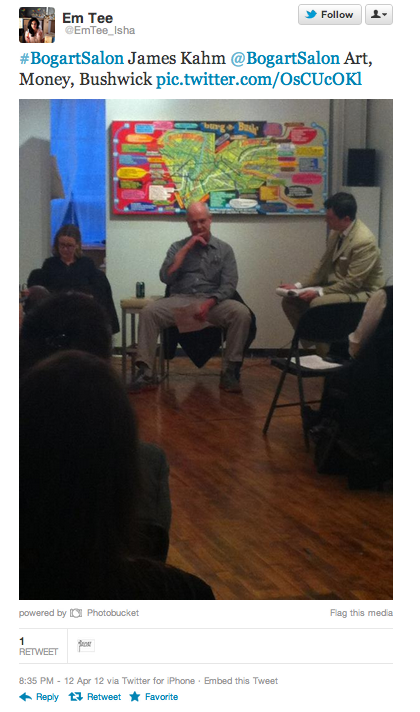
The panelists from "Capital and Its Discontents: Art, Money, Real Estate and the Changing Face of Bushwick": Peter Hopkins (Bogart Salon), Natalia Sacasa, Francis Greenburger, Ann Fensterstock, James Panero (host), Loren Munk, and William Powhida. "Burg n Bush," work in progress by Loren Munk, in background. Photograph by famous Bushwick documentarian Meryl Meisler

UPDATE: THE FULL DISCUSSION IS NOW ONLINE HERE

James writes:

On Thursday, April 12, I hosted a panel discussion at The Bogart Salon called "Capital and its Discontents: Art, Money, Real Estate and the Changing Face of Bushwick." You can read all about the run up here.

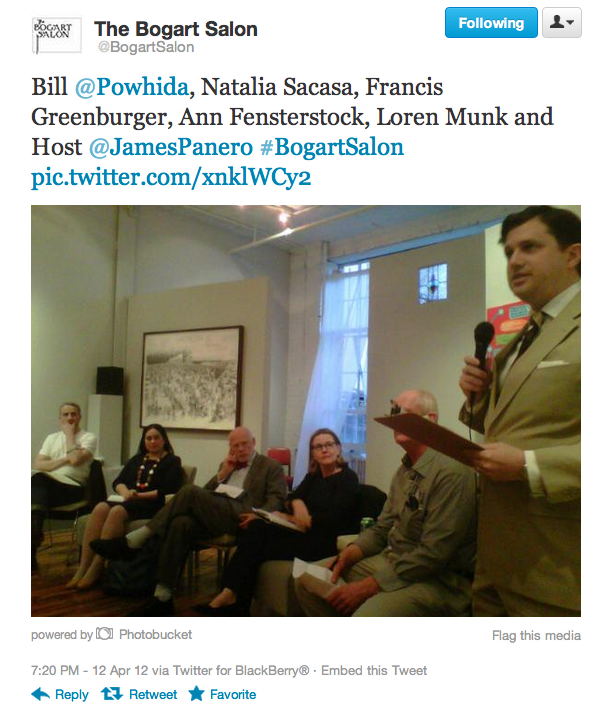
My panelists were Ann Fensterstock (collector, arts patron, historian), Francis Greenburger (collector, founder of Time Equities), Loren Munk (artist), William Powhida (artist), and Natalia Sacasa (Senior Director, Luhring Augustine). 

Art, money, and real estate. These three forces are changing the face of Bushwick. We may not agree on how it’s changing, but we can all agree that the neighborhood of Bushwick is changing quickly. By last count, there were over 35 galleries in Bushwick, up from just a handful a few years ago. Until recently, 56 Bogart, the venue for the panel, was mainly used for light manufacturing. Now it’s filled with new galleries and non-profits--some new, others well established and coming in from elsewhere. And in February, Luhring Augustine, one of the bluest of Chelsea’s blue-chip galleries, opened a 10,000-square-foot outpost in the heart of Bushwick, to the fascination and consternation of the neighborhood’s arts community.

As I said in the panel’s introduction:

If we are here to put capitalism on trial, and capitalism loses, I wouldn’t question capitalism. I would question our judgment.

Yet art, money, and real estate have always had a complex relationship, and lately it seems to be getting more complicated.

According to the New York Times, a chief executive at UBS wealth management informs us that “art is becoming more and more of an asset class.”

Money has always been a component of art, but now it seems to have become art’s defining characteristic. Bill Powhida, in your own work, you ridicule the business side of art, calling the dominance of money “asset classicism”--a term that may speak to our age better than any other.

Up to this point, one thing that has struck me about Bushwick is that the neighborhood seems to exist outside of the arts industrial complex you lampoon. Bushwick has developed something of a micro-economy of its own, with artists bartering with each other and tiny galleries selling work in the hundreds, rather than the tens of thousands, of dollars.

As Bushwick begins to attract a wider pool of collectors, is it a good thing, or is “asset classicism” not far behind?

Following up from "Capital," Kianga Ellis and Trent Morse are hosting "War Room" at the Bogart Salon through Sunday, April 15. Keep up with the discussion here. 

Real-time Twitter feed from Bogart

"Capital and its Discontents" on Artinfo.com


CapitalDiscontents_Meisler-7593

Peter Hopkins of Bogart Salon introduces the panel. Showing: Francis Greenburger, James Panero, Ann Fensterstock, and Loren Munk. Off camera: William Powhida and Natalia Sacasa 


CapitalDiscontents_Meisler-7606
Your host!

Screen shot 2012-04-14 at 10.14.09 AM
Screen shot 2012-04-14 at 10.16.21 AM
Screen shot 2012-04-14 at 10.19.32 AM


Here is some press from the first Bogart Salon panel where Hrag Vartanian headed up a great discussion with Deborah Brown, Thomas Burr Dodd, Carolina A. Miranda, and Marco Antonini:

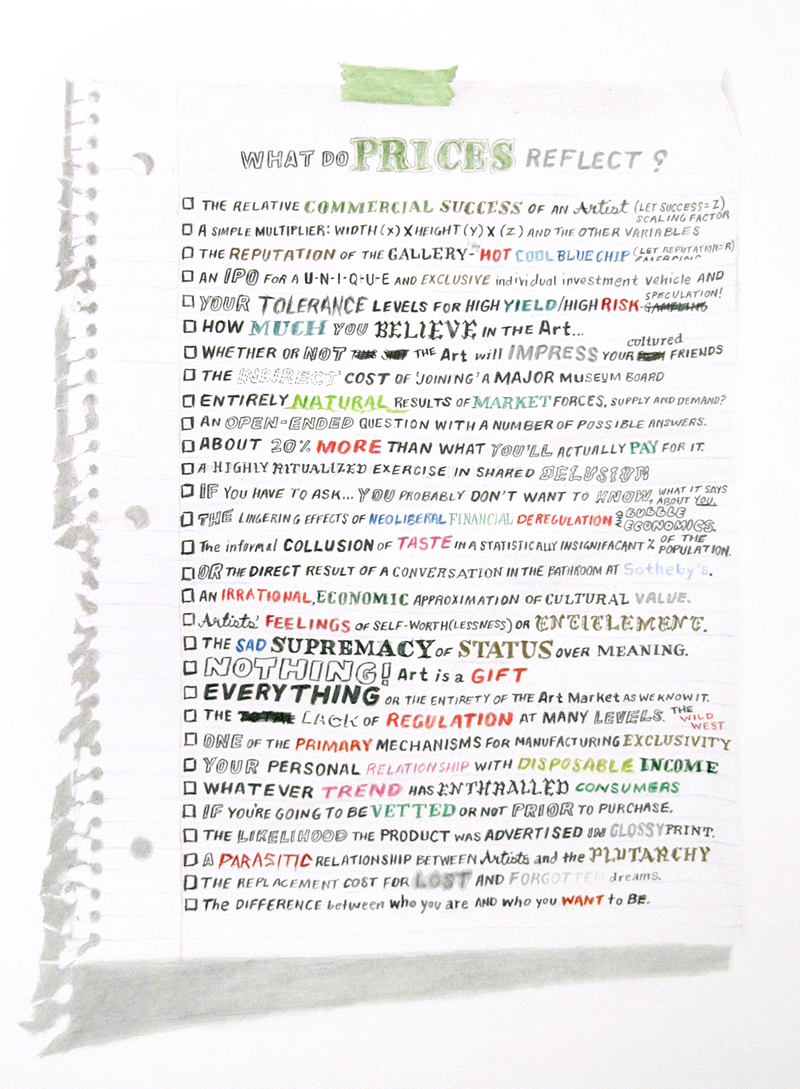
Prices_large1
William Powhida, "What Do Prices Reflect?" Graphite, watercolor, and colored pencil on paper, 2011. Courtesy of Postmasters Gallery.

Time for Tim Tebow to Stand Tall

Tim Tebow appearing in Superbowl commercial for Focus on the Family, 2010

NEW YORK DAILY NEWS
April 1, 2012

Time for Tim Tebow to stand tall
by James Panero

His voice and values may be just what New Yorkers are looking for

Out of the circus that has surrounded the arrival of the Jets new backup quarterback, one thing is clear: New York has never seen a culture warrior like Tim Tebow — a fact that could challenge the city in profound ways.

For this “muscular Christian,” football and faith have been a winning combination. And like his game on the field, Tebow’s powers of religious persuasion didn’t come by chance. They date back long before his star turn for the Denver Broncos, his championship runs with the Florida Gators or the local squad he joined as a home-schooled teenager.

Tebow is an evangelist — not just for his Christian faith, but more importantly, for the kind of living it commands. And now, rather than that message being spread in more conservative Colorado, Tebow has the opportunity to practice what he preaches on the world’s largest stage.

In a city where sky-high abortion rates are rarely questioned, he should spotlight the problem. In a city where churches are being forced out of public schools on weekends, he should speak for them. In a city where abstinence-only sex education is passé to the powers that be, he should connect with young people on the virtues of saving oneself for marriage.

Call it Tebow’s biggest mission.

Abortion is the first and most obvious opportunity. The son of Baptist missionaries, Tebow was born in the Philippines. While pregnant, his mother Pam went against doctors’ orders and refused to have an abortion. This story has long informed Tebow’s own pro-life beliefs. During the 2010 Super Bowl, the organization Focus on the Family famously aired a pro-life advertisement featuring her being “tackled” by her loving son.

The ad proved to be a simple and positive treatment of a mother’s love for her “miracle baby.” “He almost didn’t make it into this world,” she said. “I can remember so many times when I almost lost him.”

Airing this soft-sell ad despite the pushback from abortion groups became a victory for Tebow and his convictions. He later claimed that a survey revealed that 5.5 million viewers changed their stance to pro-life because of its message. A football star can be a powerful argument against an abortion that had once been presented as a medical necessity.

What better place to repeatedly make the case than in New York City? This is the country’s “abortion capital,” with the highest rate of any city in the nation. Yet it’s rarely discussed that fully 40% of all pregnancies here end in abortion — 83,000 in 2010 — compared to 23% nationally, according to the Chiaroscuro Foundation.

It’s not that New Yorkers are happy about the fact: Two-thirds of us, including a majority of pro-choice supporters, believe these numbers are too high. It’s just that we’d prefer not to think about it. That may be coming to an end; it’ll be impossible for Tebow to ignore the epidemic in his new backyard.

Second, Tebow should challenge a city administration that’s been downright hostile to a few dozen small churches fighting for the right to use public school space on weekends. If secular groups can rent the spaces, the churches contend, why should religious organizations be forbidden?

But that’s precisely what Michael Bloomberg has fought to do, citing a policy prohibiting “worship services” that courts have, up until now, endorsed.

A visit from Tebow to the Bronx Household of Faith, which is at the eye of this storm, would send a powerful message and likely change many minds.

And imagine if, instead of only serving as a spokesman for car dealerships and clothing brands like other sports stars, Tebow also uses his celebrity to sell New Yorkers on the evangelical Christian values that course through his bloodstream. For example, back in 2009, Tebow openly admitted in a press conference that he was a virgin — an earnest and honest expression of his convictions.

That sort of straight talk could win him many converts of the literal kind. Kids wearing his jersey might think twice before getting pressured by peers to engage in irresponsible behavior.

None of this is a leap of faith: Unlike Charles Barkley, who famously chafed when called a “role model,” Tebow embraces the term.

The Tim Tebow Foundation, which the football star first envisioned when he was an undergraduate, now uses “the public platform that God has blessed Tim Tebow with to inspire and make a difference in people’s lives throughout the world,” according to its website. As the testimonial from coaching legend Tony Dungy makes clear, “His leadership and Christian values set an example not just for his teammates, but for all young people.” Now, he has the opportunity to set an example for New Yorkers of all ages.

In the process, he just might call New York City to recognize its true character, hidden in plain sight. Much has been made about the pious Tebow landing in a heathen town. “So the Denver Broncos have sent quarterback Tim Tebow to the New York Jets, which is akin to dropping the Christian among the lions,” wrote Tracee Hamilton in the Washington Post.

It’s a common refrain, but it relies on a caricature. New York is far from the Gomorrah that Woody Allen describes in “Annie Hall”: “Don’t you see the rest of the country looks upon New York like we’re left-wing, communist, Jewish, homosexual pornographers? I think of us that way sometimes, and I live here.”

In fact, Andrew A. Beveridge, a professor of sociology at Queens College and a demographer at Gotham Gazette, reports that an “estimated 6.8 million New Yorkers — or more than 83% of the population — were identified as being affiliated with some organized religion in 2000.”

Just how religious does that make New York City? More religious than all states except Louisiana and “even slightly higher than Utah,” writes Beveridge.

From the tallest church in America — Riverside Church, at 22 stories — to the seat of a newly reinvigorated Catholic archdiocese led by Timothy Cardinal Dolan, to the epicenter of American Jewry, to evangelical ministries now sprinkled into old theaters throughout the city, New Yorkers take their religion seriously but silently.

Tebow’s words and, more importantly, his actions, can help get religion out further into the public square.

“If people are still somehow talking about prayer or talking about my faith, then I think that’s pretty cool,” Tebow said on Monday.

Just days after his arrival, that strategy is already working.

UPDATE: Syracuse Post-Standard picks up on this story and reports the Jets may have other ideas for their backup quarterback.