Kissinger Receives First Burke Award

237

Dr. Henry Kissinger at The New Criterion's inaugural Edmund Burke Award with editors David Yezzi, James Panero & Roger Kimball

THE WALL STREET JOURNAL
May 1, 2012

Kissinger Receives First Burke Award
by Gary Shapiro

Eighteenth-century statesman Edmund Burke looked favorably upon the American Revolution: If he were alive today, there's no reason to think he would not laud an American award in his honor, too.

Patrons and connoisseurs of culture assembled to celebrate the New Criterion, the New York-based monthly journal of arts and culture, which conferred upon Henry Kissinger its inaugural Edmund Burke Award. Last week's event marked the 30th anniversary of the publication.

Looking over the intimate gathering, it appeared as though the mastheads of prominent conservative publications had sprung to life and joined the party. Three editors at large, Myron Magnet of City Journal, John O'Sullivan of the National Review and Norman Podhoretz of Commentary magazine, rubbed shoulders with figures such as R. Emmett Tyrrell Jr., the editor in chief of the American Spectator. The think-tank world was represented by those such as Lawrence Mone, president of the Manhattan Institute. Roger Kimball, the editor and publisher of the New Criterion, rose to introduce the famous diplomat. He said Mr. Kissinger needed no introduction, but, nonetheless, found words to offer.

"I hear it often said that it's difficult to introduce me," said the former secretary of state. "But no one enjoys an introduction more than I do." The audience laughed when Mr. Kissinger began recounting self-deprecatingly how his late friend William Simon often said that Mr. Kissinger's knowledge of economics was a good argument for ending universal suffrage.

As roast rack of lamb with Provencal herb crust was being cleared, all ears were on Mr. Kissinger, who delivered a talk on "The Limits of Universalism: Conservatism and Neo-Conservatism in American Foreign Policy." Fittingly for the Burke Award, he spoke about the implications of what Burke's thoughts on English liberty had for fraternal arguments between contemporary conservatives and neoconservatives.

The questions and answers following his talk electrified the room. One asked, "Of the great British statesmen of the 19th century, who is the most able and least?" Mr. Kissinger said one far ahead of his time was Lord Castlereagh. Another asked, "Does the United States have a foreign policy or have we lost our way?"

Those who wished they had attended will not be disappointed to learn that Mr. Kissinger plans to publish the lecture. (Note: If you are Henry Kissinger, you can publish just about anywhere you like.)

As the evening closed, Mr. Kimball presented the Mr. Kissinger with a first edition of Burke's political writings. Mr. Kimball noted that the book contained "Thoughts on the Cause of the Present Discontents." The presenter emphasized how a tract about the abuse of power and what can be done about it remains uncannily pertinent today.

A group headed downstairs for a nightcap, where Mr. Kissinger, in his famous submarine voice, held court on a chair near the right side of room.

Missing was the New Criterion founding editor, Hilton Kramer, who will be remembered this month at a memorial.

Those leaving did not come away empty handed, either. Each received a signed copy of Mr. Kissinger's book, "On China" with a New Criterion bookplate that has a visage of Edmund Burke peering out.

Supreme Court should have taken the Harmon rent control case


Do you have the right "real estate karma" to rent here? The UWS Harmon house with its three rent-regulated tenants. 

NEW YORK DAILY NEWS
April 24, 2012

Supreme Court should have taken the Harmon rent control case
by James Panero

Current law allows for lavish living, practically for free

On Monday, the U.S. Supreme Court refused to hear an appeal from James and Jeanne Harmon, the owners of two townhouses on West 76th St. who have challenged the constitutionality of rent control.

In Harmon v. Kammel, the Harmons claimed that such controls meant that the government has essentially made them the private funder of a welfare program. It had also illegally taken their property in violation of the 5th Amendment, which reads that “no person shall be . . . deprived of life, liberty, or property, without due process of law; nor shall private property be taken for public use, without just compensation.”

Rent control, they argued, has taken their private property “without just compensation.”

When the Harmons took ownership of their two small buildings, which had been in the family since 1949, they also got the tenants occupying three rent-controlled apartments. By law, these tenants now lease their apartments at 59% below market rate with lifetime tenure and generous succession rights.

A decade ago, one of Harmon’s tenants even bragged to a newspaper that he lived there “practically free” due to his great “real estate karma.”

Monday’s Supreme Court decision might only sound like a setback for landlords like the Harmons, but really it’s bad news for our entire city, which has long been the victim of a disastrous and near fatal experiment in price fixing. This is especially true for neighborhoods like the upper West Side, where I have been a lifelong resident.

Rent control was an “emergency” measure put in after World War II that stayed on the books for political convenience, even as it nearly bankrupted our city’s aging housing stock. These laws, which came out of a fear of the dangers of the free market, in fact demonstrated how government-manipulated pricing could be far more destructive than market forces.

With rents, services and evictions all regulated by the legislature and the courts, the city and state became the absentee landlords of neighborhoods like the upper West Side.

Power flowed from a politician’s apparent ability to depress rental rates for existing tenants while “taking on” the buildings’ now captive owners for diminishing services.

The city’s price controls, among the most stringent in the country, meant that the rate of apartment turnover plummeted. This created an artificial apartment shortage that continues to raise the rental rates of new construction. Since lower rent also meant that existing owners had less revenue for upkeep, for years aging buildings decayed for lack of funds, meaning that politicians could exert even greater rhetorical leverage over their “slumlord” conditions.

Historically, rent control has exacted its heaviest toll on the very tenants it purports to serve. The wealthy could maintain multiple residences while keeping their sprawling and under-used rent controlled apartments off the market.

Corrupt tenants learned to manipulate their rents even further by calling in phony complaints to the Department of Buildings and suing for bogus “diminution of services” in order to tie up rate increases in litigation (the practice remains commonplace today). Meanwhile, average, honest renters became hostage to the artificially depressed rents of their apartments as rent control diminished surplus and drove up the prices of alternative rental apartments.

Even as their building and their neighborhood collapsed around them, they were often unable to afford to relocate and became increasingly captive to the whims of a political class that purported to have a say in rental rates.

What saved New York wasn’t rent control. It was the cooperative revolution. Stocked with rent-controlled and rent-regulated tenants, the aging buildings in neighborhoods like the upper West Side, despite their grandeur, became next to worthless to their owners.

In the 1970s and 1980s, non-eviction plan coop conversions finally allowed owners to sell shares of their buildings to their own rent-controlled and rent-stabilized tenants, who could then invest their capital and sweat equity into the restoration of the neighborhood. Rather than taking on the landlords, as landlords themselves they took on the squalor of their neighborhood and restored areas like the upper West Side to what we see today.

Despite the damage done to our neighborhoods, rent control and rent regulation still feeds our city’s political machine. In 2008, Rep. Charlie Rangel, with a reported net worth of $566,000 to $1.2 million, was even caught taking up four rent regulated apartments for his personal use.

If the courts won’t take it on, the time has come for New Yorkers to do the right thing in the voting booth and say no to a system that has given their politicians a free ride while damaging their neighborhoods almost beyond repair.

Capital and its Discontents: A Discussion Grows in Bushwick

CapitalDiscontents_Meisler-7598

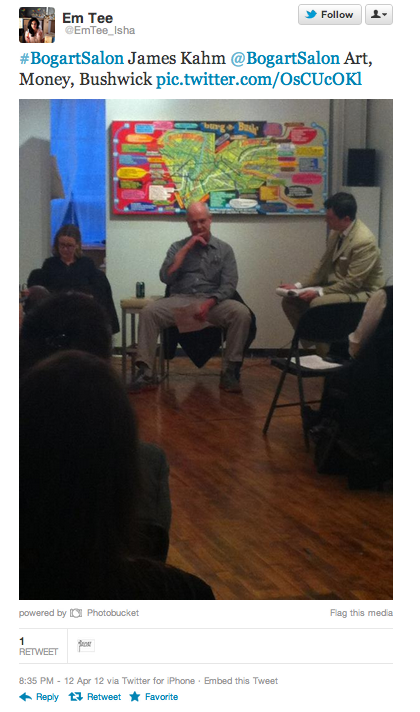
The panelists from "Capital and Its Discontents: Art, Money, Real Estate and the Changing Face of Bushwick": Peter Hopkins (Bogart Salon), Natalia Sacasa, Francis Greenburger, Ann Fensterstock, James Panero (host), Loren Munk, and William Powhida. "Burg n Bush," work in progress by Loren Munk, in background. Photograph by famous Bushwick documentarian Meryl Meisler

UPDATE: THE FULL DISCUSSION IS NOW ONLINE HERE

James writes:

On Thursday, April 12, I hosted a panel discussion at The Bogart Salon called "Capital and its Discontents: Art, Money, Real Estate and the Changing Face of Bushwick." You can read all about the run up here.

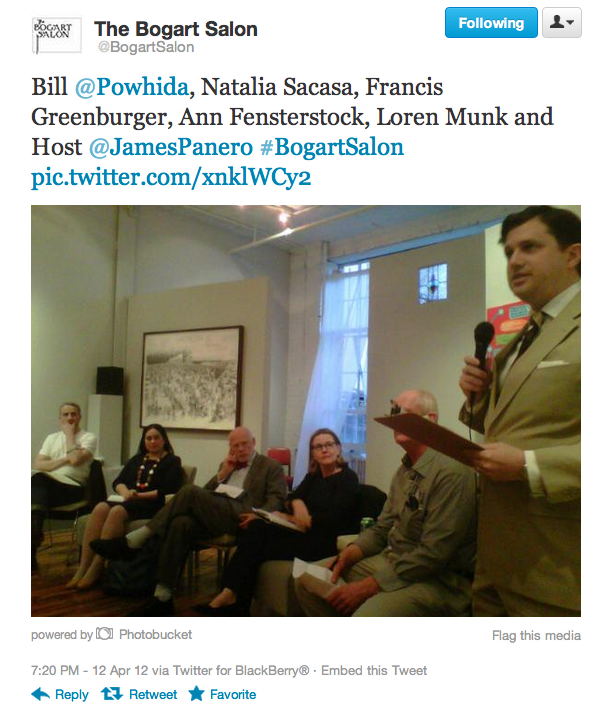
My panelists were Ann Fensterstock (collector, arts patron, historian), Francis Greenburger (collector, founder of Time Equities), Loren Munk (artist), William Powhida (artist), and Natalia Sacasa (Senior Director, Luhring Augustine). 

Art, money, and real estate. These three forces are changing the face of Bushwick. We may not agree on how it’s changing, but we can all agree that the neighborhood of Bushwick is changing quickly. By last count, there were over 35 galleries in Bushwick, up from just a handful a few years ago. Until recently, 56 Bogart, the venue for the panel, was mainly used for light manufacturing. Now it’s filled with new galleries and non-profits--some new, others well established and coming in from elsewhere. And in February, Luhring Augustine, one of the bluest of Chelsea’s blue-chip galleries, opened a 10,000-square-foot outpost in the heart of Bushwick, to the fascination and consternation of the neighborhood’s arts community.

As I said in the panel’s introduction:

If we are here to put capitalism on trial, and capitalism loses, I wouldn’t question capitalism. I would question our judgment.

Yet art, money, and real estate have always had a complex relationship, and lately it seems to be getting more complicated.

According to the New York Times, a chief executive at UBS wealth management informs us that “art is becoming more and more of an asset class.”

Money has always been a component of art, but now it seems to have become art’s defining characteristic. Bill Powhida, in your own work, you ridicule the business side of art, calling the dominance of money “asset classicism”--a term that may speak to our age better than any other.

Up to this point, one thing that has struck me about Bushwick is that the neighborhood seems to exist outside of the arts industrial complex you lampoon. Bushwick has developed something of a micro-economy of its own, with artists bartering with each other and tiny galleries selling work in the hundreds, rather than the tens of thousands, of dollars.

As Bushwick begins to attract a wider pool of collectors, is it a good thing, or is “asset classicism” not far behind?

Following up from "Capital," Kianga Ellis and Trent Morse are hosting "War Room" at the Bogart Salon through Sunday, April 15. Keep up with the discussion here. 

Real-time Twitter feed from Bogart

"Capital and its Discontents" on Artinfo.com


CapitalDiscontents_Meisler-7593

Peter Hopkins of Bogart Salon introduces the panel. Showing: Francis Greenburger, James Panero, Ann Fensterstock, and Loren Munk. Off camera: William Powhida and Natalia Sacasa 


CapitalDiscontents_Meisler-7606
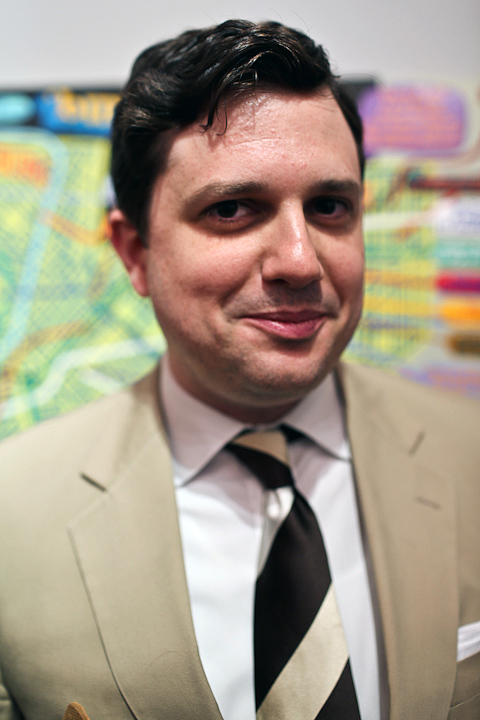
Your host!

Screen shot 2012-04-14 at 10.14.09 AM
Screen shot 2012-04-14 at 10.16.21 AM
Screen shot 2012-04-14 at 10.19.32 AM


Here is some press from the first Bogart Salon panel where Hrag Vartanian headed up a great discussion with Deborah Brown, Thomas Burr Dodd, Carolina A. Miranda, and Marco Antonini:

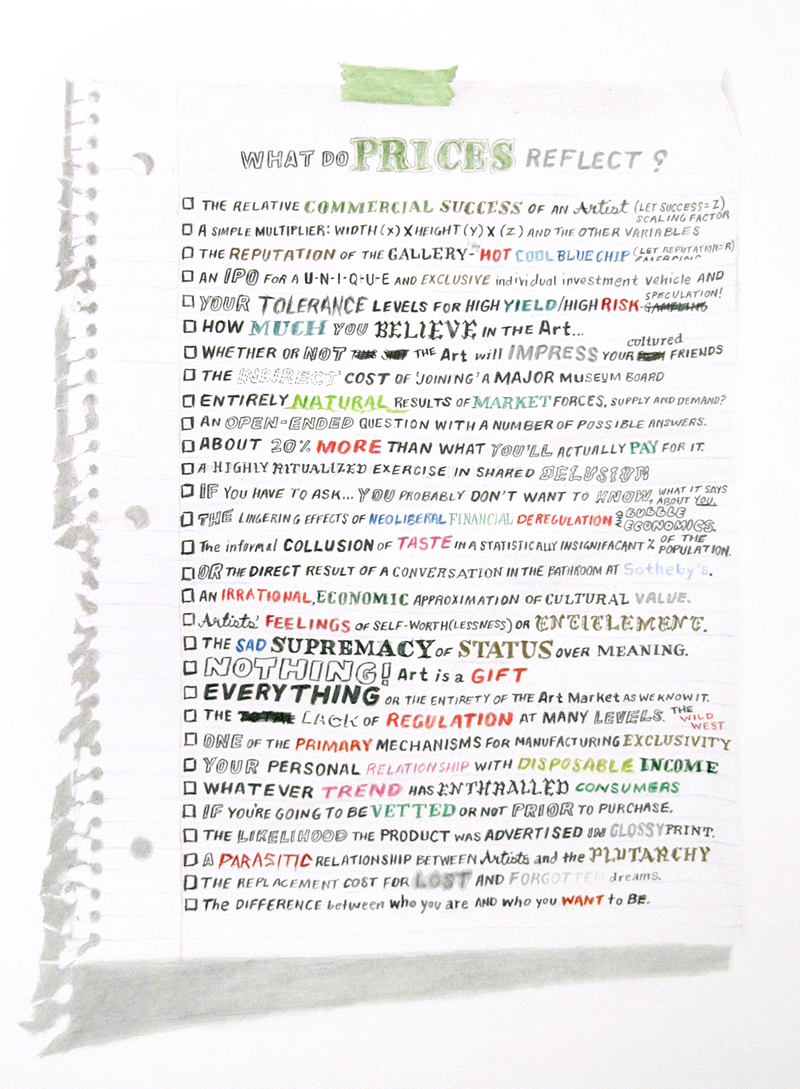
Prices_large1
William Powhida, "What Do Prices Reflect?" Graphite, watercolor, and colored pencil on paper, 2011. Courtesy of Postmasters Gallery.