Ai Weiwei, September 2009, © Ai Weiwei.
Note: an adaptation of this article appeared on September 6, 2012, on page D6 in the U.S. edition of The Wall Street Journal with the headline "American Punk's Unheralded Impact"
THE NEW CRITERION
September 2012
The New Political Art
by James Panero
Political art is usually terrible, or good for bad reasons. The Death of Marat, Jacques-Louis David’s 1793 painting of the French revolutionary murdered in his bathtub by Charlotte Corday, may be a masterpiece, but its politics led to the guillotine. Reproduced by the Jacobins, Marat became an image used to incite The Terror.
Do the arts offer special access to political truth? History would say no. Following David’s example, political art has mainly meant the seduction of art by the state. In the twentieth century, the arts were used to advance regimes that sought to oppress the very freedoms that had given rise to their artistic champions. Communism and Fascism each used art to destroy art. Meanwhile, in the free world, with a few notable exceptions, art that has been “politically engaged” has most often been directed against those who defend freedom while either ignoring or praising those who oppose it. Or politics has been used as a selling point, offering art with the illusion of controversy while merely reiterating the assumptions of the buying public.
Is the Chinese political artist Ai Weiwei any different? Not on the face of it. When I first saw his work at Robert Miller Gallery in 2004, the exhibition announcement featured a photograph of Ai’s neon-lettered sign spelling out “FUCK.” Meanwhile the gallery window displayed a self-shot photograph of Ai giving the middle finger to the White House.
Ai could have been just another political artist flipping off the usual suspects, but as I wrote in these pages at the time, “Ai Weiwei is a more complex artist than this one piece leads you to believe.” He was an equal opportunity offender. Ai gave the Eiffel Tower and other world monuments the same treatment. As part of this series, which he called a “Study of Perspective,” he also photographed his middle finger directed against the portrait of Chairman Mao in Tiananmen Square.
Obviously the perspective he was studying was not foreground/background. The study was a perspective on the political implications of each image. Raising the middle finger against the (Clinton) White House may be a silly but harmless act. For a Chinese artist living and working in Beijing, however, to flip the bird at Mao from the site of the Tiananmen Square massacre had a different implication. So too the photograph Ai took of his wife, Lu Qing, raising her dress and showing her underwear before the Chairman—a light-hearted provocation directed at the icon of an unsmiling regime.
In the United States, the ability to criticize the government is a birthright if not a national pastime. In China, Ai was already dancing on “the red line of Chinese law,” as state newspapers later described him. Determined either to push it back or cross it, Ai has never backed down from his criticism of the Chinese Communist Party (CCP), even while working from within the confines of its “open” closed society.
Since 2004, Ai has found ways to amplify his criticism with a volume that nobody expected. He has shown that political art can be more than just another form of propaganda. It can act against propaganda to become the conscience of reform. The objects of this art may be transitory, but the freedom of art can be a leading edge advancing the freedom of others. In addition to his exhibitions and his tireless self-broadcasting, his story now comes together in Ai Weiwei: Never Sorry, a documentary by the young filmmaker Alison Klayman that will serve to broadcast his work to an even wider audience.
Ai Weiwei’s father, Ai Qing, was a well-known Chinese poet. Originally trained as a painter, in 1929 he moved to Paris and fell under the spell of Émile Verhaeren, who used poetry to describe the harsh realities of the modern city. Ai Qing also became a follower of Mao. When he returned to China, he was imprisoned by the rival Nationalist Party.
It wasn’t long after his release that Ai Qing suffered the fate of countless intellectuals in Mao’s China. A fellow poet accused him of falling “into a quagmire of reactionary formalism.” In 1958, he was sent off to Xinjiang, China’s “Little Siberia,” where he cleaned the toilets of a labor camp. As part of his punishment, youth gangs poured ink on his face and pelted him with stones. For a time, the family inhabited a cave dug in the earth. Ai Weiwei, born in 1957, lived here in the provincial city of Shihezi with his father and mother, Gao Ying, for the next fifteen years.
Ai Weiwei returned with his family to Beijing in 1976, the year of Mao’s death. He enrolled in Beijing’s film academy and became part of an avant-garde group called “Stars” at a moment of cultural thaw known as the “Beijing Spring.” The Stars group was named “in order to emphasize our individuality,” said its central member Ma Desheng. “This was directed at the drab uniformity of the Cultural Revolution.” After being denied entrance to the official exhibition of contemporary art, the Stars displayed their work on the street. When this show was removed by police, they organized a demonstration demanding democracy and artistic freedom and eventually won permission to have an exhibition of their own. The Stars also participated in Beijing’s “Democracy Wall”—a brief state-
sanctioned attempt at recognizing the party’s new policy of “seeking truth from facts.”
The removal of Democracy Wall by the CCP in 1979 closed the doors on the country’s brief experiment with artistic freedom. Two years later, Ai moved to New York and enrolled in Parsons School of Design. He lived in a basement apartment near East Seventh Street and Second Avenue. Ai’s resources were meager—he supplemented his income by drawing portraits of tourists and gambling in Atlantic City (he is recognized in blackjack circles as a top-tier player). His apartment nevertheless became a hub for Chinese artists plugging into the East Village art scene.
Ai spent thirteen years in New York before returning to Beijing in 1993 to be close to his ailing father. His artistic output during this period was modest, but the influence was formative. Modern history has often been shaped by foreigners absorbing the intellectual culture of the West’s great cities. Ai was fortunate to find himself not in the Marxist circles of Paris but in the alternative punk scene of New York. He inherited its art of provocation and its anti-authoritarian philosophy. (He later demonstrated his affinity with the city by marrying his wife, Lu Qing, at New York’s City Hall.)
Back in Beijing, Ai sharpened his tools. The punk tactics he saw employed against New York’s police department in the Tompkins Square riots of 1988, which he photographed, he directed against the CCP. As he lodged his dissent at a political party ungoverned by the rule of law—“Kafka’s castle,” he called it—he used the freedom of art to get his message out while also insulating himself from state reprisal. The avant-garde neighborhood that first attracted him was nicknamed Beijing East Village.
Ai began his new career in Beijing by publishing illicit books and establishing an architecture firm, which later earned him an advisory role in the design of Beijing’s Olympic Stadium, dubbed The Bird’s Nest. With the rise in prices of contemporary Chinese art, the CCP saw how art could be used to advance the interests of the state. By and large, China’s newly profitable avant-garde did not “share either the political intent or the reckless bravery of the Tiananmen organizers,” wrote the critic Richard Vine. “The cruel lesson of June 4, 1989 is that repression sometimes works.” (See my article “Made in China” from The New Criterion of December 2008 for more.)
With his confrontational art, Ai was different. At the time of his exhibition in 2004, Ai was China’s sanctioned provocateur, but he soon began stepping over the red party line with historic intensity. He criticized the Olympic stadium he helped design as a “fake smile.” He then used his blog, which he started in 2005, along with homemade video, to document the 5,200 children who died when faulty government buildings collapsed in the 2008 Sichuan earthquake. When the government shut down his website in 2009, he turned to Twitter, using proxy servers to bypass The Great Firewall of China.
Ai often spent eight hours a day on Twitter. Volunteers came from around China to join him. Each day, his office tweeted the birthdays of those students who died in the quake. For an exhibition at Munich’s Haus der Kunst, he built an enormous screen of school backpacks that spelled out, in Chinese characters, “She lived happily on this earth for seven years”—the message of a mother whose child died in the quake.
As Ai’s provocations accelerated and the government increased its surveillance of his activities, he filmed the state looking back. When he went to testify in the trial of Tan Zuoren, an earthquake activist, he broadcast his own arrest and beating at the hands of police. This assault of August 2009 gave Ai a subdural hematoma that required emergency surgery. As he convalesced and filed claims of police brutality, he again turned documentation into art. “I want to prove that the system is not working,” he said to Evan Osnos for a profile in The New Yorker in 2010. “You can’t simply say that the system is not working. You have to work through it.” Ai followed this same documentary practice as the government demolished his studio building in Shanghai.
In 2010, Ai’s international stature reached new heights when he installed 100 million handmade ceramic sunflower seeds in Tate Modern’s Turbine Hall. Nevertheless, the CCP determined that the threat he now posed outweighed the repercussions of silencing him. In April 2011, the party apprehended Ai and held him for eighty-one days in two secret locations. As the CCP charged him with everything from tax evasion to harboring pornography, the party subjected him to over fifty sessions of interrogations. Two guards were never more than a few feet from his side.
Since his release, the CCP has been waging a propaganda campaign against Ai both at home and abroad. Suspicious comments with knock-off American idioms have appeared beneath articles about him, such as this one in The New Yorker: “Were he a US citizen, pari passu, he would be languishing in a Federal penitentiary for acting as an undeclared (well paid) foreign agent. Or for failing to pay Federal taxes, another big no-no in The Land of the Free.” Meanwhile China’s Global Times has declared that “the law will not concede before ‘mavericks’ just because of the Western media’s criticism. . . . The experience of Ai Weiwei and other mavericks cannot be placed on the same scale as China’s human rights development and progress.”
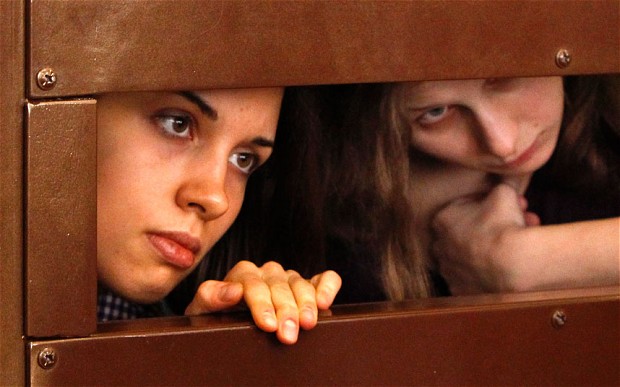
The promise that his jailers made has become CCP strategy: “You criticized the government, so we are going to let all society know that you’re an obscene person, you evaded taxes, you have two wives, we want to shame you.” Yet the art of Ai Weiwei has demonstrated how a single individual can also shame the state. His example is now closely followed by another punk-inspired act, the Russian band Pussy Riot. The three young women of this group have been sentenced to two years in prison for challenging the corruption of the Orthodox Church and the thugocracy of Vladimir Putin. As John O’Sullivan recently wrote at National Review: “The Pussy Riot girls are seeking to protest not oppression by religion but the oppressionof religion by the Russian state.”
An American expert on China recently explained to me how the CCP can tolerate anything but criticism of its own authority. Since the Communist Party believes that such criticism is a threat that must be suppressed, it seeks to eliminate it early and save the Chinese people from a larger conflagration. Ai Weiwei has put this oppressive logic to the test. His art has shown how a state without dissent is the greatest threat of all.