NEW YORK MAGAZINE
August 27, 2013
‘I Am the Central Victim’: Art Dealer Ann Freedman on Selling $63 Million in Fake Paintings
by James Panero
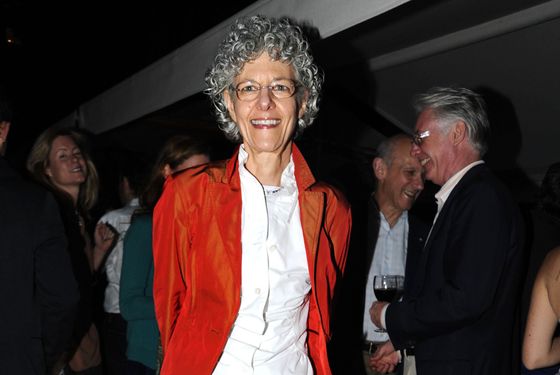
“I am as shocked as everybody, more shocked, as I am the central victim,” Ann Freedman, the gallerist at the center of an $80 million art forgery scandal, told me earlier this month. “Fifteen years. In my head, these paintings have been right up until five days ago. Horrible.”
Over the course of most of those fifteen years, Freedman had put all of her influence and credibility as the president of Knoedler & Company, until recently one of New York’s oldest and most respected art galleries, behind what she believed to be a treasure trove of newly discovered modern art by the biggest names in Abstract Expressionism. In May, federal authorities announced that the paintings — 63 in all — were fakes and charged Glafira Rosales, the obscure art dealer who supplied Knoedler and at least one other gallery with the paintings, with tax evasion. Earlier this month (five days before Freedman spoke those words), the feds spelled out the details of the long-running scheme in a follow-up indictment, charging that Rosales had never, as she claimed, represented the son of a mysterious anonymous collector. Rather, she allegedly paid an artist in Queens (73-year-old Chinese-American painter Pei-Shen Qian,according to reports) as little as $5,000 each to create the counterfeit masterpieces.
Freedman, who spoke publicly about the scandal for the first time in a series of recent conversations with New York, says that the results of the federal investigation prove she was an unwitting agent in the scheme. Under her leadership, Knoedler sold 40 of the fakes for an alleged $63 million. Before shutting down abruptly in late 2011, the gallery made a $20 million payment to Rosales.
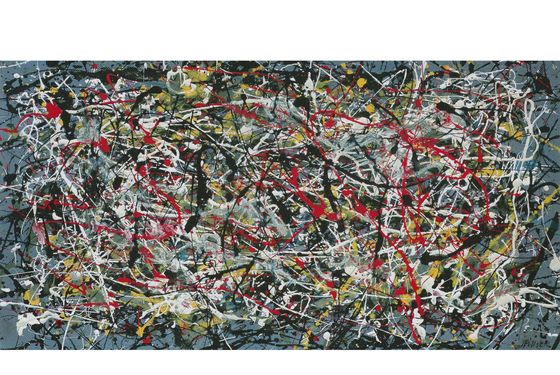
This "Pollock" sold for $17 million
According to the indictment, the saga began in the early nineties when Rosales approached Freedman with a fabulous tale. She claimed to represent a foreign collector who “was of Eastern European descent, maintained residences in Switzerland and Mexico, wished to remain anonymous, and had inherited the works ... from a relative.” Based on this account, Freedman came to call the relative “Mr. X” and the anonymous seller “Mr. X, Jr” — of course, neither existed.
“The story was credible,” said Freedman, who is tall with tightly curled silver hair and a controlled, energetic manner. “Dealers often do not know the specifics of origin or background, or how the art left the artist’s studio. You cannot turn the pages of an auction catalogue or museum publication without seeing a majority of the works labeled ‘private collection.’ The chain of ownership is often out of order and incomplete.”
With time, the story of how Rosales obtained the paintings became more complex: The married Mr. X and David Herbert, a real-life gallery employee and owner who died in 1995, knew each other in the fifties; they were lovers, and Herbert offered Mr. X access to the studios of the Abstract Expressionists, through whom he could purchase paintings off the books; these works were hidden away until Herbert’s death to protect Mr. X’s secret. (Herbert, of course, had nothing do with any Mr. X or secret stash of paintings — since neither existed.)
Freedman says that she did her best to get answers from Rosales. “I went to Glafira and pushed and pushed to get more information, relentlessly,” Freedman said. "My ongoing diligence met more than the gold standard; there is plenty of evidence of that.”
Speaking with Daily Intelligencer last month, Freedman listed some markers that led her to believe that the paintings were genuine. “They were very credible in so many respects,” says Freedman. “I had the best conservation studio examine them. One of the Rothkos had a Sgroi stretcher. He made the stretchers for Rothko. They clearly had the right materials. I got a consensus. Some of the paintings were featured on museum walls,” she continued. “The Rothko went to the Beyeler [Foundation], and the Newman went to Guggenheim Bilbao for the tenth anniversary exhibition. The most knowledgeable in the art establishment gave me no reason to doubt the paintings.”
Experts seem to have been convinced, by and large, that the individualistic quality of the Abstract Expressionist paintings Rosales obtained could only have been achieved by the artists themselves. “The fact is that the entire Eastern establishment believed in them. I saw the paintings,” said Stephen Polcari, a scholar of Abstract Expressionism and author of Abstract Expressionism and the Modern Experience. “And they were very good. You wouldn’t think twice about them for a second. Ann did everything she could possibly do.”
But others in the art world see a pattern of lax, self-interested behavior on Freedman's part. “This has ruined one of the greatest galleries in the world. It has trashed a lot of people’s money. It seems to me Ms. Freedman was totally irresponsible, and it went on for years,” said Marco Grassi, owner of Grassi Studios gallery on the Upper East Side and a well-known expert on Old Master paintings. “Imagine people coming to someone and saying every painting you sold me is a fake. It is an unthinkable situation. It is completely insane. A gallery person has an absolute responsibility to do due diligence, and I don’t think she did it. The story of the paintings is so totally kooky. I mean, really. It was a great story and she just said, ‘this is great.’”
Over time, Freedman came to see the paintings’ lack of provenance as a challenge to overcome. What they were missing in the past, she would make up for in the present. By placing them in the best collections, she would give them a footing. Freedman saw a mandate to sell — and sell she did.
“The point is that I believed that these paintings were genuine, that it was my responsibility to place them into the best of collections,” she said. Once the paintings were out there and established, she hoped “to get many of these works to come back together for a major museum exhibition that Knoedler would take part in.” Establishing these discoveries as accepted works, she believed, would in fact be among her greatest accomplishments at the gallery. “I felt that I was going to create a legacy for Knoedler with these newly discovered paintings, a treasure trove of paintings to bring out into the world,” she said.
At Knoedler, getting paintings out into the world was Freedman’s speciality. She had started her art career as a receptionist of the André Emmerich Gallery in the early seventies but quickly discovered her natural talent for sales. “My enthusiasm for the art was contagious and won people over. André started seeing more and more invoices on his desk that he could not have imagined,” she said. “There was a sense of some disbelief, if not resentment — no one paved the way for me to sell, but I sought out the opportunity and never looked back.”
In 1977, at age 29, Freedman took a job at Knoedler — at the time, the oldest continuously operating gallery in New York. She continued to outperform and eventually took over the palatial central office of the gallery’s gilded-age Upper East Side mansion.
The paintings from Rosales proved to be enormously lucrative for the gallery. Among the sales were a “de Kooning” that went for $4 million, a “Rothko” for $8.3 million, and a “Pollock” for $17 million. She successfully built up a market for each of the paintings as they came in. “If something had been off or wrong on any one of the paintings, I would have put on the brakes,” she said.
She was so convincing, and so convinced, about the paintings that she even bought three herself — a “Rothko,” a “Motherwell,” and a “Pollock.” “I was a believer. Not to be stubborn, but I lived with three of those paintings,” she said. “I lived with them, and in the context of my personal collection.”
For over a decade as they emerged, the paintings were the envy of the art world. Art experts, conservators, and museum professionals praised what appeared to be a newly discovered collection of masterworks. But in 2009, forensic testing on two paintings supposedly by Robert Motherwell revealed paint chemicals that were historically inconsistent. Suspicion descended on the lot, and multi-million-dollar buyers agitated for their refunds. Meanwhile, the FBI began circling Rosales.
Freedman, coming off a battle with lung cancer, left Knoedler just as these suspicions began to emerge. (She describes her departure as a management dispute.) Two years later, the 165-year-old business closed up shop, with no warning, the very same week the buyer of the $17 million Pollock sued both the gallery and Freedman.
Even in cases of a forgery, art buyers don’t necessarily have a lifetime money-back guarantee (the Pollock sale was settled out of court). Owing to statutes of limitations, legal experts say, some buyers of Rosales’s 63 works may have limited recourse in recovering their money — a fact that may also insulate Knoedler and Freedman from additional litigation. “Purchasers of artwork in New York must be diligent and act quickly, otherwise they may lose important remedies,” says Raymond Dowd, a partner and art law specialist at Dunnington, Bartholow & Miller. “In essence, a purchaser who has been defrauded may have no civil remedies against the gallery.”
Robert K. Wittman, a former FBI agent who founded and led the Bureau's National Art Crime Team, told Daily Intelligencer that the buyers were taking a foreseeable risk. "With Abstract Expressionist and modern paintings, there was never any real cataloguing when the artists were alive, so things can pop up on the market that turn out to be legitimate," he said. "The problem is that because these paintings are modern, it is harder to authenticate them. What this does is put the buyers on notice. Unless a piece has really good provenance, forensics, and connoisseurship — the three-legged stool — the buyer shouldn’t buy on someone else’s word."
Freedman has continued to be an active dealer despite the scrutiny of the Rosales case. She recently opened her own gallery, FreedmanArt, on East 73th Street, where she now represents Frank Stella, Lee Bontecou, and the estate of Jules Olitski, among others.
With the revelation of the crime, even though she says she finds relief in knowing the truth of where the paintings came from, she feels most betrayed by the paintings themselves. “I am so angry and upset. It is shattering, as if a trusted friend deserted you.” She says the money she spent on her own three paintings is “a loss. It is a big loss.”
“How can we know the truth? You not only believe in your own instincts. You believe in others who believe.”