'Tintoretto's Thunderbolt'

THE WALL STREET JOURNAL

MASTERPIECE
'Tintoretto's Thunderbolt'

His 'Crucifixion' of 1565 just may be the Italian Renaissance's single best work of religious art

By JAMES PANERO
September 22, 2007
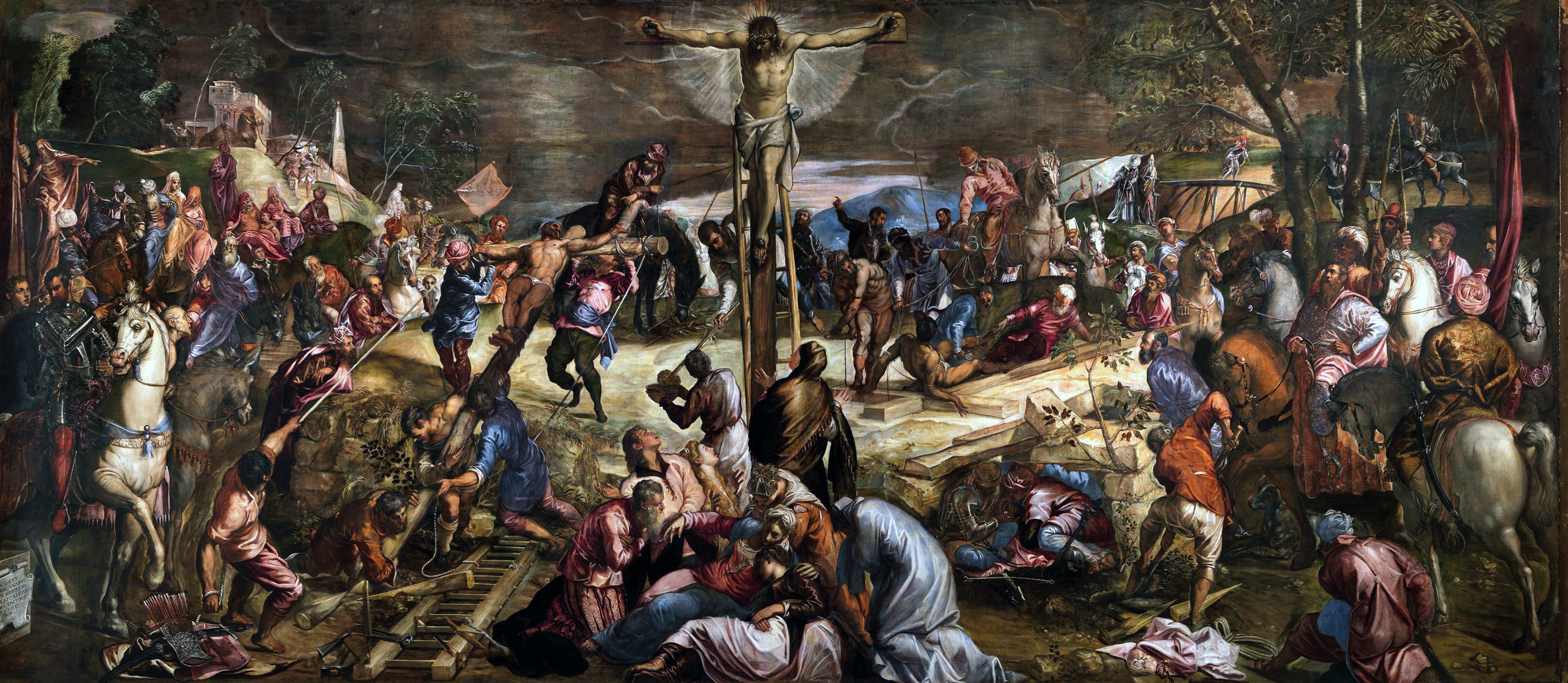
The Venetian painter Tintoretto (c. 1518-1594) never commanded the sculptural vocabulary of Leonardo or Michelangelo. He did not luxuriate in the warmth of Giorgione or Titian. He displayed neither the draftsmanship (disegno) of Florentine art nor the affection for coloring (colorito) that was the legacy of his native city.

But through a synthesis of each tradition, "il disegno di Michelangelo e il colorito di Tiziano," as one Venetian writer identified it, Tintoretto may just have painted the single best work of religious art in the Italian Renaissance. His "Crucifixion" of 1565 comes as both a concluding statement to the art of the high Renaissance and also something wildly new.

To see it, you have to visit Venice. Tintoretto's "Crucifixion" continues to fill the back wall of the boardroom (albergo) of the Scuola Grande di San Rocco, where he left it. Tintoretto dedicated his artistic and spiritual life to this confraternity, a charitable organization of Christian laymen dedicated to the plague-healer St. Roch. Surrounded by over 50 other religious images that Tintoretto painted for the Scuola Grande for the cost of materials, the "Crucifixion" forms the centerpiece of one of the largest intact cycles of religious work by a single artist in history.

Unlike Michelangelo, who initially fled Rome rather than finish the ceiling of the Sistine Chapel, Tintoretto never hesitated to apply his vision to paint. He persevered even as he was rejected by the Venetian establishment -- a situation that may explain the manic, expressive urgency of his compositions.

Consider how he first made his way into the Scuola. Since Tintoretto was the son of a silk dyer (tintore), the profession of a quarter of the Scuola's membership, his acceptance by the confraternity might have been a given. But in 1564, when he entered the artistic competition to supply the first ceiling painting to the newly completed albergo, the odds were not on his side. A young man with an evangelical zeal, Tintoretto had already been rejected for membership. In the conservative Scuola, resentment ran high against his brash personality and unorthodox paint handling -- "the thunderbolt of his brush," as one 17th-century painter called it. One member of the Scuola even pledged to contribute 15 ducats if Tintoretto was not chosen for the commission.

Meanwhile Titian, the ruling monarch of Venetian painting, who supposedly once expelled Tintoretto from his workshop after recognizing the young student's great talent, backed his protégé Veronese as heir apparent to the colorito legacy. (Their three-way rivalry will be examined in a show at the Museum of Fine Arts, Boston, in spring 2009.)

Giorgio Vasari, the great Florentine chronicler of Renaissance art, recounts how "the little dyer" overcame the odds. (They had their differences, but Vasari still saw fit to call Tintoretto "swift, resolute, fantastic and extravagant, and the most extraordinary brain that the art of painting has ever produced.") Rather than submit a drawing of his ceiling plan, Tintoretto secretly measured the open space and "sketched a great canvas and painted it with his usual rapidity, without any one knowing about it, and then placed it where it was to stand."

When the confraternity protested, Tintoretto made an offer: "If they would not pay him for the work and for his labor, he would make them a present of it." It was a clever move. Since no donation to St. Roch may be turned away, through this gift "he so contrived that the work is still in the same place." (It didn't hurt that the painting's subject was the Scuola's patron saint.)

Within a year, Tintoretto overcame the Scuola's lingering resentment; he was accepted for membership and allowed to attempt his great "Crucifixion."

The layout of the room posed several challenges. Three different architects worked on the Scuola's design. When it was finished by Scarpagnino in 1549, the building's small, elevated windows provided only minimal interior light. The albergo was also wider than it was long, so that any painting covering the back wall would have to be viewed from close proximity and below.

Tintoretto conceived of a revolutionary program. Rather than keep his design locked in strict perspective, which would have been distorted by the room's oblique points of view (think of the front row of a movie theater), Tintoretto folded his narrative around the central figure of Christ on the cross. He then depicted Christ bending down -- to address the good thief, the figures in mourning at the foot of the cross, and our gaze from below. The fixity of the cross provides an anchor within an undulating sea of dark details that seems to extend beyond the picture plane out into our own space. With blank faces, the mundane figures surrounding Christ stir up the awful scene. A crowd of onlookers, carpenters, soldiers and even a dog make up "a centrifugal energy that charges the entire picture," as the art historian David Rosand wrote in his survey of 16th-century Venetian painting.

The ominous tones, curved landscape and artistic urgency that underlie Tintoretto's color choice, composition and paint handling make this work a point of departure. Rather than look back to the neo-Platonic ideals of classical sculpture -- brilliantly embodied at the start of the 16th century in the ceiling frescoes of the Sistine Chapel -- Tintoretto's "Crucifixion" anticipates the fallen angels of our modern era.

Like a thunderbolt from the brush, Tintoretto's "Crucifixion" can stop you in your tracks. The Victorian writer and artist John Ruskin certainly thought so. "I have been quite overwhelmed today by a man I have never dreamed of -- Tintoret," he wrote to his father on his first visit to Venice. "I always thought of him a good and clever and forcible painter, but I had not the smallest notion of his enormous powers. . . . And then to see his touch of quiet thought in his awful crucifixion -- there is an ass in the distance, feeding on the remains of strewed palm leaves. If that isn't a master's stroke, I don't know what is."

From 1565 to 1588, Tintoretto expanded his swirling cycle of religious art in the Scuola out and down from the cross of the "Crucifixion": to canvases on the facing wall of the albergo ("Ecce Homo," "Christ Before Pilate" and "The Way to Calvary"); to a monumental series of images from the New and Old Testaments covering the walls and ceiling of the Scuola's central upper room (sala superiore); to episodes from the life of the Virgin Mary on the walls of the ground floor (sala terrena).

Tintoretto's work at the Scuola, executed over more than 20 years, became a perfect union of form, content, application and artistic intention. In Tintoretto's lifelong dedication to the Scuola, "the act of painting thus becomes a gesture of piety," writes the academic Rosand.

Earlier this year, the Prado Museum in Madrid hosted the first major survey since 1937 of Tintoretto's work. The museum also published an excellent catalog, in English, on the artist. No museum exhibition will ever do justice to Tintoretto, since his largest work never travels, but the Prado show came close, shedding light even on San Rocco: "the most personal and intensely felt of his works, conveying a powerful sense of the artist's own deeply held faith," writes Frederick Ilchman, a curator at the Museum of Fine Arts and an essayist for the catalog.

The Scuola Grande di San Rocco, which remains active as a confraternity, long ago opened its doors to the public. It now also maintains an excellent Web site, www.scuolagrandesanrocco.it, which includes interactive pictures of the rooms.

But there's no substitute for the real thing. The artist El Greco once called Tintoretto's "Crucifixion" the greatest painting in the world. Next time you are in Venice, make a visit to the Scuola your own act of piety, and experience a work of art that reaches across the centuries to our own time and place.

Mr. Panero is the managing editor of the New Criterion.

'A(nother) Very Political Show'

THE WALL STREET JOURNAL

A(nother) Very Political Show
By JAMES PANERO
June 26, 2007; Page D5

It isn't every day that you find yourself sitting beside Robert De Niro in a water taxi as he tries to lose two boatloads of paparazzi pursuing him in a slow-speed chase down the Grand Canal. Or that Bobby D asks you to explain Matthew Barney, the shock-jock artist now on display at Venice's Peggy Guggenheim Collection whom the New York Times once called "the most important American artist of his generation." ("Installation art and Vaseline," I say, which he repeats with a down-turned smile.)

Then again, it isn't every day that you're there for the start of the 112-year-old International Art Exhibition of the Venice Biennale, when the Renaissance city fills to the brim with contemporary art. Leading up to the official opening, which took place June 10, the art world descends on Venice for its biggest, most spectacular and certainly oddest schmoozefest -- and departs just as the gates open to the general public.

The Arsenale, which houses the Biennale show's less established artists, comes off as a gantlet of gloom.
The Biennale mainly takes place in the docklands past San Marco and in a park nearby, the Giardini. Here the exhibition space is divided up among nations that maintain permanent pavilions and an international group show, this year organized by Robert Storr, dean of the Yale School of Art and formerly a curator at MoMA.

Seventy-six nations are participating this year, spread out not only in the pavilions across the Giardini but also in palazzos and other buildings throughout Venice. For the preview days, which began on June 6, hotels in Venice booked up months in advance. "Collateral" art events filled the city. Mr. De Niro was in town with the gallery owner Larry Salander to meet with journalists and present an exhibition of work by the actor's father, the accomplished and under-recognized New York School painter Robert De Niro Sr.

The De Niro show is now taking place at the San Marco Casa d'Aste in the center of town -- timed to the opening of the Biennale, but unconnected to the official exhibition. Neither Mr. Salander nor Mr. De Niro even made plans to see the central shows of the Biennale. For many, it's been a long time since the Biennale hosted must-see art.

The Biennale will remain open through Nov. 21. But visit Venice past the preview time and you miss half the point. Indeed, while the Biennale as an art fête may never be more important, the Biennale now faces stiff competition as a pre-eminent international art show from more nimble gallery-driven art fairs -- Frieze in London, the Armory Show in New York, Basel Miami, and Basel in Switzerland, which took place a week after the Biennale preview. Even Dubai now hosts its own contemporary art fair.

The Biennale has not been a "selling" fair since 1968. And with so much world-wide attention now focused on the marketplace, the exhibition has felt the pressure. Enter Bob Storr, the Biennale's first American-born curator.

At the preview press conference in Venice, Mr. Storr spoke only in English as he introduced this year's group show, an exhibition he calls "Think With the Senses, Feel With the Mind: Art in the Present Tense." The title is meant to bridge the gap, as he sees it, between "conceptual" and "perceptual" art. "It is not a political show," Mr. Storr promised, but a "sober show at a time that lots of people are intoxicated by cash. The cash will go away some day. I hope the works in this show will not."

In fact, Mr. Storr has put together a very political show. Meant as a catch-all, "Think With the Senses" is instead an international survey with an all-too-narrow, tidy scope. Rare is the art here without a conceptual if not overtly political component. The Arsenale, a former naval factory building that houses his show's less-established artists, comes off as a gantlet of gloom, steps away from multimillion-dollar yachts parked outside.

One of the first rooms here is dedicated to the theme of crashing airplanes (by the artists Charles Gaines and Léon Ferrari). There is a work that explores the "politics of flowers" (by Yto Barrada). There are machine guns (by Nedko Solakov). There is a meditation on the Pinochet coup (by Melik Ohanian). There is a video of a child playing soccer with a human skull (Paolo Canevari's "Bouncing Skull"). There are portraits of tenured radicals like Edward Said and Eric Hobsbawm (by Rainer Ganahl).

The other half of Mr. Storr's group show, which as usual is displayed in the Padiglione Italia of the Giardini, may contain more established artists, but the message is often the same. Here in a video, Mr. Ganahl repeats the words "I am not a terrorist" in different languages (at the Biennale, terrorists are the grievance group of the moment). Elsewhere, Raymond Pettibon has graffitied up a room with a diatribe against American politics. "America loves (adores) Israel," "Hillary Clinton, Hillary Kristol, Hillary Kramer: Post-op or same person" and "Alan Dershowitz, David Horowitz" are scrawled besides images of the Star of David.

One can only imagine that anti-Americanism and anti-Semitism are the natural extensions of Mr. Storr's understanding of avant-garde art. The national pavilions, outside of Mr. Storr's control, do offer some relief. At the French pavilion, Sophie Calle has put together a chic piece occasioned by her break-up with a boyfriend. In a building off the Arsenale, the Italians have created a sensuous exhibition by Guiseppe Penone, a sculptor once associated with Italy's Arte Povera movement, which sought to create art from common, "poor" materials, and a humorous (for once) meditation on the American political process by Francesco Vezzoli. The Russians have a sophisticated work by AES+F Group, computer artists who channel Wagnerian mythology and Symbolism.

The U.S., meanwhile, under the aegis of the Guggenheim Museum and the State Department, has put on an uninspired posthumous show of Felix Gonzalez-Torres, a Cuban-born artist who died of AIDS in 1996.

Mr. Storr promised to bring to Venice a diverse display of international contemporary art. But most of the artists in his Padiglione Italia -- Gerhard Richter, Elizabeth Murray, Nancy Spero -- can be seen in any major museum (often in exhibitions organized by Mr. Storr). Several of the younger, foreign-born artists in the Arsenale now work and exhibit in New York.

Mr. Storr's show, at the center of the Biennale, will be a disappointment to anyone who believes there is a place for art outside politics. The message here can also be downright bizarre. In his opening statement, Mr. Storr maintained that "the social barrier to enter a gallery is enormous. The barrier to come to Venice is not." They must be laughing on their yachts at that one.

On my way out of Venice, past the parking lots of the Piazzale Roma and a world away from the Biennale, I met up with Augustus Rylands, the 25-year-old Anglo-American son of the director of the Peggy Guggenheim Collection. This year, timed to the preview days of the Biennale, Mr. Rylands organized a modern and contemporary art fair called Cornice. It featured 52 galleries. "Unofficially, the Biennale is extremely commercial," he told me as we walked up and down his tent of gallery stalls. "To complain about art fairs is hypocritical to say the least. The gallery is always the greatest champion of the artist."

Outside, Mr. Rylands showed me the mockup of a monument to 9/11, a work by Helidon Xhixha sponsored by the Young Artists Foundation in association with Cornice. The sculpture reconfigures the Twin Towers as a vertical American flag -- a stirring tribute destined for Battery Park City. And unless I am mistaken, it does not include a single reference to Halliburton.

This summer, should you find yourself in Venice, be sure to check out the Scuola di San Rocco -- the guild hall with Venice's original art installation, a 16th-century cycle of paintings by Tintoretto, culminating in a 40-foot "Crucifixion" -- and side shows like the De Niro before making your way over to the Biennale.

Daniel Buren, the curator of this year's Sophie Calle show, once noted, "Increasingly, the subject of an exhibition is less likely to be the exhibition of works of art, than the exhibition of the exhibition as a work of art." If you really want to experience the latter in Venice, best get yourself on the preview list for 2009.

Mr. Panero is the managing editor of the New Criterion.

'A Fiddler on the Roof of Modernism'

THE NEW YORK SUN
Books

'A Fiddler on the Roof of Modernism'
BY JAMES PANERO
March 14, 2007

The problem with art biographies is that they tend to contain very little art. You cannot quote a painting the way you can a novel, a letter, or a line of poetry. To compensate, art biographers toss in everything about an artist but the kitchen sink — the models and the mistresses, the comrades and the critics. But without direct contact with the work — the reason we are reading the biography in the first place — can an art biography ever really describe the heart of its subject's life? And I'm not talking about including a few color reproductions.

In just more than 200 pages of "Marc Chagall" (Schocken, 256 pages, $19.95), Jonathan Wilson solves this problem with an artfully written art biography that captures its subject in the same kaleidoscopic palette as Chagall painted. This is not a biography that settles on describing an artist's life. It is a book that looks out from the artist's work — the literalization of an oeuvre.

"The man in the air in my paintings ... is me," Chagall said to an interviewer in 1950. "It used to be partially me. Now it is entirely me. I'm not fixed anyplace. I have no place of my own." In the air, floating over the mundane non-essentials of an artist's life, that's where Mr. Wilson finds Chagall.

Mr. Wilson filters his story through a Jewish lens. His biography is just one of several dozen new and forthcoming books on "Jewish Encounters" published by Schocken/Nextbook in a series edited by Jonathan Rosen. Rather than limiting the narrative, Mr. Wilson's focus reveals Chagall in high relief. As an artist, Chagall discovered a unique resonance between the modern Jewish Diaspora and the modernist condition. Born Moishe Shagal in 1877, in the Belorussian town of Vitebsk, Chagall utilized the color-and-line principles of the French avant-garde to document the "twilight of a Jewish world."

In life, as in his art, Chagall floated over adversity. He skirted the race laws of Imperial Russia to study art in St. Petersburg. He made his exit of the Iron Curtain just as Kazimir Malevich's "Suprematist Academy" was moving in on his Vitebsk Free Academy. He took his last step on Vichy soil, with the help of Varian Fry and other American supporters, just as the Reich was sealing up the French borders.

Chagall also floated over distinctions that might have hemmed in more Earth-bound personalities. "His work and his life both reveal a reactive desire to be a Russian to Russians, a Jew to Jews, and a Frenchman to the French," Mr. Wilson writes. In his paintings Chagall often incorporated the figure of Jesus, whom he saw as the embodiment of Jewish suffering as a stand-in for the artist and, after the war, the Shoah. "[T]he Holocaust takes place on the streets where Chagall grew up and Jesus, frequently wearing a tallith (prayer shawl) around his waist, is repeatedly crucified there." Mr. Wilson argues that as a Jew working in Christian iconography, Chagall was like Irving Berlin, his painting "White Crucifixion" like the song "White Christmas." For Chagall, this meant imagining a "pre-Christian Jesus" who was "a great poet, the teaching of whose poetry has been forgotten by the modern world," as the artist said to Partisan Review in 1944.

In subject matter, Chagall drifted between the ascetic parameters of high modernism and the nostalgic sentimentality for a lost home. For art purists, this has been the one fact that grounds Chagall's reputation. The critic Robert Hughes once called Chagall "the Fiddler on the Roof of Modernism." But Chagall was more than a mere Jewish Surrealist, as Mr. Wilson writes, "preserving it in schmaltz." A novelist and literary critic, Mr Wilson himself floats above the etiquette of art biography to write magical paragraphs like this one:

A book marking the vast contribution of Jews to the history of sentimentality ... has yet to be written. But in it Chagall would surely have his own chapter, not because his paintings are desper ately mawkish (and after all, sentimentality is not the attribute only of weaker artists — think of Dickens or Renoir) but because he walked the tightrope that separates sentimentality from deeper, more authentic feeling better than anyone, except perhaps the great Israeli poet Yehuda Amichai.

Mr. Wilson begins his book with the acknowledgment that "sophisticated art aficionados weren't supposed to love or even like Chagall. His lovers and his rabbis, his massive bouquets and his violins were equally dubious, equally cloying, not kitsch, but living somewhere dangerously close to that ballpark." Two hundred pages later, Mr. Wilson returns his subject from the dustbin of college poster art to the skies above Vitebsk, where Chagall belongs.