'Tales of the Spirit'

Inness_432 ART & ANTIQUES
February 2008

'Tales of the Spirit'
by JAMES PANERO

For the study of art there may be nothing more important, and more impressive, than the catalogue raisonné. Literally a “reasoned” catalogue, the catalogue raisonné is a publication by a preeminent scholar or scholars that attempts to identify and describe all work produced by a given artist. Always printed in a small quantity, and with a price that reflects the expense of its production, such a book is rarely marketed to the general public, although it can be a beautiful object of art in itself.

The catalogue raisonné of the American painter George Inness (1825–94), recently published by Rutgers University Press and listed at $400, is no exception. Slipcased, weighing more than 16 pounds, with 1,274 pages divided among two volumes and nearly 150 color plates, it is a monument of scholarship on the iconoclastic painter of the Hudson River School, whose career spanned 50 years, from 1844 to his death. The publication of this catalogue is also a testament to the spell this artist can cast more than a century after his death. Behind the book is the story of the scholar who pursued the project for 15 years and the patron who made it possible.

This part of the story begins in the late 1980s, when New York financier Frank Martucci entered a Madison Avenue gallery and saw his first George Inness painting. He told me the painting encouraged him “to see beyond the canvas. There was a bigger world out there. Inness went beyond painting the everyday occurrences in life and expressed spirituality on canvas. He was an optimist, a non-conformist, a social egalitarian and an avid abolitionist.”

Martucci’s discovery had lasting repercussions for a self-effacing scholar named Michael Quick. In 1985 and ’86, Quick had organized a traveling retrospective of Inness’s works that began at the Metropolitan Museum of Art, was seen in Cleveland, Minneapolis and at the Los Angeles County Museum of Art (where he was curator of American art) and ended at the National Gallery in Washington, D.C.

Fresh from the success of that show, as Quick related it to me, he ran into Martucci, who “expressed an interest in supporting scholarship and asked me to name a project that I thought was the most important. And I told him that an up-to-date, improved catalogue raisonné that combined all the information of other scholars would be most useful.” Though Martucci admits that, at first, he didn’t know what a catalogue raisonné was, this did not stop him from underwriting Quick’s labors for the time it took to produce the book. In fact, Martucci would make several commitments to Inness. In addition to building a personal collection of eight Inness landscapes, he funded the construction of an Inness wing at the Montclair Art Museum in Inness’s New Jersey hometown. And then there was the catalogue.
Like his fellow American landscape painters Asher B. Durand and John F. Kensett, Inness began his training in an engraver’s shop in New York. He studied the 17th-century landscapes of Claude Lorrain, Mein-dert Hobbema and Jacob van Ruisdael. Multiple visits to Europe brought him in contact with the Barbizon School in France and the pre-Raphaelites in England.

Upon his arrival to the United States, Inness took his first spiritual turn under the advisement of the Reverend Henry Ward Beecher, a patron. As Quick writes in the catalogue, Beecher “advocated a more intimate, emotional relationship toward God, which he indicated could be found through ecstatic experiences in nature.” Inness’s spiritual development continued into the 1860s. Through the largely forgotten American painter William Page, Inness discovered Emanuel Swedenborg, the 18th-century Christian mystic and occult philosopher who also influenced Ralph Waldo Emerson and many other artists and writers of the period. Through Swedenborg and Page, Inness developed a “fresh concept of nature as a place of divine harmony and peace,” writes Quick, “together with a technique that was designed to create paintings full of this same harmony and balance.”

Inness’s vision progressed from strict fidelity to the observable world to mysterious images infused with rich atmosphere, which he built up through glazes of translucent pigment. In his famous early painting of Pennsylvania’s Lackawanna Valley, from 1855, now in the National Gallery of Art, “Inness’s representation of Scranton is accurate, even down to the tree stumps in the middle ground,” writes Quick. For “Autumn Oaks” (c. 1876–77), a well known painting in the Metropolitan Museum of Art, Inness incorporated “a complicated process of painting the colors at nearly full intensity, glazing them back, and then adding intense highlights [so that] the color is both deep and intense, and the modeling is full and atmospheric.” As he reached the end of his career in the 1880s and 1890s, the layers deepened, and Inness produced his most haunting works, for example “Early Autumn, Montclair” (1891), now in the Delaware Art Museum, which Quick calls “one of Inness’s great late paintings.”

Martucci’s patronage allowed Quick to examine, personally, all of these paintings and then some. “It was two week-long trips twice a month for three years,” he recalls. “With just a few exceptions, I saw every painting in the book. That was one of the principles, that I actually examine each work. This was critical to the book’s success.” It also sets this book apart from the 1965 catalogue by LeRoy Ireland, which was based largely on black-and-white photographs of the paintings.
During this rigorous period of examination, Quick gained a new understanding of the artist. “It was a precondition for authenticity and also gave me insight into his work,” he notes. “I was able to arrive at some very new conclusions that could not have been discovered by any other means.”

After funding the indexing of old exhibition catalogues, magazines and microfilm, which accompanies each entry, Martucci underwrote the catalogue’s printing. This was carried out, after a delay of nearly a year, in Hong Kong, once the catalogue’s designers were able to color-correct and personally oversee the print run.

How does Martucci view the 15-year journey? “It was a lot of fun,” he says. “The purpose was quite provocative and certainly important. The outcome has exceeded my expectations, very much so. The amount of research that went into this becomes self-evident when one looks at the book. Every single picture has an extensive provenance with a commentary, a total exhibition history and summaries before each period. To me it’s quite unbelievable.”

“Today, people are interested in contemporary art,” Quick says. “Inness’s art is of a different kind. It’s not showy. It’s more subtle; that may be out of sync with today’s public.” But, he concludes, “reproductions have power.”

At the time of his death, George Inness was one of America’s best-known painters. Just over a century later, his spiritual landscapes contrast with the rather more jaded landscapes of contemporary art. A catalogue raisonné will never alter the fortunes of an artist overnight. But like a vision emerging from one of Inness’s mists, such a catalogue can provide the spark of recognition that makes the rediscovery of a great artist possible.

'Comeback Kid'

ART & ANTIQUES
December 2007

Comeback Kid

The return of Thornton Willis reflects the enduring legacy of abstract painting.

by James Panero

Action_shot

F. Scott Fitzgerald famously wrote, “There are no second acts in American lives.” However in the past few years, a painter by the name of Thornton Willis, born in 1936, has re-emerged from near-obscurity. Almost 40 years after his New York debut, and after a brief shot at fame in the 1970s as a post-Minimalist, Willis is now creating some of the boldest work of his life, with critically acclaimed back-to-back New York solo shows, at Elizabeth Harris Gallery in Chelsea and Sideshow Gallery in Williamsburg. In an era defined by market trends, Willis is that uncompromising artist who still manages to rise above public taste.

“I was always an abstract painter,” he recently told me. “I’ve always done what feels right.” Willis is one of my favorite artists to visit in the studio. I spoke with him in his unadorned SoHo loft, among canvases propped against the walls, in the same neighborhood where he has lived and painted since the late 1960s. Here Willis is an original artist-resident, someone who has painted his way through the neighborhood’s transformation from industrial wasteland to multi-million-dollar residential enclave.

“I hardly think when I paint; I’m feeling,” says Willis. Seeing abstract art for the first time in the 1950s, he continues, “was like a punch in the face, a punch in the gut. A boom! Something fundamental to the human condition. I didn’t know what painting was before that. Seeing that work was the epiphany that brought me to painting. I’ve been chasing that ever since.”

Willis’s chase began in Pensacola, Florida. His family roots go back to rural Virginia and Georgia. His father was a Church of Christ minister, an evangelical who established congregations throughout the South. When his mother fell ill, Willis went to live with his grandparents. He was 7. “I always liked to draw. When I was 4 years old, my dad used to sit me on his lap and read the Sunday comics to me. They were in color. I was fascinated with the boxes, the color.”

Willis began in architecture school at Auburn University in Alabama. There he caught two traveling exhibitions: One featured the students of Hans Hofmann, the legendary painter and teacher of the Abstract Expressionists, and the other was a show of New York School painters brought by the American Federation of Arts. “Seeing those paintings spoke to me. It hit me on the head,” Willis recalls. He decided to become a painter, transferring to the University of Southern Mississippi to pursue abstract painting under the G.I. Bill. He then enrolled in graduate school at the University of Alabama in Tuscaloosa to study with Melville Price, an abstract artist from the 10th Street years who died in 1970 at the age of 49. In a recent interview with myartspace.com, Willis said, “From Mel I learned that the idea was to ‘live the work.’ To ‘be in’ the painting and to see the work as an extension of one’s self.” The life of the artist does not always fit into one’s assumptions about art history. By the time Willis arrived at abstract painting, Pop Art and Minimalism were in their heyday. “I see myself as having rejected those two possibilities,” he says. “Minimalism was reductive. I could not work that way. I need to act out on a painting. I need to work through accident.”

Willis moved to New York in 1967, a time when painters were starting to challenge the confines of Minimal art and experiment again with improvisation. “It was when Brice Marden and Richard Serra and Bob Ryman and Sean Scully began,” he recalls. “Alan Saret and Gordon Matta-Clark and Lynda Benglis were finding new ways of making art: Serra tossing lead into the corners; or Saret working with chicken wire. It was sometimes referred to as the ‘fold and pleat’ movement. My work was taking the same cues.”

In the 1970s and early ’80s, through experiments with lines and voids, Willis developed a signature style that brought him international attention. He called it “the wedge.” Predicated on the relationship between figure and ground, a tension that Willis built up in his edging and color choice, these haunting images could resemble a curtain or a mountain peak, a threshold or a monolith. Wedges such as “Bisby” (1977) found an eager market. Collectors and dealers ranging from Larry Gagosian to Charles Saatchi to Sidney Janis to Jackie Onassis (who called Willis “Maestro”) scrambled to the studio and galleries to buy them.

At the time, Serra advised, “Just keep doing the same thing, Thornton. Just keep doing the same thing,” Willis recalls. But at the height of his fame, Willis felt he had exhausted his motif. He abandoned the wedge. He gave up figure-ground paintings. With work in the Museum of Modern Art, the Whitney and the Guggenheim, he in fact gave up painting entirely.

When Willis returned to painting in the late 1980s, his market had moved on. But Willis brought with him a new focus on Cubism and new interests. “I was reading about quantum physics, how everything is absolutely saturated with matter. With the figure-ground paintings there was the idea of negative-positive space. But in quantum physics I realized that everything is filled. There is no such thing as negative space. This influenced my own thinking about painted space. My paintings became areas of energy bouncing off each other. Cubism seemed to have that in it already.” Triangles and facets filled his canvases. Work such as “Gray Harmony” (1993) featured regimented designs of quiet beauty. Then came 9/11, and that changed everything. “The first plane went right over our house. I said, ‘That plane was really low.’ I listened. Kept listening. Then I heard something go ‘snap’ and I went to the fire escape. All day, refugees were streaming up the street. People crying. People covered in soot and ash. I went out onto the street and watched the towers come down.”

In shock, Willis did not work for six weeks. Then one morning he got on the other side of it. “I just started to draw,” he says. In three hours, he created his first painting after the attacks: In “Cubist Painting for Vered” (2001), a work dedicated to his wife, Willis did away with measured construction. “I realized the world was taking a major change, with more uncertainty.” Drips ran down the front; the painting wept.

A new urgency now fills his compositions, a tension between the structures of Cubism and the gestures of Abstract Expressionism. He says he struggles with these recent paintings. Edgy, bending and sticking out into our space, they are animated by a career in abstraction. The art critic for The New Republic, Jed Perl, has called them “wonderfully persuasive” and suggestive of “an emotional terrain at once rambunctious and saturnine ... Although Willis was always a powerful painter, he seems to me to be a far more inviting artist now.”

The life of Thornton Willis is a testament to the fact that an artist at any age, in any style, can produce remarkable work. He has been chasing abstraction for 40 years, and now, once again, the art world is starting to chase him.

'The Picture of Lucian Freud'

THE NEW YORK SUN

'The Picture of Lucian Freud'
BY JAMES PANERO
November 7, 2007

66038_main_large

Isn't it ironic that postwar art has traded one Freud for another. The very influence that Sigmund once exerted in the 1950s, his grandson Lucian, now in his mid-80s, might claim today. John Currin, Elizabeth Peyton, Lisa Yuskavage, Tracy Emin: All are among the younger artists who look to Lucian's analysis of the body just as many Abstract Expressionists once drew on Sigmund's dissection of the mind.

In his new monograph on the artist, "Lucian Freud" (Rizzoli, 488 pages, $135), billed by the publisher as the most comprehensive survey of Lucian to date, William Feaver writes, "There's an easy assumption that, metaphorically speaking if not by actual bequest, Lu the Painter inherited the couch of his renowned grandfather." An easy assumption, yes, but an overworked one. Mr. Feaver, a British art critic and painter who has organized several Freud exhibitions, fortunately knows better than to spend much time on the Sigmund-Lucian comparison. Instead, his book hints at more interesting terrain. Although it is not an argument made explicitly in the book (a somewhat tongue-tied, soft appreciation), Mr. Feaver offers up nearly 400 reproductions, four interviews with the artist, and an introductory essay that suggests a different conclusion: The secret of Lucian's success may not be his Sigmundness. It may instead be his Englishness.

Born to Jewish parents in Berlin in 1922, Lucian escaped with his family to England in 1933. He did not look back. He never dilated on the Jewish identity that first sent him abroad — "Being Jewish?" Mr. Freud remarked to Leigh Bowery, the corpulent performance artist who became one of his favorite subjects, "I never think about it, yet it's a part of me" — he gave up on Germany — "Hitler's attitude to the Jews persuaded my father to bring us to London, the place I prefer in every way to anywhere I've been" — and, finally, he wanted little to do with Sigmund: "I think [psychoanalysis is] unsuited to the lifespan," he told Mr. Feaver, somewhat elliptically. "I feel very guarded about it but I'm fairly ignorant about it."

What replaced all this was an adopted national canon. Sure, boiling things down to national style may be reductive, but Mr. Freud clearly set about performing that reduction himself. The process began in boarding school, where Lucian worked to rid himself of Teutonic mannerisms. "When I came to England first I could only do German Gothic handwriting," says Mr. Freud. Mr. Feaver continues: "The spikiness lapsed and he developed a rounded, laboured, but not inelegant script of his own, each word treated as a novelty, written as though drawn."

The same transition can be seen through his early artwork. Despite little formal training, Lucian displayed an immense talent for draftsmanship. Although less well known than his paintings, his etchings remain a high point of his oeuvre (a subject that will be examined in an exhibition at the Museum of Modern Art starting in December). Ink drawings, such as "Loch Ness from Drumnadrochit" (1943), likewise became crystalline interpretations of the visible world.

Yet his paintings through the 1940s still shout "Weimar." The bug-eyed portraits of the period, though accomplished, betray an expressionist manner. Mr. Feaver writes how this led to the "assumption (he took it as an accusation) that he was a Germanic sort of artist, carrying on willy-nilly in prewar, pre-Hitler, 'Neue Sachlichkeit' style."

Well, up to a point, he was. In the mid-1950s, however, the manner matured. Suddenly we see the signature style, the splotchy red-yellow-green brushwork that he would apply, for the rest of his career, to his analysis of human flesh.

The 19th-century British painter Benjamin Haydon once remarked:

The explanation of the propensity of the English people to portrait painting is to be found in their relish for a Fact. Let a man do the grandest things . . . yet the English people would prefer his portrait to a painting of the great deed.

The likeness they can judge of; his existence is a Fact. But the truth of the picture of his deeds they cannot judge of, for they have no imagination.

If Mr. Freud was not born with English sensibility, he developed one in paint. And he found ready success in the "honesty" of these fleshy facts. It comes as no surprise that one of Mr. Feaver's interviews with Mr. Freud concerns Lucian's appreciation of John Constable. This interest began when Mr. Freud was "living in Dedham, in the Constable country. I'd seen the little painting of the tree trunk, close-up, in the V&A, and I thought what a good idea." Mr. Freud continues: "I mean, this is so English isn't it?"

But of course, beyond the interest in fact, Mr. Freud's most famous paintings are English for more tabloid reasons, too. Oscar Wilde once said, "The English public, as a mass, takes no interest in a work of art until it is told that the work in question is immoral." As is underscored by Mr. Feaver's book, Mr. Freud's shortcoming is that he can abandon English fact for mere English sensationalism.

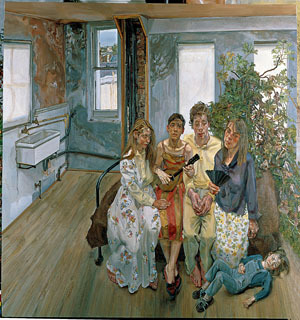
In 1964, Mr. Freud was dismissed from a teaching job for assigning his students to paint naked self-portraits that would be "something really shameless, you know." Thereafter, the subject in his own work became evermore shameless and grotesque. Enter Leigh Bowery and "Big Sue," Mr. Freud's obese painter's models. Enter taboo. For one painting he positioned his half-naked, pre-pubescent daughter Isobel on the floor beside a houseplant ("Large Interior, Paddington," 1968-69). He also featured a man, the photographer David Dawson, breastfeeding a baby as Francis Wyndham reads Flaubert's letters ("Large Interior, Notting Hill," 1998).

The slow rise of British art, which tracked the demise of the New York School and the dying influence of the French avant-garde, has privileged Mr. Freud as the embodiment of English style. Unfortunately, he inhabits the best and worst attributes of what England can offer up in paint. His champions point to John Constable. But Mr. Freud is rather more Dorian Gray.