Gallery chronicle (October 2008)

20a55a8c

Giorgio Morandi, Grande natura morta con la lampada a destra, 1928, etching

THE NEW CRITERION
OCTOBER 2008

Gallery chronicle
by James Panero

On "The Etchings of Giorgio Morandi" at Pace Master Prints, New York, and "Giorgio Morandi: Paintings and Works on Paper" at Lucas Schoormans Gallery, New York.

For thirty years, the director of the Metropolitan Museum of Art, Philippe de Montebello, has been a model of sobriety in a decadent age. Other institutions have succumbed to the fashions of the moment, but the Metropolitan has remained a museum of art. Great art and excellent curators have been championed over financial and egotistical concerns. And while de Montebello’s leadership has been rooted in the best traditions of conservatorship, it has also been visionary. The good works of his museum radiate out into the culture at large. The story in the galleries this month certainly bears that out.

I don’t put much stock in the forwards to museum catalogues, usually a boilerplate of acknowledgments. But de Montebello’s essay for the Met’s Giorgio Morandi retrospective, reviewed in this issue by Karen Wilkin, is revealing. “Like his paintings,” writes de Montebello, “small in scale and intimate in content, Morandi never fit into the declamatory, self-aggrandizing mode of the most prominent twentieth-century masters. He was a quiet, almost reclusive, and deeply thoughtful man, content to explore his own artistic preoccupations without concern for the expectations of the fast-paced world of artistic fashion.”

These statements could have been a manifesto for de Montebello’s leadership over the last three decades—an attitude that, outside of the Metropolitan, has given license for the New York art world to look beyond the “fast-paced world of artis- tic fashion” and to appreciate slower rewards. “It is indeed unusual to see twenty-seven of Giorgio Morandi’s etchings in a New York gallery,” writes the painter and curator Janet Abramowicz in her essay this month for “The Etchings of Giorgio Morandi” at Pace Master Prints.[1] How right she is. I doubt that even a top-flight gallery like Pace could have considered mounting a sizable exhibition of Morandi’s intimate etchings without the institutional legit- imation provided by the Metropolitan Museum.

Abramowicz studied printmaking with Morandi at Bologna’s Accademia di Belle Arti and went on to become his teaching assistant. She has written the essay on Morandi’s etchings for the Metropolitan catalogue and acted as curator for the Pace show, assembling work from six American collections and from the Museum of Modern Art. The result is an education in Morandi’s development as an etcher, here displayed chronologically in work ranging from 1921 to 1961.

“Etching was an integral part of Giorgio Morandi’s oeuvre,” Abramowicz notes in her Metropolitan essay. “Rather than simply being a complement to his painting,” certain images, Morandi believed, “could be expressed in this medium only.” Yet as Abramowicz writes for Pace, “traditional etching was the medium least conducive to the tonalities Morandi sought in his oeuvre, and it is a tribute to him that he mastered one of the most trying of traditional techniques.”

Morandi’s artistic development was very much defined by his evolution as an etcher. In 1912, as a student, Morandi dropped out of the Accademia for a year in order to teach himself the printmaking process. In doing so he revealed his passion to be more traditional than even his academic minders—he wanted to learn the hard-ground technique of Rembrandt—but he also wanted to apply etching to his modernist vision.

It took Morandi six years to feel comfortable with etching, a process that relies on a volatile chemistry of acid baths to open up or “bite” the furrows in the metal printing plate carved out by the etching needle. You might say it took Morandi a lifetime to test etching’s potential, learning how to adapt a lineal art, an art based on line, to reflect his interest in tone. Il ponte sul Savena a Bologna (Bridge on the Savena River at Bologna, 1912), a landscape and the earliest work in the show, already reveals Morandi’s reserved sense of composition but not yet the assuredness of his etching needle. His marks are a loose thicket of hatchings, his lines doggedly tracing out the architecture of the landscape—the curve of the road, the arch of the bridge. The hatchwork of shadow lines mingles and loses itself in the tonal shading of the trees and rooflines. Compare this to Natura morta con bottiglie e brocca (Still Life with Bottles and Pitcher, 1915), a futurist still life where the tonal areas already feel more assured and light-handed. Rather than merely containing shadow lines, the volumes here are defined by the etching hatchwork.

Morandi’s breakthrough comes in 1921 with the tiny Pane e limone (Bread and Lemon), just one-and-a-half by three inches, which, for Abramowicz, calls to mind Rembrandt’s Small Gray Landscape. Here the background and surrounding area get equal, if not more, attention from the etcher’s needle than does the subject matter itself. The hatch marks have an all-over effect. Morandi defines his objects entirely through their tone, using a texture of lines woven like linen, reflecting the weave of the printed paper, to darken the areas around and beneath the lemon and bread. In Veduta della Montagnola di Bologna (View of the Montagnola in Bologna, 1932), these textures become more abstracted, largely uniform fields of pattern—a dense but even hatchwork of diagonal, vertical, and horizontal lines for a field in shadow, a more open pattern for areas in sun.

The remaining work in the Pace show displays Morandi’s application of his all-over hatching for his iconic still lifes of bottles and other household objects. The blissful regularity of his ordinary subject matter is probably Morandi’s most radical contribution to modernism and still his most debated accomplishment. Through repetition, Morandi was able to revisit the same objects with an experimental eye, changing his approach each time and turning his etching technique into a subject matter of its own. His work becomes more interesting the more he dissolves the plastic shapes of his bottles and cans into the patterns of the etching line. I prefer the wavy Natura morta a grandi segni (Still Life with Large Signs, 1931) to the more “realistic” rendering of Grande natura morta circolare con bottiglia e tre oggetti (Large Circular Still Life with Bottle and Three Objects, 1946).

Of all the examples on view at Pace, Grande natura morta scura (Large Dark Still Life, 1934) stands out for its atmospheric mood, a vision glimpsed in the spectral light of night. The darkness of this work is achieved through the compaction of thousands of etching lines. It is remarkable to consider the density of these lines and the master’s needle carving out each one. Mark for mark, you find more in a square inch of Morandi’s printmaking than in a foot of most modern multiples. You might say that Morandi is the high-thread-count etcher of modernism. The luxuriance of his work comes through in its feel rather than its mere appearance. Consider moreover that Morandi printed most of his etchings himself, sometimes in limited runs of only three or four, and you realize that each of these multiples is a rarified object in its own right, as intimate as any of his oils on canvas.

Intimacy is one aspect of Morandi’s art that poses a unique challenge to curators. Before there was “installation art,” there was simply art’s installation, an awareness of how stand-alone objects become informed by the space around them. I can think of few other examples of modern art that place such a high demand on their hanging as Morandi’s. Rather than reach out to us, Morandi’s paintings and etchings pull us in. It is true that Morandi’s work does not clash against itself—there are no bold colors, no conflicts of program—but his introverted works can tug at one another when arranged too close together. It is a common mistake to assume that Morandi’s intimacy demands proximity, when really his work benefits from open space.

The Metropolitan’s installation of its Morandi survey in the basement of the Lehman wing, a troublesome venue resembling an airport hotel conference center, could not be worse for appreciating Morandi’s particular touch. The Pace exhibition suffers in a similar way. Here the work is packed together in a small dark space, arranged chronologically, clockwise around the room, left to right. Such an exhibition sacrifices pleasure for didacticism.

In terms of presentation, by far the most successful Morandi exhibition this month is now taking place at Lucas Schoormans in Chelsea.[2] Gallery-goers may recall that in 2004 Schoormans mounted a small exhibition of Morandi oils that became the hit of the season. This month the gallery follows up with an equally impressive display. From the open, light-filled space to the sky- blue color of the walls, Schoormans has mounted his exhibition with an eye for intimate detail that complements Morandi’s own.

The gallery’s ground floor focuses on Morandi’s compact oil still lifes from the 1940s and 1950s. His Natura morta (Still Life), rendered in a buttery batter of paint, here from 1953, nears perfection. I also like how a moderately sized still life from 1948 gets to take up its own wall, affixed by two simple screws. The minimal presentation shows Morandi at his elegant best. He seems thoroughly contemporary, rather than dusty and reclusive.

Upstairs, Schoormans has assembled an exhibition of works in pencil and, in fact, several of the same etchings found at Pace. You might wonder if there is anything produced by Morandi not on public display this month in New York—not exactly a terrible situation to contemplate.

It is a delight to find these repetitions and see the same work in different surroundings: just as at Pace, we find Ponte sul Savena a Bologna, Natura morta con bottiglie e brocca, and Natura morta a grandi segni, among others, but here in more congenial surroundings. I like how this presentation does not set out to be all-inclusive. Instead it aims merely to please. I also enjoyed seeing Morandi’s etchings alongside a few of his wispy pencils and watercolors on paper.

I suppose there is something for each side of the brain in these two gallery shows—a printmaking class at Pace, and a sentimental education at Schoormans. They are both worth visiting, and each benefits from the other. Pace and Schoormans also vary as to which of their limited prints is listed for sale. It’s quite a month when we can find two gallery shows of Morandi multiples at once. For this, indirectly, we owe thanks to the singular vision of Philippe de Montebello, a museum director who dares to mount a major survey of this quiet modern master.


Notes
Go to the top of the document.


  1. “The Etchings of Giorgio Morandi” opened at Pace Master Prints, New York, on September 18 and remains on view through October 18, 2008. Go back to the text.
In search of Watteau

8187

THE NEW YORK SUN
September 17, 2008

In Search of Watteau
By JAMES PANERO

A review of Jed Perl's 'Antoine's Alphabet' (Knopf)

Who is your favorite painter? Jed Perl, the art critic for the New Republic, responds: "Whenever I'm asked to name my favorite painter I reply, without a moment's hesitation: 'Watteau.'"

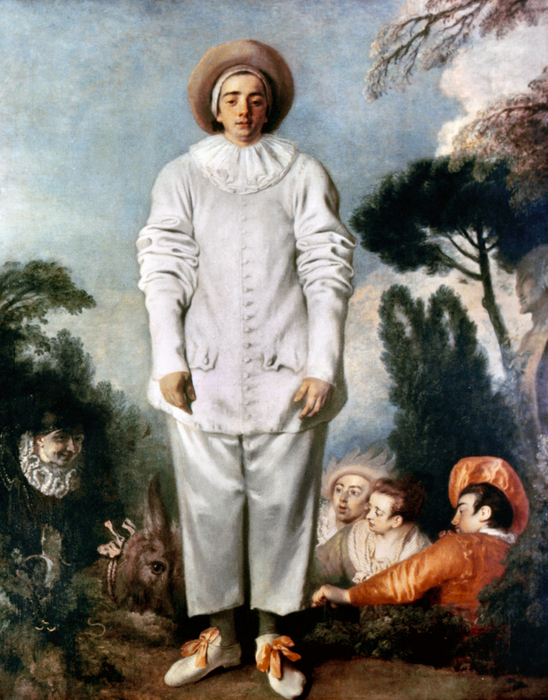
Come again? Watteau? A confection of the ancien regime, Jean-Antoine Watteau was born in 1684 and lived a mere 36 years, dying in 1721, the master of the fête gallant and the portraitist of the commedia dell'arte. It's not the answer you might expect to come out of a tough-minded critic on the contemporary scene.

But "Antoine's Alphabet" (Alfred A. Knopf, 224 pages, $25.95), a brief, deeply felt follow-up to "New Art City," Mr. Perl's muscular account of the New York art world at mid-century, defies expectations. "I may be perceived as being somewhat sardonic," Mr. Perl writes in his introduction, "or ironic, or even impish when I say that Watteau is my favorite painter, as if I were trying to mock the question, or were hiding my true feelings behind a dandyish façade."

Far from retreating from reality, however, Mr. Perl finds engagement with the present moment through Watteau. "This artist who said hardly anything about his paintings and struck most of his friends as something of a mystery man took as his essential subject the invention of self-consciousness, the struggle to feel fully alive." While this critic who rails against the commercialism of the contemporary art world makes no mention of today's art politics, one cannot help but see a counter-example in the fancy-free Watteau to the predetermined art that now fuels record sales at Sotheby's and is bought up by the oligarchs of Beijing, Moscow, and New York as cynical investments.

In its best sense, Mr. Perl sees the birth of the modern in Watteau's figures awakening to their own imperfections. "Watteau's young people seem to want, above all else, to feel at ease, somewhat at ease, in an uneasy world," he writes. In work such as Watteau's famous painting of "Gilles," the contemplative clown, Mr. Perl finds "doubts," though they are "clothed in the commedia dell'arte lightness of an improvisation or a folly." He calls Watteau "The man who practically invented the bohemian imagination." In his aesthetic wanderlust, his reveries of vagabond performers, Watteau did not follow the dictates of the church or a rich clientele, but pursued art for art's sake, the prototypical modernist.

"Antoine's Alphabet" is not a generic appreciation, or a typical brief history. Mr. Perl presents his volume as a primer, arranged as an alphabet: A is for actors, Anthony, and Art-for-Art's-Sake; B is for Backs, Beardsley, and Beginnings, and so on. "The power of certain great paintings," Mr. Perl writes, "no matter how much self-conscious craft the artist brings to the work, is the quality of a daydream, an orchestration of elements whose meaning remains ambiguous or contradictory." Mr. Perl follows the same daydreaming impulse in the footloose presentation of his book. Each definition examines an aspect of Watteau while also offering a meditation on the Watteau-esque — a glint of history, an inspiring theme, a personal rumination. For example, we get:

Beginnings: So much begins with intense yet fragmentary experiences. At the start of a friendship or a love affair there may be some acute recognition, some striking sliver of experience, although initially it's impossible to know where this will go, if indeed it will go anywhere. ...

Cappricio: Watteau is recklessly capricious, a weaver of arabesques who embraces the grotesque, not in the sense of gothic horrors but in the sense of curious divagations and transmutations.

My favorite is "Enough: One day in his studio, D said to me: 'I've always had enough. I'm tall enough, I'm good-looking enough. I have enough money.'" Enough said.

The literary games on display might, in the hands of another writer, come off as an indulgence, but here they serve a clear purpose: They not only describe the mood of an artist, but they let us inhabit his sensibility. The book speaks in the serendipitous language of Watteau's canvases — serendipitous, additionally, because we know very little about Watteau outside of his work. "At the time of his death," Mr. Perl writes, "Watteau was a famous figure in Paris, with his share of devoted friends. The nuggets of reliable information about his life, however, are few and far between, so that every attempt to construct a biography from what scattered facts there are appears bound to fail."

Mr. Perl is not the first to take an unorthodox approach to his history of this artist. Watteau's most successful biography, Mr. Perl recounts, came out of a fictionalized memoir by Walter Pater called "A Prince of Court Painters," which was published in 1885, and which, "in assembling and readjusting some of the facts of the artist's life ... constructs a fable about Watteau that is truer to what we feel when we're looking at his paintings and drawings than a more straightforward account could possibly be." In his story, Pater "imagines himself as a part of the eighteenth-century Pater family that actually knew Watteau."

Mr. Perl here does something of the same, going one step further. Rather than merely imaging himself an associate of Watteau, he becomes a Watteau in print. So am I crazy to see a resemblance between the portrait of Watteau drawn by François Boucher, reproduced in the book, and the photo of Mr. Perl on the dust jacket? Mr. Perl constructs his book around the arabesque, the daydream, and the fragment. "Much of the fragment's fascination has to do with its delicious air of possibility," he writes, "for a fragment provokes a partial experience that can leave us with a heightened awareness of what we are missing."

Many of those "experiences" are personal for Mr. Perl. But that does not mean they are artful dodges. Rather, Watteau allows this trenchant thinker — arguably our best art critic writing today — to show, for once, his own hand. We see the painted ceiling of his boyhood home in Brooklyn, and are given a manifesto of his desires in paint: "What I really want from art is a variety of qualities, a multiplicity of qualities, a kaleidoscope of qualities, the unpredictability of qualities, qualities that are as varied as the artists who create the works of art."

In its oddity, the book gambles and wins. I hope that "Antoine's Alphabet" will become a cult classic among artists, a call to caprice, in the way that Dave Hickey's "Air Guitar," a critic's libertarian riff, gave license to a generation of artists to forego politics for the rapture of the marketplace. In this capricious cross-pollination of history and memoir, Jed Perl does not merely show us how to live. Like Watteau, he illuminates the struggle to feel fully alive.

Mr. Panero is the managing editor of the New Criterion.

Hudson River Schooled

IMG_0916
Jacob Collins, founder of the Hudson River School for Landscape, on location in Hunter, New York, August 7, 2008

THE NEW CRITERION
SEPTEMBER 2008

Hudson River Schooled
by James Panero

On Jacob Collins's Hudson River School for Landscape.

Anyone who suspects that nineteenth-century American art has less to teach us than twentieth-century modernism should take a drive up the winding road of Route 23A, up Kaaterskill Clove in the eastern escarpment of the Catskill Mountains. Here in the town of Hunter, New York, a group of young artists is studying the nineteenth-century traditions of the Hudson River School by walking in the footsteps of the original American masters.

In the summer months, Hunter can be a desolate modern town—a weedy ski village in downtrodden Greene County trying to survive the heat while waiting for snow. Ten years ago, an organization called the Catskill Mountain Foundation saw a need to turn this area into more than just a seasonal resort, so the Foundation bought up real estate downtown and set about building an arts program, offering the traditionalist painter and teacher Jacob Collins the use of the Foundation’s buildings for a summer painting school.

This donation became the beginning of Collins’s Hudson River School for Landscape. Dedicated to reviving nineteenth-century landscape technique by “modeling itself after the artistic, social and spiritual values of the Hudson River School painters,” Collins wrote in his mission statement, his school aimed to “bring together the reawakening enthusiasm for the old American painters.” Ideally, he says, his student artists “and their beautiful representations of nature will help to lead the culture back to a stronger connection to the landscape.” This year Collins offered five-week summer fellowships for two dozen painters to live together in Hunter and paint in the surrounding countryside. The school term ran from July 17 through August 22. I dropped in during one mid-session weekend.

Over 180 years before my visit, the painter Thomas Cole went by ship up the Hudson from New York City and disembarked at West Point. He traveled into the Catskill Mountains to paint the terrain around which I was staying, becoming the inspiration for all artists who followed and the ultimate reason for my trip. Cole’s show of Catskill landscapes was a smash when he exhibited in New York in 1826. Widely publicized in the New York Evening Post, Cole’s three paintings included his image of the falls at Kaaterskill, still flowing just down the road from present-day Hunter.

In his History of the American People, Paul Johnson calls Cole, “the first painter to appreciate the immensity of the opportunities offered by the scale and variety of the American landscape.” His Falls at Kaaterskill were likewise “the first American masterpiece of landscape art.” Cole’s achievements sparked an entire movement of landscape painting and opened up the Catskills, in particular the area around Kaaterskill, to a wave of artists. Palenville, at the base of the gorge of Kaaterskill Clove, became America’s first art colony. Lavish hotels went up along the mountaintops around The Clove. A year after Cole’s death, in 1849, Asher B. Durand dedicated perhaps the most famous American landscape painting, Kindred Spirits, to his colleague by depicting Cole and William Cullen Bryant, the poet and editor of the Post, standing on a promontory overlooking Kaaterskill. (In a lowpoint for New York’s artistic patrimony, this painting, in the collection of the New York Public Library for over a century, was sold in 2005 for $35 million to the Wal-Mart heiress Alice Walton of Arkansas.)

At the time of Cole’s initial trip in 1825, the changing wilderness of New York State was very much on the American mind. Emerson’s Transcendentalism was still more than a decade off, but the idea of a natural theology, as articulated by William Paley at the turn of the century, had instilled a new reverence for the natural world. Meanwhile, the Erie Canal, the technological marvel that tamed the West by connecting the Great Lakes with the Hudson River, was built between 1817 and 1825. The rough landscape of rural New York took a literary turn in these years as well. In 1819, Washington Irving located his popular story of Rip Van Winkle in the Catskill Mountains, and four years later James Fenimore Cooper published his colonial story of the Catskill woodsman Natty Bumppo in The Pioneers—one of Cole’s reference books for his trip.

“This is the birthplace, the origin,” Collins said to me when I found him in early August, painting a sky study in an overgrown parking lot off Hunter’s Main Street. Like his students, Collins paints from eight in the morning until sunset, seven days a week when he is in town, building up a portfolio of studies that he will assemble into complete landscapes back in the studio.

After the daytime painting hours are over, the Hudson River School for Landscape turns into a commune and a summer camp. The students in each cabin prepare meals for their housemates. The bonhomie of the school is not lost on Collins, who wants to revive the camaraderie of the Hudson River School. After dinner on the evening I visited, the students laid out the day’s work for a critique that quickly turned technical. “So what would you do, Jacob?” asked Josh, a student, of his latest forest scene. “I would put something in front of it,” said Collins. Then: “When you have a white sky, you can drop the value one step.”

After the crits, Collins introduced George O’Hanlon, the owner of a paint company called Natural Pigments, who came in from California to give a talk. Collins runs a regular evening lecture series for his students, and on the day I visited O’Hanlon delivered a PowerPoint presentation on “The Secrets of the Old Masters.” His talk lasted from nine to eleven-thirty in the evening, but Collins’s students showed little sign of wear as O’Hanlon moved from the chemistry of pigments to the nuances of linseed oil. (His secret of the Old Masters had to do, in part, with the viscous properties of natural pigment versus the homogenized consistency of modern oil paints).

The next morning, a number of the students made the half-mile hike up Kaaterskill Falls. At 260 feet, the two-drop falls of Kaaterskill are the highest in New York. They are also as breathtaking as the day Cole first saw them. Cole’s dark autumn scene of the double cascades, with a mammoth boulder resting in the falls’ upper amphitheater, is both an accurate depiction of the topography and an awesome image of an untamed wilderness—a tiny, lone figure can be seen among the straggly trees and the black rocks.

Have Collins’s students been able to approach the majesty of Cole’s great image? Their successes will depend on the final paintings that, like Cole, they work up in the studio from studies in the field. But I am concerned that these students, with their small, scrupulous studies of rocks and stumps, may be missing the forest for the trees of genuine Hudson River School landscape. In his mission statement, Collins maintains, “It is through extensive and real engagement that the artist learns to capture the spirit of the landscape. The many hundreds of hours spent out in the sun and the wind, scrupulously studying nature, transform the artist. It was by this experience that the old masters of the landscape realized their art. And it is how we hope to realize ours.”

Pragmatism informed by observation is laudable, but during my visit I came to wonder if “extensive and real engagement” was truly enough to “capture the spirit of the landscape.” Collins’s students may be learning the vocabulary of the Hudson River School, but I saw little evidence that they are being taught how to speak it. Collins’s students are young, mainly in their twenties. They are the products of an art world that shouts but has little to say. So the silence offered by Collins’s draftsman drills, developed in his schools in New York and carried over to landscape, is itself a form of rebellion, a release that looks for depth in the details of leaves and bark. But this must only be a means to an end, not an end in itself.

The original Hudson River School was full of secrets—perhaps more than any other movement in American art. So the prospect of a genuine revival giving way to false profundities couched in technique is a serious concern. The original Hudson River School artists did not go into the wilderness to paint illustrations of the natural world. They went to paint the God they saw manifest in the natural world. “It’s the best piece of work that I’ve met with in the woods,” Natty Bumppo says of Kaaterskill Falls in Cooper’s story, “and none know how often the hand of God is seen in the wilderness, but them that rove it for a man’s life.”

Can there be a Hudson River School revival without the revival of God? This is the question that Collins and his students must confront. Their studies, no matter how precise, may never come together as a whole without an underlying philosophy that goes beyond mere proficiency. In a small exhibition I saw of last year’s student work, I found a landscape by Mikel Olazabal, River in Hunter, NY, to be the most accomplished but also the most problematic painting of the show. After viewing it, I walked across the street and down to the riverbank where, along an old foundation, I found the exact spot on which his image was based. Olazabal’s landscape was highly proficient, full of happy thoughts, but it struck me as altogether wrong. With flowers peeking through the rocks and every leaf on every tree glittering in the sun, his buffed-up interpretation was an idealized illustration of rural renewal, mood communicated through mood lighting.

I don’t want to suggest that landscape painters need to seek out ugliness over beauty, but if an artist believes a landscape evinces God, as the original Hudson River School painters surely did, then an artist should not improve on it without cause, or he risks descending into sentimentality.

On the day I visited, the waters of Schoharie Creek had been redirected through plastic pipes around a construction site upstream, so that the dried-out riverbed gave off a sooty odor. I am not sure this unsightly mess would be right on its own for treatment in paint, but when I think back to the best landscape painting of the nineteenth century—and the art of such modern interpreters as Rackstraw Downes—great work is defined by the intersection of industry, agriculture, and wilderness: the tamed farmland in contrast with the rugged forest in The Oxbow by Thomas Cole, or the railroad and tree stumps populating George Inness’s verdant images of the Lackawanna.

For the Hudson River School painter, the entire landscape was part of God’s world. Such thoughts, of course, rarely infiltrate modern belief. “And what remains when disbelief has gone?” asks Philip Larkin in his poem “Church Going”: “Grass, weedy pavement, brambles, buttress, sky,/ A shape less recognizable each week,/ A purpose more obscure.” To understand the Hudson River School today, Collins’s students must learn to see themselves as seminarians as well as painters. They otherwise risk becoming the mere technicians of grass, weedy pavement, brambles, buttress, and sky. Deep in the Catskill wilderness, they may be in a house of God, but that doesn’t mean they’ve got religion.