Made in China

Im01
Zhang Huan, “½” (1998)

THE NEW CRITERION
DECEMBER 2008

Made in China
by James Panero

On Zhang Huan & contemporary art in China.

The art world success of Zhang Huan makes a compelling story, the postmodern Horatio Alger myth at the heart of contemporary Chinese art. Today, at the age of forty-three, Zhang is a multimillionaire. In New York, he is represented by PaceWildenstein, which held a survey of his latest work in Chelsea last spring. At his factory studio in Shanghai, a hundred assistants living in dormitories churn out labor-intensive carvings of propaganda scenes, photorealistic “ash paintings,” and fifty-foot-tall giants constructed of calfskins stitched with wire. After a decade and a half of privations, Zhang has become a giant himself, one of the artistic titans of the new Chinese economy. But his tale should come with a warning label. Zhang has struck it rich through cunning and compromise and contamination. He embodies all that it means to be a contemporary artist “made in China.”

In the early 1990s, when Zhang started out, the prospects for artistic survival in the People’s Republic looked grim. Born in 1965 in Henan Province, the Chinese Midwest, and raised by his grandmother in a rural town, Zhang took an undergraduate degree in oil painting at Henan University in 1988. At the time, the first flush of Western-style artistic experimentation in China, through a movement known as the ’85 New Wave, was working its way through modern modes, most notably Pop Art. Artists started criticizing the regime of the Chinese Communist Party and the cult of Mao. Shows of Western artists such as Robert Rauschenberg came to Beijing. The culmination of these developments took place in 1989, when an exhibition called “China/Avant-Garde” went up at the National Art Museum. Then, four months later, the tanks rolled into Tiananmen Square, leading to a crackdown on democratic expression from which China has yet to recover.

The art critic Richard Vine, a senior editor at Art and America and for many years one of the few incorruptible observers of China’s cultural scene, recounts this history in his new critical survey called New China New Art, published by Prestel.[1] Today’s Chinese avant-gardists do not “share either the political intent or the reckless bravery of the Tiananmen organizers,” he notes. “The cruel lesson of June 4, 1989 is that repression sometimes works.”

In the post-Tiananmen world, Zhang confronted his limits. In 1993, after receiving an advanced degree in oil painting at the selective Central Academy of Fine Arts in Beijing, he moved to a run-down section of the city, where rent was $16 a month, and promptly became depressed. He listened to the music of Kurt Cobain—the suicidal front man of the grunge band Nirvana.

Look up Chinese art history and you won’t find chapters on illusionistic painting or abstraction or high modernism. Traditional Chinese art is limited to calligraphic ink on paper. So today’s hot Chinese artists, who skillfully replicate the contemporary practices of Western art, never passed through the history that created it. “Mao Zedong, having set out to establish a Communist utopia,” notes Vine, “inadvertently paved the way—at the cost of forty to seventy million peacetime lives—for a postmodern society par excellence.”

Western-style art in China did not emerge from a vacuum. In the twentieth century, the Soviet Union exported its oil-on-canvas technique to the PRC—handed down through the nineteenth-century Russian Beaux Arts—to be used for propaganda purposes in socialist realism (think of the portraits of Mao). Two constellations of art schools developed in China—a division that can still be found in most cities—with one dedicated to native techniques and the other to foreign influences.

By studying oil-on-canvas, Zhang had already cast his lot with imported artistic practice. Zhang’s brilliance was his ability to appropriate these foreign influences—along with textbook knowledge of Western art history—and to apply them effectively to his particular Chinese condition.

Zhang chose not to threaten the Chinese Communist Party. Instead he followed a model of success that was about to revolutionize the Chinese economy. In recent years, China has seen 10 percent annual growth. It now boasts fifteen billionaires and over 300,000 millionaires. Along with Western collectors, this new super-rich class has become the patrons of contemporary Chinese art.

Like the industrialists who learned to apply the “China price” to international commerce—pushing cheaper work into the marketplace at the expense of quality, originality, safety, and liberty—Zhang struck the mother lode of art-world success by outsourcing the Western avant-garde to China’s economy of scale, employing “mercantile skills for which China is renowned,” writes Vine, “a legacy only temporarily suppressed during the high Communist period.” Artistically, what Zhang was about to create had been done before—it was part of his brilliance to combine the Western practice of appropriation with the Eastern penchant for copyright infringement.

Zhang and a handful of artists christened their benighted Beijing neighborhood the “East Village” after the New York artist district. Then, in 1994, Zhang enacted his defining early performance. For 12 Square Meters, he covered his naked body with fish oil and honey and sat monk-like in a torrid communal outhouse swarming with flies. An hour later he walked out and washed himself in the waters of a brackish pond.

As a matter of cultural comparison, the privations to which Zhang subjected himself in this and other performances replicated but never overshadowed the horrors of American performance art in the 1970s. In 1971, in Santa Ana, California, Chris Burden had a friend shoot him in the arm with a 22 caliber rifle. (The art critic Peter Schjeldahl calls Burden “pretty great” and praised this work at “perfectly repellent.”) In another example, Burden spent five days, rather than a mere hour, in a small locker with one bottle for water and one bottle for waste. In yet another, Burden had himself crucified on top of a Volkswagen beetle with nails hammered through his hands.

In terms of abnegation of the flesh, for those of us keeping score, Western art still had Zhang beat. The Chinese have no native tradition of asceticism, and in his monasticism Zhang was making another appropriation, referencing both Christian and Buddhist practice. But compared to the blurry black-and-white snapshots of Burden’s 1970s provocations, the iconic photographs taken of Zhang’s 1994 event, with a chiseled, glistening artist in meditative chiaroscuro, come off as far more reproducible. They would soon make Zhang a star.

In the year that followed, Zhang, gagged and naked, suspended himself from a ceiling by chains while doctors below extracted 250 cc’s of his blood, which they cooked on a hot steel pan (65 Kilograms). For his thirtieth birthday, he lay underneath a highway with earthworms stuffed in his mouth (Original Sound). For an hour, he reclined naked beneath a steel cutting tool as sparks shot over his body (22 mm Treading Steel).

The media-savvy Zhang, who like a dancer understood how to use his own toned physique, recorded these actions by camera and retained the copyright. Sure enough, his hairless, meditative portraits began appearing in Western publications, from Artforum to the cover of the New York Times Arts & Leisure section. In 2006, after an eight-year residency in New York (several contemporary Chinese artists have become bi-continental), Zhang moved to Shanghai. He gave up performance art, and his self-abuse, to inaugurate his current studio practice.

In New China New Art, Richard Vine divides his survey by medium. In performance art, Zhang takes the lion’s share of the coverage, perhaps rivaled only by Ai Weiwei, the son of an exiled poet and a more fleshy contrarian than Zhang. A one-time outsider, Ai now enjoys the support of the CCP, serving as a consultant on the “bird’s nest” stadium for the 2008 Beijing Olympics. In fact, Chinese artistic participation in the games was widespread; the fireworks-cum-installation artist Cai Guo-Qiang, a self-described Maoist who retains a large studio in New York and a second in Beijing, served as the Olympiad’s Art Director of Visual and Special Effects.

Today in China, Mao is officially said to have been “70 percent correct, 30 percent wrong.” In the 1970s, Mao’s successor Deng Xiaoping renounced the Cultural Revolution of the late 1960s. Deng learned to modify the party line to serve the long-term prospects of China’s authoritarian regime.

Such pragmatism accounts for the explosion of China’s new rich. After the death of Mao, Deng updated Chinese socialist principles by declaring “poverty is not socialism; to grow rich is glorious.” It also accounts for the survival of China’s vanguard art once foreign collectors began buying it up. The CCP, which once backed traditional calligraphic work “both as a compensation for the now-renounced Cultural Revolution and as an assertion of national identity,” writes Vine, “has today, however grudgingly, come to value avant-garde art as part of a soft power strategy to enhance China’s global status.”

For a time, in fact, the CCP’s allowances were so broad that they encouraged grotesque artistic attempts at shock, which Vine recounts in graphic detail: “There is very little sentimentality about livestock in China; and for a time at the turn of the twenty-first century, preserved human ‘medical specimens’ were readily available.”

In the early 1990s, Wenda Gu used menstrual blood, semen, and placenta powder in his installations. (Wenda’s website announces that his placenta powder came from “normal, abnormal, aborted, [and] still born [pregnancies], produced according to Chinese ancient medical methods.”) When the British shock team Gilbert and George toured Beijing’s East Village in 1993, Ma Liuming protested their lack of interest by masturbating and drinking his own semen. In 1997 Sheng Qi injected, hacked, and urinated on live chickens (Universal Happy Brand Chicken). In 2000 Liu Jin wrestled a bound pig to death in a fire-heated vat of soy sauce (Large Soy Sauce Vat). That same year Yang Zhichao had grass implanted in his shoulder (Planting Grass) and encouraged Ai Weiwei to scar him with a hot brand (Iron).

As upsetting as these performances are, the Chinese use of human material has been its most reprehensible artistic practice. In 2000 Peng Yu dripped oil into the mouth of an infant corpse (Oil for a Human Being), Sun Yaun arranged a “dead fetus snuggled against the face of a deceased old man in bed covered with ice” (Honey), and the two artists together transfused blood from their arms into the mouths of Siamese-twin corpse fetuses (Linked Bodies). That same year, in a “protest against groundless strictures forbidding cannibalism,” according to Vine, Zhu Yu “cut a fetus specimen into five handy pieces (two arms, two legs, one head-and-torso) and gnawed—or at least pretended to gnaw—the morsels for a still camera” (Eating People).

“A certain psychological arc is implicit in this development of mainland performance art,” writes Vine, “from utilization of one’s own living body to the manipulation of objects to deployment of the dead bodies of others. The genre seems to have begun by claiming freedom and selfhood, passed into a critique of consumerism, and arrived at a commodification of others for the sake of notoriety and financial gain.”

In 2001 the Chinese Ministry of Culture banned exhibitions involving torture, animal abuse, corpses, and overt violence and sexuality, yet their history reveals the cynicism informing much of contemporary Chinese art. (No surprise, but one of China’s artistic movements is known as “cynical realism.”)

While the handful of Chinese painters who have emerged as celebrities may be less repellent—but perhaps more pernicious—than the performers, they share the same exploitative nature. The painter Wang Guangyi is openly dismissive of artists who fail to game the system. Zhou Tiehai has advocated “exploiting the international art market as a means of personal and collective self-defense.” The top-selling Yue Minjun, Fang Lijun, and Zhang Xiaogang have created an iconography of laughing men, bald thugs, and expressionless portraits, which they endlessly reproduce. In China, common artistic practice includes “blatant imitation of other artists’ works, willingness to pay for art criticism and museum exposure, refusal to adhere to dealer-artist exclusivity, an elastic notion of ‘limited’ editions, and mass replication of the artists’ own most successful motifs.”

The goings-on of artists halfway around the world would be of limited interest were it not also a window on our own artistic culture. “This immense, newly capitalistic country on the far side of the globe,” writes Vine, “has an unsettling way of reflecting our cultural-financial reality like a magnifying mirror.” Chinese contemporary art has entered the “international monoculture.” Western patrons were the first collectors and remain the primary boosters of contemporary Chinese works, some of which have seen price escalations of 2,500 percent. In 2006, Sotheby’s New York took in $13 million from an Asian sale of mostly Chinese art. In 2007 that number jumped to $38.5 million. That same year a painting by Yue Minjun sold at Sotheby’s for $5.9 million. Paintings by Zhang Xiaogang have sold for up to $3 million. How the financial meltdown will play out in the Chinese art market remains to be determined, but it will undoubtedly trigger a significant correction in prices as the global contemporary art bubble pops.

Last June, in an article called “Mao Crazy,” Jed Perl in The New Republic wrote a blistering attack on new Chinese art for its apparent embrace of the personality cult. “Make no mistake about it,” Perl concluded, “many among the current generation of Chinese artists are in the business of re-educating the public. By the time they are done with the Cultural Revolution, it will be just another art event, neither more nor less significant than a performance by Joseph Beuys or Matthew Barney.”

As they say of the Chairman himself, this assessment is 70 percent right and 30 percent wrong. Contemporary Chinese artists may use Maoist iconography, but their cult belongs to Warhol’s Mao, not Chairman Mao. Instead of the production, it is the Western consumption of Chinese art that deserves our scrutiny. By turning Chinese art into the latest trend, we have extended the global transformation of serious art into a speculative commodity, supported the soft power strategy of an oppressive state, and reveled in the negative force of an avant-garde linked to an authoritarian regime not seen since the Futurism of Fascist Italy. We have shipped our vanguard dreams abroad, and we have brought back home an imitation art, cheaper, more compelling than the real thing, but containing the fatal taint of melamine.


Notes
Go to the top of the document.


  1. New China New Art, by Richard Vine; Prestel, 240 pages, $60. Go back to the text.

Gallery chronicle (October 2008)

20a55a8c

Giorgio Morandi, Grande natura morta con la lampada a destra, 1928, etching

THE NEW CRITERION
OCTOBER 2008

Gallery chronicle
by James Panero

On "The Etchings of Giorgio Morandi" at Pace Master Prints, New York, and "Giorgio Morandi: Paintings and Works on Paper" at Lucas Schoormans Gallery, New York.

For thirty years, the director of the Metropolitan Museum of Art, Philippe de Montebello, has been a model of sobriety in a decadent age. Other institutions have succumbed to the fashions of the moment, but the Metropolitan has remained a museum of art. Great art and excellent curators have been championed over financial and egotistical concerns. And while de Montebello’s leadership has been rooted in the best traditions of conservatorship, it has also been visionary. The good works of his museum radiate out into the culture at large. The story in the galleries this month certainly bears that out.

I don’t put much stock in the forwards to museum catalogues, usually a boilerplate of acknowledgments. But de Montebello’s essay for the Met’s Giorgio Morandi retrospective, reviewed in this issue by Karen Wilkin, is revealing. “Like his paintings,” writes de Montebello, “small in scale and intimate in content, Morandi never fit into the declamatory, self-aggrandizing mode of the most prominent twentieth-century masters. He was a quiet, almost reclusive, and deeply thoughtful man, content to explore his own artistic preoccupations without concern for the expectations of the fast-paced world of artistic fashion.”

These statements could have been a manifesto for de Montebello’s leadership over the last three decades—an attitude that, outside of the Metropolitan, has given license for the New York art world to look beyond the “fast-paced world of artis- tic fashion” and to appreciate slower rewards. “It is indeed unusual to see twenty-seven of Giorgio Morandi’s etchings in a New York gallery,” writes the painter and curator Janet Abramowicz in her essay this month for “The Etchings of Giorgio Morandi” at Pace Master Prints.[1] How right she is. I doubt that even a top-flight gallery like Pace could have considered mounting a sizable exhibition of Morandi’s intimate etchings without the institutional legit- imation provided by the Metropolitan Museum.

Abramowicz studied printmaking with Morandi at Bologna’s Accademia di Belle Arti and went on to become his teaching assistant. She has written the essay on Morandi’s etchings for the Metropolitan catalogue and acted as curator for the Pace show, assembling work from six American collections and from the Museum of Modern Art. The result is an education in Morandi’s development as an etcher, here displayed chronologically in work ranging from 1921 to 1961.

“Etching was an integral part of Giorgio Morandi’s oeuvre,” Abramowicz notes in her Metropolitan essay. “Rather than simply being a complement to his painting,” certain images, Morandi believed, “could be expressed in this medium only.” Yet as Abramowicz writes for Pace, “traditional etching was the medium least conducive to the tonalities Morandi sought in his oeuvre, and it is a tribute to him that he mastered one of the most trying of traditional techniques.”

Morandi’s artistic development was very much defined by his evolution as an etcher. In 1912, as a student, Morandi dropped out of the Accademia for a year in order to teach himself the printmaking process. In doing so he revealed his passion to be more traditional than even his academic minders—he wanted to learn the hard-ground technique of Rembrandt—but he also wanted to apply etching to his modernist vision.

It took Morandi six years to feel comfortable with etching, a process that relies on a volatile chemistry of acid baths to open up or “bite” the furrows in the metal printing plate carved out by the etching needle. You might say it took Morandi a lifetime to test etching’s potential, learning how to adapt a lineal art, an art based on line, to reflect his interest in tone. Il ponte sul Savena a Bologna (Bridge on the Savena River at Bologna, 1912), a landscape and the earliest work in the show, already reveals Morandi’s reserved sense of composition but not yet the assuredness of his etching needle. His marks are a loose thicket of hatchings, his lines doggedly tracing out the architecture of the landscape—the curve of the road, the arch of the bridge. The hatchwork of shadow lines mingles and loses itself in the tonal shading of the trees and rooflines. Compare this to Natura morta con bottiglie e brocca (Still Life with Bottles and Pitcher, 1915), a futurist still life where the tonal areas already feel more assured and light-handed. Rather than merely containing shadow lines, the volumes here are defined by the etching hatchwork.

Morandi’s breakthrough comes in 1921 with the tiny Pane e limone (Bread and Lemon), just one-and-a-half by three inches, which, for Abramowicz, calls to mind Rembrandt’s Small Gray Landscape. Here the background and surrounding area get equal, if not more, attention from the etcher’s needle than does the subject matter itself. The hatch marks have an all-over effect. Morandi defines his objects entirely through their tone, using a texture of lines woven like linen, reflecting the weave of the printed paper, to darken the areas around and beneath the lemon and bread. In Veduta della Montagnola di Bologna (View of the Montagnola in Bologna, 1932), these textures become more abstracted, largely uniform fields of pattern—a dense but even hatchwork of diagonal, vertical, and horizontal lines for a field in shadow, a more open pattern for areas in sun.

The remaining work in the Pace show displays Morandi’s application of his all-over hatching for his iconic still lifes of bottles and other household objects. The blissful regularity of his ordinary subject matter is probably Morandi’s most radical contribution to modernism and still his most debated accomplishment. Through repetition, Morandi was able to revisit the same objects with an experimental eye, changing his approach each time and turning his etching technique into a subject matter of its own. His work becomes more interesting the more he dissolves the plastic shapes of his bottles and cans into the patterns of the etching line. I prefer the wavy Natura morta a grandi segni (Still Life with Large Signs, 1931) to the more “realistic” rendering of Grande natura morta circolare con bottiglia e tre oggetti (Large Circular Still Life with Bottle and Three Objects, 1946).

Of all the examples on view at Pace, Grande natura morta scura (Large Dark Still Life, 1934) stands out for its atmospheric mood, a vision glimpsed in the spectral light of night. The darkness of this work is achieved through the compaction of thousands of etching lines. It is remarkable to consider the density of these lines and the master’s needle carving out each one. Mark for mark, you find more in a square inch of Morandi’s printmaking than in a foot of most modern multiples. You might say that Morandi is the high-thread-count etcher of modernism. The luxuriance of his work comes through in its feel rather than its mere appearance. Consider moreover that Morandi printed most of his etchings himself, sometimes in limited runs of only three or four, and you realize that each of these multiples is a rarified object in its own right, as intimate as any of his oils on canvas.

Intimacy is one aspect of Morandi’s art that poses a unique challenge to curators. Before there was “installation art,” there was simply art’s installation, an awareness of how stand-alone objects become informed by the space around them. I can think of few other examples of modern art that place such a high demand on their hanging as Morandi’s. Rather than reach out to us, Morandi’s paintings and etchings pull us in. It is true that Morandi’s work does not clash against itself—there are no bold colors, no conflicts of program—but his introverted works can tug at one another when arranged too close together. It is a common mistake to assume that Morandi’s intimacy demands proximity, when really his work benefits from open space.

The Metropolitan’s installation of its Morandi survey in the basement of the Lehman wing, a troublesome venue resembling an airport hotel conference center, could not be worse for appreciating Morandi’s particular touch. The Pace exhibition suffers in a similar way. Here the work is packed together in a small dark space, arranged chronologically, clockwise around the room, left to right. Such an exhibition sacrifices pleasure for didacticism.

In terms of presentation, by far the most successful Morandi exhibition this month is now taking place at Lucas Schoormans in Chelsea.[2] Gallery-goers may recall that in 2004 Schoormans mounted a small exhibition of Morandi oils that became the hit of the season. This month the gallery follows up with an equally impressive display. From the open, light-filled space to the sky- blue color of the walls, Schoormans has mounted his exhibition with an eye for intimate detail that complements Morandi’s own.

The gallery’s ground floor focuses on Morandi’s compact oil still lifes from the 1940s and 1950s. His Natura morta (Still Life), rendered in a buttery batter of paint, here from 1953, nears perfection. I also like how a moderately sized still life from 1948 gets to take up its own wall, affixed by two simple screws. The minimal presentation shows Morandi at his elegant best. He seems thoroughly contemporary, rather than dusty and reclusive.

Upstairs, Schoormans has assembled an exhibition of works in pencil and, in fact, several of the same etchings found at Pace. You might wonder if there is anything produced by Morandi not on public display this month in New York—not exactly a terrible situation to contemplate.

It is a delight to find these repetitions and see the same work in different surroundings: just as at Pace, we find Ponte sul Savena a Bologna, Natura morta con bottiglie e brocca, and Natura morta a grandi segni, among others, but here in more congenial surroundings. I like how this presentation does not set out to be all-inclusive. Instead it aims merely to please. I also enjoyed seeing Morandi’s etchings alongside a few of his wispy pencils and watercolors on paper.

I suppose there is something for each side of the brain in these two gallery shows—a printmaking class at Pace, and a sentimental education at Schoormans. They are both worth visiting, and each benefits from the other. Pace and Schoormans also vary as to which of their limited prints is listed for sale. It’s quite a month when we can find two gallery shows of Morandi multiples at once. For this, indirectly, we owe thanks to the singular vision of Philippe de Montebello, a museum director who dares to mount a major survey of this quiet modern master.


Notes
Go to the top of the document.


  1. “The Etchings of Giorgio Morandi” opened at Pace Master Prints, New York, on September 18 and remains on view through October 18, 2008. Go back to the text.

In search of Watteau

8187

THE NEW YORK SUN
September 17, 2008

In Search of Watteau
By JAMES PANERO

A review of Jed Perl's 'Antoine's Alphabet' (Knopf)

Who is your favorite painter? Jed Perl, the art critic for the New Republic, responds: "Whenever I'm asked to name my favorite painter I reply, without a moment's hesitation: 'Watteau.'"

Come again? Watteau? A confection of the ancien regime, Jean-Antoine Watteau was born in 1684 and lived a mere 36 years, dying in 1721, the master of the fête gallant and the portraitist of the commedia dell'arte. It's not the answer you might expect to come out of a tough-minded critic on the contemporary scene.

But "Antoine's Alphabet" (Alfred A. Knopf, 224 pages, $25.95), a brief, deeply felt follow-up to "New Art City," Mr. Perl's muscular account of the New York art world at mid-century, defies expectations. "I may be perceived as being somewhat sardonic," Mr. Perl writes in his introduction, "or ironic, or even impish when I say that Watteau is my favorite painter, as if I were trying to mock the question, or were hiding my true feelings behind a dandyish façade."

Far from retreating from reality, however, Mr. Perl finds engagement with the present moment through Watteau. "This artist who said hardly anything about his paintings and struck most of his friends as something of a mystery man took as his essential subject the invention of self-consciousness, the struggle to feel fully alive." While this critic who rails against the commercialism of the contemporary art world makes no mention of today's art politics, one cannot help but see a counter-example in the fancy-free Watteau to the predetermined art that now fuels record sales at Sotheby's and is bought up by the oligarchs of Beijing, Moscow, and New York as cynical investments.

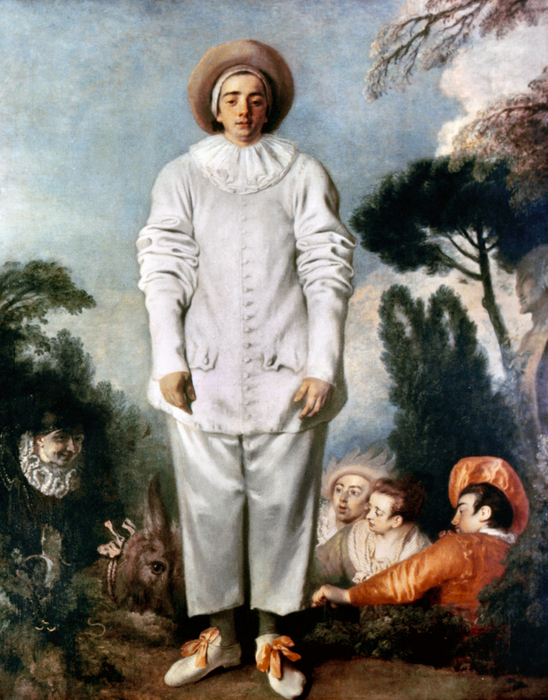
In its best sense, Mr. Perl sees the birth of the modern in Watteau's figures awakening to their own imperfections. "Watteau's young people seem to want, above all else, to feel at ease, somewhat at ease, in an uneasy world," he writes. In work such as Watteau's famous painting of "Gilles," the contemplative clown, Mr. Perl finds "doubts," though they are "clothed in the commedia dell'arte lightness of an improvisation or a folly." He calls Watteau "The man who practically invented the bohemian imagination." In his aesthetic wanderlust, his reveries of vagabond performers, Watteau did not follow the dictates of the church or a rich clientele, but pursued art for art's sake, the prototypical modernist.

"Antoine's Alphabet" is not a generic appreciation, or a typical brief history. Mr. Perl presents his volume as a primer, arranged as an alphabet: A is for actors, Anthony, and Art-for-Art's-Sake; B is for Backs, Beardsley, and Beginnings, and so on. "The power of certain great paintings," Mr. Perl writes, "no matter how much self-conscious craft the artist brings to the work, is the quality of a daydream, an orchestration of elements whose meaning remains ambiguous or contradictory." Mr. Perl follows the same daydreaming impulse in the footloose presentation of his book. Each definition examines an aspect of Watteau while also offering a meditation on the Watteau-esque — a glint of history, an inspiring theme, a personal rumination. For example, we get:

Beginnings: So much begins with intense yet fragmentary experiences. At the start of a friendship or a love affair there may be some acute recognition, some striking sliver of experience, although initially it's impossible to know where this will go, if indeed it will go anywhere. ...

Cappricio: Watteau is recklessly capricious, a weaver of arabesques who embraces the grotesque, not in the sense of gothic horrors but in the sense of curious divagations and transmutations.

My favorite is "Enough: One day in his studio, D said to me: 'I've always had enough. I'm tall enough, I'm good-looking enough. I have enough money.'" Enough said.

The literary games on display might, in the hands of another writer, come off as an indulgence, but here they serve a clear purpose: They not only describe the mood of an artist, but they let us inhabit his sensibility. The book speaks in the serendipitous language of Watteau's canvases — serendipitous, additionally, because we know very little about Watteau outside of his work. "At the time of his death," Mr. Perl writes, "Watteau was a famous figure in Paris, with his share of devoted friends. The nuggets of reliable information about his life, however, are few and far between, so that every attempt to construct a biography from what scattered facts there are appears bound to fail."

Mr. Perl is not the first to take an unorthodox approach to his history of this artist. Watteau's most successful biography, Mr. Perl recounts, came out of a fictionalized memoir by Walter Pater called "A Prince of Court Painters," which was published in 1885, and which, "in assembling and readjusting some of the facts of the artist's life ... constructs a fable about Watteau that is truer to what we feel when we're looking at his paintings and drawings than a more straightforward account could possibly be." In his story, Pater "imagines himself as a part of the eighteenth-century Pater family that actually knew Watteau."

Mr. Perl here does something of the same, going one step further. Rather than merely imaging himself an associate of Watteau, he becomes a Watteau in print. So am I crazy to see a resemblance between the portrait of Watteau drawn by François Boucher, reproduced in the book, and the photo of Mr. Perl on the dust jacket? Mr. Perl constructs his book around the arabesque, the daydream, and the fragment. "Much of the fragment's fascination has to do with its delicious air of possibility," he writes, "for a fragment provokes a partial experience that can leave us with a heightened awareness of what we are missing."

Many of those "experiences" are personal for Mr. Perl. But that does not mean they are artful dodges. Rather, Watteau allows this trenchant thinker — arguably our best art critic writing today — to show, for once, his own hand. We see the painted ceiling of his boyhood home in Brooklyn, and are given a manifesto of his desires in paint: "What I really want from art is a variety of qualities, a multiplicity of qualities, a kaleidoscope of qualities, the unpredictability of qualities, qualities that are as varied as the artists who create the works of art."

In its oddity, the book gambles and wins. I hope that "Antoine's Alphabet" will become a cult classic among artists, a call to caprice, in the way that Dave Hickey's "Air Guitar," a critic's libertarian riff, gave license to a generation of artists to forego politics for the rapture of the marketplace. In this capricious cross-pollination of history and memoir, Jed Perl does not merely show us how to live. Like Watteau, he illuminates the struggle to feel fully alive.

Mr. Panero is the managing editor of the New Criterion.