Gallery chronicle (January 2009)

Frankenthaler_ca27958

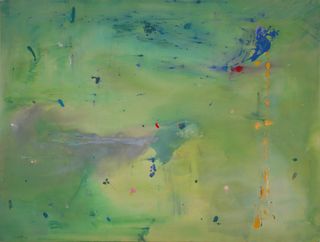
Helen Frankenthaler, A Green Thought in a Green Shade (1981),
© Helen Frankenthaler / courtesy Knoedler & Company

THE NEW CRITERION
JANUARY 2009

Gallery chronicle
by James Panero

On “Frankenthaler at Eighty: Six Decades” at Knoedler & Co., New York.

Living masters have it rough, and Helen Frankenthaler has been living as a master for over half a century. In 1952, at the age of only twenty-three, she created Mountains and Sea, an iconic painting that forever secured her place in the history of art. It was a work that at once defined Frankenthaler’s style and changed the visual texture of abstract painting. Mountains and Sea built on the achievements of Jackson Pollock with its poured paint and rolled-out canvas—but it also outdid Pollock. With its thinned pigments soaked directly into linen, it displayed a new artistic temperament, subsuming the artistic ego into forms of color that absorbed the Abstract Expressionist gesture into an all-over stain. It paved the way for an entire new school of American abstraction known as Color Field, with Frankenthaler’s experimentation leading to the lush mannerisms of Kenneth Noland and Morris Louis.

Unfortunately, nothing hurts a career more than an impeccable reputation, especially in the annals of modernism. Without a doubt, Helen Frankenthaler’s standing today has been diminished by her historical significance. Few would deny her importance, but the fidelity of her artistic vision, which has remained remarkably pure for half a century, has yet to receive its full due.

In a tribute to Frankenthaler’s eightieth birthday this past December, Knoedler has mounted a small survey of paintings spanning six decades, selected by Karen Wilkin from the artist’s own collection.[1] The best argument for Frankenthaler’s importance is not her textbook relevance but the authority of her work.

A Green Thought in a Green Shade (1981), the enormous work that looks back from the far wall of the gallery, comes off as a painterly ecosystem, with algae blooms swirling in a liquid medium. On one of my visits, I noticed two patrons transfixed by this painting, with their noses a few inches from the canvas for what must have been an hour. Frankenthaler employs such a masterly, easy touch that she can let her work, you might say, work on its own, with biomorphic forms bubbling up and dissolving from view not as a vision of the artist’s unconscious but rather as a vision of the canvas’s unconscious, if that’s at all possible.

American museumgoers were reminded of Frankenthaler’s particular touch over the past year. Mountains and Sea temporarily left its permanent home at the National Gallery in Washington for a multi-city tour as part of “Action/Abstraction,” an exhibition that looked at the evolution of American painting through the influence of the critics Clement Greenberg and Harold Rosenberg. In the court of public opinion, Frankenthaler’s reputation has been tied to Clement Greenberg’s own approval ratings, a disservice to the artist and to the historical record, as Greenberg’s theories of flatness and the direction of abstract art owe more to Frankenthaler’s development on canvas than the other way around.

And Frankenthaler’s public esteem has suffered in other ways as well. Consider her biography of family privilege, against which she never rebelled. There is also her cosmopolitan style and her physical beauty—not for nothing, the supermodel Stephanie Seymour portrayed her in the recent biopic of Jackson Pollock. Frankenthaler never bared the tortured soul that is often assumed to be at the heart of important art (one reason, perhaps, why the reputation of Joan Mitchell, a lesser contemporary of Frankenthaler’s and a notoriously foul-mouthed drinker, has recently been on the rise). There has also been Frankenthaler’s resistance to identity politics. She has made little of her position as a groundbreaking woman in the arts. This decision speaks to an inner confidence; she knows she is a groundbreaking artist, regardless of gender. And finally there is her resistance to serialism and the demands of a marketplace that says it wants newness but really seeks more of the same. She could have turned Mountains and Sea into a commodity, producing variations on the theme. Instead, she passed up ready-made labeling, packaging, and selling for a life of pure artistic pursuit.

Which was why seeing Mountains and Sea in “Action/Abstraction,” removed from its usual context in Washington, had been a delight. For such a well-known painting it is still awesome and strange, with its lyrical hints of landscape dissolving into sunspots, which further separate out into oil stains and untreated white canvas. There is an unexplainable beauty at its heart. Frankenthaler is the American Fauve, and she shares several similarities with Henri Matisse. Both artists staked their claim in color rather than tone, and both artists have been accused of bourgeois sentiment, choosing to channel their energies directly into their work rather than into their biographies. For Frankenthaler this process became quite literal. She never battled her way to a high style. There were no decades of experimentation before arriving at a signature work; her signature work began as experimentation filtered through her artistic intuition. Experimentation, in fact, has been the one quality that has defined her oeuvre as she has gone from painting to drawing to printmaking to metal sculpture to pottery and back again.

You might also say that Frankenthaler arrived on the scene at a soaking-in moment for American art. Her achievement was to develop a way to translate this mood directly to canvas. The battles against European surrealism and homegrown regionalism had been fought and won, if not in the public’s mind, then at least for its forward-looking artists of Abstract Expressionism. Frankenthaler never felt compelled to fight a Freudian-like death match with the Beaux-Arts in the manner of de Kooning or to channel Pollock’s Indian rain dance. To do so would have been pantomime. The language of abstraction had already evolved into a lingua franca, and it no longer required overt gesticulation. Frankenthaler purified this language in shapes and colors. Through her thinned pigments and nimble physicality, she discovered how to execute a vision on canvas that removed the evidence of artistic will and seemed to bring forward forms already buried deep in the picture plane.

Recently, in The Wall Street Journal, William Agee described Frankenthaler’s particular journey to Mountains and Sea:

In August 1952, Ms. Frankenthaler traveled to Nova Scotia, where she continued her practice of doing small landscapes. She painted in watercolor and oil on paper, working freely from nature. These studies helped to keep her limber and flexible, like a dancer or athlete tuning up or, as was the case here, a painter preparing for a major new effort.

On the afternoon of Oct. 29, back in New York, she tacked a large—roughly 7-by-10-foot—piece of untreated canvas to the floor of her studio to begin the largest painting she had ever undertaken. Her mind and her arms were filled with memories of the spectacular Cape Breton landscape. After roughing in a few charcoal marks as an initial guide, she poured highly thinned oil paint from coffee cans directly onto the canvas, as if she were drawing with color. She had no plan; she just worked, with control and discipline. At the end of the afternoon, when she had finished, she climbed on a ladder and studied the painting. She was not yet sure what she had done; she was “sort of amazed and surprised and interested.” … It soon became clear that what she had done was invent a new way of making art.

Once you understand Mountains and Sea as something altogether different from the premeditated “next step,” the unprogrammatic nature of Frankenthaler’s career-long output makes perfect sense. The catalogue that accompanies this latest Knoedler show is a delight, because it economically divides her paintings by decade, assigning a full-page studio shot to each. The 1950s photograph shows Frankenthaler with her hair loosely pulled back, her white shirtsleeves rolled up, waving her arm over the canvas like a conductor calling forth a response. Western Dream (1957), the work on display from this decade at Knoedler, is a diffuse assembly of sun shapes and pictographs resembling an accretion of graffiti, with flattened lizards and what might be a rabbit and who knows what else. There’s a little too much iconography here to work as a landscape and not enough to be read as a rebus, and so the picture never quite comes together as a whole, certainly not as well as Mountains and Sea. The image also suffers from the evidence of too much hand, too much artistic will, even with the poured-in oils.

The photograph of Frankenthaler from a decade later shows the artist taking another step back as she lets fuller fields of color bleed into the canvas through a sponge. Provincetown I (1961) takes the notion of the canvas as picture window and gives it a life of its own. The semblance of a drawn-in frame and the image it contained melts and folds into abstract shapes of blue, red, and brown. Pink Lady (1963), just two years later and now acrylic rather than oil, takes a further turn, as the paint spreads out from a center black line as if by tectonic process, without the artist anywhere in sight.

By the 1970s the internal rhythm of her paintings had shifted to a slower beat. The photograph from this period shows her walking away from a work in progress with a sheet of paper in hand while pointing back, as if issuing the watering instructions for something now growing on its own. Sphinx (1976), a closed-mouth assembly of orange, brown, and gray, really does keep its riddles to itself, perhaps a little too much, as a monument reduced to ruin.

The 1980s photograph shows Frankenthaler bending over a large canvas with a brush and paint can in hand, bringing a synthesis of stained and poured techniques to works like A Green Thought in a Green Shade, the highlight of the show. The 1990s, at least as represented here, come off rather poorly by comparison, as Snow Basin (1990) flirts with frosting, The Rake’s Progress (1991) attempts a visual pun (the paint has been scraped by the teeth of a rake), and Aerie (1995), with its looping swirls, seems too preconceived.

The current decade brings her back into her majesty. The athleticism required of her enormous earlier canvases has given way to repose and modestly sized work of great intellectual complexity. Knoedler’s 2003 exhibition of new Frankenthaler paintings demonstrated just how good she had become in the last several years, in many ways at the peak of her powers, and one of these paintings, Warming Trend (2002), has returned for this show.

“What I want,” Matisse famously said, “is an art of balance, purity, an art that won’t disturb or trouble people. I want anyone tired, worn down, driven to the limits of endurance, to find calm and repose in my paintings.” Luxe, calme, et volupté: All three are now on view at Knoedler.


Notes
Go to the top of the document.


  1. “Frankenthaler at Eighty: Six Decades” opened at Knoedler & Co., New York, on November 6, 2008 and remains on view through January 10, 2009. Go back to the text.

Brought to You by the Letter S

Panero-650
THE NEW YORK TIMES BOOK REVIEW
December 28, 2008

Brought to you by the Letter S
By JAMES PANERO

a review of
STREET GANG: The Complete History of “Sesame Street.”
By Michael Davis (Viking. $27.95)

In 1981, when I was 6, about 10 million American children daily tuned in to the PBS show “Sesame Street.” That same year, one of the writers for “Sesame Street,” my real-life neighbor, asked if I’d like to appear on the show. It was my golden ticket, but crossing over to the other side of the television screen can be a demystifying journey. The “Sesame Street” soundstage looked like a facsimile of the televised world — small and (surprisingly) indoors. The Muppets were controlled by operators; we were told not to look down at them. And there was Big Bird, stored in the middle of the set on a massive hook. When I reached out to pet him, a voice came from the sky: “Don’t touch those feathers!” admonished one of Big Bird’s creators, the remarkably named Kermit Love.

The address of 123 Sesame Street was never quite the same. Yet to be cast out of the garden of television-land can be a learning experience. “Street Gang: The Complete History of ‘Sesame Street,’ ” by Michael Davis, a former columnist for TV Guide, now offers the behind-the-lens story, the first comprehensive account, of this 39-year-old show.

The book details the awesome lengths that “Sesame Street,” undoubtedly the most workshopped and vetted program in the history of children’s television, went through to captivate its young audience. The show’s music and quick cuts concealed its educational ambitions. “Commercial breaks” advertised numbers and the alphabet through Jim Henson’s Muppet pitchmen: the Count, Grover and Cookie Monster. Kermit the Frog, wearing a trench coat, told fairy tales through news flashes from Rapunzel’s tower. Meanwhile, the urban street scenes at the center of the show communicated the social values of a progressive culture. Here was TV at its most sublime, but also an entrancing product of a liberal age, something Mom was happy for us to watch.

The “Sesame Street” story begins on a Sunday in December 1965. At 6:30 in the morning, 3-year-old Sarah Morrisett tuned in to the test patterns while awaiting her cartoons to begin a half-hour later. Her father, Lloyd Morrisett, an experimental psychologist and a vice president of the Carnegie Corporation, took note. “It struck me there was something fascinating to Sarah about television,” he says.

“Sarah Morrisett had memorized an entire repertoire of TV jingles,” Davis writes. “It is not too far a stretch to say that Sarah’s mastery of jingles led to a central hypothesis of the great experiment that we know as ‘Sesame Street’: if television could successfully teach the words and music to advertisements, couldn’t it teach children more substantive material by co-opting the very elements that made ads so effective?”

The thought of using the trappings of television for progressive ends seemed anathema to most intellectuals, who were wholly skeptical of this mass-culture medium, but Morrisett brought up his observation at dinner with Joan Ganz Cooney, the future creator of “Sesame Street.”

In the mid-1960s, as one of his grand social initiatives, Lyndon B. Johnson took up the cause of National Educational Television (later known as the Public Broadcasting Service), a lackluster confederation of chalk-dusted channels. Like the show she developed for PBS that would define the network, Cooney was steeped in the ideals of Johnson’s Great Society. In New York, while working in publicity for commercial television, she was introduced to William Phillips, co-founder of Partisan Review, the small but vastly influential journal of highbrow leftist opinion. In her spare time, Cooney did publicity for Partisan Review and produced a fund-raiser at Columbia that was attended by Norman Mailer, Mary McCarthy and Lionel Trilling.

Cooney’s ability to transcend the divisions between high and low culture defined her success at “Sesame Street,” which brought Madison Avenue advertisers and game show creators together with New York intellectuals and the education department of Harvard. Lloyd Morrisett, through his connections at the Carnegie Foundation, helped Cooney line up the millions in grants to cover the research, writing and production needed to create a show that could compete with the commercial networks. McGeorge Bundy, one of “the best and the brightest” in the Kennedy administration and by then president of the Ford Foundation, sharpened the show’s political edge by homing in on the children of the urban underclass. “Sesame Street” would be the television equivalent of Head Start, the federal child-welfare program founded by Johnson in the belief, Davis writes, that “the tyranny of America’s poverty cycle could be broken if the emotional, social, health, nutritional and psychological needs of poor children could be met.”

In its high ideals and comprehensive approach, “ ‘Sesame Street’ came along and rewrote the book,” Davis says. “Never before had anyone assembled an A-list of advisers to develop a series with stated educational norms and objectives. Never before had anyone viewed a children’s show as a living laboratory, where results would be vigorously and continually tested. Never before in television had anyone thought to commingle writers and social science researchers.”

“Sesame Street” turned the entertainment of children’s television into a science, as the program was extensively tested with nursery school audiences through a “distracter” machine that gauged children’s eye focus second by second during the run of each show. It is no coincidence that the program proved to be so popular. When early studies determined that its street scenes were faltering, Jim Henson brought about a final breakthrough. At the time, his Muppets were relegated to the “commercial” segments as cut-aways from the street-based story line. For this, Henson drew on his own experience. He had originally developed Kermit and the Muppets for commercial work; his 1950s show “Sam and Friends,” with its zany ads for Wilkins coffee, has now found a second life on YouTube. Over the objections of researchers, who had advised against mixing the fantasy of the Muppets with the reality of the street, Henson developed Big Bird and Oscar the Grouch to be central characters on the main stage, both driving and subverting the program’s self-seriousness.

Davis tracks down every “Sesame” anec dote and every “Sesame” personality in his book, and the result is more an oral history than a tightly organized narrative. The development of the show’s characters, as well as the performers’ own lives, can be illuminating. Bob McGrath, who has played Bob from the start, once enjoyed a pop singing career in Japan. Gordon, the neighborhood’s black role model, played by Matt Robinson and then Roscoe Orman, was named for the photographer Gordon Parks. The character Susan, Gordon’s stay-at-home wife, was once denounced by feminists. Emilio Delgado and Sonia Manzano joined the cast in the ’70s as Luis and Maria after protests against the show’s lack of Hispanic characters. Will Lee, who played the store owner Mr. Hooper, came through the Yiddish theater and the radical Group Thea ter, and was blacklisted in the ’50s; Lee’s death in 1982 became a defining moment when “Sesame Street” chose to address the news directly on the air. Northern Calloway, who played Mr. Hooper’s young assistant, David, proved to be an even more tragic case: by the time I appeared on camera with him, according to Davis, Calloway was medicated with lithium after a violent psychotic breakdown; a manic-depressive in and out of treatment, he remained on the show through the late ’80s, but died in 1990 after suffering a seizure in a psychiatric hospital.

Davis lingers on such gossip. I could do without dwelling on the drinking habits of Captain Kangaroo (Bob Keeshan, forever jealous of the acclaim for “Sesame Street”) or several of the book’s other trivial details. Do we really need to know that Cooney served boeuf bourguignon, “a traditional French country recipe . . . on Page 315 of the first volume of ‘Mastering the Art of French Cooking,’ ” to Lloyd Morrisett at their 1966 dinner?

Far more interesting are the failings and criticisms of the lavishly praised show. Terrence O’Flaherty, a television critic for The San Francisco Chronicle, accused “Sesame Street” of being “deeply larded with ungrammatical Madison Avenue jargon.” Carl Bereiter, a preschool authority, said, “It’s based entirely on audience appeal and is not really teaching anything in particular.” And Neil Postman complained that it relieved parents “of their responsibility to teach their children to read.”

The real challenge to the show came in the 1990s, around the time Joan Cooney retired as chairwoman of the Children’s Television Workshop, the program’s nonprofit governing body. Once revolutionary, “Sesame Street” came to be seen as a dated reminder of urban decay, while the purple dinosaur Barney took children’s television out to the clean suburban schoolyard. “None of Barney’s friends lives in a garbage can, and none grunts hip-hop,” National Review cheered. In response, “Sesame Street” made an ill-fated attempt at urban renewal, developing an extension to the set called “Around the Corner” that seemed “less like Harlem and more like any gentrified up-and-coming neighborhood in America,” Davis writes. Professional child actors were regularly employed for the first time.

The broken-window theory may have worked to clean up New York, but not so for “Sesame Street” — as its empire expanded abroad, ratings eroded at home, and the gentrified set was abandoned. “Sesame Street” ceased to be a reflection of its surroundings. Early on, the writer-producer Jon Stone rejected the traditional trappings of children’s television: “Sesame Street” would have “no Treasure House, no toy maker’s workshop, no enchanted castle, no dude ranch, no circus,” Davis says. But this is what “Sesame Street” had become, and perhaps what it really always was: an urban fantasy world born of ’60s idealism. Davis has written a tireless if not altogether artful history of this unique place. Here, finally, we get to touch Big Bird’s feathers.

Made in China

Im01
Zhang Huan, “½” (1998)

THE NEW CRITERION
DECEMBER 2008

Made in China
by James Panero

On Zhang Huan & contemporary art in China.

The art world success of Zhang Huan makes a compelling story, the postmodern Horatio Alger myth at the heart of contemporary Chinese art. Today, at the age of forty-three, Zhang is a multimillionaire. In New York, he is represented by PaceWildenstein, which held a survey of his latest work in Chelsea last spring. At his factory studio in Shanghai, a hundred assistants living in dormitories churn out labor-intensive carvings of propaganda scenes, photorealistic “ash paintings,” and fifty-foot-tall giants constructed of calfskins stitched with wire. After a decade and a half of privations, Zhang has become a giant himself, one of the artistic titans of the new Chinese economy. But his tale should come with a warning label. Zhang has struck it rich through cunning and compromise and contamination. He embodies all that it means to be a contemporary artist “made in China.”

In the early 1990s, when Zhang started out, the prospects for artistic survival in the People’s Republic looked grim. Born in 1965 in Henan Province, the Chinese Midwest, and raised by his grandmother in a rural town, Zhang took an undergraduate degree in oil painting at Henan University in 1988. At the time, the first flush of Western-style artistic experimentation in China, through a movement known as the ’85 New Wave, was working its way through modern modes, most notably Pop Art. Artists started criticizing the regime of the Chinese Communist Party and the cult of Mao. Shows of Western artists such as Robert Rauschenberg came to Beijing. The culmination of these developments took place in 1989, when an exhibition called “China/Avant-Garde” went up at the National Art Museum. Then, four months later, the tanks rolled into Tiananmen Square, leading to a crackdown on democratic expression from which China has yet to recover.

The art critic Richard Vine, a senior editor at Art and America and for many years one of the few incorruptible observers of China’s cultural scene, recounts this history in his new critical survey called New China New Art, published by Prestel.[1] Today’s Chinese avant-gardists do not “share either the political intent or the reckless bravery of the Tiananmen organizers,” he notes. “The cruel lesson of June 4, 1989 is that repression sometimes works.”

In the post-Tiananmen world, Zhang confronted his limits. In 1993, after receiving an advanced degree in oil painting at the selective Central Academy of Fine Arts in Beijing, he moved to a run-down section of the city, where rent was $16 a month, and promptly became depressed. He listened to the music of Kurt Cobain—the suicidal front man of the grunge band Nirvana.

Look up Chinese art history and you won’t find chapters on illusionistic painting or abstraction or high modernism. Traditional Chinese art is limited to calligraphic ink on paper. So today’s hot Chinese artists, who skillfully replicate the contemporary practices of Western art, never passed through the history that created it. “Mao Zedong, having set out to establish a Communist utopia,” notes Vine, “inadvertently paved the way—at the cost of forty to seventy million peacetime lives—for a postmodern society par excellence.”

Western-style art in China did not emerge from a vacuum. In the twentieth century, the Soviet Union exported its oil-on-canvas technique to the PRC—handed down through the nineteenth-century Russian Beaux Arts—to be used for propaganda purposes in socialist realism (think of the portraits of Mao). Two constellations of art schools developed in China—a division that can still be found in most cities—with one dedicated to native techniques and the other to foreign influences.

By studying oil-on-canvas, Zhang had already cast his lot with imported artistic practice. Zhang’s brilliance was his ability to appropriate these foreign influences—along with textbook knowledge of Western art history—and to apply them effectively to his particular Chinese condition.

Zhang chose not to threaten the Chinese Communist Party. Instead he followed a model of success that was about to revolutionize the Chinese economy. In recent years, China has seen 10 percent annual growth. It now boasts fifteen billionaires and over 300,000 millionaires. Along with Western collectors, this new super-rich class has become the patrons of contemporary Chinese art.

Like the industrialists who learned to apply the “China price” to international commerce—pushing cheaper work into the marketplace at the expense of quality, originality, safety, and liberty—Zhang struck the mother lode of art-world success by outsourcing the Western avant-garde to China’s economy of scale, employing “mercantile skills for which China is renowned,” writes Vine, “a legacy only temporarily suppressed during the high Communist period.” Artistically, what Zhang was about to create had been done before—it was part of his brilliance to combine the Western practice of appropriation with the Eastern penchant for copyright infringement.

Zhang and a handful of artists christened their benighted Beijing neighborhood the “East Village” after the New York artist district. Then, in 1994, Zhang enacted his defining early performance. For 12 Square Meters, he covered his naked body with fish oil and honey and sat monk-like in a torrid communal outhouse swarming with flies. An hour later he walked out and washed himself in the waters of a brackish pond.

As a matter of cultural comparison, the privations to which Zhang subjected himself in this and other performances replicated but never overshadowed the horrors of American performance art in the 1970s. In 1971, in Santa Ana, California, Chris Burden had a friend shoot him in the arm with a 22 caliber rifle. (The art critic Peter Schjeldahl calls Burden “pretty great” and praised this work at “perfectly repellent.”) In another example, Burden spent five days, rather than a mere hour, in a small locker with one bottle for water and one bottle for waste. In yet another, Burden had himself crucified on top of a Volkswagen beetle with nails hammered through his hands.

In terms of abnegation of the flesh, for those of us keeping score, Western art still had Zhang beat. The Chinese have no native tradition of asceticism, and in his monasticism Zhang was making another appropriation, referencing both Christian and Buddhist practice. But compared to the blurry black-and-white snapshots of Burden’s 1970s provocations, the iconic photographs taken of Zhang’s 1994 event, with a chiseled, glistening artist in meditative chiaroscuro, come off as far more reproducible. They would soon make Zhang a star.

In the year that followed, Zhang, gagged and naked, suspended himself from a ceiling by chains while doctors below extracted 250 cc’s of his blood, which they cooked on a hot steel pan (65 Kilograms). For his thirtieth birthday, he lay underneath a highway with earthworms stuffed in his mouth (Original Sound). For an hour, he reclined naked beneath a steel cutting tool as sparks shot over his body (22 mm Treading Steel).

The media-savvy Zhang, who like a dancer understood how to use his own toned physique, recorded these actions by camera and retained the copyright. Sure enough, his hairless, meditative portraits began appearing in Western publications, from Artforum to the cover of the New York Times Arts & Leisure section. In 2006, after an eight-year residency in New York (several contemporary Chinese artists have become bi-continental), Zhang moved to Shanghai. He gave up performance art, and his self-abuse, to inaugurate his current studio practice.

In New China New Art, Richard Vine divides his survey by medium. In performance art, Zhang takes the lion’s share of the coverage, perhaps rivaled only by Ai Weiwei, the son of an exiled poet and a more fleshy contrarian than Zhang. A one-time outsider, Ai now enjoys the support of the CCP, serving as a consultant on the “bird’s nest” stadium for the 2008 Beijing Olympics. In fact, Chinese artistic participation in the games was widespread; the fireworks-cum-installation artist Cai Guo-Qiang, a self-described Maoist who retains a large studio in New York and a second in Beijing, served as the Olympiad’s Art Director of Visual and Special Effects.

Today in China, Mao is officially said to have been “70 percent correct, 30 percent wrong.” In the 1970s, Mao’s successor Deng Xiaoping renounced the Cultural Revolution of the late 1960s. Deng learned to modify the party line to serve the long-term prospects of China’s authoritarian regime.

Such pragmatism accounts for the explosion of China’s new rich. After the death of Mao, Deng updated Chinese socialist principles by declaring “poverty is not socialism; to grow rich is glorious.” It also accounts for the survival of China’s vanguard art once foreign collectors began buying it up. The CCP, which once backed traditional calligraphic work “both as a compensation for the now-renounced Cultural Revolution and as an assertion of national identity,” writes Vine, “has today, however grudgingly, come to value avant-garde art as part of a soft power strategy to enhance China’s global status.”

For a time, in fact, the CCP’s allowances were so broad that they encouraged grotesque artistic attempts at shock, which Vine recounts in graphic detail: “There is very little sentimentality about livestock in China; and for a time at the turn of the twenty-first century, preserved human ‘medical specimens’ were readily available.”

In the early 1990s, Wenda Gu used menstrual blood, semen, and placenta powder in his installations. (Wenda’s website announces that his placenta powder came from “normal, abnormal, aborted, [and] still born [pregnancies], produced according to Chinese ancient medical methods.”) When the British shock team Gilbert and George toured Beijing’s East Village in 1993, Ma Liuming protested their lack of interest by masturbating and drinking his own semen. In 1997 Sheng Qi injected, hacked, and urinated on live chickens (Universal Happy Brand Chicken). In 2000 Liu Jin wrestled a bound pig to death in a fire-heated vat of soy sauce (Large Soy Sauce Vat). That same year Yang Zhichao had grass implanted in his shoulder (Planting Grass) and encouraged Ai Weiwei to scar him with a hot brand (Iron).

As upsetting as these performances are, the Chinese use of human material has been its most reprehensible artistic practice. In 2000 Peng Yu dripped oil into the mouth of an infant corpse (Oil for a Human Being), Sun Yaun arranged a “dead fetus snuggled against the face of a deceased old man in bed covered with ice” (Honey), and the two artists together transfused blood from their arms into the mouths of Siamese-twin corpse fetuses (Linked Bodies). That same year, in a “protest against groundless strictures forbidding cannibalism,” according to Vine, Zhu Yu “cut a fetus specimen into five handy pieces (two arms, two legs, one head-and-torso) and gnawed—or at least pretended to gnaw—the morsels for a still camera” (Eating People).

“A certain psychological arc is implicit in this development of mainland performance art,” writes Vine, “from utilization of one’s own living body to the manipulation of objects to deployment of the dead bodies of others. The genre seems to have begun by claiming freedom and selfhood, passed into a critique of consumerism, and arrived at a commodification of others for the sake of notoriety and financial gain.”

In 2001 the Chinese Ministry of Culture banned exhibitions involving torture, animal abuse, corpses, and overt violence and sexuality, yet their history reveals the cynicism informing much of contemporary Chinese art. (No surprise, but one of China’s artistic movements is known as “cynical realism.”)

While the handful of Chinese painters who have emerged as celebrities may be less repellent—but perhaps more pernicious—than the performers, they share the same exploitative nature. The painter Wang Guangyi is openly dismissive of artists who fail to game the system. Zhou Tiehai has advocated “exploiting the international art market as a means of personal and collective self-defense.” The top-selling Yue Minjun, Fang Lijun, and Zhang Xiaogang have created an iconography of laughing men, bald thugs, and expressionless portraits, which they endlessly reproduce. In China, common artistic practice includes “blatant imitation of other artists’ works, willingness to pay for art criticism and museum exposure, refusal to adhere to dealer-artist exclusivity, an elastic notion of ‘limited’ editions, and mass replication of the artists’ own most successful motifs.”

The goings-on of artists halfway around the world would be of limited interest were it not also a window on our own artistic culture. “This immense, newly capitalistic country on the far side of the globe,” writes Vine, “has an unsettling way of reflecting our cultural-financial reality like a magnifying mirror.” Chinese contemporary art has entered the “international monoculture.” Western patrons were the first collectors and remain the primary boosters of contemporary Chinese works, some of which have seen price escalations of 2,500 percent. In 2006, Sotheby’s New York took in $13 million from an Asian sale of mostly Chinese art. In 2007 that number jumped to $38.5 million. That same year a painting by Yue Minjun sold at Sotheby’s for $5.9 million. Paintings by Zhang Xiaogang have sold for up to $3 million. How the financial meltdown will play out in the Chinese art market remains to be determined, but it will undoubtedly trigger a significant correction in prices as the global contemporary art bubble pops.

Last June, in an article called “Mao Crazy,” Jed Perl in The New Republic wrote a blistering attack on new Chinese art for its apparent embrace of the personality cult. “Make no mistake about it,” Perl concluded, “many among the current generation of Chinese artists are in the business of re-educating the public. By the time they are done with the Cultural Revolution, it will be just another art event, neither more nor less significant than a performance by Joseph Beuys or Matthew Barney.”

As they say of the Chairman himself, this assessment is 70 percent right and 30 percent wrong. Contemporary Chinese artists may use Maoist iconography, but their cult belongs to Warhol’s Mao, not Chairman Mao. Instead of the production, it is the Western consumption of Chinese art that deserves our scrutiny. By turning Chinese art into the latest trend, we have extended the global transformation of serious art into a speculative commodity, supported the soft power strategy of an oppressive state, and reveled in the negative force of an avant-garde linked to an authoritarian regime not seen since the Futurism of Fascist Italy. We have shipped our vanguard dreams abroad, and we have brought back home an imitation art, cheaper, more compelling than the real thing, but containing the fatal taint of melamine.


Notes
Go to the top of the document.


  1. New China New Art, by Richard Vine; Prestel, 240 pages, $60. Go back to the text.